



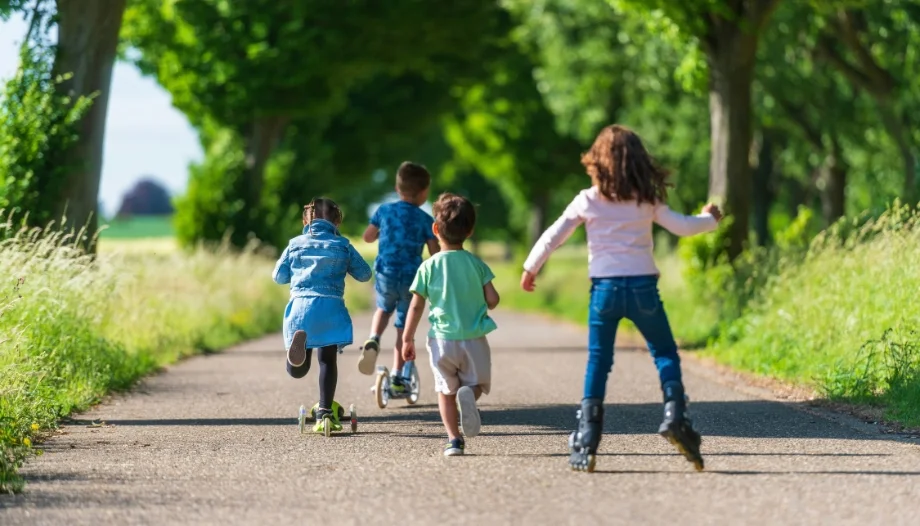
The other day, I was in the park and I came across a situation that gave me a lot to think about.
Two children were playing with an empty plastic bottle, filling it with sand. They were so engrossed that their parents could talk quietly without interruptions like: I want water, so-and-so won't let me have the ball, Pepito insulted me…
It was getting dark and time to go home. The children didn't want to leave because they were having such a good time. After their refusal, one of the parents played his secret weapon: "Let's go upstairs and watch a movie." Surprisingly, his son replied no.
How can a plastic bottle beat the screen?
We're used to thinking that a screen always wins. It has colors, sounds, stories, characters, games… It can offer us anything instantly. And yet, that child preferred to keep playing with a simple plastic bottle.
Perhaps because that bottle wasn't simply a bottle. It was a possibility of entering into a relationship with reality.
The boy was touching the sand, watching it fall into the bottle, discovering how much he could fill it, emptying it, and refilling it. He was inventing a game from something right in front of him. And, above all, he was having an experience.
This reminds me a lot of what Don Luigi Giussani proposes when he speaks of reality as the starting point for knowledge. For Giussani, the first step in knowing something is realism: not imposing our ideas on reality, but letting reality itself reveal itself. The method for knowing something is determined by the object we want to know.
And this has a lot to do with what's happening to us today with digital technology. I don't mean to say, not at all, that new technologies are bad. On the contrary: they are tools that help us enormously in our daily lives. They allow us to communicate, learn, work, explore new places, and access a vast amount of information.
The problem arises when the screen ceases to be a tool for relating to reality and ends up becoming our reality. Because then something curious can happen: we're looking at many things, but we stop looking at what's right in front of us.
We have access to thousands of experiences, but we can stop experiencing our own lives. And, little by little, we can end up trapped in what we ourselves have chosen to focus on. Reality, however, doesn't work that way.
Reality imposes itself on us. We cannot completely choose what happens. We encounter people we didn't expect, events we hadn't foreseen, something as simple as a park, friends, a bottle full of sand, or the fact that night is falling and it's time to go home.
And it is precisely there that we can discover something about ourselves. Perhaps that was what was happening with those children. They weren't doing anything extraordinary. They were simply playing. But they were completely immersed in what they were experiencing.
And that's why the bottle won. Not because it was more entertaining than a movie, but because that bottle was putting them in touch with something real.
Perhaps the problem is not that screens offer us too much, but that sometimes they offer us so much that we risk forgetting that there is something that cannot appear on any screen: reality itself.
A screen can show us a landscape, but it can't replace being there. It can show us a person, but it can't replace meeting them. It can tell us a story, but it can't live it for us. It can teach us many things, but it can't answer for us the question of what makes life worth living. That's why I spent that afternoon thinking about that plastic bottle. Perhaps the bottle didn't win. Reality won.
Father of six daughters. Speech-Language Pathologist and child of deaf adults (CODA). My personal and professional stories are intertwined in a single calling: to break down communication barriers.





 Español
  English
  Italiano
  Français
  Deutsch
  Polski
  简体中文
简体中文