


 The Humanity of Christ. Pompeo Batoni, The Sacred Heart of JesusThe titles of the works: "Christ by Antonello da Messina," "Christ Blessing"The temptation of the first parents. Albrecht Dürer: "Adam and Eve"."
ARTISTIC COMMENTARY
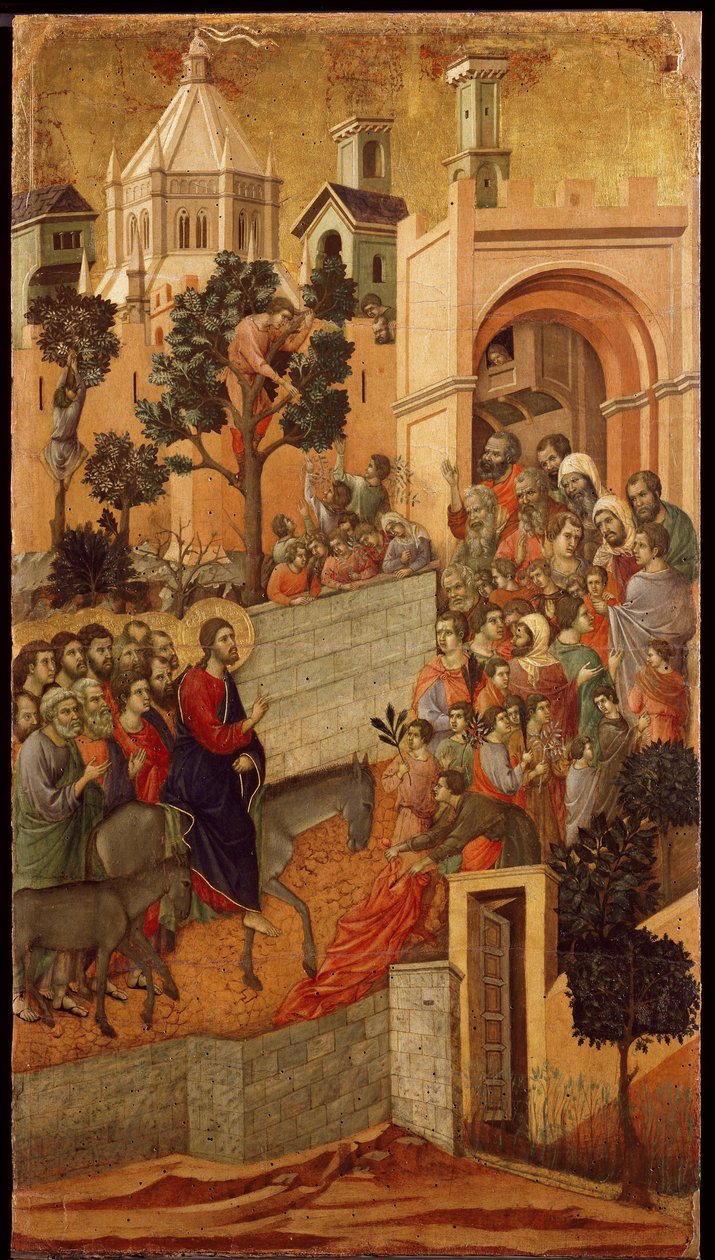
This panel belongs to a monumental altarpiece known as the Master, Commissioned by the city of Siena for its cathedral between 1308 and 1311, the altarpiece takes its name from the central image: the Virgin and Child enthroned with angels and saints. The front of the altarpiece presents narrative scenes from Christ's childhood, while the reverse, depicting the Entry into Jerusalem, shows the Passion narrative along with scenes from the life of the Virgin.
The vertical depiction of Jesus' entry into Jerusalem shows Christ riding a donkey, recognizable by his halo, blue cloak, and red tunic. These attributes were well known to viewers in the early 14th century. Behind him, two rows of apostles follow closely. This group enters from the left and begins to ascend the path leading to the heavenly Jerusalem. The temple dominates the upper part of the panel, a gleaming white building whose architectural features are contemporary with Duccio's time. The other buildings and the arch are depicted with great detail and realism, except for the representation of space, which is still somewhat clumsy. But this did not pose a problem in the Trecento Italian: these types of works were valued for their narrative power and their ability to depict everyday life intertwined with the lives of saints and sacred figures. The public was perfectly capable of interpreting the message these paintings conveyed.
An expectant crowd
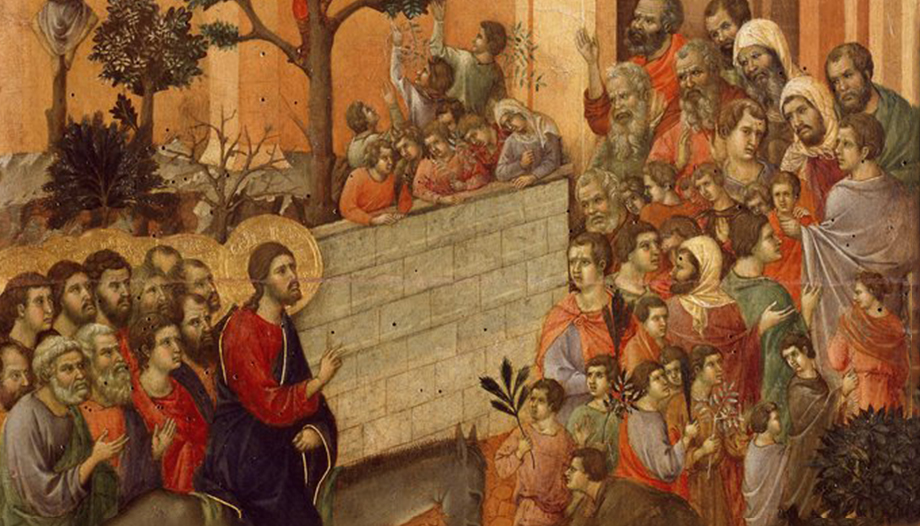
The crowds await Jesus; we see people positioned in every possible spot to catch a glimpse of the Savior. Duccio has taken great care to depict what this Gospel scene would have looked like had it occurred between 1308 and 1311. Each figure is rendered in a very natural way: a man spreads his red cloak on the cobblestones before the donkey's hooves, others busily wave olive branches, and still others have climbed trees and are gathering branches. The people are shown in different sizes to indicate their varying ages and social standing.
In the foreground are smaller figures that appear to be children; then, middle-aged men; and, bringing up the rear, some elderly men with gray beards. The figures are very expressive, each in a distinct pose, and many gesture with their hands as they converse with one another. Some display surprise, doubt, or curiosity. There is a clear sense of anticipation and excitement.
Doors and trees: a symbolic language
The path leads to an arched gate, the main entrance to Jerusalem. In the lower right corner is another, smaller gate. Beside it stand two leafy trees, in stark contrast to the withered tree to Jesus' left. The place on the right is the place of honor, which the blessed will ultimately occupy when they ascend to Heaven. The smaller gate is described in the Gospels as the direct path to salvation. The left is for the damned. Here, on the left, in clear association with the fall of man and the death of Christ, a dead tree stands among other green and leafy trees: the Tree of Knowledge after the Fall, a reminder of Christ's death, since the wood of the cross came from a dead tree. This withered tree is one of eight trees present in the painting. Eight has been, since the earliest days of Christianity, the number associated with the Resurrection (baptismal fonts often have eight-pointed stars, which also appear guiding the Magi to Bethlehem in numerous paintings).
The location of this panel on the reverse of the Master This means that it was not visible to everyone, but mainly to the clergy and educated spectators with important positions, who would have understood all the layers of meaning of this beautiful panel, the work of one of the great artists of the Trecento, the Sienese Duccio di Buoninsegna.
CATECHETICAL COMMENTARY
Throughout Jesus' public life, the proclamation of the Kingdom, as we have seen in previous articles in this series, occupies the central content of his preaching and actions. The culmination of this proclamation occurs when Jesus, having completed his public ministry first in Galilee and then throughout Judea, enters Jerusalem as King—the holy city, the city of David, the city in which, for a thousand years, the people of Israel had placed all their hopes and longings for the coming of the definitive King, the Messiah, and the establishment of the Kingdom of God, a new era in history in which the Lord would reign over the entire world from Jerusalem and through his chosen people: Israel.
This anticipation is reflected in the vibrant reds with which Duccio paints the cloaks that the Hebrew people, especially the children, spread out to carpet the King's path. That red, however, will become the red of Jesus' Passion, who receives his title of Christ (that is, anointed, the king chosen by God as the Messiah of Israel) on the Cross and is established as sovereign of Heaven and Earth in his Resurrection. This is the true destiny Jesus pursues upon entering Jerusalem: to live out in the city of David the Paschal Mystery that will bring the Kingdom of God to earth.
From incarnatus at crucifix
The earthly mysteries of Jesus' life are explained in brief phrases from the Creed: “and was incarnate by the Holy Spirit of the Virgin Mary, and became man; for our sake he was crucified under Pontius Pilate, and suffered and was buried”The creed, therefore, when considering the earthly life of Christ, only mentions the Incarnation and the Passion, with the transition between these two statements of faith occurring precisely at Jesus' entry into Jerusalem. The Incarnation, the mystery by which the Son of God assumes a true human nature, unfolds throughout the mysteries of Christ discussed in the previous articles. The Passion, the redemptive work by which Jesus Christ atones for the sin of humanity and reconciles it with God on the cross, will be addressed in the following articles. Between the two, Jesus' entry into Jerusalem unites his public life, with the disciples and the crowds who accompany him, with what will be the Passion, in which he alone will enter into the redemptive sacrifice of the cross, symbolized in the temple depicted in the painting, the site of the sacrifices of the Old Covenant.
Jesus, therefore, enters Jerusalem prepared to die, for that is why he has freely set out for that city (Lk 9:51). He himself warned the apostles that his triumphal entry as Messiah would not lead to immediate triumph but to suffering, humiliation, and death. He clearly indicates this in the three announcements of his passion and resurrection recorded by the evangelists during his public life (Mk 8:31-33; 9:31-32; 10:32-34).
To make matters worse, the disciples, like Jews in general, were familiar with the tradition that prophets died cruelly in Jerusalem, persecuted and killed by their own people. A contemporary writing, the Lives of the Prophets, He even paused to recount the martyrdom of God's messengers in the holy city and the places where their tombs could be venerated. Jesus himself alludes to this tradition in Luke 13:33. The entire scene of the entry into Jerusalem, therefore, must be seen in this context of martyrdom, which will culminate in the crucifixion.
The King's reception
The atmosphere of suffering and sacrifice is present in this scene, but at the same time it is also filled with the hope and joy of the people welcoming their King, because Jesus also clearly indicated that the Passion he was about to face in the holy city was intended to reunite the people of Israel, as a hen gathers her chicks under her wings (Mt 23:37), even though this would cost him tears because of the rejection by many of Jerusalem's inhabitants. Nevertheless, many of them welcomed him, acclaiming him as the Son of David, that is, as the Messiah, especially the children and the poor, as happened at his first public appearance in Bethlehem (Lk 19:38).
In short, Jesus, who refused to be named King in times of human triumph and success (Jn 6:15), now chooses to be revealed as Messiah in the hour of trial and suffering. As the new David, he enters Jerusalem as king; as the Son of God, he himself chooses the time and place of his royal proclamation. As a meek and humble man, he prefers to enter the city of David not as a conqueror, but riding on a donkey, as the prophecies had foretold (Zechariah 9:9). With equal gentleness and mercy, he will win over his Church, defined as the New Jerusalem, the Bride coming down from Heaven adorned for the Bridegroom (Revelation 21:2).
Upon the Messiah's entry into Jerusalem, the crowds exclaimed "Hosanna" y “Blessed is he who comes in the name of the Lord.”. Both expressions have been incorporated into the Holy of Holies of the Eucharistic Liturgy, as a way of preparing for the coming of Christ in the Eucharist, using the same words with which the Hebrews prepared for Jesus' coming to Jerusalem. The first word Hosanna Of Hebrew origin, it means “Please save us!” or “Save us now.” Over time, it evolved from a cry for help into an acclamation of praise, joy, and recognition of God in the Judeo-Christian tradition. The expression “Blessed” is a literal quote from Psalm 118:16, a psalm that culminated in the Jewish Hallel celebrations, praising God for the redemptive work of the Exodus, the first Passover.
These expressions from the people of Israel complete the scene that links the public life of Jesus Christ with his Passion and Resurrection. Therefore, the entire life and mission of Jesus should awaken praise and gratitude on the lips of the faithful. Hence, these are the words we must read in the mouths of the figures in Duccio's painting to understand this work in all its depth.
Work
Art historian and Doctor of Theology






 Español
  English
  Italiano
  Français
  Deutsch
  Polski
  简体中文
简体中文