


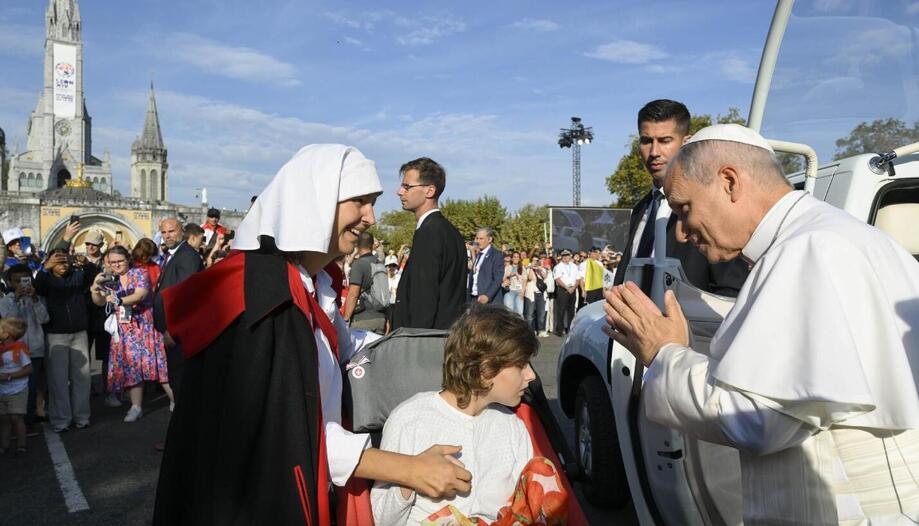
 The Pope closes his second day in Paris celebrating life where there was once death.From the Élysée Palace to Notre-Dame, Leo XIV opens his visit to Paris focusing on the dignity of human life
On Sunday morning, September 27, the pontiff met behind closed doors with the bishops of France in the Saint Bernadette Hall of the Lourdes sanctuary.
The Holy Father asked the prelates for courage, boldness and creativity to evangelize and left them with a single roadmap: "to make Jesus Christ known and loved.".
Based on that foundation, he reviewed the major challenges facing the Church in France at this time: the voice of the Church in public debate, secularism, Catholic education, abuse, vocations, family, and unity.
The Church present in society
Regarding the Church's role in public debate, he affirmed that the Church has contributed to building France and remains part of its culture and identity. Therefore, he said, its voice has a place in public discussion, with prophetic authority, even if it is not always heard or followed.
Referring to French secularism—which he described as a unique system, the product of a turbulent and now calm history—he warned that this balance is gradually being challenged, as in other Western countries.
Therefore, he asked the bishops not to resign themselves and to remain vigilant in defending the freedom of the Church to evangelize, educate and publicly celebrate worship, so that it may visibly exercise charity.
Meeting with victims of abuse
Referring to the sexual abuse of minors committed by members of the clergy or in ecclesial settings, which he described as a painful scourge, he thanked the bishops for the courageous measures they have taken: listening, the search for truth, justice, reparation and a culture of prevention.
He acknowledged that there had been very difficult moments for the Episcopal Conference and called for continued vigilance. On this same topic, in the afternoon, shortly after 5:30 p.m., the Pope met privately at the Episcopal Residence in Lourdes with seven victims of abuse, four men and three women.
The Holy See Press Office reported that the pontiff listened to each one separately, prayed with some of them and, at the end of the meeting, reaffirmed his commitment that this evil will never be repeated.
The Pope in Lourdes: Conversion and Healing
At 11:00 a.m., the Pope presided over Mass in the meadow of the sanctuary, before approximately 150,000 people. In his homily, he spoke of conversion, a central aspect of the message that the Virgin Mary entrusted to Saint Bernadette. Conversion is choosing life—including eternal life—and it brooks no delay: «It is today—not tomorrow—that we must convert.» Because, he explained, «conversion means abandoning the paths of straying in order to follow the Way of Life.».
This demand, he emphasized, also applies to the Church: «This demand for conversion commits the Church itself in its earthly pilgrimage. It must, above all, have the courage to live this conversion.» He added: «To heal the deep wounds, the infidelities, and the painful strayings committed within its midst, we must humbly submit to the purifying gaze of the Lord.».
Lourdes, the place of the sacredness of life
Alluding to the recent French law on assisted dying, the Pope stated: «In the face of current trends that seek to redefine the value of human life in the face of illness, suffering, or old age, the Grotto of Massabielle stands as a sanctuary of Christian hope. Here, no fragility is rejected. […] Lourdes is the blessed place of a profession of faith in the beauty and sacredness of life.».
At the end of the mass he led the Angelus prayer, in which he invited the faithful to pray the Rosary during the month of October for the end of wars.
“It is impossible to consider ending a life as normal.”
In the afternoon, during a meeting with the staff and patients of the Accueil Notre-Dame—a part of the sanctuary dedicated to welcoming and supporting sick pilgrims—he spoke again with greater emphasis about the dignity of human life. The Pope affirmed that the dignity of the person «cannot be measured or debated» and that no human law should undermine the certainty of that dignity.
«It is precisely in the name of this inalienable dignity of the human person that the temptation to take a life under the pretext of false compassion must be firmly rejected,» he said. He added: «It is impossible to consider ending a life normal. What is legal is not necessarily moral.».
He reminded doctors and caregivers that their vocation is "to care for a suffering person, not to eliminate them." He also repeated some words he had spoken last June: "Medicine can never become a servant of programmed death!" And to the sick he said: "You are not a burden; you are the beating heart of our humanity and a precious treasure for the Church.".
In the evening, the Pope led the recitation of the Rosary and the torchlight procession, in which he appeared as just another pilgrim among the pilgrims. The tradition of the candles originated on February 19, 1858, when Bernadette arrived at the grotto with a lit blessed candle. The first Marian torchlight procession was held on August 28, 1872.





 Español
  English
  Italiano
  Français
  Deutsch
  Polski
  简体中文
简体中文