


 Pope visits prison on Holy ThursdayPope Leo tells young Argentinians: Stand firm, become saints, 'go and proclaim'Returning to the first yes: the Pope's message to Argentine priests and consecrated persons
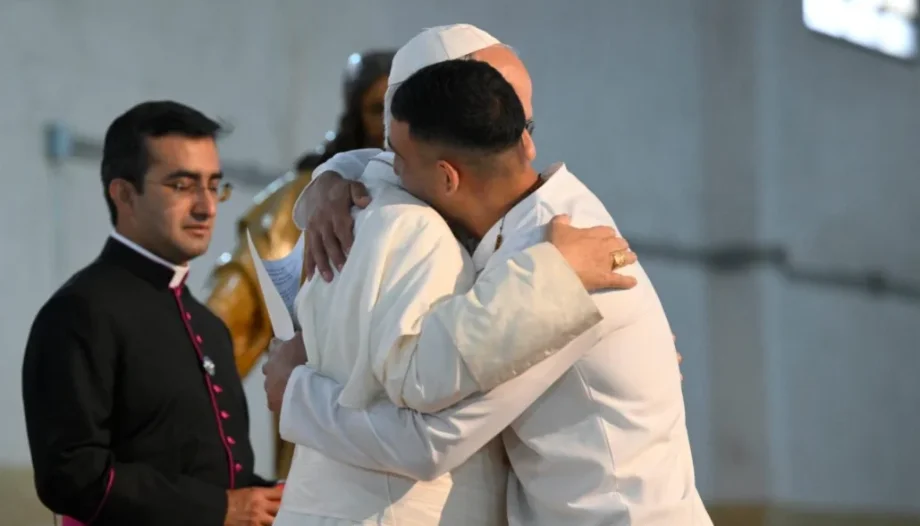
On his last day in Argentina, Pope Leo XIV began his visit this Wednesday at the Buenos Aires Federal Penitentiary Complex, Villa Devoto prison. There, in the prison gymnasium, he was received by the Archbishop of Buenos Aires and Pontifical Delegate for Prison Ministry, Jorge García Cuerva; the Director of the Federal Penitentiary Service, Fernando Martínez; the Minister of Security, Alejandra Monteoliva; and the Minister of Justice, Juan Bautista Mahiques.
In his welcoming remarks, García Cuerva noted that this is a men's prison that once housed 1,500 inmates and is now undergoing a gradual transfer of prisoners “with a view to its eventual closure.” Some 70 inmates, the last remaining at the prison, attended the meeting. He also mentioned Pope Francis, who “came to this prison every Holy Thursday to celebrate the Eucharist and perform the washing of the feet,” and emphasized that “the problem of prisons is a problem that affects society as a whole.”.
From the street to the chapel
Two inmates and a man who has already served his sentence told the Pope how their lives changed behind bars. Cristian, 29, recounted how he used to live on the streets and commit crimes to support his drug and alcohol addiction. The first few nights after his arrest he couldn't sleep: “I kept remembering my mother's advice and it hurt that I hadn't listened to her sooner.” In the prison chapel, he explained, he felt he wasn't alone. He is about to be released and dreams of “getting a job, having my own place to live, going to church, and eventually starting a family.”.
Maximiliano, 32, also spoke about drugs, which he called “a true pandemic,” and about the time he lost with his daughters: “I want to return to God and show my daughters that their father can change.” Next, Reinaldo Chiconi, 44, a father of four, spoke. He had been in this same prison and is now free. Thanks to the prison ministry led by chaplain Matías De Martini, he found what he called “the embrace” of Jesus in the prison chapel, and he wanted to share some “good news”: “A new life is possible.”.
The experience of the limit
The Pope dedicated his greeting to an experience that, he said, all human beings have in common: the experience of limitations. Starting with his first encyclical, Magnifica humanitas, He warned that society often presents illness, old age, or suffering as “a defect that needs to be corrected,” and gave examples that those present know well, such as “the feeling of omnipotence caused by drugs” or “the false power that comes from easy money.”.
In response, he stressed that “human beings do not flourish despite limitations, but often through them,” and encouraged the inmates to see their situation as a starting point: “Their time in this institution can be an opportunity to begin again, making peace with God and reintegrating without fear into their families and society.”.
The Pope did not hide the harshness of prison: “I imagine their sleepless nights, missing their loved ones or thinking about those they may have hurt.” But he wanted to emphasize that prison is also a witness to people who “knew how to transform the desert of their own existence into a fertile garden.”.
A task for all of society
In the second part of his address, Leo XIV spoke to the families of prisoners, reminding them that Jesus “identified himself with a prisoner” and was deprived of his freedom without having committed any sin. He urged prison staff, volunteers, and pastoral workers not to succumb to the “structures of sin” and to work to make prisons a “more humane and respectful” environment that fosters rehabilitation. He also emphasized that visiting prisoners “is a work of mercy to which we are all called.”.
His final message was for the authorities and all of Argentine society, with a plea directed at the youngest members of society: “Let us especially accompany our children and young people, educate them in authentic values, care for them, and protect them so that they do not fall into the nefarious traps of crime. The Lord will hold us accountable for what we have done for each of our brothers and sisters.”.
After entrusting everyone to Our Lady of Mercy, the Pope presented a polychrome wooden sculpture of the Virgin and Child, and the chaplain asked for his blessing on the images crafted by inmates of Unit 47, which will travel to prisons throughout the country. From Devoto, he traveled to the Basilica of Our Lady of Luján, where he celebrated Mass.





 Español
 English
 Italiano
 Français
 Deutsch
 Polski