


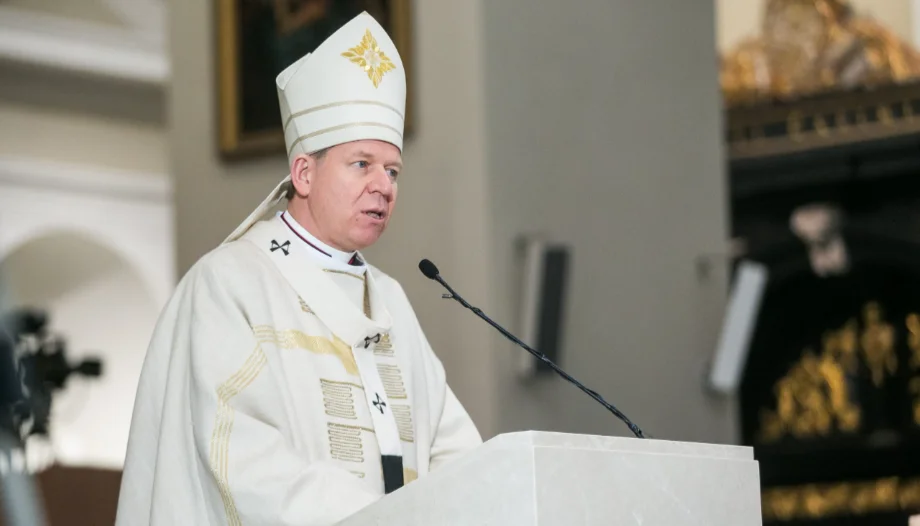
As Vilnius prepares to host the Sixth World Apostolic Congress on Mercy (WACOM 6) from June 7 to 12, 2026, Archbishop Gintaras Grušas, President of the Council of European Episcopal Conferences, spoke with Omnes, where he discussed the virtue of mercy, understood as an act that helps societies understand justice and respond to those who suffer.
“A culture of mercy seeks restoration rather than exclusion, reconciliation rather than endless polarization, and solidarity rather than fear,” he explained.
As archbishop of Vilnius, a city often referred to as the «Rome of the North,» he pastors a place that St. John Paul II commissioned to proclaim the message of Divine Mercy to the world.
The archbishop explained that mercy is “God’s love poured out upon us and within us,” emphasizing that it is not an abstract idea but a lived reality, encountered “in a privileged way through the sacraments, especially the Eucharist and Reconciliation.”
What is WACOM?
WACOM is a global Catholic apostolic conference held every three years in a different country to help people encounter God's mercy and translate it into concrete acts of compassion.
Vilnius holds a special place in the history of Divine Mercy. Saint Faustina lived in the city and recorded her visions of Jesus in her diary, while the first widely recognized image of the Merciful Jesus was painted there under the guidance of her confessor, Blessed Father Michał Sopoćko.
The theme of WACOM 6, Building a City of Mercy, is intended to frame the congress not only as an important gathering, but as a call to conversion and daily witness. In a pastoral letter published in preparation for the congress, Grušas urged Catholics to begin a shared pilgrimage now by building a “city of mercy, not of stone,” but one built on forgiveness, faithfulness, love, and compassion.
Mercy is not theoretical
Grušas said that several images immediately come to mind when he hears the word “mercy”: the image of Divine Mercy itself, the father who runs to embrace the prodigal son, and the Good Samaritan who crosses borders to care for the wounded stranger.
During the conversation, the archbishop frequently emphasized that mercy is not an alternative to justice, but one of its most demanding forms. “A culture of mercy seeks restoration rather than exclusion, reconciliation rather than endless polarization, and solidarity rather than fear,” he explained. The statement reads like a diagnosis of Europe’s current state of mind and, at the same time, an invitation to imagine another.
His understanding of mercy, he added, deepened through personal milestones. He first encountered the Chaplet of Divine Mercy during his preparatory year at the Franciscan University of Steubenville, at a retreat led by Fr. George Kosicki, CSB, who had participated in the translation of St. Faustina’s Diary into English.
Later, in 2000, as a priest in the Archdiocese of Vilnius, he attended the canonization of St. Faustina and participated in previous World Apostolic Congresses on Mercy. Now, as host of WACOM 6, he sees mercy as “a shared mission entrusted to the whole Church.”
Grušas also highlighted pastoral experiences that vividly demonstrated concrete mercy. Witnessing a person being set free during an exorcism, he said, clarified St. John Paul II’s teaching that “mercy is the limit that God places on evil.” It also shed light on what he called the hidden drama of the confessional: “Every confession is a silent liberation, a real victory of grace over darkness.”
Mercy after the Soviet occupation
Lithuania’s recent history, including decades of Soviet occupation, also shapes how the archbishop speaks about mercy. Oppression, he said, wounds “memory and identity,” but the survival of faith under pressure shows that spiritual resilience can outlast political regimes.
As Grušas explained, forgiveness has been a key element since independence in rebuilding the nation; “not as an exercise in forgetting,” but as a firm refusal to allow resentment to define the future. Mercy, he said, allowed the nation to move from mere survival toward renewal and hope.
Differences between the U.S. and Europe
Grušas’s international background, shaped by his childhood in the United States and his subsequent studies in Rome, also informs how he compares mercy across different cultural contexts. “In the U.S.,” he said, “mercy is often expressed through initiative: service, outreach, and concrete action. In Europe, by contrast, mercy is approached with greater caution and depth of reflection, shaped by long and complex histories.” Both instincts, he argued, are necessary: mercy must be “active and courageous,” but also “mature and discerning.”
On a personal level, Grušas explained to Omnes that many Catholics struggle more with accepting mercy than with extending it. People often believe that love must be earned, he noted, and frequent confession helps heal that wound by teaching that grace comes first and conversion follows.
He also cautioned against a common misunderstanding: that mercy excludes repentance. “Mercy invites repentance,” he said, pointing to the prayer “Jesus, I Trust in You” as a concise expression of the relationship between mercy, trust, and conversion.
What WACOM 6 intends to proclaim
According to the conference organizers, the six-day program will include prayer and adoration, talks and testimonies, Mass, reconciliation services, pilgrimages in Vilnius, and charitable works—with 6,000 pilgrims expected to participate. The dates also place the congress between the feasts of Corpus Christi and the Sacred Heart, with organizers linking this time to Pope Francis’s 2024 encyclical on the Heart of Jesus, Dilexit nos.
For Grušas, however, the ultimate measure of success will not be the numbers, but what the participants bring back to their local churches.
“I hope they come as pilgrims and return as witnesses,” he added. If they leave convinced that mercy is not just something received, but something to be lived and proclaimed in their homes, parishes, and communities, he clarified, “then WACOM 6 will have fulfilled its mission.”
Journalist and essayist born in the United Arab Emirates and based in Lithuania. He is a contributor to Omnes, EWTN News and CNA Deutsch.






 Español
  English
  Italiano
  Français
  Deutsch
  Polski