The Vatican

Vatican finances, the balance sheets of the IOR and of the St. Peter's Obligation

There is an intrinsic relationship between the budgets of the Oblates of St. Peter's and the Institute for works of Religion.

Andrea Gagliarducci-July 12, 2024-Reading time: 4 minutes

There is a close relationship between the annual declaration of the St. Peter's obolus and the balance sheet of the Istituto delle Opere di Religione, the so-called "Vatican bank". Because the Obolo is destined to the charity of the Pope, but this charity is also expressed in the support of the structure of the Roman Curia, an immense "missionary budget" that has expenses, but not so many incomes, and that must continue to pay salaries. And because the IOR, for some time now, has been making a voluntary contribution of its profits precisely to the Pope, and these profits serve to lighten the budget of the Holy See. 

For years the IOR has not had the same benefits as in the past, so that the portion allocated to the Pope has decreased over the years. The same situation applies to the Obolo, whose income has decreased over the years, and which has also had to face this decrease in the IOR's support. So much so that in 2022 it had to double its income with a general divestment of assets.

That is why the two budgets, published last month, are somehow connected. After all, the Vatican finances have always been connected, and everything contributes to helping the Pope's mission. 

But let's look at the two budgets in more detail.

The St. Peter's Oblong

Last June 29, the St. Peter's Oblates presented their annual balance sheet. Revenues were 52 million, but expenses amounted to 103.4 million, of which 90 million were for the apostolic mission of the Holy Father. Included in the mission are the expenses of the Curia, which amount to 370.4 million. The Obolo thus contributes 24% to the budget of the Curia. 

Only 13 million went to charitable works, to which, however, must be added donations from Pope Francis through other dicasteries of the Holy See totaling 32 million, 8 of which were financed directly through the obolo.

In summary, between the Obolus Fund and the funds of the dicasteries financed in part by the Obolus, the Pope's charity financed 236 projects, for a total of 45 million. However, the balance deserves some observations.

Is this the true use of the St. Peter's Obligation, which is often associated with the Pope's charity? Yes, because the very purpose of the Obligation is to support the mission of the Church, and it was defined in modern terms in 1870, after the Holy See lost the Papal States and had no more income to run the machine.

That said, it is interesting that the budget of the Obolus can also be deducted from the budget of the Curia. Of the 370.4 million of budgeted funds, 38.9% is earmarked for local Churches in difficulty and in specific contexts of evangelization, amounting to 144.2 million.

Funds earmarked for worship and evangelization amount to 48.4 million, or 13.1%.

Dissemination of the message, that is, the entire Vatican communication sector, represents 12.1% of the budget, with a total of 44.8 million.

37 million (10.9% of the budget) was allocated to support the apostolic nunciatures, while 31.9 million (8.6% of the total) went to the service of charity - precisely the money donated by Pope Francis through the dicasteries -, 20.3 million to the organization of ecclesial life, 17.4 million to the historical heritage, 10.2 million to academic institutions, 6.8 million to human development, 4.2 million to Education, Science and Culture and 5.2 million to Life and Family.

Income, as mentioned above, amounted to 52 million euros, 48.4 million of which were donations. Last year there were fewer donations (43.5 million euros), but income, thanks to the sale of real estate, amounted to 107 million euros. Interestingly, there are 3.6 million euros of income from financial returns.

As for donations, 31.2 million came from direct collection by dioceses, 21 million from private donors, 13.9 million from foundations and 1.2 million from religious orders.

The countries that donate the most are the United States (13.6 million), Italy (3.1 million), Brazil (1.9 million), Germany and South Korea (1.3 million), France (1.6 million), Mexico and Ireland (0.9 million), Czech Republic and Spain (0.8 million).

IOR balance sheet

Pope IOR 13 million to the Holy See, compared to a net profit of 30.6 million euros.

The profits represent a significant improvement over the €29.6 million in 2022. However, it is necessary to compare the figures: they range from the 86.6 million profit declared in 2012 - which quadrupled the previous year's earnings - to 66.9 million in the 2013 report, 69.3 million in the 2014 report, 16.1 million in the 2015 report, 33 million in the 2016 report and 31.9 million in the 2017 report, to 17.5 million in 2018.

The 2019 report, meanwhile, quantifies profits at 38 million, also attributed to the favorable market.

In 2020, the year of the COVID crisis, the profit was slightly lower at 36.4 million.

But in the first post-pandemic year, a 2021 still unaffected by the war in Ukraine, it returned to a negative trend, with a profit of only €18.1 million, and only in 2022 did it return to the €30 million barrier.

The IOR 2023 report speaks of 107 employees and 12,361 customers, but also of an increase in customer deposits: +4% to €5.4 billion. The number of clients continues to fall (they were 12,759 in 2022, even 14,519 in 2021), but this time the number of employees also decreases: they were 117 in 2022, they are 107 in 2023.

Thus, the negative trend of clients continues, which should give us pause for thought, bearing in mind that the screening of accounts deemed not compatible with the IOR's mission ended some time ago.

Now, the IOR is also called upon to participate in the reform of Vatican finances desired by Pope Francis. 

Jean-Baptiste de Franssu, president of the Council of Superintendence, highlights in his management letter the numerous accolades the IOR has received for its work in favor of transparency over the past decade, and announces: "The Institute, under the supervision of the Authority for Supervision and Financial Information (ASIF), is therefore ready to play its part in the process of centralizing all Vatican assets, in accordance with the Holy Father's instructions and taking into account the latest regulatory developments.

The IOR team is eager to collaborate with all Vatican dicasteries, with the Administration of the Patrimony of the Apostolic See (APSA) and to work with the Investment Committee to further develop the ethical principles of FCI (Faith Consistent Investment) in accordance with the Church's social doctrine. It is crucial that the Vatican be seen as a point of reference."

The authorAndrea Gagliarducci

Integral ecology

Ana Ruiz: “Abortion not only affects the baby, but also the woman”.”

Following the government's approval of the reform of the Constitution to protect abortion as a right, we interviewed Ana Ruiz, a worker at Refugio Provida.

Álvaro Gil Ruiz-April 19, 2026-Reading time: 4 minutes

The Government of Spain has recently approved a project for the reform of the Constitution, The idea is to protect the right to the ”voluntary interruption of pregnancy”. In view of this news, we can ask ourselves several questions: is abortion a right? Does it not achieve the opposite of what it seeks: to perpetuate the greatest obstetric violence that a woman can receive -that of removing something as intimate as a child from the womb-? Are we shielding the greatest silent genocide in history? 

To shed light on this issue, we have the postabortion expert and social worker at the Provida Shelter, Ana Ruiz.

Why do you think this proposal is more than just a smokescreen?

- Yes, it is more than a smokescreen and it is not casual. It is a strategy to consolidate what we call the culture of death and to do so, moreover, as a mechanism to stay in power. Doing so at the cost of something as serious as the lives of thousands of babies.

Is abortion a constitutional right? 

- No. Abortion is not a right. Neither constitutional nor of any kind. The right is life, and that is what we stand for. In fact, we should start to stop normalizing it with language: abortion is murder, and murder can never be a right.

Let's talk about you, about your personal experience. Why did you decide to have an abortion? How was your transformation process?

- I did it without thinking about what I was doing, I lived in a world far away from reality and I did not stop to think about anything, even I had not thought about abortion at that time. I was young and led a crazy life, I thought it was the easy solution to the problem, when in fact it was the beginning of the problem of always living with a great burden of conscience.

After the abortion I quickly realized what I had done and went to church to confession without much success, because I did not believe in Jesus Christ and so the priest did not give me absolution. I only knew that I had done something very bad that transcended this world, and little by little I found my way in the Catholic Church.

When and why did you decide to “rescue” women who were going to have abortions?

- After having an abortion, I always tried to avoid abortions wherever I met a woman who was considering having an abortion. I managed to get a good friend to have her child and some other cases that came to me through acquaintances.

It was a huge satisfaction to see those children being born and growing up. So I started working in a foundation that helps vulnerable women to have their children and later I was offered the possibility to work in El Refugio Provida and it is a dream fulfilled to be able to work here saving lives, with God's help.

Can you tell us about a rescue that has had the greatest impact on you? 

- All rescues are exciting, they are miracles of the Lord that he gives us. That a woman who was about to kill her child changes her mind because of a conversation is a true miracle. I always tell my abortion experience to all the women I talk to, and it makes many of them think twice..
A particularly exciting rescue was that of a woman who had taken the abortion pill at 9 weeks of pregnancy to expel the fetus at home. The excuse she had given was that she had no steady job, after telling her that the perfect time was now, that God had chosen it that way, we went for an ultrasound and saw the baby formed with its heart beating, then we went to the hospital chapel, prayed and I asked the priest to bless her child. I was very upset because I thought that she would not be able to give birth because she had taken the abortion pill, but she, conscious of wanting to have her child, took a reversal treatment to the pill and kept informing me during the pregnancy that everything was going well. She had a beautiful daughter, a miracle. 

I assume that a special bond is generated with the person rescued. Is this the case?

- Well, in most cases, yes. They are all very grateful and happy to have their children. No woman regrets having her child.

I am the godmother of one of the rescued babies, her name is Catalina and I have a special bond with the mother. 

I have also made friends with a woman who is a neighbor of mine and is a psychologist and due to an unforeseen need, she found herself sleeping in the car pregnant because, being Spanish and with studies, she did not meet the profile to enter a maternity home. Among the volunteers of the Refuge we paid for a room for her and she has moved forward, now we are friends and we tell each other our things, I have a lot of affection and admiration for her and she is very happy with her daughter.

Going back to the Government's proposal... Does this proposal not achieve the opposite effect to the one it seeks? That is to say, to perpetuate the greatest obstetric violence that can exist against women -that of removing something as intimate as a child from the womb-?

- Yes. What happens is that the left has constructed a narrative in which it sells as liberation what in many cases ends up being a lifelong emotional condemnation for the mother.

We must not forget that there is not only a physical dimension to abortion, but also a very deep emotional dimension. In many cases, this imprint lasts a lifetime. This is what is known as post-abortion syndrome. That is why I insist that abortion affects not only the baby, but also the woman. It is a reality that people try to hide.

There are many of us who think that we live in times in which we will be held accountable in the future. Are we not shielding the greatest silent genocide in history? That is precisely the title of the documentary that Derecho a Vivir and Terra Ignota promoted in 2024 and that we premiered in December of that year, «The Silent Genocide».

It has already happened in France, and in Spain we must be very vigilant. Because if that happens, a direct consequence will be the attempt to silence even more those who defend.

What can we in civil society do to change today's society? How can we shed light on the terrible consequences of abortion?

- Inform, speak out and spread the word. We must not remain silent. We must do everything in our power to defend life, break the single narrative and give visibility to the reality that many try to hide.

And there is something key: that the media begin to take a real interest in the defense of life, in the work of pro-lifers and to offer a complete vision. Only in this way will we be able to reach more people and generate a real change.

The Vatican

Leo XIV explains to journalists the scope of his remarks about Trump

Leo XIV has pointed out that his words in favor of peace, in homilies and speeches during the trip to Africa, were prepared in advance of the polemic with Trump.

OSV / Omnes-April 18, 2026-Reading time: 4 minutes

By Courtney Mares, OSV News

Pope Leo XIV dismissed the media narrative that has pitted him against President Donald Trump since the start of his 11-day apostolic trip to Africa, telling reporters aboard the papal flight to Angola on April 18 that «there has been a certain narrative that has not been accurate in all its aspects.».

«Because of the political situation that was created when, on the first day of the trip, the President of the United States made some comments about me, much of what has been written since then has been more commentary on commentary, trying to interpret what has been said,» the Pope said aboard the papal flight from Yaoundé , Cameroon, to Luanda, Angola.

«Just a small example: the speech I gave at the peace prayer meeting a couple of days ago I prepared two weeks ago, long before the president made any comments about me and the message of peace that I promote. And yet it was interpreted as if I was trying to debate, once again, with the president, which I am not interested in at all,» he said.

The Pope stressed to the approximately 65 journalists aboard the papal plane, among whom were major television networks and newspapers from around the world: «I come to Africa primarily as a pastor, as head of the Catholic Church, to be with all the Catholics of Africa, to celebrate with them, to encourage them and to accompany them«.

The North American vision

Leo XIV spoke out in response to the media firestorm unleashed in the United States with a «Trump v. Leo» narrative since the U.S. president lashed out at the Pope on social media and in verbal statements over the pontiff's opposition to the Iran war for several days beginning April 12.

Over the past six days, while the Pope was visiting Algeria and Cameroon, the story continued to evolve as Vice President JD Vance addressed a Turning Point USA event on April 14 at the University of Georgia in Athens, Georgia, invoking «the 1,000+ year tradition of just war theory» to justify his opposition to the Pope's comments objecting to the Iran war.

As Pope Leo XIV presided over a peace meeting in Bamenda, Cameroon, a city ravaged by violence in a conflict between separatists and government forces since 2017, some media outlets ran headlines implying that Pope Leo XIV's comments to the long-suffering Cameroonian community were directed at Trump.

The major media

As reported by Reuters on the Pope's peace rally, «Pope Leo XIV lashed out at leaders who spend billions on wars and said the world is being ‘ravaged by a handful of tyrants,’ in unusually blunt remarks in Cameroon on Thursday, days after U.S. President Donald Trump attacked him on social media.».

The New York Times ran the following headline about the same peace meeting on April 16: «‘Woe to those who manipulate religion,’ Pope says amid clash with Trump.».

The article stated, «Amid a growing dispute with the Trump administration over the legitimacy of U.S. strikes in Iran, Leo used a speech Thursday in Cameroon to express ‘Woe to those who manipulate religion and the very name of God for their own military, economic and political gain, dragging the sacred into darkness and filth.'».

The Pope clarified to reporters aboard the papal plane that his speeches were written two weeks earlier, long before Trump's comments.

The Pope made these harsh statements about tyrants and the manipulation of religion in a speech delivered in the heart of a conflict zone in Bamenda, Cameroon, where he sought to draw the world's attention to the Anglophone crisis, which was described by one of the local participants in the peace meeting as «one of the forgotten crises on planet Earth.».

In his remarks on board the plane, the Pope tried to refocus attention on the Cameroonian people.

«The visit to Cameroon was very significant because, in many ways, it represents the heart of Africa,» he said. «It is an English- and French-speaking country, with about 250 local languages and ethnicities. At the same time, it has great wealth and great opportunities, but also the difficulty that we find throughout Africa: a very unequal distribution of wealth.».

«We go forward, we continue to proclaim the message of the Gospel. The Gospel texts that we have used in the liturgies offer a number of fantastic and beautiful aspects of what it means to be a Christian, of what it means to follow Christ, of what it means to promote fraternity, trusting in the Lord, but also seeking ways to promote justice and peace in our world,» the Pope added.

Before leaving for Angola, Pope Leo XIV celebrated Mass in the capital of Cameroon before some 200,000 people, according to local authorities, at the Yaoundé air base. .

«Jesus is always with us, stronger than any power of evil,» the Pope told a jubilant crowd of Cameroonian Catholics .

In his homily, the Pope reflected on the Gospel account of Jesus walking on the water, saying, «In every storm, (Jesus) comes to us and repeats, ‘I am here with you: do not be afraid.'».

«Jesus draws near to us. He does not calm the storm immediately, but comes to us in the midst of danger and invites us, in our joys and sorrows, to remain with him, like the disciples, in the same boat. He invites us not to turn away from those who suffer, but to draw near to them, to embrace them,» the Pope said in French.

The lively Mass ended the Pope's trip to Cameroon, April 15-18, where he visited three cities: Yaoundé, Bamenda and Douala. The second part of his 11-day African tour will take Pope Leo XIV to Angola and Equatorial Guinea before returning to the Vatican on April 23.

«Let us keep alive in our hearts the memory of the beautiful moments we have lived together,» Pope Leo XIV said at the end of his homily. «Even in the midst of difficulties, let us continue to make room for Jesus, allowing him to enlighten and renew us each day with his presence. The Church in Cameroon is alive, young, blessed with gifts and enthusiasm, energetic in its diversity and magnificent in its harmony. With the help of the Virgin Mary, our Mother, may your joyful presence continue to flourish».

The authorOSV / Omnes

Evangelization

A website to help confession: YoMeConfieso.es is born

To help make a good examination of conscience, Javier - one of the priests of the “10 minutes with Jesus” - has launched the website “Yo me Confieso” (I confess).

Javier García Herrería-April 18, 2026-Reading time: 2 minutes

There is a lot of talk lately about the Catholic turn, but there is a turn that is not seen and is not part of the statistics. Only the priests who sit regularly in the confessional know about it. Many of them are no longer surprised that every week there are people - young and not so young - who sit in the confessional after a long time without receiving the sacrament. 

Far from being isolated cases, the phenomenon is repeated frequently. “Every week we see people who have not gone to confession for five, ten or fifteen years,” he says. Penitents must also be helped to “distinguish between what is a sin, what is a feeling or a wound; and, of course, the parts of the rite and the answers they must give must also be explained to them,” he adds. 

To remedy these shortcomings, Javier - one of the priests behind the “10 minutes with Jesus”.”- has launched the website “I Confess”which guides the penitent through a complete examination of conscience, in addition to facilitating 

The idea was not born from a technological laboratory or from a planned pastoral strategy, but from daily experience. “It comes from nothing, from the experience that people don't know how to confess,” Javier explains naturally. 

How the tool works

The Yo Me Confieso proposal does not consist of a conversational artificial intelligence, but of a guided system of questions and answers. The user selects areas in which he/she thinks he/she has failed and the website saves the answers and then prepares a summary among some 150 sinful categories.

“Depending on the answers you give, the web asks you more specific questions,” explains Javier. At the end of the process, the platform prepares a script ready to be used in the confession, so that you can easily remember everything you wanted to confess”.

Privacy and practical use

One of the usual concerns with tools of this type is privacy. Javier insists that the system works locally: “There is no AI behind it collecting data, nor does it require identification in any way”. 

Even so, he recognizes that each user can adapt its use: from taking the cell phone to the confessional to copying the content into another application or writing it down on paper.

“People already write things down on their cell phones,” he says. “And whoever doesn't trust it, just put it on paper and that's it.”.

Beyond technique: educating the conscience

The objective of the website is not only to facilitate the process, but also to educate. One of the key points is to help distinguish between feeling and acting. “You can't control your emotions, but you can control the outward manifestation,” he explains. This distinction, he says, “unloads a lot” on those who carry blame that does not correspond to them.

It also seeks to order the experience: from the basic mechanics - what to say, how to begin - to the content of the confession. “We live in a society where many people come to God and need you to take them by the hand. Very much by the hand,” he sums up.

Although the website is already operational, its creator conceives it as an open project. Among future improvements, he plans to add educational content, audio or age-based options.

Read more
The Vatican

Pope addresses ongoing kidnappings and killings in Cameroon

Leo XIV urged them to see their future not in violence or quick profit, but in rebuilding their communities.

OSV / Omnes-April 18, 2026-Reading time: 9 minutes

By Josephine Peterson, Catholic News Service

«Voices in the bushes.» That is the fear that defines daily life for many residents of this town in Cameroon's troubled English-speaking region.

«You don't know where they are,» Cajetan Nfor told Catholic News Service April 16. «You don't know how many there are.» A resident of Bamenda since 1964, Nfor has witnessed firsthand the rapid decline of the town he calls home.

What began in 2016 as a political protest movement led by English-speaking professors and lawyers denouncing professional and political marginalization by Cameroon's majority Francophone government quickly devolved into violence. Armed separatist groups emerged in the Anglophone regions, initially with some support from residents.

But as time passed, the movement changed and separatist groups began to terrorize their own.

Development of the conflict

Armed groups began kidnapping civilians, looting businesses and imposing their control through fear. Today, residents of northwest Cameroon say they live caught between separatist fighters and government forces, both capable of violence. Human Rights Watch estimated in 2024 that more than 6,000 civilians had died at the hands of both sides after a decade of conflict.

Thousands of people have been kidnapped, many killed, while others have been sexually assaulted, beaten and held for ransom.

Among them was Sister Carine Tangiri Mangu, of the Sisters of St. Anne congregation, who told Pope Leo XIV during a community meeting on April 16 that she and a priest were taken «into the bush» in November 2025 and held for three days.

Denied food, water and sleep

«We went on hunger strike and explained to our captors that we were simply doing our work for the poor and had nothing to do with politics,» he said at the meeting, which was attended by local representatives of different religions and traditions. «They demanded that we give them our phone numbers so they could collect the ransom.».

As he recounted, they prayed the rosary incessantly and were finally released after local Christians negotiated their release.

Other residents present at the meeting with the Pope shared similar accounts with Catholic News Service, describing kidnappings for ransom and beatings perpetrated while family members listened on the phone.

Cameroon's Anglophone separatist groups, which began fighting for the independence of the country's English-speaking regions, have increasingly turned to criminal activities to finance their rebellion, while violence against civilians has increased. In the first half of 2024, the northwest region ranked as the second most dangerous administrative area for civilians in Africa, behind only Al-Jazirah state in central Sudan, according to the Armed Conflict Location and Events Data Project.

Latest events

In addition to fear of the separatists, many residents fear retaliation by the army. Nfor reported that on two occasions in the course of a week last month, he woke up to gunfire in his street. On both occasions, when he went outside, he found the bodies of two neighbors lying in the street about 500 meters from his house. 

According to him, his street has become a dumping ground where heavy rains wash away dead bodies. He believes that the deceased were victims of routine law and order enforcement. Human Rights Watch reported in 2024 that the army is known to directly target local civilians.  

Before the crisis, he remembers a very different Bamenda: a vibrant city of 630,000 inhabitants, where this kind of fear did not exist.

«Imagine a river flowing slowly, murmuring, and you in a boat enjoying the ripples,» Nfor said. «That was the kind of life that was lived here.».

That life has completely disappeared.

Social deterioration

Bamenda, once one of the country's most economically dynamic cities, has been devastated by years of conflict. Traders have fled after repeated looting and kidnappings. Farmers struggle to cultivate their land for fear of being kidnapped and killed. Roads are dangerous, as separatists have strongholds along the main thoroughfares, and the movement of goods is very difficult.

Food prices have skyrocketed and access to medical care is limited as the region becomes increasingly isolated.

«No one stays out after 7 p.m.,» Nfor said. «If you're still out there and you don't have transportation ... it becomes impossible.».

Even short journeys have become an ordeal. Trips that used to take a few hours can now take up to half a day as drivers avoid conflict zones.

For Joseph Kitu, the violence has made it impossible to return to his hometown.

«For the past ten years, our lives have been miserable,» he told CNS as he waited for the Pope to arrive at the community meeting. «We have lost family members. They burned our houses, looted our properties. I am an orphan. My parents passed away because of this.».

The Pope's words

As soon as the Pope arrived in war-torn Cameroon on April 15, he did not hesitate to deliver a message of peace that directly confronted the suffering people face on a daily basis.

In clear and direct language, the Pope spent his time in Cameroon denouncing violence, corruption and exploitation, while advocating reconciliation and credible leadership. He has repeatedly raised peace not as an abstract ideal, but as a responsibility shared by political leaders, communities and individuals alike. 

In his first meeting with the diplomatic corps in Cameroon, he urged leaders to overcome paralysis and fear.

«We live in a time where hopelessness is spreading and the feeling of impotence tends to paralyze the renewal so longed for by the peoples,» he declared in Yaoundé, at the presidential palace, on April 15. «There is a great thirst for justice! A thirst for participation, for a vision, for courageous decisions and for peace!»

To politicians

The Pope began his call for peace in the country during an address to the diplomatic corps and 93-year-old President Paul Biya, who has been in power since 1982 and whose long rule has drawn criticism from opposition figures and human rights groups. Quoting his spiritual father, St. Augustine, the Pope said the saint believed that those who govern must do so to serve the people, and that they must govern «not for love of power, but out of a sense of duty to others.». 

«From this perspective, serving the homeland means dedicating oneself, with a clear mind and an upright conscience, to the common good of all the citizens of the nation,» he said.

Throughout this leg of his apostolic journey, which spanned hundreds of miles and three cities, Pope Leo XIV condemned what he described as a global system that fosters conflict for profit. After listening to residents express fear, loss and exhaustion during the April 16 meeting, the Pope acknowledged both the violence within the country and the external forces that have deepened the crisis.

«The architects of war pretend to ignore that an instant is enough to destroy, but that often a lifetime is not enough to rebuild,» he said during the community meeting in Bamenda. «Those who plunder the resources of your land often invest much of the proceeds in weapons, thus perpetuating an endless cycle of destabilization and death.».

The power of profit

«Added to these internal problems, often fueled by hatred and violence, is the damage caused from outside, by those who, in the name of profit, continue to take over the African continent to exploit and plunder it,» the Pope said April 16 in a homily during Mass at Bamenda International Airport before an estimated crowd of 20,000 people.

The depletion of a land rich in resources and marked by suffering was a theme to which the Pope repeatedly returned.

«It is a world turned upside down, an exploitation of God's creation that must be denounced and rejected by every honest conscience,» the Pope told the community meeting, describing the exploitation of both people and the earth. «The world is being devastated by a handful of tyrants, but it is held together by a multitude of brothers and sisters in solidarity!».

This is how he urged Cameroonians not to give up after years of violence: working together and serving each other no matter what.

Call for change

«This is the moment to change, to transform the history of this country,» Pope Leo XIV said in his homily in Bamenda. «The time has come, today and not tomorrow, now and not in the future.».

His presence alone has already had an impact on the English-speaking region of Cameroon. After years of neglect, the Bamenda airport was repaired prior to the papal visit, and the main access road to the city was completed, making it easier for residents to get around, locals told Catholic News Service. 

Religious leaders in the region have begun pushing for dialogue between the government and separatist groups, describing the conflict as one of the world's «forgotten crises.» Rev. Fonki Samuel Forba of the Presbyterian Church said the Vatican has shown willingness to support mediation efforts.

At a community meeting, Archbishop Andrew Nkea Fuanya of Bamenda told the Pope that his visit came at a critical time, stating that the land of Bamenda has «drunk the blood of many of our children.». 

«Bamenda will never forget that you visited them and prayed for them, and even more, that you visited them when they needed you most,» Archbishop Fuanya said after the Pope's homily at the Mass celebrated at the airport. 

For many residents, however, the road to peace is complicated by the reality on the ground. Years of instability have created incentives for young fighters to remain in armed groups.

«How could you see someone who was making $5 or $2 a week suddenly start making $200 a day?» said Nfor. «How do you expect him to give up his gun?»

With young people

The Pope addressed this reality directly, especially in his appeal to young people, precisely the group most vulnerable to recruitment by armed groups.

«Dear young people... Be the first faces and hands to bring the bread of life to your neighbors, giving them the nourishment of wisdom and freedom from all that does not nourish them, but obscures good desires and robs them of their dignity,» he said during an April 17 Mass in front of the Japona Stadium in Douala before a crowd of more than 120,000 people. «Do not let yourselves be corrupted by temptations that waste your energies and do not serve the progress of society.».

The Pope urged them to see their future not in violence or quick profit, but in rebuilding their communities.

«Do not forget that your people are even richer than this land, for its treasure lies in its values: faith, family, hospitality and work,» he said during the open-air Mass. He especially exhorted them to «proclaim the Gospel without ceasing.».

At the university

In an address delivered at the Catholic University of Central Africa in Duoala, Pope Leo XIV elaborated on this concept, stating that for change to occur, students must cultivate moral discernment. 

«No society, in fact, can prosper unless it is founded on consciences of integrity, formed in truth,» he told professors and students on April 17. «Do not look away: this is a service to truth and to all humanity.». 

Many have told CNS that the Pope's visit has rekindled hope.

Jeneth Moki said she has lived through years of what she calls «sad patience,» watching friends and family die while fearing for her own safety.

«If I go [to my village], I won't come back,» Moki said before the April 16 community meeting. «They are going to kidnap me.».

Esperanza

The Pope himself seemed to recognize both the pain and resilience of the people before him.

«How beautiful are also your feet, dusty for this land stained with blood but fertile, battered but rich in vegetation and fruits !», he said during the community meeting. «Your feet have brought you here, and despite the difficulties and obstacles, they have kept on the path of good ».

Addressing those who have endured years of suffering, the Pope said, «Bamenda, today you are the city on the hill, resplendent in the eyes of all! Sisters and brothers, be the salt that continually gives flavor to this land. Do not lose your flavor, not even in the years to come!».

Those attending the meeting shared this optimism. Regina Anchang commented that some traveled for hours, even days before, just to be present for the visit. She said that, of all the places in the world, her community feels recognized.

«We need nothing but peace,» he said.

Time and again, the Pope posited peace not simply as the absence of violence, but as something built through concrete acts of solidarity.

«There is bread for all if it is taken, not with a hand that snatches, but with a hand that gives,» the Pope said during his homily in Douala, urging both leaders and the community to reject exploitation and opt for mutual accountability.

According to him, every act of solidarity becomes «a little piece of bread for humanity in need of care,» but there also needs to be more.

«This alone is not enough: the food that sustains the body must be accompanied, with equal charity, by food for the soul, food that sustains our conscience and gives us firmness in the dark hours of fear and amid the shadows of suffering,» the Pope said in Douala. 

But turning that call for peace into reality for a country scarred by years of violence and mistrust remains a challenge.

The vice president of Cameroon's national bishops« conference, Bishop Philippe Alain Mbarga of Ebolowa, warned that the Pope's visit is not a »magic wand« and that the »walls of tribalism, the walls of hatred" must be torn down.

«The people are demanding responsibility from us, they are asking us to recognize that the destiny of humanity, of the country, is in our hands,» he said in an interview with Catholic News Service. «They have called on political leaders, religious leaders and civil society to take responsibility. Therefore, it is up to each one of us to be aware of what is at stake.».

Archbishop Fuanya told the Pope that the people «must not waste the opportunity that your presence gives us to continue working for peace, justice and reconciliation.».

For now, residents resume their routines: weathering the danger and weighing hope against experience. In Bamenda, the voices in the bushes have not disappeared.

But in the midst of fear, another voice has emerged, Peter's successor, insisting that even here, in a place marked by violence, it is still possible to choose peace. 

The authorOSV / Omnes

The World

The little ‘miracles’ of Dr. Baby Tendobi

Dr. Céline Tendobi is more than just an expert gynecologist. Thanks to her, many women with few resources are able to receive adequate treatment in the area of gynecology and have their children in a dignified health environment.

Gabriel González-Andrío-April 18, 2026-Reading time: 6 minutes

Céline Tendobi (52 years old), affectionately known as Baby Tendobi, is today one of the great leaders in the defense of maternal and child health in the Democratic Republic of Congo. 

Her story is not only that of a brilliant doctor, but of a woman who decided to swim against the tide in a country where talent often emigrates and health is a luxury that few can afford.

This woman, who has just celebrated a quarter of a century of saving lives, stresses that “my parents were good Christians, and they educated us in those values; they explained to us that we had to study conscientiously to be able to help the people of our country in the future, always living Christian charity, something difficult in the Congo where almost everyone is very distrustful”.

After finishing her medical studies at the University of Kinshasa, Céline knew she wanted to dedicate herself body and soul to saving lives. Her destination was Monkole Hospital, located in Mont-Ngafula, a suburb of Kinshasa where precariousness is the norm. 

In this area, many families survive on just 2 or 3 euros a day, in a national context where the DRC ranks at the bottom of the Human Development Index and has one of the highest maternal mortality rates in the world (more than 400 deaths per 100,000 live births).

Vocation of service

Dr. Tendobi's vocation was precocious and observant. She studied at the Mama Mobutu Center and the Cardinal Malula School Complex, but her real school was the reality of her country: “Ever since I was a little girl, I knew I had to be a doctor because I was so struck by seeing doctors - especially women - treat patients with care. I wanted to do the same.”, recalls in an interview for the podcast Voices from the Congo, a space that brings the reality of this African region closer to the listeners. 

For her, medicine was never a transaction, but a delivery: “It was like a passion, like offering what I have inside me to other people. There are many women who have followed the same path. Before there were not many women doctors, there were more nurses, but that is changing.”.

Two worlds

Seeking excellence to serve better, Céline obtained a scholarship to specialize at the Clínica Universidad de Navarra in Spain. The cultural and professional shock was immense. “You quickly realize that the situation is not the same. In Spain there were good quality roads, the means of transportation worked perfectly... At the CUN there were all kinds of devices. For me it was like a paradise”.”he explains.

This contrast is painful when compared to the reality of Kinshasa, a megalopolis of 20 million inhabitants plunged into a brutal traffic chaos, where it can take three hours to travel a few kilometers due to the lack of infrastructure.

Brain drain

However, in the face of the “brain drain” phenomenon - where hundreds of Congolese doctors emigrate every year to France, Belgium or Canada in search of competitive salaries - Céline kept his promise.

“I wanted to go to Spain to get this training and return to my country to give back what I learned. I never considered leaving my homeland. I knew I was in Spain on a mission to then come back and treat the women of my country.”, he states emphatically.

Today, as Director of the Gynecology Department at Monkole Hospital, her day starts earlier than anyone else's. At 7:30 a.m., she is already meeting with the team to assess who has delivered overnight and who is facing complications. By 7:30 a.m. she is already meeting with the team to assess who has delivered overnight and who is facing complications. In a country where postpartum hemorrhage is a frequent death sentence, every minute counts.

“Occasionally we encounter patients who lose blood in the wee hours of the morning and there is not enough in the bank to save them. We have had to resort to urgent donations from our own doctors and nurses to make it happen.”, He recounts, showing the extreme precariousness that they make up for with personal heroism.

Elikia: Hope against cancer

One of its major milestones is the Elikia Project (“Hope” in Lingala). 

During her training, Céline watched helplessly as young women with cervical cancer died within weeks of arriving at the hospital because the disease was too advanced. 

Cervical cancer is the leading cause of female death in the Congo, ahead of breast cancer.

Thanks to Dr. Luis Chiva, Head of Gynecology and Obstetrics at the Clínica Universidad de Navarra, and other Spanish and Congolese specialists, they were able to set up a screening center in Monkole. “The key is prevention. In Africa there are many difficulties to treat, but with prevention we can prevent the disease from appearing. A woman cannot die giving birth or from a preventable cancer; that can be perfectly foreseen.”. To date, more than 5,000 women have benefited from this program.

Community involvement

The training of local personnel has been a fundamental pillar of the Elikia Project, Its objective is not only to send one-off aid, but to create an autonomous and high quality health structure in the Democratic Republic of Congo.

Many women are afraid to return to the hospital for fear of the diagnosis or because of social stigma. To this end, the project works with:

Local leaders: They collaborate with community and religious leaders to encourage women to complete their treatments.

Family education: The family is often involved so that they understand that preventive treatment is much simpler and cheaper than treating advanced cancer.

Many leaders or influential people appointed by them receive basic training from Dr. Tendobi's team.

They are explained in a simple way what cervical cancer is and how it can be prevented.

In addition, they are provided with tools to demystify fears (such as the fear that the test will cause infertility or that it will be painful).

These leaders become “multipliers” of the message in markets, plazas and neighborhood meetings.

Leaders often introduce women from their own community who have already been screened and are healthy, which generates a much greater impact than any explanatory medical brochure.

Community leaders are key to changing the narrative. They explain that cervical cancer is a disease caused by a virus (Human Papilloma Virus) that almost everyone can have and that detecting it early is an act of family responsibility.

They help explain that “a healthy mother is the engine of the family”.”, appealing to the social value of women in the Congolese structure.

Ultimately, Dr. Tendobi and her team understand that medicine ends at the hospital door, but health begins in the community. Without these leaders, the Elikia Project only reach those who are already informed; thanks to them, it reaches those who need it most.

Thanks to the assistance provided by the Friends of Monkole Foundation, In the case of women without financial resources, positive cases are covered by solidarity funds. Knowing that the treatment will be free or highly subsidized is the strongest incentive for the patient to complete the follow-up.

Follow-up and care

For treated patients, the project establishes a schedule of check-ups (usually after 6 months or a year). The hospital maintains close contact through SMS reminders, a very effective method in the Congo, where cell phone use is widespread even in vulnerable areas.

The organization of screening campaigns in vulnerable communities by the Elikia Project and Monkole Hospital is a high-precision logistical and social operation. It is not just a matter of performing medical tests, but of moving an entire health structure to areas where access is almost impossible.

Under the leadership of Dr. Tendobi, the training to develop this project has focused on several critical areas, including Advanced Screening Techniques. (Screening).

Local personnel (doctors and nurses) have been trained in early detection methods, which are essential in low-resource settings:

Visual Inspection with Acetic Acid (VIA) and Lugol (VILI): Low-cost techniques but require great visual expertise to identify precancerous lesions in the cervix.

Cytology and HPV testing: Training in sampling and, most importantly, in the technical interpretation of the results.

Pope Elikia Project, The program, with the participation of experts in epidemiology and preventive medicine such as Dr. Silvia Carlos, and Dr. Gabriel Reina, specialist in clinical microbiology, has trained the staff in:

Patient follow-up: Creation of databases and protocols to ensure that women who screen positive are not lost in the system and receive their treatment.

Health education: Training of social workers and nurses to communicate the importance of prevention to women in the most vulnerable neighborhoods, adapting medical language to the local reality.

In summary, the Elikia Project has evolved from a medical initiative to a model of health sustainability for the Congo, demonstrating that with prevention and international partnerships it is possible to drastically reduce female mortality even in contexts of extreme poverty.

Monkole: A model of dignity

Monkole, founded in 1992, is today an oasis of 130 beds and 350 employees that breaks the rules of the Congolese healthcare system: it was the first to provide sheets and food to the sick and, above all, to not turn anyone away for lack of money.

“You can't put money first when a life is in danger. At Monkole, the first priority is to save lives, and then we look for the means. If everyone worked in this spirit, putting the patient at the center without social discrimination, we would go much further.”, she points out.

For Céline, the future of the Congo inevitably depends on the education of women. “There are still many women who are illiterate. We have to fight for them to receive training and better understand the situation of their families. In Congo, women are the ones who fight every day to move the country forward.”. And in that fight, Baby Tendobi is undoubtedly your best ally.

The authorGabriel González-Andrío

Kinshasa

The World

Five Franciscans who opposed polygamy, future Blesseds

These Franciscans had integrated very well with the indigenous people, which belies the black legend that the Spaniards were cruel and greedy. They are martyrs for defending the dignity of women and the sanctity of marriage.

Fernando Mignone-April 17, 2026-Reading time: 3 minutes

On October 31 (Halloween), Cardinal Frank Leo of Toronto will be beatifying, by delegation of Pope Leo XIV, a five missionaries martyred in September 1597 in Spanish Florida (1513-1821).

Six Franciscans were attacked by Indians. Pedro de Corpa, Blas Rodríguez, Miguel de Añón, Antonio Badajoz and Francisco de Veráscola died. in odium fidei.

Fray Pedro had not allowed Prince Juanillo, one of the Christian Guale Indians, to take a second wife. Juanillo gathered non-Christian henchmen and proceeded to kill five of the six. The sixth, Fray Francisco de Avila, after being detained and tortured for nine months, finally escaped. He later refused to testify at the trial of the accused Indians by the Hispanic authorities so that they would not be condemned.

Future Blesseds Peter and Anthony

Pedro de Corpa and Antonio de Badajoz arrived at the missions in northern Florida in 1587. The former was born near Madrid, while Antonio was from Extremadura and the only one of the martyrs who was a brother but not a priest. Pedro was killed in the village of Tolomato, near the present-day city of Darien. 

As Friar Antonio knew the guale (Miguel de Añón, a native of a noble family from Zaragoza, was sent to mission on the island of Santa Catalina. It is on this island where the most important archaeological remains of any Catholic mission have been found, and the remains of the oldest Christian church in all of present-day U.S. territory. Due to climatic circumstances it is possible that erosion will destroy, in the course of this century, this sacred place, where half a thousand Indians are buried.

Future Blesseds Blas, Miguel and Francisco

Blas Rodriguez arrived in La Florida in 1590 and settled in the mission of Tupiqui, near the present town of Eulonia. Blas was born in the province of Cáceres, near the monastery of Yuste, where Charles V had ended his days 49 years before Blas' martyrdom.

The friars Miguel de Añón and Francisco de Veráscola arrived in 1595. The first was of noble origin, apparently. But more is known about Francisco. His Basque compatriots remember him well, in the town of Gordejuela or Gordexola (near Bilbao), where he was born on February 13, 1564. He was killed when he arrived at his mission, near present-day Darien, from the city of St. Augustine, with gifts for the natives. He was tall, strong, good sportsman, and would have been killed in the Judas manner, in a treacherous way.

“Martyrs of marriage”.”

As noted, when Fray Pedro tells Juanillo that polygamy would disallow him to be a tribal chief, a position to which he aspired, he organizes a rebellion. Fray Pedro, the leader of the Franciscans, was bludgeoned on Sunday, September 14, the Exaltation of the Holy Cross, when he was on his way to the church to say Mass. His head, like that of John the Baptist, was cut off and displayed. The rebels began to look for the other Franciscans.

Friar Blas died in Tupiquí on September 16, after telling his captors that he did not fear death. The two martyrs of the Island of San Catalina fell on September 17, feast of St. Catherine. stigmata of San Francisco. The local chief warned them, encouraging them to escape, but they decided to celebrate Mass and stay, awaiting their fate.

Fray Antonio, the Basque, died soon after. Apparently, these Franciscans had integrated very well with the Indians. With their lives and deaths they disprove the black legend that the Spaniards were cruel, bloodthirsty, despots and greedy. They are martyrs for defending the dignity of women and the sanctity of marriage. This is exactly what the other Franciscans of La Florida declared to King Philip III in 1612 (translated from English, in turn translated from seventeenth Spanish):

«In the early days we suffered great hardships, as well as death threats. On several occasions they tried to kill us; in fact, in the province of Guale they killed five friars and captured others. Although they did not kill them because of doctrine, it is certain that they killed them because of the Law of God that we taught them and because of our moral precepts... Specifically, they killed them because we did not allow any married Christian to have more than one wife. It was for that very reason, and for no other, that John the Baptist was beheaded, for he had rebuked Herod precisely for that very reason».

Beatified 429 years later

Cardinal Leo, 54, born in Montreal, will preside over the beatification ceremony. He was appointed archbishop of Toronto, Canada's largest diocese with two million Catholics, and created a cardinal by Francis in 2024.

Unfortunately it will not be possible to venerate their relics, as no relics of any of these martyrs have been found.

This beatification will be “of great significance for the faithful of the Diocese of Savannah and the Archdiocese of Atlanta,” said Bishop Stephen Parkes of Savannah.

The promoters of the cause for the beatification of the Georgian martyrs produced a video in 2022 in which they tell their story.

The World

“It's time to rebuild and compose unity,” pope tells Cameroon

At a peace meeting in Bamenda, a city in the northwest of Cameroon ravaged by years of separatist violence, and at Holy Mass at the airport with 20,000 people, Leo XIV encouraged the rebuilding of unity and peace in the country.

OSV / Omnes-April 17, 2026-Reading time: 6 minutes

- Courtney Mares, Bamenda, Cameroon (OSV News) / F. Otamendi

A Cameroonian nun kidnapped a few months ago by separatists and held hostage for three days, was one of the people who shared her testimony with Pope Leo XIV on April 16 at a peace meeting in Bamenda, in northwestern Cameroon. Cameroon, region marked by years of separatist violence.

“We were abducted for three days and three nights. During those days and nights, we did not sleep or eat,” Sister Carine Tangiri Mangu told the Pope.

“What kept our hope alive was the rosary, which we prayed continuously during those days,” he added.

“Most Holy Father, this is the situation in which many consecrated women carry out their work and live their lives in this war zone. Some have lived through more dramatic and traumatic experiences, but we continue to trust in God's help and in the intercession of the Blessed Virgin Mary,” he said.

Separatist conflict since 2017 in Bamenda.

Pope Leo presided over a historic Meeting for peace on April 16 in Bamenda, a city located in the northwest of Cameroon, a region ravaged by years of separatist violence.

The prolonged conflict in its English-speaking regions has caused thousands of deaths since 2017. The violence pits Anglophone separatists against the Francophone-dominated government, leaving entire communities displaced and children out of school in what humanitarian organizations describe as one of the world's most neglected conflicts.

Pope Leo XIV delivers the homily during a Mass he celebrated at the international airport in Bamenda, Cameroon, April 16, 2026. (Photo by OSV News/Guglielmo Mangiapane, Reuters).

Cycle of destabilization and death, and announcement by the Pope

In his speech at St. Joseph's Cathedral in Bamenda, Leo XIV said loudly and passionately, “I am here to proclaim peace,” which provoked an enthusiastic reaction from the crowd.

The Pope also pronounced harsh words of condemnation against those who perpetuate war. “The architects of war pretend to ignore that an instant is enough to destroy, but that often a lifetime is not enough to rebuild,” the Pope said. 

“They turn a blind eye to the fact that billions of dollars are being spent on murder and devastation, while the resources needed for healing, education and reconstruction are conspicuous by their absence.”.

Pope Leo strongly denounced those who “drain your land of its resources and generally invest much of the proceeds in weapons, thus perpetuating an endless cycle of destabilization and death.”.

Meeting for Peace at St. Joseph Cathedral in Bamenda, Cameroon, April 16, 2026, with Pope Leo XIV in attendance (Photo by OSV News/Guglielmo Mangiapane, Reuters).

What's happening in the world

“The world is being ravaged by a handful of tyrants, but it is held together by a multitude of brothers and sisters who support us,” he stressed.

During the meeting, the Pope heard testimonies from local traditional and religious leaders, as well as from a family displaced by violence.

Local imam recounts attacks on mosque

An imam in the area told the Pope how, in November, armed men invaded a mosque in Sabga, near Bamenda, during prayer time, killing three people and wounding nine others.

Mohammed Abubakar of the Buea Central Mosque went on to say that on January 14, 2025, “the Islamic community has suffered in many English-speaking towns and villages, and there were Muslim victims in what is known as the Ngabur Massacre, in which 23 civilians were killed in 2020.

“Holy Father, welcome, and please help us to have peace again,” the imam added.

The story of Denis Salo and his family

Denis Salo met with the Pope, along with his wife and three children, and told Pope Leo XIV how “five of my neighbors were killed and one of my close friends was also killed. While the separatists were attacking us, government soldiers were also burning houses.”.

“I now live in a small rented house with my whole family and work as a janitor at Maria Soledad hospital, and at the same time as a gardener at Immaculate Conception parish, Ngomgham,” Salo added.

The Pope affirmed to the afflicted community that “God has never abandoned us! In him, in his peace, we can always begin again!”.

Several women gather to welcome Pope Leo XIV, who arrived in Bamenda, Cameroon, on April 16, 2026. (Photo by CNS/Lola Gomez).

Peace Movement to mediate

Rev. Fonki Samuel Forba, moderator emeritus of the Presbyterian Church of Cameroon, described to the Pope how religious leaders of different denominations have “come together and founded a Peace Movement through which we have tried to mediate peace and dialogue with the government of Cameroon and the separatist fighters.”.

“Virtually all of us who have gathered here are traumatized and in need of both psychological and spiritual healing,” said Rev.

Bishop: impossible to live normally

Bishop Michael Miabesue Bibi of Buea told OSV News that the Anglophone crisis made it impossible for people to live normally in the conflict region.

In addition to the loss of lives and educational opportunities for children, he said people “experienced extreme poverty” as farmers were unable to sell their produce due to the violence.

“There are people whose houses have been destroyed and who have become homeless,» instantly becoming internally displaced, the bishop listed. Although the pastoral work has been challenging, the bishop affirmed, «We continue to have faith in God, we continue to pray and the situation will improve.».

Warning against those who manipulate God to their advantage

Pope Leo XIV strongly condemned those who wage wars in the name of God, and also issued a warning: “Woe to those who manipulate religion and the very name of God for their own military, economic and political gain, dragging the sacred into darkness and filth,” Pope Leo said.

“Yes, dear brothers and sisters, you who hunger and thirst for righteousness, who are poor, merciful, meek and pure of heart, who have wept, you are the light of the world! (cf. Mt 5:3-14),” he said.

Pope Leo XIV greets the crowd upon his arrival at Bamenda International Airport in Cameroon to celebrate Mass on April 16, 2026. (Photo by OSV News/Guglielmo Mangiapane, Reuters).

Doves symbolizing peace

After the ceremony, Pope Leo XIV released a dove in front of the cathedral, symbolizing peace. A crowd gathered outside the cathedral, singing and cheering enthusiastically.

“Our hearts overflow with joy and it seems incredible that the successor of St. Peter is among us, in this remote part of Africa,» Archbishop Andrew Nkea of Bamenda told the Pope.

“This is the moment to change, to transform the country's history: today, not tomorrow.”

At Holy Mass at Bamenda International Airport, celebrated in English in front of more than 20,000 people, the Pope stressed that “in addition to the internal problems fueled by hatred and violence,” there is also “the evil caused from outside by those who in the name of profit continue to interfere in the African continent to exploit and plunder it”.

However, “this is the moment to change, to transform the history of the country. Today, and not tomorrow, now and not in the future, the time has come to rebuild, to recompose the mosaic of unity, assembling it with the variety and richness of the country and the continent, to build a society in which peace and reconciliation reign”.

The word of God opens new spaces, and “we can become active protagonists of change. God is newness. He makes us courageous people who, defying evil, build good, said the Pontiff.

A woman, along with nuns, watches as Pope Leo XIV prepares to celebrate Mass at Bamenda International Airport in Bamenda, Cameroon, April 16, 2026. (Photo by OSV News/Guglielmo Mangiapane, Reuters).

“Obey God rather than men. God alone liberates”.”

The Pope then recalled the episode in the Acts of the Apostles, when the authorities of the Sanhedrin rebuked the apostles and threatened them because they had publicly proclaimed Christ. 

The Pope recalled: “We must obey God rather than men”. “The courage of the apostles becomes a critical conscience, a denunciation of evil. This is the first step to change things. Obeying God does not annul our freedom. On the contrary, obedience to God makes us free, because it means entrusting our life to him (...) God alone sets us free”.

The Pope concluded by affirming his constant prayer and his blessing to the Church here present, so many priests, missionaries, religious and lay people, who work to be a source of consolation and hope. I encourage you to continue on this path, and I entrust you to the intercession of Mary Most Holy, Queen of Apostles and Mother of the Church.”.

——————–
Courtney Mares is Vatican editor for OSV News. Follow her on X @catholicourtney.
——————-

The authorOSV / Omnes

Evangelization

From the ‘scooter’ to the altars: Milan starts the cause of sainthood for young Marco Gallo

The young Milanese Marco Gallo was 17 years old when he died in a traffic accident on November 5, 2011. His parents are members of the Communion and Liberation movement. Now his canonization process has begun, and his mother, Paola, reflects on her son's faith.  

Junno Arocho Esteves-April 17, 2026-Reading time: 5 minutes

It was a typical autumn day in 2011, like any other, when Marco Gallo, a 17-year-old from northern Italy, was riding his ‘scooter’ to school. 

The last month had been a difficult period, marked by a heightened awareness of the fragility of human mortality. The tragic deaths of Italian professional motorcycle racer Marco Simoncelli, who was killed in an accident during the 2011 Malaysian Grand Prix, as well as the death of an acquaintance, prompted existential reflection in the young teenager.

Life is short, it cannot be wasted.

“It could have happened to me.” 

After a minor accident in which a classmate slipped and fell, Marco wrote to one of his friends, “Can you imagine? It could have happened to me,” and added, «Life is short, you can't waste it.».

On the evening of November 4, 2011, he decided to write on the wall of his room his final reflection on recent events. 

The next day, while riding his bicycle to school, he was hit by a vehicle and died. 

Marco's mother

Marco's mother, Paola Cevasco, recalled discovering the words he had engraved on the wall in large letters, right next to the San Damiano cross that hung in his room: “Why do you seek the living among the dead?.

These words, taken from the Gospel of St. Luke, were spoken by angels to the women who found the tomb empty.

A comforting reminder in the midst of pain.

For Cevasco, the words written by her son offered comfort in the midst of the pain she and her family felt, reminding her that death does not destroy everything. 

The cross of San Damiano hangs on the wall of the room of Marco Gallo, a young Milanese who died at the age of 17 in a traffic accident. The Archdiocese of Milan has begun the diocesan phase of his cause for canonization (Photo by OSV News/Courtesy of the Archdiocese of Milan).

“Death does not destroy everything.”

“He had big questions about what God wants to tell us. And that's why he wrote it. He was aware that the question of what is life, what is death, was truly gigantic,” Cevasco told OSV News on March 19.

“It was the same question asked by those women who went to the tomb. The key, the central point, the focus, is that this life does not end. Death doesn't destroy everything,” he said. 

His curiosity, his devotion and participation in the sacraments, and the example of his spiritual life prompted the Archdiocese of Milan to initiate the diocesan phase of his cause for canonization in March. 

‘True joy in his love for Jesus’.’

The edict declaring the opening of his cause noted that Marcus “loved life, asked many questions and, above all, found the source of true joy in his love for Jesus and his neighbor.”.

“For this reason, he left a deep conviction of his holiness in all who knew him,” the edict proclaimed, adding that the teenager's reputation for sanctity had only “grown stronger with the years.”.

Born in 1994, Marco grew up in a close-knit family active in the Church. His parents were members of  Communion and Liberation, a Catholic lay movement whose members seek to discover the presence of Christ in all aspects of life. 

‘The fullness of our humanity’

Cevasco said she and her husband, Antonio Gallo, saw their faith as “the fullness of our humanity, something beautiful, the reward that the Lord promises in this life, which is so fascinating. And, to be honest, something that also involves suffering.”.

However, they did not try to impose their faith on Marco or his two sisters, Francesca and Veronica, because “if God created us free, how could we impose it on ourselves?”.

Like his sisters, he noted, Marco was a person who always asked questions, «but never indiscreetly.».

‘The heart of the matter’

“He wasn't one to overwhelm people; he respected them, he valued them. He could spend an afternoon playing with you and then, afterward, he would get to what he called ‘the nitty-gritty,’” he said. 

Cevasco told OSV News that, from a young age, Marco had always been «a little different» and “had a very marked sensitivity.”.

“One thing that always struck me was that he didn't seem very interested in conversations. In that sense, he was, you could say, very typical of a man. He tended to be reserved,” he commented. “However, if something happened - if there was tension or if something important was being said - even from another room, he would notice and intervene. In other words, he was attentive.”.

For her, Marco's need to observe and her search for “something meaningful and true” helped her «deepen her spiritual quest.».

A favorite church hymn

Looking back, Cevasco said he really noticed her search for deep spirituality when he was 15 years old. He handed her a piece of paper with a reflection on a Church hymn, “Io non sono degno” (“I am not worthy”).

“I'm not worthy of what you do for me. You who love someone as much as I do, look, I have nothing to give you, but if you want it, take me,” the song goes.

When he gave her that thought, she told OSV News, «That's when I realized there was really something there.».

That reflection, which Cevasco said he wrote when he began studying philosophy, began with the words: «I am 15 years old and I am writing this for myself and for all young people my age».

The «fundamental questions» of life

In it he wrote “that fundamental questions often arise in life, and he discusses what can also be the desire to try things, to do things, to be distracted, what he called ‘the Saturday night idol.’ And he explains how, when it happens, it leaves you with even greater bitterness,” the mother recalled. 

After his death, his family was able to find more of his writings on his “search for happiness” and compiled them in a book entitled “Anche i sassi si sarebbero messi a saltellare” (“Even the stones would have started to bounce”).

“He wanted to live his life fully for himself, he wanted to find joy and what he had discovered, he couldn't bear for others not to know,” Cevasco told OSV News. 

A note in your wallet

This search for true happiness was something that accompanied him, literally, until the end of his short life. Among the objects found in his wallet after his death was an image of Our Lady of Medjugorje and a note.

“Today I promise that, with great longing and with constant fortitude, as if it were the last day of my life, in choosing to whom to give my day and my life, I will open myself to the search for the Mystery, with discernment and respect for the reality that presents itself to me, even when it is difficult. I depend only on the Mystery,” the note said. 

——————–

- Junno Arocho Esteves is an international correspondent for OSV News. Follow him on X @jae_journalist.

The authorJunno Arocho Esteves

Resources

Human Rights: Christian Roots and Contemporary Challenge

All fundamentalism - whether religious or ideological - is incompatible with the effective recognition of the dignity and rights of the person, because it arises from a refusal to face the complexity of reality and generates exclusion.

Gerardo Ferrara-April 17, 2026-Reading time: 6 minutes

I want to make it clear that this topic is of particular interest to me: when I was at university, I took a full semester of a subject devoted, in Arabic, to Islamic declarations of human rights.

The recent death of Jürgen Habermas, who, in his famous dialogue with Joseph Ratzinger had reflected on the «pre-political» foundations of the liberal state, he once again brings to the forefront a decisive question: on what foundations do secularism and human rights really rest in our democracies? In this debate, the secular philosopher recognized that religious traditions can offer moral resources that the state alone is unable to produce, as long as they can be translated into a language accessible to all in the public sphere. 

In the West, we take it for granted that every person, by the mere fact of being a human being, possesses inalienable rights, regardless of his or her social class or origin. However, it is important to remember that this view did not come out of nowhere, but has its roots in the Christian tradition.

Freedom and the person in the Christian heritage

The great German philosopher Georg Hegel, in his work “Introduction to the History of Philosophy”, states: “Neither the Greeks, nor the Romans, nor the Asiatics knew that man, as man, is born free: they knew nothing of this concept. They knew that an Athenian, a Roman citizen, an ‘ingenuus’, is free: that freedom is granted and not slavery. However, they did not know that man is free as man - that is, universal man, man as conceived by thought and as apprehended in thought. It was Christianity that brought the doctrine that before God all men are free.”.

This leads to a paradigm shift: the dignity of the person no longer depends on birth, status or education, but on the simple fact of having been created in the image of God. For this reason, for authors such as Marcello Pera, the culture of human rights in the West is based on a moral choice of Christian origin: a moral law prior to the positive law, which is the foundation of equality and the inviolability of fundamental rights.

Pope Catechism of the Catholic Church recalls furthermore that freedom has its foundation in reason and will, and that every person, as the image of God, has the natural right to be recognized as free and responsible. The right to exercise freedom, especially in the moral and religious sphere, must therefore also be recognized and protected in the civil sphere, within the limits of the common good.

Tradition« in Christianity

How has the idea of freedom and human rights evolved in Christian and Islamic thought? Differently, since they are two different systems of thought, starting with the idea of God, his attributes and the interpretation of the sacred texts.

The different conceptions of freedom can be attributed both to theology and to the limitations imposed by the interpretation of the sacred texts, the Bible and the Koran.

In Christianity, and in particular in Catholicism, the constitution “Dei Verbum” affirms that, although God is the author of the corpus of sacred texts, those who wrote these texts were men inspired by God, with their own historical and cultural limitations.

Therefore, Scripture must not be understood as dictated directly by God, but must be interpreted «critically», through a hermeneutic based on multiple disciplines: the historical-critical method, linguistic, textual, comparative, etc. analysis.

Faith and reason, religion and science, revelation and tradition go hand in hand and allow the faithful to assimilate the divine teachings through the seal constituted by the apostolic tradition and the doctrine of the Church. The famous phrase «Render therefore to Caesar the things that are Caesar's and to God the things that are God's,» pronounced by Jesus and recorded in the Gospels, constitutes, so to speak, the basis of the so-called separation of powers in Christianity.

The Islamic vision

In Islam, this separation does not exist: there is an indissoluble union between divine power and temporal authority. In fact, the constructive work of derivation of «law,» of «right» (Arabic: “shari'a”), both religious and secular, is based on four sources (the Qur'an, the sunna, the qiyās and the iǧmā‛) and is called “iǧtihād” (from ǧ-h-d, the same root as the term “ǧihād”). This effort, a genuine elaboration of Islamic positive law, based however on a «revealed» word, lasted until the tenth century, when the legal schools (“maḍhab”) were formed, after which time «the gates of ‘iǧtihād’» are considered officially closed. Since then the idea prevails that no further innovations should be introduced (“bid‛a”).

The rigorist currents, such as Wahhabism and Salafism, insist on a return to the «golden age» of the pious ancestors (“salaf”), in particular the model of Medina and the first caliphs. It is true that the Islamic world is very varied, with different schools and interpretations, but the idea that revealed law has primacy over state legislation remains common. 

The vision of the human being: the basis of the human rights discourse

As we have seen, the concept of «human right» is based on the so-called natural law, which in the West has been recognized through the moral perspective of Christianity. 

Hegel points out that, for Christianity, the individual has infinite value because he is the object of God's love and is destined for the greatest freedom in his relationship with God.

This means that human freedom has an origin, a cause and an objective: to be like God in the relationship with Him, a relationship that deepens throughout life and makes the meaning of existence to be discovered, not invented.

Authors such as Vladimir Soloviev point out that, in classical Islam, we do not find, on the contrary, an ideal of «divinumanity», that is, of perfect union of man with God. The emphasis is rather on submission to God and the observance of the commandments that define religious life from the outside. 

Christian fundamentalisms

While there are those who accuse Muslims alone of religious fundamentalism, it should be remembered that in the Christian sphere there are also fundamentalist currents and groups. In these contexts, the Bible (especially the Old Testament) is read in a rigid and literal way, without the filter of the living Tradition of the Church, of the magisterium and of the critical exegetical method adopted by the Catholic Church. 

Some forms of Christian fundamentalism tend to reject the distinction between Church and State, to distrust modern human rights and to reduce the Gospel to a juridical code to be imposed on society through political power. In this way they obscure the vision of the person - free, responsible and capable of dialogue - which is one of the most precious fruits of the Christian tradition.

The recent magisterium, from the Second Vatican Council onwards, has clearly distanced itself from any ideological use of Christianity and from any form of violence perpetrated in the name of God, reaffirming the primacy of conscience, religious freedom and the rejection of any coercion in matters of faith.

Declarations of rights: the UN and the Islamic world

These theological and anthropological differences have had concrete consequences. Paradoxically, although not as much so, the Christian vision has contributed to give rise to the modern liberal state and the Universal Declaration of Human Rights (1948), in which the foundation of law is the human being himself and natural law is interpreted from a secular perspective. 

In the Islamic world, on the other hand, the UN Declaration has often been considered an expression of a secularized Judeo-Christian tradition and therefore not fully acceptable. Diplomat Sa'id Rajaie Khorasani (representative of the Islamic Republic of Iran to the UN) defined it, for example, as «a secular interpretation of the Judeo-Christian tradition.». 

Thus various «Islamic declarations» of rights emerged: the Islamic Declaration of Human Rights (1981), the Cairo Declaration (1990) and the Arab Charter of Human Rights (1984). In all these texts, rights refer explicitly to divine Islamic law: it is God, through the Koran and the sharia, who is the sole supreme legislator of relations between individuals. 

Consequently, religious law prevails over secular law, and no Muslim should be compelled to violate sharia law; indeed, he or she may feel entitled to disregard state laws that contradict it. In practice, the scope of rights differs from what is understood from a Western perspective. 

Some critical points

There are some problematic points in the Islamic declarations in relation to the Western concept of universal human rights. Among them, it is worth noting:

  • Lack of full equality between men and women: in the family codes of all Muslim countries, men enjoy advantages in inheritance, child custody, repudiation and testimony. 
  • Denial of the right to apostasy: switching from Islam to another religion remains a very serious crime, sometimes punishable by death.
  • Limited religious freedom: Muslims are allowed to profess and publicly manifest their faith, while restrictions for other religions can be very strict. 
  • Conditional freedom of thought and expression: although there is a margin of freedom, the State may limit or control it if it considers it dangerous to the security of the community, by controlling the media and social networks (as is the case in Iran). 

These elements show how the claim of universality of rights is, in fact, reformulated in the light of religious law.

A challenge for dialogue

In conclusion, all fundamentalism - whether religious or ideological - is incompatible with the effective recognition of the dignity and rights of the person, because it arises from a refusal to face the complexity of reality and generates exclusion, if not violence. 

And that course at the university, along with my life experiences, taught me that anyone who cares about human rights must fight fundamentalism, first and foremost, within his or her own tradition.

Read more
Spain

The Spanish Church builds, at last, a story against government lies

There are growing doubts as to whether there is an effective commitment by both the government and the media to comprehensively address the reduction of child sexual abuse in all areas of society.

Javier García Herrería-April 16, 2026-Reading time: 3 minutes

The director of the information office of the Spanish Bishops' Conference, Josetxo Vera, published on April 15 a article in El Mundo in which, in a respectful tone, he reproaches Minister Félix Bolaños for the disinformation he is promoting in his repeated public statements on the agreement reached on March 30 between the Catholic Church, the Ombudsman and the Government for the reparation of victims of sexual abuse. 

Vera's text is great news, especially insofar as it breaks the spiral of silence that seemed to have been installed in the Spanish Church regarding the lack of consistency of the government and the political class when it comes to truly investigating the sexual abuse of minors.

The Minister's falsehoods

Vera's article argues that the minister is constructing a narrative that does not conform to the facts or the truth, and refutes several of his assertions:

First of all, he questions the idea that before these agreements, victims did not receive attention. He points out that this is not correct, since the Church created in 2020 more than 200 offices throughout Spain for the care of victims of abuse and the protection of minors, to which more than a thousand people have gone in recent years.

He also denies that the Church has begun to pay compensation only as a result of these agreements. As he explains, the institution has been doing so for some time in different ways: complying with the compensation ordered by the civil, criminal or canonical justice; making payments voluntarily even without judicial obligation; and applying the reparation measures contemplated in the Plan of Integral Reparation for Victims of Abuse (PRIVA), especially in cases where justice could not intervene due to the statute of limitations of the crime or death of the aggressor.

Likewise, Vera rejects the statement that the agreement establishes that the State fixes the indemnities and the Church pays them. He clarifies that, although it is the Church who assumes the payment, the amount is not determined by the State, but arises from an agreement between the Ombudsman's proposal and that of PRIVA. He suggests that to interpret otherwise would imply that the Government understands that the Ombudsman is not an independent figure.

The article also argues that, in matters of child abuse, the Church has been able to act in areas where the State finds legal limits, such as in cases where the statute of limitations has expired or the offender has died, situations in which the ordinary justice system cannot intervene.

What the minister does not say 

On the other hand, Vera points out aspects that, in his opinion, the minister omits. Among them, he highlights the existence of prevention and action protocols developed by the Church, and stresses that other institutions have not implemented similar structures of attention to victims. He adds that some victims of abuse in other areas turn to church offices for lack of alternatives.

He also mentions that financial compensation received by victims must currently be taxed, something that he believes looks set to change soon thanks to the Church's insistence.

Finally, she recalls that the minister committed himself in a pre-agreement signed in January to address the comprehensive reparation of victims of abuse in all social spheres, including those under the direct responsibility of public administrations, an aspect that, according to Vera, is not being sufficiently taken into account by the government.

The silence of the media

So much for the content of Josetxo Vera's article. To this can be added another relevant element of the Spanish context: the scant interest of the media in demanding that the government fulfill its commitments. This phenomenon, however, is not new, since for years there has been a double yardstick on these matters, as several examples show.

On the one hand, the limited pressure exerted by “public opinion” when, in 2020, the negligence of some politicians and public administrations in the management and concealment of child abuse in centers under their care came to light.

On the other, the scant criticism of the media that proclaim themselves champions of the fight against abuse when, in 2022, Congress refused to open an investigation into abuses in all social spheres, choosing instead to confine itself only to cases related to the Church.

It is also worth noting the lack of insistence that the government make public detailed data on the origin of the cases of sexual abuse of minors that are registered each year. The only official reference in this regard comes from the Attorney General's Office in 2023, whose data indicated that 0.45 % of the complaints corresponded to the ecclesiastical sphere, also including lay personnel linked to educational centers.

In light of these elements, there are growing doubts as to whether there is an effective commitment, on the part of both the government and the media, to comprehensively address the reduction of child sexual abuse in all areas of society.

Read more
The World

Pope insists in Cameroon: “Those in charge are at the service” of everyone

On the flight to Cameroon, Pope Leo said that Algeria has been a wonderful opportunity to “continue to build bridges” and promote interreligious dialogue. In Yaoundé, before authorities and civil society, the Pope defined authority as “a service, never a factor of division”.

OSV / Omnes-April 16, 2026-Reading time: 6 minutes

- Courtney Mares, OSV News / F. Otamendi

Pope Leo XIV spoke to journalists aboard the papal plane on April 15 during the five-hour flight from Algeria to Cameroon, underscoring the enduring importance of St. Augustine today and affirming that the saint's invitation “to seek God and to seek the truth is something very much needed today.”.

Reflecting on the last two days in Algeria, the Pontiff said that his return to the modern Algerian city of Annaba and the ruins of the Roman city of Hippo was not only “a special blessing for me personally”. But it also has “a strong symbolic value,” to “offer to the Church and to the world a vision that St. Augustine offers us in terms of that search for God and the effort to build community.”.

St. Augustine: seeking God and seeking the truth

Speaking in English, Pope Leo said St. Augustine “remains a very important figure today.” “His writings, his teaching, his spirituality, his invitation to seek God and to seek the truth is something very necessary today, a very real message for all of us today, as believers in Jesus Christ, but also for every person.”.

“And as you have seen, even the people of Algeria, the vast majority of whom are not Christian, honor and deeply respect the memory of St. Augustine as one of the great sons of their land,” Pope Leo added.

“I am happy to greet you all this morning after what I personally consider to have been a truly blessed trip and visit to Algeria,” Pope Leo said.

Pope Leo XIV arrives at Yaoundé Nsimalen International Airport, Cameroon, April 15, 2026, from Algeria (Photo by OSV News/Luc Gnago, Reuters).

“Continue to build bridges”

Pope Leo described his stay in Algeria as a great opportunity to «continue to build bridges» and promote interreligious dialogue between Catholics and Muslims.” “I think the visit to the mosque was significant in saying that, although we have different beliefs, different ways of praying and different ways of living, we can live together in peace,» the Pope said.

Once in the capital of Cameroon, the Pope was warmly received by the authorities and the people. In his address to the President, civil society and the diplomatic corps, the Pontiff thanked them “from the bottom of my heart for the warm welcome you have given me and for the words of welcome you have addressed to me”.

Faithful gather at Yaoundé-Nsimalen International Airport in Yaoundé, Cameroon, April 15, 2026, ahead of Pope Leo XIV's arrival to begin his apostolic journey to the African country... (Photo by OSV News/Luc Gnago, Reuters).

‘Africa in miniature’: its variety is a treasure trove 

“It is with deep joy that I find myself in Cameroon, often defined as “Africa in miniature” because of the richness of its territories, its cultures, its languages and its traditions. This variety is not a fragility; it is a treasure. It constitutes a promise of fraternity and a solid foundation for building lasting peace. I come among you as a pastor and as a servant of dialogue, fraternity and peace.” Thus began the Pope's address.

Visits of St. John Paul II and Benedict XVI in memory

Leo XIV expressed the will to strengthen the ties of cooperation between the Holy See and the Republic of Cameroon, “founded on mutual respect, on the dignity of every human person and on religious freedom”. 

It is a country that “retains in its memory the visits of my predecessors: that of St. John Paul II, The message of hope for all the peoples of Africa, and that of Benedict XVI, He stressed the importance of reconciliation, justice and peace, as well as the moral responsibility of those in power.

Women hold portraits of Pope Leo XIV at Yaounde-Nsimalen International Airport in Yaounde, Cameroon, April 15, 2026, ahead of the pontiff's arrival to begin his apostolic journey to the African country. (Photo by OSV News/Luc Gnago, Reuters).

Authority according to St. Augustine

Then, among other questions, the Augustinian Pope, as he has done several times in recent weeks, recalled two important ideas of his spiritual father, St. Augustine.

   1) “Public authority is called to be a bridge, never a dividing factor, even where insecurity seems to reign. Security is a priority, but it must always be exercised with respect for human rights, combining rigor and magnanimity, with particular attention to the most vulnerable.”.

   2) Sixteen hundred years ago, St. Augustine wrote words of great timeliness: “Even those who command are at the service of those who, according to appearances, are commanded. And they do not command them out of a desire to dominate, but out of their obligation to look after them; not out of pride to excel, but out of a service full of goodness”.

Complex trials in Cameroon: tensions, violence and suffering

The Successor of Peter then referred to the “complex trials” that Cameroon is going through. “The tensions and violence that have affected some regions in the northwest, southwest and far north have caused deep suffering: lives lost, families displaced, children deprived of school, young people who see no future.”. 

In the face of such dramatic situations, “at the beginning of this year I invited humanity to reject the logic of violence and war, to embrace a peace founded on love and justice,” said Leo XIV. 

“A peace that is unarmed, i.e., not based on fear, threat or weaponry; and disarming, because it is capable of resolving conflicts, opening hearts and generating trust, empathy and hope. Peace cannot be reduced to a slogan: it must be embodied in a personal and institutional style that repudiates all forms of violence. That is why I strongly reiterate: ‘The world thirsts for peace.

Pope Leo XIV speaks to members of the media aboard the papal plane on April 15, 2026, en route to Yaoundé, Cameroon, from Algeria. (CNS photo/Lola Gomez).

 “Enough with the wars!”

 “Enough wars, with their painful accumulation of deaths, destruction and exiles,” he repeated the cry of these days. “This cry wants to be an appeal to the will to contribute to a genuine peace, putting it before any particular interest.”

Peace, in fact, is not decreed: it is welcomed and lived, he stressed yesterday in Cameroon. “It is a gift of God, which is developed in a patient and collective work. It is everyone's responsibility.

Civil society, a vital force

In addition, the Pope stated, in French, like his entire speech, that “civil society must be considered a vital force for national cohesion. It is a step for which Cameroon is also prepared”.

“Associations, women's and youth organizations, trade unions, humanitarian NGOs, traditional and religious leaders: all play an irreplaceable role in building social peace,” he reiterated.

Pope Leo XIV watches children perform during his visit to the Ngul Zamba orphanage in Yaounde, Cameroon, April 15, 2026. (Photo by OSV News/Alberto Pizzoli, pool via Reuters).

God bless Cameroon

In his conclusion, the Pontiff ended before the large audience: “May God bless Cameroon, sustain its leaders, inspire civil society, enlighten the work of the diplomatic corps and grant all the Cameroonian people - Christians and non-Christians, political leaders and citizens - to welcome the Kingdom of God, building together a future of justice and peace”.

The Pope will visit three cities in Cameroon: Yaoundé, its capital, starting today; the northwestern city of Bamenda, on April 16, where separatists operating in the Anglophone regions of Cameroon announced a temporary cessation of hostilities; and Douala, the country's largest city and economic center, on the 17th.

--------

Courtney Mares is Vatican editor for OSV News. Follow her on X @catholicourtney.

-------

The authorOSV / Omnes

Jesus, I trust in You

St. Thomas More expressed it with disarming lucidity: “Nothing can happen to me that God does not want. And whatever He wills, however bad it may seem to us, is in reality the best”.

April 16, 2026-Reading time: 3 minutes

Do you trust in God?

Stop for a moment and answer honestly. Do you trust in God, or do you just say you trust? A few days ago I spoke with Sofia. With an anguished look, agitated breathing and a face unhinged by pain, she told me about her situation: nothing was right, her son was a slave to drugs (crystal meth), her brother was an alcoholic, she was devastated and her husband was distant and cold. She told me she was tired of praying and not getting an answer. I asked her if she trusted in God and she answered yes... then she hesitated and added: “the truth is that I don't, I don't trust Him, I have come to doubt if He exists”. 

Don't wait for a miracle to believe in God...believe in God, and you will see what miracles are!

In a world that pushes us to be in control of everything - results, times, relationships, the future - to speak of trust in God may sound, to some, like evasion or passivity. However, authentic Christian trust is far from being inaction. Nor is it anxious hyperactivity. It is, rather, a mature and serene way of living life.

Trusting in God does not mean to stop doing what we are responsible for, but to do it with responsibility... and to let go of the result. It is to recognize with humility that there is a part that is ours to decide, to act, to make an effort, and another part that is not in our hands. And that is precisely where trust begins.

In faith, we live sustained by the certainty that we are not adrift. Our life is not the fruit of chance, but rests in the hands of a Father who loves and who is infinitely wise. Therefore, trust does not eliminate difficulties, but it does transform the way we face them.

Saint Thomas More He expressed it with disarming lucidity: “Nothing can happen to me that God does not want. And whatever He wills, no matter how bad it may seem to us, is in reality the best. This affirmation is not naivety or denial of pain; it is a profound conviction of faith that allows us to go through uncertainty without losing peace.

Sacred Scripture reinforces this interior attitude: “Trust in the Lord with all your heart and lean not on your own understanding; in all your ways acknowledge him, and he will make your paths straight” (Proverbs 3:5-6).

To trust, then, is to walk doing what is in our hands - with diligence, prudence and virtue - and to leave what we cannot control in God's hands. It is to act without overflowing anxiety, without falling into the illusion of omnipotence that wears out the soul so much.

From the behavioral sciences, we know that much of anxiety comes from the need for control and catastrophic anticipation of the future. The mind, when uneducated, tends to imagine negative scenarios and react as if they were already real. This triggers stress responses that affect our bodies, our decisions and our relationships.

This is where trust in God also becomes profoundly healing. It does not replace personal work, but it guides it. Learning to guard our thoughts, to question irrational interpretations and to focus on the present are fundamental practices for mental health. And they all find a natural echo in the spiritual life.

As I said St. Francis de SalesThe measure of love is to love without measure. And he who knows he is loved by God learns, little by little, to rest in that love, even in the midst of uncertainty.

Trust does not eliminate responsibility: it purifies it. It allows us to act with serenity instead of impulsiveness, with clarity instead of fear. It removes us from anxiety, from despair, from the inner exhaustion that comes from wanting to control everything.

St. Ignatius of Loyola also summed it up with a formula that perfectly unites faith and action: “Act as if everything depended on you; trust as if everything depended on God”.

Be prepared for the issue you are suffering from (addictions), act courageously by doing the right thing, set limits, offer means, keep praying but without anguish. Convinced that the good end will come because God is a Father who loves and is infinitely wise.

Saying “Jesus, I trust in You” is not an empty devotional phrase. It is a daily decision. It is choosing peace over anguish, hope over fear, surrender over control.

It is, in short, to walk through life with a firm step... and a peaceful heart. 

The authorLupita Venegas

Gospel

Inflammable hearts. III Sunday of Easter (A)

Vitus Ntube comments on the readings of Sunday III of Easter (A) corresponding to April 19, 2026.

Vitus Ntube-April 16, 2026-Reading time: 2 minutes

Today we are presented with a very picturesque Gospel scene. Last Sunday -Quasimodo Sunday- was about the encounter between Thomas and the risen Christ. Today we see Jesus accompanying two disciples on their way to Emmaus, inflaming their hearts and showing how they were able to recognize him in the breaking of the bread.

The Gospel shows us the importance of having a heart on fire. Only a heart inflamed by love can truly recognize Christ and rediscover new strength: “...".“And their eyes were opened, and they recognized him [...] And they arose at that moment and returned to Jerusalem.”. For a heart to ignite, it must be flammable and receive light from an external source. The heart does not ignite itself.

Today's readings show us the disposition of the heart and how it can be set on fire. A heart on fire seeks to understand faith, it allows the Word of God to permeate it. In the Gospel we see how Jesus makes an exegesis of himself to the disciples on the road to Emmaus. In his explanation of the Scriptures, he inflames their hearts: “Did not our hearts burn within us as he spoke to us along the way and explained the Scriptures to us?".

The disciples did not fully understand Jesus and spoke of Him only as a prophet mighty in deed and word. They had expected Him to be the one to redeem Israel, and the testimony of the women and the other apostles was not enough to bring them out of their depression and disappointment. Before these dejected hearts that had lost the flame of faith, Jesus then explains everything that referred to Him in all the Scriptures, beginning with Moses and continuing through all the prophets. Depressed hearts begin to come alive at Christ's explanation of Himself. Their faith and their hearts are renewed and revived.

Christ's mission in explaining the Scriptures to the disappointed hearts of the disciples on their way to Emmaus continues today. That mission continues in the law Church, and this is what we see the apostle Peter doing in the first reading and in his letter in the second reading. He explains the reality of the resurrection, which is the foundation of our faith, in the Acts of the Apostles: "Then Peter, standing up with the Eleven, raised his voice and with all solemnity declared before them: [...] hear me well and listen carefully to my words.». Peter speaks with authority; he asks them to listen to his words. He then uses the same method employed by Jesus Christ by referring to David: “.“for David says, referring to him: [...] my flesh shall rest in hope. For thou wilt not forsake me in the place of the Dead.".

The authority to explain the Scriptures in such a way that hearts are inflamed now belongs to the Church and its magisterium. What the apostles and women could not accomplish by their witness alone, Christ taught them how to do. The Magisterium of the Church, good theology and reading the Scriptures with the mind of the Church are essential to inflame hearts.

Today the readings remind us that our depressed hearts, devoid of faith and hope, can truly become inflamed hearts if we allow Christ, Peter and the Church to accompany us and explain Christ's love for us. We have been set free by love, “not with something corruptible, with gold or silver, but with precious blood, like that of a lamb without blemish and without spot, Christ”and that is what inflames the heart.

Dossier

The different rites in the Church

The Catholic Church is not a monolithic bloc, but a “communion of Churches”. Although in the West the Roman Rite is the best known, the faith is expressed through various liturgical traditions dating back to the earliest centuries.

Javier García Herrería-April 16, 2026-Reading time: 6 minutes

Within the Catholic Church, the rites transcend the mere execution of rubrics; they are understood as the delicate architecture of actions, prayers, gestures and disciplines that embody the faith and actualize the Sacramental Mystery. Under this meaning, tradition recognizes liturgical treasures such as the Ambrosian or Mozarabic Rite. However, in ecclesial terminology and its magisterial documents, the term «rite» often acquires a deeper juridical and anthropological dimension, referring to the Churches. sui iuris.

These communities, particularly those in the East, have their own liturgy, ecclesiastical discipline and spiritual patrimony that distinguish them from one another and from the Latin West. However, as the decree rightly emphasizes Orientalium Ecclesiarum, all «are entrusted equally to the pastoral government of the Roman Pontiff».». This diversity is not a fracture, but a richness: among these Churches and rites there reigns a communion which, far from wounding unity, manifests it in all its fullness. Unity in otherness is, in fact, the visible hallmark of catholicity.

From the Upper Room in Jerusalem to the Parousia, the Churches of God guard the apostolic faith by celebrating the same Paschal Mystery. As the Catechism of the Catholic Church well summarizes (n. 1203): «The Mystery is one, but the forms of its celebration are diverse.». This plurality is the fruit of the evangelizing mission itself; liturgical traditions germinated in specific geographical and cultural contexts, typifying the «deposit of faith» through symbolisms, community organizations and particular theological sensibilities.

Today, globalization and migratory flows have brought about a mutual rediscovery. The Catholic faithful of different traditions have begun to appreciate this spiritual map that has accompanied the journey of God's people since apostolic times. Recently, in the context of the Jubilee of Hope, Pope Leo XIV reminded the representatives of the Eastern Churches of its intrinsic value: «They are Churches to be loved: they are custodians of unique spiritual and sapiential traditions. They are priceless treasures that have much to tell us about synodality and Christian life.».

The origin of the various rites in the Catholic Church is the fruit of the crystallization of the preaching of the apostles in the great metropolises of the ancient world and the work of saints who, centuries later, codified these traditions.

The five sources of tradition

To understand the origin of the various rites of the Church, one must look to the original apostolic sees. Each developed its own way of celebrating the mysteries, adapted to the language and culture of its region.

First of all, the Alexandrian Rite was born in Egypt under the figure of St. Mark the Evangelist. From his preaching in Alexandria emanate the Coptic Church and the Churches of Ethiopia and Eritrea. This tradition reached the Horn of Africa through St. Frumentius († 383), the first bishop of Aksum, who structured the faith in the region under Alexandrian authority.

The Antiochene or Western Syriac Rite has its origin in Antioch, the see founded by St. Peter before his departure for Rome. From here drink the Syriac Church and the Maronite Church, which owes its spiritual identity to St. Maron († 410), a hermit monk whose charism shaped this community. 

This is also the origin of the Syro-Malankar Church in India, which, although it uses the Rite of Antioch, was founded by St. Thomas the Apostle, and its present Catholic structure is due to the impulse of Mar Ivanios († 1953).

To the east, in Mesopotamia, the Chaldean or Eastern Syrian Rite was consolidated. Its roots are in the work of St. Thomas and his disciples St. Addai and St. Mari. It is the liturgy of the Christians who lived outside the Roman Empire, maintaining Aramaic as the sacred language.

The Constantinopolitan (Byzantine) Rite is the most widespread and has its origin in the preaching of St. Andrew. Its expansion throughout the Slavic world is due to Saints Cyril († 869) and Methodius († 885), who adapted this liturgy to the vernacular. In other contexts, such as Italo-Albanian, the figure of St. Nilus the Younger († 1004) stands out.

Finally, the Armenian Rite is attributed to the apostles St. Jude Thaddeus and St. Bartholomew, but it was St. Gregory the Illuminator († c. 331) who, in the fourth century, gave it its definitive form by making Armenia the first Christian nation in history.

Apostles who did not originate rites?

When reviewing this genealogy, a doubt arises: What happened to James, Matthew, Philip or Simon the Zealot? Did they not originate anything? The answer is that their work was the foundation of the aforementioned rites, but their names were not linked to a specific liturgical rite for historical and geographical reasons.

James the Greater is the clearest example. He evangelized Hispania, but his early martyrdom in Jerusalem (he was the first apostle to die, in 44 AD) prevented him from establishing a lasting administrative structure. His legacy merged into the Latin tradition of the West. St. Matthew, for his part, preached in Ethiopia, but that community ended up under the organizational influence of the See of Alexandria, adopting the rite of St. Mark.

In the ancient world, local churches in small towns tended to adopt the liturgy of the nearest large metropolis to ensure unity. Thus, the work of St. Philip in Turkey or that of St. Simon the Zealot in Persia was absorbed by the political importance of sees such as Constantinople or Antioch. 

The success of these apostles was their historical humility: their missions were the invisible bricks that allowed the great liturgical families to become the beacons we know today. It is not that they did not found rites, it is that their rites became the basis of the unity of the Church.

The 23 Churches that “came back home”.”

The Catholic Church is a communion of 24 autonomous Churches (sui iuris): the Latin is the largest, but there are 23 other Eastern Churches. The history of the latter is a tale of painful separations and hopeful returns. 

Although the popular imagination places the division of Christianity in the Great Schism of 1054, the fracture began much earlier. The robe of Christ began to tear in the 5th century, after the Councils of Ephesus (431) and Chalcedon (451), due to disagreements over the nature of Jesus. There, the Churches we know today as “Pre-Chalcedonian” (Copts, Armenians, Syriacs) split. Centuries later, political and cultural tensions between Rome and Constantinople culminated in the mutual excommunication of 1054. 

Over time, groups within these separated communities felt the need to re-establish communion with the Bishop of Rome. They did so not to “become Latin” but to become “Catholic” while maintaining their own laws, liturgy and, in many cases, married clergy.

Over the centuries, various Christian communities in the East have re-established their communion with Rome, giving rise to the 23 Eastern Catholic Churches that exist today. This process was neither uniform nor simultaneous, but took place at different historical moments and in contexts marked by theological disputes, political tensions and searches for ecclesial identity.

Alexandrian and Armenian Rite

In the Alexandrian and Armenian traditions, often linked to a memory of resistance and martyrdom, some of the most significant returns occurred after long periods of separation. The Coptic Catholic Church, for example, formalized its union with Rome in 1741, after remaining separated since 451. 

Similarly, the Ethiopian and Eritrean Churches - heirs of the ancient mission of St. Frumentius - were progressively structured in communion with the Holy See between the 19th and 21st centuries. For its part, the Armenian Church, also separated after the Chalcedonian controversies, saw its Catholic patriarchate recognized in 1742.

Antiochian and Chaldean Rite

The heart of Syria and Mesopotamia is another major focus of these encounters. The Maronite Church occupies a unique place here, since it never considered itself formally separated from Rome, although it explicitly reaffirmed its full communion in 1182, in the context of the Crusades. 

The Chaldean Church, on the other hand, was born from the rapprochement of a large sector of the Church of the East, separated since 431, which in 1553 sought communion with the Pope and established its center in the region of Mesopotamia, in present-day Iraq. Further east, in India, the Syro-Malabar and Syro-Malankar Churches went through complex historical and identity processes before re-establishing their link with Rome in 1599 and 1930, respectively.

The heritage of Constantinople

Finally, the Byzantine sphere - heir to Constantinople - saw a considerable number of unions after the great schism of 1054. In many cases, these rapprochements were formalized through regional agreements. This was the case with the Ukrainian and Byelorussian Churches, whose union was sealed in 1595 with the agreement of Brest, and which today constitute the largest Eastern Catholic group. 

The Ruthenian and Slovak Churches were also incorporated into Rome through the Union of Uzhhorod in 1646. In 1724, the Patriarchate of Antioch underwent a division from which the Melkite Church emerged, one of whose branches opted to resume communion with Rome. Something similar happened in the Romanian sphere, where the union was formalized in 1697 in Alba Iulia. In contrast to these processes, the Italo-Albanian Church represents a singular continuity, since its communities never separated from Rome after the schism of 1054. 

The persecution of the 20th century

The Eastern Catholic Churches in the 20th century experienced one of the most dramatic periods of their history, marked by the systematic persecution by the communist regimes in Eastern Europe. These Churches, which maintained communion with Rome but preserved their own Eastern liturgical and disciplinary traditions, were seen as a political and cultural threat by the Soviet states and their satellites.

After World War II, the advance of communism in countries such as Ukraine, Romania and regions of the former Russian Empire unleashed a policy of religious repression that particularly affected the Eastern Catholic Churches. Unlike the Orthodox Churches, which in many cases were tolerated under strict state control, the Churches united to Rome were perceived as instruments of foreign influence. As a consequence, they were officially banned.

In Ukraine, the Ukrainian Greek Catholic Church was outlawed in 1946. Its structures were dissolved and its assets transferred to the Russian Orthodox Church. Similar situations occurred in Romania in 1948, where the Romanian Greek Catholic Church was suppressed and its faithful forced to join the state-controlled Romanian Orthodox Church.

Evangelization

Clare Crockett: every day, a blank check to God

Ten years after the death of Irish Clare Crockett (1982-2016), in the earthquake that struck Ecuador on April 16, 2016, testimonies about the life of the young nun are growing. Cach day I offered the Lord a blank check.  

Francisco Otamendi-April 16, 2026-Reading time: 3 minutes

The Irishwoman who dreamed of becoming a Hollywood actress and who gave herself to Jesus Christ joking that she would become “a famous nun,” Sister Clare Crockett, is succeeding. It is now, on April 16, ten years since her death in an earthquake in Ecuador, and HM Television (Home of the Mother), has recently launched a series entitled “10 years, 10 moments. Sr. Clare, unpublished memories".

The videos include interviews with children and young people with whom he dealt, his friends and community sisters who, ten years later, tell of the influence he has had on their lives, explains Sister Beatriz Liaño.

In addition, the documentary about her life, ‘O todo o nada’, has already been translated into fifteen languages, thanks to volunteers who have been ‘touched’ by her testimony and wanted to share it. The book ‘Alone with Solo’ has also been translated into many languages. It will soon be presented in Croatian and a Hungarian translation is being prepared.

Testimonies of evangelization

The testimonies of the series, which will also be published in English, focus on Sister Clare's understanding of the evangelization, for example with music. They reveal details of his love for children and young people, and how he led them to Jesus Christ and describe the conversion of his heart. 

They tell anecdotes about her love for praying the Rosary and how she tried to instill this devotion in others; and they reveal what Sr. Clare was like in the community with images of her life, some of them still unpublished. 

Ángel, Ecuadorian student: “Music to praise God”.”

In the first video, entitled ‘I will sing forever’, Angel, a student of Sr. Clare's at the Holy Family Educational Unit in Playaprieta (Ecuador) shares his memories about the criteria Sr. Clare is seen in many situations, in the liturgy, “but also on trips, pilgrimages, evenings at camps... and even running in the subway!.

How he prepared Jacob for his First Communion

Jacob met Sr. Clare when she was only twenty-three years old and prepared him for his First Communion. He remembers the afternoon he met her and how they would play by the parish. But when they entered the adoration chapel, or went to Mass with her, her manner made them understand. “You have to put things in their place and give God the respect and love they deserve.” Shortly before she died, Sr. Clare sent Jacob a message...Jacob reflects on the video about what he experienced with her and the impact it has had on his life.

Sr. Clare Crockett: put her life in God's hands (@HM Television).

Among its biographical sketches, In addition, numerous facts can be selected, which will serve for its cause beatification process that has just begun. Some of them took place on the occasion of her perpetual vows. Sisters who were her superiors agree that her perpetual vows marked a before and after in her spiritual life.

Sister Isabel Cuesta: The image of the ‘blank check’.’

When she was assigned to the community that the Servants of the Home of the Mother were opening in Valencia (Spain), her superior, Sister Isabel Cuesta, recalls the following.

“Clare had just made her perpetual vows. She had given herself totally to the Lord and her way of living it was to do everything with all her soul. (...) There was an image that Sr. Clare used a lot and that helped her to put her life in God's hands every day. It was the image of the “blank check”. Every day she offered the Lord a blank check, so that He could ask Him for whatever He wanted.

Exhibition at the Rimini Meeting this summer

In parallel, HM Television has confirmed that the Meeting for Friendship among Peoples, better known as the Rimini Meeting, organized by Communion and Liberation, will this year feature an exhibition dedicated to Sister Clare. The exhibition will be held from August 21-26, and the Holy See has already confirmed that the Holy Father Leo XIV will visit the Rimini Meeting on Saturday, August 22.

The authorFrancisco Otamendi

The World

Cameroon, 8 million Catholics (28.9%), awaits Pope with ebullition 

The Pope arrives today in Cameroon, the second stop of his apostolic journey to Africa. A young Church awaits him, which, with the support of Catholics from all over the world, is growing year by year. Pablo Muñoz, one of the 41 Spanish missionaries who are in the country, explains the expectation.

Editorial Staff Omnes-April 15, 2026-Reading time: 4 minutes

“Today we are celebrating, the atmosphere (before the arrival of the Pope) is of tremendous excitement,” says Pablo Muñoz, a Verbum Dei missionary from Ciudad Real who arrived in Yaoundé (Cameroon) two and a half years ago, after thirty years of missionary experience in other countries, reports Pontifical Missionary Works (OMP) Spain.

“All the parishes are mobilized, the areas where the Pope will pass through have been distributed, so that Leo XIV can feel the warmth of the Cameroonian people,” adds Pablo Muñoz.

“An official cloth has been made, which is then sold and each one makes his shirt, his pants with it, and in this way there is a sense of union and celebration”, affirms this missionary. The preparation is noticeable even in the streets. “Here we joke that the Pope should come at least once a year, because they have fixed in a very short time streets that were impassable, they have made everything very beautiful”.

Details of the official cloth that has been made in Cameroon, for the faithful to make the clothes they will wear to the various events of Pope Leo XIV in these days.(@OMP).

Lion XIV wanted to come to Cameroon since he was elected.

According to describes Pablo Muñoz, Cameroonian Catholics often feel social pressure for having abandoned traditional religions to embrace ‘a white religion’. “Catholics sometimes find it difficult to fully live their identity as Catholics, it is not always easy for them,” he explains. 

“And so there is the temptation to be with one foot here and one foot somewhere else, to go to mass and also to go to the marabou - spiritual chief - to have him work his charms and deliver them from the spirits that haunt them.”. 

Sense of belonging to the universal Church

The Pope's visit is an important moment for them. “I think that perhaps this visit can reinforce that sense of belonging to a universal reality, to the universal Church, which gives the assurance that this is really where I find salvation.”.

According to this missionary, already in June of last year Pope Leo XIV, one month after being elected Pope, asked the Nuncio in Cameroon to prepare this trip. “Many of the visits that the Pope has made up to now had been programmed by Pope Francis. But he wanted his first visit scheduled by him to be to Africa.”.

A lady in a bakery in Yaoundé this very morning, wearing her dress made from the official fabric (@OMP).

Cameroonian, African church

The increase of Catholics and the great strength of the Catholic Church in Cameroon is relevant when comparing these statistics with those of 95 years ago, explains OMP.

Today the Cameroonian Church is truly African and does not depend exclusively on the missionary impulse of the congregations and religious orders that did so much to spread the Gospel in the country.

André Kwa Mbangue was the first Cameroonian to be baptized in 1889, and since then the numbers of the Catholic Church in Cameroon have grown remarkably. 

27.4 million inhabitants, almost 8 million Catholics

The Republic of Cameroon, whose capital is Yaoundé, has a population of 27,419,000 inhabitants, of whom 7,917,000 are Catholics; 28.87% of the population. There are 26 ecclesiastical circumscriptions, 1,325 parishes and 4,821 other pastoral centers. 

Currently there are 34 bishops, 3,108 priests, 3,301 religious sisters, and 26,694 catechists. There are 2,064 minor seminarians and 2,177 major seminarians.

A total of 403,763 students attend the 1,948 Catholic educational institutions, from nursery schools to university. 

As far as charitable and social centers owned by the Church or run by ecclesiastics or religious, there are 601 in Cameroon: 44 hospitals, 294 clinics, 17 homes for the elderly and disabled, 35 orphanages, 5 leprosaria....

95 years ago, when the country had not even been constituted, the Catholic Church was articulated (it was 1932), in what is now Cameroon, through three apostolic vicariates (Foumban, Yaoundé and Douala). It had 246,742 Catholics and the number of priests was 77, none of them from the country. Along with this small number of priests, there were 32 non-priest religious brothers, 8 of whom were indigenous. There were 37 religious sisters, two of whom were African.

Growth supported by the entire Church

The Church in Cameroon is 100% mission territory, that is, all the dioceses are young churches that, having been founded by missionaries, are not self-sufficient either in human or economic terms, explains Pontifical Mission Societies.

The Pope takes special care of them every year, and he does so through OMP. This institution, which belongs to the Dicastery for Evangelization -formerly Propaganda Fide-, channels the contributions for the missions of all the Catholics of the world -through the Domund, Missionary Childhood and Native Vocations-. It distributes them in an equitable manner among the 1,132 mission territories of the Church.

In the case of Cameroon, the 26 dioceses receive this support annually. In the last 5 years, OMP has sent 13.4 million euros to support growth. This aid has been provided in three areas. 

On the one hand, they have received nearly seven million from the Domund collections for the expenses of the evangelization day, the construction of 75 new parishes, and convents of various congregations, training of native catechists... which allow the Church to have a stable presence in new villages.

On the other hand, they have received more than two and a half million euros for children's projects from Infancia Misionera: diocesan schools, dispensaries, catechesis, refugee children in the English-speaking area, food....

Support for the 21 diocesan seminaries

Finally, the 21 diocesan seminaries in Cameroon are supported every year, without which many of them would have to close. In the last five years they have been supported with 3.8 million euros, thanks to the contributions to the Native Vocations Day, reports OMP.

The authorEditorial Staff Omnes

The World

Leo XIV invites Christians to remain in Algeria, like St. Augustine.

On his second day in Algeria, the Pope yesterday invited Christians at Mass in Annaba to remain in the country where the saint of Hippo, St. Augustine, “loved his flock” for decades. It was one of his last messages before leaving on Wednesday for Cameroon.

Francisco Otamendi-April 15, 2026-Reading time: 4 minutes

“Dearest Christians of Algeria, remain in this land as a humble and faithful sign of Christ's love. Bear witness to the Gospel with simple gestures, true relationships and a dialogue lived day by day; in this way you will give flavor and be light where you live”. These were the words of Leo XIV at the Holy Mass in Annaba, formerly Hippo, which marked the end of the Algerian leg of his journey. This Wednesday he leaves for Yaoundé (Cameroon), on a 5-hour flight.

“Your presence in the country,” he added, “brings to mind incense: an incandescent grain, which spreads perfume because it gives glory to the Lord and joy and comfort to so many brothers and sisters. 

Visit to the archeological site of ancient Hippo

That incense is a small and precious element, which is not at the center of attention, but “invites us to direct our hearts to God, encouraging one another to persevere in the difficulties of the present time,” said the Pontiff, who on Tuesday visited, truly moved, the archaeological site of the ancient episcopal see of St. Augustine, his spiritual father, as he has said several times.

Due to bad weather and rains, the tour through the streets of Annaba was shortened, and the Pope planted an olive tree and laid a wreath of white and yellow roses before the ruins.

The Augustinian Pope recalled in his homily that “here the martyrs prayed, here St. Augustine loved his flock, seeking the truth with passion and serving Christ with ardent faith. Be heirs of this tradition, giving witness in fraternal charity to the freedom of the one who is born from on high as the hope of salvation for the world”.

Bishop Michel Guillaud of Constantine-Hypon, Algeria, presents the Pope with a picture of St. Augustine after celebrating Mass in the saint's basilica in Annaba, Algeria, April 14, 2026. On the left, smiling, Bishop Michel Guillaud (Photo by OSV News/Simone Risoluti, Vatican Media).

Decades as Bishop of Hippo

The saint of Hippo, as is known, was born in Tagaste in 354, son of Patricius and St. Monica. And after his conversion to the Catholic faith, he was named Bishop of Hippo, He remained there until his death in 430. 

The Pontiff precisely began his homily in the Basilica of St. Augustine, saying: 

“Today we listen to the Gospel, good news for all times, in this basilica of Annaba, dedicated to St. Augustine, Bishop of ancient Hippo. Over the centuries, the places that welcome us have changed their names, but the saints have remained our patrons and faithful witnesses of a bond with the earth, which comes from heaven”.

Nicodemus: reborn from above, key to overcoming difficulties

This is precisely the dynamic that the Lord ignites in the night of Nicodemus, the Pope said immediately, this is the strength that Christ infuses into the weakness of his faith and the tenacity of his search.

Jesus is a special guest for Nicodemus. He calls him to a new life, giving his interlocutor and us a surprising task: ‘you must be reborn from above’ (v. 7), the Pope continued.

“Here is the invitation to every man and woman seeking salvation! From the call of Jesus flows the mission for the whole Church and, therefore, for the Christian community of Algeria: to be born again from above, that is, from God. In this perspective, faith overcomes earthly difficulties and the grace of the Lord makes the desert bloom”.

“Can our life really start over from scratch? Yes!”

So, when we ask ourselves how a future of justice and peace, of harmony and salvation is possible, the Pope said, “let us remember that we are asking God the same question as Nicodemus: can he really change our history? We are so burdened with problems, threats and tribulations! Can our life really start again from scratch? Yes!”.

For “the Crucified One carries all these burdens with us and for us. No matter how much our weaknesses discourage us; for it is precisely then that the power of God, who raised Christ from the dead to give life to the world, is manifested (cf. Rm 8:1),” the Successor of Peter stressed.

Before the Mass, in which the Pope was accompanied by several cardinals, bishops and Algerian families, the Pope had gone by car to the shelter of the Little Sisters of the Poor, where he was greeted by Mother Philomena, Archbishop Desfargues, and also by some Muslim residents.

The Pope receives a painting from a resident during his visit to the Little Sisters of the Poor nursing home in Annaba, Algeria, April 14, 2026. (Photo by OSV News/Andrew Medichini, pool via Reuters).

The Church, motherly womb for all peoples

The Church is a motherly womb for all the peoples of the earth, the Pope stressed in the Basilica of St. Augustine in Annaba. “Together with you, brothers in the episcopate, and with you, priests, let us constantly renew this mission for the good of all those entrusted to us, so that the whole Church may be, in her service, a message of new life for those we encounter.”.

Tomorrow morning, the farewell ceremony will take place at Algiers airport, and the plane will take Leo XIV to the lands of Cameroon, ready for the Pope's embrace of hope.

The authorFrancisco Otamendi

The Pope in Spain: «Noli me tangere».»

Let us raise our eyes, let us open our ears, leaving behind our preconceived ideas and let us allow ourselves to be immersed in the Good News that the Pope wants to give us!

April 15, 2026-Reading time: 3 minutes

«Do not touch me». This is what the Risen Jesus said to Mary Magdalene when the apostle, after confusing him with the gardener, finally recognized him. But what do you mean, «Do not touch me»? Was such an unfriendly answer really necessary? The famous «Noli me tangere» of the Latin Vulgate (Jn 20:16) has been translated by the Bible of the Spanish Episcopal Conference in a kinder way that helps to better understand the true meaning of what Jesus meant. Concretely it translates it as «Do not hold me back».

What Jesus says to the woman of Magdala is not a moral prohibition or an advice not to be contaminated by the possible radiation arising from the process of resurrection, as some have deduced after studying the Shroud. Nor is it that the Risen One suddenly had an attack of haptophobia, which is the irrational fear of physical contact with other people, ChatGPT informs me.

What the «Master» (translation of the Aramaic «Rabunní» with which Mary addresses him when she realizes who he really is) was doing was acting as such and teaching her something very important. She was telling him that there is a before and an after the Resurrection, that the Jesus in a mortal body that she knew, the one who had driven seven demons out of her, whom she followed as a privileged disciple and whom she accompanied to the end on Calvary, no longer relates to us in the same way. His body has been glorified and now lives in another sphere.

Although Mary, the rest of the apostles, those of Emmaus and even «more than 500 brothers and sisters at the same time,» as St. Paul recounted, had the privilege of seeing and physically touching Jesus after his resurrection, this will not be the «normal» thing to do. Since that event, we men and women can continue to see him, feel him, hear him... but not in a physical way, but in faith.

Billions of Christians since then can categorically affirm that we have had an encounter with Jesus, through listening to the Word, the sacraments, prayer or any other kind of mystical experience, even if none of us has a selfie with him or can tell what he smells like. 

Mary's situation is very logical. As a human being, she tries to cling to the mortal Jesus of flesh and blood, whom she knew and with whom she shared so much, especially after having seen Him die horribly; but the Risen One does not let her, because He wants to lead her to what is important: to the new way of relating to Him, to faith. 

The Pope's upcoming visit to Spain has generated great expectation and, to a certain extent, everyone also wants to appropriate a bit of it, to grab it in their favor. Starting with the particular churches themselves, which fought at the beginning, when the project became known, to get at least a short visit to their territory; continuing with the politicians who, for or against, will take advantage of the visit to please their electorate; and ending with the millions of people who will try to get the best places to be as close as possible to him, to have him give us a look, let alone a handshake, a hug or a sentence, even if it is brief!

Everyone will talk about the Pope's trip. For a week, nothing else will be talked about. Every gesture, every word will be interpreted, his clothes, the car that will carry him or the place where he will sleep will be analyzed; and each one will interpret it according to his own preconceived cliché for happiness or displeasure. «In this he is moving away from Pope Francis» -one will say-; «in that he is moving closer to Pope Francis» -another will say-; a little step forward, Mary, a little step backward.

With honorable exceptions, the television sets, the radio talk shows and the opinion platforms will be filled with rare Christians, very rare, certainly far from the common parishioners, who will represent some ecclesiastical current of rebounded people very much to the taste of the editorial line of the media. Whatever it takes before giving a voice to Christians close to the Church, lest it seems that the media is proselytizing. 

These will be days in which each one will pull on his own white cassock to get closer to him, to support his own ideas and to take hold of his figure, shaking the poor Pope. That is why I really liked the imperative motto of the trip: «Lift up your eyes», because like the «Noli me tangere» it invites us not to remain only in the superficial and to let God be God, and the Pope be Pope. If we do not open our hearts to what is new, if we do not allow ourselves to be surprised by what the Pope comes to tell us, the visit will have been in vain. Leo XIV will return to Rome and we will return to our usual routine, leaving no trace.

Let us raise our eyes, let us open our ears, leaving behind our preconceived ideas and let us allow ourselves to be immersed in the Good News that the Pope wants to give us!

The authorAntonio Moreno

Journalist. Graduate in Communication Sciences and Bachelor in Religious Sciences. He works in the Diocesan Delegation of Media in Malaga. His numerous "threads" on Twitter about faith and daily life have a great popularity.

Evangelization

Ordinary Christians. Work and secularity in St. Josemaría

Laity and secularity are defined by the presence of people in the world, through professional work, individual freedom and responsibility.

José Ignacio Murillo-April 15, 2026-Reading time: 10 minutes

It is not uncommon to find in ecclesiastical circles a certain confusion about the nature of those Christians we could call “ordinary”, who neither belong to the clergy nor have been attracted to the consecrated life in any of its forms. For some it seems that they are something like an undifferentiated remnant -especially if they are male, since in recent times there is a great sensitivity towards the role of women in the Church- whose place in the Church is, in some way, yet to be determined.

After the Second Vatican Council, no one dares to maintain that these faithful are not called to holiness. And they often receive from their pastors valuable advice and guidance for encountering God in their daily lives. However, when it comes to taking important initiatives, which presuppose an adequate vision of their place and mission in the Church, they easily fall into decisions that ignore and neglect them, if not into simple misunderstandings.

In those who are aware of this difficulty and intend to resolve it, this disorientation sometimes leads to the need to attribute to them something added to their status as Christians, which supposedly puts them on an equal footing with clerics and religious, without realizing that this may make sense for those who receive a consecration or a special mission, but not for the Christian who is simply a Christian.

Definition and scope of secular status

Ordinary Christians is presented as a contribution to the understanding of secularity: its nature, its extent and its place in the Church. The book contains five studies, which can be read separately, but which together form a kind of fresco on some basic features of secularity and on some of its implications for the life of the Church and the world.

The first text, “Secularity”, proposes, as a novelty, to define this notion from a strictly secular point of view, so to speak. To speak of secularity would not make any sense if there were not something in the Church that distinguishes itself from it. In reality, this is identified with the spontaneous, with ordinary life, which baptismal consecration does not alter: the Christian continues to be part of human society and does not, by virtue of being a Christian, abandon his family or his work, nor does he alter his status as a citizen.

Where, then, does the need to attribute secularity to some Christians come from? The tripartite division of the faithful that became widespread around the Second Vatican Council - priests, religious and laity - could perhaps suggest that secularity distinguishes the laity from both priests and religious. However, it is not difficult to realize that this division, however useful it may be in some contexts, can be confusing because it contains two distinct criteria: the difference between the common priesthood and the ministerial priesthood, on the one hand, and the difference between those who embrace the religious life and those who do not.

Perhaps some might think that the most relevant distinction for understanding secularity is that between the clergy and the laity. After all, the cleric has received a special consecration that, it would seem, separates him from the simple faithful. But if we understand that secularity has to do with belonging to the world, to the spontaneous relationships established among human beings, is it legitimate to eliminate from them the service rendered by the ministerial priesthood? This would surely be tantamount to drawing a world that is configured on the margins of the divine.

Professional work as the axis of lay life

The fact that, in the Latin Church, priestly orders have been reserved to celibate men may have led us to think that what is characteristic of the laity and, therefore, of secularity, is marriage and that any form of celibacy is either a consecration that separates from the world or a certain frustration of the secular condition. But, in this case, are we to consider that single Christians are not fully secular or that they must shape their spiritual life along the lines of clerics or religious? 

The proposal of this book consists in defining secularity from the perspective of professional work, understood as a socially recognized service. The family introduces us into life and generates the home, the place to which we return; professional work, however, puts us in relation to society as a whole, since it makes our contribution visible and is the privileged channel through which citizenship is exercised. 

If making oneself present through work is proper to secularity, then this condition cannot be taken away from those priests who are simply priests and who fulfill a clear public mission in the heart of society, not only for Christians, but for all human beings. Moreover, it would be a mistake to confuse work with the labor market, since this contribution is also carried out, and sometimes in a privileged way, beyond the laws of the market.

Nor should it be forgotten that the priesthood is not the prerogative of the clergy, since all Christians are priests and carry out their work of mediation between God and men, but only in the clergy does priestly activity present itself in the form of what we could call “a professional activity”.

The distinction of the religious state and the universal call to sanctity

But then, why is it necessary to speak of secularity? Because of the existence of a phenomenon that is perhaps unforeseeable, but which the Church has recognized as inspired by the Holy Spirit: the religious state.

It may seem daring to attempt a definition of the religious. It is necessary to anticipate that it is not a question of enclosing such a rich and varied phenomenon in an idea. However, I believe that, if we consider that work is the key to society, it is possible to define the religious from this point of view. And, in this case, the religious does appear as something distinct or separate, since we can affirm that, unlike what happens in the ordinary Christian, who makes himself present in society through his professional work, the “professional work of the religious” is of such a particular nature that it separates him in some way from the society of men to place him in relation to it in a totally new way. For the work proper to the religious, his public “profession”, consists in nothing other than the pursuit of holiness.

It is not that the lay Christian or the cleric should not seek holiness. In fact, this is a requirement for them to adequately fulfill their mission in the world: in the case of the layperson, their work, their family relationships and their status as citizens; in the case of the ordained minister, their sacred function. But in neither case is this their “letter of introduction” in the world, but rather the public service they render.

Freedom, divine sonship and the dignity of labor

The consideration of secularity as a form of Christian existence runs through the remaining chapters, which develop some of its essential features, together with some of the difficulties it may face. One of these features is undoubtedly freedom. Secularity implies acting in the world not as a representative of the Church or of the transcendent, but in one's own name, and for this reason it is necessary to recognize and respect the freedom of the Christian faithful in society.

As an expression of this awareness, the second chapter discusses the place of freedom in the life of the ordinary Christian, adopting not only the ideas of St. Josemaría, but also the way in which his message was embodied in the institution of which he is the founder. 

To this end, he takes as a basis a definition of the vocation to Opus Dei offered by his first successor, Alvaro del Portillo. According to him, it is characterized externally by being given in the world and internally by being rooted in the sense of divine filiation. If considered carefully, both aspects refer to freedom.

As we said before, because it is proper to being in the world, to secularity, to be free and responsible for one's own decisions, which cannot be unloaded on someone else or on an institution to which one belongs. But this importance of freedom is very coherent with the foundation of Christian life in the sense of divine filiation, from which springs the clear awareness of the freedom of the children of God, which is expressed before God, before the Church and before the world.

It is a novelty that, as the philosopher Cornelius Faber pointed out with regard to St. Josemaría, a Christian, Catholic spirituality is founded on freedom and not on obedience. But if Christian secularity is as we have described it, this seems to be the most consistent with it. As St. Josemaría used to say, “because I feel like it” is the most supernatural reason.

Without detracting one iota from the importance of obedience in the work of redemption, it is not necessary to put in first place the renunciation and emptying of self, forgetting that the obedience that God asks of us is the fruit of love and that Christian love, charity, can only spring from freedom. If this is important for all Christians, it is vital to understand it for those who live in the midst of the world without any external subjection as Christians.

On the other hand, it is not surprising that this Christian emphasis on freedom should see the light of day in the midst of what has come to be called modernity. The great theorists of modernity, such as Hegel, have not hesitated to present the progress of history as a progress in the awareness of freedom. There are many ambiguities in this desire for freedom and in the haste to translate it effectively into relations between human beings, which must be recognized and to which answers must be found. But, with all its possible shortcomings and misunderstandings, this aspiration for freedom cannot be understood without the spread of the Christian message. It would therefore be a mistake to ignore its Christian inspiration, but it would also be negligent not to develop a concept of freedom that is equal to the yearnings and challenges of our time.

The third chapter returns to work, previously mentioned as a key to the definition of secularity. Work has undergone numerous changes in recent centuries and acquired a special prominence, but the vindication of work over contemplation has often been linked to a problematic conception of its place in human life and in society, in which it clashed with the latter and ended up becoming an object of exchange. But how can we understand the place of work in Christian life? If, in the light of revelation, we accept that human nature has been in Jesus Christ a channel for God to reveal himself and that work is part of this nature, it is worth reformulating this question in this other one: what does the human need to work reveal about God and his relationship with man? Christ himself says of himself that, just as his Father always works, so does he. 

For St. Josemaría, the dignity of human work is founded on Love, and it is in the light of Love that it must be understood. It is, of course, a love that is a gift, but which can be costly. The relationship between work, effort and love is illuminated in St. Josemaría's teaching by a particular discovery: his joyful but costly experience of participating in divine work at Mass.

If work is to be seen in the light of love, it cannot be separated from the love of Christ who gives himself to the Father for his brothers and sisters, mankind. The contrast between the contemporary, often short-sighted and problematic vision of human work and the joyful Christian conviction of its profound meaning makes it a privileged way to approach God.

Hegel and St. Josemaría

Seen in the light of love, the old opposition between work and contemplation acquires new nuances. If contemplation is a loving vision, work can also become contemplation. But this obliges us to face some difficult cases, which we could consider borderline cases. If contemplation implies having God in the mind, how to make it compatible with intellectual work in which the mind seems absorbed by its object? This is the subject of the fourth chapter.

This question forces us to think more deeply about the nature of work and the nature of prayer, especially contemplative prayer. With regard to work, the intellectual nature of “all” human work, when it is carried out with care and perfection, that is, when it is a true expression of the person who works. At the same time, the importance of study and training as a requirement to be up to the demands of work. When this is understood, it is easier to discover that intellectual work can also be a form of contemplation, which has its own nature and rules that derive from it.

The last chapter takes up the question of secularity and its various dimensions by presenting an imaginary dialogue between Hegel and St. Josemaría. It may seem curious to bring together two seemingly disparate characters. Hegel, on the one hand, a philosophy professor who considers himself, at the same time, a Christian philosopher and the greatest exponent of modern thought. On the other hand, a Christian priest who has renounced the academic life to open a path of holiness in the Church.

For the author of this book, the conviction that there was a profound harmony and also a profound divergence between the two comes from my years of career, when, from the hand of Professor Juan Cruz Cruz Cruz, I learned the text of the speech that, as rector of the University of Berlin, he gave on the third centenary of the Augsburg Confession. 

The insistence on work well done and on ordinary life as the path to holiness has led some to attribute to St. Josemaría's teaching some Protestant overtones. Similarities and differences become clear if one compares one of St. Josemaría's most emblematic homilies with Hegel's discourse, the one he gave on the campus of the University of Navarre on October 8, 1967, which was published under the title “Passionately Loving the World. In it we find, in my opinion, an adequate response to Hegel's criticism of Catholicism and a rectification of a vision of Christian life so deeply rooted that even some Catholics, including some theologians, seem to accept it.

Hegel contrasts the Christianity known to Luther, akin to the Catholic interpretation of Luther, with the ancient world. With his usual method, he presents ancient society, with its virtues, as an indistinction between the holy and the profane. In the family, work and politics, of whose goodness no one doubts, both aspects are interwoven without it being possible to separate them.

Medieval Christianity, however, represents a split between the sacred and the profane, perverting these spontaneous dimensions of human life by virtue of the three vows. The vow of chastity condemns the family. The vow of poverty condemns productive work and protects the laziness of the clergy. And the vow of obedience, “the crown of all,” according to Hegel, condemns the political order and reduces Christians to servitude, consecrating the contempt and abandonment of human life that this vision fosters. 

In this conception, Luther represents the reconciliation of the sacred and the profane on a deeper level than that of the pagans. The first negation introduced by medieval Christianity is overcome by the second, which reconciles the sacred with the mundane.

St. Josemaría does not refer directly to Hegel, but he seems to recognize the danger that accompanies an erroneous vision of Christianity. To love the world passionately is the opposite of the condemnation of the human that Hegel denounces. On the contrary, it is not Christian to consider either that the Christian life requires isolation from the world in order to insert oneself into a religious sociology alien to it, or that the only possible intervention of the Christian in the world is as a representative of the Church.

The depth of the debate only becomes clear when one realizes that both Hegel and St. Josemaría put forward two different ways of conceiving the Eucharist as the key to their conception. While the Hegelian interpretation of Luther does not admit the real presence of Christ in the Eucharist beyond the subjective reception of the sacrament, the Catholic vision accepts that presence. But this is not, as Hegel denounces, a reification of the sacred, but a manifestation that the present time is not the ultimate homeland.

On the other hand, the Eucharistic presence is not presented only as an external object of adoration, but as a symbol of Christ's presence in the world, of his company, and a requirement to carry out a task still pending: to establish all things in Christ and to bring forward his glorious coming, which will give its full meaning to the effort to convert the universe and the city of men into the kingdom of God.


Ordinary Christians. Work and secularity in the light of St. Josemaría.

AuthorJosé Ignacio Murillo
EditorialRialp : Rialp
Year: 2025
Number of pages: 152
The authorJosé Ignacio Murillo

Professor of Philosophy. University of Navarra.

The World

Amel Shamon, the new Chaldean Patriarch (Iraq) who replaces Cardinal Sako

Pope Leo XIV met with the Chaldean bishops on April 10, prior to their electoral process, and said that "the new Patriarch must be, above all, a father in the faith and a sign of communion with all and among all.".

OSV / Omnes-April 14, 2026-Reading time: 3 minutes

Junno Arocho Esteves, OSV News

Iraqi Archbishop Amel Shamon Nona, who until now headed the Chaldean Eparchy of St. Thomas the Apostle of Australia and New Zealand, was elected Patriarch of the Chaldean Catholic Church, succeeding Cardinal Louis Sako.

Archbishop Nona was elected on April 12 during a synod of bishops convened in Rome, and chose the name Paul III, the Chaldean Patriarchate announced.

«His Beatitude announced his acceptance of the election in accordance with the requirements of the laws of the Church, expressing his trust in God's grace and his commitment to exercise his patriarchal service in a spirit of faithfulness and responsibility, in full communion with the Synodal Fathers and in the service of the unity of the Chaldean Church and its mission in the homeland and in the countries of the Diaspora,» the patriarchate stated.

Biography

Born in Alqosh, in the Iraqi plain of Nineveh, on November 1, 1967, the new Chaldean patriarch served as a priest in the diocese of Alqosh. He received episcopal ordination in 2010, which, at the age of 42, made him the youngest Chaldean archbishop in the world.

After his ordination, he served as archbishop of Mosul, a city to which he was displaced in 2014 due to the Islamic State invasion, the patriarchate reported.

«His Beatitude was also known for the depth of his theological thought, his human closeness to his people and his courage in bearing witness to the faith in the midst of difficulties, bringing a message of hope in the heart of pain and embodying the image of the Good Shepherd who lays down his life for his sheep,» the patriarchate said.

The Pope's message

Pope Leo XIV met with the Chaldean bishops on April 10, prior to their electoral process, and said that «the new Patriarch must be, above all, a father in the faith and a sign of communion with all and among all.».

While living according to Gospel values may be considered «countercultural and sometimes even counterproductive,» the Pope said, it is the right path «because love is the only force that overcomes evil and defeats death.».

The daily holiness to which the future patriarch is called, the Pope said, is «made of honesty, mercy and purity of heart,» reminding the bishops that «authority in the Church is always service and never hegemony.».

Reactions

Cardinal Sako welcomed the election of the new Patriarch and expressed his «great joy» at the news of the election. «On this occasion, I offer His Beatitude my heartfelt congratulations and best wishes for a reign full of achievements, progress and joy,» the Iraqi cardinal said. «Being a patriarch is not a title or an office, but a message of faith and loving service with courage and hope.».

The patriarchs of the region also sent their best wishes to Patriarch Mar Paul, among them Maronite Catholic Cardinal Bechara Rai, Patriarch of Antioch and All the East.

In a telephone conversation with the Chaldean Patriarch, Cardinal Rai wished him «continued success in his pastoral and fatherly work and expressed his hope for cooperation between the Eastern sister Churches in the wounded Middle East.».

The Chaldean Patriarchate reported that Patriarch Paul thanked the Lebanese cardinal, «wishing him health and success, and praying for peace to prevail in the Middle East and throughout the world, in accordance with the appeals for world peace made by Pope Leo XIV.».

Cardinal Pierbattista Pizzaballa, Latin Patriarch of Jerusalem, also expressed his joy for the election of the Chaldean Patriarch and congratulated him on behalf of «all the patriarchal vicars, priests and faithful of the Holy Land», and assured that he would pray for his new ministry.

Reactions in Iraq

Congratulations and best wishes also came from government authorities, including Iraqi President Nizar Amidi, who wished the patriarch «success and good fortune in fulfilling his spiritual and humanitarian mission.».

«While we greatly value the historical and national role of our Christian people, and their remarkable contributions to the building of Iraq and the establishment of a culture of diversity and fraternity, we reaffirm our commitment to preserve their rights and ensure their active participation in the progress of the nation,» Amidi wrote.

Iraqi Prime Minister Mohammed Shia’ al-Sudani echoed the president's words and expressed his hope that the new patriarch will continue «along the path of the leaders of the ancient Iraqi churches in the service of society and the strengthening of cohesion among the children of the same nation.».

The Prime Minister also highlighted the important role played by the clergy in society as «a fundamental pillar in consolidating national stability and harmony, and in presenting the national discourse in the face of various challenges.».

During the April 10 meeting, Pope Leo XIV asked the Chaldean bishops to remain messengers of peace «in a world marked by absurd and inhuman violence, which, in these times, is driven by greed and hatred.».

The Pope affirmed that the election of a patriarch is a «moment of precious ecclesial discernment» and added that the Chaldean Church possesses apostolic traditions «intimately linked to the places of origin of salvation.».

The authorOSV / Omnes

The Vatican

Pope praises Christian martyrs in Algeria to local Catholics

Pope Leo XIV has honored the memory of Algeria's Christian martyrs, telling the country's small Catholic community that the blood of those who died for their faith remains “a living seed that never ceases to bear fruit.”.

OSV / Omnes-April 14, 2026-Reading time: 7 minutes

- Courtney Mares, OSV News

In an address delivered inside the Basilica of Our Lady of Africa, a 19th-century church on a promontory overlooking the Mediterranean Sea and the city of Algiers, the Pope praised the 19 religious men and women beatified in 2018 who died during the Algerian civil war of the 1990s.

“It was precisely the love for his brothers and sisters that inspired the testimony of the martyrs we have commemorated,” the Pope said. “In the face of hatred and violence, they remained faithful to charity to the point of sacrificing themselves alongside many other men and women, Christians and Muslims.”.

Sisters Mia, Kelly and Cindy await Pope Leo XIV's meeting with the Algerian community on April 13, 2026, at the Basilica of Our Lady of Africa in Algiers, Algeria. Kelly, 12, affirmed that “Jesus is the best part” of being Catholic (OSV News/Courtney Mares photo).

9,000 Catholics and Sunni Muslim majority

The visit marks a momentous occasion for this North African country, where Catholics number fewer than 9,000 in a predominantly Sunni Muslim nation of more than 45 million people. Pope Leo XIV described the Church's role in Algeria as a “discreet and valuable presence.”.

Outside the basilica, in the pouring rain, stood a 19-year-old Catholic convert who shared with OSV News how, having grown up in a Muslim family, he was baptized in 2024 despite his family's opposition. 

Speaking on condition of anonymity, he said he was inspired by the miracles of the Church, particularly the Marian apparition of Our Lady of Zeitoun in Egypt. As an active member of the local Catholic community, he volunteered to help with the Pope's visit.

Pope Leo XIV and the rector of the Grand Mosque of Algiers, Mohammed Al-Mamoun Al-Qasimi Al-Hassani, during his visit to the Grand Mosque of Algiers (Djamaa El Djazair), in Mohamadia, Algiers, Algeria, April 13, 2026. (Photo OSV News \/Guglielmo Mangiapane, Reuters).

At the Great Mosque of Algiers: respecting each other and living in harmony

Prior to his arrival at the Basilica, the Pope visited the Great Mosque of Algiers. “Through this place of prayer, through the search for truth, including study and the ability to recognize the dignity of every human being, we know - and today's meeting is proof of this - that we can learn to respect each other, to live in harmony and to build a world of peace,” he commented spontaneously in Italian.

Pope Leo XIV prays during a meeting with the Algerian community at the Basilica of Our Lady of Africa in Algiers, Algeria, April 13, 2026. (Photo by OSV News/Simone Risolutie, Vatican Media).

Our Lady of Africa Basilica, a sign of the desire for peace and unity

Inside the Catholic basilica Our Lady of Africa, Pope Leo sat under the apse mosaic with an inscription in French that translates as, «Our Lady of Africa, pray for us and for the Muslims.».

Cardinal Jean-Paul Vesco, Archbishop of Algiers, told the Pope that the vast majority of people who cross the threshold of the basilica are Muslims.

“‘Madame l'Afrique,’ as she is often called here, is engraved in the heritage of Algeria and in the hearts of Algerians,” the cardinal said in French. “The inscription that welcomes them, “pray for us and for Muslims,” expresses the maternal vocation of Mary for all humanity, and the vocation of this basilica, which hosts so many cultural and religious events, and gathers so many confidences and moments of intimate prayer.”.

In his speech inside the basilica, Pope Leo, also speaking in French, said, “This very basilica is a sign of our desire for peace and unity.”.

Communion between Christians and Muslims

“It symbolizes a Church of living stones, where communion between Christians and Muslims takes shape under the mantle of Our Lady of Africa,” he said.

During the event, people waited outside in the pouring rain while the basilica was completely full.

Among those present at the basilica was Father Jean Fernandes Costa, rector of Sacred Heart Cathedral in Algiers, who described the local Catholic Church as very small and “very diverse in terms of nationalities and cultures.” He added that the community serves “as a sign of the universality of the Church in a non-Christian society.”.

Brazilian parish priest, dialogue with Algerian society

He has been in Algeria for seven years, he told OSV News, serving the Archdiocese of Algiers not only as pastor of the cathedral, but also as chaplain to university students from sub-Saharan Africa.

“It is a very particular situation, since we are immersed in a predominantly Muslim society and we must constantly adapt to this reality,” said the priest, a Brazilian member of the Shalom Catholic Community. “Dialogue with Algerian society has gradually developed through welcoming visitors to our small churches and through our service to the poorest.”.

Father Fernandes affirmed that, for local Catholics, the papal trip to Algeria is “a great gift from God for this small Church, which never imagined a papal visit so early in his pontificate and at the beginning of his apostolic journey to Africa. It is also a sign of hope for the future of this small community”.

Sister Brigitte Zawadi, of the Missionary Sisters of Our Lady of Africa and originally from the Democratic Republic of Congo, is one of the many religious who filled the Basilica of Our Lady of Africa, in Algiers, Algeria, in anticipation of Pope Leo XIV's visit for his meeting with the Algerian community on April 13, 2026. (Photo OSV News/Courtney Mares)

Missionary in the D.R. of Congo

Among those attending the event was Sister Brigitte Zawadi, a member of the Missionary Sisters of Our Lady of Africa, originally from the Democratic Republic of Congo, who has been serving as a missionary in Algeria for two years.

“I work with students from many African countries, some of them from Algeria,” he told OSV News. “For me, it's a very special mission.”.

Great witnesses to the faith in North Africa

In his address, Pope Leo XIII highlighted the great witnesses to the faith, both ancient and modern, in North Africa, where St. Augustine was a bishop in the 4th century. He cited the writings of St. Charles de Foucauld, the French hermit and missionary canonized by Pope Francis in 2022, who lived in Algeria among the Tuareg people of the Sahara before his martyrdom. 

He also mentioned Brother Luc, the elderly doctor-monk of the Trappist community of Notre-Dame de l'Atlas in Tibhirine, Algeria, whose story was portrayed in the acclaimed 2010 French film «Of Men and Gods.».

Before his martyrdom, when offered the opportunity to flee from potential danger at the cost of abandoning his patients, Brother Luc simply replied: “I want to stay with them”.

Augustinian Sisters

Hours earlier, the Pope paid a private visit to the Augustinian Missionary Sisters of Bab El Oued to honor two of their members, Sister Esther Paniagua Alonso and Sister Caridad Alvarez Martin, who were killed in 1994 while on their way to Mass. Both are among the 19 martyrs beatified in 2018. Their congregation continues to serve the local community through education and social work aimed at children, youth and women.

After his address in the basilica, Pope Leo prayed in a side chapel dedicated to St. Monica, mother of St. Augustine, which also contained the cross of the Tibhirine monastery and an icon of the martyrs of Algeria, where the Pope lit a candle in prayer.

Pope Leo XIV greets a young woman during a meeting with the Algerian community at the Basilica of Our Lady of Africa in Algiers, Algeria, April 13, 2026. (Photo by OSV News/Simone Risolutie, Vatican Media).

Geography of Algeria, vast Sahara Desert

In his message to the local Catholic community, Pope Leo XIII reflected on Algeria's geography as a spiritual metaphor, pointing to the vast Sahara desert that dominates much of the country's territory.

“In the desert, no one can survive alone,” he said. “The hostile environment dispels any presumption of self-sufficiency, reminding us that we need each other and we need God.”.

The evening meeting included an eclectic mix of hymns and multiple testimonies, including the words of a missionary and a Muslim.

“It's a real honor to meet the Pope.”

Rakel Anzere, 26, a Pentecostal Christian from Kenya studying in Algeria, shared with the Pope her experience participating in the ecumenical Taizé prayers with other students in Algeria.

“It's a real honor because I get to meet the Pope in person and also speak on behalf of ... what our experience has been like here in Algeria as Christians,” Anzere told OSV News before his testimony.

He added that it is evident to him that Pope Leo “carries the people of Africa in his heart”.

The meeting at the basilica was the Pope's last public act of the day before returning to the apostolic nunciature, where he will meet privately with the bishops of Algeria. On April 14, the Pope is scheduled to travel to Annaba and the ruins of the ancient Roman city of Hippo, where he will celebrate Mass in the Basilica of St. Augustine.

The Algerian leg of his journey is the first stop of an ambitious papal tour of 18 flights and 11,000 miles through four African nations: Algeria, Cameroon, Angola and Equatorial Guinea, which will run through April 23.

——————-

- Courtney Mares is Vatican editor for OSV News. Follow her on X @catholicourtney.

——————

The authorOSV / Omnes

The Vatican

Pope urges Church to move to a bold mission centered on the Gospel

Pope Leo XIV has sent a letter to the College of Cardinals, outlining a roadmap for the future of the Church and summoning the cardinals to a consistory in June 2026.

Editorial Staff Omnes-April 14, 2026-Reading time: 2 minutes

In a letter addressed to the College of Cardinals on the occasion of Easter, Pope Leo XIV outlined a road map for the future of the Church, calling for a profound transformation that prioritizes evangelization over institutional bureaucracy.

The Pontiff takes up the conclusions of the January Consistory to deepen the validity of “Evangelii Gaudium”, describing it as a «breath of fresh air» that must go from being a read document to a practiced reality.

Levels of missionary conversion

The Pope stresses that Christian identity must be renewed in three critical dimensions to avoid stagnation:

  • Personal level: To move from a «received faith» by tradition to a “lived and experienced faith”, where the encounter with Christ transforms daily life and personal coherence is the main witness.
  • Community level: It is necessary to put an end to the «pastoral of maintenance». Parishes must cease to be administrative centers and become “living agents of proclamation”, welcoming and healing.
  • Diocesan level: Pastors should avoid their work being «weighed down by organizational excesses». The structure should serve the mission, not suffocate it.

A mission by «attraction», not by conquest

Leo XIV redefines the concept of integral mission, distancing it from any attempt at proselytism or institutional expansion. According to the Pontiff, the Church must:

  1. Focus on the “Kerygma” (the proclamation of God's love).
  2. Understand that the goal is not the survival of the Church, but the communication of divine love to the world.

Reforms and next steps

The letter does not limit itself to theological concepts, but proposes concrete lines of action to be analyzed by the cardinals:

  1. Evaluate “Evangelii Gaudium” to check “what has really been assimilated over the years” alongside what “remains unknown or has not been put into practice”.”
  2. “To value apostolic and pastoral visitations as authentic opportunities for the proclamation” of the kerygma and for strengthening relationships
  3. “Re-evaluating the effectiveness of ecclesial communication” from a mission perspective.

Finally, the Pontiff summons the cardinals for the next Consistory, The meeting will be held on June 26 and 27, where it is hoped that these reflections will mature into concrete ecclesial decisions.

Read more
Evangelization

“Pedro Ballester is not a saint because of his illness or his vocation, but because he said yes to God at every moment”.”

This new biography of Pedro Ballester Arenas describes his life through the eyes of a young author who does not belong to Opus Dei.

Javier García Herrería-April 14, 2026-Reading time: 4 minutes

Pedro Ballester (1996-2018) was a student who studied at Imperial College London and later at the University of Manchester. He was a member of the Opus Dei, But his life was marked by a serious illness that he faced with a deep faith and an attitude that had a strong impact on those around him, to the point that many consider his life an extraordinary example of holiness in the ordinary.

His new biographer, Paloma López Campos - editor-in-chief at Omnes - has researched his life, especially being in close contact with the family. She has been able to interview parents, siblings and some cousins, an experience that has allowed her to know first-hand what Pedro was like in his most intimate environment. In the end, telling the story of Pedro's life also implies telling part of his family intimacy.

Peter is one of the many examples of young Christians who have died with a reputation for holiness in recent years. A list headed by Carlo Acutis, but which has a good list of followers, such as the Sister Clare o Marcos Pou.

There is already a biography of Peter written by one of the priests who knew him best. What does this new work bring to the table?

-I think they are different perspectives. Jorge Boronat's biography is very good, and it is written by someone who belongs to Opus Dei and who was very close to Pedrito. That gives it a very special closeness.

What offers my biography is another look. On the one hand, that of a young person. I am 25 years old, and I still have very recent university years, which is precisely what he lived through. On the other hand, it is the perspective of someone who has not been a direct part of his life, nor does he belong to Opus Dei.

I have seen everything I am telling from the outside, through the eyes of someone of his generation. My objective was very clear: to tell young people that we have before us a young man who lived the message of Christ in a way that is very close to our circumstances. I have not discovered anything new; the facts are what they are. But I do try to offer a different reading, more accessible to young people.

Where does Peter's reputation for holiness come from?

-Although it is for the Church to decide the sanctity of any Christian faithful, I personally believe that he is a saint. I think he lived the virtues to a heroic degree, which in the end is what defines a saint.

However, I insist very much on an idea that seems to me fundamental: Peter is not a saint because of his illness or his vocation. To reduce him to that would be to greatly impoverish his life. He is a saint because in every little detail he said yes to God.

He was a good friend, a good son, a good brother, a good student..., and all this with difficulties, because he had defects like everyone else. His holiness is in his daily life, in how he responded to what God asked of him at every moment.

You speak of “virtues in heroic degree”. How do you understand that in someone so young?

-I believe that to live them to a heroic degree is to live them like Christ, who is always the reference. In Peter we see it in very concrete things. For example, when he was already very sick and tired, sometimes he would get angry if there was noise in his room. He could even ask people to leave.

But the impressive thing is what came next: he called them back to ask for their forgiveness. Therein lies the heroism. Not in not failing, but in realizing, rectifying and starting over. This ability to constantly start over is, for me, profoundly heroic.

Was he like that since he was a child or did he change over time?

-Since he was a little boy, he had been a natural, but he knew himself very well and knew where he had to improve. For example, he had a certain «quickness,» he could be a bit impatient. The nice thing is that he worked on those aspects from a very young age. He was polishing his character little by little. He died very young, but he had already made an important journey in that sense.

Pedrito with his brothers, Carlos and Javier, and his father, Pedro.

What surprised you the most when researching his life?

-His normality. When you read biographies of saints, sometimes it seems that you are dealing with someone exceptional from the beginning, almost unattainable. But when you meet his family and listen to them talk about him, you realize that he was a completely normal guy.

That's what struck me the most: that there was nothing extraordinary about him in appearance. He was a typical classmate, the neighbor next door. And that's precisely why his life is so challenging, because he's telling you that you can live like that too.

Are there any anecdotes that show your more human side?

-Pedrito lived in the digital era, like all of us. He loved watching videos on YouTube, often on topics that interested him. But he could get hooked and end up wasting time in front of the screen, something we can all relate to.

There is a lot of talk about the “Pedrito effect”. Have you noticed it too?

-Yes, where I noticed it most was in his family. In spite of having lived through such a hard illness and the loss of a son and a brother, there is a very deep peace in them.

When you talk to them, they get emotional, their eyes fill with tears, they remember difficult moments..., but at the same time they transmit an impressive serenity. It is difficult to explain, but it gives the feeling that there is a special grace there. As if Pedro's life continues to have an effect on those around him.

The fruit of Peter's life can also be seen in the testimonies of friends or companions -many of them non-believers-. Peter did not deal only with believers; he was close to all kinds of people.

As a result, his fellow students at the University of Manchester insisted that the institution award him the university degree posthumously, as he was unable to finish his degree due to illness. 

It was a very special recognition, not only academically, but also for the human impact he had had on his peers and professors. In fact, it is something quite exceptional. It is not usual for a university to award such a degree, and in his case it was a way of recognizing all that he had left in such a short time.

Pedro Ballester. An apostle of the XXI century

Author: Paloma López
Editorial: Word
Year: 2026
Number of pages: 160
Books

Right to honor and good reputation

The inquisitors and bishops who managed the Judaizing problem between 1478 and 1511 discovered the envy and rivalries that provoked false denunciations. For this reason, false denunciations or criticism of families for having had a heretic in their midst were punished.

José Carlos Martín de la Hoz-April 14, 2026-Reading time: 3 minutes

The first universal catechism of the Catholic Church, also called «catechism of parish priests», was approved in 1566 by the Congregation of the Council of Trent and promulgated by St. Pius V (1504-1572). Finally, it was published in a bilingual Spanish-Latin edition in 1782, of which a copy is preserved in the Prado Museum in Madrid and in the National Library of Spain; it has also been republished several times by the publishing house Magisterio Español since 1972.

The original of the text that was sent to the Roman press was discovered in 1985, in the Vatican Archives, by Professor Pedro Rodriguez, professor at the University of Navarra. He was able to verify in situ the theory of Alfredo García Suárez, also a professor at that university, who affirmed that the catechism of parish priests was based, as a template, on the catechism of Bartolomé de Carranza (1503-1576) and that of Domingo de Soto (1494-1560). Both were Dominicans and prominent members of the School of Salamanca, whose fifth centenary we are celebrating in this year 2026.

Sins against honor and fame

It is very interesting that, in dealing with sins against the truth - that is, the eighth commandment of the law of God («thou shalt not bear false witness or lie») - the Catechism of St. Pius V dwells specifically on the importance of honor and fame. For a good number of pages, he affirms that these goods are almost as important for people «as the value of their own life» (part III, chap. VIII).

Indeed, Professor Manuel Peña Díaz, Professor of Modern History at the University of Cordoba, has signed a magnificent work about the «sambenitos» and other medicinal penalties. These were used to heal the sin of heresy committed by Christians who, once repentant, had to pay the penalty due. Certainly, the great fear of the Inquisition was the relapse of the defendant, since this would require greater punishments according to the mentality of the time. Therefore, the sambenitos sought to encourage the horror of sin and the fear of the worst punishment: the fear of looking bad in front of family, friends or enemies (p. 234).

Logically, the great evil of the Inquisition was not the numerous trials that were carried out, but the inquisitorial mentality that was formed in society, according to which everyone could judge their neighbors or enemies by their ideas and set themselves up as judges. In turn, the Inquisition produced the perverse error of trying to convince others of our ideas instead of simply exposing them.

Sambenitos

Forcing acquitted convicts - after acknowledging their sin or being reconciled with a penalty of levi o of vehementi- to wear a «sambenito» (a sign with the symbol of their fault: blasphemy, etc.), provoked a reaction against all the Christian people (p. 236). There are many files consulted by Professor Peña Díaz, which is to be welcomed, as it has opened new lines of research to explore these archives and help us to know how the court of the Supreme Inquisition and the suffragan courts that were distributed throughout the dependent kingdoms of the Crown of Castile functioned.

It is very interesting to see how the words of the catechism influenced daily life. As Professor Peña Díaz demonstrates, it was the parish priests themselves who eliminated the sambenitos from the parishes and encouraged relatives to forget that dark page of the family, among other pastoral measures (p. 237). For example, in Seville, according to data from the court archives, there should have been more than 7,000 sambenitos banners on display in the mid-sixteenth century; the reality is that the parish priests themselves, the interested parties and their families made them disappear (p. 239).

In fact, let us recall the strong reaction of the Holy See to the Statutes of cleanliness of blood adopted in the Chapter of the Cathedral of Toledo, which had influenced other bishoprics, ministries and major colleges. These statutes went against the morals and doctrine of the Catholic Church, which has always sought the union of the Christian people. On the other hand, when the Catholic Monarchs asked Sixtus IV to establish the Inquisition, they did so seeking the unity of the kingdoms under a single monarchy and common laws; prolonging the statutes of blood only provoked division.

False allegations

In addition, those inquisitors and bishops who managed the Judaizing problem between 1478 and 1511 discovered for themselves the envy and rivalries that provoked false denunciations. For this reason, false denunciations or criticism of families for having had a heretic in their midst were punished. As Peña Díaz rightly reminds us, it is one thing for someone to be condemned and «relaxed to the secular arm» and another, very different, for someone to be unjustly denounced by a malevolent enemy.

It was urgent to put a stop to the insults, slander and envy that often flared up in towns and neighborhoods, and which were resolved through accusations before the high court. Hence the importance of knowing how to forgive, forget and trust one's neighbors. Ultimately, the mandate of charity prevailed over that of justice (p. 33).


The sambenito. Everyday history of the Inquisition

AuthorManuel Peña Díaz
Editorial: The walk
Year: 2026
Number of pages: 268
ColumnistsAlberto Martín Colino

Under the skies of Rome I came to know the universality of the Church

Rome, capital of an empire that dominated the past and cradle of a kingdom that will live forever. Where, since the time of Caesar and Trajan, art and beauty have been the maximum and have ended up meeting God, on the altar of every church and in the marble of every monument.

April 14, 2026-Reading time: 2 minutes

Heaven and earth seem to meet at the doors of the basilica, a few minutes before the beginning of the services. The last ray of afternoon sunshine bathes hundreds of kneeling boys, many in shirts and ties, with its orange glow. The temple lights go out, solemnly replaced by candles. Jesus is going to rise tonight, and Rome already knows it: it prepares to celebrate. 

This scene takes place in Santa Maria dell'Ara Coeli, a church on the top of the Capitoline Hill. It is located between the Campidoglio, the heart of the greatest and most exuberant Empire of Classical Antiquity, and the Altar of the Fatherland. It is one of the many churches where you can contemplate with compunction the mystery of the Passion and celebrate like a child the Resurrection. Its only drawback is the height: there are so many stairs to climb that it seems that, if you still have the strength to finish, you can reach the sky with two more flights of stairs. 

The center of the Catholic Church is a fundamental place of pilgrimage and, especially, a place to experience Holy Week in communion with all other Christians. From the balcony where Leo XIV prays the Angelus to the rosary store where you meet cardinals, to the ice cream parlors where a «how are you, Padre, how are you?» anticipates a great dessert and an even better conversation.

Young and old crowd around the popemobile's route, cherishing these scenes for the rest of their lives. They seem silly, but they are not. I have a photo with Francis from two years ago and I know that there is no one in my family who has not prayed for his pontificate, thanks in part to having that picture framed in the living room. You have to know the Church to love it. 

Of course, such a large city with a millenary culture is capable of gathering within its walls a wide range of movements. The diversity of Catholicism is very edifying, no doubt. But, as a friend of mine rightly commented, this also brings with it its respective range of sensitivities. My mischievous and irreverent humor as a young Spanish Catholic has clashed several times with decency, decorum and geography, provoking more awkward situations than laughter. Alas, however, those conversations that have turned out well: I have met 17 nuns from Guatemala who are now praying for my intentions, or a pastor from Armenia with whom we insisted on having our picture taken. 

Finally, Rome. Capital of an empire that dominated the past and cradle of a kingdom that will live forever. Where, since the times of Caesar and Trajan, art and beauty have been the maximum and have ended up finding God, on the altar of every church and in the marble of every monument. Jesus has risen, and in Rome they already know it, for everywhere one hears nothing but a joyous Buona Pasqua. In the city, salvation continues to be news and a reason to celebrate.

The authorAlberto Martín Colino

5th year student of Telecommunications Engineering and Business Analytics.

Culture

Catholic Scientists: Josefina Pérez Mateos

Josefina Pérez Mateos, from a military family, was born in Ciudad Rodrigo. She studied two degrees, in Pharmacy and Natural Sciences.

Alfonso Carrascosa-April 14, 2026-Reading time: 2 minutes

Josefina Pérez Mateos (December 15, 1904 - April 14, 1994), from a military family, was born in Ciudad Rodrigo (Salamanca).

He completed his high school and university studies in Madrid. He then took two degrees, in Pharmacy (1928) and Natural Sciences (1934).

After the Civil War, she earned her living as a professor of Geology at the Central University (1939-1946) and of Agriculture at the Lope de Vega Institute (1939-1943). In addition, she worked in pharmacy and developed a doctoral thesis under the title: “Investigation of color in tourmaline” (later she defended another thesis in Pharmacy, entitled ‘The Spanish scheelites’).

In 1940 he was already a member of the Consejo Superior de Investigaciones Científicas (CSIC), specifically in the Mineralogy Section of the José de Acosta Institute, where he assembled a collection of minerals mentioned in the Holy Scriptures, and in 1946 he obtained a position as a Scientific Collaborator.

She later moved to the Institute of Soil and Plant Biology, where she was head of the Sedimentary Petrography Section (she also headed the Soil Mineralogy Section at the Institute of Soil and Agrobiology).

In 1949 she was promoted to Research Scientist, the first woman in the history of Spain, and then visited several prestigious institutions in France and Germany to learn their techniques and bring them to Spain.

In 1959 the International Association of Mineralogy was founded in Madrid, of which Josefina was a founding member. She was also head of the Spanish Sedimentology Group (1960-1968), and published emblematic books such as Mineralogical analysis of sands: study methods. Finally, he obtained the highest category of professional scientist in the history of Spain: Research Professor of the CSIC (1971).

After retiring in 1975, he received the Grand Cross of the Order of Alfonso X the Wise. He also belonged to societies such as the Royal Spanish Society of Natural History, the Spanish Society of Soil Science and the Academy of Doctors.

Josefina Pérez Mateos died in Madrid in 1994. Her co-workers recognize that she was a woman of deep faith, and Margarita Pérez Peñasco, niece and Research Assistant at the CSIC, declares that she was: «Very believing, very believing. They proposed her to belong to the Teresian Sisters, to Opus Dei... but she wanted to practice her faith in the Catholic Church without belonging to any of the ecclesiastical realities then existing in Spain».

The authorAlfonso Carrascosa

Spanish National Research Council (CSIC).

ColumnistsVictor Torre de Silva

400 years of San Pedro

– Supernatural St. Peter's Basilica celebrates its 400th anniversary in 2026 as one of the great symbols of Christianity. The The Vatican is promoting new initiatives to rediscover its spiritual value. A journey between history, faith and personal experience.

April 14, 2026-Reading time: < 1 minute

I still remember my astonishment when I first saw the immense façade of St. Peter's Basilica, and my disappointment when I discovered that those large Latin letters were not a Gospel quote, but the name of a Pope who wanted to leave his mark on one of the most important churches in Christendom. Over time, I have come to better understand the history of this peculiar building, which this 2026 celebrates four hundred years of its dedication after having replaced the ancient Constantinian basilica.

In anticipation of this anniversary, the Vatican has organized a series of initiatives to help deepen the immense spiritual value of the church. There will be times of prayer and liturgical singing every Saturday afternoon, an app to help pilgrims better follow the liturgy in the basilica and meditations by the preacher of the Pontifical Household, among other things. Also noteworthy is the inauguration of a new Stations of the Cross commissioned to the Swiss artist Manuel Dürr. Other initiatives also highlight the artistic value of the Gregorian and Clementine domes, which can now be visited, as well as new exhibition areas.

This program of celebrations brings back the memory of the most impressive visit I made to this basilica. It was in May 2020, the day the confinement in Rome ended. I went with a friend walking through the empty streets. The long lines of pilgrims in the square had disappeared and only the murmur of the fountains could be heard. As we entered, we discovered the immensity of the temple immersed in absolute silence. There were barely fifteen of us in the entire enclosure. In the midst of that overwhelming solitude, my friend leaned over and whispered: “Truly, this is the house of God.”.

The authorVictor Torre de Silva

The World

Pope in Algiers: Mediterranean and Sahara, “crossroads of great importance”.”

Ehe Mediterranean on the one hand and the Sahara on the other have been crossroads of geographic and spiritual paths of great importance, said Pope Leo XIV in the first major meeting in Algiers with the authorities, civil society and the diplomatic corps.

Francisco Otamendi-April 13, 2026-Reading time: 4 minutes

After the appeal for peace, forgiveness and fraternity among peoples made by Leo XIV in his first stop of his trip to Algeria - the monument of the martyrs Maqam Echahid - the Pope met in Algiers with the authorities, civil society and the diplomatic corps, at the Convention Center ‘Djamaa el Djazair’.

The President of the Algerian Republic, Abdelmadjid Tebboune, and Pope Leo XIV showed special harmony and fraternity, especially in the need for justice, and in a “hospitality deeply rooted in the Arab and Berber communities, that sacred duty that we would like to find everywhere as a fundamental social value”, thanked the Pope.

President Tebboune pointed out that Leo XIV is considered one of the greatest advocates of social justice, a value to which Algeria is deeply committed, and which is a cornerstone of its constitutions and national policy. 

In his response, the Catholic Pontiff shared that “without Justice there is no authentic peace, which is expressed in the promotion of equitable and dignified conditions for all”.

The Enduring Legacy of St. Augustine

The Algerian president described the Pope's visit as a historic event for the country, and welcomed him ‘to this fertile land that saw the birth of Augustine of Hippo, his spiritual father and one of the most brilliant thinkers in history’. ‘St. Augustine remains a favorite son of this land”.". 

“Augustine's enduring legacy can inspire the world today at such a delicate and decisive moment, and his voice has a special relevance that appeals to the conscience of all humanity,’ he said.

Pope Leo XIV listens to Algerian President Abdelmadjid Tebboune during a meeting with Algerian authorities, civil society and the diplomatic corps at the Djamaa el Djazair convention center in Algiers, Algeria, April 13, 2026. (Photo OSV News/Simone Risoluti, Vatican Media).

“The Catholic Church also wishes to contribute to the common good of Algeria.”

The Pope stressed that “the true strength of a country lies in the cooperation of all to achieve the common good. The authorities are not called to dominate, but to serve the people and their development”. 

Consequently, “the Catholic Church, with its communities and initiatives, also wishes to contribute to the common good of Algeria, strengthening its particular identity as a bridge between North and South, East and West”.

Mediterranean and Sahara, immense human treasures in their history

At this point, the Pope referred to the Mediterranean Sea and the Sahara Desert, which “represent geographical and spiritual crossroads of enormous importance. If we delve into their history, free from simplifications and ideologies, we will find immense human treasures hidden there, for the sea and the desert have been places of mutual enrichment between peoples and cultures for millennia.”. 

People listen to Pope Leo XIV's speech at Maqam Echahid (Monument to the Martyrs) in the municipality of El Madania, in Algiers, Algeria, April 13, 2026. (Photo by OSV News/Guglielmo Mangiapane, pool via Reuters).

“Let's multiply the oases of peace!”

His analysis has, however, provoked a strong lament: “Woe to us if we turn them into cemeteries where even hope dies! Let us free these immense basins of history and future from evil! Let us multiply the oasis of peace, Let us denounce and eliminate the causes of despair, let us fight against those who profit from the misfortune of others! 

“Those who speculate with human life, whose dignity is inviolable, are illicit profiteers. Let us therefore unite our forces, our spiritual energies, every intelligence and resource that makes the earth and the sea places of life, encounter and wonder,” the Pope said.

Leo XIV was in Algeria in 2004 and 2013.

At the beginning of his speech, the Pope expressed his gratitude for the welcome, and added: “You know that, as a spiritual son of St. Augustine, I have already been to Annaba twice: in 2004 and 2013. I thank divine Providence for, according to its mysterious plan, it has arranged for me to return there as the Successor of Peter. I come among you as a pilgrim of peace, eager to meet the noble Algerian people.”.

“We are all one family”

“We are brothers and sisters,” he added, “because we share the same heavenly Father: the deep religious sense of the Algerian people is the secret of a culture of encounter and reconciliation, of which this visit of mine is also intended to be a sign. In a world full of conflicts and misunderstandings, let us meet and seek to understand one another, recognizing that we are all one family. Today, the simplicity of this awareness is the key to opening many closed doors”.

Pope Leo XIV is welcomed by Algerian President Abdelmadjid Tebboune upon his arrival at Houari Boumediene International Airport in the Dar El Beida district of Algiers, Algeria, April 13, 2026 (Photo by OSV News/Simone Risoluti, Vatican Media).

Country of peaceful coexistence

The President of Algeria, Abdelmadjid Tebboune, described as “courageous” the Pope's position on the Gaza tragedy, and “in the commitment to the Palestinian cause,” and “we join in his defense of peace in the Gulf region and for Lebanon,” he added. 

“Freedom, dialogue and peaceful coexistence, constitute the core of national coexistence. Algeria is a place of harmony, interaction and peaceful coexistence,” he said.

In the afternoon, the Pope visited the great mosque of Algiers, and a center of welcome and friendship of the Augustinian Missionary Sisters in Bab El Qued. And finally, the meeting with the Algerian community in the Basilica of Our Lady of Africa. 

Tuesday, St. Augustine

Tuesday is a day of special intensity centered on St. Augustine. The Pope visits the archaeological site of Hippo, a retirement home of the Little Sisters of the Poor, and will hold a private meeting with members of the Order of St. Augustine, before celebrating Holy Mass in the Basilica dedicated to the Saint.

The authorFrancisco Otamendi

The Vatican

Lion XIV responds: “I am not afraid of the Trump administration”.”

Pope Leo XIV has responded during his flight from Rome to Algeria to the criticism made by Donald Trump on April 12 on the social network "Truth Social".

Paloma López Campos-April 13, 2026-Reading time: 2 minutes

On Sunday, April 12, the president of United States, Donald Trump criticized Pope Leo XIV. The US ruler described the Pontiff as “indulgent to crime” and “terrible for foreign policy”.

Trump's attacks come on the heels of Leo XIV's many public condemnations of war. The Pope insists in all his interventions on the urgency of seeking peace, which is why he called for a prayer vigil on Saturday, April 11 at the Vatican.

Donald Trump's criticism

Given the Holy Father's opposition to the war in Iran, the U.S. president wrote a lengthy text on the social network “Truth Social”: “I don't want a Pope who thinks it's OK for Iran to have nuclear weapons. I don't want a Pope who thinks it's terrible that the United States attacked Venezuela, a country that shipped massive amounts of drugs to the United States and, worse, emptied its prisons - including murderers, drug dealers and murderers - to send to our country. And I don't want a pope criticizing the president of the United States because I am doing exactly what I was elected, by an overwhelming majority, to do: reduce crime to historic lows and create the best stock market in history.”.

In addition, Trump assured in the same publication that Leo XIV is Pope thanks to him, because the Church needed an American Pontiff to deal with him.

The mission of the Church

For his part, Pope Leo XIV responded to the President's words during his flight from Rome to Algeria stating, “I am not afraid of the Trump Administration or of proclaiming out loud the message of the Gospel, which is what I believe I am here for, what the Church is here for.”.

During his conversation with journalists, the Holy Father also expressed his excitement at visiting Africa and called the trip a blessing for himself.

Spain

Cibeles experiences a prelude to the Pope's visit with the Gipsy Kings, Hakuna and Boney M.

On the Feast of the Resurrection, 85,000 people joyfully received the message of Leo XIV in which he summoned all the faithful to the Plaza de Cibeles in June.

Jose Maria Navalpotro-April 13, 2026-Reading time: 4 minutes

“While the time comes for us to meet in Cibeles... God willing, we will see each other in June”. The final words of the Pope's message to the participants in the Feast of the Resurrection, read by Cardinal José Cobo, caused the 85,000 people in Madrid's Plaza de Cibeles to burst into jubilation. An audience already ready to jump, shout and dance, which reached absolute joy with the first performance. 

Saturday, April 11, could be experienced -with the obvious differences- as a prelude, and on a small scale, to what is expected to be the first visit of Pope Leo XIV to Spain. It is not risky to suppose that in June, in that same cordial spot in the capital, the number of faithful will increase at least tenfold.

“He who sings breeds twice, said St. Augustine,” repeated the announcer of Cadena 100 Javi Nieves to the devoted audience in Cibeles. And he recalled that the Feast of the Resurrection, the fourth of its kind, was to celebrate the essential event of Christians, who want to show it in the streets. In a festive way, with a concert that united the seventies or eighties music of mythical groups like Boney M or Gipsy Kings with the current music of Hakuna.

“Easter does not remain enclosed in the tomb; it bursts into the city,” said Pope Leo XIV in a message addressed to the gathering and read by the Archbishop of Madrid, Cardinal Cobo. The phrase was visually embodied in the thousands of young and old, teenagers and families, immigrants from parishes in the suburbs, students and nuns who gathered at the foot of the Palacio de Comunicaciones de Cibeles along the Paseo de la Castellana and the Paseo del Prado.

Language of music and joy

The text of Leo XIV, disseminated in a festive atmosphere, was meaningful. He recalled that what is proper for a Christian is to be joyful and to celebrate -this is the underlying idea of these concerts organized by the ACDP, the Association of Propagandists-: “It is good and necessary that Easter also finds a language of music, of encounter and shared joy”, the Pontiff pointed out. “Faith in Jesus Christ gives meaning to human joy; it purifies it, elevates it and brings it to fullness.” But he warned that this is more than an emotional high: “Easter asks of us something greater than a passing emotion; it invites us to allow ourselves to be reached by the Resurrection, so that our life too may begin to be new.” “Easter does not remain enclosed in the tomb; it bursts into the city and enters into everyday life through the lives of men. And this continues to happen today. 

In this connection, he recalled the martyrs of the faith in the religious persecution in Spain during the Second Republic (124 of them ascended to the altars in October last year and almost two hundred others will do so this year): “You see in your compatriots who, in the last century, were martyrs and witnesses of Jesus; in them, the victory of Christ over death became fidelity, fortitude and dedication. You are not only called to remember them, but to rely on their example so that Christ may once again pass through your streets”.

He insisted: “The world needs to hear about Christ and see him in the works of Christians. We need young people who are not ashamed of the Gospel, communities that radiate hope, witnesses capable of making the Lord present in every environment, lives on fire that make the beauty of faith visible. Evangelization is not born, above all, of strategies, but of hearts transformed by the Risen Lord.

As Javi Nieves recalled, the Cibeles concert celebrated Easter, but it was open to anyone, Christian or non-Christian. The believer shares his joy with others. And it was palpable in the euphoric, familiar and joyful atmosphere, in the joyful bounces, in the dances of people riding on top of each other, in the shaken cell phones with the flashlight on....

The concert began with the intervention of Angel Catela, a young artist of great talent, who was the winner of the contest organized by the ACDP last year.

The Gipsy Kings, French gypsies, kings of flamenco rumba, made the audience dance to some of their best-known songs such as “Volaré” and “Bamboleo”. “Joy and heart is the main thing” and “gypsies are also Christians, we follow Jesus”, proclaimed the veteran vocalist of the group.

The popular DJ El Pulpo, announcer of the COPE channel, was in charge of cheering up the audience between acts. And the apotheosis -well, one of many that night- came when Liz Mitchell, from Boney M, another iconic group of the seventies, appeared on stage. A frenzy of jumping from the audience and other performers on stage began. They belted out numerous hits of theirs, including the popular “Rasputin”. 

A moment to pray

“Christians are not boring,” repeated El Pulpo between performances, although at this point, explanations were almost superfluous. Javi Nieves recalled that the meaning of the celebration was not only to live the Resurrection with a feast, but also to be in communion with those who cannot celebrate it because of the war. He asked to join the prayer called by the Holy Father on the same day to pray for peace, so that those who have power may stop the wars in the world.

The climax was provided by Hakuna Music Group. Little presentation was needed. Their songs were sung loudly by the tens of thousands of attendees. “Huracán”, “La misericordia”, “Un segundo”, “La madre de Hakuna”, among others, to finish “unidos a la Reina de la Paz”, with an overwhelming Salve rociera.

“How I wish there were festivities all over the world! How I wish that everywhere Easter joy would find voices, faces and songs! But even more: how I wish that the very existence of Christians could become a concert, a great harmony of faith, unity, communion and charity, capable of proclaiming to the world that Christ is alive. The Pope's message continued to echo in thousands of hearts gathered around one of the fountains that are the capital's hallmark.

ColumnistsJosé María Maldonado Casado

I have neither silver nor gold, but what I have I give you.

The most trivial gospel stories are also reproduced in our lives much more than we think, as can be seen in this story.

April 13, 2026-Reading time: 3 minutes

Peter's boldness has always brought a smile to my face. It is easy to imagine the scene: two friends, motivated by the treasure of witnessing the Resurrection of Jesus, but without a penny. I imagine Peter, almost an old man but with the freshness of a young man in love, telling the lame man to get up, doubting himself, but remembering what the Master said to him when he doubted while walking on the water: «How little faith you have, why did you doubt?.

So, without giving the matter too much thought, he takes the plunge. He knows that it is not in his power for the lame man to get up; he does not want to be the protagonist of anything. Jesus has changed his heart. That is why his almsgiving is not for his own vainglory, but for the glory of God: not in the name of Peter, son of Jonas, but in the name of Jesus Christ of Nazareth.

But Luke does not give us the name of the lame man.

On the same day of this Gospel I met a poor man at the door of the ecumenical temple in the south of my island. He was coming from a day at the beach with a friend who had arrived from York those days. I escaped to Mass with my hat of a classic brand of Canarian rum. A summer sun was shining through the large window of the place. I was moved by the ambience: the orange light of the sunset, the variety of

The asthmatic priest who lovingly celebrated the liturgy in several languages, like Leo XIV a few days ago at St. Peter's, and the tourists who left the beach to receive the Lord.

When I entered, I had not yet read the Gospel of the day.

After Mass I went to the side exit of the church. I was surprised that it was closed. I was going to jump over the wall so as not to change my plans (it was not a serious infraction). However, I decided to turn around, skirted the small square of the church and went out the same way I had come in. Citizenship Education was of some use to me.

There was still that man, the poor man I had glanced at out of the corner of my eye when I came in. He looked at me with shining eyes and exclaimed in a hoarse voice:

-Beautiful hat, my friend!

He thought I was English. I was expecting something along the lines of: Can I have something to eat? A phrase to which, unfortunately, we are all too accustomed.

But he didn't ask me for anything. From the ground, he looked at me like a friend you haven't seen for years.

At that moment I stopped dead in my tracks. I looked at him from above. He was only smiling. I took off my hat, in a gesture that seemed like a greeting worthy of Castilian knights, the kind that Cervantes knew how to represent so well.

-What is your name? I asked somewhat absent-mindedly.

-You're Spanish! Those hats are very guiris, my friend. I'm Marco, and you?

-Chema, how do you do," I said as I bent down, got to his level and held out my hand. I could see in his gray eyes the absence of shared glances.

In the squeeze I noticed that her hands were black and her nails were long, like those of a model, although natural. I neither felt disgusted nor pretended to put on a good face. I moved a little closer to him. His beard and his smell of liquor reminded me of Captain Haddock.

-Do you like this hat? -I asked.

-Not bad. I used to wear a similar one when I was young. Now I'm just a gimp without a hat.

I remained silent, pensive. I remembered the Gospel and my hair stood on end. Marco, who had his left leg stretched out, was also lame. I felt great respect for him, who was still smiling.

-Well, it's yours," I said as I held the hat out to him. He just looked at me, deep inside me.

-Try it on," I insisted, holding it to his sweaty forehead.

Image by Marco, reproduced with his permission.

He, docile, let himself be loved. He let himself put on someone else's hat, like the one he had when he was young. Of course, it looked much better on him than it did on me, and he put it on with the class and naturalness of someone who has done it before.

That day Marco did not lose his limp; he only gained a little shade on his tanned face.

Some may think that the hat was my handout. No. Marco gave me the scarcest treasure of our time: an unbending gaze.

I arrived serious, focused on myself, but I left happy, with my heart enlarged.

Lucas does not give us the name of the lame man. I can see why.

The authorJosé María Maldonado Casado

4th year student of Law and Economics.

The World

What is driving the violence against Christians in Nigeria?

We interviewed Dr. John Eibner, president of Christian Solidarity International, a historian and human rights activist who has spent decades documenting religious persecution throughout Africa.

Bryan Lawrence Gonsalves-April 13, 2026-Reading time: 8 minutes

On March 29, gunmen opened fire on residents gathered in the streets of Jos, the capital of Plateau State in north-central Nigeria, as worshippers returned from Palm Sunday services in the predominantly Christian Angwan Rukuba district.

Dr. John Eibner, president of Christian Solidarity International.

The attack, which struck a densely populated civilian area, reflects the persistent violence that has gripped parts of northern Nigeria, where killings, kidnappings, and limited state protection continue to leave communities highly vulnerable.

As Nigeria mourns the victims, renewed attention is being drawn to a country that, despite having one of the world’s largest Christian populations, is frequently cited among the most dangerous places in the world for Christians.

To better understand the crisis, Omnes spoke with Dr. John Eibner, president of Christian Solidarity International, a historian and human rights activist who has spent decades documenting religious persecution across Africa.

Nigeria has a large Christian population yet consistently ranks among the most dangerous countries for Christians. What specific factors make Nigerian Christians so vulnerable despite their numbers?

– Two major factors help explain why Nigerian Christians remain highly vulnerable to ongoing violence, despite their significant population, not only in Nigeria but across Africa as a whole.

The first factor is historical. During its northward expansion, the British colonial administration defeated the Sokoto Caliphate in 1903. It then chose to govern Nigeria through Lord Lugard’s policy of indirect rule. This approach unwittingly created a political structure that favored the Islamic north, often at the expense of the diverse ethnic and tribal groups in the Middle Belt. As a result, the foundation of the Nigerian state was flawed from the outset.

The second factor is ideological. Christians have generally adhered to biblical teachings that emphasize respect for governing authorities, who are expected to protect the vulnerable and ensure justice. Christianity also maintains a distinction between church and state, unlike Islam, which can integrate religious and political authority.

Consequently, many Nigerian Christians have historically avoided active political engagement, with the Church remaining largely apolitical for decades. This disengagement may have had negative consequences, particularly in a context where Islam often operates as a political force.

Who are the main actors carrying out violence against Christian communities and what are their respective motivations?

– The perpetrators of these attacks have been consistently identified by the Nigerian government, Islamic clerics, and victims across affected villages as Fulani Islamist militia groups. In some cases, the attackers themselves have posted videos on platforms like TikTok and Facebook, displaying ransom. Additional evidence, including confessional material released by security agencies, further supports these claims. Their kidnapping operations and propaganda videos also reveal the scale of their weaponry and their capacity to invade communities.

These attacks do not resemble spontaneous clashes between herders and farmers. The assailants do not arrive as pastoralists engaged in grazing disputes; rather, they enter villages in large numbers on motorcycles, heavily armed and organized, resembling coordinated military incursions. This undermines the characterization of the violence as mere “herder–farmer clashes.”

The Nigerian government has also acknowledged the presence of terrorist groups such as Ansaru, Lakurawa, and Jama'at Nasr al-Islam wal Muslimin (JNIM), an Al Qaeda affiliated organization operating in the Sahel, which are involved in attacks in Nigeria’s Middle Belt region.

In this region, Christian communities are specifically targeted. In several instances, in Plateau State, attacks have focused on Christians while Muslim in the same communities were left unharmed. There are also reports of Muslim neighbors, many of whom are farmers themselves, protecting Christian neighbors during these attacks. Taken together, these patterns suggest a deliberate and targeted campaign against Christian populations.

Attacks on Christians in Nigeria are often described as ethnic or land-related rather than purely religious. Does that distinction matter for how the international community responds?

– Describing the attacks as “ethnic” or “land-related” can obscure the extent to which religious ideology may also be a motivating factor. Critics argue that framing the violence primarily as “herder-farmer clashes” or resource competition reduces the perceived need for international intervention and can shield both perpetrators and state authorities from greater scrutiny.

Fulani Islamist militia groups have been accused of targeting Christian villages in Nigeria’s Middle Belt, and many local communities view these attacks not as isolated incidents but as part of a longer historical pattern. Oral histories recount similar 19th-century raids in which villages were attacked, populations displaced, and individuals captured into slavery. For communities that resisted Islam and later adopted Christianity, current violence is often interpreted as a continuation of these earlier conflicts.

Observers who emphasize this perspective argue that massacre of Christians by these armed groups differ significantly from the commonly cited image of pastoral herders engaged in spontaneous disputes with farmers. Instead, they describe this as a well-organized militias equipped with advanced weaponry, including drones, night-vision equipment, high-caliber rifles, and rocket-propelled grenades. These groups are said to be capable of coordinated attacks on multiple villages, often carried out at night, with limited intervention or response from state security forces.

This distinction matters because how the violence is characterized directly influences international policy responses. If viewed primarily as criminality or resource conflict, the crisis is more likely to be treated as a domestic governance issue. If recognized as organized ideological or sectarian violence, it may prompt stronger diplomatic pressure, targeted sanctions, or greater scrutiny of the Nigerian government’s response.

Among many affected Christian communities, the continued use of resource-conflict narratives reinforces the perception that both domestic and international actors have failed to fully acknowledge the nature of the threat they face.

Nigeria’s Middle Belt region has become the epicenter of anti-Christian violence. What is it about that region specifically that makes it so volatile?

– It is important to place this issue in context. The region not only resisted the spread of Islam and the 19th-century jihad movements, but states such as Benue and Plateau have also, for decades, consistently demanded greater regional autonomy. Rather than identifying with the constitutionally recognized “North Central Nigeria,” the region has resisted this classification.

Since independence, this designation has often been perceived as a political tool used by the northern establishment, historically linked to the Sokoto Caliphate, to consolidate electoral strength in the National Assembly in response to what is seen as southern political dominance.

Within this context, efforts to assert control over the Middle Belt, particularly its predominantly Christian communities, can be interpreted in two ways: historically, as a continuation of earlier jihadist ambitions that were curtailed during British colonial rule, and contemporarily, as part of a struggle to maintain political and demographic influence.

In this light, tensions in the Middle Belt are sometimes framed as a broader contest over values and governance, with some supporters of Sharia governance viewing Christian institutions and Western-influenced civic structures as incompatible with their religious and social framework.

Some analysts cite Fulani expansion into Christian farming areas as a driver of violence in the Middle Belt. To what extent are land and resource disputes a root cause, and how does religion shape the conflict?

– Many analysts do not critically examine the historical context or antecedents of these issues. Instead, they often approach them from an academic perspective based on published research or journal articles, or they rely on media platforms that seek commentators to discuss these developments. In doing so, they frequently adopt the politically convenient conclusion that competition for land resources is the primary cause.

The traditional Fulani herders are a migratory pastoral community and have historically not owned land in the Middle Belt region. As migrants, they do not seek permanent land ownership and do not remain in one location for extended periods. Historically, conflicts between herders and farmers have occurred when cattle encroach on farmland. Traditional leaders have long been responsible for mediating and resolving these disputes, a role they have fulfilled for decades.

Many analysts focus on violence from the year 2000 onward while overlooking the fact that these events are part of a deeper, long-standing religious and political divide inherited from the British colonial administration. Three years after independence in 1960, Nigeria’s political arrangement collapsed, and following three years of unrest, a civil war broke out in 1967. During this conflict, nearly one million people were killed, many of them Christians from the southern region.

The war is often described as reflecting a broader divide between the Muslim north and the Christian south. While some analysts may overlook this history, many Nigerians who lived through the post-independence period remember it vividly. Ignoring this context in addressing current crises risks misdiagnosing the problem and pursuing solutions that are unlikely to be effective.

How is the international community responding to the violence, and what would a meaningful response look like?

– The hope, resilience, and sustenance that Christians have received over the past decade have largely come from international churches, Christian organizations, and individual believers. Much of this support has been lifesaving for many families. It has included emergency food aid, medical supplies and payment of medical bills, educational materials, and, importantly, economic empowerment projects that have helped families begin to rebuild their lives after their losses. In addition, psychosocial support has also played a critical role.

Western governments have provided military support to the Nigerian army, particularly in efforts against Boko Haram in the north-east. However, little of this support, as far as local communities are aware, has been directed toward assisting communities in the Middle Belt.

A meaningful response from the Nigerian government would involve setting aside federal funds for the rebuilding and rehabilitation of villages destroyed in the Middle Belt region. These rebuilding projects should be implemented by local community development associations and monitored by the communities themselves. This approach would promote transparency and allow the government to oversee the process, reducing opportunities for corruption among some officials.

The government should also establish a special court to try cases of terrorism, so that justice can be seen to be done. History shows that peace and closure are unlikely where justice has not been served. Without accountability, there is a significant risk that such violence will resurface in the future.


Author’s Note: The interview responses have been condensed for length and readability while preserving their original intent and substance.

The authorBryan Lawrence Gonsalves

Founder of "Catholicism Coffee".

The Vatican

Martyrs of Abitinia: ‘Without Sunday we cannot live”," Pope urges

The phrase “Sine dominico non possumus” (without Sunday - without the Eucharist - we cannot live), pronounced by one of the 49 martyrs of Abitinia in 304, was recalled this morning by Pope Leo XIV, on the eve of his trip to Africa.

Editorial Staff Omnes-April 12, 2026-Reading time: 3 minutes

On the Second Sunday of Easter, established as Divine Mercy Sunday, and on the eve of his trip to four African countries, as the Pope recalled in the Regina caeli, Leo XIV referred to the 49 martyrs of Abitinia. One of them affirmed that “without Sunday we cannot live”. Abitinia or Abitina was in the Roman province that included part of Tunisia, Libya and northeastern Algeria.

Faith nourished in the Eucharist

This Sunday's Gospel recounts the Apostle Thomas“ profession of faith, ‘the highest in the entire Fourth Gospel: ’My Lord and my God” (v. 28)".

The Pope said in the Regina caeli that “certainly, believing is not always easy. It was not for Thomas and it is not for us either. Faith needs to be nourished and sustained. That is why, on the “eighth day,” that is, every Sunday, the Church invites us to do as the first disciples did: to gather and celebrate the Eucharist together.”.

In it we listen to the words of Jesus, taught the Successor of Peter, “we pray, we profess our faith, we share the gifts of God in charity, we offer our life in union with the Sacrifice of Christ, we are nourished by his Body and Blood, so that we too may be witnesses of his Resurrection, as the term “Mass” indicates, that is, “sending”, “mission” (cf. Catechism of the Catholic Church, 1332)”.

The martyrs of Abitinia: a beautiful testimony 

The Sunday Eucharist is indispensable for the Christian life, the Pope continued. “Tomorrow I will leave for the Apostolic Journey to Africa, and precisely some martyrs of the African Church of the first centuries, the martyrs of Abitinia, They have left us a beautiful testimony in this regard”. 

“Faced with the proposal to save their lives in exchange for giving up celebrating the Eucharist, they responded that they could not live without celebrating the Lord's Day. It is there that our faith is nourished and grows”.

Benedict XVI: “we would lack the strength”.”

At the closing of the XXVI Italian Eucharistic Congress in Bari (Italy), in May 2005, Benedict XVI recalled the scene.

It was the feast of Corpus Christi. The Pope said: “It was significant, among others, the answer that a certain Emeritus gave to the proconsul who asked him why they had transgressed the severe order of the emperor. He answered: “Sine dominico non possumus”; that is, without gathering in assembly on Sunday to celebrate the Eucharist we cannot live. We would lack the strength to face the daily difficulties and not succumb”. 

After atrocious tortures, saint Saturninus and other 48 martyrs of Abitinia were killed. “Thus, with the effusion of blood, they confirmed their faith. They died, but they conquered; now we remember them in the glory of the risen Christ. On the experience of the martyrs of Abitina we too, Christians of the 21st century, must reflect,” Pope Benedict suggested.

Eastern churches: wishes for peace

After the recitation of the Regina caeli, The Pontiff recalled that many Eastern Churches celebrate Easter according to the Julian calendar. “To all these communities, I extend my most sincere wishes for peace, in communion of faith in the Risen Lord.”. 

Beloved Ukrainian and Lebanese peoples

He then prayed for those suffering because of the war, especially for “the beloved Ukrainian people” and for the “dear Lebanese people”. 

Three years of war in Sudan

The Pope stressed that “next Wednesday marks three years since the beginning of the bloody conflict in Sudan, and how much the Sudanese people, the innocent victims of this inhuman tragedy, are suffering! I reiterate my sincere appeal to the parties to the conflict to lay down their arms and to begin, without preconditions, an honest dialogue to put an end to this fratricidal war as soon as possible”.

Divine Mercy

Finally, the Pontiff greeted the Romans and pilgrims present in St. Peter's Square, “especially the faithful who celebrated the Sunday of the Eucharist". Divine Mercy in the Sanctuary of Santo Spirito in Sassia”. 

Divine Mercy. Painting in the Sanctuary of Divine Mercy in Vilniusz Kazimirowski, Vilnius (Lithuania) (Eugeniusz Kazimirowski, Wikimedia commons).

Accompanying the Pope on his apostolic journey to Africa

Before giving the blessing, he asked and thanked us to accompany him with prayers during his ten-day apostolic journey to four African countries: Algeria, Cameroon, Angola and Equatorial Guinea. And he referred to “the Virgin Mary, blessed for having been the first to believe without seeing (cf. Jn 20,29)”.

The authorEditorial Staff Omnes

Read more
Books

An invitation to move freely in God's plans

A call to leave behind fears and embarrassments, but also the comfort of settling for little.

Lucas Buch-April 12, 2026-Reading time: 2 minutes

That human freedom plays a role in the way God's plan for each person is made concrete is something that is present in the teaching of recent Popes. The synod which, in 2018, was dedicated to “Young People, the Faith and Vocational Discernment” recalled it once again. Now, that which sounds so good, how does it fit in with the common idea of Providence and the Will of God? How does it fit in with the Commandments? And with the vocation stories we read in Scripture? This booklet The idea is illustrated with reflections, examples from life and biblical passages (especially scenes from the life of Mary). 

The exposition is structured in five chapters, divided into brief sections. The first proposes a broad vision of the Will of God and its relationship with human freedom. It takes as its starting point the complicity that is proper to personal relationships marked by affection and the value that Christian revelation gives to freedom (which we find in the Gospel and which has been developed by theologians of the stature of St. Thomas Aquinas).

The second chapter develops this aspect a little more, showing how God enjoys seeing his creature put the best of himself - and, in particular, his creativity - at the service of the plan of salvation. God enjoys our freedom, he “goes crazy” (with love) when he sees our generous response, and we can even “dance” with God, as the saints have done.

Hence, the third chapter becomes an invitation to deploy to the maximum the possibilities of our freedom. An invitation to leave behind fears and embarrassments, but also the comfort of being content with little. It is Christ himself who said: “He who believes in me will do the works that I do, and greater works than these, because I am going to the Father” (Jn 14:12).

Of course, on the path of following the Lord, not everything is rosy. In chapter 4, the book focuses on the reality of the Cross, which in one way or another presents itself in life. It approaches this reality in an encouraging way, using real stories and, at the same time, drawing inspiration from the example of Mary at her Son's side at the culminating moment of his Passion. Knowing our limits," the author proposes, drawing inspiration from J.M. Esquirol, "is also a way to build communion with others.

The chapter that closes the book develops some aspects of this relational dimension of the Christian life: we are not shipwrecked people lost in the middle of the ocean, but, as the Second Vatican Council recalled, a people gathered around the Lord. There are many ways in which we live this beautiful reality, and one of them, to which the volume dedicates the last sections, is spiritual accompaniment. 

In short, a short, simple book that can be read in one sitting and that helps - and encourages - the unfolding of one's own freedom in the response to the God who comes to seek us. The reader will not find a theological discussion of the possible objections to theological thinking. However, the illustration of the main thesis is so rich in its exposition that it illuminates in a remarkable way a question that is not at all easy.  

Choose life. An invitation to move freely in God's plans.

AuthorGerard Jiménez Clopés
EditorialAlbada : Albada
Year: 2026
Number of pages: 142
The authorLucas Buch

Books

Cardinal Sarah's latest: 25 years from now, will the Church still be a beacon?

Tomorrow will belong to those Catholics who today live in the communion of the Church the commitment of faith, charity and evangelization.

José Miguel Granados-April 12, 2026-Reading time: < 1 minute

A French lady in my parish was kind enough to give me several weeks ago the latest book-interview of the Guinean Cardinal Robert Sarah, in dialogue with Nicolas Diat, titled 2050, not yet published in Spanish.

Recently I thanked her again, telling her that I had liked it very much for the depth and courage of the answers. Then she asked me point-blank how the world will be on the date that gives the title to the text of the wise priest. I answered her succinctly that everything will depend on adherence to Jesus Christ.

Indeed, I believe that the synthesis of this timely, well-documented and clear-sighted volume is summed up in this dilemma: the future of humanity depends on the full fidelity of Christians to the authentic doctrine of our Lord and Master, taught and lived by the Catholic Church for twenty centuries. Where there is holiness, based on integral formation, persevering prayer and love for liturgical celebrations, and manifested in generous dedication in the multiple spheres of society and culture, there will be abundant life. 

On the other hand, those who reject the treasure of the doctrinal patrimony of the Bride of Christ, lowering and adulterating it, by accommodating it to paganism and worldly relativism, will irremediably wither away. 

Therefore, the outlook for the future is exciting for those who truly choose to follow Christ without palliatives or compromises. Tomorrow will belong to those Catholics who today live in the communion of the Church the commitment of faith, charity and evangelization.

Debate

Cris Cons: “Is there anything more powerful than a woman educating her children?

Cris Cons, an expert in affective-sexual education, assures that teenagers are looking for a different vision of sexual relations than the one that is in fashion.

Jose Maria Navalpotro-April 12, 2026-Reading time: 13 minutes

It takes a lot of courage today to confront the postulates of radical feminism. Simple disagreement causes fear. Rejecting feminism in the workplace, let alone in politics, is problematic. However, a reflection on feminism and femininity is necessary. Cris Cons is a young wife and mother, and pedagogue, an expert in affective-sexual education, with the program “Feminism and femininity".“Love Revolution”aimed at young people and families.

He lives in Santiago de Compostela with his family. In 2018 he was one of two Spaniards who participated in the Pre-Synod of Bishops in Rome, dedicated to young people. Since then he has offered hundreds of conferences and formation sessions on affectivity. But it was not always like that. He has just published in Palabra a book with the challenging title of “A woman as God intended".

“Simone de Beauvoir used to say, ”A woman is not born, she is made," and she reflects it in the book. This is a sign of a whole mentality. Is that so?

- I believe that this phrase has worked because it is interesting. The error is obvious. We are born male and female, and that is the greatest of the evidences. And it is not until this cultural era that this reality is suddenly called into question.

There are people who act from naivety, with the desire to have maximum freedom and to be able to decide everything, and they confuse freedom with the capacity to decide. Then, any reality that they feel oppresses them, even nature itself, they experience it as oppression. It is a deep desire to be able to decide and be what one decides, as if it were not determined. Culturally and philosophically perhaps this is the origin and therein lies the error.

In the case of Simone de Beauvoir, she actually experienced machismo as such, that is to say that she would be taken less into account in her opinions because she was a woman. In “The Second Sex” she argues that since we are discriminated against, we will make the difference between man and woman no longer exist and then discrimination will end. But that is barbaric. The fact that there is discrimination is not because there is a difference.

The difference between men and women is a cause for celebration. If there is discrimination, it will be necessary to provide education, above all, so that it does not occur. 

Simone's thinking starts from here. But then you see a lot of interests. All the support that this gender ideology is getting, that sex is a social construct, and it's not significant. What is important is gender and how one feels. 

But the truth is that gender studies are being subsidized by the same people: foundations such as the Rockefellers, and also by universities, such as Berkeley. From the spheres of culture and power, this kind of thinking is being financed and encouraged.

I think it is best to go back to normality and see what is obvious to everyone's eyes.

Is the main thing to be realistic and to start from biology? These approaches deny reality and biology. 

- Yes, or they manipulate it. They say that sex is not something fixed and that there are people who are born with genes of one type or another. But even when there are people who are born with these alterations (a tiny percentage of the population), there is a certain predominance. It can be seen that it is a genetic alteration. In these cases, medicine traditionally used to let the child grow up and see how it developed, what preferences it had. Then identify their own nature. Rather the dominance, because they are small alterations that have to be discovered. In the child itself, naturally you see differences, but also in the character, in the way of being. From the time he is a baby there are sexual differences in the brain; the brains of men and women are different.

There is research at the moment of birth. For example, Baron-Cohen, a professor at Cambridge, studying autism, discovered that there were differences according to sex at the moment of birth. For example, he placed two images in front of a baby: one of a human face, and one of a mechanical mobile, a stroller or something like that. Almost all the girls looked at the face and almost all the boys looked at the car. 

Most differences of this type that are seen in children occur between the ages of 0 and 3 years, which is a time when they have not yet identified and do not understand sexual differences. They do not have gender stereotypes until the age of 3. 

Personally, I can say that it caught my attention when we took my son to daycare. They told us that they are careful not to take more boys than girls because it would get out of hand if they had more boys, because they are very intense. 

When our second baby was born, and we went to pick up our other son with the baby, all the girls came running to greet the baby and the boys kept playing alone. The teacher said to us, “It's strange that only girls do this. Well, we are different. 

The differences are there and they are great. They are cause for celebration. 

Do you think there is a problem in understanding equality, confusing legal equality with biological equality?

- Absolutely. On a social and political level, there has to be equality. In fact, it is something that does not really exist today, but not against us.

But biologically, psychologically, spiritually, we are not the same men and women. And that's fine. Fortunately, there is complementarity. 

Personally, you haven't always thought that way, have you? It has had its own evolution.

- Yes. In fact, my husband ate all the feminist badges my husband ate when we were dating and in college. Of today's feminism, politicized.

I don't know what it was. Life, maturity. The world is making you wake up. 

I think this is being seen at the societal level. On the one hand, feminism is politicized and instrumentalized. But the moment you are a person who seeks the truth, this ends up jumping in your face. There comes a point when you say “we are different”, and being different is a good thing and that's it. 

She defends a feminism, I don't know whether to call it classical, because, as she explains in the book, in principle, what the feminist movement defended was the dignity of women.

- I personally would not label myself as a feminist, because nowadays it carries specific connotations. Although there are people who do it from a Christian feminism or with approaches related to Christianity and I think it's fine. But I do defend women. As an affective-sexual educator, I see a very real machismo.

Where?

- For example, in pornography that teaches rape and in books that teach rape and romanticize rape. This is a world that is absolutely unknown to most adults. Pornography consumption is barbaric. Almost 90 % of the pornography on the Internet is violence against women and very grotesque violence. 

There are video games that are about this, like GTA, that all the kids play. You access prostitution and then you kill the prostitute, you keep the money... This is not normal.

Many books that teenagers read are absolutely toxic. They teach them to get into abusive, violent and abusive relationships. In particular, there is now a genre called “dark romance,” which literally romanticizes rape and abuse and torture.

I hear it from the kids who are reading it. It is a very flagrant machismo that takes place in our society and it seems that nobody cares. 

I fight against this. I try to show the consequences of these evils, and that we are human beings with infinite value, and the dignity, the respect of people, of women. 

I don't see any real criticism of all this, on the contrary. They try to generate a feminist pornography or they try even from the “mainstream” feminist spheres, politicized, to normalize, for example, the sexual relations of minors. And it is not normal. If you don't have a developed brain until you are 20 years old, you can't make a serious sexual decision, that is, to have a sexual relationship in a free way because you don't have a developed brain to understand the long-term consequences. 

And in this chapter of machismo, does it include abortion?

- It is an outrage, like so many things about the lack of protection for women. The other day I heard a man on the program “Sexto Continente” say that he was dedicated to protect women who were going to have an abortion, to talk to them and ask them what they needed in order not to have an abortion. Phenomenal. I wish we asked that question before.

The question is whether we care about the woman or what we want is to save effort and money, because if we gave these women the resources they need, how many would not abort.

When you hear about women's empowerment, what do you think? 

- It depends on who is using the concept. 

I believe that women should be aware of the power we have. And in fact, it seems to me that today, socially, we have been deprived of much of that power. For example, to take us completely out of the home, as has been done culturally (mind you, I think it's great that women work outside the home, I do it).

But really, is there anything more powerful than a woman raising her children? Don't you understand the influence, the power and the impact of raising human beings? Just from age 0 to 3, by raising a child you are laying the foundation of who they are going to be as a person. 

A woman in the home seems to me to be one of the most absolutely powerful things there is, because that woman is raising her children and laying the foundation for who they are going to be someday, how they are going to think. There is nothing more powerful than a mother. 

I think to what extent, by selling us the theme of empowerment, what we have done is to wear ourselves out absolutely, because we have to be perfect in everything: at home, as mothers, as wives, as professionals... and that is absolutely impossible. We spend eight hours away from home, we live exhaustively, and then we have to come back with a lot of guilt for not having been with our children.

Nowadays there is a lot of talk about quality time instead of quantity. But now that I am a mother, I realize that quality time, when one is exhausted, is not possible. What quality time? If I'm exhausted, I scream at the drop of a hat, but when I'm rested, I'm the most tender and kind and wonderful mother in the world.

Maybe we need to rethink things and re-empower ourselves, which doesn't mean that we don't have to work and we have to go back to being at home all day. There are women who love their careers, and they are at the top of their game and live like that. That's great. But I think it would be very empowering in this day and age to open up the possibility of being able to reduce hours, for example, of work, or to take it off completely for a period of time in our lives without guilt, not only personally but professionally and socially.

It would be great to be able to make the adjustments to understand that in the first years of life, a mother has to be very present. Today it is seen as something secondary, and it is something that is the most powerful thing we have. And I think it is intentional the fact that we have been made to feel that empowering ourselves is to take on professional responsibilities leaving the maternal ones.

She gives affective-sexual training courses. I don't know if frustration sometimes arises, because the environment is not conducive to it. What can you do when addressing adolescents on affective issues? 

- In my case there is zero frustration because teenagers are very well made and are eager to hear a different proposal. I wish people could see and hear what I see and hear, because the kids are burned out, they are sick to death of it. You think that they have been watching pornography since they were 8, 9 or 10 years old, they are disgusted, they have been told that they are objects, that they have to have sex.

We don't understand the violence you have to do to yourself to say yes to the world's proposals. You feel like an object. You suffer because you feel used and you feel treated like a thing. And we are very well made. So, the feelings we have very well.

Unless we end up so bad that we end up making a dissociation, feelings are warning us. When I hook up with someone, sleep with someone, without wanting that person, my feelings react and I feel bad and I feel used and I feel sad, empty and lonely. And I need something else, but I don't know what that something else is.

So, when I speak in a classroom and make a different proposal, what I see are faces that shine and are excited. They ask themselves: “What are you telling me? In other words, I don't have to let myself be used, I don't have to go around undressing”.

You would be amazed at the number of young people who have come to tell me that they want to stop having sex with their boyfriend, they want to start living differently. A lot of them. Or they write to me: “We were having sex and have decided to stop having sex. And now we want to wait until marriage to have sex, because we have understood the value of sex. We haven't had sex for a year now because we listened to you in I don't know what talk.” You tell me, in a one-hour talk, how is it possible to make this decision? I don't speak so well. I would love to speak well enough to convince someone of this. But that's not the point. It's about the fact that we are desperate. 

I have lived it myself. So I know what it's like to be desperate to discover something else and think it doesn't exist. And when you suddenly discover it you say “I need this”.

Because she doesn't come from an environment where that has always been the case, right? You've experienced what you're talking about, you can't be called a prude.

- No, no. I lived the other. It sucks. It sucks to be on the other side.

You feel so bad and you also think you're the only one who feels that way because all your influences tell you that's the bomb and you're empowered and you have to live that way because that's what gives you power and control over others and I don't know what. 

You expose yourself to sexually abusive situations because you're with guys who don't give a damn about you. One day, in a talk, a college guy said to me, “Hey, isn't it more pleasant to have sex with a girl you don't love? Because then you can do whatever you want with her and you don't feel guilty.”.

This is the mentality we live in today, because this is what pornography has taught our generations. 

It's very cruel to be on the other side. That's why it's so easy when you discover that there is something new, I'm not telling you to assume it, but at least to desire it, to desire something different. The problem is usually in feeling if I am worthy or not worthy to live something like that.

In my case, the difference is that I met Jesus and I did feel worthy of living something like that because I suddenly felt loved by Him. And He told me that I was precious in His eyes, of great value, and that He loved me and had given His life for me. That began to change the way I perceived myself. 

When was that? 

- When I was 13 years old I met Jesus, but in reality I started to live the sexual theme in college, when I was about 20-21 years old, because I did convert and I went all out with everything related to faith, but I had never had any training in affective issues, I didn't know anything about it.

Then when at 17 I met a boy I loved and started making out with him, I started having a normal courtship in the world. It was in college when I met a happy marriage and I thought I would like mine to be like that. I researched what I needed to do and I started seeing courtships around me that I found out that they didn't have sex. This was something absolutely unknown to me and I started to hallucinate. Moreover, when I understood this world of affectivity and sexuality from the perspective of personal anthropology I thought: “I want this”. That's when I also changed my relationship. I told my boyfriend that I wasn't going to have sex with him anymore, and he was fine with it, and we got married five years later. 

You can see that it does not come from a bubble.... 

- I wish I came from a bubble and could have been spared all the injuries I had, but no, I lived through them and now I can speak with full knowledge of the facts. It is true that what I have lived through helps me a lot to speak with authority.

With all that it reflects, it seems an obvious conclusion that the Church's sexual morality is based on purely anthropological issues, not meaningless impositions. Is that so?

- Yes, absolutely. Living like this is brutal. It gives you freedom, you order everything, everything makes sense.

In fact, as I comment in the book, there are those who see this as one of the reasons for the expansion of Christianity. Authors who, from a non-Christian, external point of view, maintain that sexual morality favored the expansion of the Christian faith. Before, polygamy, abortion and debauchery were normal. How did the Romans live? Suddenly something appears that puts order here. And it is that order gives a lot of peace and freedom.

Suddenly, couples are monogamous, and not only that, but for life; that precious idea of man, protect your wife; love your wife as Christ loved the Church and gave his life for her. I want a man like that, capable of giving his life for me as Christ gave his life for his Church.

This is a different story. Because sex is designed for marriage, for forever. Even the hormonal consequences of having a sexual relationship (oxytocin, vasopressin), which provokes an affective bonding, attachment. Sex is very well done, the person is very well done, and it is very well done to listen to the Creator to make our design, but of course it gives happiness. You can ask any person who is living it well, if it gives happiness or not. 

With the multiplication of marriage failures, is the key to a correct affective or sexual education? 

- I think so. Look, from the Church it is very “heavy” that in order to prepare someone for marriage we give them a course that may last three days. We have to see how we are taking care of marriages, which is the most important thing. 

A happy marriage changes everything. Because those children will be happy, those communities will be nurtured by it, we are all nurtured by a happy marriage. And there is no more perfect picture of who God is than a happy marriage.

God in the Bible constantly uses the allegory of marriage - it is the most used - to speak of how much he loves us and how we are loved. Therefore, we must guard and protect happy marriages. And that begins by taking care of the children, from childhood, with an affective-sexual accompaniment, working on their self-esteem, their relationships, their friendships. In adolescence, answering their questions, their concerns, giving them training and formation. When they start looking for a boyfriend, we accompany them in their single life, accompany them in their engagement and, of course, accompany them in their preparation for marriage, which is not a matter of three talks. In three days you cannot prepare me for the rest of my life. 

Suddenly you get married and say, "What now? If I, who am highly trained in the subject, find it challenging at times, in some situations, I wonder how people who don't have that training do it. What surprises me is that there are not more divorces. It is that there has been an absolute abandonment of what marriage is.

It is necessary to ask ourselves, from each Christian community, if we are doing an adequate accompaniment, training and formation of married couples and affective or sexual education throughout life.

One last point that caught my attention. You maintain that “women should not have friendships with anyone with whom we are not in a relationship”. Haven't some people thrown their hands up in the air? 

- When I wrote it I thought I was going to make a mess by putting this... But when you are in a marriage you understand. It's very sensible, because the areas of my heart that are intimate for the opposite sex have to be full for my husband.

Obviously, we have friends of both sexes, but the intimate friendship to whom I turn to... I believe that women need the experience of welcoming another woman in friendship, which is fundamental. 

Beware of having an intimate friendship with another man when I am married or when I am trying, or I am in another vocation, because it can be a risk, because we are very well made and we are made for complementarity and it is very easy to fall in love.

The Vatican

Pope shouts ‘Enough of war’ and invokes peace in the midst of negotiations

Leo XIV cried out this Saturday for the gift of peace for the world, with ‘Enough of war and force’, after a Rosary to the Virgin Mary prayed in St. Peter's Basilica. The Pope has involved the rulers, and also each one, to be “artisans of peace”.  

Francisco Otamendi-April 11, 2026-Reading time: 6 minutes

The Prayer Vigil for Peace, announced by the Pope, has finally consisted of a solemn Marian act, with a strong message in favor of peace, and the cry of ‘Enough of war’, ‘Never again war’, in “this dramatic hour of history”, said Leo XIV.

It was a Rosary to the Virgin Mary, in which the Pope prayed for the construction of peace in the world together with many faithful in St. Peter's Basilica, in this Roman evening.

In addition to the recitation of the Hail Marys, the Marian litanies, and the chanting of the refrain of the ‘Hail Mary’, the Pontiff has relied on texts of five Fathers of the Church: St. Cyprian of Carthage, St. Caesarius of Arles, St. John Chrysostom, St. Ambrose and St. Augustine of Hippo.

Precisely at this very moment, the talks between important delegations from Iran and the United States begin in Pakistan, while the war between Russia and Ukraine also has a few hours of truce on the occasion of Orthodox Easter.

Effectiveness of prayer, “let us lift up our eyes”.”

The Pope introduced his extensive address at the end of the Holy Rosary, arguing why the act, the efficacy of the prayer.

“Prayer, in reality, is not a refuge to escape our responsibilities, it is not an anesthetic to avoid the pain that so much injustice unleashes,” he said. “It is, instead, the most gratuitous, universal and explosive response to death: we are a people already rising again! In each one of us, in every human being, the inner Master teaches peace, impels us to encounter, inspires invocation. Let us raise our eyes, then! Let us rise from the rubble!” .

St. John Paul II and St. Paul VI: “Never again war”.”

The Pope then quoted St. John Paul II, when he said on the occasion of the Iraq crisis in 2003: ‘Never again war”,“ a cry also uttered by St. Paul VI on his first visit to the United Nations. »We must do everything possible! We know well that peace at any price is not possible. But we all know how great this responsibility is” (Angelus, 16 March 2003). Tonight, I make his timely appeal my own," added Leo XIV.

The human family

The Successor of Peter then forcefully pointed out a series of arguments for rejecting war. Among them, this one: 

“The balance of the human family is seriously destabilized. Even the holy Name of God, the God of life, is dragged into discourses of death. A world of brothers and sisters with one Father in heaven disappears, and, as in a nightmare, reality is populated by enemies.”.

Therefore, he has called for a stop to war and the search for peace.

“Enough shows of force!”

“Enough of idolatry of self and money! Enough of demonstrations of strengthNo more war! True strength manifests itself in the service of life. St. John XXIII, with evangelical simplicity, wrote: ‘Everyone benefits from peace: individuals, families, peoples, all humanity».« And repeating the pithy words of Pius XII, he added: »Nothing is lost by peace. Everything can be lost by war" (Encyclical Letter Pacem in Terris, 62).

Pope Leo XIV speaks to the media as he leaves the papal residence at Castel Gandolfo to return to the Vatican April 7, 2026. (Photo by OSV News/Guglielmo Mangiapane, Reuters).

“Let us unite the energies of millions of men and women.”

“Let us therefore unite the moral and spiritual energies of millions, of billions of men and women, of old and young, who today believe in peace, who today choose peace, who heal the wounds and repair the damage caused by the madness of war.

I receive many letters from children in conflict zones: reading them, one perceives, with the truth of innocence, all the horror and inhumanity of acts of which some adults proudly boast. Let us listen to the voices of the children!

Leaders: Stop, it is time for peace! Us: “equally great responsibility”.”

“Undoubtedly, the leaders of nations have inescapable responsibilities. We cry out to them: Stop! It is time for peace! Sit down at the table of dialogue and mediation, not at the table where rearmament is planned and death is deliberated!” said the Pontiff, who leapt at this moment to personal responsibility.

However, “all of us, men and women from so many different countries, have an equally great responsibility: an immense multitude that repudiates war with deeds, not just words”.

Let us transform ourselves into a Kingdom of peace that is built day by day, the Pope added, “In homes, schools, neighborhoods, civil and religious communities, overcoming polemics and resignation with friendship and the culture of encounter. Let us believe again in love, moderation and good politics. Let us educate ourselves and commit ourselves to them first hand, each one responding to his own vocation. We all have a place in the mosaic of peace!”.

The Rosary has united us

The Rosary, like other ancient forms of prayer, has united us tonight in its constant rhythm, based on repetition: thus peace breaks through, word after word, gesture after gesture, as a rock erodes drop by drop, as on a loom the weaving advances movement after movement, the Pope continued.

Pope Francis: “artisans of peace”.”

Leo XIV has referred on this point to his predecessor: “As Pope Francis taught us, ‘we need artisans of peace, ready to initiate processes of healing and renewed encounter with ingenuity and daring»” (Encyclical Letter Fratelli Tutti , 225). Indeed, there is «an “architecture” of peace, in which the various institutions of society intervene, each according to its competence, but there is also a “craftsmanship” of peace that involves us”.

The Church, at the service of reconciliation and peace

In concluding, Leo XIV encouraged us to return “home with the commitment to pray always, tirelessly, and to achieve a profound conversion of heart. The Church is a great people at the service of reconciliation and peace, moving forward steadfastly, even when rejecting the logic of war can bring her incomprehension and contempt. 

The Church proclaims the Gospel of peace and “teaches us to obey God rather than men, especially when it comes to the infinite dignity of other human beings, threatened by the constant violations of international law,” the Pope stressed.

At the end, he referred again to St. John Paul II: “Brothers and sisters of all languages, peoples and nations: we are one family that weeps, hopes and rises again. Never again war, an adventure of no return; never again war, a spiral of pain and violence‘ (St. John Paul II, Prayer for Peace, February 2, 1991).

The Pope wished peace to all, and added: “It is the peace of the Risen Christ, the fruit of his loving sacrifice on the cross. For this reason, we direct our prayer to him:

Prayer to Jesus

Lord Jesus,
you defeated death without weapons or violence:
you dissolved its power with the force of peace.
Grant us your peace,
like the one you gave to the insecure women on Easter morning,
like the one you gave to the hidden and frightened disciples.
Send us your Spirit,
the breath that gives life, that reconciles,
that turns adversaries and enemies into brothers and sisters.
Inspire us with the confidence of Mary, your mother,
who stood with a broken heart at the foot of your cross,
firm in the faith that you would rise again. Let
end the madness of war,
and that the Earth be cared for and cultivated by those who are still
know how to generate, protect and love life.
Hear us, Lord of life!»

Peoples, religions, races: “it is possible to live together”.”

Before entering the Basilica, the Holy Father greeted the faithful present in St. Peter's Square and addressed a few words to them.

The Pope said that “in these days of the Octave of Easter, we deeply believe in the presence of the Risen Jesus among us. United in the prayer of the Holy Rosary, asking the intercession of our Mother, the Virgin Mary, we want to tell the whole world that it is possible to build peace, a new peace. 

“That it is possible to live together with all peoples, with all religions, of all races, that we want to be disciples of Jesus Christ united as brothers and sisters, all united in a world of peace”.

The authorFrancisco Otamendi

Read more
Resources

«John Locke's »Essay Concerning Human Understanding".

John Locke's dissection of human understanding divided the theory of knowledge into two eras, the one before and the one after this work.

Ignacio Sols-April 11, 2026-Reading time: 24 minutes

A shorter version of this article can be found here.


This is one of the most important works ever written on the theory of knowledge, to the point that it has sometimes been divided into two eras, before and after the work we are about to present and comment on. In part it has had so much repercussion because of the practical sense with which it is written -in this it is reminiscent of the excellent political work of the same author-, and because it is written from common sense (and even a sense of humor, when it refers to skeptics, doubting whether what they see exists and whether its very existence is a dream). It seems that, in one of the many meetings that this man of action had, a question of morality had arisen, and they did not know if it made sense to discuss it since they were not clear if it was a matter that could be known with certainty and objectivity, so they decided to study this point each one on his own, or that John Locke would study it, the fact is that it was Locke who really did his homework. And the homework was this voluminous book, written with little order, which is reflected in its frequent repetitions, because his activity left him little free time, and he had to take and retake the project again and again, so he repeatedly presents his excuses to the reader. 

The book has four chapters, but we will only comment on the ones I consider most important, because in a way they include the others: the second book on ideas and the fourth book on knowledge. That is to say, we will speak first of what we see in reality - the ideas - and then of what we can know about them (the first chapter is a rejection of the very Cartesian theme of the innatism of ideas, whose pretended universality he sees nowhere - there being very little agreement on them - and is incidentally a rejection of first principles, which he understands as innate principles, ignoring, it seems, that for Scholasticism they are habits of knowledge, and therefore not innate but acquired. The third chapter deals with the word, a very important subject for Locke, and very topical today: but it comes to be included in the second, because it comes to say that our names are signs of ideas, as these are signs of things. Common names correspond to abstract ideas, a subject of which he speaks at length in the second chapter. 

Locke takes the word ιδεα in the Greek sense of the seen or perceived, a word of the same root as the verb ειδειν, which means “to see” (in fact, in Greek, it also had the metaphorical sense of “the known” This explains the two senses given to this word in the rationalist philosophy of Descartes and in the empiricist philosophy of Locke. Plato and Aristotle used this word in the metaphorical sense of that which is “known” - or that which is “seen” with the intelligence - which Thomism will translate by the “essences” of beings. This is the sense that we give in the usual language to this word when we speak, for example, of “the idea” of man to refer to his essence). 

Our knowledge begins with “ideas” in the strictest sense of that which comes to us through the senses, which he calls “simple ideas”. But this does not mean only colors, tastes, sounds, aromas, tactile sensations, but also considers what comes to us through our inner senses: our idea of the self, although we do not see ourselves, hear ourselves, etc., is perceived by our inner sense in what he calls “reflection”. 

And the fact that an idea is simple does not mean that we perceive it only by one sense, as for example the idea of corporeality that we perceive not only with sight but also with touch that tells us “tate, here you have encountered a body”, or even many times we perceive them at the same time with some external senses and with the internal sense. 

Moreover, the same simple idea can be presented in different modes. Perhaps the English word “modes” would cause some difficulty to an old English translator, but nowadays we have so Anglicized our language that even our hand watch has different “modes”: for chronometer, for alarm, or simply to tell us the time. Thus, for example, the simple idea of “I” can be presented in different “modes”: as the “thinking I”, as the “doubting I”, as the “rejoicing I”, and so on.  

An important example of simple idea is for Locke space or extension of sensory apprehension, of which the various spatial forms are simple modes. And another important example is duration, of reflexive apprehension - that is, by internal sense - as a succession of instants or possibility of change of attention, passing from one idea to another. (This will influence Kant, who greatly admired Locke, because also for Kant time will be in our faculty of knowing, although he will add that it is only in it).

In order to facilitate the next step, in which the formation of complex ideas will be considered, let us conclude this presentation of simple ideas or modes by saying that man - and this differentiates him from animals - is capable of abstracting simple ideas by considering them as independent of the concrete existences that have caused them in us and of the other simple ideas that we have perceived in coexistence with them. Thus, for example, when we form the simple and abstract idea of whiteness, it no longer refers to the body that has produced in us the simple concrete idea of the color white.  

The other type of ideas Locke considers are complex ideas, or ideas formed from simple ideas, by which he means mixed modes, substances and relations. 

Mixed modes, or complex ideas in the strict sense, are the ideas that we form in the mind by composing several simple ideas or modes, either because we perceive that they coexist in some being-a substance, something of which we will speak below-or by forming nominal essences through composition at will of simple ideas. 

An example of mixed mode apprehended by coexistence of several simple ideas in a being would be the concept of metal, defined by certain properties such as having brightness, thermal and electrical conductivity, ductility, malleability. An example of a mixed mode composed at will or whim without our perceiving coexistence in any being could be the concept of unicorn, if by such we understand an ungulate with a single horn, or any other fictitious being or chimera. Our ability to form nominal essences is very important in science, since the concepts of scientific theories, as for example the quantity of motion (product of mass by velocity), are nominal essences formed at will because of their usefulness for the formulation of the scientific theory.

We arrive at the complex ideas classically called substances, a philosophical notion that Locke seems to accept reluctantly, not so much for respecting tradition as for being unable to articulate his own description of human knowledge without this notion. It is that we perceive certain simple ideas, which come to us through the senses, as always grouped and “seen” by us in the same being, which would be the support of those simple ideas and of others that we do not perceive. He calls the complex idea formed by all of them substance, although he also refers to substance in the classical sense of being that “sub-is” or “is-under” our perceptions as a support of them, as being not perceived but cause of perceptions. He calls these simple ideas or perceptions qualities of substance when he considers them as their potentialities to cause impressions in us.

Thus Locke sees quality as an active potentiality in substance - the potentiality to make an impression - to which corresponds in our understanding a passive potentiality - the potentiality to receive that impression or idea. However, he only affirms this properly of primary qualities, for Locke distinguishes between primary qualities -extension, with its modes of form and motion, and quantity- and secondary qualities, which would be the rest of the external sensations: sounds, colors, tastes, smells. Locke expresses his conviction, common with the mechanists, that secondary qualities are reduced to primary ones, so that only these correspond to a potentiality in substance, and the rest is provided by our subjectivity. 

Thus the movement of the molecules of a membrane - that of a drum, for example - is then the movement of the particles of the air, and this is ultimately the movement of our eardrums that transmits the sensation of sound (and he is not far off the mark in his assumption that all sensations are reduced to movement: today we know that color is also reduced to movement, but not of air or of any space-filling ether, but movement or vibration, even in empty space, of the electromagnetic field at each point: the different colors correspond to frequency bands within the visible spectrum).

Relationships, finally, are “ideas” or “something seen” in a broad sense of the term “seeing,” for we see a relationship between two ideas when we are able to see both juxtaposed,“ Locke says in a special effort to explain himself, ”as in a single glance. It is then that one leads us to the other, having seen the relation between them. (I would explain this by saying that we "see" the relation of the articles of a law, for example, when we grasp their concatenation -quite different from seeing them separately as a disjointed and indigestible mosaic for the student- so that the memory of one article leads us to the memory of another that we have related to it, that is, we have grasped both in a single glance). As I have said, the relation is a complex idea only in a broad sense, since once juxtaposed the two ideas form a single idea.

Once the ideas have been classified, Locke classifies them: whether they are clear, that we perceive their content well, or they are dark; if they are different, well differentiated from other ideas, or if confusing, not well delimited from them.; if they are real, that is, whether there is something in reality that corresponds to this idea, or whether they are fictitious; and if they are real, whether they are appropriate or inadequate to their true value, i.e. whether or not they are a true and fair view of it.

In the case of simple ideas, there is little to say, because of their very platitude: the idea is clear and distinct, for no one pretends that a color, for example, is more than that color, and it is supposed to be distinguishable from another color, or from a sound. They are real because, if we receive an impression, there must be a quality that has caused it, and no one in his right mind doubts this because these impressions are sometimes dreamed. Locke says that the heat of a fire that is burning me is very different from the heat of a fire that I am dreaming. And they are appropriate because they correspond to the qualities that have caused them.

The mixed modes are also clear and distinct, as are the simple ideas of which they are composed, if this composition has been clear. But they can be real or fictitious, for I have been able to compose simple ideas that are not given composed in reality, that is, that do not coexist in any substance, as when I have imagined a unicorn. And they are adequate because there is in them nothing more than what is said in their definition. 

We arrive at substances. These are real, for no one in his right mind can think that the beings that we perceive through their qualities, that is, through their potentialities to produce impressions in us, do not exist. But the idea of a substance is not clear and distinct, but obscure and confused, for we can never know what that being is, and what other qualities, besides those we have perceived, may compose that complex idea of substance. The complex idea that, as a mixed mode -as a nominal essence or definition- , we can form of it will always be clear and distinct but insufficient: fewer qualities will always enter into that definition than those that substance really has, which will always remain obscure and confused for us. In short, the complex ideas (in the strict sense) that we form of substances (complex ideas in the broad sense) are always inadequate. 

It is for this reason that Locke thinks that the notion of substance is of little use in philosophy, since we know nothing about them, but only suppose that certain impressions we perceive are qualities “of something,” but that “something” remains unknowable to us.

Locke deals in the last chapter with the adequacy of our ideas with the known reality (of truth, then, since “veritas est adaequatio inter intellectus et rei”). He only calls the propositions we formulate about them knowledge when we have certainty about them, and he speaks of mere judgments when we only see them as probable.

Using the word knowledge in this precise sense, Locke says that there can be true knowledge of propositions dealing with modes, simple or mixed, because they are ideas that we have clearly and distinctly, and in fact adequate ideas. In particular, there can be true knowledge of identity or diversity among ideas; or in statements dealing with whether simple ideas grouped together in a complex idea appear grouped in some reality, or is it a fictitious grouping.

As for the propositions that refer to substances, he says that they can never be the object of true knowledge, and that they will be simply judgments, formulated with greater or lesser probability, but never with certainty, since we do not know what the substance is. In a certain way this lack is what comes to remedy the capacity of our intelligence to formulate judgments about something of which we do not properly have knowledge.

And as for the relation between ideas, Locke says that true knowledge of such relations is possible. In particular, we can have knowledge of the relation of causality or necessary coexistence that can be given between ideas, that is, we can come to know that whenever certain simple ideas coexist in a substance, whenever a certain nominal essence is given in that substance, there must also coexist the ideas that have been shown to stand in necessary relation to them. 

For example, this would be so if it were shown that whenever the qualities of gold (a certain luster, color, ductility, malleability, resistance to oxidation) that are taken as its nominal essence or definition are given, these qualities imply its property of fixity, or of not being consumed in fire. However, he is of the opinion that knowledge of such relations is rare (this is precisely the kind of knowledge in which physical science consists, and that is why it was then rare, because it was then in its infancy. Thus, for example, we define gold today by a single quality, its atomic number 59, from which the solid state theory deduces, using quantum mechanics, its chemical properties and also the physical properties of brightness, ductility, malleability, and it can even be shown that it must also have the property of fixity mentioned by Locke).

What he sees as very rarely realized in the sciences of nature, he sees already realized in geometry, true knowledge that studies the relationships between certain types of ideas, geometric objects, whether or not they exist in reality (some of them certainly exist in reality, but in an approximate way, never in the exact way in which geometric science contemplates them).).

This is how he arrives at what was the motive of this long study: whether a valid knowledge of morality is possible. And he comes to the conclusion that knowledge of general morality is possible, since it deals with relations: the general moral norm can be derived from the relations that creatures must have with their Creator, even if neither creatures nor Creator exist. And also about special morality there can be valid knowledge, since it deals with the relations existing between concrete acts and the general moral norm. 

It is thus that this man of integrity, who took his assigned task seriously, concludes that true and objective knowledge about morality is possible. 

         b) Texts 

BOOK TWO: OF IDEAS

In the first place, our senses, which have dealings with particular sensible objects, transmit respective and different perceptions of things to the mind, according to the varied ways in which those objects affect them....

The other source from which experience supplies ideas to the understanding is the perception of the inner operations of our own mind... Such are the ideas of perception, of thinking, of doubting, of believing, of reasoning, of knowing, of willing....

It can be properly called internal sense. But just as I called the other one sensation, I call this one reflection.

Division of simple ideas ... First, there are some that penetrate our mind by only one sense; Second, there are others that enter the mind by more than one sense; Third, others that are obtained by reflection alone; And fourth, there are some that break through and suggest themselves to the least by all the ways of sensation and reflection. 

VIII

Ideas in the mind. Qualities in the bodies. In order to better discover the nature of our ideas and to discourse intelligibly about them it will be convenient to distinguish them insofar as they are ideas or perceptions. And this, lest we should think (as perhaps is usually done) that ideas are exactly the images and likenesses of something inherent in the subject that produces them, since most ideas of sensation are no more in the mind the likeness of something that exists outside of us, than the names that signify them are a likeness of our ideas, although hearing those names does not fail to provoke them in us.  

These qualities I call the original or primary qualities of a body, which, I believe, we may note produce in us the simple ideas of solidity, extension, form, motion, repose, and number.    

There are qualities such that in truth they are nothing in the objects themselves, but powers to produce in us diverse sensations by means of their qualities.

The ideas of the primary qualities are similarities; but not so the ideas of the secondary qualities. Whence, I think, it is easy to draw this observation: that the ideas of the primary qualities of bodies are resemblances of those qualities, and that their models really exist in the bodies themselves; but that the ideas produced in us by the secondary qualities in nothing resemble them. There is nothing that exists in the bodies themselves that resembles those ideas of ours. 

 XI

Composing ideas. Another operation that we can observe with respect to his ideas is composition, by which the mind gathers together several of those simple ideas that it has received by the ways of sensation and reflection and combines them to form complex ideas. 

Abstraction (...) The mind makes particular ideas, received from particular objects, become general, which is done by considering them as they are in the mind those appearances, that is, separated from all other existence and from all the circumstances of real existence, such as time, place or any other concomitant ideas. This is called abstraction, by means of which the ideas taken from particular beings become representative of all those of the same species.... 

The mind has the power to consider several united ideas as a single idea, and this is so not only as they occur united in external objects, but as it itself has united them. Ideas thus made up of several simple ideas united together I call complex ideas. Such are beauty, gratitude, a man, an army, the universe... Complex ideas are made at will. 

Complex ideas are [mixed] modes, substances or relations.. I call modes [it is understood that he means “mixed modes”] those complex ideas which, however composite they may be, do not contain in themselves the assumption that they subsist by themselves, but are regarded as dependencies or affections of substances... Such are the ideas signified by the words triangle, gratitude, murder, etc. 

Simple and mixed modes (...) There are some that are just variants or different combinations of one and the same simple idea [simple modes, and when they are combinations of more than one idea, mixed modes].

XIII

Idea of space. Above I showed that we acquire the idea of space by sight as well as by touch. ...

The shape. There is another modification of this idea of space, which is nothing more than the relationship that the parts that complete the extension have to each other....

The notions of substance and accident are of little use to philosophy. Those who first hit upon the notion of accidents as a kind of real beings that needed some thing to which to be inherent, were compelled to discover the word substance, to serve as a support for accidents....

We are satisfied with the answer and good doctrine of our European philosophers, when they tell us that substance, without knowing what it is, is that which sustains the accidents. Of substance, then, we have no idea what it is, and have only a confused and obscure idea of what it does... If the Latin words inhaerentia and substantia were plainly translated into the English words corresponding to them, to express the action of adhering and sustaining, it would show how little clearness there is in the doctrine of substance and accidents, and would show what use that doctrine is in the decision of philosophical questions. 

XXI

We could explain the nature of colors, of sounds, of tastes, of odors, and of all the other ideas we have, if our faculties were sufficiently acute to perceive the various modifications of extension, and the various movements of those minute bodies which produce in us all these different sensations. 

How ideas about substances are formed ... The mind notices, moreover, that a certain number of these simple ideas always go together; and that being presumed to belong to one thing, they are designated, thus united, by one name, since the words accommodate themselves to the common apprehension... For as I have already said, not imagining in what manner these simple ideas can subsist by themselves, we are accustomed to suppose some substratum where they subsist and from which they result; which we therefore call substance ... While it is certain that we do not have any clear or distinct idea about the thing which we assume to be the support.

The now secondary qualities of the bodies would disappear if we could discover the primary qualities of the tiny parts. 

Sensation convinces us that there are extensive solid substances, and reflection that there are thinking substances. Experience assures us of the existence of such beings, and that the one has the power to move the body by impulse, and the other by thought. 

XXV 

What is the relationship ... When the mind considers a thing in such a way that, as it were, it brings it to be placed next to another, and looks at one and the other, it is, as the word indicates a relationship ... relative terms respond to them with a reciprocal allusion, such as father and son; major and minor: cause and effect ... The whole, taken as a whole and considered as one thing, and producing in us the complex idea of one thing, which idea is in our mind as a single picture. 

Moral relations. There is a type of relationship which is the conformity or nonconformity between the voluntary actions of men with respect to a norm, to which they are referred and according to which they are judged. 

Moral right and wrong. Therefore, good and evil, morally considered, are nothing more than the conformity or nonconformity between our voluntary actions and some law.. By divine law I mean the law which God has established for the actions of men, whether it has been promulgated by the light of nature, or by the voice of revelation. 

XXIX

Our simple ideas are clear when they are just like the objects themselves, from which they come ... As for complex ideas, since they are formed from simple ideas, they will be clear to the extent that the ideas of which they are composed are clear.... 

 XXX

Simple ideas are all real ... Mixed modes and relations having no other reality than that which they have in the minds of men, nothing is required of that kind of ideas to make them real ... 

The ideas of substances are real ... insofar as they are combinations of simple ideas actually united and coexisting in things outside of us. 

XXXI

I call adequate those [ideas] which perfectly represent those archetypes from which the mind supposes they have been taken.... 

Simple ideas are all right... because, as they are but the effects of certain powers in things, adapted and ordered by God to produce in us such sensations, they cannot but correspond and be adequate to those powers....

The modes are all adequate. Since our complex ideas of modes are voluntary collections of simple ideas that the mind assembles, without reference to any fixed archetype or model that exists somewhere, they are ideas that are and cannot but be adequate ideas....

The ideas of substances, insofar as they refer to real essences, are inadequate. The complex ideas we have of substances are, as has been shown, certain collections of simple ideas... Such a complex idea cannot be the real essence of substance....

BOOK FOUR: KNOWLEDGE

I

All that we know or can affirm about ideas is that one is or is not the same as another; that it coexists or does not coexist always with another idea in the same subject; that it bears this or that relation to another idea; or that it has a real existence beyond the mind. Thus this proposition, blue is not yellow, is a disagreement in identity; that of the two triangles of equal bases between two parallel lines are equal in area, The proposal, which states the following iron is susceptible to receiving magnetic impressions  is an agreement of coexistence; and the words “God is” contain an agreement of real existence.... 

Of coexistence. It belongs particularly to the substances. Thus when, speaking of gold, we say that it is fixed, the knowledge of this truth does not go beyond this, that fixity, that is, the power to remain in fire without being consumed, is an idea that always accompanies and is always attached to that particular kind of yellowness, heaviness, fusibility, malleability and solubility in aqua regia, which make up the complex idea signified by the word "fixed". gold

III

Our understanding of identity and diversity is as far as our ideas go...

Regarding coexistence, it achieves very little...because we do not know the connection between most simple ideas...especially secondary qualities...since no connection between secondary and primary qualities can be discovered [this science has been able to discover, but it was then in its infancy]....

Regarding actual existence, we have an intuitive knowledge of our own existence; a demonstrative knowledge of the existence of God, and a sensible knowledge of the existence of a few things. 

IV

How can the mind, since it perceives only its own ideas, know that these are in agreement with the things themselves?

Simple ideas ... Thus, the idea of whiteness or bitterness, as it is in our mind, responding exactly to that power which any body has to produce it in the mind, has all the real conformity it can or should have with things outside of us ... 

Our complex ideas, except those of substances. They are archetypes forged by the mind, without the purpose of being a copy of anything that serves as an original. 

Therefore, the reality of mathematical knowledge ... It is knowledge of our own ideas ... because real things do not enter into its propositions ... and therefore the mathematician is certain that all his knowledge about that idea is real knowledge ... and he can be certain that everything he knows about those figures, even if they only have an ideal existence in his mind, will also be valid if they come to have a real existence in matter ... Existence is not a requirement for knowledge to be real ...

Since we do not know the real constitution of the substances on which our simple ideas depend (and which is indeed the cause of some of them being closely united in the same subject, while others are excluded), of very few can we be sure that they are or are not congruent in nature, beyond the knowledge attained by experience and sensible observation. On this, therefore, is founded the reality of our knowledge about substances, namely, that all our complex ideas about them must be such, and only such, that they are formed from simple ideas that have been discovered to coexist in nature. To that extent our ideas are true, and, although they may not be very exact copies of substances, they are nevertheless subjects of all the real knowledge we can have about substances.

VI

No proposition can be known to be true unless the essence of each species mentioned is known. ... This, dealing with all simple ideas and [mixed] modes, is not difficult to do, because, in such cases the real essence and the nominal essence is the same ... it is not possible for any doubt to exist as to ... what things are comprehended under each term ... But in substances, where a real essence, distinct from the nominal, is supposed to constitute, determine and limit the species, the scope of the general word is very uncertain, because we cannot know what is, and what is not, of that species.... 

Few are the universal propositions about substances whose truth can be known ... because only in a few cases can the coexistence of their [simple] ideas be known ... For example, the fixity of gold has no necessary connection, that we can discover, with color, weight, or any other simple idea of those which form our complex idea of gold. 

IX

We possess a knowledge of our own existence, by intuition; of the existence of God, by demonstration; and of other things by sensation. 

XIV

Judgment makes up for lack of knowledge. The mind has two faculties concerning truth and falsehood: First, the knowledge by which the mind perceives with certainty ... Second, to gather or separate ideas when their certain agreement or disagreement is not perceived, but merely presumed. 

XV

The probability is to make up for the lack of knowledge ... since it makes us presume things to be true before we know they are true. 

XVII

Inferring is nothing more than showing a proposition to be true by virtue of another proposition previously established as true.

The syllogism is not the capital instrument of reason.. I believe that there is hardly anyone who proceeds by syllogisms when he reasons with himself. 

c) Criticism

Let us begin by pointing out what seems to me to be a great success in Locke's philosophy: the basis he offers for understanding the scientific method. Locke has said that the human mind can conveniently form those complex ideas which he calls mixed modes and come to “know” - a strong word for Locke because in him it means certainty - the relation they bear to other ideas, which relation allows us to understand their observed coexistence in substances, which will no longer appear as casual coexistence, but as necessary coexistence. 

This is the essence of the scientific method, and Locke rightly says that on few occasions has it been possible to achieve this kind of knowledge, since at the time John Locke writes his Essay The science of nature is at its dawn (Let us bear in mind that he publishes in 1690, that is, three years after the publication of Isaac Newton's Philosophiae Naturalis Principia Mathematica, a work in which physical science is brought to light, as a theory deduced from postulates, after several centuries of gestation, if we call this the establishment of its empirical basis throughout the centuries, medieval, renaissance and baroque).  

Through mere observation, in a merely empirical phase, we only come to the conclusion that certain ideas - “something seen” in us, but qualities in bodies - always coexist, but we only come to know the reason for this coexistence when we come to “see” the relation existing between these ideas. In the definition of scientific theory, on the other hand, we form with several simple ideas-several qualities of bodies-a complex idea in the strict sense of mixed mode or nominal essence, susceptible of being studied in that theory. With the postulates of the theory and what is derived from them, properties can be deduced from that definition that must necessarily occur wherever the ingredients of the definition concur. The construction of the object in scientific theory is thus given by the axioms or postulates of the theory and by its definition in the language of the theory. Since the object is nothing more than the definition we have given of it, we have a clear and distinct idea of it, since we ourselves have created it by defining it.

As an example of the difficulty that this type of knowledge entails -knowledge of relationships between complex ideas- and as an explanation for the fact that it has so rarely been achieved, Locke has cited the case of gold, since he understands that it would be very difficult to deduce from the defining properties that have been given for gold -metallic luster, yellow color, malleability and ductility- other properties such as fixity, that is, the property of not being consumed in fire.

As we have said, today, in the context of quantum mechanics, gold can be defined by a single property: its atomic number 59. From the principles of quantum mechanics we can deduce the number of electrons that must be in each energy level (irreducible representations of the SU(2) group) and then deduce the number of electrons in the last shell, responsible for the chemical properties of the element. Similarly, the physical properties of gold such as fixity, and also ductility, malleability, metallic luster and yellow color (certain frequency of the visible spectrum), which had historically been taken as the definition of gold, are deduced. Thus, this object under study in quantum mechanics has been constructed with the statement of the principles of the theory and that of its particular definition: that its atomic number is fifty-nine.  

Locke has thus given us a magnificent basis for explaining what scientific knowledge is, and also the reason why it proceeds by means of clear and distinct ideas, since scientific ideas are complex ideas-in the strict sense of mixed modes-which are merely nominal essences created by us in scientific theory. But I think he has done philosophy a disservice by concluding from what is evident - that we have no clear and distinct idea of substances - something that is no longer in any way evident: that substance must therefore be a useless notion in philosophy. The implicit reason why Locke speaks of the uselessness of the notion of substance in philosophy is that, in the intellectual environment of his time, since the work of Descartes, all human knowledge must be required to be articulated in clear and distinct ideas in order to be true.

This requirement is met, as I have said, by complex ideas in the strict sense - the mixed modes or nominal essences - such as the ideas whose relations are studied by scientific theories, but it is not met by those complex ideas in the broad sense that appear in philosophy under the name of substances. Therefore, when Locke demands of ideas in philosophy the same clarity and distinction of the ideas of the sciences of nature, in the same way that Descartes demanded of philosophy the same clarity and distinction as of mathematical science, he is demanding of philosophy not its own but that of science, which is, in my opinion, the erroneous Leitmotiv of modern philosophy.

As we have seen, John Locke will not, however, get rid of substances in the exposition of his philosophy, since he needs them for his key notion of coexistence of simple ideas in the same substance, as qualities of it. But his desideratum will be carried out in the following century by Berkeley and by Hume. The philosophy of this radical man, David Hume, will leave no trace of this absolutely necessary notion for human thought: it is true that in our usual discourses we do not speak of substances, but we speak of beings as existent, that is, as something that underlies our impressions, which is the meaning of this philosophical notion.

If we cannot speak of existing beings but only of colors, sounds, etc., as becomes the case in the work of David Hume and of any other who takes at face value the joke of dispensing with substances, we are left totally disarmed for ethical discourse and in general for any discourse that is not merely scientific: philosophy, and with it human wisdom itself, of which this is but its academic presentation, has thus begun the path of self-destruction. 

This has been a brief prospection of the future, but if we now look into the past of this work which has influenced modern philosophy so much, we will see in it reminiscences of Ockham's Summa Logicae by which it might be considered the “venerabilis inceptor” of the late Middle Ages as a precursor or beginning of modern philosophy. In reality, Ockham was not a nominalist but a “conceptualist”, and the same I think could be said of Locke, something I will explain by recalling the key concept of abstraction in both Ockham and Locke. 

For Ockham, this did not consist in an intellective intuition of beings, as in Aristotle, in which our understanding captures the essential of a being, then making further abstractions from that first abstraction, but consisted in the formation of a nominal essence that gathered some common features in different beings, which he saw as similar in that precise sense. This was a universal for Ockham. It is false, then, that Ockham denied universals, as is sometimes taught in philosophy classrooms, for in fact he continually speaks of them in his main work Summa totius Logicae, Rather, his “conceptualism“-which distances him from the Aristotelian tradition-consists in the fact that these universals are not abstracted by man, but constructed by him. 

And the fact is that what Ockham called abstraction is in reality a construction, since it is a choice of a few properties to form with them a nominal essence, just as we do in science! In fact, the first concepts constructed to study the initially called “natural philosophy” - and today called physical science - such as uniform motion, uniformly accelerated motion, and average speed were born in the same place, Oxford, and at the same time, the first half of the fourteenth century, as nominalism, or rather conceptualism, of Ockham in philosophy (the previous 13th century having ended with a “subtle doctor”, the blessed Duns Scotus, in that same Oxford, who put an essence in each existence, a philosophical gesture precursor of an Ockham who did not consider more real essences than the existences themselves - a real identification of essence and existence that Francisco Suárez would later take up again in the last chapters of his Disputationes Metaphisicae- universals consisting therefore in mere nominal essences or human constructions). 

For Locke, abstraction in the Aristotelian-Thomistic sense does not occur either, for although he does not deny substances, he says that they are unknowable by our understanding. The abstraction that occurs in the mixed modes is the sum of the abstractions carried out in the ideas or simple modes, which consists only in considering them separated from the real beings from which they proceed and from the other simple ideas coexisting with them in those beings, just as whiteness expresses the abstraction of the white color of a concrete body. And this is followed by the abstraction of mixed modes in Locke - exactly the kind of abstraction of scientific concepts - which is already a construction, not an abstraction, as in the Summa Totius Logicae of the “venerabilis inceptor” of Oxford. We conclude, then, much as we did with our critique of Descartes: we meet again the gnosceological gesture of science where the gnosceological gesture of philosophy was expected. 

Let us end with this consideration, so as not to depart from common sense: 1) We know that things are (and up to here Locke would agree, he had not lost being). 2) We know what things are. 3) Our knowledge of what things are is not exhaustive, it does not exhaust what they are. 4) God's knowledge of what things are is exhaustive, it does exhaust what they are. I believe that this is the common sense of medieval philosophy, and that which, in my opinion, was lacking in John Locke, influenced, in my opinion, by a certain atmosphere of admiration for the clarity of science, precisely in the one who was to show so much common sense in his political theory, inspiring a constitutional monarchy in England.

The authorIgnacio Sols

Complutense University of Madrid. SCS-Spain.
Read more
Resources

«John Locke's »Essay Concerning Human Understanding".

It may well be said that this dissection of human understanding by a man of action, in order to determine whether it is possible to know moral norms or whether they are pure convention, divided the theory of knowledge into two eras, the one before and the one after this work.

Ignacio Sols-April 11, 2026-Reading time: 8 minutes

An extended version of this article can be found here.


Biography

The “famous Locke”, as Immanuel Kant calls him, was the analogue of our Jovellanos in England, one of the fathers and most lucid minds of the Enlightenment. Educated at Oxford, he had a wide culture as a physician, philosopher and politician. His Essay on human understanding founded English empiricism in philosophy and his political theory of the State established the rule of law over absolute monarchy. His prestige was enough to bring peace to the Glorious Revolution of 1688, and he was the inspiration in 1776 for the Founding Fathers of the United States of America.                     

«John Locke's »Essay Concerning Human Understanding".

EXHIBITION

Simple ideas

Contrary to a Cartesian rationalism which, starting from thought, admitted the innatism of ideas, Locke begins by energetically rejecting such innatism, since for him all knowledge starts from what is arrived at by the senses, which he calls “ideas”, in the literal Greek sense of “what is seen” or “what is known”. Simple ideas are what is primarily or elementally “seen” or perceived by the senses, and they can arrive by a single sense - the case of a color or a sound - or by several, as in the case of corporeality, which we perceive by sight and touch; and they can be external senses, as in the examples mentioned, or internal, as in the case of our perception of the self. 

These simple perceptions or simple ideas, The “I”, external or internal, can present itself under different "modes", as for example the different postures or the movement in a corporeal being, or the different perceptions of the "I" as "I" that feels, "I" that thinks, "I" that doubts. Thus, these simple ways come to be classically called accidents. And simple modes are also the various spatial forms and duration. Finally, a simple idea can be considered concretely, as a white color that I see, or abstractly, as whiteness itself. 

Complex ideas: mixed modes, substances and relations.

Locke calls complex ideas combinations of simple ideas, which can be mixed modes or substances or relations. For mixed modes -or complex ideas, strictly speaking- means complexes formed at will by putting together several simple modes, as we do when defining a concept, whether of a real or fictitious being.

 The substances would be a set of simple ideas that are given in one and the same being that sub-states all of them, and of which they are qualities. Primary quality is extension extension, with its modes of form and movement. The others are secondary, since all sound - and probably all color, smell, taste... are reduced to the movement of particles (today we know that color is vibrations of the electromagnetic field). Gold, for example, would be a substance, and its metallic luster and its fixation would be qualities:

 “Thus, when speaking of gold we say that it is fixed, the knowledge of such a truth is only that fixity, that is, the power of remaining in fire without being consumed, is an idea which always accompanies and is always annexed to that particular species of yellowness, of heaviness, of fusibility, of malleability and of solubility in aqua regia, which compose the complex idea signified by the word gold”.  

Finally, he also calls complex ideas, in a broad sense, those that are relations between ideas, since they can be understood as “ideas” or as “something seen” in the broad sense of the term “seeing”: we see relationship between two ideas when we are able to juxtapose them - Locke says in an effort to explain himself - as encompassed in a single glance. Because of the relationship between ideas, the knowledge or memory of one leads us to another related to it (the good law student grasps the relationship between the articles of a law when he understands it in depth, very different from the disjointed and impossible to memorize mosaic that a law is for the student who has not understood it).

Of the simple ideas he will say that we can know them clearly and distinctly - well distinguishable from each other - and therefore we also know clearly and distinctly the complex ideas in the strict sense, since we know all the simple ideas that form them (although they may not be real, since they may be the definition of a being that does not exist).

On the other hand, those complex ideas in the broad sense which are the substances, we cannot know them in a clear and distinct way, but they are obscure and confused, because we do not see the being that sub-states in the impressions that come to us together, but only see the impressions themselves. Therefore we have no true knowledge of substances, but only of some of the simple ideas of which they are composed. We can with these simple ideas enunciate a mixed mode - a complex idea in the strict sense - as a nominal definition of substance, but it will always be an approximation, the substance itself remaining unknown. 

Since, therefore, we have no clear and distinct idea of substances, but rather an obscure and confused one, Locke considers them useless in philosophy, although he himself cannot dispense with them by using them in the classical sense of supporting their qualities, both those we perceive and those that remain hidden from our perception. And the fact is that Locke preserves the English common sense, and cannot admit that they are qualities of nothing, they must be qualities of something, and that is for him the substance, although our knowledge of them is obscure and confused.

Quid est veritas?

In the last chapter Locke examines what truth we are capable of, that is, the adequacy of our ideas with known reality, i.e. truth, since this is classically the “adequatio inter intellectus et re”. He distinguishes between propositions about ideas that we state with the intention of telling the truth, because we are certain about them, and those that we state as mere judgments when we only see them as probable.

Simple ideas are true, or adequate to the perceived reality, since we perceive them in a clear and distinct way (Locke has common sense and does not think that some little genie has put them in our mind), and so are also the mixed modes or combinations we make of them. Therefore, the statements we make about them can be true: about their identity or diversity; or about whether a certain complex idea is given in reality or is fictitious, as in defining an imaginary being.

But with regard to propositions about substances, about beings! John Locke says that we can never have a claim to truth in what we say about them, but that they will be mere judgments, with greater or lesser probability, but always without certainty, since we do not know what a substance is (this is said early, and seems to be unimportant, but it is a death sentence for our knowledge of being, if the reader reads well).

And as for the relation between ideas, Locke says that true knowledge is possible. In particular, we can have knowledge of the relation of causality or necessary coexistence that can be given between ideas, that is, we can come to know that whenever certain simple ideas coexist, whenever a certain nominal essence is given, other ideas must also be given, because they necessarily derive from such nominal essence.

 “But only in a few cases can the coexistence of their ideas be known... For example, the fixity of gold has no necessary connection, that we can discover, with color, weight, or with any other simple idea of those which form our complex idea of gold.”. 

In fact, this is the kind of knowledge that occurs in science, since science only deals with relations between ideas, so Locke's lament is because science was at its dawn (little could he imagine that from just one of the unseen qualities of gold, its atomic number, all its qualities, including fixity, could be demonstrated today as necessary).

 But this is not possible in the case of “substances, where it is supposed that a real essence, distinct from the nominal, constitutes, determines and limits the species... since we cannot know what is, and what is not, of that species... there are few universal propositions about substances whose truth can be known” (Locke speaks of substance sometimes with the classical notion and sometimes as a complex idea according to his philosophy, but always as something unknowable and useless in philosophy).

And this is how Locke finally and abruptly arrives at morality, which was the reason for such a long study. For Locke, morality deals with relations: the general moral norm can be derived from the relations that creatures must keep with their Creator, and this even if there are no creatures and there is no creator; and furthermore, special morality deals with the relations existing between concrete acts and the general moral norm. Thus concludes this man, who knew how to do his duties, that a true and objective knowledge of morality is possible. This would have more or less value, but what he had left on the way was a totally revolutionary theory of knowledge, where substances, that is, being itself, began to be superfluous.

CRITICS 

It is an accurate description of our knowledge if it were only about scientific knowledge, but it is a very unwise philosophy if it pretends to be the description of all human knowledge. 

Excellent philosophy of science

Science begins by constructing nominal essences -what Locke here calls mixed modes or complex ideas- by means of definitions that put simple ideas together. Since the correspondent of these simple ideas is clear, it is also clear which beings correspond to such complex ideas.

And then science studies the relations between the complex ideas it has constructed - relations between the objects defined in scientific theories - and sometimes finds necessary relations, so that the observed coexistence of such ideas in the same being, in reality, comes to be understood as a necessary coexistence.

Locke says that knowledge of these relations is possible for science, although, as we have already commented, writing in 1690 , only three years after the start of physics in Newton's work Philosophiae Naturalis Principia Mathematica, He believes that science rarely achieves this, giving as a negative example those properties of gold that he believes it is very difficult for science to ever find them in a necessary relationship.

Now the reader can understand that the first scientific concepts, in the medieval prehistory of physics, were born precisely in a nominalist environment (Oxford, first half of the 14th century). And the fact is that Locke's complex ideas, those that we know clearly - as well as their relations - because we construct them, are exactly the universals of which Ockham speaks in his Summa Logicae, those constructed by us when we define them (Ockham admits universals, but as a mere human construction; he is therefore not a “nominalist”, but a “conceptualist”). 

As we have said, this is what really happens in science. It was the Calculators of Trinity College, Oxford, who created by definition the first physical notions: uniform motion, uniformly accelerated motion, average velocity, which would later be followed by others such as quantity of motion, living force (kinetic energy) etc., notions that made possible the birth of physics in Newton's work, after centuries of necessary gestation.

Returning to Locke's example, the future development of this science would make it possible to define the element gold by a single quality - its atomic number - from which all those qualities of luster, ductility, malleability, etc. observed in gold could be deduced, i.e., demonstrated in necessary relation.

Death sentence for metaphysics

For he is saying, of all human knowledge, what is valid only for scientific knowledge. His description of knowledge is, yes, a perfect description of scientific theory, for, in effect, the latter constructs by means of definitions ideas whose relations it studies. But the problem is the title of the book: it pretends to be a description of all human knowledge. Implicit in this philosophical gesture is the positivism that will appear a century and a half later, for which only scientific knowledge, and not philosophy, is valid knowledge. And philosophy is not because it deals with notions of which we do not have a clear and distinct idea, the main one of which - in the philosophy of being, metaphysics - is the idea of substance, precisely that of which Locke said that we do not have a clear and distinct idea. 

The prestigious Descartes had prescribed a century before, not to philosophize with notions of which we do not have a clear and distinct idea. For the Locke of Essay on Human Understanding, we would be better off in philosophy if we were to dispense with the notion of substance: “We would be better off in philosophy if we dispensed with the notion of substance".“The notions of substance and accident are of little use to philosophy.... If the Latin words inhaerentia and substantia were translated plainly ... it would show what use that doctrine has in the decision of philosophical questions.”. 

We have said that Locke cannot do without substances in his philosophy-something contradictory since he considers them useless-because without them the simple ideas with which his philosophy begins would be mere impressions without anything to cause them: a metallic shine or a sound when struck, but nothing that shines or sounds. But a David Hume will come next who will dare what Locke has not dared: he will banish from philosophy the notion of substance, to remain with impressions alone. The loss of being in philosophy will thus have been consummated. The error of applying to philosophy the demands of the scientific method will have been the “chronicle of a death foretold” for metaphysics. In the end we will be left with science but without wisdom. Bravo, famous Locke.

The authorIgnacio Sols

Complutense University of Madrid. SCS-Spain.

Read more
The World

Sadio Mané, star footballer, dedicated to helping others in Senegal

The image of top soccer players is usually that of millionaires in luxurious mansions and high-end cars. So to meet one like Senegal's Sadio Mané, who builds schools and gives a monthly allowance to poor families, comes as a surprise. Mané plays with Cristiano Ronaldo in the Saudi League.  

Francisco Otamendi-April 11, 2026-Reading time: 3 minutes

“What do I want ten Ferrari cars, twenty watches and two airplanes for?» expressed African player Sadio Mané in 2019, during an interview with TeleDakar. I went hungry, worked in the fields, played barefoot and didn't go to school. Today I can helping people. I prefer to build schools and give food or clothes to poor people,” he said.

A few weeks ago, in March, a news story shook the sports media. The Confederation of African Football (CAF) declared the Morocco winner of the 2026 Africa Cup of Nations soccer tournament, despite losing the final to Senegal. 

I was able to see it on BBC News, but at the same time it also appeared in newspapers all over the world including Spaniards. That sparked interest, once again, in Senegalese star Sadio Mané, who plays alongside Cristiano Ronaldo as a striker for Al-Nassr F.C. in the Saudi League.

Bambali, Metz, Salzburg, Liverpool, Bayern, Al-Nassr F. C.

But he is almost better known, at least in his homeland, because a year and a half ago, for example, he appeared in a soccer match played in Bambali, the village where he grew up and took his first steps in soccer. 

Sadio Mané born on April 10, 1992 in Bambali (Senegal), started his career as a footballer at the Academy ‘Génération Foot’ based in Dakar, Senegal. He was transferred to Metz in France in 2011. Then to Red Bull Salzburg, Southampton F. C. in 2015, Liverpool, and Bayern Munich. 

He spent a single season there, scoring 12 goals, making 38 appearances and helping the team win the German Supercup and the Bundesliga. But in 2023 he signed for Saudi Arabia's Al-Nassr F. C., following an agreement with Bayern.

Helping those who have less

“The African ”king" who changed the history of Senegalese soccer and inspires new generations, he has been called. The 33-year-old Senegalese footballer, a footballing icon, is known for his generous contributions to the social work in your country.

Sadio Mané's greatest investment has been to improve the quality of life of the Senegalese people. Among other initiatives, he is credited with building a hospital for his people, financing a gas station so that they do not have to travel to other villages, setting up a post office, and building a school and a soccer stadium.

In addition, the Senegalese star has provided computers for the school's students, and gives a monthly allowance of 70 euros to people with very limited resources. All this has made him an idol in his country.

No support, but he was doing well

Mané did not go to school because his parents could not afford to pay for his studies, and when he said he dreamed of playing soccer, they thought he was not in his right mind. His family preferred another physical activity, not least because soccer is not Senegal's national sport, but Senegalese Wrestling. Sadio knew that he would not prosper in his village and left for Dakar. That's when he made the leap to Metz.

“I don't need to brag about fancy cars, luxurious houses, trips or airplanes. I prefer that my people get some of what life has given me,” he said.

On the other hand, when he was younger he was seen helping those responsible for his team's water bottles, or cleaning the toilets of a mosque, and this made him popular on social networks.

Senegal, an example of peaceful coexistence

Senegal is home to 18 million people, and is the world's largest economy 109 by volume of Gross Domestic Product (GDP). Its GDP per capita in 2024 was €1,625, which places it very low in the world ranking.

With a 92 percent Muslim population, of Sunni tradition, and 4 percent Christian, Senegal is not one of the countries with the largest Muslim population in the world. Pope to visit on his impending trip to Africa from April 13 to 23. 

However, the Senegalese nation confirms itself as an example of “.“peaceful coexistence Paul Richard Gallagher, Secretary for Relations with States and International Organizations of the Holy See, in April last year in a message to an international symposium organized by the Cheikh Anta Diop University in Dakar.

The authorFrancisco Otamendi

Ryan Gosling confesses: love has a name

Ryan Gosling has not only starred in and produced a cinematic masterpiece, he has also come to remind us from space that love must be made concrete in a name. Christ did not save humanity, he saved you and me.

April 10, 2026-Reading time: 2 minutes

I couldn't care less about outer space - total darkness where you float and explode if you don't wear a helmet? I prefer the beach. But Ryan Gosling has managed to make me look at that array of neutrinos, radiation and dark matter with a certain fondness. In his new film “Salvation Project”(“Project Hail Mary” is its original title) he is sent into space in order to save humanity from a slowly dying sun.

Gosling steps into the shoes of a high school teacher with no aspirations but a brilliant mind. Out of laziness, lack of ambition and lack of motivation, Dr. Grace (the pun in the film is constant) refuses to take advantage of his abilities and his doctorate in molecular biology.

When he is told about the Salvation Project and all that it implies, the protagonist refuses to be part of it. Until his curiosity piqued, he gets involved, but only on the theoretical level of this mission to rescue the human race. However, reality knocks at the door of this man, who can no longer hide in his hypotheses. He is asked to take a risk, to risk himself as a person.

Find a by whom

Dr. Grace's reaction, made up with excuses implying that he is not prepared, is understandable: Why is he going to risk his life? More specifically, for whom?

And therein lies the key to this film, which, although not explicitly mentioned at any point in the film, is summed up in a phrase that Christ said more than two thousand years ago: “Greater love has no man than this, that a man lay down his life for his friends” (Jn 15:13). But these “friends” must be identified. One does not sacrifice oneself for “humanity” in such an abstract sense that it approaches nothingness. Love has a name. God also mentioned it through the prophet Isaiah: “I have called you by name” (Isaiah 43:1).

It is a dogmatic truth that Christ knows us personally, since he is true God and redeemed us by dying on the Cross for us in a concrete way, thinking of each one of us.

Love is concrete, in short. This is also captured in “Project Salvation”, where Dr. Grace only understands the meaning of sacrifice when he gives it a name and, as a breath of fresh air, does not do so through a romantic relationship.

Ryan Gosling has not only starred in and produced a cinematic masterpiece, he has also come to remind us from space that love, to be called love, must be concretized in a name. Christ didn't save humanity, he saved you and me. Affirmative.

The authorPaloma López Campos

Editor-in-Chief of Omnes

The World

Popes and bishops created with deepfake technology abound

Catholic leaders such as Bishop Barron, Cardinal Ouellet or the popular priest Mike Schmitz, have been victims of videos made with Artificial Intelligence.

OSV / Omnes-April 10, 2026-Reading time: 5 minutes

Kimberley Heatherington, OSV News

The scene in the video shared on Instagram is fraught with tension: U.S. immigration agents wearing bulletproof vests and masks, some of them with egg splatter, are confronted by a silver-haired Catholic bishop on the steps of a gothic-looking church.

©OSV News screenshot/Instagram

The prelate, easily identifiable by his amaranth-colored cassock, sash and trimmings, pushes aside an approaching agent as he waves a book and his pectoral cross swings around his neck.

«‘Get out! You are not welcome here!’ thunders the bishop, while the parishioners cheer him. ‘Not today, not in this church! I don't know what god you worship... but my God is love!'».

It's very dramatic, but it never happened.

Viralization in social networks

If the total absence of news about this incident is not a clue, the fact that the same script, word for word, appears in numerous other videos with other fake herds and other simulated shepherds confirms it: this is a deepfake generated by artificial intelligence.

But thousands of comments on Instagram, Facebook and TikTok reveal that many viewers were fooled by these AI-created videos, and they're not the only ones. Social media is rife with fake videos mimicking Catholic Church leaders, from fake prelates to Pope Leo XIV himself.

And some of these posts are not simply to get «likes», but there are also fraudulent posts aimed at scamming viewers who, moved by the situation, steal their money.

Priests supplanted

Father Rafael Capó, vice president for mission and ministry and dean of theology at the University of St. Thomas in Miami, Florida, knows what it feels like to discover that your online identity has been stolen.

«I have been present on social networks for a long time, evangelizing, especially to young people,» he explained to OSV News. «And because of that, people started appearing who were trying to impersonate my identity, my role as a priest, and my images, and using them.».

«They would create fake profiles on social networks and fake images,» he added. «And with that, they would start contacting people who followed those social networks, making them think it was me.».

Father Capó, a bodybuilder who also evangelizes through physical exercise, didn't notice at first. But then the questions started, especially when imposters began asking for money.

«I started getting messages from followers and people on social media asking me, ‘Father, is that you? Did you post this? Did you just ask this?’ And it became a disturbing trend.».

It wasn't easy to fix either. «It was very difficult,» he shared. «It became such a problem that I started contacting social media companies. They asked me to verify my profiles. And by verifying them, by taking that step, I started to notice improvement.».

But in an era of ever-multiplying AI-generated fakes and scams, even experienced influencers like Padre Capo may feel they are fighting against the tide.

AI and trust

«The problem today is not just impersonating a profile,» he noted. «It also involves creating videos. That takes everything to another level. And it's a very complex issue, because people are also using AI to create videos for positive purposes.».

Obviously, not all AI is malevolent, a reality that takes advantage of viewers' trust.

«It takes news, for example - Church news and current affairs - and manipulates it in such a way that people are confused about whether it is a legitimate news source,» Father Capó said.

At the University of St. Thomas, the institution is actively working to address these types of problems.

«We just passed our own standards for ethical AI,» Father Capó shared.

How to be well informed

Deacon John Rogers, vice president of Catholic services for Prenger Solutions Group, a technology and fundraising firm serving more than 100 dioceses in the United States and Canada, said there are ways the faithful can inform and protect themselves.

First, consult only the official or known channels of communication of the Church.

«You look for information such as ‘This is the official diocese of such-and-such a name,’ or that comes from the U.S. Conference of Catholic Bishops , or that is from an apostolate I know well,» Deacon Rogers advised.

Editing cuts - where scenes in a video jump around or something looks strange - are another clue.

«That's what everyone, especially in the digital world, calls ‘the uncanny valley’: when someone looks like a human being, but not quite enough,» said Deacon Rogers. «You always have to be on the lookout for things that don't look good.».

«And, frankly,» he added, «one of the best antidotes is simply to read more spiritual texts. If everyone would read five pages a day of solid, good quality Church documents ... they would be prepared to detect them on their own.».

It also affects the Pope

Following the online proliferation of numerous digital forgeries of Pope Leo XIV, the monthly email newsletter of the Vatican's Dicastery for Communication warned its readers that it receives «dozens» of such reports each day, in which fake accounts «increasingly use artificial intelligence to make the Pope say words he never uttered and to portray him in situations in which he never actually found himself.».

In a January 24 message on the occasion of the 60th World Communications Day, Pope Leo XIII acknowledged the problem.

«It is important that we inform ourselves, and educate others, on how to use AI intentionally,» the pontiff advised, «and in this context, protect our image (photos and audio), our face and our voice, to prevent them from being used in the creation of harmful content and behaviors such as digital fraud, cyberbullying and deepfakes, which violate people's privacy and intimacy without their consent.».

Other victims

Other prominent Catholic leaders who have been victims of deepfakes include Bishop Robert E. Barron of Winona-Rochester, Minnesota, known for his Word on Fire apostolate; Cardinal Marc Ouellet, retired prefect of the Vatican's Dicastery for Bishops; and popular speaker and author Father Mike Schmitz.

«Antiqua et Nova» (Note on the Relationship between Artificial Intelligence and Human Intelligence), a 2025 document from the Vatican's Dicastery for the Doctrine of the Faith and Dicastery for Culture and Education, was blunt: «AI-generated fake media can gradually undermine the foundations of society.».

Steven Umbrello, managing director of the Institute for Ethics and Emerging Technologies and editor-in-chief of the International Journal of Technoethics, asserted that the moral authority of the Church is under attack by artificial intelligence.

«For Catholics, this is especially serious because the faith is transmitted not only through ideas, but also through credible witnesses, through our testimonies. Deepfakes directly attack that credibility,» he said. «They can make it appear that a pastor endorsed something he never endorsed, or that the Church taught something it never taught.».

«And once doubt is sown,» Umbrello said, «the damage often persists even after a correction. The result is a culture where people assume, «I can't know what's real,» which is precisely the posture sought by those who act with bad intentions.».

Therefore, both the faithful and the Church must be vigilant and aware. «We must be honest in saying that the faithful do not need to become forensic experts, but they need a reliable workflow for verification and a moral standard that prevents them from spreading unverified claims,» he said.

Umbrella added: «Technically, the Church will need basic security measures, such as official channels that are constantly maintained and rapid response clarifications when something goes viral.».

Nor should obvious deepfakes be shared, as that only amplifies them. «When Catholics know where to look for the truth, deepfakes will lose their power,» Umbrella explained.

«Ultimately, the deepfakes are a test of whether we will allow technology to induce cynicism or whether we will respond with the virtues of prudence, justice and charity,» he reflected. «The authority of the Church is moral credibility, and moral credibility is defended with truth and the patient rebuilding of trust whenever it comes under attack.».

The authorOSV / Omnes

Books

The merchant friends of St. Teresa of Jesus

Brief review of one of the articles included in the book "Historical Studies: Saint Teresa of Jesus and Saint John of the Cross" by Teófanes Egido".

José Carlos Martín de la Hoz-April 10, 2026-Reading time: 4 minutes

One of the contributions of the works of Saint Teresa of Jesus (1515-1582) to the history of spirituality and to the history of Christian morality is, undoubtedly, the anthropological background they contain, since, in contrast to Lutheran negativism and pessimism -for whom man was condemned to hell and sin, since his nature was completely corrupted by original sin-, Teresa of Jesus will show an optimistic vision of man, called to holiness of life and, even more, to a life of contemplation in daily life and ordinary tasks.

The spirituality publishing house Fonte has decided to select 24 articles (15 on St. Teresa and 9 on St. John of the Cross), published in specialized journals, as a tribute to their author, Professor Teofanes Egido (1936-2024), an illustrious professor who did so much to raise awareness of two key figures of the Castilian mysticism of the Golden Age. The coordinators of the edition were Professors Salvador Ros García and Luis J. Fernández Frontela.

We would like to dwell on one of these articles, entitled “My merchant friends: common people, collaborators in the foundations of St. Teresa”, which will help us to understand the vision of the economy and its people that the saint had in the sixteenth century.

The author will stick to the years between 1562 and 1582, the time of the foundations of the saint in the lands, above all, of Castile, and will use as his main source the “Libro de las fundaciones”, referring to the specific bibliography for the rest of the questions (253).

In the first place, the saint would refer to the lack of interior freedom of the members of the nobility and of the nobility in general and of their servants, all of them slaves of the world, of forms and customs, and given over to “what they will say” (254). She would direct the saint's prayer to them, for on the piety and holiness of life of the nobility depended many thousands of people and the good morals of the people (255-256).

Likewise, Teófanes Egido will refer to the concept of beauty that prevailed at the time and to the hoax that if women were beautiful, they should not enter the cloister or be for the Lord, as if beauty were an impediment (257).

Next, he will also deal with the poor, especially the so-called “shameful poor”, that is, those who had suffered a financial loss, had been left on the street and were ashamed to have their condition known (257).

Of particular interest is the relationship of the saint with the guild of builders, bricklayers and quantity surveyors, who often worked on credit, relying on the credit and the reputation of the saint as a miracle worker; however, they are shown as good-hearted men, concerned about their family and honest to a fault (263).

Likewise, the world of transportation will be described -diligencias, carters, stable hands, beasts and modes of traction- (267). The encounters with the people of this guild show both the uneducated nature of the people and their good faith. As for the state of the roads, they were certainly very backward (269).

In the field of communication, St. Teresa discovered the efficiency of the carriers and the post offices in sending letters, for they were as diligent or more so than the postal service, which was already functioning (271).

Focusing on the merchants, first of all, Teófanes Egido will emphasize that the Mother was a woman who had lived all her life in an important city, such as Ávila, and not so much in the countryside; for this reason, her projects were centered on large villas where there was the possibility of alms and protection for her daughters (272).

Theophanes also comments that the saint came from a family of merchants, both on her father's and grandparents' side; therefore, this was the environment in which her family and the families she had to deal with lived.

The alms that could arrive from the Indies brought her into contact with the world of the Casa de Contratación of Seville and with that of navigation, where contracts were the order of the day and where one can observe the naturalness with which the so-called precarious loans were made, which had replaced usurious loans after the expulsion of the Jews from Spain in 1492 (273). These questions, elucidated by the School of Salamanca, can be studied in more detail in the book by Bartolomé de Albornoz, published in Valencia in 1573.

Certainly, the other great source of alms came from the wool merchants who were active in the great fairs, both in Medina del Campo and in Burgos. There the saint looked for honest, good-hearted merchants, concerned for the salvation of their family, the nation and their soul. Saint Teresa witnessed some serious economic setbacks in the wool trade, and she even commented, according to Teofanes: «Burgos was not what it had been» (273).

Indeed, Professor José Antonio Álvarez Vázquez wrote an interesting paper on this subject in the collective volume Teresa of Jesus and the 16th century economy (Trotta, Madrid, 2000, pp. 182-184), in which he narrates some of the economic vicissitudes and famines in the Castile of the time (274).

Undoubtedly, St. Teresa “spares no praise for the behavior of the merchants [...]. Not only does she extol their virtues, but she also does not mince her words when proclaiming her friendship with them, and the “my friend” is almost inevitable when the merchant appears: ‘a merchant, my friend of the same place, who has never wanted to marry nor does he understand anything but doing good works with the prisoners in jail and many other good works he does’ (Foundations 15, 6)” (275).

We cannot end this brief review without mentioning some comments of the saint about the merchants that indicate the fineness of her soul and the good heart of those men: “the merchants are sensitive, capable of being moved and weeping at the spectacle of the extreme poverty of virtue that the friars live”.

Historical Studies: St. Teresa of Jesus and St. John of the Cross

Author: Teófanes Egido
Editorial: Mount Carmel
Print length: 708 pages
Date of publication: 2026
Integral ecology

Friends of Monkole supports motherhood in the Congo with the movement ‘Por Arte de Madre’.’

The Friends of Monkole Foundation has launched the ‘Por Arte de Madre’ campaign with the ‘Forfait Mamá’ project, which aims to provide access to safe motherhood in the Democratic Republic of Congo, through the Monkole Maternal and Child Hospital in Kinshasa.

Editorial Staff Omnes-April 9, 2026-Reading time: 3 minutes

The Friends of Monkole Foundation, which has already helped more than 150,000 people in the Democratic Republic of Congo, Ivory Coast and Cameroon, mainly children and women in vulnerable situations, is promoting a new project, which has to do with safe motherhood.

It is called ‘By Mother's Art’and is an initiative of Friends of Monkole, on the occasion of Mother's Day. It seeks to transform Congo's extreme maternity into a living artistic current, and brings together artists who create works inspired by maternity in Kinshasa, in order to finance safe deliveries at Monkole hospital.

Importance of comprehensive medical care

100% of the proceeds go to this project. Every €500 enables a woman in the Democratic Republic of Congo to have access to complete medical care: prenatal check-ups, assisted childbirth and neonatal care. In the context of the country, this project is of vital importance as it has one of the highest maternal and infant mortality rates in the world.

The ‘Forfait Mamá’ Partnership Program 

To collaborate with Por Arte de Madre you can access to porartedemadre.org This website features the works created by the different artists participating in this edition: Coco Dávez, Matoya Martínez-Echevarría, Carmen García Huerta, Tania Ciffer, Loreto Innerarity and María Zavala. Each painting has a fundraising goal that translates into a number of mothers helped with a Forfait Mamá (500€ = 1 Forfait Mamá).

For each €50 you donate to the chosen work, you get one participation for the raffle of that specific work. That is, if you donate between €1 and €50 you get one participation, between €51 and €100 two and so on. The more you donate, the more chances that the artwork will be yours. Below each painting you will see a progress bar that shows how much is left to reach the Forfaits Mamá goal set by the artist. 

Whether the fundraising goal is not reached or exceeded, each work will be raffled among donors on Sunday, May 3, Mother's Day.

What underlies the project

Gabriel González-Andrío, Director of Communications and Content of the Friends of Monkole Foundation, based in Madrid, explains that “the maternal mortality rate in Congo is 427 deaths per 100,000 live births. Complications such as postpartum hemorrhage and infections account for 75 % of these deaths”.

Almudena Yebra, the foundation's education technician, comments that “this is not exactly a campaign. It is rather the creation of a new territory where extreme maternity becomes an artistic movement, a cultural conversation, a collective action.

Creativity at the service of those who need it most

Behind Por Arte de Madre are creative directors Gemma Llopis Gómez, Carlos Maiolatesi y Moira Casela Tamames, alumni of the Madrid Content School (MCS), who have been the architects of this project since its conception. We started generating ideas in October of last year and, after a lot of thinking, we created the Por Arte de Madre concept,“ explain Gemma Llopis and Carlos Maiolatesi.

This is an artistic solidarity movement and an innovative way to approach a fundraising campaign for an NGO or foundation. We are confident that this movement will continue to grow and create a large community of artists who join the cause. A proposal that demonstrates how creativity can become a powerful tool at the service of those who need it most.

At present. Friends of Monkole has 15 projects on the African continent, many of them through the Monkole Mother and Child Hospital in Kinshasa or the Walé Medical Center in Ivory Coast. These projects can be supported through Bizum 03997.

The authorEditorial Staff Omnes

“And for all mankind” (or “how to correct Christ”).

Benedict XVI, in his 2012 letter to the German bishops, justified the use of the formula "by many" (pro multis) based on the Church's deep respect for the words of Jesus and Christ's own fidelity to the Scriptures.

April 9, 2026-Reading time: 3 minutes

Almost a year and a half. This is the time that, at least one morning a week, I have been listening to a priest alter the words of Jesus in the formula of the Eucharistic consecration: instead of saying, with regard to the precious Blood of the Lamb, “which will be poured out for you and for many...”, the minister introduces a particular innovation: “For you and for all mankind”. Just like that, so quietly. Again and again.

And again and again this writer - and believer - wonders why he continues to do so. Yes, yes: I have already spoken to the gentleman, but he is unapproachable to discouragement. “It's just that I couldn't stick to a schematic formula,” he tells me, in a sort of vindication of human freedom to transform the rite, to make it more palatable, closer, less rigid... It's not that Jesus said: “For you and for all the immeasurable relation of human beings whose nature was damaged by the first sin and who, if they believe in the Gospel, will be redeemed by me in a few hours”. No, no. It is nothing fancy, nor extensive, nor noisy: it is a simple and faint “and for many”, but it seems to the good priest that the formula stifles him and puts him in an uncomfortable mold that prevents him from making visible the expansive grace of Christ. So no one should feel left out: “This is for all mankind, guys, okay?.

In the decades that I have been practicing the faith, I have certainly seen everything. I will not give a list of anecdotes, because who more, who less, has witnessed some liturgical irregularity, some outburst of tone, some nonsense said from the ambo... But a change at whim of the consecratory formula was not something I imagined I would ever hear. It is the inviolable summit, the sancta sanctórum The verbal and active announcement of the most sublime thing that happens in the universe at that precise moment: that Christ offers himself to the Father, in the Holy Spirit, under two meals that, minutes later, will be distributed to common people, fallible, capable of great injustices..., but capable of faith, of conversion, of amendment. 

“Miracle of love so infinite...”, says a song. It is Christ who gives himself to us. It is to tremble, but not with terror: it is that our good God has gone mad with love for a speck of dust. Contemplation, awe and reverence. There is no more.

It is not understood, therefore, that it is necessary to make amends to the blessed Establisher of the Eucharist, as if He had forgotten to tell us something and a priest needed to fix the “forgetfulness” of the Redeemer with a footnote. The Church, of course, in her journey through history, would continue to need help, clarifications, lights..., but nothing has escaped Him. “I still have much to say to you, but you cannot do it now. When he, the Spirit of truth, comes, he will guide you into the whole truth” (Jn. 16:12-13). 

And indeed, the Spirit has come. He is still around, and he inspires the successors of the apostles, in communion with Rome, to judge what can be opportune and what not for the People of God, and to do so, moreover, in the light of pastoral experience in a concrete time. Thus it was that Benedict XVI, in his 2012 letter to the German bishops on the adoption of the “and for many” (pro multis) in the new translation of the Roman Missal, noted as the basis for the decision the “reverential respect of the Church” for the word of Jesus and the fidelity of Our Lord to the word of Scripture. “This twofold fidelity,‘ he added, ’is the concrete reason for the formula ”for many'. 

In harmony with the Holy Father, four years later the Spanish Episcopal Conference published its Instruction “Celebrating the Eucharist with the Roman Missal”, in which it pointed out that, if the Church demanded “a reverential respect for every liturgical text, so that it is not licit to change or substitute it in whole or in part, this norm must be applied with greater reason to the Eucharistic prayers and especially to the words of consecration”. 

So no: we are grateful for the concern about whether “what Christ meant to say was this and not that”, but for that purpose there are already “doctors in the Church” who, assisted by the Holy Spirit, are in charge of the configuration of the Eucharistic liturgy and the preservation of the treasure of faith, of which they know they are administrators, not owners; not owners of this House of ours built on rock, as if they could widen a door or pull down a pillar at will. Let there be no mistake: the Church does not belong to her pastors, but only to a Pastor.

One of the first to forget ended up nailing down his own ideas -sui generis, The first, curious, somewhat bizarre - on a piece of paper on the door of a German church five centuries ago. It was “successful”, it must be said, because it ended up attracting a good group of fans. 

But his name is not in the saints' calendar. Nor, foreseeably, will it be.

The authorLuis Luque

Journalist

Read more
The World

Holy Week baptisms confirm religious revival among young people

France, the United Kingdom and the United States lead the surprising "ranking" of the number of converts to Catholicism.

Javier García Herrería-April 9, 2026-Reading time: 2 minutes

Holy Week 2026 has left an increasingly common image in much of the Western world: temples full of adults and young people who have decided to take the step of baptism in the Catholic Church. Data collected in different countries point to a global upward trend that was especially visible during the Easter Vigil.

In Europe, the most striking case is that of France, where a historic figure has been reached with more than 21,300 people prepared to receive baptism. Of these, about 13,200 are adults and more than 8,100 adolescents, confirming a significant change in the profile of the new faithful. In the last decade, adult baptisms in the country have more than tripled. In this context, the Archdiocese of Paris has also recorded an all-time high with 788 adult catechumens.

A global phenomenon

A similar evolution has been observed in the United Kingdom. The Archdiocese of Westminster has reported the highest number of converts since 2011, with an increase of 60% over the previous year. In Spain, the trend is also consolidating: in 2025 more than 13,000 adults have joined the Church, the highest figure recorded in the last two decades.

This year the number of baptisms is expected to exceed 14,000. For example, during the Easter Vigil of the Diocese of Getafe alone, 48 catechumens received the sacraments of Christian Initiation (Baptism, Confirmation and Eucharist), in the cathedral and in the Cerro de los Ángeles. This figure consolidates an upward trend, since the number of baptized has increased by 40 % compared to the previous year.

The growth is not limited to the European continent. In the United States, several dioceses have reported significant increases. The Archdiocese of Los Angeles has counted 8,598 new faithful, while the Archdiocese of Atlanta has recorded 3,442 additions. In Asia, the phenomenon is also noticeable: in Singapore, some 1,250 people were baptized during the Easter Vigil, while in Hong Kong 2,500 new baptisms were recorded. Even in Japan, where the Catholic community is a minority, more than a hundred people were baptized in Tokyo.

Also in San Pedro

This upturn is taking place in a global context in which the Catholic Church has approximately 1.422 billion baptized faithful worldwide. According to various reports, a significant part of this recent growth is driven by young people in their 20s and 30s who are seeking a combination of stability, a sense of truth and community in the faith.

The trend has also been reflected in the Vatican. During the Easter Vigil celebrated in St. Peter's Basilica, the Pope baptized a small group of adults, in a gesture that symbolizes an increasingly widespread reality: the return or late arrival to the faith of new generations in different parts of the world.

Read more
Culture

Fallen Humanity. Masaccio, «The Expulsion from the Garden of Eden».»

Masaccio inaugurates the story of St. Peter with the fall of Adam and Eve, an emotionally charged fresco that connects original sin with the promise of redemption.

Eva Sierra and Antonio de la Torre-April 9, 2026-Reading time: 6 minutes

ARTISTIC COMMENTARY

This scene is the first fresco in the series dedicated to the life of St. Peter, which, at first glance, may seem out of context. However, it has a deep theological meaning: it represents the consequences of the fall of Adam and Eve and the need for salvation offered through the Church founded by St. Peter. Placed high on the left wall of the Brancacci Chapel, the expulsion of Adam and Eve begins the narrative, setting the spiritual background for the stories that follow. Next to it, another emblematic work by Masaccio stands out, The Currency Tribute, which narrates later events.

Masaccio and the naturalistic turn

This representation of Adam and Eve is deeply emotional and charged with drama. The life-size figures are designed to be viewed from below, which enhances their visual impact. According to the biblical account, after God reprimands Adam for his disobedience (as illustrated in a work by the Bassano brothers discussed previously), he expels him and Eve from the Garden of Eden. Masaccio depicts this moment by including a foreshortened angel who, wielding a sword, expels them from Paradise. On the left, there is an illusory door, a characteristic element of international Gothic, which pays homage to the tradition of spatial realism initiated by artists such as Giotto. However, the spatial arrangement between the angel and the door seems somewhat forced. The shadows cast by the figures on the ground anchor them to the scene, providing greater dimensionality.

Adam and Eve are on the move, moving away from Eden under the watchful eye of the angel. The burden of sin is reflected in the stooped posture of Adam, who covers his face with his hands, dejected by shame. His nakedness, exposed to the viewer, symbolizes his vulnerability. Masaccio uses chiaroscuro (contrast between light and shadow) to endow Adam's body with an extraordinary naturalism; the tonalities of his torso demonstrate a technical skill uncommon in his time. 

In contrast, Eva tries to cover her body with her hands, reflecting modesty and guilt. Her gaze towards the sky and her half-open mouth show us the tearing produced by guilt. 

His posture evokes the classic type of the Venus Púdica, reinterpreted here to express human suffering instead of idealized beauty. In front of them stretches what looks like a desolate landscape, symbol of the consequences of their disobedience.

Restoration and technique of frescoes

Between 1988 and 1990, the frescoes in the Brancacci Chapel underwent a major restoration to remove centuries of dirt, candle smoke and repainting that had obscured their original coloring. This process allowed for a better understanding of how the artists used the technique of the buon fresh, or real fresh. In the case of The Expulsion from the Garden of Eden it is possible to observe how the figures are delimited by separate areas. The visible patches are a consequence of this technique and of the use of the giornatas, daily sections of fresh plaster applied for painting. Fresco painters had to carefully plan which areas they would paint each day, as they had to complete them before the plaster dried. Masaccio seems to have dedicated giornatas The darker shades of blue behind Adam reveal differences in the plaster layers, the result of chemical changes in pigments over time. The darker shades of blue behind Adam reveal differences in the layers of plaster, the result of chemical changes in the pigments over time. These marks, imperceptible in the 15th century, have become visible as the fresco has aged.

The Expulsion from the Garden of Eden contrasts with the rest of the scenes in the series, which are more restrained in style. Compared to the idealized and serene depictions of Adam and Eve by Dürer or Bassano, Masaccio chooses here to emphasize raw emotion. The characters show their despair; their body language expresses shame and pain. There is nothing beautiful in this scene, only the agony of realizing that they have disobeyed God and there is no turning back. Yet even in this moment of despair, hope for redemption arises. God, in His infinite mercy, sent His Son, Jesus Christ, to redeem humanity. Through Mary, the new Eve, this redemption became possible. The immaculate conception of Mary and her fiat allowed the restoration of grace by Jesus, the new Adam, who reconciles humanity with God.
CATECHETICAL COMMENTARY

The image of pain and loss that dominates the fresco painted by Masaccio for the Brancacci Chapel expresses crudely that after the original sin the whole of humanity lives in a state of exile. Indeed, the sin committed by the first human couple means that the whole of their descendants must live banished from Paradise, the garden that God created for their enjoyment when he thought of them. The mock gate to which Adam and Eve turn their backs evokes the immense goods they have lost by passing through it, and recalls, with its cold gray tone and its barren surroundings, the immense misery of the exile faced by all human life, subjected from then on to evil and death.

Indeed, sin, the true death of the soul, shows its consequences in the faces and gestures of Adam and Eve, whose crude drama reminds us of their need for redemption and justification. Not only for them, but for all their descendants, since humanity, banished from paradise, walks through history dragging its fallen nature from generation to generation, since original sin, by transmission, reaches all life that comes into this world.

All united in Adam's guilt

The unity of the human race explains this universal transmission of original sin. Indeed, the whole of humanity forms one body in solidarity, and just as the whole of humanity receives life from its first parents, so the whole of humanity is affected by the consequences of its sin. Hence, even if the sin of Adam and Eve was personal, the one body of the whole of humanity must bear its stigma. Any human being, therefore, can recognize himself in the figures of the painting, for however distant he may be from them in time, he has received by transmission the sin narrated in it.

We can say, therefore, that every human life comes into the world with the burden of original sin, although, since it is not a sin committed, but received by transmission, it can only be called, by analogy, "original sin". sin. In fact, original sin is a state, contracted by the fact of existing in a human nature, it is not a sin committed by an act of one's own will. It is not a sin in the absolute sense of personal fault that causes a greater or lesser deprivation of God's grace, but in the analogous sense of absolute deprivation of original holiness and justice.

It is this absolute deprivation that makes every human person an outcast, for the home intended by God for his creature is intimacy in his holiness and righteousness, as he came to live in the garden of Eden. Thus, the human being, bent over himself, naked, trying to cover his shame, as Masaccio paints him, is wounded and expelled from grace, but he is not completely corrupted. He is wounded, not dead; banished, but not executed; fallen, but not buried.

It is important to value this wound in its proper measure, so that it is neither ignored nor magnified. In the 5th century, St. Augustine had to refute the thesis of the heretic Pelagius, who affirmed that Adam's sin was only a bad example, a scratch on the conscience that every human being could heal with the mere strength of an austere and virtuous life. In the 16th century the heretic Luther, on the contrary, maintained the absolute corruption of human nature, whose original wound could no longer be healed but only covered. Faced with this, the Council of Trent had to recall that humanity, although wounded and subject to ignorance, sin and death, can be healed by the redemption of Christ, the new Adam who restores the human being with a universal scope. As all sinned in Adam, so all have been redeemed by Christ, and all need to embrace this redemption through the reception of Baptism.

All redeemed by the new Adam

Human nature can be restored by Baptism, which unites us to the redemptive work of the new Adam and thus converts the exile into a pilgrim who, after being baptized, initiates his return to paradise. The baptized person is justified and sanctified by the bath of the new birth, so that before him the door that Adam and Eve left behind is reopened. The hope of returning home is open to him, although this path must be traveled with effort. Baptism erases original sin and forgives his guilt, but it does not completely erase the wound of the soul, the inclination to evil that beats in concupiscence.

Hence, the baptized person's personal and communal struggle is necessary, and above all, the help of God's grace, received in baptism and guiding us along the way. This help reminds us that God neither abandoned humanity in its fall nor abandons the baptized in their daily struggle against concupiscence. Sacred Scripture, just as it reveals sin to us (Genesis 3:7-13), it also announces the permanent providence of the God who not only does not abandon, but promises future redemption (Genesis 3, 14-15).

What was promised in this Protoevangelium for all the descendants of Adam and Eve, who introduced original sin by their disobedience, has been fulfilled in Christ and Mary, in the Redeemer and his Mother, who by their obedience made reparation for the first sin. The Redemption worked by Christ, in fact, was shown first and foremost in Mary, in whose immaculate conception the original sin with which every human life is conceived was absent.

Christ is for all humanity not only the door that leads back to paradise, but the giver of a state superior to that of original justice, for, as St. Thomas reminds us, he is not only the door that leads back to paradise, but the giver of a state superior to that of original justice, “the human being was destined for a higher purpose after sin.”. The evil that we see in this image, therefore, is a reminder that, in the end, God brings out of evil a greater good, and that, as St. John of the Cross wrote, "God brings out of evil a greater good, “God wisely and beautifully knows how to bring good out of evil, and from what was our evil, to make the cause of greater good.”.

Work

Title of the workThe Expulsion from the Garden of Eden
AuthorMasaccio
Years: 1426-1427
Material: Fresh
Measures: 208 x 88 cm
LocationBrancacci Chapel, Florence
The authorEva Sierra and Antonio de la Torre

Art historian and Doctor of Theology

Gospel

Quasimodo, as newborn children. Second Sunday of Easter (A)

Vitus Ntube comments on the readings of Sunday II of Easter (A) corresponding to April 12, 2026.

Vitus Ntube-April 9, 2026-Reading time: 2 minutes

On Easter Day, we read in the Gospel how Peter and John ran to the empty tomb. John went in, saw and believed. Today's Gospel brings us to another moment of faith: the episode of Thomas. Thomas insists on having evidence before believing: «If I don't see in his hands the sign of the nails, if I don't put my finger in the nail hole and I don't put my hand in his side, I don't believe it.». That «I don't think so» sounds a lot like what an adult would say: measured, cautious, demanding of evidence.

This reminds us of a surprising literary connection. Victor Hugo introduces us to the famous character Quasimodo in his book Notre-Dame de Paris. Most people know him as the hunchbacked bell ringer of the cathedral, but perhaps not the origin of his name. He received that name from the entrance antiphon of such a Sunday, because he was found and baptized on this day. His name comes from the first two words of the entrance antiphon of today's Mass in Latin, which begins with: «Quasi modo géniti infántes».», «like newborn children». The author even suggests another level of meaning: quasi modo may sound as almost formed or somehow incomplete, which evokes Quasimodo's physical deformities.

The entire antiphon speaks of the newly baptized as newborn children who desire pure spiritual milk, so that they may grow toward salvation. Spiritually, we are invited to become children again - not infants, but as children: open, trusting, receptive. To believe not only by calculation and trial, but with the humble trust of a child who trusts the one who speaks to him. Being newborn in faith also shapes our way of believing. We are invited to go beyond Thomas' demand for proof in all circumstances. Jesus says to him: «Because you have seen me you have believed? Blessed are those who believe without having seen». 

This Sunday is also known as Sunday in albis, The Church has treated them as white, that is, in white, because those baptized at Easter take off their white vestments today, after eight days of wearing them. The Church has treated them as «newborn in the faith».», learning little by little to walk in this new life. And today is also Divine Mercy Sunday. God's mercy not only forgives, it recreates us, it makes us new.

The risen Jesus approaches his disciples and greets them saying: «Peace to you.». Then he blows on them and says: «Receive the Holy Spirit; whose sins ye forgive, they are forgiven them; whose sins ye retain, they are retained.». At this moment, Christ entrusts to the Church the sacrament of mercy. Through the sacrament of reconciliation, God's mercy touches us personally and makes us new again. Every confession is, in a real sense, a new birth. We come out of it quasi modo géniti infántes, like newborn children.
Today, the Church gently reminds us to let ourselves be made new, to let God's mercy remake us, to become, once again, like newborn children: ready to believe, ready to let ourselves be embraced by God's mercy, ready to live the life of the risen Christ.

The Vatican

Pope's satisfaction with immediate truce and Peace Vigil on Saturday

Only one theme prevailed in the Pope's catechesis this Easter Wednesday on the universal vocation to holiness. Leo XIV's satisfaction with the announcement of a two-week truce in the Middle East war, and the call to the Prayer Vigil for Peace this Saturday.

Francisco Otamendi-April 8, 2026-Reading time: 3 minutes

In the Pope's Audience this Easter Wednesday, two themes stood out. The universal vocation to holiness, and Leo XIV's satisfaction with the “immediate truce” of two weeks in the Middle East war.
The Pope had said yesterday that it was unacceptable the threat expressed by U.S. President Donald Trump against the entire Iranian people. Today, Leo XIV has welcomed in the Audience “with satisfaction and a sign of lively hope the announcement of an immediate two-week truce” in the war.
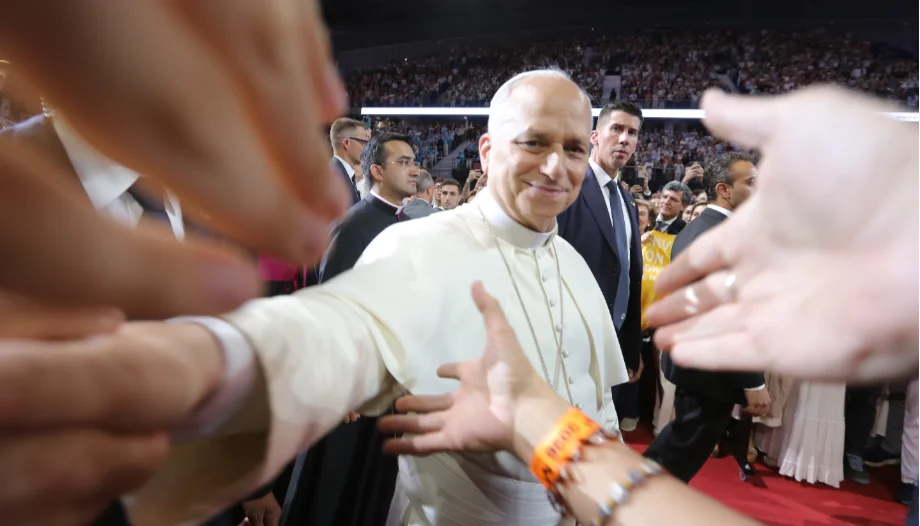
“Only through a return to negotiations can the end of the war be achieved. I exhort to accompany in this time the diplomatic work “with prayer, hoping that availability and dialogue can be instruments to resolve these situations of conflict in the world”.

Prayer vigil for peace on Saturday 11th

The Pontiff then renewed the invitation to all to join me at the Vigil of Prayer for Peace to be held in St. Peter's Basilica on Saturday, April 11”.

The words of the Papa were welcomed by the thousands of pilgrims and Romans gathered in St. Peter's Square with great applause.

“Holiness is not the privilege of a few”.”

“The Council's Constitution Lumen Gentium (LG) on the Church devotes an entire chapter, the fifth, to the universal vocation to holiness of all the faithful.... Each one of us is called to live in God's grace, practicing the virtues and conforming ourselves to Christ,” the Pope began.

According to this conciliar document, “holiness is not a privilege of a few, but a gift that commits all the baptized to live the fullness of love for God and their brothers and sisters,” added the Successor of Peter. 

And “the sacraments, especially the Eucharist, are the nourishment for growing in a holy life, that is, for being configured to Christ in virtue of the Holy Spirit”.

Charity is, in fact, the heart of the holiness to which all believers are called, and the highest level of holiness, as in the origin of the Church, is martyrdom, ‘supreme witness of faith and charity’ (LG, 50), the Holy Father said.

St. Paul VI: duty to be saints

Last Wednesday, when referring to the laity, The Pope quoted St. John Paul II and Pope Francis. Today, the Pope mentioned St. Paul VI. These were his words;

“He (Christ) sanctifies the Church, of which he is the Head and Shepherd: holiness is, from this point of view, his gift, which is manifested in our daily life every time we accept it with joy and respond to it with commitment. 

In this regard, St. Paul VI, in the General Audience of October 20, 1965, recalled that the Church, in order to be authentic, wants all the baptized to ‘be saints, that is, truly her worthy, strong and faithful children’. This is realized as an interior transformation, whereby the life of each person is conformed to Christ by virtue of the Holy Spirit (cf. Rom 8:29; LG, 40). 

Sin and our conversion

In the midst of the celebration of the Resurrection of the Lord, as he reminded the pilgrims in several languages, the Pope also launched a message on “the sad reality of sin in the Church, that is, in all of us. And he invited ”each one of us to undertake a serious change of life, entrusting ourselves to the Lord, who renews us in charity“, in ”a mission that we must fulfill day after day: that of our conversion“.

Witness of consecrated life

Finally, the Holy Father referred to “consecrated persons, who bear witness to the universal vocation to holiness in the whole Church, in the form of a radical following. The evangelical counsels manifest the full participation in the life of Christ, even to the Cross: it is precisely through the sacrifice of the Crucified One that we are all redeemed and sanctified!”.

“Signs of the Kingdom of God, already present in the mystery of the Church, are those evangelical counsels which shape every experience of consecrated life: poverty, chastity and obedience,” Leo XIV pointed out. “These three virtues are not prescriptions that fetter freedom, but liberating gifts of the Holy Spirit, through which some of the faithful consecrate themselves totally to God.”. 

In concluding, the Pope prayed that “the Virgin Mary, Mother of the Incarnate Word, may always sustain and protect our journey”.

The authorFrancisco Otamendi

Read more
The World

Algeria's complicated religious situation

Algeria, the African country where Pope Leo will arrive on April 13, has a complicated religious situation that seriously harms the nation's Christians.

Bryan Lawrence Gonsalves-April 8, 2026-Reading time: 5 minutes

Pope Leo XIV will arrive in Algeria on April 13 for a four-day visit , marking the first papal visit to the country. While the pontiff has visited Algeria twice before, once in 2003 and again in 2014 as Prior General of the Order of Saint Augustine, his return as head of the Catholic Church comes against a backdrop of mounting restrictions for the country’s Christian minority.

To better understand the situation, Omnes spoke with Constance Avenel, Advocacy Officer for Freedom of Religion at the European Center for Law and Justice (ECLJ). Having recently published a report on the treatment of Christians in Algeria, she also helped organize a March 18 side event conference at the United Nations Human Rights Council addressing the discrimination of Algerian Christians.

A Legal Grey Zone

Algeria officially enshrines Islam as its state religion, but non-Muslim communities operate in what Avenel describes as a “precarious legal grey area”. She explains that a 2006 government ordinance and its implementing decrees allow authorities to restrict Christian practice without explicitly banning it.

Churches can be refused registration, administratively closed, or targeted under technical pretexts such as urban planning or safety regulations. “In fact, the authorities have closed several churches on sanitary grounds”, she notes, a legal ambiguity that discourages new initiatives and forces many communities to adopt self-censorship.

The distribution of Bibles exemplifies this dynamic. “Bibles are not officially banned, but their importation into the country is subject to administrative control”, Avenel says.

Pastor Youssef Ourahmane, Vice President of the Protestant Church of Algeria (EPA), confirms that the organization faces “significant difficulties” importing bibles, while distributing Bibles can be interpreted as proselytism, potentially criminal under Algerian law. 

The prosecution of Habiba Kouider shortly after the 2006 ordinance for carrying Bibles illustrates how even routine religious practice can lead to legal consequences.

Legal Restrictions and Social Pressures

Algeria’s Christians are constrained not only by administrative regulations but also by broader societal pressures. Converts from Islam experience intense scrutiny, as apostasy is often viewed by family and community as betrayal.

Avenel describes this as part of a climate where non-Muslim religious practice is not just restricted by law, but monitored socially, particularly during Ramadan, when public Islamic observance is highly visible.

“Employers are strongly encouraged, and sometimes even compelled, to report Christian employees to the authorities, thereby contributing to significant social stigmatization”, Avenel explains, highlighting how state and societal pressures intertwine to limit economic and social mobility for Christians.

Institutionally, Protestant and Catholic communities alike operate under constant scrutiny. The EPA has seen dozens of churches closed, while Catholic humanitarian arms, such as Caritas Algeria, was shut down by the Government despite their services benefiting all communities regardless of faith.

The government’s selective enforcement illustrates a larger political principle: only a state-controlled vision of religion is tolerated, often framed as protecting national sovereignty.

This was made public when in 2010, former Minister of Religious Affairs Bouabdellah Ghlamallah, stated, “no one wants there to be religious minorities in Algeria, because that could serve as a pretext for foreign powers to interfere in the country’s internal affairs under the guise of protecting minority rights.” Ghlamallah also declared that “an Algerian can only be a Muslim”. 

This reflects the government’s mindset that leaves little room for religious diversity. As a result, churches prioritize presence and service over expansion, focusing on education, healthcare and interreligious dialogue rather than evangelization. Even these modest initiatives remain vulnerable to closure or restriction, a testament to the fragility of institutional space for minority communities. 

The Papal Visit: Symbolism and Limitations

The arrival of Pope Leo XIV offers both symbolic significance and practical challenges. International attention can provide temporary protection and visibility, but it does not guarantee religious reform.

“President Tebboune will, in reality, be content to present the Pope with a ‘showcase’ Christianity… and carefully avoid addressing the real issues”, Avenel warns, noting that Protestants in particular may see little visibility during the visit.

Avenel further stresses that the Pope’s itinerary, focusing on historic Catholic landmarks like Notre-Dame d’Afrique Cathedral and the Sacré-Cœur Basilica, will be carefully curated to project religious tolerance without confronting systemic restrictions.

Historical precedent suggests the limits of these gestures. When Pope Francis visited neighboring Morocco in 2019, King Mohammed VI described Christians as “guests”, reinforcing their status outside the social mainstream.

Algeria operates with a similar logic, although in truth, Christians were in Algeria long before Muslims. The nation's pre-Islamic Christian roots are largely unacknowledged by state authorities. The papal visit, coinciding with the 30th anniversary of the martyrdom of the monks of Tibhirine, would stress the symbolic stakes for Algeria’s Christian community, offering a rare opportunity for international scrutiny of systemic repression.

A Path Forward: International Pressure and Domestic Reform

Avenel stresses that “no major legal reform will occur without profound political change,” pointing to the structural limitations inherent in Algeria’s governance of religious freedom.

Recommendations from the UN conference she helped organise as part of the ECLJ, called for constitutional recognition of freedom of conscience, legal functioning of Protestant churches, revision of criminal provisions on proselytism and the reopening of institutions like Caritas Algeria. Engagement from international bodies, including a visit by the UN special rapporteur on freedom of religion or belief, is seen as critical to apply consistent pressure.

Despite geopolitical considerations, Algeria is a major energy supplier to Europe, a counterterrorism partner for the United States and a significant weapons buyer from Russia. None of these international players would want to upset the Algerian government on the basis of providing religious freedom to its minority Christian community.

For the country’s Christians, the Pope’s visit represents both hope and a reminder of ongoing vulnerability. In the face of legal ambiguity, social pressure and institutional fragility that define daily life, restrict religious freedom and prevent charitable activity, Algeria’s Christian community endures. Sustained by resilience, international solidarity and the hope that global attention will translate into meaningful protection.

The authorBryan Lawrence Gonsalves

Founder of "Catholicism Coffee".

Read more