Vocations
God called me to serve: my vocation in the Andes of Peru

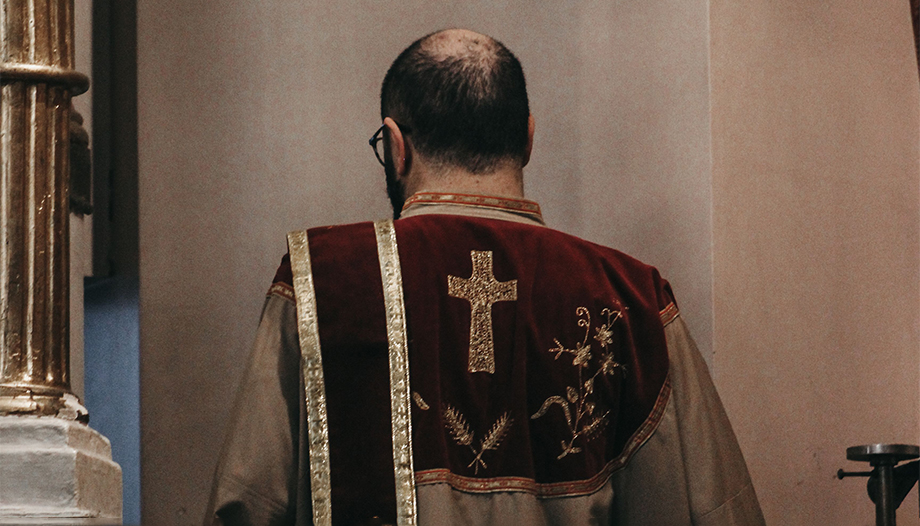
In the context of rural Peru, a priestly vocation such as that of Christian Anthony Burgos acquires its own nuances.

Sponsored space-April 27, 2026-Reading time: < 1 minute


In the context of a rural Peru, a vocation The priestly ministry, like that of Christian Anthony Burgos, acquires its own nuances. Great distances, scarcity of resources and a strong cultural identity of the Andean peoples mean that the priest's ministry must be lived from the discomfort and without urban schemes.

In this area, the presbyter is an expected and necessary presence, often the only stable reference of the Church in vast and difficult-to-reach territories.

👉🏻 Read the full testimonial in the CARF Foundation blog

The Vatican

“Christians engaged in politics”: 6 challenges from the Pope to the EPP
Leo XIV has urged the European People's Party (EPP) to recover the spirit of the founders of the European Union, put the people back at the center, and rediscovering the Christian heritage without falling into confessionalism, facing 6 challenges.

Francisco Otamendi-April 27, 2026-Reading time: 4 minutes

In a speech in which the Pope recalled the founding fathers of the European Union, such as Adenauer, De Gasperi, and Schuman, The Holy Father encouraged EPP leaders and parliamentarians to “discover the Christian heritage without falling into confessionalism.

That is, “maintaining the distinction between the prophetic mission proper to the Church and concrete political action,” the Pontiff added. “Being a Christian in politics,» he explained, «does not mean imposing a religion, but allowing the Gospel to illuminate difficult decisions, even when they do not generate immediate applause. In this context, he defended ”the link between natural law and positive law, and between Christian roots and public action".

The Pope greeted in a special way the president of the EPP, the German Manfred Weber, and the Irish Mairead McGuinness, special envoy of the European Union for the promotion of religious freedom outside the EU.

In the wake of the last Popes

The meeting takes place “in the wake of those that took place with my predecessors, St. John Paul II and Pope Benedict XVI, as well as the message that Pope Francis sent to them in June 2023, when he was unable to receive them personally due to his hospitalization. I am therefore pleased to continue this dialogue with the European People's Party, which draws its political inspiration from figures such as Adenauer, De Gasperi and Schuman, widely considered the founding fathers of modern Europe,” the Pope said.

“Like Benedict XVI twenty years ago, I too appreciate your Group's recognition of Europe's Christian heritage.”.

The European project, which arose from the ashes of World War II, “was undoubtedly born of the practical need to prevent such a conflict from happening again,” Leo XIV added. “However, it is equally imbued with an ideal vision, namely, the desire to foster a cooperation that overcomes centuries of division and enables the peoples of the continent to rediscover the human, cultural and religious heritage they share,” the Holy Father continued. 

Christian principles, a common and unifying element

The founding fathers were inspired by their personal faith and saw Christian principles as a common, unifying element that could help end the spirit of revenge and conflict that had led to World War II. The Pope Francis’ coined a beautiful and simple expression that sums up this idea: “unity is superior to conflict”.

Human person at the center, and not leaving the people aside.

De Gasperi pointed out that pursuing an ideal means placing the human person at the center, the Pope recalled, “with his spirit of evangelical brotherhood, with his reverence for the law inherited from antiquity, with his appreciation for beauty refined over the centuries and with his commitment to truth and justice, sharpened by millennia of experience.”.

This is the framework within which politics can still be practiced today and to which political activity needs to be redirected. “Your party is called the European People's Party. The people is at the heart of their commitment, and they cannot leave it aside. They are not mere passive recipients of political proposals and decisions; they are, above all, called to be active participants who share responsibility for every political action,” Leon XIV said clearly yesterday.

The best antidote to populism

According to Pope Leo, “being present among the people and involving them in the political process is the best antidote to populism, which seeks only easy approval, and to elitism, which tends to act without consensus. Both are widespread trends in today's political landscape. An authentically “popular” politics requires time, shared projects and love for the truth”.

It is necessary to recreate a genuine sense of ‘people’, involving “personal contact between citizens and their representatives, in order to respond effectively to the concrete problems of the people in the light of an ideal vision,” the Pope added.

We could say metaphorically that in the era of the ‘digital triumph’, “political action truly oriented to the common good requires a return to the ‘analog’”.

In addition, to overcome a certain disaffection with politics, it is necessary to “recover people by bringing them closer personally and rebuilding a network of relationships in the areas where they live, so that everyone can feel that they belong to a community and share its future”.

6 challenges: what it means to be committed Christians

Finally, the Pope specified some points of what it means “to be Christians engaged in politics: a realistic perspective that begins with the concrete concerns of people”. The phrases are verbatim, although synthesized. You can consult them here.

1 - Encourage decent working conditions that encourage people's ingenuity and creativity in the face of an increasingly dehumanizing and unsatisfactory market. 
2 - Allow people to overcoming the fear of starting a family, of having children, a fear that seems to be especially prevalent in Europe.

3 - Addressing the root causes of migration, caring for those who suffer, taking into account the real capacities to welcome and integrate migrants into society. 

4 - Addressing the major challenges of our time in a non-ideological manner, such as creation care and artificial intelligence. The latter offers great opportunities, but is also fraught with dangers.

5 - Investing in freedom -not a trivialized freedom reduced to mere personal preferences- but one based on truth, which safeguards religious freedom as well as freedom of thought and conscience in all places and circumstances. 

6 - Avoiding the promotion of a “short-circuit” of human rights, because it ends up yielding to force and oppression.

The Pope concluded “with the hope that they may constitute a starting point for your commitment”.

The authorFrancisco Otamendi

The World

Pope warns against «thieves» of joy
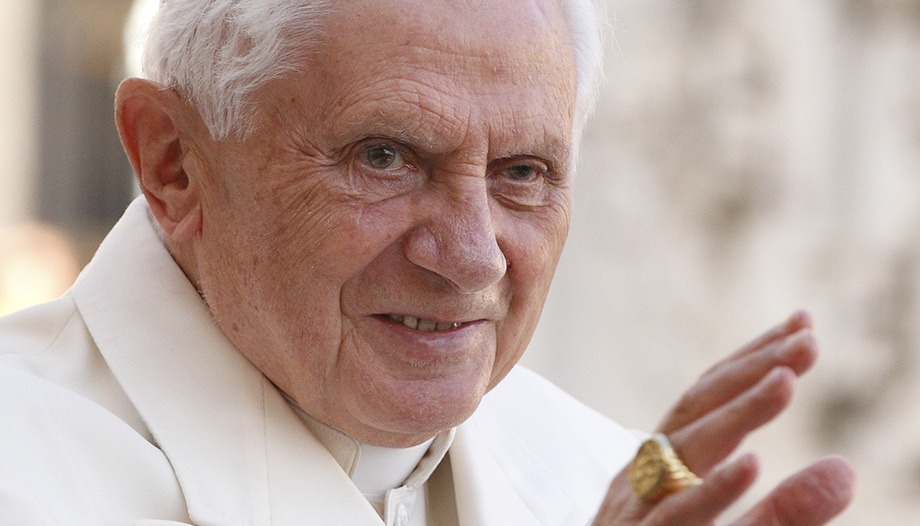
On the occasion of Good Shepherd Sunday, the Pope called attention to various kinds of “thieves” who can steal our joy. At yesterday's Roman ordinations, he offered three secrets for new priests.  

Editorial Staff Omnes-April 27, 2026-Reading time: 4 minutes

As we continue our journey through the Easter season, today's Gospel presents the words of Jesus, who compares himself to a shepherd and then to the gate of the sheepfold (cf. Jn 10:1-10), the Pope began his brief address before the Regina coeli. It is the Sunday of the Good Shepherd.

Jesus contrasts the shepherd with the thief. In fact, he affirms: “Truly I tell you, anyone who does not enter the sheepfold by the gate but jumps in by another way is a thief and a robber”. And further on, even more clearly: “The thief comes only to steal and kill and destroy. But I have come that the sheep may have life, and have it more abundantly”. 

The “thieves” can take on many faces

We are invited to reflect and, above all, “to watch over our hearts and our lives,” said the Vicar of Christ, “because those who enter them can multiply joy or, like a thief, can steal it from us,” said the Pope. 

And thieves can take on many faces:

- are those who, despite appearances, restrict our freedom or do not respect our dignity; 

- are beliefs and prejudices that prevent us from having a clear vision of others and of life; 

- are misconceptions that can lead us to make negative decisions; 

- are superficial or consumerist lifestyles that empty us internally and drive us to live always outside of ourselves. 

- let us not forget either those “thieves” who, by plundering the earth's resources, waging bloody wars or nurturing evil in any form, do nothing more than rob us all of the possibility of a future of peace and serenity”.

“Who do we want to guide our lives?

In concluding, the Successor of Peter suggested that we can ask ourselves: “Who do we want to guide our lives? Who are the “thieves” who have tried to enter our interior? Have they succeeded, or have we been able to reject them?

“Today the Gospel invites us to trust in the Lord: he does not come to rob us of anything; on the contrary, he is the Good Shepherd, who multiplies life and offers it to us in abundance,” he concluded. May the Virgin Mary always accompany us on our journey and intercede for us and for the whole world.

Before giving the blessing, the Pontiff recalled the 40th anniversary of the tragic accident at Chernobyl, and urged that at all levels of decision-making, “discernment and responsibility should always prevail, so that every use of atomic energy may be at the service of life and peace.”.

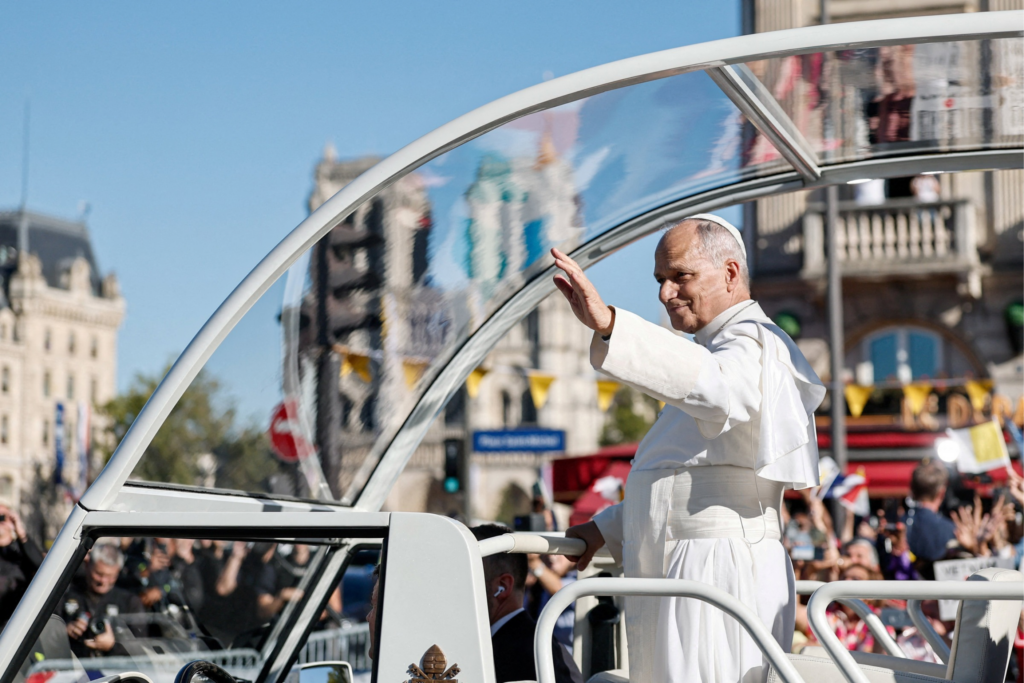
Pope Leo XIV waves as he arrives to celebrate the final Mass of his apostolic journey to Africa at the Malabo Stadium in Malabo, Equatorial Guinea, April 23, 2026. (Photo OSV News/Simone Risoluti, Vatican Media).

“Three secrets” of the Pope to the ordinands.

At the priestly ordinations of Roman seminarians, Pope Leo XIV said that “in the availability of the young men whom the Church today asks to be ordained priests, we note much generosity and enthusiasm”.

At the homily, has offered “three secrets” for consideration.

1) “This is a first secret in the life of the priest..

The deeper your union with Christ, most radical is their belonging to the common humanity. There is no opposition, no competition between heaven and earth; in Jesus they are united forever”. 

Like the love of spouses, he continued, “the love that inspires celibacy for the Kingdom of God must always be nurtured and renewed, because every true affection matures and becomes fruitful with time. They are called to a specific, delicate and difficult way of loving and, even more, to a way of letting themselves be loved in freedom”.

2) A second secret of the priest: reality should not frighten us.

He who calls us is the Lord of life. May the ministry entrusted to you, dear brothers and sisters, communicate the peace of those who, even in the midst of danger, know why they feel safe.

In the Gospel we have just proclaimed (Jn 10:1-10) Jesus‘ reference to figures and gestures of aggression is surprising: between him and those he loves, strangers break in, thieves and robbers who exceed the limits; they do not come, Jesus says, ’but to steal, kill and destroy' and, above all, they have a voice different from his own, unrecognizable, the Pontiff stressed.

“What they announce and celebrate will protect them.”

“Today, the need for security makes people aggressive, encloses the communities within themselves, instigates the search for enemies and scapegoats (...) What they announce and celebrate will protect them even in difficult situations and times”.

“The communities to which you will be sent are places where the Risen One is already present, where many have already followed him in an exemplary way,” says the Pope.

3) Third secret. “By initiating others into the faith, they will rekindle their own faith.”.

The Pastor of the universal Church also reflected on what people lack, “a place where to experience that together is better, that together is beautiful, that it is possible to live together. Facilitating encounters, helping to bring together those who otherwise would never meet and bringing opposites closer together is intimately linked to the celebration of the Eucharist and Reconciliation. I am the door,‘ Jesus says. 

“Dear ordinands, feel yourselves part of this suffering humanity that awaits life in abundance. By initiating others into the faith, you will rekindle your own faith. Go out and encounter culture, people, life.” “Sometimes it will seem to you that you do not have the maps; but the Good Shepherd possesses them, and you must listen to his voice, so familiar to you,” the Pope concluded.

The authorEditorial Staff Omnes

Culture

Catholic Scientists: Vicente Mut

Vicente Mut was a military man, engineer, lawyer and chronicler. He received his doctorate in law and reached the rank of sergeant major of Palma.

Ignacio del Villar-April 27, 2026-Reading time: 2 minutes

Vicente Mut (October 25, 1614 - April 27, 1687), born and died in Palma de Mallorca, was the son of a captain of the cavalry corps in the service of King Philip III. He studied with the Jesuits and entered the Society of Jesus, but did not continue in it. Afterwards he continued studying and attained a doctorate in law. In the military field, he achieved the rank of sergeant major in Palma, where he was an administrator and military engineer. He also worked as a lawyer, juror and general chronicler of the Kingdom of Mallorca.

Mut published several works on politics, history, hagiography, military tactics and cartography. Among them we can highlight History of the Kingdom of Mallorca y The prince of war and peace, in which he defends, in accordance with the Catholic Counter-Reformation, that the prince should subordinate politics to moral values and the State to religion. Another proof of his Catholicism is found in his Treatise on Military Architecture, an engineering work where he declares about a fortification: “it will be stronger, which in Peace would have the Laws as a wall and in War the defense of Reason, Justice and the Catholic Faith”.

But it is in astronomy where he shone the most, publishing three astronomical works: De Sole Alfonsino restituto (1649), where he defended the validity of the Alphonsian Tables and studied solar eccentricity by measuring the apparent diameter of the Sun; Observationes motuum caelestium (1666), with more than twenty years of observations of eclipses, planetary movements and parallaxes, applying instruments such as telescopes and micrometers; and Cometarum anni MDCLXV (1666), in which he studied the comets of 1664 and 1665. To explain the trajectory of the comet of 1664, Mut applied analogies with Galilean ballistics, suggesting a parabolic trajectory similar to that of a projectile.

He also corresponded with numerous astronomers, among them the Jesuits Athanasius Kircher and Giovanni Battista Riccioli, who included some of his observations in their work. Almagestum Novum.

Although he respected Kepler's ellipses, Mut did not fully understand their physics and preferred circular geometric models for the planets. Nevertheless, his rigorous methods of observation contributed to the improvement of measurements, especially the determination of the solar diameter and the analysis of parallax.

The authorIgnacio del Villar

Public University of Navarra.

Society of Catholic Scientists of Spain

Evangelization

We are not meant to be alone

The Theology of the Body sheds much light on the feeling of “solitude,” understood as a space of self-discovery that reveals our vocation to love through communion and the sincere gift of self.

Hugo Elvira-April 27, 2026-Reading time: 4 minutes

We continue our series of articles inspired by the Theology of the Body of Jesus Christ. St. John Paul II. In the previous article we reflected on a fundamental truth that restores the body to its true place: the body is God's creation, it is good and allows us to make love visible when we allow it to speak its own language. Thanks to it we can live communion, mutual donation and service.

However, an inevitable question arises. If we are called to such rich relationships - affiliation, fraternity, friendship, courtship, marriage - why do we continue to experience loneliness? This is the question that will accompany us in this second article.

A curious phenomenon

Many of us have had this experience. A party ends. The lights go out. The phone stops receiving notifications. And silence sets in. It doesn't matter if you have many followers on social networks, many contacts, or are in several social media groups. WhatsApp. At some point we all experience that inner feeling that makes us think: “I am alone”.

Sometimes that silence is good. It can be a moment of peace to rest or to concentrate. But when loneliness lasts too long, it can turn into sadness, discouragement or even lead us to seek the wrong consolations. An important question then arises: Why does it seem that there is a “good” solitude and another that weighs heavy on our hearts? Could this experience hide a deeper truth about the human being?

Before the first embrace

The book of Genesis contains a phrase that sheds much light on this reflection: “It is not good for man to be alone....” (Genesis 2:18). What is interesting is that these words appear before original sin, before human suffering. This means that the experience of solitude is not born simply as a consequence of sin. For this reason, St. John Paul II called this experience: “original loneliness”. A primordial state in which Adam was created. 

But then another question arises: if loneliness can be painful, why did God allow man to experience it? St. John Paul II explains that this solitude was not and cannot be thought of as a punishment, but as a moment of discovery. Thanks to this primordial state, man understands who he is before God and the rest of creation. Adam gives names to the animals and realizes something surprising: none of them is like him. None of them dialogues with God. None can decide freely. None has been given the responsibility of guarding creation. In this experience, Adam discovers his own dignity. He realizes that he is neither a thing nor a mere animal, but a person....

The discovery of communion

If we continue the reading from Genesis, we find the following: “Adam gave names to all the cattle, to the birds of the air, and to the beasts of the field; but he found none like him.” (Genesis 2:20). And then something decisive happens. God forms the woman and presents her to the man. And Adam exclaims with joy: “This one sure is bone of my bones and flesh of my flesh!” (Genesis 2:23). Many theologians see in these words of joy the first marriage celebration. Adam recognizes before him someone equal in dignity and, at the same time, different and complementary. And it is with this marvelous event that man discovers that his vocation is not solitude, but communion. Before this encounter Adam could be satisfied with creation..., but he did not yet fully experience the joy of interpersonal communion.

The first human embrace, therefore, reveals something fundamental: we have been created for encounter.

The remedy for loneliness

Adam's experience is still revealing for us today. When we feel lonely, we usually seek some kind of relationship. Sometimes we call a friend, chat with someone. Other times we try to fill the void with distractions: parties, social networking, entertainment... But often the feeling of loneliness returns.

Why?

Perhaps because loneliness is not cured simply by interaction, but by authentic communion: with family and friends when we dedicate time and offer true affection. In marriage when we live fidelity, mutual care and self-giving. In short: in any relationship where the person becomes a sincere gift of self, as St. John Paul II so often explains.

Therefore, when our relationships stay on the surface they may distract us for a moment, but the heart will always continue to search for something deeper.

What does real communion look like?

We could give many examples. All human relationships have their authentic way of being lived. But Genesis offers us a very clear image in the encounter between Adam and Eve. The text says that “They were both naked, Adam and his wife, but they were not ashamed of each other.” (Genesis 2:25). This means that their bodies expressed the truth of their love. There was no domination, no use, but mutual recognition and surrender. Adam saw in Eve someone different, but equal in dignity. Someone to love, not to possess. Someone to share life with, not to dominate. Their bodies spoke the language for which they had been created: the language of self-giving.

What does this tell us today? That when we experience loneliness, the heart is not simply asking for distraction, for escape. It is asking for real communion. It can be said, then, that loneliness, rather than something negative as such, can become a sign that reminds us of our deepest vocation: to love God and neighbor as ourselves.

So when you feel lonely, it may be worthwhile to stop for a moment and ask yourself: Am I living only for myself? Have my relationships become superficial? Am I making room for God in my life?

And after that reflection, the best thing to do is to take action: call someone to say hello. Ask forgiveness to whom we still hold resentment. Listen patiently to someone who needs to be heard. Or simply pray in silence. All these small gestures of love can transform the experience of loneliness. Because when love becomes concrete, the heart, body and soul experience their deepest joy: that of having been created and given to the person by God, not for solitude, but for authentic communion.

Debate

Brain bioethics: reflections of a catholic neurosurgeon.

How to consider the rapid advances in medical technology, and the rise of transhumanism within a Catholic framework? Brain-computer interfaces can restore, in medical use, the autonomy of patients with severe neurovegetative damage, and improve their quality of life in what was previously untreatable.

OSV / Omnes-April 26, 2026-Reading time: 5 minutes

- Charlie Camosy, OSV News

An important area of study and research is now in the field of neurotechnology, which is closely related to neurosurgery. Brain-machine interfaces have the potential to help patients with debilitating conditions, such as total quadriplegia, to regain significant autonomy.

The idea is that the brain is healthy in this group of patients. The pathology they suffer affects the connections of the brain with the rest of the body. 

We talked about it with Gabriel LeBeau, a second-year neurosurgery resident at the University of Kansas Medical Center, who has been thinking about brain bioethics for some time, and is interested in brain-machine interfaces, neurotechnology, and cerebrovascular neurosurgery.

Charlie Camosy: Can you tell us a little bit about your Catholic journey and how it led you to do a residency in neurosurgery?

- Gabriel LeBeau: I was born and raised Catholic, especially in the Catholic Charismatic movement. My family was devout and I am deeply grateful to my parents for fostering the gift of faith.

I grew up in Arizona, but chose to attend college at Benedictine College in Atchison, Kansas. This college experience deeply solidified my Catholic identity and united my desire for excellence with the Catholic intellectual and moral tradition. I studied philosophy, also studied medicine and had always been attracted to biomedical ethics.

As I progressed in my studies of philosophy, philosophical psychology, the questions of free will, the difference between brain, mind and soul, mind-body duality, etc., were the ones that grabbed me the most. I was fortunate enough to be accepted to the University of Kansas Medical School, and it was these philosophical interests that propelled me into brain-related specialties.

While in medical school, I was fortunate to be mentored by a deeply Catholic neurosurgeon, Dr. Paul Camarata. He helped foster and support my interests in neurosurgery, as well as my Catholic identity in that field. His care for patients, commitment to faith and operational excellence gave me the confidence to pursue neurosurgery as my specialty of choice.

How do you define neurosurgery?

- Neurosurgery is a surgical specialty that deals with pathologies and emergencies affecting the central and peripheral nervous system, i.e. the brain, spine and nerves. Patients present with symptoms that affect their sense of identity, autonomy and many other factors central to the human condition. Often, these pathologies appear without warning and in the context of an emergency, and can be fatal or life-changing without intervention.

I believe that the Catholic moral tradition, guided by the spiritual and corporal works of mercy, is essential to my future training and practice as a neurosurgeon in the care of these patients and families.

Brain-computer interfaces, potential for patient support

Thank you for joining our team at the Institute for Advanced Catholic Studies at the University of Southern California. Can you share a brain-related idea you've had from our time together?

- It is difficult to share just one brain-related idea, because there have been so many. One that comes to mind is especially related to brain-computer interfaces. The group in question is studying the philosophy (or movement) of transhumanism and its impact on multiple fields.

One area of impact would be in the field of neurotechnology, which is closely related to neurosurgery. Brain-machine interfaces have the potential to help patients regain autonomy.

Through a brain-machine interface, a device can be implanted in the brain, which in turn would collect and synthesize neural data in a computer to produce an actionable output, such as moving a robotic arm or having autonomy over the actions of a computer or other device.

There are many models of this with early success, such as patients regaining ownership of their businesses, operating prostheses and many other exciting developments. 

A situation that was once intractable now enters the realm of neurosurgical intervention. Prominent industries involved in this sector are Neiuralink and Synchron.

These innovations can be used for many purposes.

- As with many technologies, this innovation can be used for many purposes. In current models, brain-computer interfaces are intended to restore patient autonomy and improve quality of life in what was once considered an untreatable condition.

However, these same devices, with the same technology, could be used with a ‘transhumanist’ mentality, in order to implant these devices in a healthy patient with the intention of improving them. 

This team has examined the philosophical and ethical implications of such use and, importantly, has collaborated with both academic and industry leaders in the world of neurosurgery, achieving a successful interdisciplinary dialogue. The neurosurgical field is becoming aware of the ethical implications of these devices because of the work of this group.

As you know, I have been asked about the relationship of the brain to self-awareness and, ultimately, to human life and death itself. Do you think there are questions worth asking here?

- Yes, indeed. There seems to be a bias in the scientific and medical community that the brain and the mind are synonymous. Given this assumption, the perceived value of a person often rests on the functionality of his or her brain.

Philosophically, there are important questions to raise here, namely, whether it is true that brain and mind are synonymous, and how best to characterize that relationship.

Many books have been written addressing this very question, but I can comment that in the operations I assist in as a resident (awake brain tumor surgeries, seizure resections), large and important parts of the brain can be removed, and the mind seems to remain intact after the operation.

However, in practice, I see the implications of the idea that a person's brain, mind and worth are synonymous most poignantly in the delineation of ‘brain dead’ and the rationale for that classification in the first place.

Sometimes you want to manipulate responses

A related issue worries me: that we have become lazy and inaccurate in thinking about the question ‘What is death?’ partly because we want to manipulate the answer to get more organs for transplants....

- From the outset, I would argue that “brain death,” or “death by neurological criteria,” in our experience has no real clinical utility beyond organ procurement.

In the field of neurosurgery we encounter many patients and their families after neurologically devastating injuries. Once all options are presented to the family, whether to have surgery or not, decisions are made without “brain death” to withdraw extraordinary care and allow their loved one to succumb to the natural process. Brain death testing is of no help at all in this process at our hospital, in almost all cases.

Now the conversation about brain death comes in. In every hospital in the region, for every patient who meets certain neurological presentation criteria-I think in our hospital it's Glasgow Coma Scale of five or less-the local organ transplant network receives automatic notifications.

We assume that you are also concerned about the organ donation industry..

- Occasionally, although rare, the organ procurement representative speaks to the family before the physician has a chance to do so. I have heard a speech by a representative in a situation where a young man attempted to take his own life with a gun to his head, in which it was said, “your son's death may mean something.” This is not physician driven, nor do many physicians of all faiths appreciate the enthusiasm of the organ procurement industry.

Other concerns I have are addressed in the medical literature, including. works published in The Annals of Thoracic Surgery and The American Journal of Transplantation.

A comment on the moral certainty of death.

- It is important to note that there are active efforts to “maintain the principle of permanence of death” in donation after circulatory death (Note: in medicine this principle coincides with the Catholic requirement of irreversibility and moral certainty of death before proceeding with donation). 

In this case, the patient dies of cardiac arrest and is declared dead. When resuscitated for surgical removal, major cerebral arteries are clamped, with the idea that the person will maintain the permanence of death by impeding blood flow to the brain.

There are aspects of the organ donation industry and of the transhumanism that are controversial and should be carefully analyzed.

(You can consult the Catechism of the Catholic Church, nn. 2292-2296, concerning ‘Respect for the person and scientific research’).

——————–

- Charles Camosy teaches moral theology and bioethics at The Catholic University of America in Washington.

The authorOSV / Omnes

Spain

Bishops hope Pope's trip will lower polarization in Spain

The secretary general of the Episcopal Conference, Msgr. Francisco César García Magán, hopes that the Pope's visit in June will reduce “the tone of polarization” in Spain. In his opinion, ”it would be good” a meeting of the Pope with victims of child abuse, who have reduced their complaints in the past year.

Editorial Staff Omnes-April 25, 2026-Reading time: 4 minutes

The decrease in reports of child abuse last year, and the hope that the visit of Pope Leo XIV will reduce “the tone of polarization in Spanish socio-political life” and provoke “the conversion of hearts to the Lord”, were two of the issues discussed at the final press conference of the Plenary of the Episcopal Conference.

In addition to these, there was still a lack of information on the confirmed events of Pope Leo XIV's visit to Spain, except for “Cibeles”, where the Holy Mass will take place on Sunday, the feast of Corpus Christi, and a large prayer vigil and Eucharistic Adoration with young people in the Plaza de Lima in Madrid, on Saturday, the same day of the Pope's arrival. In addition, national political issues, such as migration, were discussed.

“Hopefully the Pope's trip that love of neighbor and the life of charity may increase, that vocations to love may increase in all its dimensions, and that there may be a conversion of hearts to the Lord. We do not expect a success in the number of people, which will happen. We do not measure or quantify by that nor by the economic issue; it is what the Pope's message, his magisterium can bring not only to Catholics but to the whole of Spanish society, to men and women of good will even if they are not Christians”, Garcia Magán stressed.

The general coordinator, Yago de la Cierva, and the deputy general coordinator, Fernando Giménez Barriocanal, took part in the Assembly to report on the work being carried out in coordination with the dioceses of Madrid, Barcelona, the Canary Islands, San Cristóbal de la Laguna and Sant Feliu de Llobregat.

“The Church does not move with slogans.”

One of the topics that came up in the conference with journalists was the ‘national priority’ proposed by Vox, together with the situation of migrants.

«We are in an era where politics moves with slogans and advertising claims that seek polarization and serve to criticize other parties. The Church does not move at the level of slogans, neither this one nor any other. The reality of the Church is broader, richer and less so when one side wants to eliminate the other”.

“Our priority is the Gospel, and it is based on two principles: the dignity of the human person, which is untouchable, unrenounceable and cannot be reduced, and the common good of society as a whole (...). And the common good of society as a whole (...) The Gospel criterion is above all other considerations and the Church is committed to being close to all», said the bishop.

Asked about the criticisms of the president of Vox, Santiago Abascal, to the bishop of the Canary Islands for illegal immigration, he said that “they are not based on truth, but on falsehood, even in a sphere of insults».

Traveling by cayuco

Regarding migrants, the Secretary General supported the statements of Bishop Jose Mazuelos. “The Church of the Canary Islands touches every day the drama of people who have to travel in cayuco. It would be a good journalistic report or radio podcast and they could do it to understand this and see if the words of Mazuelos have veracity or not,” he has suggested.

Abuses, less testimonies/complaints last year

The 262 Offices for the Protection of Minors dependent on the Spanish dioceses and congregations in Spain received 93 testimonies or denunciations of sexual abuse last year, a figure lower than the 146 cases presented in the previous year. With these 93 complaints, the total number rises to 1,131 in five years.

On the other hand, the EEC has prepared a draft decree, adapted to the reform of Book VI of the Code of Canon Law, which is to be revised in the Vatican, and which contemplates monetary fines, but not only in relation to abuses, nor only to clerics, but also to lay people.

Among other figures, the bishops report that during 2025, 465,465 people (including 363,060 minors; 34,175 teachers; 32,310 parents; 19,265 pastoral agents, leisure time monitors and catechists; 7,712 priests and religious; and 1,388 seminarians and religious in formation) have received training for the prevention of abuse and protection of minors. The total number, close to half a million, is increasing.

The Ombudsman reports to Parliament

On the subject of child abuse and the statements of Minister Felix Bolaños -‘the State decides the compensation and the Church pays’- the bishop and secretary general Garcia Magan wanted to expand. “In those statements there are a series of inaccuracies that are not exactly as stated”.

“It was said that the Church was now starting to pay, which is not true because it has been paying for years through judicial channels; the dioceses and congregations have paid even in agreements outside the judicial sphere, there were structures in place before this agreement with the Government, there were the 220 reparation offices, the PRIVA is working and continues to work without problem and has given that reparation.”.

The Church works “in a concept of integral reparation, to meet the needs of each victim, not only at an economic level” “The compensation is paid by the Church if there is no judicial process, as the Church has imposed on itself. The agreement says that if there is no agreement in the first two instances, the Ombudsman decides, which is a free institution that does not work for the Government, it reports to Parliament”. 

On this point, reiterating the independence of the current Ombudsman, Ángel Gabilondo, he has insisted on several occasions. 

Other matters 

Among other topics, García Magán was also asked about the process of re-signification of the Valley of the Fallen, and his answer was the same at various times: “It is not a matter within the competence of this Conference”.

On the advancement of Christian initiation, or the proposal of a ministry of charity (in addition to those of lector, acolyte and catechist), you can see the final note of the Plenary Assembly. The next episcopal meeting will take place at the end of June, after the visit of Pope Leo XIV to Spain.

The authorEditorial Staff Omnes

Evangelization

“Happiness is like solar panels, you can't store it for just one.”

Jaime Sanz collects in an informative book on the path of the Beatitudes a route to be happy that starts from the surrender of oneself.

Jose Maria Navalpotro-April 25, 2026-Reading time: 6 minutes

“I want people to discover that a Christian is not a ‘pringao’. It is to be happy. With this idea, Jaime Sanz (Palencia, 1962) has just published in Palabra ”No busques ser feliz, ¡consíguelo!“. Monsignor Jesús Sanz, in the prologue, assures that ”the secret of the happiest happiness is the one explained in that Sermon on the Mount“. The Beatitudes, as a way to be happy... also in the human aspect.

Jaime Sanz, with the same surname as his bishop, although not related, now works in the parish of the Sagrada Familia in Oviedo and as a hospital chaplain. A Doctor of Law, he has previously been a university chaplain at the University of Navarra in Madrid, at the Brafa Sports School and in educational centers. He has published more than half a dozen books on marriage, vocation and listening.

Now he is releasing “Don't look for happiness, get it! The title sounds a bit like a self-help book, a smoke peddler's book... 

-Yes, it sounds, it sounds, but that's why it has a subtitle: “The Way of the Beatitudes”. 

The idea is to explain to people that to be a Christian is to be happy, that is, it is not to stop being a Christian, but it is really to seek to be happy.

Because sometimes there is the idea that to be a Christian is to sign up just in case there is something, or to say “look, this is what there is, so resignation”. Well, no, to be a Christian is to be happy to the fullest and to enjoy happiness. This is the key. If one does not understand this, one does not understand the Christian message of the beatitudes.

What is heaven? Well, life on earth taken to its maximum expression. It does not mean that there is no cross and contradiction, which there will be, but it means that in the cross one meets the Lord and finds the reason for the pain. In the contradiction one often finds that one is like Our Lady at the foot of the cross, accompanying the Lord, with tremendous pain, but with a serenity that is not sad, but joy, as Our Lady would be. 

But where is the saying of St. Teresa of Jesus that life is a bad night in a bad inn? 

-She says it referring, precisely, to the earth. I mean, heaven is so much more. Not because this is a disaster. It's true that the world is very complicated, we're in a war, we're with very needy people, people are disoriented. It's a bad night in a bad inn, but it's still a marvel. So, if this is a bad night, what will heaven be? We live with our feet on the ground, but our head in the sky.

You have been with university students, now in a parish and in a hospital. Do you have direct experiences of people who experienced happiness precisely because of their faith? 

-You have the experience of the saints, the experience of Jesus Christ. There is a chapter in the book that says that Jesus Christ was the happiest man in the world. Why? Because he fulfilled the mission that the Father had entrusted to him. That mission is to bring about the Redemption. And it was not easy. He dies on the cross, he is condemned with an unjust trial, and in addition, he is inflicted a penalty, such as scourging, which is death. A bestial injustice. For the Lord dies absolutely happy.

Everything has been fulfilled, he says at the end. I think it is very important that we understand this, because if we do not, we do not understand the Christian life. In other words, the Christian life is happiness.

Some non-believers accuse Catholics of being bitter because they are always thinking about the cross. And it seems to them that the message of Jesus and his life are centuries-old history. What to say to young people who think that? 

-That is the idea of the book. To make people see, first, that happiness is not in having everything, or in giving oneself all kinds of pleasures, or in the selfishness of getting everything and living happily for oneself and for others, but that one has the experience that when one has been happiest, it is when one has surrendered oneself. Happiness is in surrender. 

Happiness cannot be accumulated. Here, above the parish [San Manuel González, in Madrid, where the interview takes place.We have solar panels, which are used for self-consumption. When there is electricity left over from the sun that has been generated, it is sent to the grid. It cannot be accumulated. Well, this is the same thing. You cannot accumulate happiness and keep it for yourself. You have to give it away. To the extent that you give more, to that extent you make others happy and there is more happiness around you. 

The beatitudes are a kind of guide to happiness. 

Even at the human level?

-Yes, they touch on almost every subject. They touch on poverty, hunger and thirst for justice, mercy, persecution, cleanness of heart, pain... All the tremendous situations that man goes through are included in the beatitudes. But they are oxymorons, because they are a contradiction.

Because they say things like “blessed are the poor...” and this is not understood. The beatitudes are not a theoretical discourse, but a discourse of what the Lord has lived and what we learn from Him. Jesus Christ does not preach a theoretical gospel, but preaches the gospel that He has lived and that those who have been with Him have shared. The beatitudes are, in a certain way, the outline of the Lord's life.

If you follow them, that's when you're really happy. 

Of all the beatitudes, which is the most difficult to live?

-Perhaps that of meekness, of the meek of heart. Because it depends a lot on character. And meekness is acquired with time and experience.

It is difficult to be meek when one is stepped on. Meekness is in accepting others as they are, in loving people, in knowing how to understand others. I think it is one of the most difficult virtues, which requires more time.

In general, older people tend to be more meek. I had a case in the hospital of a doctor, who was a well-known cardiologist. He had a broken heart and was in very bad shape. He spent months in the hospital. When you went to see him, he would tell you about all the Santiago Posteguillo novels he had read, he made you spend a nice time with him. Impressive. Why? Because he was devoted even in such a difficult situation. For example, he asked not to be given painkillers and not to be given morphine at the end, because he wanted to offer the pain to the Lord.

He was an example in the hospital. All the nurses, the doctors on the floor, the priests who went to see him, we were really excited. 

Aren't we in danger of making these beatitudes seem a bit utopian? That is to say, an ideal, but unattainable. 

-You run that danger if you don't live them.

If you truly strive to be poor, to be poor in spirit, to detach yourself from things, to embrace the values that are really worthwhile. Or if you try to be merciful, always knowing how to forgive and forget, and forgive immediately, well, then it is nothing theoretical, it is a practical reality. 

Jesús Sanz, my bishop of Oviedo, in the prologue, says that the beatitudes are like a balcony to which we look out to see what we have to live of the life of Christ, and then apply it to ourselves. In other words, it is to contrast the life of Christ with our life, as the Catechism says.

In the book you talk a lot about happiness. What is the greatest enemy of happiness?

-Selfishness, no doubt.

What does this book contribute? Because there are a million books on the beatitudes.

What it provides is, first of all, a modern, up-to-date vision of the beatitudes in informative language.

I try to spread the highest things in a simple way to the people of today. I am in contact with many people, I am in the spotlight, because I am with university students, in the hospital with those who suffer, in a parish poorer than Vallecas, in Oviedo, in the neighborhood of Ventanilles, which is the poorest of the poor. 

On my way here, a lady called me. She said she wants to talk to me because she has three children, she has been kicked out of her apartment, she has no housing, she has nowhere to sleep, she doesn't know what to do. I have given her some provisional solutions, and we will talk next week. That is the real beatitude, that is what one has to learn to live. 

It is to realize that it is possible to live this way, that it is possible to lead a Christian life today, as things are, and in the environment in which one moves. It is not necessary to go to South Sudan, but in your environment you can live the beatitudes to the full. But without being half-hearted. To remain half-hearted is a bet for unhappiness. It is a want and I can't. It is like saying that you could have bought the lottery ticket that won the jackpot, but you didn't buy it because you were a rat. 

Integral ecology

Catholic social teaching, taxation and generosity

Pope Benedict XVI also wrote about how charity was known, admired and crucial in bringing people closer to the faith in the early Church.

Philip Booth-April 25, 2026-Reading time: 5 minutes

The Catholic Bishops' Conference of England and Wales recently published a document on taxation titled  «Render unto Caesar what is Caesar's.». Catholic doctrine on taxation is relatively sparse. Catholics apply principles such as the universal destination of goods, the right to property and the primacy of the family to try to develop practical approaches to taxation in the wide variety of specific circumstances in which they find themselves. Predictably, they disagree with each other.

They disagree on how to apply the principles in particular circumstances. A politician from one party, for example, might think we should have a smaller, more effective welfare state, with more resources going to local action and less to families. A politician from another party might believe in more decisive action at the central government level, involving higher taxes and direct spending to reduce poverty.

Empirical issues also matter. One might think that they are irrelevant to a body of teaching that has moral principles as its basis. However, Pope Benedict (when he was Cardinal Ratizinger) wrote the following:

A morality that believes itself capable of dispensing with technical knowledge of economic laws is not morality, but moralism. As such, it is the antithesis of morality... Today we need a maximum of specialized economic knowledge, but also a maximum of ethics so that this knowledge is put at the service of the right objectives.

Again, opinions may differ. Those who share a political stance might consider that higher taxation harms family life, work and entrepreneurship, thus aggravating the problem the government is trying to solve. Others, on the other hand, might look at the evidence and come to a different conclusion. It is prudence that links the empirical with the moral issues.If a person reduces his or her disposable income by donating to charities, it is only fair that he or she be taxed on that reduced disposable income.

In «Render unto Caesar the things that are Caesar's» different perspectives were reflected, but two messages stood out quite strongly.

The first point was the importance of levying taxes sparingly and in proportion to ability to pay. As far as charity is concerned, this principle implies two things: first, that people have enough after-tax money to meet their charitable obligations; and second, that tax revenues are calculated after deducting charitable donations made. In fact, the Gift Aid system works quite well in our country.

At  «Render unto Caesar what is Caesar's.» , André Alves wrote: «Taxes should be moderate, as they reduce a family's ability to meet its responsibilities, including charitable obligations». And, in her contribution, Ruth Kelly (former Treasury minister and currently a member of the Vatican Council for the Economy) wrote: «If a person reduces his or her disposable income by giving to charity, it is only fair that he or she should be taxed on that reduced disposable income.».

There are many reasons why the state must ensure that it leaves sufficient room for charitable work. Perhaps Pope Benedict XVI put it best in his encyclical  Deus caritas est :

The State that would provide everything, absorbing everything, would ultimately become a mere bureaucracy incapable of guaranteeing that which the suffering person - every person - needs: namely, personal and loving attention... Ultimately, the claim that just social structures would make charitable works superfluous masks a materialistic conception of man: the erroneous idea that man can live “on bread alone” ( Mt 4:4; cf. Dt 8:3), a conviction that demeans man and ultimately ignores all that is specifically human.

In the same encyclical, Pope Benedict XVI explained the three functions of the Church, one of which is charity. He wrote: «The Church's deepest nature is expressed in her threefold responsibility: to proclaim the word of God, to celebrate the sacraments and to exercise the ministry of charity. These duties are mutually presupposed and inseparable».

And this function is not something that can be delegated.

Pope Benedict XVI also wrote about how charity was known, admired and crucial in bringing people closer to the faith in the early Church. This practice radically influenced the development of the Church's institutional structures, which were unfortunately destroyed during the Reformation. Today, however, these charitable structures exist, of course, in other forms.

Pope Benedict XVI concludes this section of  Deus caritas est  noting: “For the Church, charity is not a kind of welfare activity that could equally well be left to others, but is part of her nature, an indispensable expression of her very being”.

In the first reading of Divine Mercy Sunday, we read about how the early Church shared its goods in a radical way. It was not an activity delegated to the political order (which was logical given the political situation of the time). It was an act of love that, instead of being done on a large scale, reached that magnitude by being replicated on a small scale. This distinction is important for organizing the Church's charitable work.One of the problems with the modern welfare state, perhaps, is that it can lead us to consider charity as a marginal obligation.

One of the problems with the modern welfare state, perhaps, is that it can lead us to regard charity as a marginal obligation. Indeed, it is paradoxical that the welfare state developed to fill the gaps left by voluntary initiative and social welfare societies, and that we now think of charity as a mere supplement to those gaps.

But the call to charity in the Church has always been demanding. Pope Pius XI emphasized, without question, the responsibility of the rich to support the less fortunate through charity. First, he pointed out that the obligation of the rich to use their property for the benefit of others went far beyond their legal obligations. Second, he emphasized that these obligations were serious, stating, «The Holy Scriptures and the Fathers of the Church constantly declare, in the most explicit language, that the rich are bound by a very grave precept to practice almsgiving, beneficence and munificence.».

The rich, it should be said, can fulfill this role in a variety of ways, including through entrepreneurship; the point is that money should not sit idle and accumulate for the sake of accumulating: it should be put to good use.

Older encyclicals tended to resort to the language of judgment to a greater extent than modern encyclicals. This is especially noticeable with regard to the obligations of the rich toward the poor. This, for example, is seen in the  encyclical Rerum Novarum of Pope Leo XIII:

Therefore, those whom fortune favors are warned that riches do not bring freedom from pain nor serve for eternal happiness, but are obstacles; that the rich should tremble before the threats of Jesus Christ... and that an account must be rendered with utmost severity to the Supreme Judge for all that we possess.....

He went on to say that private ownership of property is a natural right of man. But then he stated that, if the question is posed, «How should one's possessions be used?», the answer is that it is a duty to give to others what we do not need; a duty that should not be required by human law (except in extreme cases), but a duty of Christian charity.

In conclusion, the importance given to charity in the Easter readings; the fact that charity is one of the three pillars of the Church described by Pope Benedict XVI; and the seriousness with which Pope Pius XI and the late Pope Leo XIII approached the subject of charity all point to the profound nature of our obligations to those in need.

We still benefit today from the radical charity of previous generations, as we celebrate Mass in the buildings they financed or send our children to study in those school buildings.

And, to end on the most positive note imaginable, when we come to the moment of judgment, as Pope Leo XIV wrote immediately after his warnings to the rich, God will regard a kindness done to the poor as if we had done it to Himself.


This article was originally published on the Catholic Social Thought website of the University of St Mary. Reprinted here with permission of the publisher.

The authorPhilip Booth

Professor of Catholic Social Thought and Public Policy at St. Mary's Twickenham University and Director of Policy and Research at the Catholic Bishops' Conference of England and Wales.

Spain

Church encourages commitment to vocations on its annual day on April 26th

The Spanish Episcopal Conference celebrates on April 26 the World Day of Prayer for Vocations and the Day of Native Vocations, an initiative that seeks to make the vocational call visible and promote the involvement of the faithful through prayer and economic collaboration.

Editorial Staff Omnes-April 24, 2026-Reading time: < 1 minute

The Spanish Episcopal Conference convenes on April 26th, coinciding with the IV Sunday of Easterthe World Day of Prayer for Vocations together with Native Vocations Day, two celebrations that have been united since 2015 on the same date.

The objective of both days is to “make the vocational call visible” and to sensitize society to the importance of supporting all vocations through prayer and financial support.

Materials of the Conference

For its celebration, various materials have been prepared for different audiences -adults, youth and children-, as well as texts for the Week of Prayer, liturgical aids and proposals for vigils. Among the novelties is an aid that invites to the blessing of water or the renewal of baptismal promises during the Easter Vigil or on Easter Sundays, with the purpose of underlining the baptismal vocation.

In addition, the day includes a hymn entitled «All Called» and specific materials for reflection and community prayer, with the purpose of encouraging the participation of the whole Church.

Promoting vocations

In the case of Native Vocations Day, the initiative focuses on supporting those called to the priesthood or consecrated life in mission territories, especially in the face of the economic difficulties they may encounter in their formation.

With these days, the Church invites the faithful to become actively involved in the promotion of vocations and to collaborate in their support, thus reinforcing the universal dimension of the Church's mission.

The Vatican

Leo XIV makes clear to German bishops disagreement with blessing of same-sex couples

The Pope drew a distinction between the formal blessings they propose in Germany and the general blessings "allowed by Pope Francis in saying: 'All people receive blessings.'".

OSV / Omnes-April 24, 2026-Reading time: 5 minutes

Pope Leo XIV said on the papal plane April 23 that the Holy See does not approve of formal blessings of same-sex couples, while stressing that the unity of the Church «must not revolve around sexual matters» and that all people are welcome in the Catholic Church.

The Pope made these remarks during an extensive press conference on the return flight from Malabo, Equatorial Guinea, to Rome, where the papal plane landed after 7:15 p.m. local time. Speaking in English, Spanish and Italian, the Pope answered five questions from journalists on topics ranging from regime change in Iran to the dignity of migrants, in which Leo XIV affirmed the right of countries to enforce their border laws, while stressing that migrants are human beings who should not be treated as «animals.».

The press conference ended an 11-day, 18-flight apostolic journey that covered more than 11,000 miles through Algeria, Cameroon, Angola and Equatorial Guinea, by far the longest trip of his pontificate.

Church unity «should not revolve around sexual issues.»

Pope Leo XIV was asked about the decision made the previous day by German Cardinal Reinhard Marx, Archbishop of Munich and Freising, to authorize the blessing of same-sex couples in his archdiocese, and how the Pope intended to preserve unity in the worldwide Church in light of that decision.

«First of all, I think it is very important to understand that the unity or division of the Church should not revolve around sexual issues,» Pope Leo XIV said. «We tend to think that when the Church speaks of morality, the only moral issue is the sexual issue, and in reality, I think there are much more important issues, such as justice, equality, the freedom of men and women, religious freedom, which should take precedence over that particular issue.».

The Pope affirmed that the Holy See had already communicated its position to the German bishops. “The Holy See has made clear that we do not agree with the formal blessing of couples, in this case homosexual couples, as you ask, or couples in irregular situations,” he said.

The Pope drew a distinction between those formalized blessings and the general blessings «allowed by Pope Francis when he said: ‘All people receive blessings'».

“When a priest imparts a blessing at the end of Mass, when the Pope imparts a blessing at the end of a great celebration, like the one we had today, there are blessings for all the people,” he explained, referring to the Mass celebrated that morning in Equatorial Guinea.

Pope Leo went on to say that Pope Francis“ ‘well-known expression of ’Tutti, tutti, tutti”“-meaning ”everyone, everyone, everyone“-is ”an expression of the Church's belief that everyone is welcome, everyone is invited.".

«All are invited to follow Jesus and to seek conversion in their lives,» Pope Leo XIV said. «However, I believe that this issue can generate more disunity than unity, and that we must seek ways to build our unity on Jesus Christ and his teachings.».

Countries should not treat migrants worse than «animals».»

The Pope also spoke out strongly on the issue of migration, stating that states have the right to enforce their borders, while insisting that the dignity of migrants must be respected.

«Personally, I believe that a state has the right to set rules for its borders,» he said. «I am not saying that everyone should be allowed indiscriminate entry, which sometimes creates even more unfair situations in the places of destination than in those from which they come.».

He went on to stress that migrants “are human beings, and we must treat them humanely, not treat them worse than pets or domestic animals”.

The Pope was responding to a question about African migration to Spain, a topic he is expected to address during his visit to the country, scheduled for June 6-12. That trip will conclude in the Canary Islands, the Spanish archipelago that serves as the main Atlantic entry point for migrants crossing from West Africa.

Pope Leo XIV urged wealthier nations to address the root causes of migration rather than focusing solely on border control. 

“What is the Global North doing to help the Global South and those countries where young people today cannot find a future?” he asked. “For many people, Africa is seen as a place to go to extract minerals and exploit its resources for the benefit of other countries,” he said.

“Perhaps at the global level we need to do much more to promote greater justice and equality in the development of these African countries, so that there is no need to migrate to Spain, etc.,” he stressed.

Iran's war and the need to protect civilians

Regarding the war in Iran, Leo XIV called for continued dialogue and the protection of innocent civilians, sharing a personal detail to underscore the human cost of war. “I carry with me a photo of a Muslim boy who, during my visit to Lebanon, was waiting for me there with a sign saying ‘Welcome, Pope Leo’; he died in this last stage of the war,” he said.

“The Iran issue is clearly very complex,” Pope Leo XIV said. “In the very negotiations they are trying to conduct, one day Iran says yes, the United States says no, and vice versa, and we don't know where it will lead.”.

“It has created a chaotic and critical situation for the world economy, and then there is the entire population of Iran, innocent people who are suffering because of this war,” he added.

A journalist also pressed the Pope to condemn the ongoing executions of political opponents in Iran. According to the Associated Press, Iran executed another member of the exiled opposition group People's Mujahedeen-e-Khalq (Mujahedeen-e-Khalq) that morning, the ninth such execution since the fighting began. 

According to the Abdorrahman Boroumand Center for Human Rights in Iran, Iranian authorities executed more than 2,000 people in 2025, the highest annual number since the late 1980s.

«I condemn all unjust actions. I condemn the killing of people. I condemn capital punishment,» the Pope said, adding that life must be protected from conception to natural death. «When a regime, when a country, makes decisions that take the lives of other people unjustly, then obviously that is something that must be condemned.».

Vatican diplomacy with authoritarian regimes

Leo XIV also defended the Holy See's practice of maintaining diplomatic relations with authoritarian governments, asserting that there is behind-the-scenes work that promotes justice and humanitarian efforts.

The issue arose in the context of his meetings during the trip with President Teodoro Obiang Nguema Mbasogo of Equatorial Guinea, who has ruled since he seized power in a 1979 coup d'état, and with President Paul Biya of Cameroon, 93 years old, who has governed for more than four decades.

“We don't always make big statements, criticizing, judging or condemning. But there is a lot of work that goes on behind the scenes to promote justice, to promote humanitarian causes, to look, at times, for situations where there may be political prisoners and find ways to free them,” Pope Leo said. 

“The Holy See, by maintaining, so to speak, a neutrality ... (is) actually trying to find ways to apply the Gospel to concrete situations, so that people's lives can be improved,” he said.

Leaving Africa with a «treasure trove» of stories and faces

Before answering questions, the Pope reflected on the trip itself, noting that while interest in the trip tends to focus on political issues, the primary purpose of an apostolic journey is to be close to the people of God.

“This trip should be interpreted first of all as an expression of the desire to proclaim the Gospel, to proclaim the message of Jesus Christ, and it is a way of approaching people in their joy, in the depth of their faith, but also in their suffering,” he said.

At the end of his last Mass on the continent, celebrated that same day, the Pope offered a final reflection on what Africa had brought him. “I leave Africa with an incalculable treasure of faith, hope and charity: a great treasure made up of stories, faces and testimonies, both joyful and sad, that will greatly enrich my life and my ministry as the Successor of Peter,” he said. 

“As in the first centuries of the Church, Africa is called today to make a decisive contribution to the holiness and missionary character of the Christian people.”

The authorOSV / Omnes

Read more
The World

Cardinal Bychok: “Being in communion with Rome is something completely natural”

From his seat at the Eparchy of Sts. Peter and Paul in Melbourne, Cardinal Bychok is speaking to Omnes in this interview to help us learn more about the world of the Eastern Churches.

Javier García Herrería-April 24, 2026-Reading time: 8 minutes

In the College of Cardinals, seniority is usually the norm, but Ukrainian Redemptorist Mykola Bychok broke all the rules when he was created a cardinal by Pope Francis. Now 46 years old, he remains the youngest cardinal in the world and continues to shepherd Byzantine Rite Catholics in the heart of Australia from Melbourne.

To understand its mission, it is necessary to look at the Ukrainian Greek Catholic Church, the largest of the 23 Eastern Churches in communion with the Holy See. This institution, juridically defined as a Church, is a sui iuris, has an autonomous hierarchy headed by Major Archbishop Sviatoslav Shevchuk. 

In a world marked by haste and noise, what can the Latin Church learn from the spirituality of silence, repetition and theological depth characteristic of Eastern rites?

-As you know, last year the entire Catholic Church celebrated the Jubilee Year of Hope. As part of these celebrations, in May 2025, the Jubilee of the Eastern Catholic Churches took place in Rome. In his address to the participants of this Jubilee, Pope Leo XIV echoed the words of his predecessor, Pope Francis, who emphasized that the Eastern Catholic Churches preserve unique traditions of spirituality and wisdom and can teach us much about Christian life, synodality, and the liturgy. At the same time, His Holiness also recalled Pope Leo XIII, who was the first to dedicate a separate document to the dignity of the Eastern Churches within the Catholic Church.

The Pope highlighted the invaluable contribution of Eastern spirituality to the universal Church. He said in particular: “We have great need to recover the sense of mystery that remains alive in your liturgies, liturgies that engage the human person in his or her entirety, that sing of the beauty of salvation and evoke a sense of wonder at how God’s majesty embraces our human frailty! It is likewise important to rediscover, especially in the Christian West, a sense of the primacy of God, the importance of mystagogy and the values so typical of Eastern spirituality!”. He called for the preservation of these traditions.

I believe that the Latin Church and the Eastern Churches mutually enrich one another precisely through these complementary emphases. Both East and West share the same mission — to lead people to Christ. And in a restless world, every authentic path that helps the human heart rediscover God is a gift to the whole Church.

From your pastoral experience, how do Eastern Catholic faithful live in communion with Rome while maintaining their liturgical and cultural identity?

-For the faithful of our Church, being in communion with Rome is completely natural. In fact, only a few decades ago, many of our faithful faced persecution and were sent to forced labour in Siberia precisely because of their commitment to this communion. In many of the court cases at that time, one of the accusations was that they “listened to Vatican radio.” Our Church endured great suffering for the sake of this unity, and continues to value and uphold it to this day.

Recently, the Head of the Ukrainian Greek Catholic Church, His Beatitude Sviatoslav Shevchuk, together with the bishops of the Permanent Synod, visited Brazil. The Permanent Synod meets four times a year, and these meetings are held each time in different parts of the world, wherever our faithful reside. For example, in December, the Patriarch and the Synod were in Australia.

In Brazil, our Church has a metropolitan structure, which includes two eparchies. Ukrainians first arrived there over 140 years ago, and to this day their descendants—more than 150,000 faithful—although some no longer speak Ukrainian and speak only Portuguese, still feel a strong sense of belonging to the Ukrainian people and to the Ukrainian Church. They make significant efforts to cultivate Ukrainian traditions, learn the Ukrainian language, and preserve Ukrainian culture. It is precisely because of their dedication and faithfulness that our Church continues to thrive in Brazil.

Many Eastern Churches have suffered persecution, war or diaspora. How has this experience of suffering marked their theology, liturgy and Christian witness?

Yes, you are right. Many Eastern Churches throughout their history have endured wars and persecution. Our Church in Ukraine has experienced the same, living under the conditions of war for over twelve years since 2014, and, since 2022, in the midst of a full-scale war. Our churches in the eastern part of Ukraine have been destroyed, and two of my fellow Redemptorist priests were held in Russian captivity for over a year. Every day, our people face extraordinary trials. This past winter was especially harsh, as the enemy deliberately targeted the energy infrastructure, attempting, quite literally, to leave our people in the cold.

Yet, Ukraine stands, Ukraine fights, and Ukraine prays. Our clergy remain with our faithful in these difficult circumstances. Chaplains support our soldiers on the front lines, while priests in the rear provide spiritual care during rehabilitation and humanitarian assistance to those in need. We are constantly seeking ways to heal the wounds of war—not only the physical, but also the spiritual and psychological.

I believe that despite all the difficulties and oppression, our Churches stand as a shining example of living faith in Almighty God, showing that it is possible to preserve faith and traditions even in extremely challenging circumstances. As Scripture says: “With men it is impossible, but not with God; for all things are possible with God”.

What other historical examples could be cited?

-For instance, in the Ukrainian Greek Catholic Church, after the pseudo-sobor of Lviv in 1946, 80 years ago, when our bishops, priests, and faithful were arrested and deported to Siberia, and when the Church in Ukraine was strictly banned and effectively forced to operate underground, our clergy and faithful who found themselves in various parts of the world after World War II did everything possible to preserve and develop the Church in their new places of residence.

In Australia, for example, the first Ukrainians began immigrating in 1948 and immediately worked to sustain their spiritual life. Officially, August 13, 1949, is considered the date when the Holy Liturgy was first celebrated in Australia by Fr. Pavlo Smal in a chapel near St. Patrick's Cathedral in Melbourne. In 1950, Fr. Ivan Prasko volunteered to come to Australia. As a priest, he served Ukrainian faithful in Melbourne, Victoria, and Tasmania for eight years, during which he founded numerous church communities, contributed to the construction of churches, organised Ukrainian Saturday schools, and established several church and community associations. On October 19, 1958, Fr. Ivan Prasko was ordained bishop by Metropolitan Maksym Hermaniuk, Archbishop Ivan Buchko, and Bishop Isidore Boretsky. He then immediately became the head of the Apostolic Exarchate for Ukrainians in Australia, New Zealand, and Oceania, established on May 10, 1958, by Pope Pius XII.

The same dedication was seen in other countries where our faithful settled. Consequently, after the Church emerged from the underground in Ukraine, the structures and experience of the diaspora greatly contributed to the restoration of the Church in Ukraine. Therefore, I believe that, with God’s help, the Eastern Catholic Churches will endure these upheavals, and through them, the faith of our people is strengthened.

How would you encourage Latin Rite Catholics to learn about Eastern rites?

-I can share what it looks like in Australia, for example. Australia as a country is made up of many immigrants who form the backbone of the Catholic Church in the country. There are five Eastern Churches in Australia: the Ukrainian, Syro-Malabar, Melchite, Maronite, and Chaldean Churches, which bring their deep culture and strong faith in Christ. We are all members of the Australian Catholic Bishops' Conference, which gathers all the Catholic bishops of Australia twice a year. 

Our Church and especially our liturgy are very exciting for young Australians. To give one example, in Sydney a choir of English-speaking Australian Catholics has been formed in our church to sing Vespers on Saturday and Divine Liturgy on Sunday, which is a living example of our mutual enrichment. With fervent faith and divine worship, as a Ukrainian Catholic Church here in Australia, we can truly challenge secularization and be a clear sign of the Lord's presence.

There are now also many Ukrainians in Spain, Eastern Catholic faithful, who have come here in large numbers, especially seeking refuge after the full-scale war of Russia against Ukraine began. Our Church always strives to be present wherever its faithful are, in order to provide them with proper spiritual support. This gives you a wonderful opportunity to experience our spirituality. You are welcome to attend the Divine Liturgy or any other church service. I believe that for all of us, having the chance to learn about each other’s traditions and to pray together is a great gift.

In ecumenical dialogue, especially with the Orthodox Churches, what role do Eastern Catholic rites play as a bridge for encounter and mutual understanding?

-The Eastern Catholic Churches often find themselves in a unique and sometimes delicate position. We share the same liturgical, theological and spiritual heritage with the Orthodox Churches, and at the same time we are in full communion with the Bishop of Rome. Because of this, we understand both the sensitivities and the hopes that exist within ecumenical dialogue.

Our role is not to create tension, but to witness that communion with Rome does not require abandoning one’s Eastern identity, spirituality or tradition. Our existence itself testifies that unity and fidelity to one’s own heritage are not contradictory realities.

Ecumenical dialogue is not only about theological commissions and official documents. It is also about encounter, prayer and personal relationships. Where we share the same liturgical language, similar spirituality and often a common history of suffering, there is already a foundation for deeper understanding.

I believe that Eastern Catholic Churches can serve as a bridge by promoting respect, patience and humility. We carry historical wounds, but we also carry hope. By remaining faithful to our tradition while living in communion with Rome, we can help demonstrate that the unity for which Christ prayed is not uniformity, but communion in truth and love.

There are currently six cardinal electors of Eastern rites. What is your perception as the youngest cardinal in the world, and what surprised you about the conclave? 

-Currently, there are 245 cardinals in the world, of whom 122 are electors and 123 are non-electors. Among them, there are seven Eastern Catholic cardinals, of whom five are electors and two are non-electors. This means that, in terms of the overall number, Eastern Catholic cardinals represent only a small group within the College of Cardinals.

Indeed, being the youngest among the cardinals was an experience I could hardly have imagined 2 years ago. This experience is important not only for me personally but, I believe, for the entire Church. 

At the conclave, I truly felt a strong sense of brotherhood. Being part of this process carries great responsibility—not only in choosing the next Pope but also in helping to shape the future of the Catholic Church, which today numbers 1.4 billion faithful. This decision affects not only bishops and priests but the entire People of God. 

During the conclave, there were many emotions, and I experienced what people call “goosebumps” on two occasions. The first moment was in the Chapel of St. Paul, from where we processed to the Sistine Chapel. When the choir began to sing and the procession started, I felt those goosebumps. And I thought to myself, what is about to happen in just a few minutes? We are about to enter the Sistine Chapel, stand beneath the scene of the Last Judgement painted by the famous Michelangelo, the doors will be closed, and we will elect the successor of the Apostle Peter. That was the first deeply emotional moment for me. The second time was after the election had already taken place. We were waiting before going out onto the balcony, and then came the moment of the announcement of the new Holy Father and the name he had chosen—Leo XIV. It was something truly incredible. When you stand on the balcony and look out, you see hundreds of thousands of people who gathered to hear this joyful news, with cameras and journalists in the square, on rooftops, and in every available space. The view from the balcony of St. Peter’s Basilica was simply breathtaking. 

What does the tradition of Eastern Catholic rites contribute to the spiritual life of the universal Church that may not always be understood in the West? 

-I think the best answer to this question is the Pope’s words at the meeting with representatives of the Reunion of Aid Agencies for the Oriental Churches (ROACO), which took place on June 26, 2025, at the Vatican. The Pope emphasised that today Eastern Catholics are no longer “distant relatives”, but due to forced migration, they live in close proximity to Western Catholics. He called on the representatives of the Council to discover the beauty of God's people in the Eastern tradition, who show resilience amid the many sufferings caused by war, as well as to look at those who“join the great ranks of martyrs and saints of the Christian East,” thus becoming witnesses to “the light of the East in the night of conflict.”

The Pope noted that there is still a great deal of ignorance and lack of knowledge about the Eastern Catholic Churches and that the wish of St. John Paul II—who said that the Church must learn to breathe again with two lungs, Eastern and Western—has not yet been fulfilled. He also talked about specific steps to remedy this situation, such as starting to organise basic courses on the Eastern Churches in seminaries, theological faculties, and Catholic university centres, and organising joint meetings and pastoral events. For me, these words are a sign that the Church, like no other, strives to deepen this unity and that, on the initiative of Pope Leo XIV, this will indeed be achieved.

Culture

Indran Amirthanayagam, a cosmopolitan poet for the times

Belonging to that lineage of those who carry poetry from one place to another and make it vibrate in cosmopoetic festivals, the poet Indran Amirthanayagam is recognized for his multilingual writing from which he assumes cultural views of a very diverse nature, and condenses, in his verbal music, the plural echo of the world.

Carmelo Guillén-April 24, 2026-Reading time: 4 minutes

Although in many respects they are situated in different coordinates, the reading of Indran Amirthanayagam's poetry leads, almost naturally, to evoke Rubén Darío as one of the figures who inaugurated the cosmopolitan spirit in the Hispanic tradition. Of course, this is not a direct inheritance, but a mere resonance that allows us to situate the work of this author in a permanent cultural crossroads and in a clear opening to multiple poetic traditions, assimilated and reworked from his own voice.

For Amirthanayagam, the experience of his itinerant condition -geographic, linguistic and cultural- constitutes much more than a biographical fact: it is part of his identity and of his way of thinking, looking at and writing the world from diverse languages such as the ones he speaks: English, French, Portuguese and Haitian Creole. Thus, the fact of his wandering does not appear as a limitation but as a way of belonging to a wider and more diverse space than that delimited by a specific geographical territory. 

This vital universe is undoubtedly at the center of his verses. The tension that runs through them is evidence of this: a sometimes broken syntax, emotionally charged punctuation marks and abrupt closings in many poems, resources capable of capturing the fractures, contradictions and fragilities of the globalized world in which he moves. However, his poetry is not limited to that dimension. It also beats with the rhythm of life and with the variety of voices that generate it.

The legacy of the poet Allen Ginsberg

Among others, the most outstanding is that of the generation's poet beat Allen Ginsberg, decisive both formally and conceptually. In fact, the centrality of rhythm and orality establishes a direct link with his poetic legacy. From him she inherits, in the first place, the confidence in long verse as a respiratory rather than metrical unit: a verse that expands following the flow of thought and breath, that resists closure and that conceives poetic creation as a bodily experience. Thus, the poem becomes a record of a lived experience in real time, where body, voice and consciousness are articulated in the same creative gesture.

But this influence is not limited to the formal aspects of his writing. It also extends to an ethical and spiritual dimension, which conceives poetry as an exercise of deep attention to the world and an opening of consciousness. Like Ginsberg, Amirthanayagam seeks to discover the sacred in the everyday and the revelatory in that which often remains on the margins, transforming his personal circumstance into a voice with the capacity for collective resonance. In this way, the poetic self ceases to be a closed realm and is transformed into a space of encounter between the intimate and the historical, between subjectivity and community.

Cosmopolitanism and music

From this perspective we can better understand his cosmopolitanism, which does not respond to a sum of influences, but is revealed as a way of being and being in the world, of linking himself, as I say, with other cultures and of conceiving the lyrical activity as a space of communion with music, the true engine of his lyrical work. His attention to rhythm, cadence, breathing and sound refers to the oral tradition as much as to the blues or singer-songwriters such as Bob Dylan or Leonard Cohen. The word, as he has said on occasion, not only communicates meanings: it vibrates, is perceived and experienced., reaching its maximum intensity in the reading aloud, something very frequent in many poets of all times but which is a priority for him. 

No excuses: incarnation of its poetics

All of this is powerfully manifested in the poem No excuses that we bring to these pages. It is a text built on the back-and-forth between what is left behind and what is embraced, between renunciation and vital impulse. In it we find essential features of his writing: intense rhythm, repetitions that work like heartbeats, and a language that alternates languages, such as French “...".“désespoir”. This linguistic shift is not ornamental, but an expression of an identity that shifts naturally between languages, bringing different nuances to the emotional experience it conveys.

On the other hand, the protagonism of the present is decisive. The insistence on the “now”and in the “with you”places the poetic experience in the shared instant. There is no nostalgia or anticipation: what is important is presence. This “with you”is not limited to a loving addressee; it opens the poem to a communal dimension, where the other can also be the reader, the community, life itself.

The closing, with its call to travel and movement - “let's go”, “let's go”, “let's get there” - "let's go", "let's go", "let's get there". recovers the idea of transit as an essential condition. To travel is not only to move: it is to exist in constant transformation. Finally, the image of the cherry blossom also brings a note of renewal and hope. Even in a world marked by fragility, life retains its capacity to open up and start again.

No excuses does not only function as an example of Amirthanayagam's poetics: it synthesizes it, since it brings together his cosmopolitan vision, his organic relationship with music, his conception of the poem as a corporal experience and his commitment to a writing that is not limited to describing life, but that accompanies and celebrates it at the very moment it happens. It is worth approaching her.

Read more
Culture

It is now possible to listen to the Confessions of St. Augustine

The Augustinian family has united in the unique production of an audiobook with the complete text of the "Confessions" of St. Augustine, which can already be listened to on platforms such as Spotify, Apple Podcast and Youtube.

Editorial Staff Omnes-April 23rd, 2026-Reading time: 2 minutes

The Order of Saint Augustine (OSA) and the Order of Augustinian Recollects (OAR) have joined forces to produce an audiobook with the complete “Confessions” of Saint Augustine. To present it, both orders convened a press conference joint on April 23, 2026, the day of the audiobook's release.

During the presentation, members of the two orders emphasized that this production “is not only a cultural product, it is a concrete gesture of communion”. They defined the audiobook as a “simple but clear gesture that it is possible to work together and build together”.

On the other hand, production has a triple purpose:

  • Cultural: Bringing the “Confessions” to many more people in an accessible format;
  • Spiritual: Offering an opportunity to pray with this masterpiece of Christian literature;
  • Charitable: The proceeds will be donated to the Apostolic Charity of the Holy See.

The topicality of the «Confessions».»

The text of the audiobook is the translation made by the Spanish Augustinian Federation, which coordinates the different branches of the Augustinian family in Spain. This Federation says, regarding the text of the “Confessions” that they have “guarded this text for generations. To see it now on the air, available to anyone with a cell phone, is the best confirmation that the tradition is not a museum, but a living stream”.

On the other hand, the Prior General of the Order of St. Augustine says that “The ‘Confessions’ is not an old book: it is a conversation that St. Augustine continues to have with each reader”. And, finally, the Prior General of the Order of Augustinian Recollects affirms that this joint production “is a family joy”.

In a joint message signed by the two priors, they also emphasize that “the ‘Confessions’ were not written only to be read, but to be prayed, listened to and accepted. In them, St. Augustine addresses God, but at the same time illuminates the experience of every human being: our searches, our frailties, our deepest desires and our thirst for meaning”.

Production

The audiobook, which as the full text contains 13 chapters, can be listened to on all audiobook platforms and on popular platforms such as Apple Podcast, YouTube y Spotify.

Blanca Serrano was in charge of the production. Each episode is narrated by a different voice, all of them belonging to members of the Augustinian family. Among the narrators are Monsignor Luis Marín de San Martín, Almoner of His Holiness; Friar Luciano Audisio, Secretary General of the Order of Augustinian Recollects; Amparo Latre, Director of Communications of the Order of Saint Augustine; and Friar Miguel Ángel Hernández, Prior General of the Order of Augustinian Recollects.

Newsroom

«Esperanza Viva», the positive documentary to be released in theaters in Spain.

Living Hope arrives as a documentary proposal that focuses on human resilience and the transforming power of hope.

Editorial Staff Omnes-April 23rd, 2026-Reading time: < 1 minute

Living Hope arrives as a documentary proposal that focuses on human resilience and the transforming power of hope.

Through eight true stories, the documentary covers different experiences marked by adversity: from solidarity work with the most disadvantaged in Madrid to young people who rediscover the meaning of faith, an artist who transmits spiritual messages through her music, a priest who finds light after difficult times and a man who rebuilds his life after losing everything.

Far from being just a testimonial story, the film delves into extreme experiences - pain, loss and uncertainty - to show how its protagonists managed to find an unexpected way out. In each case, the spiritual dimension appears as a key element, not as an abstract idea, but as a concrete experience that directly influences their decisions and the course of their lives.

Living Hope does not avoid the difficulties of today's world, but proposes an alternative view: the existence of acts of kindness, profound changes and reasons to continue believing in new opportunities. A work that ultimately seeks to remind us that even in the most complex contexts, hope can find its way.

Consult the schedules and tickets to see the documentary in theaters. The feature-length documentary has a running time of 74 minutes and is distributed in theaters by European Dreams Factory.

The World

Pope leaves Africa with appeal to holiness and missionary character

In an electric atmosphere, due to the torrential rain and the vitality of the crowd, the Pope said goodbye to Equatorial Guinea and Africa in the Malabo stadium. His appeal was to “contribute significantly to the holiness and missionary character of the Christian people, as in the first centuries of the Church”.

OSV / Omnes-April 23rd, 2026-Reading time: 3 minutes

The atmosphere in Equatorial Guinea was absolutely electric yesterday in Bata, as the crowds ran and danced, excited for the arrival of Pope Leo XIV, the last act of his trip to Africa.

This was also the case early in Malabo, even though it stopped raining later. At Mass in the capital, the Pontiff encouraged the “Church on pilgrimage in Equatorial Guinea to continue with joy the mission of the first disciples of Jesus”. 

Reading the Gospel together, “may you be passionate proclaimers, as was Philip the deacon. By celebrating the Eucharist together, may you bear witness with your lives to the faith that saves, so that the Word of God may become good bread for all”. It is precisely the love of the Lord that sustains our commitment, especially in the service of justice and solidarity, he stressed.

Condolences on the death of the vicar general

The Pope has expressed in the homily Fortunato Nsue Esono, whom he remembered during the Eucharist, expressed his condolences for the death, a few days ago, of the Vicar General of the diocese, Msgr.

“I invite you to live in a spirit of faith this moment of sorrow and I trust that, without being carried away by hasty comments or conclusions, full light will be shed on the circumstances of his death.”.

Farewell: “I take with me a priceless treasure of faith, hope and charity”.”

At the end of the Mass in Malabo, after the Archbishop's thanksgiving, and before giving the final blessing, Leo XIV passed on his legacy, on the 170th anniversary of the evangelization of the country.

Each of the phrases has been chanted and applauded by the crowd.

"The time has come to say goodbye after this 10-day trip to Africa. I thank the Archbishop, the other bishops, the priests and all of you, the People of God on pilgrimage in these lands”. 

“Ye are the salt of the earth and the light of the world.”

“Christ is the Light of Equatorial Guinea, and you are the salt of the earth and the light of the world. My gratitude goes to the civil authorities of the country, and to all those who in various ways have contributed to the success of my visit”.

“I leave Africa taking with me a priceless treasure of faith, hope and charity. It is a great treasure, made up of stories, faces and testimonies, both joyful and suffering, which abundantly enrich my life and my ministry as the Successor of Peter”.

“As in the early centuries of the Church.”

“As in the first centuries of the Church,” Pope Leo stressed, ”today Africa is called to contribute significantly to the holiness and missionary character of the Christian people. 

“I entrust this intention to the intercession of the Virgin Mary, to whom I heartily commend you, as well as your families, your communities, your nation, and all African peoples.”.

After the final blessing, the Holy Father left for the airport. The warm welcome of the people of Equatorial Guinea floated in the air. And the cheers for the Pope, who has thrown down the gauntlet to continue with joy the mission of the first disciples of Jesus.

His clearly Christocentric message has also surfaced in Malabo, this time based on St. Ambrose, the bishop of Milan who baptized St. Augustine.

“Christ is everything for us. In Him we find fullness of life and meaning. If you are oppressed by injustice, He is justice; if you are in need of help, He is strength; if you are afraid of death, He is life. If you desire heaven, He is the way; if you are in darkness, He is the light‘ (St. Ambrose, De Virginitate, 16,99). 

With the Lord's company, Pope Leo remarked, “our problems do not disappear, but they are illuminated. Just as every cross finds redemption in Jesus, so in the Gospel the story of our life finds meaning”.

Pope Leo XIV waves upon his arrival to celebrate the final Mass of his apostolic journey to Africa at the Malabo Stadium in Malabo, Equatorial Guinea, April 23, 2026. (Photo by OSV News/Simone Risoluti, Vatican Media).

After a six-hour flight from Malabo, the Pope arrived in Rome in the evening of April 23.

————–

This article has been written with information from Courtney Mares, OSV News editor specializing in the Vatican, from Bata and Malabo, Equatorial Guinea.

————–

The authorOSV / Omnes

The World

Leo XIV in Bata stresses the “exciting mission of being spouses and parents.”

On the second day of his visit to Equatorial Guinea, Leo XIV told Catholics that “the future of Equatorial Guinea depends on your decisions. And he stressed ”the importance of protecting and caring for the family and the values learned in it“, and the ”exciting mission of being spouses and parents“.

OSV / Omnes-April 23rd, 2026-Reading time: 8 minutes

- Courtney Mares, OSV News, Mongomo, Equatorial Guinea (OSV News) / F. Otamendi

Pope Leo XIV celebrated Holy Mass on Wednesday in the second largest Catholic church in Africa telling the faithful that “the future of Equatorial Guinea depends on your decisions”.

“Brothers and sisters, it is necessary for Christians to take into their own hands the destiny of Equatorial Guinea”He encouraged them in his morning homily. “Therefore, I would like to encourage you: do not be afraid to proclaim the Gospel and to bear witness to it with your lives.”.

The Mass took place in the Basilica of the Immaculate Conception, in the eastern city of Mongomo, near Equatorial Guinea's border with Gabon. The basilica is currently the largest church in Central Africa and the second largest Catholic church in the entire continent, after the Basilica of Our Lady of Peace in Ivory Coast.

Prioritizing the common good over private interests

In his homily, delivered in Spanish, Pope Leo XIII appealed to the leaders and citizens of the country, as in Angola, to prioritize the common good.

“The Creator has endowed you with great natural wealth: I urge you to work together to make it a blessing for all,” he said.

“May the Lord help you to become a society in which all, according to their respective responsibilities, work ever more fully to serve the common good rather than private interests, building bridges between the privileged and the disadvantaged.”.

«May there be more room for freedom and may the dignity of the human person always be safeguarded,” he added.

Pope Leo XIV arrives to celebrate Mass at the Basilica of the Immaculate Conception in Mongomo, Equatorial Guinea, on April 22, 2026. (Photo by OSV News/Simone Risoluti, Vatican Media).

Basilica consecrated by Cardinal Arinze in the name of Benedict XVI

Thousands of people attended the Mass. Many gathered in the square surrounding the basilica's colonnade. Before the liturgy, the Pope greeted the crowd from the popemobile as colorful fireworks lit up the skies and a giant rosary made of balloons was released into the air.

Mongomo is the hometown of President Teodoro Obiang Nguema Mbasogo, who has ruled the country since 1979 and who attended the mass with his wife.

The basilica, inspired by St. Peter's Basilica in Vatican City, was begun in 2006 and financed by the State. It was consecrated on December 7, 2011 by Nigerian Cardinal Francis Arinze on behalf of Pope Benedict XVI.

“The Eucharist, the living Bread that nourishes us”.”

“We have gathered in this magnificent cathedral basilica, dedicated to the Immaculate Conception, Mother of the Incarnate Word and Patroness of Equatorial Guinea, to listen to the word of the Lord and to celebrate the memorial that he has left us as the source and summit of the life and mission of the Church,” said Pope Leo XIII.

“The Eucharist truly contains all the spiritual good of the Church: it is Christ, our Passover, who gives himself to us; he is the living Bread that nourishes us,” he continued. “His presence in the Eucharist reveals God's infinite love for all humanity and the way in which he encounters every woman and every man, even today.”.

People cheer Pope Leo XIV as he arrives at the Bata stadium in Bata, Equatorial Guinea, April 22, 2026, for a meeting with young people and families. (Photo by OSV News/Kevin Thoma, Reuters).

“What hunger do we feel, and what does this nation yearn for today? The motto chosen for my visit is ‘Christ, Light of Equatorial Guinea, Towards a Future of Hope’. Perhaps this is precisely the greatest hunger we feel today,” said Pope Leo XIII.

Gratitude to missionaries, priests and laity on the 170th anniversary of evangelization

The Pope expressed his gratitude to the missionaries, priests and lay people who helped spread the faith in the country, commemorating the 170th anniversary of its evangelization. He also quoted St. Paul VI, referring to his visit to Africa in 1969: “Africans, from now on, you are missionaries of yourselves. The Church of Christ is firmly rooted in this blessed land”.

Sr. Kebam Fien Blenderline, Cameroonian missionary 

Sister Kebam Fien Blenderline, a Cameroonian missionary of the Daughters of the Divine Shepherd, has been serving in Equatorial Guinea for almost two years. Speaking to OSV News, she explained that her mission focuses on evangelization, education and promoting the dignity of women.

“Over the years that I've been here working with young people, I think what they need to know is that it's good to serve the Lord, it's good to know the Lord, it's good to practice Christian values and to love God,” he said.

“This basilica reminds us of the Vatican,” he added. “It is an opportunity for the people of Guinea to truly value the presence of God in their lives through this basilica, through the images. The Blessed Sacrament is there and it is a place of spiritual retreat.”.

During the mass, the prayers of the liturgy were offered in Spanish and other local languages, such as Fang, Bisio and Kombe.

“Faithful to the Gospel, called to proclaim it.”

“Brothers and sisters, even when we face personal, family and social situations that are not always favorable, we can trust that the Lord is at work, making the good seed of his kingdom grow in ways we are unaware of, even when everything around us seems barren, and even in moments of darkness,” the Pope said .

“With that confidence, rooted in the power of his love rather than in our own merits, we are called to remain faithful to the Gospel, to proclaim it, to live it fully and to bear witness to it with joy,” he said.

Pope Leo XIV blesses the cornerstone of the church in Peace City with the papal coat of arms before celebrating Mass at the Basilica of the Immaculate Conception in Mongomo, Equatorial Guinea, April 22, 2026. (Photo by OSV News/Simone Risoluti, Vatican Media).

Groundbreaking for a new cathedral in the City of Peace

During his visit to the basilica, the Pope also blessed the first stone of a new cathedral in Ciudad de la Paz, the new capital of Equatorial Guinea, where approximately 75% of its 1.67 million inhabitants are Catholic.

After Mass, Leo XIV visited the Pope Francis School of Technology before heading to Bata, the country's largest coastal city, where he prayed at a memorial honoring the victims of the 2021 explosion that killed more than 100 people.

To young people: “the Church needs your enthusiasm!”

In the midst of a black storm that did not affect the joy of thousands of young people and families gathered at the Bata stadium, which hosted the 2012 Africa Cup of Nations, Pope Leo encouraged, asking “who is afraid of the rain, the Church needs your enthusiasm!.

“Dear brothers and sisters, I greet you with great joy and thank the Bishop for his kind words. I thank you all for your warm welcome and your enthusiasm, which manifests the joy of your faith,” said the Vicar of Christ at the beginning of his speech, which answered the testimonies that were heard.

Pope Leo XIV watches a group of dancers at a meeting with young people and families at the Bata stadium in Equatorial Guinea April 22, 2026. (Photo by OSV News/Guglielmo Mangiapane, Reuters).

Its values: service, unity, hospitality, trust...

The Pope referred first of all to the ancient and noble values that animate the life of young Equatoguineans: “service, unity, hospitality, trust and celebration. This is the luminous and challenging legacy of which you, dear young people, are called to be, with faith, the foundation of your future and that of this land. The future is yours!”.

Alicia spoke of the importance of “being faithful to one's duties and contributing, through daily work, to the good of the family and society”. Francisco Martin gave testimony referring to the call to the priesthood, and “opened a window to the beautiful reality of so many young people who give themselves totally to God for the salvation of their brothers and sisters,” the Pope said.

The Pontiff said: “if you feel that Christ is calling you to follow him on a path of special consecration - as priests, religious men and women, catechists - do not be afraid to follow in his footsteps: as he himself assured you - and I also want to tell you firmly here today - you will receive “a hundredfold and [...] eternal life” ( Mt 19:29)”.

Vocation to marriage, “a path to sanctity”.”

Following the words of Purificacion and Jaime Antonio, he encouraged them to “entrust themselves to Him so that their families may grow in unity, embrace life as a gift to be treasured and educate them to find the Lord, the Lord who is the Way, the Truth and the Life”.

Leo XIV then referred in his speech to the “exciting mission of being spouses and parents, a covenant to be lived day by day, in which you rediscover yourselves always new for each other, promoters, together with God, of the miracle of life and builders of happiness, for yourselves and for your children”.

“Prepare to live this vocation as a path of true love, which grows in freedom, a path of hope born of the knowledge that God will not abandon you, a path of holiness that always seeks the good and happiness of others,” the Holy Father added.

Protecting and caring for the family and its values

Victor Antonio reminded us that welcoming life requires love, commitment and care, and these words, from his adolescent lips, should make us reflect seriously on the importance of protecting and caring for the family and the values learned in it. Let us cultivate them, live them and bear witness to them, even when doing so requires sacrifice, or when, as Jaime Antonio and Purificacion said, judgments, prejudices and stereotypes try to undermine their value.”. 

Finally, the Pope asked us to let ourselves be inspired “by the beauty of love” and to bear “witness every day that to love is beautiful, that the greatest joys, in every circumstance, come from knowing how to give and from giving ourselves to others, especially when we help those most in need. The light of charity, cultivated in our homes and lived in faith, can truly transform the world”.

Pope Leo XIV holds a cross during a visit to the Bata prison in Equatorial Guinea, April 22, 2026. (Photo by OSV News/Simone Risoluti, Vatican Media).

To the inmates at Bata: “God never abandons you.”

A couple of hours earlier, in the Bata prison in Equatorial Guinea, Pope Leo listened to an emotional performance by the inmates, to whom he spontaneously addressed at first: “God never abandons you!”, as reported on the X network by Paulina Guzik, @Guzik_Paulina, international editor of OSV News.

One of the inmates, on behalf of the community, said, “Your support and blessing will give us strength to move forward. We want to be responsible citizens and contribute to the welfare of our community.”. 

“Each one of us, with our unique stories, our mistakes and our sufferings, remains precious in the eyes of the Lord. We can affirm this with certainty, because Jesus revealed it to us in every encounter, in every gesture and in every word. Even when he was arrested, condemned and executed without having committed any crime, he loved us to the end,” the Pope noted.

“In doing so, he showed us that he believed in the power of love to change even the hardest hearts.” “An authentic justice does not seek to punish but to help,” the Successor of Peter said in another moment, at an event in which the inmates danced and sang, as he spoke to them of hope, change and that “it is always possible to get up again, to learn and become a new person.”.

——————

- Courtney Mares is Vatican editor for OSV News. Follow her on X @catholicourtney.

The authorOSV / Omnes

Vocations

10 conclusions on the 400 seminarians to be ordained priests this year in the United States

Vocations raised in adolescence, involvement as altar boys, coming from Christian families, the profile of the U.S. priests of 2026.

OSV / Omnes-April 23rd, 2026-Reading time: 6 minutes

This spring, the United States will see the ordination of more than 400 men to the priesthood, both diocesan and religious. What is the latest generation of priests in the United States like and what factors have influenced their vocation?

To find out, OSV News examined data from the 2026 Ordination Promotion Study, conducted by Georgetown University's Center for Applied Research in the Apostolate. The annual report, which CARA has overseen since 2006, is commissioned by the Committee on Clergy, Consecrated Life and Vocations of the U.S. Conference of Catholic Bishops.

Of the 428 citizens who were asked to participate in the survey conducted between February 12 and March 20, 334 (78%) responded to CARA.

As in previous years, the latest findings - announced by the United States Conference of Catholic Bishops (USCCB) in an April 21 press release - come ahead of the World Day of Prayer for Vocations, which is celebrated on the Fourth Sunday of Easter (April 26), also known as Good Shepherd Sunday in the Latin Church. The Gospel passage (Jn 10:1-10) used for the Mass highlights the role of Jesus as the Good Shepherd.

These are the 10 main conclusions of the CARA report:

Sixteen is the average age at which one begins to consider a priestly vocation.

Approximately half of the respondents said they were between the ages of 3 and 16 when they first considered the priesthood, while the other half were between the ages of 16 and 51, with an average age of 16.

But that age was slightly higher for those about to be ordained priests in religious orders, who were generally 18 years old when they first considered a vocation. Half of that group was between the ages of 3 and 19, and the other half between 19 and 39.

More than one-third (39%) of the candidates for the priesthood first considered ordination to the priesthood when they were still in elementary school, between the ages of 6 and 13.

2. The younger priests will, for the most part, be in their early 30s at the time of their ordination.

The current class of candidates for the priesthood will be, on average, 33 years old at the time of their ordination, half of them between 26 and 31 years old, and the other half between 31 and 75 years old.

Nearly half (49%) of this year's ordinands are 30 years old or younger, and 38% are between 31 and 40 years old. The latter age group accounts for 59% of religious institute ordinands, in contrast to 33% of their diocesan counterparts, a difference CARA called «statistically significant.».

The majority of respondents (62%) identified themselves as White, 17% as Hispanic or Latino, 11% as Asian or Pacific Islander, 5% as Black or African American, and 2% indicated another ethnicity.

More than 25% of this year's graduates were born outside the United States.

More than a quarter of this year's ordination promotion was born outside the United States. Of the survey participants, 26% claimed to be born outside the United States, with the most common countries being Vietnam (5%), Mexico (3%) and Colombia (2%). CARA noted that the class of 2026 came from 30 different countries.

4. Eucharistic adoration, rosary and prayer/bible study groups top the list of pre-seminary prayer practices.

The majority of respondents - 81% in total - claimed to spend time in prayer before the Blessed Sacrament. Diocesan seminarians were somewhat more likely to mention Eucharistic adoration (83%) than their religious order counterparts (75%), but this practice was in the majority in both groups.

Close behind adoration was the rosary, with 79% overall, and 81% of diocesan respondents and 70% of those in religious orders mentioning this devotion.

Just over half (52%) of respondents mentioned prayer groups and Bible studies, with members of religious orders (59%) more likely than diocesan ordained (50%) to mention such practices.

In general, lectio divina (48%), high school retreats (44%) and university retreats (29%) were also formative.

5. Most of this year's students had been altar servers before entering the seminary.

The majority of respondents (79%) claimed to have been altar servers before entering the seminary, with 81% of diocesan participants and 72% of members of religious orders mentioning that ministry.

Members of the ordination class also served as lectors (49%), extraordinary ministers of Holy Communion (35%), campus or youth ministers (34%) and catechists (32%).

6. At least one person encouraged them to consider ordination to the priesthood, and it was usually a parish priest.

Nearly all (92%) of those ordained this year claimed to have received encouragement from at least one person to consider becoming a priest. Overall, 70% of respondents indicated that person was a pastor, followed by a friend (49%), mother (46%), parishioner (44%) and father (37%).

Less than half (41%) were dissuaded from entering seminary by another family member (22%), friends or classmates (17%), or a mother or father (12% each).

7. Most of the new priests come from Catholic homes with both parents present and several siblings, and were baptized Catholic in infancy.

Overall, 93% of respondents claimed to have been baptized Catholic in infancy, accounting for 94% of diocesan ordinands and 89% of those ordained in religious orders. The latter group had a higher rate (11%) of persons who converted to Catholicism later in life.

The majority (86%) of the class of 2026 stated that both parents were Catholic: 88% in the diocesan group and 81% in the group of candidates for religious ordination. CARA predicted that, if current trends continue, this number is expected to reach 88% in 2031.

Nearly all members of the class of 2026 (97%) claimed to have been raised by at least one biological parent, and 88% claimed to have been raised by a married couple living together. Another 5% lived with a separated or divorced parent, and 2% with a widowed parent during the most formative stage of their childhood.

Another 2% were raised by an unmarried couple living together; those raised by an unmarried or married couple living separately, an unmarried single parent, or another person totaled approximately 1% each.

Younger priests tended to have three siblings, and most (37%) were somewhere in between in terms of birth order, while only 5% claimed to be an only child.

8. Not all students in the class attended a Catholic school, but more than 60% participated in a parish religious education program.

Overall, 45% of the ordination candidates attended a Catholic elementary school, while a smaller percentage attended a Catholic high school (38%) or college (34%). Another 11% reported being homeschooled.

The majority of respondents (63%) claimed to have participated in a parish religious education program. Diocesan seminarians (66%) were more likely to have done so than their religious order counterparts (51%).

9. More than half earned a college degree and worked full time before entering seminary.

Three out of five respondents, or 61%, claimed to have earned an undergraduate or graduate college degree prior to entering seminary. Philosophy, theology, engineering, business administration, science and mathematics were the most common areas of study.

CARA found that 64% of seminarians had at least some full-time work experience prior to entering seminary. The most frequently mentioned fields were pastoral ministry (18%), education (17%), business (15%), and sales and customer service (12%). One-third (33%) of the religious order group members who had worked full-time cited education as their field of employment.

10. While student debt was significant for some, it was not a problem for most when they entered the seminary.

The majority of respondents (79%) claimed to have no educational debt upon entering the seminary. Those who did, accumulated an average debt of just over $33,000, with half having between $2,000 and $25,000, and the other half between $25,000 and $150,000.

At the time of ordination, those with educational debt had average balances slightly above $22,000, with one half reporting between $800 and $11,500 and the other half between $11,500 and $150,000. Family members (65%) provided the primary assistance in paying off educational debt, followed by religious communities (29%), the Labouré Society (19%), the Knights of Columbus (16%), parishes (10%), and friends or co-workers (10%).

The authorOSV / Omnes

Books

The entrepreneurial function in Huerta de Soto and the Social Doctrine of the Church

Business ethics has much to do with the art of the possible, as it moves between moral relativism and the rigidity of "this has always been done this way”.

José Carlos Martín de la Hoz-April 23rd, 2026-Reading time: 4 minutes

In the following lines we will summarize the doctoral thesis in Moral Theology of Justice and Social Doctrine of the Church, written by Professor Paulo Jorge Vieira Carvalho Oliveira, an intelligent and prepared Portuguese businessman and economist who was ordained a priest and who has produced this magnificent work.

Likewise, the thesis itself is a summary of the contributions of a professor of Economics at the Universidad Rey Juan Carlos to the Social Doctrine of the Church from the angle of the so-called Austrian School, of which he is an important defender and disseminator. Logically, the volume includes all the recent papal magisterium.

Method and sources

I hope not to disappoint either Paulo Jorge or my great friend Jesús Huerta de Soto, and that this summary of the summary of the summary of the summary does not become the depauperation of such a rich doctrine and such a wise and enriching spirit, in accordance with the old principle that “copying impoverishes”.

Certainly, the Austrian School, based, like the School of Salamanca, on the dignity of the human person and on the Christian humanism propitiated from Francisco de Vitoria, Domingo de Soto and Melchor Cano to the present day, will add, through the contribution of Friedrich Hayek, a systematic and exhaustive critique of the socialism of the forties and today; that is, the control of the State over the institution of the free market and prices (p. 41).

The business function

The fundamental contribution of Huerta de Soto will be focused by Professor Vieira on “the entrepreneurial function in Huerta de Soto”, for which he will explain the main characteristics of the entrepreneur in the life of the market.

Logically, the characteristics of today's businessman have a different profile than the one thought by Francisco de Vitoria, since the market life of that time is not the same as today. In any case, Huerta de Soto sees the merchant as the entrepreneur, as a man who has taken upon his shoulders the mission of serving the nation, while at the same time serving the family and his own community. The common good is much more, therefore, than the sum of particular goods (p. 49).

Ethics and virtues

Certainly, Francisco de Vitoria has a great influence on Huerta de Soto, since he grants freedom the key characteristic, as well as that of thinking about the whole society in which he is working and the repercussion of the works on society as a whole (p. 50). In this sense, he will unite justice with charity as two essential virtues for social life, together with prudence.

For Huerta de Soto, being entrepreneurial means being “homo sapiens” and “entrepreneurial man” (p. 51). Certainly, new technologies have contributed to a new vision of dignified and responsible human action.

It is interesting to note the practicality that Huerta de Soto imposes on the philosophy and ethics of a company, since “business ethics must be entrepreneurial. It is not about determining the ideal behavior or finding the perfect person, but the decision to be good here and now in certain circumstances” (89).

Market, prices and competition

And he adds: “ethics is the search for the reason for existence; it is not a theoretical search, that would be Anthropology or Metaphysics. Ethics is the search for the raison d'être of life in life. Ethics aims at every moment to orient towards the ultimate end” (p. 90). Evidently, business ethics has much to do with the art of the possible, since it moves between two extremes: moral relativism, on the one hand, and, on the other, the rigidity of forms: “this has always been done this way” (p. 93).

Therefore, for Huerta de Soto, the key element of business ethics is the free and collegial decision: “its actions are not measured only by questions of efficiency, since these are preceded by considerations of ethics and justice” (p. 96).

We would now like to dwell on the theory of the just price. For Francisco de Vitoria it would be the common feeling of Christian merchants. Moreover, he adds, the State should let the law of supply and demand work. Huerta de Soto would affirm that it is fixed “through a social process, in a system based on the division of knowledge and labor and applying the law of marginal utility” (p. 108).

With respect to healthy competition and failed monopolies, the entrepreneur must handle himself with the utmost prudence and maintain his interest in serving his own family and the society in which he lives. He will then point out: “consumers are the great beneficiaries of this adjustment of the market to their needs, which improves their quality of life” (p. 112).

Current issues and conclusion

With respect to credit expansion and the readjustments that had to be made after the 2008 crisis, given the abundance of credit and the necessary control mechanisms and the problems of certain toxic funds and products, our doctor will bring in Huerta de Soto's opinion about maintaining the maximum level of freedom of action for both bankers and businessmen (p. 129).

Further on, our doctor will refer us to Huerta de Soto's opinion on international relations and immigration. Logically, these considerations are of the utmost interest, since both in the 16th century and nowadays they are having repercussions on the number of unemployed, homeless and familyless people, which has repercussions on social fragility and discarding, problems of addictions and violence, crime, etc. (p. 141).

Evidently, neither Huerta de Soto nor Francisco de Vitoria had any other opinion than the dignity of the human person and the right of nations to regulate traffic and immigration.

The last chapter will gather the extensive documentation of the Church's magisterium on Social Doctrine and will underline the convergence with Huerta de Soto's ideas.


Entrepreneurship and God. The entrepreneurial function in Jesús Huerta de Soto and his contribution to the Social Doctrine of the Church.

AuthorPaulo Jorge Vieira Carvalho Carvalho Oliveira
EditorialUnión editorial
Year: 2026
Number of pages: 269
The World

“Diego de Pantoja Institute, an initiative to strengthen ties between China, Spain and Latin America.

The “Diego de Pantoja Institute” seeks to promote Christian humanism in multiple dimensions: art, history, philosophy and international relations.

Javier García Herrería-April 23rd, 2026-Reading time: 2 minutes

The legacy of Diego de Pantoja, considered a pioneer of cultural exchange between China and Spain, has been revived with the creation of an Institute that bears his name and seeks to revitalize relations between the two countries.

Born in 1571 in Valdemoro (Madrid), Father Diego de Pantoja traveled to China in 1600, where he collaborated closely with the Jesuit Matteo Ricci. Together they undertook a trip to Peking in 1601 with the aim of approaching the court of Emperor Wanli. Thanks to a series of gifts - among them clocks and a harpsichord - they managed to capture the imperial attention and gain access to the Forbidden City, where Pantoja taught music and mechanics to the court eunuchs.

During his 21 years in China, Pantoja played a key role as a cultural bridge between East and West. His famous Carta annua, sent in 1602 to the Jesuit provincial Luis de Guzmán, offered Europe one of the first detailed descriptions of Chinese geography, history and political organization. The text reached wide circulation and was translated into several languages.

An Institute with an international vocation

Centuries later, the spirit of that cultural exchange inspires a new initiative promoted by the Aragonese priest and resident in Shanghai, Esteban Aranaz. The project, called the “Diego de Pantoja Institute”, seeks to strengthen cultural ties between China, Spain and the world of Latin America through the promotion of Christian humanism in multiple dimensions, art, history, philosophy and international relations.

Within the framework of this project, last April, the Spanish Ambassador to China, Marta Betanzos, visited the historic South Cathedral in Beijing together with the promoters of the Institute and other members of the embassy. There they were received by the parish priest Joseph Zhang and members of the local community.

This temple was for years the cathedral of Pekin and has a deep historical connection: both Matteo Ricci and Diego de Pantoja lived on the grounds. In the present church, which dates from 1908, three large paintings on the main altar - dedicated to the Immaculate Conception, St. Michael and St. Gabriel - are the work of the Malaga painter Raúl Berzosa.

Esteban Aranaz showing Raúl Berzosa's paintings.

The visit also included a tour of the new stained glass windows, including those dedicated to St. Ignatius of Loyola and St. Francis Xavier, as well as the “Diego de Pantoja Conference Room”, presided over by a portrait of the Jesuit missionary.

In this space, the attendees learned about the recently created “Fondo Bibliográfico Pantoja”, composed of works in Chinese and Spanish on the relations between the two countries and the Latin American world. The day concluded with the screening of a documentary on the life and legacy of Pantoja, in an atmosphere marked by cordiality and cultural exchange.

With this initiative, the “Diego de Pantoja Institute” aims to recover and project into the future the spirit of dialogue and understanding that marked the life of one of the first great mediators between China and Spain.

Read more
Gospel

The flock of Jesus: sheep and shepherds. Fourth Sunday of Easter (A)

Vitus Ntube comments on the readings for the fourth Sunday of Easter (A) corresponding to April 26, 2026.

Vitus Ntube-April 23rd, 2026-Reading time: 2 minutes

On this fourth Sunday of Easter, often referred to as the Good Shepherd Sunday, We return to the Gospel according to John after last week's passage from the Gospel according to Luke. The first three Sundays of Easter presented us with scenes of the risen Christ appearing to his disciples. Now, St. John introduces us to one of Jesus' great discourses, rich in images and figures of speech.

Today, Jesus presents Himself, not only as the Good Shepherd, but even more strikingly as the door: “I am the gate of the sheep..., I am the gate of the sheep..., I am the gate of the sheep..., I am the gate of the sheep....”. Before speaking of shepherds and sheep, we must first pass through the gate. Christ himself is the entrance, the access, the way to life.

We are encouraged to be part of Jesus“ flock as both sheep and shepherds. Only those who enter for Christ can truly be shepherds; only those who learn to recognize his voice can truly follow him as sheep. Jesus establishes a very clear criterion: "He that entereth not by the door into the sheepfold, but leapeth out at another place, the same is a thief and a robber: but he that entereth in by the door is the shepherd of the sheep.”. The true pastor is the one who enters through the door. The authenticity of any pastor is measured by his relationship with Christ. He must go through Christ. He must belong to Christ. He must love Christ.

Jesus asked Peter three times before his ascension: “What is your answer?You love me?”. Only after Peter professed his love did Jesus confide to him these words, “Feed my sheep”. Love is the door. To love Christ totally is the way to enter.

The first reading of the Acts of the Apostles shows us Peter acting as a shepherd. On the day of Pentecost, Peter demonstrates that he has indeed passed through that door of love. He stands up and speaks, not with mere rhetoric, but with the voice of Christ resounding in him. His words pierce hearts. The people do not simply applaud; they are heartbroken and exclaim: “...".“What do we have to do, brothers?”That day about three thousand people were added to the flock. The flock grows because the voice of the Shepherd is heard in the voice of Peter.

The sign of every true pastor in the Church is to make the voice of Christ resound. Authority is born of communion with the Lord. This is why Peter can later speak of Christ as the “shepherd".“shepherd and guardian of your souls”. He knows he is a shepherd only because he first belongs to the Shepherd.

Sheep also have a responsibility. They are not passive. Jesus says they recognize his voice. They even flee from strangers because they do not recognize a stranger's voice. There is an instinctive sense to recognize the voice of Christ. This instinct grows with closeness to Him, with a life of prayer and sacraments. The more time we spend with Christ, the more clearly we recognize his voice. In a world full of competing voices - political, social, ideological, digital - it is essential to distinguish the voice of Christ from all others if we are to remain in his flock.

Today the Church also invites us to pray for vocations. From among the sheep, God calls shepherds who allow their voice to become the voice of Christ. But vocations flourish where love for Christ is strong. Where the flock listens attentively to the Shepherd, new shepherds emerge.

The World

Pope denounces arrogance in Equatorial Guinea and praises gestures of kindness

The name of God nor can be profaned by domination, arrogance and discrimination. And it should never be invoked to justify decisions that cause death, said Pope Leo XIV in Equatorial Guinea. On the first day, he highlighted the small daily “hidden” poems of goodness.

OSV / Omnes-April 22, 2026-Reading time: 6 minutes

The first day of Pope Leo XIV's visit to Equatorial Guinea, with 1.6 million inhabitants, 74.81% of whom are Catholics, had two distinct parts, in addition to the noise, cheers and flags of the people in the streets.

Before President Teodoro Obiang Nguema Mbasogo, the authorities, civil society and the diplomatic corps, the Pontiff said that “the new technologies seem to have been conceived and used mainly for military purposes and in contexts that do not allow us to glimpse an increase in opportunities for all”.

Humanity's destiny, compromised

On the contrary, “without a change of course in the assumption of political responsibility and without respect for institutions and international agreements, the destiny of humanity risks being tragically compromised. God does not want this,” he said.

And using an even stronger tone, he stressed that “His Holy Name cannot be profaned by the will to dominate, arrogance and discrimination; above all, it must never be invoked to justify decisions and actions that cause death”.

Pope Leo XIV sits with President Teodoro Obiang Nguema Mbasogo of Equatorial Guinea and First Lady Constancia Mangue de Obiang at the Presidential Palace in Malabo April 21, 2026 (Photo by OSV News/Guglielmo Mangiapane, Reuters).

Mobiles, networks and AI within reach of millions, including the poor

Then, referring to St. Augustine, to the earthly city and the heavenly city, in which “Christians have their true homeland”, he pointed out that today “exclusion is the new face of social injustice (...) and that “the lack of land, food, housing and decent work coexists with access to new technologies that spread everywhere through globalized markets”.

“Cell phones, social networks and even artificial intelligence,” he has said, “are within the reach of millions of people including the poor”(Speech to the Popular Movements, October 23, 2025).

“It is therefore an inescapable task of the civil authorities and of good politics to remove the obstacles to integral human development, the fundamental principles of which are the universal destination of goods and solidarity.”.

“Serving human life.”

In the afternoon, however, the context was different, and so were the messages. At the Jean Pierre Olie Psychiatric Hospital in Malabo, capital of Equatorial Guinea, the Pope was “warmly welcomed with dances and songs”, which allowed him to open his heart.

The Vicar of Christ shared his “mixed feelings” every time he visits a hospital. On the one hand, he feels sadness for the patients and their families. However, on the other hand, he admires and feels comforted by all the work done to “serve human life.”.

Being present at the hospital in Malabo is no different, he said. But the Pope noted that it seemed to him that “joy prevails.” This joy that comes from gathering in the name of the Lord and caring for those whose health is fragile.

Pope Leo XIV greets a person during a visit to the Jean Pierre Olie Psychiatric Hospital in Malabo, Equatorial Guinea, April 21, 2026, during his apostolic visit to the African nation. (Photo by OSV News/Simone Risoluti, Vatican Media).

Moved to “surround weaknesses with love”.” 

The Successor of Peter was moved with the testimonies The director of the hospital, Prof. Bechir Ben Hadj Ali, explained that “a truly great society is not one that hides its weaknesses, but one that surrounds itself with love. The director explained that ”a truly great society is not one that hides its weaknesses, but one that surrounds them with love.". 

Pope Leo referred to the words of one of the hospital patients, Pedro Celestino, who concluded his testimony by thanking the Holy Father for “loving us just as we are”.

In conclusion, he thanked “Mr. Tarcisio for his poetry. I would like to say that in an environment like this, many hidden “poems” are composed every day, perhaps not with words, but with small gestures, with feelings, with attention to the relationships between you. It is a poem that only God can fully read and that consoles the merciful Heart of Christ”.

The Pope concluded this visit by expressing his closeness to all the patients of the hospital, in particular to the most seriously ill and those who are most alone, and imparted his apostolic blessing to all those present.

The mercy and closeness of Pope Francis 

On April 21, during the papal flight from Luanda, Angola, to Malabo, capital of Equatorial Guinea, Pope Leo XIV spoke to journalists traveling with him, reflecting on the legacy of Pope Francis, who died on April 21, 2025.

“I would like to remember, on this first anniversary of his death, Pope Francis, who gave so much to the Church with his life, his witness, his words and his gestures,” Pope Leo told reporters, speaking in Italian.

He recalled how Pope Francis truly lived with “closeness to the poorest, to the little ones, to the sick, to children, to the elderly”.

“We can also remember his message of mercy,” Pope Leo said, recalling in particular how his predecessor invited the whole Church to join in the “beautiful celebration of an extraordinary Jubilee of Mercy.”.

“We pray that he is already enjoying the mercy of the Lord and we thank the Lord for the great gift of Francis” life for the whole Church and for the whole world," Leo XIV said during the flight.

Pope Leo XIV speaks to journalists aboard the papal flight from Angola to Equatorial Guinea on April 21, 2026. (CNS photo/Lola Gomez).

The creation of new cardinals has not yet been considered.

Asked about the possibility of appointing new African cardinals, Pope Leo XIV said that “this is a question that many want to ask,” and noted that “it has not yet been decided when new cardinals will be created.”.

“We must look at the question on a global level,” he said. “We hope that, in the future - I don't mean the near future, but in the longer term - Africa, and also Angola, we can consider the creation of new cardinals.”.

Following in the footsteps of St. John Paul II

Leo XIV arrived in Equatorial Guinea in the morning, following in the footsteps of St. John Paul II, who visited this land 44 years ago, and of the Second Vatican Council. The intention is to “confirm in the faith and console the people of this rapidly changing country”.

“We are the only country in Africa that was colonized by the Spanish,” explained Apolinar Mbo Olinga, vicar general of Ebibeyin, one of the country's five dioceses. “We are a special people in Africa: we are the only Spanish-speaking country, with a notorious presence of Catholics. The Church has a very important role there, since colonization, it is very present in education, health... in all sectors of the country. It is the vital soul of Equatorial Guinea”, he told Pontifical Mission Societies Spain (PMS).

Pope Leo XIV arrives in Malabo, Leo XIV campus of the National University of Equatorial Guinea, for a meeting with representatives of the world of culture, April 21, 2026, at the start of his apostolic visit to the African nation. (Photo OSV News/Guglielmo Mangiapane, Reuters).

At the León XIV University Campus

The Pope also expressed his gratitude for having been invited to the inauguration of a new campus of the National University of Equatorial Guinea, and for giving “my name to this seat, aware that such an honor goes beyond the person and refers rather to the values that together we wish to transmit”.

“This inauguration is a gesture of confidence in human beings,” he said. “It is an affirmation that it is worth continuing to support the training of the new generations and that task, as demanding as it is noble, which consists of seeking the truth and placing knowledge at the service of the common good.”.

Intense Wednesday in Mongomo and Bata

This Wednesday is presented with numerous events in the papal program. Leo XIV flies to Mongomo, celebrates Holy Mass in the Basilica of the Immaculate Conception, visits the Pope Francis School of Technology, and will travel to Bata, the most populous city in Equatorial Guinea, with 300,000 inhabitants, where he will visit the prison and hold a meeting with young people and families, before returning to Malabo.

The authorOSV / Omnes

ColumnistsMaría Paz Montero

Is magic in children's books dangerous?

Good fantasy trains something that everyday life cannot always train in the same way: the moral imagination.

April 22, 2026-Reading time: 5 minutes

Why good fantasy forms something more than imagination. 

There are parents who discover that their child reads fantasy like one who finds the child talking to himself in an unknown language: with a mixture of curiosity and mild alarm. Suddenly maps appear at the beginning of the book, unpronounceable names whispered under their breath, creatures that do not exist and a plot that takes place far away from any recognizable place. The question arises almost by itself: what is all this doing in a child's head? And, more to the point, is it compatible with faith, or are we opening a door that would be better left closed?

It is useful to begin by clearing up a widespread misunderstanding. When the Christian tradition warns against magic - it is enough to open the Catechism of the Catholic Church to prove it - it is not thinking of adventure novels, but of practices that seek to manipulate the spiritual in real life. To confuse the two would be like supposing that those who read about thieves are learning how to steal. Literature does not teach techniques; it proposes worlds. And that is precisely the key.

Because what is at stake is not the acquisition of esoteric knowledge - no one learns to cast spells by reading them - but the formation of the moral imagination. Here it is appropriate to recover J. R. R. R. Tolkien, who was not exactly naïve in these matters. He spoke of fantasy as «subcreation»: human beings do not invent from nothing, but rearrange what they have received. Therefore, a good fantasy world is not an escape from reality, but a way of seeing it better. At The Lord of the Rings, The ring is not just a magical object; it is an image of power that corrupts. The decisive question is not who possesses it, but who is capable of renouncing it.

Something similar occurs in The Chronicles of Narnia, by C. S. Lewis: the marvelous does not replace God, but refers, in an indirect way, to a higher truth. What saves there is not cunning or strength, but sacrifice.

They are not the only ones. The Chronicles of Prydain, by Lloyd Alexander, build a hero who learns, over the course of five books, that greatness is neither inherited nor conquered: it is earned by renouncing it. And Brandon Sanderson, who dominates a good part of the juvenile and adult fantasy shelves of the last two decades -with sagas designed for different ages-, almost always places a similar question at the center: what does someone who could abuse power do with it? They are different worlds, with very different registers, but they share something essential: admiration does not go to the most skillful, but to the most upright.

The point, then, is not whether or not magic appears, but what kind of world that story constructs. There are books where «magic» functions as a symbolic language: it makes visible the difference between good and evil, it dramatizes temptation, it shows the cost of decisions. The magic is not the center; it is the scenery. And there are others where magic is presented as a neutral technique, available to anyone who learns enough, detached from a clear moral order. In the former, power is subordinate to truth; in the latter, power begins to seem the measure of all things. This difference is not academic. A child perceives it, even if he does not formulate it, in that which the story admires and rewards.

However, it would be naive to conclude that any fantasy book is equally valid. There are sagas -The school of good and evil, by Soman Chainani, is an example that circulates a lot among pre-adolescents - where the problem is not the presence of magic but the logic that sustains it: good and evil cease to be real categories and become interchangeable labels, power is presented as a value in itself, and moral ambiguity does not serve to deepen but to dissolve. An adult, educated reader can read that critically. A ten-year-old child, not necessarily. The difference is not in prohibiting, but in knowing what comes at what time and with what accompaniment.

That is why discernment is not so much a matter of lists of permitted or forbidden titles - which age badly and rarely convince anyone - but of a finer look. What is celebrated in this universe? Loyalty or efficiency? The capacity for sacrifice or the ability to impose oneself? The truth or the result? There is no need to turn the reading into a seminar. Sometimes it is enough to ask a question in passing, without the tone of an interrogation: why this character made this decision, what would have happened if he had chosen differently, what do you think about it?.

It also helps to remember something elementary: age matters. The same book does not mean the same thing at nine as it does at fifteen. Children read with admirable seriousness; they do not ironize, they do not take distance, they do not «consume content». They get into the story. That is precisely what makes literature valuable -and what demands care. Not everything has to come at any time, and not everything has to be read in solitude. Between systematic prohibition and indifference there is a quite reasonable space called accompaniment.

It is worth pausing here, because the question is not only whether fantasy does harm. It is also what it does good, and why it is worthwhile. Good fantasy trains something that everyday life cannot always train in the same way: the moral imagination. A child following Frodo carrying the ring is not just following an adventure; he is experiencing, from the inside, the weight of a decision he cannot delegate. He is learning -without anyone explaining it to him- that there are things that cost, that good is not free, that temptation does not always have the face of a monster. And he is learning it in the only way children really learn: by living it, even if only in his imagination.

There is more. Good fantasy gives language to inner experiences that the child already has, but does not know how to name: the fear of not measuring up, the loyalty that remains when it costs, the temptation to take the shortest path. And it not only names them: it makes them desirable or repugnant. It generates desire for good, not just knowledge of good. That difference is not minor. Knowing that loyalty is a virtue is one thing; having accompanied Sam Gamyi to Mount Doom and understanding why he didn't quit is another.

Perhaps the underlying fear is something else: that fantasy will displace reality, that the imaginary will end up blurring the real. Experience suggests the opposite when the books are good. Well-chosen fantasy does not alienate from the world; it widens it. It gives thickness to words that otherwise sound abstract: good, evil, fidelity, temptation, hope. And, incidentally, it introduces an intuition that is not alien to Christianity, even if it comes wrapped in cloaks, swords and improbable creatures. G. K. Chesterton formulated it better than anyone else: fairy tales do not teach that dragons exist -children already know that-, but that dragons can be defeated.

This is not bad news for faith. It is, rather, one of its entrance doors.

The authorMaría Paz Montero

Journalist and Language and Literature teacher. She combines her teaching work with cultural dissemination projects. She recommends books on Instagram @milesdebuenoslibros

Read more
The World

The Church in Sweden publishes a clear document to guide Catholics in their vote

It is noted that Catholics have a duty to consider how their vote may influence legislation on abortion or euthanasia.

Jorge Salas-April 22, 2026-Reading time: 2 minutes

The commission Justitia et Pax of the Catholic bishopric of Stockholm has published a document in which he appeals to Catholics - and to all people of good will - on the occasion of the elections in Sweden on September 13, 2026.

It is emphasized that politics is a legitimate sphere for believers to collaborate in the building of the Kingdom of God, guided by the social doctrine of the Church. For this reason, the faithful are encouraged to participate actively in democratic life: to be informed, to become politically involved and to vote.

The document distinguishes between two types of moral issues. On the one hand, values of practical prudence, where there may be disagreement of opinion among Christians (such as the economy, migration, climate or security). In these matters, decisions should be guided by principles such as solidarity, subsidiarity and the common good.

On the other hand, there are the absolute values, especially the right to life from conception to natural death. The Church firmly rejects abortion and euthanasia as grave violations of human dignity. It is noted that Catholics have a duty to consider how their vote can influence legislation on these fundamental issues.

The text also addresses specific issues such as the possible legalization of euthanasia and the debate on denominational schools, defending the right of parents to choose the education of their children according to their religious convictions.

Finally, it is recalled that, although faith illuminates political decisions, one should not identify a particular political option with the Catholic faith. Different believers can reach different conclusions. We are urged to maintain mutual respect and avoid polarization, always acting with charity towards others.


Editor's noteThe Justice and Peace Commission of the Diocese of Stockholm deals with issues related to Catholic social teaching. The main mission of the Commission is to advise the bishop and to
to foster the knowledge and commitment of the faithful of the diocese with respect to social doctrine and related issues concerning the way in which the Catholic faith can mark the Christian's relationship with his or her environment.

The authorJorge Salas

Judicial vicar of Stockholm.

Read more
The World

“Angola, stay true to your Christian roots!”, Pope cries out in the final stretch

In the final part of his stay in Angola, the Pope lashed out against the frustration caused by violent and arrogant people, and urged the country to “remain faithful to its Christian roots”. In the afternoon, he encouraged the Catholic community to be faithful to Christ and to remain committed to peace.

Francisco Otamendi-April 21, 2026-Reading time: 7 minutes

I don't know if anyone was expecting a sweet speech on the third day of Pope Leo's stay in Angola. If so, they will have been disappointed. Before the last meeting with the Catholic community, in Our Lady of Fatima, and his departure tomorrow, the Pope criticized, for example, corruption and violence.

“We were not born to become slaves either to the corruption of the flesh or to that of the soul: every form of oppression, violence, exploitation and lie denies the resurrection of Christ, the supreme gift of our freedom,” the Pontiff said.

Today we see, in fact, that many people's desires are frustrated “by the violent, exploited by the arrogant and deceived by wealth. When injustice corrupts hearts, the bread of all becomes the possession of a few,” he continued.

“Christ hears the cry of the peoples”.”

In the face of these evils, “Christ hears the cry of the people and renews our history; from every fall he raises us up, in every suffering he consoles us and in mission he encourages us. Like the living bread that he always gives us - the Eucharist - his history knows no end, and therefore he removes the end, that is, death, from our history, which the Risen One opens with the power of his Spirit. Christ lives! He is our Redeemer”.

“This is the Gospel that we share, making brothers and sisters of all the peoples of the earth. This is the proclamation that transforms sin into forgiveness. This is the faith that saves life!” the Pope added.

Call to build justice and peace in Africa

On the eve of his departure for Equatorial Guinea, the Successor of Peter wanted to send a final message in Saurimo, after thanking “the bishops, and with them the priests and deacons, as well as the consecrated and lay faithful, for having prepared my visit”, and also “the Angolan civil authorities for the great organizational effort”.

“Angola, remain faithful to your Christian roots! In this way you will be able to continue to offer your help ever better for the construction of justice and peace in Africa and in the whole world. Thank you very much!” the Pope encouraged.

The last meeting, with the Catholic community

After the Holy Mass in Saurimo, the Holy Father returned to the capital, Luanda, where he held his last meeting in Angola, in the Parish of Our Lady of Fatima, with bishops, priests, men and women religious and pastoral workers.

José Manuel Imbamba, the president of the Episcopal Conference, thanked for the welcome and listened to some testimonies, such as that of catechist Manuel Almeida, married and father of seven children, or that of some religious sisters.

Thanks from the Pope

The Pope's first words were words of thanksgiving. “I express my gratitude to all those who have served and continue to serve the Gospel in Angola. Thank you for the work of evangelization carried out in this country, for the hope of Christ sown in the hearts of the people, for the charity towards the poorest.” “Thank you because you continue to contribute constantly to the progress of this nation on the solid foundations of reconciliation and peace.”.

“Open wide the doors to Christ.”

The Pontiff assured that the Lord knows “the generosity with which you have embraced your vocation and he is not indifferent to all that, out of love for him, you do to nourish his people with the truth of the Gospel. For this reason, it is worthwhile to open our hearts completely to Christ.

“He takes nothing away, and gives everything. Whoever gives himself to him receives a hundredfold. Yes, open, open wide the doors to Christ, and you will find true life (Benedict XVI, Homily at the beginning of the Petrine ministry, 24 April 2005)”.

To seminarians: “Do not be afraid to say “yes” to Christ”.”

The Pope then addressed “the many young people in your seminaries and houses of formation: don't be afraid to say “yes” to Christ, to shape your life entirely according to his,” he encouraged them.

“Do not be afraid of tomorrow: you belong totally to the Lord. It is worthwhile to follow him in obedience, in poverty, in chastity. He takes nothing from you! The only thing he takes from us and takes upon himself is sin,” he said.

“Missionary disciples: everything is a gift.”

“Dear brothers and sisters, the Lord gives you the joy of being his missionary disciples, the strength to overcome the wiles of the evil one, the hope of eternal life. All this is yours, all this is a gift. A gift that ennobles you and makes you great, that commits you and makes you responsible”.

Pope Leo XIV, surrounded by faithful, on the day he led the recitation of the rosary at the shrine of “Mama Muxima” during his apostolic journey through Africa, in Muxima, Angola, April 19, 2026. (Photo by OSV News/Guglielmo Mangiapane, Reuters).

“A free, reconciled, beautiful and great Angolan society.”

And the greatest gift is the Holy Spirit who, poured into their hearts at Baptism, with a view to mission, “has conformed them in a special way to

Christ, who sent them to build a free, reconciled, beautiful and great Angolan society on the basis of the Gospel,” Leo XIV stressed. “How important is, in this mission, the ministry of catechists!”.

“The first way is from faithfulness to Christ”.”

Further on, the Pope asked. “What paths does the Lord open to the Church in Angola? Surely there will be many. Try to follow them all! But the first path is that of fidelity to Christ. To this end, continue to value ongoing formation, ensure consistency of life and, especially in these times, persevere in proclaiming the Good News of peace.”.

Fifty years after the independence of your country, the present and the future of Angola belong to you, he said, but you belong to Christ.  

“You are the salt and light of this earth because you are members of the Body of Christ and, therefore, your gestures, your words and your actions, reflecting the charity of the Lord, build communities from within and edify for eternity.”.

Priestly or religious family

Later, after quoting St. Paul VI, St. John Paul II, and Pope Francis, he entrusted them, as a true Father, to “nourish fraternity among yourselves with frankness and transparency, do not give in to arrogance or self-referentiality, do not distance yourselves from the people, especially the poor, flee from the search for privileges. 

For his fidelity and, therefore, for his mission, the priestly or religious family is indispensable, but so is the family in which we were born and grew up, he said. 

The Church's esteem for the institution of the family 

“The Church holds the institution of the family in great esteem, teaching that the home is the place of sanctification of all its members,” the Pope also recalled. “For many of you, undoubtedly, the cradle of vocation has been precisely the family, which has appreciated and cared for the emergence of that special call received. To your families, therefore, I address my sincere thanks for having cared for, sustained and protected your vocation.”. 

At the same time, “I exhort you to always help them to remain faithful to the

Gospel, not to seek personal advantage in their ecclesial service. May they support them with their prayers and infuse them with enthusiasm with the good advice of a father and a mother, so that they may be saints and never forget that, in the image of Jesus, they are servants of all,” he encouraged.

“Your commitment to peace is not over: promote a reconciled memory”.”

Finally, their fidelity, here in Angola, as it must be throughout the world, “is today particularly linked to the proclamation of peace”, and “this commitment has not ended,” he reminded them.

In this sense, he said: “Promote, therefore, a reconciled memory, educating everyone to harmony and valuing, in your midst, the serene witness of those brothers and sisters who, after having gone through painful tribulations, have forgiven everything. Rejoice with them, celebrate peace! Moreover, do not forget that, in the words of St. Paul VI, «development is the new name for peace» (Encyclical Letter Popolorum Progressio, 87)”.

It is therefore essential that, “in interpreting reality with wisdom, they do not fail to denounce injustices, offering proposals inspired by Christian charity,” he advised.

“Continue to be a generous Church that cooperates in the integral development of your country. That is why everything you do in the areas of education and health has been and continues to be decisive”. 

Pope Leo XIV leads the recitation of the rosary at the Shrine of Our Lady of Muxima in Muxima, Angola, April 19, 2026. (Photo by OSV News/Simone Risoluti, Vatican Media).

“Remember the heroic testimony of the faith of the Angolan people.”

In this sense, when difficulties arise, “remember the heroic witness of faith of Angolan men and women, missionaries born here or coming from abroad, who had the courage to give their lives for this people and for the Gospel, preferring death to betraying the justice, truth, mercy, charity and peace of Christ,” said Pope Leo XIV.

You too, “dear brothers, beginning with each Eucharist, are a body offered and blood poured out for the life and salvation of your brothers and sisters. At your side is always the Virgin Mary, Mama Muxima, and may God bless and make your dedication and your mission bear fruit!.

Pope Leo XIV listens to a man speak during his visit to a nursing home in Saurimo, Angola, April 20, 2026. (CNS photo/Lola Gomez).

Caring for the frail, an indicator of the quality of social life

Yesterday, at the Saurimo Home for the Elderly, the Pope expressed his gratitude to the Angolan authorities “for the initiatives in favor of the most needy elderly, as well as to all the collaborators and volunteers”.

“Care for the frail is a very important indicator of the quality of a country's social life,” he added. “And let us not forget that the elderly must not only be assisted, but above all they must be listened to, because they are the custodians of the wisdom of a people. And we owe them gratitude, because they have faced great difficulties for the good of the community”.

Prayer of the rosary at Mama Muxima's Shrine

Yesterday, Pope Leo XIV prayed the rosary at the most visited Catholic Marian shrine in Angola, together with tens of thousands of Angolan Catholics.

The Holy Father made the pilgrimage to the Shrine of Mama Muxima, which means “Mother of the Heart” in the local Kimbundu language, after celebrating morning Mass for approximately 100,000 faithful in Kilamba, a district near Luanda, the capital of Angola. 

“For a long time now, Mama Muxima has worked quietly to keep the heart of the Church alive and beating,” the pope said, as reported by Courtney Mares, Vatican editor for OSV News.

The authorFrancisco Otamendi

The Vatican

One year ago today: The Pope of the peripheries died on Easter Monday

One year ago today, Pope Francis passed away at 7:35 a.m. on April 21, 2025, after 13 years of pontificate.

OSV / Omnes-April 21, 2026-Reading time: 2 minutes

He arrived the day after Easter, when, barely able to raise his hands, he gave his blessing «urbi et orbi» (to the city and the world). Looking haggard and tired, the 88-year-old Argentine pope made his last tour in the popemobile, staying about 15 minutes among the crowd.

But the next morning, which was an important holiday in Italy, church bells rang out announcing the death of American Cardinal Kevin J. Farrell, Chamberlain of the Holy Roman Church, who announced that Pope Francis had died just a few hours before.

«His whole life was dedicated to the service of the Lord and his Church,» Cardinal Farrell said in a video announcement broadcast from the chapel of the Domus Sanctae Marthae, where Pope Francis lived.

The Wikimedia Foundation stated that his entry «Deaths in 2025», which included Pope Francis, was the second most read of the year. In addition, many people took the opportunity to learn more about his life, adding that «His English Wikipedia article was the eleventh most read page of the year.».

Elected on March 13, 2013, Pope Francis was the first pope in history from the Southern Hemisphere, the first non-European to be elected in nearly 1,300 years and the first Jesuit to succeed St. Peter.

Following in the footsteps of his predecessors, Pope Francis was a tireless voice for peace, urging an end to armed conflict, supporting dialogue and fostering reconciliation.

He infused new energy into millions of Catholics - and caused concern in some - by transforming the image of the papacy into a pastoral ministry based on personal encounters and strong convictions about poverty, mission and dialogue.

His simple lifestyle, which included his decision not to live in the Apostolic Palace and his choice to move around Rome in a small Fiat or Ford rather than a Mercedes sedan, conveyed a message of austerity to Vatican officials and clergy throughout the Church.

Although he repeatedly stated that he did not like to travel, he made 47 trips abroad, taking his message of evangelical joy to North and South America, Europe, Africa and Asia.

He was elected after the retirement of Pope Benedict XVI in 2013. The then Cardinal Jorge Mario Bergoglio was already a well-known and respected figure within the College of Cardinals, so much so that no one questioned the report of a prestigious Italian magazine that claimed he had received the second highest number of votes in the four ballots cast in the 2005 conclave that elected Pope Benedict XVI.

Elected on March 13, 2013, Cardinal Bergoglio chose the name Francis to honor St. Francis of Assisi.

«Go out» was Pope Francis' constant exhortation to all Catholics, from the cardinals of the curia to the faithful. On more than one occasion, he told them that, while the Bible presents Jesus knocking at the door of people's hearts to enter, today Jesus knocks at the doors of parish churches to go out and be among the people.

The authorOSV / Omnes

ColumnistsSara Perla

When you pray to St. Joseph for a husband and you receive no answer.

The only reason I can continue to trust that Joseph lives in heaven and intercedes for me is that I have people in my life who are a bit like him. People who do things quietly, but generally keep their thoughts to themselves.

April 21, 2026-Reading time: 3 minutes

One of the pieces of advice that married Catholics often give to single Catholic women who wish to get married is to pray to St. Joseph. 

Mary's faithful and loving husband is believed to be the ideal intercessor for women looking for someone like him: the strong, silent type (just kidding, just kidding). I can't tell you how many times I've been told, «Make a novena to St. Joseph!» or «Have you ever tried asking St. Joseph?» Once, this happened on a live radio broadcast, and I was moved to tears as I responded, «That's not how prayer works. I have prayed the novena to St. Joseph many, many times, and nothing ever happens. In fact, nothing ever happens when I pray novenas, period.».

I finally counted them: 21. I have prayed the novena to St. Joseph, husband of Mary, which ends on his feast day, March 19, every year for 21 years. My novenas are now of legal drinking age. 

Although I've probably phrased it differently each year, depending on my mood, one of my intentions for the novena has always been, «to find a man to share my life with.» And about five years ago, I discovered a prayer to St. Joseph that I love, so I started praying it every night after evening prayer. So I declare: St. Joseph has left an indelible mark on me.

Prayer is a relationship. It is a conversation with someone real, whom you cannot see but whom you trust exists and listens to you. It can be verbal or silent, tearful or joyful. During all these years of my closeness to St. Joseph, he has remained silent. He has left me in the dark and in uncertainty (sorry, iPhone users). But I continue to trust that when I ask him for something, he hears me. He prays to God for me, as a good friend would. He just doesn't tell me. He doesn't give me information. He doesn't reveal his secret to me.

The only reason I can continue to trust that Joseph lives in heaven and intercedes for me is that I have people in my life who are a bit like him. People who do things quietly, but generally keep their thoughts to themselves. They send me packages when they know I've hit a rough patch. They text me funny memes or offer to bring me coffee. Their kids start calling me «Aunt Sara» even though no one has told them. They may not share much of what they think or feel at any given time - apparently I already do for everyone - but they are present. They are there. And so is St. Joseph.

In the Church there is a long tradition of accepting the silence of God. I am not referring here to the dark night of the soul, which is a specific suffering of the saints who have reached a level of contemplation that I have certainly not reached. I am referring to the apparent lack of response from the Father, something normal and ordinary. 

St. Teresa explained it by saying that she saw herself as a little toy that belonged to the Child Jesus, a toy that he could take or leave, according to his will. She said she didn't mind being set aside, waiting to be chosen. For me, that has been a real challenge, as I do want to be chosen, not only by Jesus, but also by a good man. I am not one to seek attention, because, on the contrary, I seek to support and defend the many wonderful women in my life. But we all want to be chosen. We all want someone to look at us and say, «That's the one.» And so far, San Jose has not helped me make that happen.

In the summer of 2023, I went to visit a friend in Montreal. Since she was working during the day, I took the opportunity to tour the city. One of the places I didn't give up on was St. Joseph's Oratory. It was one of those places that people told me I had to go on pilgrimage to if I really wanted to find a husband. «My friend did it and she met her husband the next day!» they would tell me. Well, (spoiler alert!) I didn't meet my husband at the oratory. 

What did happen was that, in the crypt, where countless candles flicker in front of St. Joseph under different invocations, I found myself lighting one in front of the «patron saint of the dying,» for my father. This didn't make much sense, since my father wasn't dying (as far as I knew), but I thought I'd ask Joseph to help him anyway. This brought me some comfort when he passed away suddenly in January 2024.

St. Joseph has been silent when I have asked him for help in finding a husband, but he has not been completely silent: he has supported me when I have needed it, in ways I didn't even know how to ask for. Like any good friend.

St. Joseph, pray for us.


This article was originally published in Angelus and is reproduced here with permission of the publisher.

The authorSara Perla

The World

The president of the Supreme Court, Aznar, Abascal and Ferrer Dalmau will be the focus of CEU Summer Courses 

The CEU summer sessions will include 16 courses on topics related to humanism, beginning with an analysis of the first year of Leo XIV's pontificate.

Jose Maria Navalpotro-April 21, 2026-Reading time: 2 minutes

Relevant personalities from the fields of law, politics, journalism and art, among others, will be present this summer at the second edition of the CEU-María Cristina Summer Courses. The 16 courses, from June 30 to July 15, cover a wide variety of topics and include speakers such as José María Aznar, the president of the Supreme Court and the General Council of the Judiciary, María Isabel Perelló, judges Carlos Lesmes and Manuel Marchena; the president of Vox, Santiago Abascal; the coach Toni Nadal; the president of the Xunta, and the painter Augusto Ferrer-Dalmau, among others.

The Real Centro Universitario Escorial-María Cristina will host for the second year an academic and cultural program that will bring together leading figures in the areas of Humanities, Politics, Society and Science, in courses organized by the CEFAS-CEU center and the San Pablo CEU University Foundation. 

The opening course, on June 30, will focus on the first year of Leo XIV's pontificate, with the participation of Monsignor Luis Marin de San Martin, Augustinian, undersecretary of the Synod of Bishops and a personal friend of the Holy Father.

The program will also address issues such as the cultural heritage of Hispanic culture, with Mexican writer Gonzalo Celorio, and with Alaska and Mario Vaquerizo; access to housing for young people, immigration, the Second Republic, misinformation, the Bible or the relationship between Christianity and politics, among other topics. 

Common good and mental health

Also, the common good, with interventions by Monsignor Reig Pla, chef Pepe Rodríguez and Julio Borges, former president of the National Assembly of Venezuela; or mental health in contemporary society, with guests such as writer Lucía Etxebarría, coach Toni Nadal, and doctor Carlos Chiclana, among others.

The course on demographics, meanwhile, will bring together former minister Jaime Mayor Oreja with former president of the Community of Madrid Joaquín Leguina, plus American Enterprise Institute political economist Nicholas Eberstadt. Marcos de Quinto, the President of the Saharawi Republic Brahim Gali and politicians such as Iván Espinosa de los Monteros and Albert Rivera will meet to discuss the Spanish economy.

Other speakers will include the former Prime Minister of Spain, José María Aznar; the president of Vox, Santiago Abascal; the president of the Xunta de Galicia, Alfonso Rueda; the painter Augusto Ferrer-Dalmau; and the mayor of Madrid, José Luis Martínez-Almeida.

These Summer Courses will incorporate complementary cultural activities, such as film screenings and book presentations. In the first edition of the courses, in the summer of 2025, more than 300 speakers and 400 students participated. 

– Supernatural official website of the CEU - María Cristina Summer Courses is now available.

Read more
The World

Making Sense of the Trump Administration’s Clash with Pope Leo XIV

Some observers have noted that attacking papal authority presents some advantages for the Trump administration as the United States heads toward the 2026 midterm elections.

Bryan Lawrence Gonsalves-April 21, 2026-Reading time: 10 minutes

The current clash between the papal office and the Trump administration reveals a fundamental confusion about the nature of religious authority, the obligations of Christian witness along with the historical relationship between Rome and the United States. Pope Leo XIV has committed no transgression in speaking about peace, war, human dignity and the growing use of political figures to weaponize religion to further their political goals.

The fact that Trump’s administration and American conservative commentators treat the Pope’s ordinal statements as direct political provocations suggests their lack of understanding with regards to both theology and the role of the Pope. If the Vicar of Christ is not allowed to speak about peace, whose job is it then?

Understanding the context

To grasp why the criticism of Pope Leo XIV is misguided, one must first understand what exactly the context is. On March 29th, Palm Sunday, the Pope invoked Isaiah 1:15, speaking of "hands full of blood" as a scriptural reference calling for peace, a broad theological appeal, not a targeted political attack. When he addressed the "abuse of the Gospel", he was defending the faith against those who would weaponize it for political ends, without naming specific critics. 

On April 5th, Easter Sunday, Trump in a profanity filled tweet, threatened Iran to open the straits of Hormuz. Political observers were quick to point out the duality of the President posting such a message on one of Christianity’s most holiest of days, while the Pope spoke about peace and on how the world was growing “indifferent to the deaths of thousands of people". After this, attacks against the Pope increased, with most claiming that the Pontiff was picking a fight with Trump.

On April 11, during a peace vigil, the Pope spoke of a "delusion of omnipotence" as describing a general mindset fueling global instability. No specific world leader or country named. He criticized "diplomacy based on force" as a general observation about international relations, not aimed at any administration. 

The Pope's response

When the Pope got questioned for his Palm Sunday and vigil addresses, he himself clarified the situation on April 13th by saying “The things I say are not meant as attacks on anyone”. Despite this, attacks against him only increased. On the same day, Trump posted an AI photo of himself as a Jesus like figure, healing a sick man, a move which drew widespread criticism from Catholics.

On April 14, 2026, the Pope celebrated Mass at the Basilica of St. Augustine in Annaba, Algeria. This was a deeply personal pilgrimage in the footsteps of the Church Father whose works remain embedded in Western philosophy for nearly 1,600 years.

During that Mass, the Pope stressed what should be uncontroversial: the Church's role in bringing hope to the despairing, dignity to the poor and reconciliation where there is conflict. These are the traditional concerns of the papal office and are not political statements but theological assertions about the nature of Christian witness.

Many of us can name political leaders from the past and present, Muslim, Christian, Hindu or even Buddhist, who have weaponized religious beliefs to further their political agendas. There is no religious monopoly on politicians being hypocrites. In none of these statements did Pope Leo XIV name any political party, leader or specific administration. If any politician felt his remarks targeted them specifically, then that was their guilty conscience speaking to them. 

A long papal tradition of speaking to the powerful

Papal statements on questions of war and peace are not new, nor is it primarily driven by partisan politics. American presidents have faced papal critique on military matters for decades. What is new is the intensity and personal nature of the current administration's response towards the Pope Leo XIV.

Historically, Pope Paul VI made his objection to the Vietnam War heard directly. On December 23, 1967, he met with President Lyndon B. Johnson to voice his concerns about American involvement. The Pope returned to the theme twice more in March 1969 and again in September 1970, making clear his consistent opposition to the conflict. He was exercising his moral responsibility to speak to the exercise of power by major nations.

Pope John Paul II continued this tradition. He spoke directly against George H.W. Bush's Persian Gulf War in 1991. Later, he rebuked George W. Bush's involvement in the Iraq War with particular clarity. When they met at the Vatican in 2004, John Paul II referenced the Abu Ghraib torture case, holding the President accountable not for political disagreement but for violations of human dignity and international law.

In each instance, these Popes understood their office as requiring them to speak prophetically when the exercise of state power conflicted with Christian teaching. They did not view silence as neutrality since they understood that in matters of war and peace, the Pope has a particular obligation to witness to the Gospel.

What distinguishes the previous tensions from the current Republican attacks is importance. Previous presidents, however much they disagreed with papal positions, did not question the pope's authority to speak on moral issues or dismiss his statements as illegitimate political interference. They recognized the legitimacy of his office, even in the event of disagreement.

By contrast, recent rhetoric from Donald Trump has at times sought to undermine that authority, including remarks suggesting the Pope is “weak on crime.” Such criticisms blur the line between political disagreement and personal disparagement, producing a tone that is likely to puzzle future historians. 

Anti-Catholic distrust in the U.S.

To fully understand the Trump administration's attack on Pope Leo XIV, one must recognize that it taps into a long American tradition of suspicion toward papal authority and hostility toward Catholics themselves. The current moment represents not a new conflict but a resurgence of old prejudices.

Many of the American Founding Fathers viewed Catholicism through the lens of European religious conflicts and regarded Rome with caution, fearing potential foreign influence. While such concerns were not unique to the United States, they took on distinct forms in the early republic and continue to echo in political discourse today.

For over a century, "Pope Day" was celebrated in American towns on November 5th. In these celebrations, effigies of the Pope were burned in the streets. This was not metaphorical criticism. It was visceral, organized hostility to Catholicism itself. The practice continued until George Washington, recognizing that anti-Catholic sentiment threatened his alliance with French and Canadian Catholic allies during the Revolutionary War, denounced it. Even the founder of the nation had to intervene to protect Catholics from organized persecution.

In the 1850s, the Know-Nothing Party made Catholic immigrants a political target, reflecting deep anxieties about loyalty and religious identity. These political movements understood that attacking the Pope and attacking Catholics were part of the same project, to exclude Catholics from full participation in American civic life based on their religious allegiance. 

In the 1900s, Irish, Italian and Latin American Catholic immigrants were openly insulted and faced discrimination. To the point when John F Kennedy was running for president, a common attack in the media by opponents was that he was simply a puppet for the Pope in Rome.

This history matters because it reveals what is at stake in the Trump administration's attacks on Pope Leo XIV. By attacking papal authority and papal pronouncements on moral matters, the administration is not engaging in principled criticism of policy. It is activating a long American tradition of anti-Catholic suspicion. It is suggesting, implicitly, that Catholics and perhaps especially an American Pope cannot be trusted to exercise independent judgment.

Vice President Vance's particular concern about the Pope's authority is especially revealing in this context. He is a newly converted Catholic, yet he is attacking the Pope's right to pronounce on theological matters and suggesting that papal statements on moral questions are inappropriate political interventions. His position essentially amounts to this: as a Catholic, I must prove my loyalty to America by rejecting papal authority. 

This reflects a modern echo of longstanding anti-Catholic discrimination. It is the expectation that American Catholics must prove their loyalty and patriotism by subordinating their religious identity to prevailing political authority.

The doctrine behind the Pope's words

Speaker of the United States House of Representatives, Mike Johnson offered a different rationale for criticizing the Pope: "A religious leader can say anything they want, but obviously if you wade into political waters, you should expect some political response." Yet the Pope waded into no political waters. He spoke in theological and moral terms about war and peace.

Catholic doctrine on war, rooted in St. Augustine and St. Thomas Aquinas, is far more restrictive than casual invocations of "just war theory" suggest. The Catechism of the Catholic Church holds that war is a tragic last resort, strictly regulated by morality. It requires a grave cause, lawful authority, right intention and the exhaustion of all peaceful alternatives. Proportionality is essential and the destruction caused must not outweigh the evil being eliminated while the probability of success must exist. All the while non-combatants must never be directly targeted. 

The Church’s position is not one of pacifism, it is about the moral seriousness about the use of force. In no way was Pope Leo XIV breaking centuries of tradition, nor was he ignoring matters of self-defense, nor was he dismissing or being ignorant towards the history of the papal states or Europe. Logically, it makes no sense for the Pope, who is an Augustine, to remain so ignorant on the just war theory, when it was something that St Augustine himself formulated upon. Such criticisms levied against the Pope are ignorant and show a lack of theological nuance. 

Most recently, Vice President Vance invoked just war theory as justification for criticizing the Pope, claiming that God was on the side of Americans who "liberated France from the Nazis". But the Second World War represents precisely the kind of conflict that meets a classical just war criteria: response to grave aggression, legitimate authority, reasonable chance of success and proportionality. 

The same cannot be said of many contemporary military actions. The Pope's point is that modern disciples of Christ must be careful about embracing war. Nowhere has the Pope Leo XIV denied the possibility of justified military action in the nature of self-defense. Just war theory asserts that such action requires the kind of rigorous moral justification that Vance and others have not provided.

Vance's attempt to lecture the Pope on just war theory is itself revealing. He does not understand, or perhaps intentionally distorts, the meaning of the doctrine. Just war theory, as formulated by Augustine, is not a permission slip for military action. It is a framework for determining when military action might be morally justified. It places the burden of proof on those who wish to wage war, not on those who advocate for peace.

Separation of powers

If the Pope should not speak on matters that touch political life, then by the same logic, politicians should not speak on theological and moral matters. The separation of church and state must run both directions. Yet the Trump administration constantly invokes religious language, claims evangelical Christian authority, and asserts that certain military policies flow from religious conviction and justification.

The Pope's statements have been models of restraint and theological precision. He has not named Trump, Vance, or any American official. He has stated basic Christian principles about peace and human dignity. That these principles challenge the current administration's military posture is a problem for the administration, not for the Pope.

The Pope does not live rent-free in the minds of the Trump administration because he has attacked them. He does so because his mere existence, his refusal to endorse military aggression and his insistence that Christian faith demands attention to peace, represents a form of authority they cannot control or dismiss as questions over the war in Iran rises.

Why attack the Pope?

Some observers have pointed out that attacking papal authority presents some benefits for the Trump administration as the US heads into the 2026 midterm elections. With roughly 70 million American Catholics representing a significant political bloc, the strategy aims to convince them that the Pope's moral authority is suspect, that his calls for peace are merely political opinions. The message to American Catholics is stark: choose between Rome and America, between the Pope and Trump.

Second, the attacks mobilize evangelical and non-denominational Protestant voters who have long harbored suspicion of Catholic institutional authority. By positioning himself as a defender of American independence against papal overreach, Trump reinforces his coalition with those who view Catholicism as theologically suspect or potentially disloyal.

Third, and most cynically, attacking the Pope deflects from the administration's own failures and unpopularity. When the Pope speaks about peace, the administration transforms the conversation from "should we pursue military escalation?" to "should we allow the Pope to meddle in American affairs?" It is simply misdirection on the political level.

Conclusion

Pope Leo XIV is the first American Pope in modern history. This fact may explain some of the administration's particular animus toward him. Trump and his supporters may view papal criticism as a form of betrayal, an American who should understand American interests siding instead with universal Christian principles. 

But this is precisely what the papal office demands. The Pope speaks not as an American political leader but as the vicar of Christ, bound by doctrines formulated over centuries and obligated to witness to truths that transcend national interest.

The Trump administration is out of its league in this conflict. It cannot win by attacking the Pope's authority, because that authority does not derive from American politics. It will not persuade Catholics that the Pope has erred in speaking about peace, because the entire tradition of Catholic moral theology stands behind him. Its only recourse is continued attacks on the Pope's person and judgment, which only demonstrates the bankruptcy of its position.

Most presidents have understood historically that picking a sustained fight with the Bishop of Rome is a terrible idea. This administration has been chosen differently. Yet in doing so, it has revealed something important: the same suspicions of papal authority and Catholic allegiance that encouraged anti Catholics mobs to burn papal effigies in the streets of 19th-century America remain active in contemporary American politics. They have simply found new expressions.

The Pope will not be silenced by these attacks. Asked about criticism from US President Donald Trump of him over the US-Israel war with Iran, Pope Leo XIV answered that he was "not afraid of the Trump administration." In other words, he will continue to speak as his office requires him to speak. History will record which party demonstrated theological acumen and which simply did not.

The authorBryan Lawrence Gonsalves

Journalist and essayist born in the United Arab Emirates and based in Lithuania. He is a contributor to Omnes, EWTN News and CNA Deutsch.

Spain

Bishop Argüello denounces government interventionism, corruption, historical memory and... accuses him of being confessional.

In his speech at the Plenary Assembly, the president of the EEC pointed out that the government talks about abuses and the Valley of the Fallen, excluding many other social issues that the Church talks about.

Javier García Herrería-April 20, 2026-Reading time: 2 minutes

The president of the Spanish Episcopal Conference, Bishop Luis Argüello, opened the plenary assembly with a speech of social, pastoral and political content, in which he denounced what he considered a growing interventionism of the government, as well as a “confessional” drift in anthropological questions and in the interpretation of history.

Bishop Argüello maintained that, although the Spanish state is non-denominational, the executive adopts “confessional” positions in defining aspects such as the beginning and end of life, marriage, the family or human sexuality from what he described as “ideological faith criteria”, outside -he said- science and common experience. Along the same lines, he criticized a “selective” vision of historical memory, with unequal attention to the victims.

The Archbishop of Valladolid also warned of an “excessive desire” to intervene in civil society and to control key institutions, both in the political and economic spheres, as well as of a “double yardstick” in cases of corruption or abuse of power, depending on who is affected. To this he added the concern about the attempt to influence the media.

However, Bishop Argüello qualified that many of these dynamics are not exclusive to the current government, but can be applied, to a greater or lesser extent, to different executives. “Power and money are very strong temptations,” he said, referring to what he described as a structural weakness in public life.

Emotivism, immigration and the Valley

In his speech, he also linked the doctrinal note Cor ad cor loquitur with the current crisis of coexistence. In his opinion, “emotivist reductionism” is feeding an “affective polarization” that transforms opinions into closed identities and turns fear into the main factor of social cohesion, leading to perceive the adversary as a threat rather than as an interlocutor.

The president of the EEC also addressed the institutional relationship with the Government, pointing out that, despite the differences, the Church maintains a commitment to “respectful and critical” collaboration. He mentioned the dialogue in matters such as immigration, housing or education, although he underlined that the main efforts of agreement have been centered on the question of the abuse of minors within the Church and on the re-signification of the Valley of the Fallen. On this point, he acknowledged the “loyal collaboration” in the preparation of the eventual visit of the Pope.

Argüello pointed out that a future visit of Leo XIV to Spain would be a call to communion and an impulse for the Church's missionary zeal.

Pastoral lines

In the final part of his speech, the President of the Episcopal Conference outlined several pastoral priorities. He stressed the need to strengthen Christian initiation in a context in which the faith can no longer be taken for granted by cultural tradition, betting on a greater personalization of the believing process. He also announced the promotion of a vocation ministry that promotes life as a call, involving dioceses, consecrated persons, married couples and lay people.

Finally, he emphasized synodality as a central feature of the current ecclesial moment, in line with the Second Vatican Council, stressing the importance of “walking together” and integrating all vocations in the common mission of the Church.

Spain

Bishop Argüello links emotivism as the driving force behind polarization in Spain

The Church has identified that the so-called «emotivist reductionism» is not only an intramural risk, but a pathology that has spread to the public sphere.

Javier García Herrería-April 20, 2026-Reading time: 2 minutes

The Spanish Episcopal Conference opened its Plenary Assembly this morning with a speech in which Bishop Luis Argüello made a diagnosis of the social and political situation of the country. Starting from the recent Doctrinal Note «Cor ad cor loquitur» -the heart speaks to the heart-, Bishop Argüello warned about how the excessive management of feelings is leading to a phenomenon of fragmentation that erodes the foundations of coexistence.

In his words he did not refer to the controversies that arose around this document and the new forms of evangelization.

The speech began by appreciating the positive role of the new evangelization initiatives that have emerged within the Church, describing them as a «breath of fresh air» that seeks to «rescue people from the desert and lead them to the place of life.» These tools are necessary to accompany those who approach the faith seeking, like the Samaritan woman, «a fountain of water springing up to eternal life».

However, this positive assessment coexists with a clear warning: the danger of the spiritual experience becoming trapped in a superficial sentimentalism that does not become a true conversion.

Emotivist reductionism in the public sphere

The Church has identified that the so-called «emotivist reductionism» is not only an intramural risk that affects new forms of consecrated life built around «emotional leadership and experiences of affective impact», but it is a pathology that has spread to the public sphere.

This morning's speech underlined that polarization in Spain is not merely a clash of ideas, but, fundamentally, an «affective phenomenon». In this sense, it has been denounced that the current «affective polarization» causes that the rejection towards the other is stronger than the own adhesion to the ideas, transforming the opinions in closed identities.

Emotional identities

Under this prism, the text warns that the citizen no longer simply gives an opinion, but «is» a certain way to belong to a group that offers «emotional security to feel that you are on the right side of history». In this social-psychological analysis, it has been identified that «fear is the strongest glue of polarization», a feeling that leads to perceive the opponent not as someone with whom one disagrees, but as an «existential threat».

This dynamic cultivates the feeling that the triumph of the opposing side would mean the disappearance of one's lifestyle or core values.

Finally, the discourse has linked this crisis of coexistence to a theological and anthropological root. Polarization arises, according to the text, because the «dialectic of opposites» of late Modernity denies the essential polarities that constitute the human being, such as the relationship between self and society or history and eternal life. For this reason, Bishop Argüello concludes that, when these fundamental links are broken, society is left without bridges of dialogue, giving way only to a «struggle for power between the opposing poles» and to a moral superiority that seeks only the emotional relief of the «echo chambers».

ColumnistsFernando Gutierrez

God's «chiringuito 

The Catholic Church is a community that God has sustained over the centuries and continues to be a sign of hope in the world.

April 20, 2026-Reading time: 2 minutes

More than two thousand years ago, God made a decision that changed history: to send His Son into the world to save man. And not only that. He also wanted to leave a visible, firm work, destined to cross the centuries without disappearing. A community capable of resisting persecution, criticism, human errors and the passing of time without ceasing to proclaim hope. His first stone was called Peter. On his weakness and his faith he began something that no one has been able to destroy: the Church.

A few days ago, a Spanish actress referred to the Catholic Church, with more mockery than affection, as “that ‘chiringuito’ that some people have set up”. Without knowing it, this actress touched a deep truth. Because if there is a “chiringuito” that has survived empires, wars, ideologies and crises, it is this one. The only one that is still standing after twenty centuries. Not because of the perfection of those who form it, but because of the strength of the One who sustains it.

The Church is not a club of the perfect. It is a hospital for souls. A place where millions of people, every day and in silence, love, educate, heal, accompany and defend the voiceless. It is in the forgotten peripheries, in the distant missions, in the family that prays, in the volunteer who serves, in the one who forgives when it seems impossible. While the world builds up and tears down structures, this community continues to walk, uniting the divided and sowing light in the midst of darkness.

Yes, she is human and fragile. But she is also mother, home and mission. She was born from the heart of a God who became a child in Bethlehem and continues to live because He does not abandon what He loves. Perhaps for this reason, beyond criticism and mockery, she continues to be the strongest sign of hope for those who are searching for meaning. The only “chiringuito” that never closes. God's “chiringuito”.

The authorFernando Gutierrez

Lay missionary and founder of Mary's Children Mission.

Books

Sor Juana Inés de la Cruz, a heroine of understanding

The description of Sister Juana Inés de la Cruz as a “heroine of understanding” could be qualified as a “heroine of feelings”, since her trajectory seems to pass rapidly through the stages of the mystical life described by St. Bonaventure: interested love of God, disinterested love and love of union.

José Carlos Martín de la Hoz-April 20, 2026-Reading time: 3 minutes

Certainly, the subtitle chosen by Juan Manuel Galaviz Herrera (1942-2019) to characterize the magnificent biographical sketch of Sister Juana Inés de la Cruz (1648-1695), a “heroine of understanding”, is still a striking figure today. It should be recognized that it aptly defines the style of this nun and the peculiar narrative approach of the work.

This way of naming Sor Juana Inés de la Cruz -religious, poetess and writer- intends to magnify her extraordinary literary qualities and to underline her outstanding position in the letters of the 17th century in America. It is also known that her works were published in the metropolis and appreciated at the Court.

First of all, it should be noted that the mother of Sister Juana Inés de la Cruz had ten siblings and was the daughter of the landowner Pedro Ramírez, a native of Sanlúcar de Barrameda (Cádiz), who would have made his fortune in the Marquisate of El Valle. Her marriage to a Mexican Creole provided her with a large number of descendants (11).

It is interesting, by the way, that already in those years the New Laws of 1542 had been applied in those lands and that, therefore, to Bartolomé de las Casas' satisfaction, the Indians would have recovered their lands and possessions, living their rights and obligations as the other subjects of the Crown of Castile, in peace and freedom (12).

Our protagonist, Sor Juana Inés de la Cruz -Juana Ramírez de Asbaje in the century-, was born in San Miguel de Nepantla, at the foot of the Popocatépetl volcano, in 1648. A natural child, she was raised with her mother and her grandfather, don Pedro Ramírez. Thanks to the early awakening of her intellectual abilities, her family decided to send her to Mexico City, where she lived with her uncles and aunts and could access a thorough education.

The portrait also focuses on the cultural and artistic life that surrounded the court of the viceroyalty of New Spain, which aspired to be a reflection of the Court of Madrid. In this environment, Juana stood out for her literary qualities, her beauty and her sympathy.

At the age of eighteen, Doña Juana's vocational awakening took place and she entered the Carmelite cloister. Months later, in 1668, she professed as a Hieronymite nun in the order's convent in Mexico.

The life of Sister Juana Inés de la Cruz is thus presented as a direct path towards growth in love: first in her spiritual life and then in her human and academic formation.

His approach to poetry, nourished by careful readings and the guidance of the educated men of the capital, ran parallel to an intense spiritual life. This evolution led both to a growing sanctity of life and to the development of an early literary vocation that, from the publication of his first volume, caused a notable impact in New Spain and in the metropolis.

It is significant that her vocation to the cloister could be linked to a love disillusionment, as she herself suggests in one of her poems of a markedly autobiographical tone: “Cogióme sin prevención Amor, astuto y tirano: / con capa de cortesano / se me entró en el corazón” (51).

In fact, the biographer acutely points out that “Juana Inés loved intensely to the point of not finding adequate correspondence” (52). To this is added the judgment of Menéndez Pelayo, who affirms: “the profane verses of Sister Juana are among the softest and most delicate that have come from the pen of a woman” (53).

Perhaps the term “heroine of understanding” could be qualified by that of “heroine of feelings,” since her trajectory seems to pass rapidly through the stages of the mystical life described by St. Bonaventure: interested love of God, disinterested love and love of union. An actualization of this itinerary can be found in the concept of “agape,” understood as love of total self-giving, developed by Benedict XVI in the encyclical Deus caritas est.

In fact, the life of Sor Juana Inés seems to confirm what María Zambrano expressed in her poetic philosophy: that knowledge and love run in parallel, both in the understanding and in the will (69).

For Sister Juana, literary creation was never a distraction from her religious vocation, but was fully integrated into her contemplative life. From this union were born works of great height -poems and prose texts- that can be inscribed with full right in the tradition of the Golden Age, given that the viceroyalty and the metropolis shared the same cultural sources.

Galaviz Herrera emphasizes the constant passion for reading that characterized Sister Juana, as well as her interest in theology. It is not strange: to love God and souls, it was necessary to know both God and human nature. Thus, study and prayer made her a woman of extraordinary inner richness, which she knew how to express in her literary work (84).

The biographer also devotes numerous pages to refute the rumors and criticisms about the dedication of the nun to writing and study. He insists that, although there were difficulties, “these setbacks, although true, were not the cross of Sister Juana” (133).

Finally, it is necessary to allude to the “injustices of the just” that she suffered throughout her religious life, especially on the part of some spiritual directors who, not content with correcting her in private, also humiliated her in public (145).

Sister Juana Inés de la Cruz: Heroine of Understanding

AuthorJuan Manuel Galvaniz
EditorialSt. Paul's
Print length: 252 pages
Date of publicationMarch 2026
Read more
The Vatican

Pope urges Angolan leaders to prioritize the common good

According to the latest Vatican statistics, 58 % of the population identifies itself as Catholic, with 1,511 priests serving more than 20 million faithful.

OSV / Omnes-April 19, 2026-Reading time: 4 minutes

Courtney Mares, OSV News

Pope Leo XIV landed in Luanda, the capital of Angola, on Saturday, April 18, kicking off a three-day visit to this southern African country, home to 20 million Catholics.

The Pope's visit comes at a time when Angola continues to face profound social challenges. Despite robust economic growth driven by oil and diamond revenues, the country is among those with the lowest life expectancy and among those with the highest infant mortality in the world. Inequality and corruption remain persistent concerns in a country still recovering from a decades-long civil war.

A call against extractive logic and for the common good

«Dear brothers, I mentioned to you the material riches that overbearing interests hoard, even here in your country. How much suffering, how many deaths, how many social and environmental catastrophes this extractive logic brings with it!» the Pope said in his first address to Angolan government authorities.

Pope Leo XIV urged Angola's wealthy political leaders to «put the common good before private interests, never confusing your part with the whole. History will prove you right, even if some are hostile to you in the immediate future.».

«The Catholic Church, whose service to the country you appreciate, wishes to be the leaven in the dough and encourage the growth of a just model of coexistence, free from the slavery imposed by elites with inordinate wealth and false joys,» he said.

National reconciliation and the roots of the Angolan faith

The scars of Angola's brutal civil war, which claimed between 500,000 and 800,000 lives between 1975 and 2002, have yet to fully heal. Landmines still dot the countryside, and Bishop Vicente Sanombo of the Diocese of Kuito-Bié said he hopes the papal visit will serve as a catalyst for continued national healing, an aspiration expressed in the papal visit's motto: «Pope Leo XIV, pilgrim of hope, reconciliation and peace, blesses Angola.».

«Your people have suffered every time this harmony has been broken by the arrogance of a few. They bear the scars both of material exploitation and of the attempt to impose one idea on the ideas of others,» said Pope Leo XIV. «Africa urgently needs to overcome the situations and phenomena of conflict and enmity that tear apart the social and political fabric of many countries, feeding poverty and exclusion.».

Angola's Catholic roots run deep. Catholicism arrived with Portuguese missionaries in 1491, and the country remained under Portuguese colonial rule until 1975. According to the latest Vatican statistics, 58% of the population identifies as Catholic, with 1,511 priests ministering to more than 20 million faithful, a ratio of more than 13,000 Catholics per priest.

Diplomatic meeting and Pope Leo XIV's role as pastor

«True joy, which faith recognizes as a gift of the Holy Spirit, frees us from this alienation,» the Pope affirmed. «Let us therefore examine our hearts, dear brothers and sisters, because without joy there is no renewal; without interiority there is no liberation; without encounter there is no politics; without the other there is no justice.».

The papal plane, a chartered ITA Airways jet, landed shortly before 4 p.m. Saturday after a two-hour flight from Yaoundé, Cameroon. At the airport, the Pope was greeted by the president of Angola, João Manuel Gonçalves Lourenço.

Aboard the papal plane, Pope Leo XIV spoke to reporters, rejecting the media «narrative» that has pitted him against President Donald Trump since the start of his 11-day apostolic trip to Africa.

«I come to Africa primarily as a pastor, as a leader of the Catholic Church, to be with all African Catholics, to celebrate with them, to encourage them and accompany them,» he told reporters.

Pope Leo XIV rode from the airport to the presidential palace in an open-top popemobile, greeting crowds in the streets of Luanda. He then met privately with President Lourenço, who is currently serving his second term as president since 2017.

Spiritual itinerary: Muxima, Saurimo and closeness to the people

The papal visit to Angola, scheduled to last until April 21, will take Pope Leo XIV beyond the capital. He plans to travel to the pilgrimage site of the Shrine of Our Lady of Muxima, one of the country's most revered Catholic sites, where he will lead a public rosary with pilgrims.

He will also visit the northeastern city of Saurimo to celebrate an open-air Mass and visit a home for the elderly, where many refugees from neighboring Democratic Republic of Congo are expected to attend, before meeting with members of the local Catholic community at Our Lady of Fatima Parish in Luanda.

Cornelio Bento, an Angolan Catholic radio journalist traveling with the Vatican press corps for the trip with Pope Leo XIV, told OSV News that Muxima is a place where many people go on pilgrimage every day, bringing their concerns and their hopes to the heart of Our Lady. He added that it is a special place of pilgrimage for women who wish to have a child.

«If you go to the Muxima Shrine, you will hear many stories of miracles,» Bento said.

«The information I have been given by my colleagues in the country is that Muxima is full. It is full and people are still arriving,» he added, noting that a large crowd has already gathered the day before the Pope's scheduled visit to the Marian shrine.

Bento works for the Catholic media outlet Radio Ecclesia, which was shut down along with other Catholic institutions by Angola's communist government shortly after the country declared independence in 1975 and did not reopen until the late 1990s.

In his address in the country, Pope Leo XIV assured Angolans that he is praying for the victims of the heavy rains and floods in the central city of Benguela, Angola, and expressed his closeness to the families who have lost their homes. The Pope's address concluded his public agenda for the day and was followed by a private dinner with the Catholic bishops of Angola.

The authorOSV / Omnes

Integral ecology

Ana Ruiz: “Abortion not only affects the baby, but also the woman”.”

Following the government's approval of the reform of the Constitution to protect abortion as a right, we interviewed Ana Ruiz, a worker at Refugio Provida.

Álvaro Gil Ruiz-April 19, 2026-Reading time: 4 minutes

The Government of Spain has recently approved a project for the reform of the Constitution, The idea is to protect the right to the ”voluntary interruption of pregnancy”. In view of this news, we can ask ourselves several questions: is abortion a right? Does it not achieve the opposite of what it seeks: to perpetuate the greatest obstetric violence that a woman can receive -that of removing something as intimate as a child from the womb-? Are we shielding the greatest silent genocide in history? 

To shed light on this issue, we have the postabortion expert and social worker at the Provida Shelter, Ana Ruiz.

Why do you think this proposal is more than just a smokescreen?

- Yes, it is more than a smokescreen and it is not casual. It is a strategy to consolidate what we call the culture of death and to do so, moreover, as a mechanism to stay in power. Doing so at the cost of something as serious as the lives of thousands of babies.

Is abortion a constitutional right? 

- No. Abortion is not a right. Neither constitutional nor of any kind. The right is life, and that is what we stand for. In fact, we should start to stop normalizing it with language: abortion is murder, and murder can never be a right.

Let's talk about you, about your personal experience. Why did you decide to have an abortion? How was your transformation process?

- I did it without thinking about what I was doing, I lived in a world far away from reality and I did not stop to think about anything, even I had not thought about abortion at that time. I was young and led a crazy life, I thought it was the easy solution to the problem, when in fact it was the beginning of the problem of always living with a great burden of conscience.

After the abortion I quickly realized what I had done and went to church to confession without much success, because I did not believe in Jesus Christ and so the priest did not give me absolution. I only knew that I had done something very bad that transcended this world, and little by little I found my way in the Catholic Church.

When and why did you decide to “rescue” women who were going to have abortions?

- After having an abortion, I always tried to avoid abortions wherever I met a woman who was considering having an abortion. I managed to get a good friend to have her child and some other cases that came to me through acquaintances.

It was a huge satisfaction to see those children being born and growing up. So I started working in a foundation that helps vulnerable women to have their children and later I was offered the possibility to work in El Refugio Provida and it is a dream fulfilled to be able to work here saving lives, with God's help.

Can you tell us about a rescue that has had the greatest impact on you? 

- All rescues are exciting, they are miracles of the Lord that he gives us. That a woman who was about to kill her child changes her mind because of a conversation is a true miracle. I always tell my abortion experience to all the women I talk to, and it makes many of them think twice..
A particularly exciting rescue was that of a woman who had taken the abortion pill at 9 weeks of pregnancy to expel the fetus at home. The excuse she had given was that she had no steady job, after telling her that the perfect time was now, that God had chosen it that way, we went for an ultrasound and saw the baby formed with its heart beating, then we went to the hospital chapel, prayed and I asked the priest to bless her child. I was very upset because I thought that she would not be able to give birth because she had taken the abortion pill, but she, conscious of wanting to have her child, took a reversal treatment to the pill and kept informing me during the pregnancy that everything was going well. She had a beautiful daughter, a miracle. 

I assume that a special bond is generated with the person rescued. Is this the case?

- Well, in most cases, yes. They are all very grateful and happy to have their children. No woman regrets having her child.

I am the godmother of one of the rescued babies, her name is Catalina and I have a special bond with the mother. 

I have also made friends with a woman who is a neighbor of mine and is a psychologist and due to an unforeseen need, she found herself sleeping in the car pregnant because, being Spanish and with studies, she did not meet the profile to enter a maternity home. Among the volunteers of the Refuge we paid for a room for her and she has moved forward, now we are friends and we tell each other our things, I have a lot of affection and admiration for her and she is very happy with her daughter.

Going back to the Government's proposal... Does this proposal not achieve the opposite effect to the one it seeks? That is to say, to perpetuate the greatest obstetric violence that can exist against women -that of removing something as intimate as a child from the womb-?

- Yes. What happens is that the left has constructed a narrative in which it sells as liberation what in many cases ends up being a lifelong emotional condemnation for the mother.

We must not forget that there is not only a physical dimension to abortion, but also a very deep emotional dimension. In many cases, this imprint lasts a lifetime. This is what is known as post-abortion syndrome. That is why I insist that abortion affects not only the baby, but also the woman. It is a reality that people try to hide.

There are many of us who think that we live in times in which we will be held accountable in the future. Are we not shielding the greatest silent genocide in history? That is precisely the title of the documentary that Derecho a Vivir and Terra Ignota promoted in 2024 and that we premiered in December of that year, «The Silent Genocide».

It has already happened in France, and in Spain we must be very vigilant. Because if that happens, a direct consequence will be the attempt to silence even more those who defend.

What can we in civil society do to change today's society? How can we shed light on the terrible consequences of abortion?

- Inform, speak out and spread the word. We must not remain silent. We must do everything in our power to defend life, break the single narrative and give visibility to the reality that many try to hide.

And there is something key: that the media begin to take a real interest in the defense of life, in the work of pro-lifers and to offer a complete vision. Only in this way will we be able to reach more people and generate a real change.

The Vatican

Leo XIV explains to journalists the scope of his remarks about Trump

Leo XIV has pointed out that his words in favor of peace, in homilies and speeches during the trip to Africa, were prepared in advance of the polemic with Trump.

OSV / Omnes-April 18, 2026-Reading time: 4 minutes

By Courtney Mares, OSV News

Pope Leo XIV dismissed the media narrative that has pitted him against President Donald Trump since the start of his 11-day apostolic trip to Africa, telling reporters aboard the papal flight to Angola on April 18 that «there has been a certain narrative that has not been accurate in all its aspects.».

«Because of the political situation that was created when, on the first day of the trip, the President of the United States made some comments about me, much of what has been written since then has been more commentary on commentary, trying to interpret what has been said,» the Pope said aboard the papal flight from Yaoundé , Cameroon, to Luanda, Angola.

«Just a small example: the speech I gave at the peace prayer meeting a couple of days ago I prepared two weeks ago, long before the president made any comments about me and the message of peace that I promote. And yet it was interpreted as if I was trying to debate, once again, with the president, which I am not interested in at all,» he said.

The Pope stressed to the approximately 65 journalists aboard the papal plane, among whom were major television networks and newspapers from around the world: «I come to Africa primarily as a pastor, as head of the Catholic Church, to be with all the Catholics of Africa, to celebrate with them, to encourage them and to accompany them«.

The North American vision

Leo XIV spoke out in response to the media firestorm unleashed in the United States with a «Trump v. Leo» narrative since the U.S. president lashed out at the Pope on social media and in verbal statements over the pontiff's opposition to the Iran war for several days beginning April 12.

Over the past six days, while the Pope was visiting Algeria and Cameroon, the story continued to evolve as Vice President JD Vance addressed a Turning Point USA event on April 14 at the University of Georgia in Athens, Georgia, invoking «the 1,000+ year tradition of just war theory» to justify his opposition to the Pope's comments objecting to the Iran war.

As Pope Leo XIV presided over a peace meeting in Bamenda, Cameroon, a city ravaged by violence in a conflict between separatists and government forces since 2017, some media outlets ran headlines implying that Pope Leo XIV's comments to the long-suffering Cameroonian community were directed at Trump.

The major media

As reported by Reuters on the Pope's peace rally, «Pope Leo XIV lashed out at leaders who spend billions on wars and said the world is being ‘ravaged by a handful of tyrants,’ in unusually blunt remarks in Cameroon on Thursday, days after U.S. President Donald Trump attacked him on social media.».

The New York Times ran the following headline about the same peace meeting on April 16: «‘Woe to those who manipulate religion,’ Pope says amid clash with Trump.».

The article stated, «Amid a growing dispute with the Trump administration over the legitimacy of U.S. strikes in Iran, Leo used a speech Thursday in Cameroon to express ‘Woe to those who manipulate religion and the very name of God for their own military, economic and political gain, dragging the sacred into darkness and filth.'».

The Pope clarified to reporters aboard the papal plane that his speeches were written two weeks earlier, long before Trump's comments.

The Pope made these harsh statements about tyrants and the manipulation of religion in a speech delivered in the heart of a conflict zone in Bamenda, Cameroon, where he sought to draw the world's attention to the Anglophone crisis, which was described by one of the local participants in the peace meeting as «one of the forgotten crises on planet Earth.».

In his remarks on board the plane, the Pope tried to refocus attention on the Cameroonian people.

«The visit to Cameroon was very significant because, in many ways, it represents the heart of Africa,» he said. «It is an English- and French-speaking country, with about 250 local languages and ethnicities. At the same time, it has great wealth and great opportunities, but also the difficulty that we find throughout Africa: a very unequal distribution of wealth.».

«We go forward, we continue to proclaim the message of the Gospel. The Gospel texts that we have used in the liturgies offer a number of fantastic and beautiful aspects of what it means to be a Christian, of what it means to follow Christ, of what it means to promote fraternity, trusting in the Lord, but also seeking ways to promote justice and peace in our world,» the Pope added.

Before leaving for Angola, Pope Leo XIV celebrated Mass in the capital of Cameroon before some 200,000 people, according to local authorities, at the Yaoundé air base. .

«Jesus is always with us, stronger than any power of evil,» the Pope told a jubilant crowd of Cameroonian Catholics .

In his homily, the Pope reflected on the Gospel account of Jesus walking on the water, saying, «In every storm, (Jesus) comes to us and repeats, ‘I am here with you: do not be afraid.'».

«Jesus draws near to us. He does not calm the storm immediately, but comes to us in the midst of danger and invites us, in our joys and sorrows, to remain with him, like the disciples, in the same boat. He invites us not to turn away from those who suffer, but to draw near to them, to embrace them,» the Pope said in French.

The lively Mass ended the Pope's trip to Cameroon, April 15-18, where he visited three cities: Yaoundé, Bamenda and Douala. The second part of his 11-day African tour will take Pope Leo XIV to Angola and Equatorial Guinea before returning to the Vatican on April 23.

«Let us keep alive in our hearts the memory of the beautiful moments we have lived together,» Pope Leo XIV said at the end of his homily. «Even in the midst of difficulties, let us continue to make room for Jesus, allowing him to enlighten and renew us each day with his presence. The Church in Cameroon is alive, young, blessed with gifts and enthusiasm, energetic in its diversity and magnificent in its harmony. With the help of the Virgin Mary, our Mother, may your joyful presence continue to flourish».

The authorOSV / Omnes

Evangelization

A website to help confession: YoMeConfieso.es is born

To help make a good examination of conscience, Javier - one of the priests of the “10 minutes with Jesus” - has launched the website “Yo me Confieso” (I confess).

Javier García Herrería-April 18, 2026-Reading time: 2 minutes

There is a lot of talk lately about the Catholic turn, but there is a turn that is not seen and is not part of the statistics. Only the priests who sit regularly in the confessional know about it. Many of them are no longer surprised that every week there are people - young and not so young - who sit in the confessional after a long time without receiving the sacrament. 

To remedy these shortcomings, Javier - one of the priests behind the “10 minutes with Jesus”.”- has launched the website “I Confess”The "The Penitent" guides the penitent through a complete examination of conscience, as well as facilitating the phrases that one must respond to the priest in the various parts of the rite.

Far from being isolated cases, the phenomenon is repeated frequently. “Every week we see people who have not gone to confession for five, ten or fifteen years,” he says. Penitents must also be helped to “distinguish between what is a sin, what is a feeling or a wound; and, of course, the parts of the rite and the answers they must give must also be explained to them,” he adds. 

The idea was not born from a technological laboratory or from a planned pastoral strategy, but from daily experience. “It comes from nothing, from the experience that people don't know how to confess,” Javier explains naturally. 

How the tool works

The Yo Me Confieso proposal does not consist of a conversational artificial intelligence, but of a guided system of questions and answers. The user selects areas in which he/she thinks he/she has failed and the website saves the answers and then prepares a summary from among some 150 sinful categories.

“Depending on the answers you give, the web asks you more specific questions,” explains Javier. At the end of the process, the platform prepares a script ready to be used in the confession, so that you can easily remember everything you wanted to confess”.

Privacy and practical use

One of the usual concerns with tools of this type is privacy. Javier insists that the system works locally: “There is no AI behind it collecting data, nor does it require identification in any way”. 

Even so, he recognizes that each user can adapt its use: from taking the cell phone to the confessional to copying the content into another application or writing it down on paper.

“People already write things down on their cell phones,” he says. “And whoever doesn't trust it, just put it on paper and that's it.”.

Beyond technique: educating the conscience

The objective of the website is to facilitate the process of examination of conscience, which allows for a quick confession (without much digression). Obviously, this does not mean that the priest should not help the penitent to learn key aspects, such as the distinction between feeling and acting. “You can't control your emotions, but you can control the outward manifestation,” he explains. This distinction, he assures, “unburdens a lot” those who carry guilt that does not correspond to them.

It also seeks to order the experience: from the basic mechanics - what to say, how to begin - to the content of the confession. “We live in a society where many people come to God and need you to take them by the hand. Very much by the hand,” he sums up.

Although the website is already operational, its creator conceives it as an open project. Among future improvements, he plans to add educational content, audio or age-based options.

Read more
The Vatican

Pope addresses ongoing kidnappings and killings in Cameroon

Leo XIV urged them to see their future not in violence or quick profit, but in rebuilding their communities.

OSV / Omnes-April 18, 2026-Reading time: 9 minutes

By Josephine Peterson, Catholic News Service

«Voices in the bushes.» That is the fear that defines daily life for many residents of this town in Cameroon's troubled English-speaking region.

«You don't know where they are,» Cajetan Nfor told Catholic News Service April 16. «You don't know how many there are.» A resident of Bamenda since 1964, Nfor has witnessed firsthand the rapid decline of the town he calls home.

What began in 2016 as a political protest movement led by English-speaking professors and lawyers denouncing professional and political marginalization by Cameroon's majority Francophone government quickly devolved into violence. Armed separatist groups emerged in the Anglophone regions, initially with some support from residents.

But as time passed, the movement changed and separatist groups began to terrorize their own.

Development of the conflict

Armed groups began kidnapping civilians, looting businesses and imposing their control through fear. Today, residents of northwest Cameroon say they live caught between separatist fighters and government forces, both capable of violence. Human Rights Watch estimated in 2024 that more than 6,000 civilians had died at the hands of both sides after a decade of conflict.

Thousands of people have been kidnapped, many killed, while others have been sexually assaulted, beaten and held for ransom.

Among them was Sister Carine Tangiri Mangu, of the Sisters of St. Anne congregation, who told Pope Leo XIV during a community meeting on April 16 that she and a priest were taken «into the bush» in November 2025 and held for three days.

Denied food, water and sleep

«We went on hunger strike and explained to our captors that we were simply doing our work for the poor and had nothing to do with politics,» he said at the meeting, which was attended by local representatives of different religions and traditions. «They demanded that we give them our phone numbers so they could collect the ransom.».

As he recounted, they prayed the rosary incessantly and were finally released after local Christians negotiated their release.

Other residents present at the meeting with the Pope shared similar accounts with Catholic News Service, describing kidnappings for ransom and beatings perpetrated while family members listened on the phone.

Cameroon's Anglophone separatist groups, which began fighting for the independence of the country's English-speaking regions, have increasingly turned to criminal activities to finance their rebellion, while violence against civilians has increased. In the first half of 2024, the northwest region ranked as the second most dangerous administrative area for civilians in Africa, behind only Al-Jazirah state in central Sudan, according to the Armed Conflict Location and Events Data Project.

Latest events

In addition to fear of the separatists, many residents fear retaliation by the army. Nfor reported that on two occasions in the course of a week last month, he woke up to gunfire in his street. On both occasions, when he went outside, he found the bodies of two neighbors lying in the street about 500 meters from his house. 

According to him, his street has become a dumping ground where heavy rains wash away dead bodies. He believes that the deceased were victims of routine law and order enforcement. Human Rights Watch reported in 2024 that the army is known to directly target local civilians.  

Before the crisis, he remembers a very different Bamenda: a vibrant city of 630,000 inhabitants, where this kind of fear did not exist.

«Imagine a river flowing slowly, murmuring, and you in a boat enjoying the ripples,» Nfor said. «That was the kind of life that was lived here.».

That life has completely disappeared.

Social deterioration

Bamenda, once one of the country's most economically dynamic cities, has been devastated by years of conflict. Traders have fled after repeated looting and kidnappings. Farmers struggle to cultivate their land for fear of being kidnapped and killed. Roads are dangerous, as separatists have strongholds along the main thoroughfares, and the movement of goods is very difficult.

Food prices have skyrocketed and access to medical care is limited as the region becomes increasingly isolated.

«No one stays out after 7 p.m.,» Nfor said. «If you're still out there and you don't have transportation ... it becomes impossible.».

Even short journeys have become an ordeal. Trips that used to take a few hours can now take up to half a day as drivers avoid conflict zones.

For Joseph Kitu, the violence has made it impossible to return to his hometown.

«For the past ten years, our lives have been miserable,» he told CNS as he waited for the Pope to arrive at the community meeting. «We have lost family members. They burned our houses, looted our properties. I am an orphan. My parents passed away because of this.».

The Pope's words

As soon as the Pope arrived in war-torn Cameroon on April 15, he did not hesitate to deliver a message of peace that directly confronted the suffering people face on a daily basis.

In clear and direct language, the Pope spent his time in Cameroon denouncing violence, corruption and exploitation, while advocating reconciliation and credible leadership. He has repeatedly raised peace not as an abstract ideal, but as a responsibility shared by political leaders, communities and individuals alike. 

In his first meeting with the diplomatic corps in Cameroon, he urged leaders to overcome paralysis and fear.

«We live in a time where hopelessness is spreading and the feeling of impotence tends to paralyze the renewal so longed for by the peoples,» he declared in Yaoundé, at the presidential palace, on April 15. «There is a great thirst for justice! A thirst for participation, for a vision, for courageous decisions and for peace!»

To politicians

The Pope began his call for peace in the country during an address to the diplomatic corps and 93-year-old President Paul Biya, who has been in power since 1982 and whose long rule has drawn criticism from opposition figures and human rights groups. Quoting his spiritual father, St. Augustine, the Pope said the saint believed that those who govern must do so to serve the people, and that they must govern «not for love of power, but out of a sense of duty to others.». 

«From this perspective, serving the homeland means dedicating oneself, with a clear mind and an upright conscience, to the common good of all the citizens of the nation,» he said.

Throughout this leg of his apostolic journey, which spanned hundreds of miles and three cities, Pope Leo XIV condemned what he described as a global system that fosters conflict for profit. After listening to residents express fear, loss and exhaustion during the April 16 meeting, the Pope acknowledged both the violence within the country and the external forces that have deepened the crisis.

«The architects of war pretend to ignore that an instant is enough to destroy, but that often a lifetime is not enough to rebuild,» he said during the community meeting in Bamenda. «Those who plunder the resources of your land often invest much of the proceeds in weapons, thus perpetuating an endless cycle of destabilization and death.».

The power of profit

«Added to these internal problems, often fueled by hatred and violence, is the damage caused from outside, by those who, in the name of profit, continue to take over the African continent to exploit and plunder it,» the Pope said April 16 in a homily during Mass at Bamenda International Airport before an estimated crowd of 20,000 people.

The depletion of a land rich in resources and marked by suffering was a theme to which the Pope repeatedly returned.

«It is a world turned upside down, an exploitation of God's creation that must be denounced and rejected by every honest conscience,» the Pope told the community meeting, describing the exploitation of both people and the earth. «The world is being devastated by a handful of tyrants, but it is held together by a multitude of brothers and sisters in solidarity!».

This is how he urged Cameroonians not to give up after years of violence: working together and serving each other no matter what.

Call for change

«This is the moment to change, to transform the history of this country,» Pope Leo XIV said in his homily in Bamenda. «The time has come, today and not tomorrow, now and not in the future.».

His presence alone has already had an impact on the English-speaking region of Cameroon. After years of neglect, the Bamenda airport was repaired prior to the papal visit, and the main access road to the city was completed, making it easier for residents to get around, locals told Catholic News Service. 

Religious leaders in the region have begun pushing for dialogue between the government and separatist groups, describing the conflict as one of the world's «forgotten crises.» Rev. Fonki Samuel Forba of the Presbyterian Church said the Vatican has shown willingness to support mediation efforts.

At a community meeting, Archbishop Andrew Nkea Fuanya of Bamenda told the Pope that his visit came at a critical time, stating that the land of Bamenda has «drunk the blood of many of our children.». 

«Bamenda will never forget that you visited them and prayed for them, and even more, that you visited them when they needed you most,» Archbishop Fuanya said after the Pope's homily at the Mass celebrated at the airport. 

For many residents, however, the road to peace is complicated by the reality on the ground. Years of instability have created incentives for young fighters to remain in armed groups.

«How could you see someone who was making $5 or $2 a week suddenly start making $200 a day?» said Nfor. «How do you expect him to give up his gun?»

With young people

The Pope addressed this reality directly, especially in his appeal to young people, precisely the group most vulnerable to recruitment by armed groups.

«Dear young people... Be the first faces and hands to bring the bread of life to your neighbors, giving them the nourishment of wisdom and freedom from all that does not nourish them, but obscures good desires and robs them of their dignity,» he said during an April 17 Mass in front of the Japona Stadium in Douala before a crowd of more than 120,000 people. «Do not let yourselves be corrupted by temptations that waste your energies and do not serve the progress of society.».

The Pope urged them to see their future not in violence or quick profit, but in rebuilding their communities.

«Do not forget that your people are even richer than this land, for its treasure lies in its values: faith, family, hospitality and work,» he said during the open-air Mass. He especially exhorted them to «proclaim the Gospel without ceasing.».

At the university

In an address delivered at the Catholic University of Central Africa in Duoala, Pope Leo XIV elaborated on this concept, stating that for change to occur, students must cultivate moral discernment. 

«No society, in fact, can prosper unless it is founded on consciences of integrity, formed in truth,» he told professors and students on April 17. «Do not look away: this is a service to truth and to all humanity.». 

Many have told CNS that the Pope's visit has rekindled hope.

Jeneth Moki said she has lived through years of what she calls «sad patience,» watching friends and family die while fearing for her own safety.

«If I go [to my village], I won't come back,» Moki said before the April 16 community meeting. «They are going to kidnap me.».

Esperanza

The Pope himself seemed to recognize both the pain and resilience of the people before him.

«How beautiful are also your feet, dusty for this land stained with blood but fertile, battered but rich in vegetation and fruits !», he said during the community meeting. «Your feet have brought you here, and despite the difficulties and obstacles, they have kept on the path of good ».

Addressing those who have endured years of suffering, the Pope said, «Bamenda, today you are the city on the hill, resplendent in the eyes of all! Sisters and brothers, be the salt that continually gives flavor to this land. Do not lose your flavor, not even in the years to come!».

Those attending the meeting shared this optimism. Regina Anchang commented that some traveled for hours, even days before, just to be present for the visit. She said that, of all the places in the world, her community feels recognized.

«We need nothing but peace,» he said.

Time and again, the Pope posited peace not simply as the absence of violence, but as something built through concrete acts of solidarity.

«There is bread for all if it is taken, not with a hand that snatches, but with a hand that gives,» the Pope said during his homily in Douala, urging both leaders and the community to reject exploitation and opt for mutual accountability.

According to him, every act of solidarity becomes «a little piece of bread for humanity in need of care,» but there also needs to be more.

«This alone is not enough: the food that sustains the body must be accompanied, with equal charity, by food for the soul, food that sustains our conscience and gives us firmness in the dark hours of fear and amid the shadows of suffering,» the Pope said in Douala. 

But turning that call for peace into reality for a country scarred by years of violence and mistrust remains a challenge.

The vice president of Cameroon's national bishops« conference, Bishop Philippe Alain Mbarga of Ebolowa, warned that the Pope's visit is not a »magic wand« and that the »walls of tribalism, the walls of hatred" must be torn down.

«The people are demanding responsibility from us, they are asking us to recognize that the destiny of humanity, of the country, is in our hands,» he said in an interview with Catholic News Service. «They have called on political leaders, religious leaders and civil society to take responsibility. Therefore, it is up to each one of us to be aware of what is at stake.».

Archbishop Fuanya told the Pope that the people «must not waste the opportunity that your presence gives us to continue working for peace, justice and reconciliation.».

For now, residents resume their routines: weathering the danger and weighing hope against experience. In Bamenda, the voices in the bushes have not disappeared.

But in the midst of fear, another voice has emerged, Peter's successor, insisting that even here, in a place marked by violence, it is still possible to choose peace. 

The authorOSV / Omnes

The World

The little ‘miracles’ of Dr. Baby Tendobi

Dr. Céline Tendobi is more than just an expert gynecologist. Thanks to her, many women with few resources are able to receive adequate treatment in the area of gynecology and have their children in a dignified health environment.

Gabriel González-Andrío-April 18, 2026-Reading time: 6 minutes

Céline Tendobi (52 years old), affectionately known as Baby Tendobi, is today one of the great leaders in the defense of maternal and child health in the Democratic Republic of Congo. 

Her story is not only that of a brilliant doctor, but of a woman who decided to swim against the tide in a country where talent often emigrates and health is a luxury that few can afford.

This woman, who has just celebrated a quarter of a century of saving lives, stresses that “my parents were good Christians, and they educated us in those values; they explained to us that we had to study conscientiously to be able to help the people of our country in the future, always living Christian charity, something difficult in the Congo where almost everyone is very distrustful”.

After finishing her medical studies at the University of Kinshasa, Céline knew she wanted to dedicate herself body and soul to saving lives. Her destination was Monkole Hospital, located in Mont-Ngafula, a suburb of Kinshasa where precariousness is the norm. 

In this area, many families survive on just 2 or 3 euros a day, in a national context where the DRC ranks at the bottom of the Human Development Index and has one of the highest maternal mortality rates in the world (more than 400 deaths per 100,000 live births).

Vocation of service

Dr. Tendobi's vocation was precocious and observant. She studied at the Mama Mobutu Center and the Cardinal Malula School Complex, but her real school was the reality of her country: “Ever since I was a little girl, I knew I had to be a doctor because I was so struck by seeing doctors - especially women - treat patients with care. I wanted to do the same.”, recalls in an interview for the podcast Voices from the Congo, a space that brings the reality of this African region closer to the listeners. 

For her, medicine was never a transaction, but a delivery: “It was like a passion, like offering what I have inside me to other people. There are many women who have followed the same path. Before there were not many women doctors, there were more nurses, but that is changing.”.

Two worlds

Seeking excellence to serve better, Céline obtained a scholarship to specialize at the Clínica Universidad de Navarra in Spain. The cultural and professional shock was immense. “You quickly realize that the situation is not the same. In Spain there were good quality roads, the means of transportation worked perfectly... At the CUN there were all kinds of devices. For me it was like a paradise”.”he explains.

This contrast is painful when compared to the reality of Kinshasa, a megalopolis of 20 million inhabitants plunged into a brutal traffic chaos, where it can take three hours to travel a few kilometers due to the lack of infrastructure.

Brain drain

However, in the face of the “brain drain” phenomenon - where hundreds of Congolese doctors emigrate every year to France, Belgium or Canada in search of competitive salaries - Céline kept his promise.

“I wanted to go to Spain to get this training and return to my country to give back what I learned. I never considered leaving my homeland. I knew I was in Spain on a mission to then come back and treat the women of my country.”, he states emphatically.

Today, as Director of the Gynecology Department at Monkole Hospital, her day starts earlier than anyone else's. At 7:30 a.m., she is already meeting with the team to assess who has delivered overnight and who is facing complications. By 7:30 a.m. she is already meeting with the team to assess who has delivered overnight and who is facing complications. In a country where postpartum hemorrhage is a frequent death sentence, every minute counts.

“Occasionally we encounter patients who lose blood in the wee hours of the morning and there is not enough in the bank to save them. We have had to resort to urgent donations from our own doctors and nurses to make it happen.”, He recounts, showing the extreme precariousness that they make up for with personal heroism.

Elikia: Hope against cancer

One of its major milestones is the Elikia Project (“Hope” in Lingala). 

During her training, Céline watched helplessly as young women with cervical cancer died within weeks of arriving at the hospital because the disease was too advanced. 

Cervical cancer is the leading cause of female death in the Congo, ahead of breast cancer.

Thanks to Dr. Luis Chiva, Head of Gynecology and Obstetrics at the Clínica Universidad de Navarra, and other Spanish and Congolese specialists, they were able to set up a screening center in Monkole. “The key is prevention. In Africa there are many difficulties to treat, but with prevention we can prevent the disease from appearing. A woman cannot die giving birth or from a preventable cancer; that can be perfectly foreseen.”. To date, more than 5,000 women have benefited from this program.

Community involvement

The training of local personnel has been a fundamental pillar of the Elikia Project, Its objective is not only to send one-off aid, but to create an autonomous and high quality health structure in the Democratic Republic of Congo.

Many women are afraid to return to the hospital for fear of the diagnosis or because of social stigma. To this end, the project works with:

Local leaders: They collaborate with community and religious leaders to encourage women to complete their treatments.

Family education: The family is often involved so that they understand that preventive treatment is much simpler and cheaper than treating advanced cancer.

Many leaders or influential people appointed by them receive basic training from Dr. Tendobi's team.

They are explained in a simple way what cervical cancer is and how it can be prevented.

In addition, they are provided with tools to demystify fears (such as the fear that the test will cause infertility or that it will be painful).

These leaders become “multipliers” of the message in markets, plazas and neighborhood meetings.

Leaders often introduce women from their own community who have already been screened and are healthy, which generates a much greater impact than any explanatory medical brochure.

Community leaders are key to changing the narrative. They explain that cervical cancer is a disease caused by a virus (Human Papilloma Virus) that almost everyone can have and that detecting it early is an act of family responsibility.

They help explain that “a healthy mother is the engine of the family”.”, appealing to the social value of women in the Congolese structure.

Ultimately, Dr. Tendobi and her team understand that medicine ends at the hospital door, but health begins in the community. Without these leaders, the Elikia Project only reach those who are already informed; thanks to them, it reaches those who need it most.

Thanks to the assistance provided by the Friends of Monkole Foundation, In the case of women without financial resources, positive cases are covered by solidarity funds. Knowing that the treatment will be free or highly subsidized is the strongest incentive for the patient to complete the follow-up.

Follow-up and care

For treated patients, the project establishes a schedule of check-ups (usually after 6 months or a year). The hospital maintains close contact through SMS reminders, a very effective method in the Congo, where cell phone use is widespread even in vulnerable areas.

The organization of screening campaigns in vulnerable communities by the Elikia Project and Monkole Hospital is a high-precision logistical and social operation. It is not just a matter of performing medical tests, but of moving an entire health structure to areas where access is almost impossible.

Under the leadership of Dr. Tendobi, the training to develop this project has focused on several critical areas, including Advanced Screening Techniques. (Screening).

Local personnel (doctors and nurses) have been trained in early detection methods, which are essential in low-resource settings:

Visual Inspection with Acetic Acid (VIA) and Lugol (VILI): Low-cost techniques but require great visual expertise to identify precancerous lesions in the cervix.

Cytology and HPV testing: Training in sampling and, most importantly, in the technical interpretation of the results.

Pope Elikia Project, The program, with the participation of experts in epidemiology and preventive medicine such as Dr. Silvia Carlos, and Dr. Gabriel Reina, specialist in clinical microbiology, has trained the staff in:

Patient follow-up: Creation of databases and protocols to ensure that women who screen positive are not lost in the system and receive their treatment.

Health education: Training of social workers and nurses to communicate the importance of prevention to women in the most vulnerable neighborhoods, adapting medical language to the local reality.

In summary, the Elikia Project has evolved from a medical initiative to a model of health sustainability for the Congo, demonstrating that with prevention and international partnerships it is possible to drastically reduce female mortality even in contexts of extreme poverty.

Monkole: A model of dignity

Monkole, founded in 1992, is today an oasis of 130 beds and 350 employees that breaks the rules of the Congolese healthcare system: it was the first to provide sheets and food to the sick and, above all, to not turn anyone away for lack of money.

“You can't put money first when a life is in danger. At Monkole, the first priority is to save lives, and then we look for the means. If everyone worked in this spirit, putting the patient at the center without social discrimination, we would go much further.”, she points out.

For Céline, the future of the Congo inevitably depends on the education of women. “There are still many women who are illiterate. We have to fight for them to receive training and better understand the situation of their families. In Congo, women are the ones who fight every day to move the country forward.”. And in that fight, Baby Tendobi is undoubtedly your best ally.

The authorGabriel González-Andrío

Kinshasa

The World

Five Franciscans who opposed polygamy, future Blesseds

These Franciscans had integrated very well with the indigenous people, which belies the black legend that the Spaniards were cruel and greedy. They are martyrs for defending the dignity of women and the sanctity of marriage.

Fernando Mignone-April 17, 2026-Reading time: 3 minutes

On October 31 (Halloween), Cardinal Frank Leo of Toronto will be beatifying, by delegation of Pope Leo XIV, a five missionaries martyred in September 1597 in Spanish Florida (1513-1821).

Six Franciscans were attacked by Indians. Pedro de Corpa, Blas Rodríguez, Miguel de Añón, Antonio Badajoz and Francisco de Veráscola died. in odium fidei.

Fray Pedro had not allowed Prince Juanillo, one of the Christian Guale Indians, to take a second wife. Juanillo gathered non-Christian henchmen and proceeded to kill five of the six. The sixth, Fray Francisco de Avila, after being detained and tortured for nine months, finally escaped. He later refused to testify at the trial of the accused Indians by the Hispanic authorities so that they would not be condemned.

Future Blesseds Peter and Anthony

Pedro de Corpa and Antonio de Badajoz arrived at the missions in northern Florida in 1587. The former was born near Madrid, while Antonio was from Extremadura and the only one of the martyrs who was a brother but not a priest. Pedro was killed in the village of Tolomato, near the present-day city of Darien. 

As Friar Antonio knew the guale (Miguel de Añón, a native of a noble family from Zaragoza, was sent to mission on the island of Santa Catalina. It is on this island where the most important archaeological remains of any Catholic mission have been found, and the remains of the oldest Christian church in all of present-day U.S. territory. Due to climatic circumstances it is possible that erosion will destroy, in the course of this century, this sacred place, where half a thousand Indians are buried.

Future Blesseds Blas, Miguel and Francisco

Blas Rodriguez arrived in La Florida in 1590 and settled in the mission of Tupiqui, near the present town of Eulonia. Blas was born in the province of Cáceres, near the monastery of Yuste, where Charles V had ended his days 49 years before Blas' martyrdom.

The friars Miguel de Añón and Francisco de Veráscola arrived in 1595. The first was of noble origin, apparently. But more is known about Francisco. His Basque compatriots remember him well, in the town of Gordejuela or Gordexola (near Bilbao), where he was born on February 13, 1564. He was killed when he arrived at his mission, near present-day Darien, from the city of St. Augustine, with gifts for the natives. He was tall, strong, good sportsman, and would have been killed in the Judas manner, in a treacherous way.

“Martyrs of marriage”.”

As noted, when Fray Pedro tells Juanillo that polygamy would disallow him to be a tribal chief, a position to which he aspired, he organizes a rebellion. Fray Pedro, the leader of the Franciscans, was bludgeoned on Sunday, September 14, the Exaltation of the Holy Cross, when he was on his way to the church to say Mass. His head, like that of John the Baptist, was cut off and displayed. The rebels began to look for the other Franciscans.

Friar Blas died in Tupiquí on September 16, after telling his captors that he did not fear death. The two martyrs of the Island of San Catalina fell on September 17, feast of St. Catherine. stigmata of San Francisco. The local chief warned them, encouraging them to escape, but they decided to celebrate Mass and stay, awaiting their fate.

Fray Antonio, the Basque, died soon after. Apparently, these Franciscans had integrated very well with the Indians. With their lives and deaths they disprove the black legend that the Spaniards were cruel, bloodthirsty, despots and greedy. They are martyrs for defending the dignity of women and the sanctity of marriage. This is exactly what the other Franciscans of La Florida declared to King Philip III in 1612 (translated from English, in turn translated from seventeenth Spanish):

«In the early days we suffered great hardships, as well as death threats. On several occasions they tried to kill us; in fact, in the province of Guale they killed five friars and captured others. Although they did not kill them because of doctrine, it is certain that they killed them because of the Law of God that we taught them and because of our moral precepts... Specifically, they killed them because we did not allow any married Christian to have more than one wife. It was for that very reason, and for no other, that John the Baptist was beheaded, for he had rebuked Herod precisely for that very reason».

Beatified 429 years later

Cardinal Leo, 54, born in Montreal, will preside over the beatification ceremony. He was appointed archbishop of Toronto, Canada's largest diocese with two million Catholics, and created a cardinal by Francis in 2024.

Unfortunately it will not be possible to venerate their relics, as no relics of any of these martyrs have been found.

This beatification will be “of great significance for the faithful of the Diocese of Savannah and the Archdiocese of Atlanta,” said Bishop Stephen Parkes of Savannah.

The promoters of the cause for the beatification of the Georgian martyrs produced a video in 2022 in which they tell their story.

The World

“It's time to rebuild and compose unity,” pope tells Cameroon

At a peace meeting in Bamenda, a city in the northwest of Cameroon ravaged by years of separatist violence, and at Holy Mass at the airport with 20,000 people, Leo XIV encouraged the rebuilding of unity and peace in the country.

OSV / Omnes-April 17, 2026-Reading time: 6 minutes

- Courtney Mares, Bamenda, Cameroon (OSV News) / F. Otamendi

A Cameroonian nun kidnapped a few months ago by separatists and held hostage for three days, was one of the people who shared her testimony with Pope Leo XIV on April 16 at a peace meeting in Bamenda, in northwestern Cameroon. Cameroon, region marked by years of separatist violence.

“We were abducted for three days and three nights. During those days and nights, we did not sleep or eat,” Sister Carine Tangiri Mangu told the Pope.

“What kept our hope alive was the rosary, which we prayed continuously during those days,” he added.

“Most Holy Father, this is the situation in which many consecrated women carry out their work and live their lives in this war zone. Some have lived through more dramatic and traumatic experiences, but we continue to trust in God's help and in the intercession of the Blessed Virgin Mary,” he said.

Separatist conflict since 2017 in Bamenda.

Pope Leo presided over a historic Meeting for peace on April 16 in Bamenda, a city located in the northwest of Cameroon, a region ravaged by years of separatist violence.

The prolonged conflict in its English-speaking regions has caused thousands of deaths since 2017. The violence pits Anglophone separatists against the Francophone-dominated government, leaving entire communities displaced and children out of school in what humanitarian organizations describe as one of the world's most neglected conflicts.

Pope Leo XIV delivers the homily during a Mass he celebrated at the international airport in Bamenda, Cameroon, April 16, 2026. (Photo by OSV News/Guglielmo Mangiapane, Reuters).

Cycle of destabilization and death, and announcement by the Pope

In his speech at St. Joseph's Cathedral in Bamenda, Leo XIV said loudly and passionately, “I am here to proclaim peace,” which provoked an enthusiastic reaction from the crowd.

The Pope also pronounced harsh words of condemnation against those who perpetuate war. “The architects of war pretend to ignore that an instant is enough to destroy, but that often a lifetime is not enough to rebuild,” the Pope said. 

“They turn a blind eye to the fact that billions of dollars are being spent on murder and devastation, while the resources needed for healing, education and reconstruction are conspicuous by their absence.”.

Pope Leo strongly denounced those who “drain your land of its resources and generally invest much of the proceeds in weapons, thus perpetuating an endless cycle of destabilization and death.”.

Meeting for Peace at St. Joseph Cathedral in Bamenda, Cameroon, April 16, 2026, with Pope Leo XIV in attendance (Photo by OSV News/Guglielmo Mangiapane, Reuters).

What's happening in the world

“The world is being ravaged by a handful of tyrants, but it is held together by a multitude of brothers and sisters who support us,” he stressed.

During the meeting, the Pope heard testimonies from local traditional and religious leaders, as well as from a family displaced by violence.

Local imam recounts attacks on mosque

An imam in the area told the Pope how, in November, armed men invaded a mosque in Sabga, near Bamenda, during prayer time, killing three people and wounding nine others.

Mohammed Abubakar of the Buea Central Mosque went on to say that on January 14, 2025, “the Islamic community has suffered in many English-speaking towns and villages, and there were Muslim victims in what is known as the Ngabur Massacre, in which 23 civilians were killed in 2020.

“Holy Father, welcome, and please help us to have peace again,” the imam added.

The story of Denis Salo and his family

Denis Salo met with the Pope, along with his wife and three children, and told Pope Leo XIV how “five of my neighbors were killed and one of my close friends was also killed. While the separatists were attacking us, government soldiers were also burning houses.”.

“I now live in a small rented house with my whole family and work as a janitor at Maria Soledad hospital, and at the same time as a gardener at Immaculate Conception parish, Ngomgham,” Salo added.

The Pope affirmed to the afflicted community that “God has never abandoned us! In him, in his peace, we can always begin again!”.

Several women gather to welcome Pope Leo XIV, who arrived in Bamenda, Cameroon, on April 16, 2026. (Photo by CNS/Lola Gomez).

Peace Movement to mediate

Rev. Fonki Samuel Forba, moderator emeritus of the Presbyterian Church of Cameroon, described to the Pope how religious leaders of different denominations have “come together and founded a Peace Movement through which we have tried to mediate peace and dialogue with the government of Cameroon and the separatist fighters.”.

“Virtually all of us who have gathered here are traumatized and in need of both psychological and spiritual healing,” said Rev.

Bishop: impossible to live normally

Bishop Michael Miabesue Bibi of Buea told OSV News that the Anglophone crisis made it impossible for people to live normally in the conflict region.

In addition to the loss of lives and educational opportunities for children, he said people “experienced extreme poverty” as farmers were unable to sell their produce due to the violence.

“There are people whose houses have been destroyed and who have become homeless,» instantly becoming internally displaced, the bishop listed. Although the pastoral work has been challenging, the bishop affirmed, «We continue to have faith in God, we continue to pray and the situation will improve.».

Warning against those who manipulate God to their advantage

Pope Leo XIV strongly condemned those who wage wars in the name of God, and also issued a warning: “Woe to those who manipulate religion and the very name of God for their own military, economic and political gain, dragging the sacred into darkness and filth,” Pope Leo said.

“Yes, dear brothers and sisters, you who hunger and thirst for righteousness, who are poor, merciful, meek and pure of heart, who have wept, you are the light of the world! (cf. Mt 5:3-14),” he said.

Pope Leo XIV greets the crowd upon his arrival at Bamenda International Airport in Cameroon to celebrate Mass on April 16, 2026. (Photo by OSV News/Guglielmo Mangiapane, Reuters).

Doves symbolizing peace

After the ceremony, Pope Leo XIV released a dove in front of the cathedral, symbolizing peace. A crowd gathered outside the cathedral, singing and cheering enthusiastically.

“Our hearts overflow with joy and it seems incredible that the successor of St. Peter is among us, in this remote part of Africa,» Archbishop Andrew Nkea of Bamenda told the Pope.

“This is the moment to change, to transform the country's history: today, not tomorrow.”

At Holy Mass at Bamenda International Airport, celebrated in English in front of more than 20,000 people, the Pope stressed that “in addition to the internal problems fueled by hatred and violence,” there is also “the evil caused from outside by those who in the name of profit continue to interfere in the African continent to exploit and plunder it”.

However, “this is the moment to change, to transform the history of the country. Today, and not tomorrow, now and not in the future, the time has come to rebuild, to recompose the mosaic of unity, assembling it with the variety and richness of the country and the continent, to build a society in which peace and reconciliation reign”.

The word of God opens new spaces, and “we can become active protagonists of change. God is newness. He makes us courageous people who, defying evil, build good, said the Pontiff.

A woman, along with nuns, watches as Pope Leo XIV prepares to celebrate Mass at Bamenda International Airport in Bamenda, Cameroon, April 16, 2026. (Photo by OSV News/Guglielmo Mangiapane, Reuters).

“Obey God rather than men. God alone liberates”.”

The Pope then recalled the episode in the Acts of the Apostles, when the authorities of the Sanhedrin rebuked the apostles and threatened them because they had publicly proclaimed Christ. 

The Pope recalled: “We must obey God rather than men”. “The courage of the apostles becomes a critical conscience, a denunciation of evil. This is the first step to change things. Obeying God does not annul our freedom. On the contrary, obedience to God makes us free, because it means entrusting our life to him (...) God alone sets us free”.

The Pope concluded by affirming his constant prayer and his blessing to the Church here present, so many priests, missionaries, religious and lay people, who work to be a source of consolation and hope. I encourage you to continue on this path, and I entrust you to the intercession of Mary Most Holy, Queen of Apostles and Mother of the Church.”.

——————–
Courtney Mares is Vatican editor for OSV News. Follow her on X @catholicourtney.
——————-

The authorOSV / Omnes

Evangelization

From the ‘scooter’ to the altars: Milan starts the cause of sainthood for young Marco Gallo

The young Milanese Marco Gallo was 17 years old when he died in a traffic accident on November 5, 2011. His parents are members of the Communion and Liberation movement. Now his canonization process has begun, and his mother, Paola, reflects on her son's faith.  

Junno Arocho Esteves-April 17, 2026-Reading time: 5 minutes

It was a typical autumn day in 2011, like any other, when Marco Gallo, a 17-year-old from northern Italy, was riding his ‘scooter’ to school. 

The last month had been a difficult period, marked by a heightened awareness of the fragility of human mortality. The tragic deaths of Italian professional motorcycle racer Marco Simoncelli, who was killed in an accident during the 2011 Malaysian Grand Prix, as well as the death of an acquaintance, prompted existential reflection in the young teenager.

Life is short, it cannot be wasted.

“It could have happened to me.” 

After a minor accident in which a classmate slipped and fell, Marco wrote to one of his friends, “Can you imagine? It could have happened to me,” and added, «Life is short, you can't waste it.».

On the evening of November 4, 2011, he decided to write on the wall of his room his final reflection on recent events. 

The next day, while riding his bicycle to school, he was hit by a vehicle and died. 

Marco's mother

Marco's mother, Paola Cevasco, recalled discovering the words he had engraved on the wall in large letters, right next to the San Damiano cross that hung in his room: “Why do you seek the living among the dead?.

These words, taken from the Gospel of St. Luke, were spoken by angels to the women who found the tomb empty.

A comforting reminder in the midst of pain.

For Cevasco, the words written by her son offered comfort in the midst of the pain she and her family felt, reminding her that death does not destroy everything. 

The cross of San Damiano hangs on the wall of the room of Marco Gallo, a young Milanese who died at the age of 17 in a traffic accident. The Archdiocese of Milan has begun the diocesan phase of his cause for canonization (Photo by OSV News/Courtesy of the Archdiocese of Milan).

“Death does not destroy everything.”

“He had big questions about what God wants to tell us. And that's why he wrote it. He was aware that the question of what is life, what is death, was truly gigantic,” Cevasco told OSV News on March 19.

“It was the same question asked by those women who went to the tomb. The key, the central point, the focus, is that this life does not end. Death doesn't destroy everything,” he said. 

His curiosity, his devotion and participation in the sacraments, and the example of his spiritual life prompted the Archdiocese of Milan to initiate the diocesan phase of his cause for canonization in March. 

‘True joy in his love for Jesus’.’

The edict declaring the opening of his cause noted that Marcus “loved life, asked many questions and, above all, found the source of true joy in his love for Jesus and his neighbor.”.

“For this reason, he left a deep conviction of his holiness in all who knew him,” the edict proclaimed, adding that the teenager's reputation for sanctity had only “grown stronger with the years.”.

Born in 1994, Marco grew up in a close-knit family active in the Church. His parents were members of  Communion and Liberation, a Catholic lay movement whose members seek to discover the presence of Christ in all aspects of life. 

‘The fullness of our humanity’

Cevasco said she and her husband, Antonio Gallo, saw their faith as “the fullness of our humanity, something beautiful, the reward that the Lord promises in this life, which is so fascinating. And, to be honest, something that also involves suffering.”.

However, they did not try to impose their faith on Marco or his two sisters, Francesca and Veronica, because “if God created us free, how could we impose it on ourselves?”.

Like his sisters, he noted, Marco was a person who always asked questions, «but never indiscreetly.».

‘The heart of the matter’

“He wasn't one to overwhelm people; he respected them, he valued them. He could spend an afternoon playing with you and then, afterward, he would get to what he called ‘the nitty-gritty,’” he said. 

Cevasco told OSV News that, from a young age, Marco had always been «a little different» and “had a very marked sensitivity.”.

“One thing that always struck me was that he didn't seem very interested in conversations. In that sense, he was, you could say, very typical of a man. He tended to be reserved,” he commented. “However, if something happened - if there was tension or if something important was being said - even from another room, he would notice and intervene. In other words, he was attentive.”.

For her, Marco's need to observe and her search for “something meaningful and true” helped her «deepen her spiritual quest.».

A favorite church hymn

Looking back, Cevasco said he really noticed her search for deep spirituality when he was 15 years old. He handed her a piece of paper with a reflection on a Church hymn, “Io non sono degno” (“I am not worthy”).

“I'm not worthy of what you do for me. You who love someone as much as I do, look, I have nothing to give you, but if you want it, take me,” the song goes.

When he gave her that thought, she told OSV News, «That's when I realized there was really something there.».

That reflection, which Cevasco said he wrote when he began studying philosophy, began with the words: «I am 15 years old and I am writing this for myself and for all young people my age».

The «fundamental questions» of life

In it he wrote “that fundamental questions often arise in life, and he discusses what can also be the desire to try things, to do things, to be distracted, what he called ‘the Saturday night idol.’ And he explains how, when it happens, it leaves you with even greater bitterness,” the mother recalled. 

After his death, his family was able to find more of his writings on his “search for happiness” and compiled them in a book entitled “Anche i sassi si sarebbero messi a saltellare” (“Even the stones would have started to bounce”).

“He wanted to live his life fully for himself, he wanted to find joy and what he had discovered, he couldn't bear for others not to know,” Cevasco told OSV News. 

A note in your wallet

This search for true happiness was something that accompanied him, literally, until the end of his short life. Among the objects found in his wallet after his death was an image of Our Lady of Medjugorje and a note.

“Today I promise that, with great longing and with constant fortitude, as if it were the last day of my life, in choosing to whom to give my day and my life, I will open myself to the search for the Mystery, with discernment and respect for the reality that presents itself to me, even when it is difficult. I depend only on the Mystery,” the note said. 

——————–

- Junno Arocho Esteves is an international correspondent for OSV News. Follow him on X @jae_journalist.

The authorJunno Arocho Esteves

Resources

Human Rights: Christian Roots and Contemporary Challenge

All fundamentalism - whether religious or ideological - is incompatible with the effective recognition of the dignity and rights of the person, because it arises from a refusal to face the complexity of reality and generates exclusion.

Gerardo Ferrara-April 17, 2026-Reading time: 6 minutes

I want to make it clear that this topic is of particular interest to me: when I was at university, I took a full semester of a subject devoted, in Arabic, to Islamic declarations of human rights.

The recent death of Jürgen Habermas, who, in his famous dialogue with Joseph Ratzinger had reflected on the «pre-political» foundations of the liberal state, he once again brings to the forefront a decisive question: on what foundations do secularism and human rights really rest in our democracies? In this debate, the secular philosopher recognized that religious traditions can offer moral resources that the state alone is unable to produce, as long as they can be translated into a language accessible to all in the public sphere. 

In the West, we take it for granted that every person, by the mere fact of being a human being, possesses inalienable rights, regardless of his or her social class or origin. However, it is important to remember that this view did not come out of nowhere, but has its roots in the Christian tradition.

Freedom and the person in the Christian heritage

The great German philosopher Georg Hegel, in his work “Introduction to the History of Philosophy”, states: “Neither the Greeks, nor the Romans, nor the Asiatics knew that man, as man, is born free: they knew nothing of this concept. They knew that an Athenian, a Roman citizen, an ‘ingenuus’, is free: that freedom is granted and not slavery. However, they did not know that man is free as man - that is, universal man, man as conceived by thought and as apprehended in thought. It was Christianity that brought the doctrine that before God all men are free.”.

This leads to a paradigm shift: the dignity of the person no longer depends on birth, status or education, but on the simple fact of having been created in the image of God. For this reason, for authors such as Marcello Pera, the culture of human rights in the West is based on a moral choice of Christian origin: a moral law prior to the positive law, which is the foundation of equality and the inviolability of fundamental rights.

Pope Catechism of the Catholic Church recalls furthermore that freedom has its foundation in reason and will, and that every person, as the image of God, has the natural right to be recognized as free and responsible. The right to exercise freedom, especially in the moral and religious sphere, must therefore also be recognized and protected in the civil sphere, within the limits of the common good.

Tradition« in Christianity

How has the idea of freedom and human rights evolved in Christian and Islamic thought? Differently, since they are two different systems of thought, starting with the idea of God, his attributes and the interpretation of the sacred texts.

The different conceptions of freedom can be attributed both to theology and to the limitations imposed by the interpretation of the sacred texts, the Bible and the Koran.

In Christianity, and in particular in Catholicism, the constitution “Dei Verbum” affirms that, although God is the author of the corpus of sacred texts, those who wrote these texts were men inspired by God, with their own historical and cultural limitations.

Therefore, Scripture must not be understood as dictated directly by God, but must be interpreted «critically», through a hermeneutic based on multiple disciplines: the historical-critical method, linguistic, textual, comparative, etc. analysis.

Faith and reason, religion and science, revelation and tradition go hand in hand and allow the faithful to assimilate the divine teachings through the seal constituted by the apostolic tradition and the doctrine of the Church. The famous phrase «Render therefore to Caesar the things that are Caesar's and to God the things that are God's,» pronounced by Jesus and recorded in the Gospels, constitutes, so to speak, the basis of the so-called separation of powers in Christianity.

The Islamic vision

In Islam, this separation does not exist: there is an indissoluble union between divine power and temporal authority. In fact, the constructive work of derivation of «law,» of «right» (Arabic: “shari'a”), both religious and secular, is based on four sources (the Qur'an, the sunna, the qiyās and the iǧmā‛) and is called “iǧtihād” (from ǧ-h-d, the same root as the term “ǧihād”). This effort, a genuine elaboration of Islamic positive law, based however on a «revealed» word, lasted until the tenth century, when the legal schools (“maḍhab”) were formed, after which time «the gates of ‘iǧtihād’» are considered officially closed. Since then the idea prevails that no further innovations should be introduced (“bid‛a”).

The rigorist currents, such as Wahhabism and Salafism, insist on a return to the «golden age» of the pious ancestors (“salaf”), in particular the model of Medina and the first caliphs. It is true that the Islamic world is very varied, with different schools and interpretations, but the idea that revealed law has primacy over state legislation remains common. 

The vision of the human being: the basis of the human rights discourse

As we have seen, the concept of «human right» is based on the so-called natural law, which in the West has been recognized through the moral perspective of Christianity. 

Hegel points out that, for Christianity, the individual has infinite value because he is the object of God's love and is destined for the greatest freedom in his relationship with God.

This means that human freedom has an origin, a cause and an objective: to be like God in the relationship with Him, a relationship that deepens throughout life and makes the meaning of existence to be discovered, not invented.

Authors such as Vladimir Soloviev point out that, in classical Islam, we do not find, on the contrary, an ideal of «divinumanity», that is, of perfect union of man with God. The emphasis is rather on submission to God and the observance of the commandments that define religious life from the outside. 

Christian fundamentalisms

While there are those who accuse Muslims alone of religious fundamentalism, it should be remembered that in the Christian sphere there are also fundamentalist currents and groups. In these contexts, the Bible (especially the Old Testament) is read in a rigid and literal way, without the filter of the living Tradition of the Church, of the magisterium and of the critical exegetical method adopted by the Catholic Church. 

Some forms of Christian fundamentalism tend to reject the distinction between Church and State, to distrust modern human rights and to reduce the Gospel to a juridical code to be imposed on society through political power. In this way they obscure the vision of the person - free, responsible and capable of dialogue - which is one of the most precious fruits of the Christian tradition.

The recent magisterium, from the Second Vatican Council onwards, has clearly distanced itself from any ideological use of Christianity and from any form of violence perpetrated in the name of God, reaffirming the primacy of conscience, religious freedom and the rejection of any coercion in matters of faith.

Declarations of rights: the UN and the Islamic world

These theological and anthropological differences have had concrete consequences. Paradoxically, although not as much so, the Christian vision has contributed to give rise to the modern liberal state and the Universal Declaration of Human Rights (1948), in which the foundation of law is the human being himself and natural law is interpreted from a secular perspective. 

In the Islamic world, on the other hand, the UN Declaration has often been considered an expression of a secularized Judeo-Christian tradition and therefore not fully acceptable. Diplomat Sa'id Rajaie Khorasani (representative of the Islamic Republic of Iran to the UN) defined it, for example, as «a secular interpretation of the Judeo-Christian tradition.». 

Thus various «Islamic declarations» of rights emerged: the Islamic Declaration of Human Rights (1981), the Cairo Declaration (1990) and the Arab Charter of Human Rights (1984). In all these texts, rights refer explicitly to divine Islamic law: it is God, through the Koran and the sharia, who is the sole supreme legislator of relations between individuals. 

Consequently, religious law prevails over secular law, and no Muslim should be compelled to violate sharia law; indeed, he or she may feel entitled to disregard state laws that contradict it. In practice, the scope of rights differs from what is understood from a Western perspective. 

Some critical points

There are some problematic points in the Islamic declarations in relation to the Western concept of universal human rights. Among them, it is worth noting:

  • Lack of full equality between men and women: in the family codes of all Muslim countries, men enjoy advantages in inheritance, child custody, repudiation and testimony. 
  • Denial of the right to apostasy: switching from Islam to another religion remains a very serious crime, sometimes punishable by death.
  • Limited religious freedom: Muslims are allowed to profess and publicly manifest their faith, while restrictions for other religions can be very strict. 
  • Conditional freedom of thought and expression: although there is a margin of freedom, the State may limit or control it if it considers it dangerous to the security of the community, by controlling the media and social networks (as is the case in Iran). 

These elements show how the claim of universality of rights is, in fact, reformulated in the light of religious law.

A challenge for dialogue

In conclusion, all fundamentalism - whether religious or ideological - is incompatible with the effective recognition of the dignity and rights of the person, because it arises from a refusal to face the complexity of reality and generates exclusion, if not violence. 

And that course at the university, along with my life experiences, taught me that anyone who cares about human rights must fight fundamentalism, first and foremost, within his or her own tradition.

Read more
Spain

The Spanish Church builds, at last, a story against government lies

There are growing doubts as to whether there is an effective commitment by both the government and the media to comprehensively address the reduction of child sexual abuse in all areas of society.

Javier García Herrería-April 16, 2026-Reading time: 3 minutes

The director of the information office of the Spanish Bishops' Conference, Josetxo Vera, published on April 15 a article in El Mundo in which, in a respectful tone, he reproaches Minister Félix Bolaños for the disinformation he is promoting in his repeated public statements on the agreement reached on March 30 between the Catholic Church, the Ombudsman and the Government for the reparation of victims of sexual abuse. 

Vera's text is great news, especially insofar as it breaks the spiral of silence that seemed to have been installed in the Spanish Church regarding the lack of consistency of the government and the political class when it comes to truly investigating the sexual abuse of minors.

The Minister's falsehoods

Vera's article argues that the minister is constructing a narrative that does not conform to the facts or the truth, and refutes several of his assertions:

First of all, he questions the idea that before these agreements, victims did not receive attention. He points out that this is not correct, since the Church created in 2020 more than 200 offices throughout Spain for the care of victims of abuse and the protection of minors, to which more than a thousand people have gone in recent years.

He also denies that the Church has begun to pay compensation only as a result of these agreements. As he explains, the institution has been doing so for some time in different ways: complying with the compensation ordered by the civil, criminal or canonical justice; making payments voluntarily even without judicial obligation; and applying the reparation measures contemplated in the Plan of Integral Reparation for Victims of Abuse (PRIVA), especially in cases where justice could not intervene due to the statute of limitations of the crime or death of the aggressor.

Likewise, Vera rejects the statement that the agreement establishes that the State fixes the indemnities and the Church pays them. He clarifies that, although it is the Church who assumes the payment, the amount is not determined by the State, but arises from an agreement between the Ombudsman's proposal and that of PRIVA. He suggests that to interpret otherwise would imply that the Government understands that the Ombudsman is not an independent figure.

The article also argues that, in matters of child abuse, the Church has been able to act in areas where the State finds legal limits, such as in cases where the statute of limitations has expired or the offender has died, situations in which the ordinary justice system cannot intervene.

What the minister does not say 

On the other hand, Vera points out aspects that, in his opinion, the minister omits. Among them, he highlights the existence of prevention and action protocols developed by the Church, and stresses that other institutions have not implemented similar structures of attention to victims. He adds that some victims of abuse in other areas turn to church offices for lack of alternatives.

He also mentions that financial compensation received by victims must currently be taxed, something that he believes looks set to change soon thanks to the Church's insistence.

Finally, she recalls that the minister committed himself in a pre-agreement signed in January to address the comprehensive reparation of victims of abuse in all social spheres, including those under the direct responsibility of public administrations, an aspect that, according to Vera, is not being sufficiently taken into account by the government.

The silence of the media

So much for the content of Josetxo Vera's article. To this can be added another relevant element of the Spanish context: the scant interest of the media in demanding that the government fulfill its commitments. This phenomenon, however, is not new, since for years there has been a double yardstick on these matters, as several examples show.

On the one hand, the limited pressure exerted by “public opinion” when, in 2020, the negligence of some politicians and public administrations in the management and concealment of child abuse in centers under their care came to light.

On the other, the scant criticism of the media that proclaim themselves champions of the fight against abuse when, in 2022, Congress refused to open an investigation into abuses in all social spheres, choosing instead to confine itself only to cases related to the Church.

It is also worth noting the lack of insistence that the government make public detailed data on the origin of the cases of sexual abuse of minors that are registered each year. The only official reference in this regard comes from the Attorney General's Office in 2023, whose data indicated that 0.45 % of the complaints corresponded to the ecclesiastical sphere, also including lay personnel linked to educational centers.

In light of these elements, there are growing doubts as to whether there is an effective commitment, on the part of both the government and the media, to comprehensively address the reduction of child sexual abuse in all areas of society.

Read more
The World

Pope insists in Cameroon: “Those in charge are at the service” of everyone

On the flight to Cameroon, Pope Leo said that Algeria has been a wonderful opportunity to “continue to build bridges” and promote interreligious dialogue. In Yaoundé, before authorities and civil society, the Pope defined authority as “a service, never a factor of division”.

OSV / Omnes-April 16, 2026-Reading time: 6 minutes

- Courtney Mares, OSV News / F. Otamendi

Pope Leo XIV spoke to journalists aboard the papal plane on April 15 during the five-hour flight from Algeria to Cameroon, underscoring the enduring importance of St. Augustine today and affirming that the saint's invitation “to seek God and to seek the truth is something very much needed today.”.

Reflecting on the last two days in Algeria, the Pontiff said that his return to the modern Algerian city of Annaba and the ruins of the Roman city of Hippo was not only “a special blessing for me personally”. But it also has “a strong symbolic value,” to “offer to the Church and to the world a vision that St. Augustine offers us in terms of that search for God and the effort to build community.”.

St. Augustine: seeking God and seeking the truth

Speaking in English, Pope Leo said St. Augustine “remains a very important figure today.” “His writings, his teaching, his spirituality, his invitation to seek God and to seek the truth is something very necessary today, a very real message for all of us today, as believers in Jesus Christ, but also for every person.”.

“And as you have seen, even the people of Algeria, the vast majority of whom are not Christian, honor and deeply respect the memory of St. Augustine as one of the great sons of their land,” Pope Leo added.

“I am happy to greet you all this morning after what I personally consider to have been a truly blessed trip and visit to Algeria,” Pope Leo said.

Pope Leo XIV arrives at Yaoundé Nsimalen International Airport, Cameroon, April 15, 2026, from Algeria (Photo by OSV News/Luc Gnago, Reuters).

“Continue to build bridges”

Pope Leo described his stay in Algeria as a great opportunity to «continue to build bridges» and promote interreligious dialogue between Catholics and Muslims.” “I think the visit to the mosque was significant in saying that, although we have different beliefs, different ways of praying and different ways of living, we can live together in peace,» the Pope said.

Once in the capital of Cameroon, the Pope was warmly received by the authorities and the people. In his address to the President, civil society and the diplomatic corps, the Pontiff thanked them “from the bottom of my heart for the warm welcome you have given me and for the words of welcome you have addressed to me”.

Faithful gather at Yaoundé-Nsimalen International Airport in Yaoundé, Cameroon, April 15, 2026, ahead of Pope Leo XIV's arrival to begin his apostolic journey to the African country... (Photo by OSV News/Luc Gnago, Reuters).

‘Africa in miniature’: its variety is a treasure trove 

“It is with deep joy that I find myself in Cameroon, often defined as “Africa in miniature” because of the richness of its territories, its cultures, its languages and its traditions. This variety is not a fragility; it is a treasure. It constitutes a promise of fraternity and a solid foundation for building lasting peace. I come among you as a pastor and as a servant of dialogue, fraternity and peace.” Thus began the Pope's address.

Visits of St. John Paul II and Benedict XVI in memory

Leo XIV expressed the will to strengthen the ties of cooperation between the Holy See and the Republic of Cameroon, “founded on mutual respect, on the dignity of every human person and on religious freedom”. 

It is a country that “retains in its memory the visits of my predecessors: that of St. John Paul II, The message of hope for all the peoples of Africa, and that of Benedict XVI, He stressed the importance of reconciliation, justice and peace, as well as the moral responsibility of those in power.

Women hold portraits of Pope Leo XIV at Yaounde-Nsimalen International Airport in Yaounde, Cameroon, April 15, 2026, ahead of the pontiff's arrival to begin his apostolic journey to the African country. (Photo by OSV News/Luc Gnago, Reuters).

Authority according to St. Augustine

Then, among other questions, the Augustinian Pope, as he has done several times in recent weeks, recalled two important ideas of his spiritual father, St. Augustine.

   1) “Public authority is called to be a bridge, never a dividing factor, even where insecurity seems to reign. Security is a priority, but it must always be exercised with respect for human rights, combining rigor and magnanimity, with particular attention to the most vulnerable.”.

   2) Sixteen hundred years ago, St. Augustine wrote words of great timeliness: “Even those who command are at the service of those who, according to appearances, are commanded. And they do not command them out of a desire to dominate, but out of their obligation to look after them; not out of pride to excel, but out of a service full of goodness”.

Complex trials in Cameroon: tensions, violence and suffering

The Successor of Peter then referred to the “complex trials” that Cameroon is going through. “The tensions and violence that have affected some regions in the northwest, southwest and far north have caused deep suffering: lives lost, families displaced, children deprived of school, young people who see no future.”. 

In the face of such dramatic situations, “at the beginning of this year I invited humanity to reject the logic of violence and war, to embrace a peace founded on love and justice,” said Leo XIV. 

“A peace that is unarmed, i.e., not based on fear, threat or weaponry; and disarming, because it is capable of resolving conflicts, opening hearts and generating trust, empathy and hope. Peace cannot be reduced to a slogan: it must be embodied in a personal and institutional style that repudiates all forms of violence. That is why I strongly reiterate: ‘The world thirsts for peace.

Pope Leo XIV speaks to members of the media aboard the papal plane on April 15, 2026, en route to Yaoundé, Cameroon, from Algeria. (CNS photo/Lola Gomez).

 “Enough with the wars!”

 “Enough wars, with their painful accumulation of deaths, destruction and exiles,” he repeated the cry of these days. “This cry wants to be an appeal to the will to contribute to a genuine peace, putting it before any particular interest.”

Peace, in fact, is not decreed: it is welcomed and lived, he stressed yesterday in Cameroon. “It is a gift of God, which is developed in a patient and collective work. It is everyone's responsibility.

Civil society, a vital force

In addition, the Pope stated, in French, like his entire speech, that “civil society must be considered a vital force for national cohesion. It is a step for which Cameroon is also prepared”.

“Associations, women's and youth organizations, trade unions, humanitarian NGOs, traditional and religious leaders: all play an irreplaceable role in building social peace,” he reiterated.

Pope Leo XIV watches children perform during his visit to the Ngul Zamba orphanage in Yaounde, Cameroon, April 15, 2026. (Photo by OSV News/Alberto Pizzoli, pool via Reuters).

God bless Cameroon

In his conclusion, the Pontiff ended before the large audience: “May God bless Cameroon, sustain its leaders, inspire civil society, enlighten the work of the diplomatic corps and grant all the Cameroonian people - Christians and non-Christians, political leaders and citizens - to welcome the Kingdom of God, building together a future of justice and peace”.

The Pope will visit three cities in Cameroon: Yaoundé, its capital, starting today; the northwestern city of Bamenda, on April 16, where separatists operating in the Anglophone regions of Cameroon announced a temporary cessation of hostilities; and Douala, the country's largest city and economic center, on the 17th.

--------

Courtney Mares is Vatican editor for OSV News. Follow her on X @catholicourtney.

-------

The authorOSV / Omnes

Jesus, I trust in You

St. Thomas More expressed it with disarming lucidity: “Nothing can happen to me that God does not want. And whatever He wills, however bad it may seem to us, is in reality the best”.

April 16, 2026-Reading time: 3 minutes

Do you trust in God?

Stop for a moment and answer honestly. Do you trust in God, or do you just say you trust? A few days ago I spoke with Sofia. With an anguished look, agitated breathing and a face unhinged by pain, she told me about her situation: nothing was right, her son was a slave to drugs (crystal meth), her brother was an alcoholic, she was devastated and her husband was distant and cold. She told me she was tired of praying and not getting an answer. I asked her if she trusted in God and she answered yes... then she hesitated and added: “the truth is that I don't, I don't trust Him, I have come to doubt if He exists”. 

Don't wait for a miracle to believe in God...believe in God, and you will see what miracles are!

In a world that pushes us to be in control of everything - results, times, relationships, the future - to speak of trust in God may sound, to some, like evasion or passivity. However, authentic Christian trust is far from being inaction. Nor is it anxious hyperactivity. It is, rather, a mature and serene way of living life.

Trusting in God does not mean to stop doing what we are responsible for, but to do it with responsibility... and to let go of the result. It is to recognize with humility that there is a part that is ours to decide, to act, to make an effort, and another part that is not in our hands. And that is precisely where trust begins.

In faith, we live sustained by the certainty that we are not adrift. Our life is not the fruit of chance, but rests in the hands of a Father who loves and who is infinitely wise. Therefore, trust does not eliminate difficulties, but it does transform the way we face them.

Saint Thomas More He expressed it with disarming lucidity: “Nothing can happen to me that God does not want. And whatever He wills, no matter how bad it may seem to us, is in reality the best. This affirmation is not naivety or denial of pain; it is a profound conviction of faith that allows us to go through uncertainty without losing peace.

Sacred Scripture reinforces this interior attitude: “Trust in the Lord with all your heart and lean not on your own understanding; in all your ways acknowledge him, and he will make your paths straight” (Proverbs 3:5-6).

To trust, then, is to walk doing what is in our hands - with diligence, prudence and virtue - and to leave what we cannot control in God's hands. It is to act without overflowing anxiety, without falling into the illusion of omnipotence that wears out the soul so much.

From the behavioral sciences, we know that much of anxiety comes from the need for control and catastrophic anticipation of the future. The mind, when uneducated, tends to imagine negative scenarios and react as if they were already real. This triggers stress responses that affect our bodies, our decisions and our relationships.

This is where trust in God also becomes profoundly healing. It does not replace personal work, but it guides it. Learning to guard our thoughts, to question irrational interpretations and to focus on the present are fundamental practices for mental health. And they all find a natural echo in the spiritual life.

As I said St. Francis de SalesThe measure of love is to love without measure. And he who knows he is loved by God learns, little by little, to rest in that love, even in the midst of uncertainty.

Trust does not eliminate responsibility: it purifies it. It allows us to act with serenity instead of impulsiveness, with clarity instead of fear. It removes us from anxiety, from despair, from the inner exhaustion that comes from wanting to control everything.

St. Ignatius of Loyola also summed it up with a formula that perfectly unites faith and action: “Act as if everything depended on you; trust as if everything depended on God”.

Be prepared for the issue you are suffering from (addictions), act courageously by doing the right thing, set limits, offer means, keep praying but without anguish. Convinced that the good end will come because God is a Father who loves and is infinitely wise.

Saying “Jesus, I trust in You” is not an empty devotional phrase. It is a daily decision. It is choosing peace over anguish, hope over fear, surrender over control.

It is, in short, to walk through life with a firm step... and a peaceful heart. 

The authorLupita Venegas

Gospel

Inflammable hearts. III Sunday of Easter (A)

Vitus Ntube comments on the readings of Sunday III of Easter (A) corresponding to April 19, 2026.

Vitus Ntube-April 16, 2026-Reading time: 2 minutes

Today we are presented with a very picturesque Gospel scene. Last Sunday -Quasimodo Sunday- was about the encounter between Thomas and the risen Christ. Today we see Jesus accompanying two disciples on their way to Emmaus, inflaming their hearts and showing how they were able to recognize him in the breaking of the bread.

The Gospel shows us the importance of having a heart on fire. Only a heart inflamed by love can truly recognize Christ and rediscover new strength: “...".“And their eyes were opened, and they recognized him [...] And they arose at that moment and returned to Jerusalem.”. For a heart to ignite, it must be flammable and receive light from an external source. The heart does not ignite itself.

Today's readings show us the disposition of the heart and how it can be set on fire. A heart on fire seeks to understand faith, it allows the Word of God to permeate it. In the Gospel we see how Jesus makes an exegesis of himself to the disciples on the road to Emmaus. In his explanation of the Scriptures, he inflames their hearts: “Did not our hearts burn within us as he spoke to us along the way and explained the Scriptures to us?".

The disciples did not fully understand Jesus and spoke of Him only as a prophet mighty in deed and word. They had expected Him to be the one to redeem Israel, and the testimony of the women and the other apostles was not enough to bring them out of their depression and disappointment. Before these dejected hearts that had lost the flame of faith, Jesus then explains everything that referred to Him in all the Scriptures, beginning with Moses and continuing through all the prophets. Depressed hearts begin to come alive at Christ's explanation of Himself. Their faith and their hearts are renewed and revived.

Christ's mission in explaining the Scriptures to the disappointed hearts of the disciples on their way to Emmaus continues today. That mission continues in the law Church, and this is what we see the apostle Peter doing in the first reading and in his letter in the second reading. He explains the reality of the resurrection, which is the foundation of our faith, in the Acts of the Apostles: "Then Peter, standing up with the Eleven, raised his voice and with all solemnity declared before them: [...] hear me well and listen carefully to my words.». Peter speaks with authority; he asks them to listen to his words. He then uses the same method employed by Jesus Christ by referring to David: “.“for David says, referring to him: [...] my flesh shall rest in hope. For thou wilt not forsake me in the place of the Dead.".

The authority to explain the Scriptures in such a way that hearts are inflamed now belongs to the Church and its magisterium. What the apostles and women could not accomplish by their witness alone, Christ taught them how to do. The Magisterium of the Church, good theology and reading the Scriptures with the mind of the Church are essential to inflame hearts.

Today the readings remind us that our depressed hearts, devoid of faith and hope, can truly become inflamed hearts if we allow Christ, Peter and the Church to accompany us and explain Christ's love for us. We have been set free by love, “not with something corruptible, with gold or silver, but with precious blood, like that of a lamb without blemish and without spot, Christ”and that is what inflames the heart.

Dossier

The different rites in the Church

The Catholic Church is not a monolithic bloc, but a “communion of Churches”. Although in the West the Roman Rite is the best known, the faith is expressed through various liturgical traditions dating back to the earliest centuries.

Javier García Herrería-April 16, 2026-Reading time: 6 minutes

Within the Catholic Church, the rites transcend the mere execution of rubrics; they are understood as the delicate architecture of actions, prayers, gestures and disciplines that embody the faith and actualize the Sacramental Mystery. Under this meaning, tradition recognizes liturgical treasures such as the Ambrosian or Mozarabic Rite. However, in ecclesial terminology and its magisterial documents, the term «rite» often acquires a deeper juridical and anthropological dimension, referring to the Churches. sui iuris.

These communities, particularly those in the East, have their own liturgy, ecclesiastical discipline and spiritual patrimony that distinguish them from one another and from the Latin West. However, as the decree rightly emphasizes Orientalium Ecclesiarum, all «are entrusted equally to the pastoral government of the Roman Pontiff».». This diversity is not a fracture, but a richness: among these Churches and rites there reigns a communion which, far from wounding unity, manifests it in all its fullness. Unity in otherness is, in fact, the visible hallmark of catholicity.

From the Upper Room in Jerusalem to the Parousia, the Churches of God guard the apostolic faith by celebrating the same Paschal Mystery. As the Catechism of the Catholic Church well summarizes (n. 1203): «The Mystery is one, but the forms of its celebration are diverse.». This plurality is the fruit of the evangelizing mission itself; liturgical traditions germinated in specific geographical and cultural contexts, typifying the «deposit of faith» through symbolisms, community organizations and particular theological sensibilities.

Today, globalization and migratory flows have brought about a mutual rediscovery. The Catholic faithful of different traditions have begun to appreciate this spiritual map that has accompanied the journey of God's people since apostolic times. Recently, in the context of the Jubilee of Hope, Pope Leo XIV reminded the representatives of the Eastern Churches of its intrinsic value: «They are Churches to be loved: they are custodians of unique spiritual and sapiential traditions. They are priceless treasures that have much to tell us about synodality and Christian life.».

The origin of the various rites in the Catholic Church is the fruit of the crystallization of the preaching of the apostles in the great metropolises of the ancient world and the work of saints who, centuries later, codified these traditions.

The five sources of tradition

To understand the origin of the various rites of the Church, one must look to the original apostolic sees. Each developed its own way of celebrating the mysteries, adapted to the language and culture of its region.

First of all, the Alexandrian Rite was born in Egypt under the figure of St. Mark the Evangelist. From his preaching in Alexandria emanate the Coptic Church and the Churches of Ethiopia and Eritrea. This tradition reached the Horn of Africa through St. Frumentius († 383), the first bishop of Aksum, who structured the faith in the region under Alexandrian authority.

The Antiochene or Western Syriac Rite has its origin in Antioch, the see founded by St. Peter before his departure for Rome. From here drink the Syriac Church and the Maronite Church, which owes its spiritual identity to St. Maron († 410), a hermit monk whose charism shaped this community. 

This is also the origin of the Syro-Malankar Church in India, which, although it uses the Rite of Antioch, was founded by St. Thomas the Apostle, and its present Catholic structure is due to the impulse of Mar Ivanios († 1953).

To the east, in Mesopotamia, the Chaldean or Eastern Syrian Rite was consolidated. Its roots are in the work of St. Thomas and his disciples St. Addai and St. Mari. It is the liturgy of the Christians who lived outside the Roman Empire, maintaining Aramaic as the sacred language.

The Constantinopolitan (Byzantine) Rite is the most widespread and has its origin in the preaching of St. Andrew. Its expansion throughout the Slavic world is due to Saints Cyril († 869) and Methodius († 885), who adapted this liturgy to the vernacular. In other contexts, such as Italo-Albanian, the figure of St. Nilus the Younger († 1004) stands out.

Finally, the Armenian Rite is attributed to the apostles St. Jude Thaddeus and St. Bartholomew, but it was St. Gregory the Illuminator († c. 331) who, in the fourth century, gave it its definitive form by making Armenia the first Christian nation in history.

Apostles who did not originate rites?

When reviewing this genealogy, a doubt arises: What happened to James, Matthew, Philip or Simon the Zealot? Did they not originate anything? The answer is that their work was the foundation of the aforementioned rites, but their names were not linked to a specific liturgical rite for historical and geographical reasons.

James the Greater is the clearest example. He evangelized Hispania, but his early martyrdom in Jerusalem (he was the first apostle to die, in 44 AD) prevented him from establishing a lasting administrative structure. His legacy merged into the Latin tradition of the West. St. Matthew, for his part, preached in Ethiopia, but that community ended up under the organizational influence of the See of Alexandria, adopting the rite of St. Mark.

In the ancient world, local churches in small towns tended to adopt the liturgy of the nearest large metropolis to ensure unity. Thus, the work of St. Philip in Turkey or that of St. Simon the Zealot in Persia was absorbed by the political importance of sees such as Constantinople or Antioch. 

The success of these apostles was their historical humility: their missions were the invisible bricks that allowed the great liturgical families to become the beacons we know today. It is not that they did not found rites, it is that their rites became the basis of the unity of the Church.

The 23 Churches that “came back home”.”

The Catholic Church is a communion of 24 autonomous Churches (sui iuris): the Latin is the largest, but there are 23 other Eastern Churches. The history of the latter is a tale of painful separations and hopeful returns. 

Although the popular imagination places the division of Christianity in the Great Schism of 1054, the fracture began much earlier. The robe of Christ began to tear in the 5th century, after the Councils of Ephesus (431) and Chalcedon (451), due to disagreements over the nature of Jesus. There, the Churches we know today as “Pre-Chalcedonian” (Copts, Armenians, Syriacs) split. Centuries later, political and cultural tensions between Rome and Constantinople culminated in the mutual excommunication of 1054. 

Over time, groups within these separated communities felt the need to re-establish communion with the Bishop of Rome. They did so not to “become Latin” but to become “Catholic” while maintaining their own laws, liturgy and, in many cases, married clergy.

Over the centuries, various Christian communities in the East have re-established their communion with Rome, giving rise to the 23 Eastern Catholic Churches that exist today. This process was neither uniform nor simultaneous, but took place at different historical moments and in contexts marked by theological disputes, political tensions and searches for ecclesial identity.

Alexandrian and Armenian Rite

In the Alexandrian and Armenian traditions, often linked to a memory of resistance and martyrdom, some of the most significant returns occurred after long periods of separation. The Coptic Catholic Church, for example, formalized its union with Rome in 1741, after remaining separated since 451. 

Similarly, the Ethiopian and Eritrean Churches - heirs of the ancient mission of St. Frumentius - were progressively structured in communion with the Holy See between the 19th and 21st centuries. For its part, the Armenian Church, also separated after the Chalcedonian controversies, saw its Catholic patriarchate recognized in 1742.

Antiochian and Chaldean Rite

The heart of Syria and Mesopotamia is another major focus of these encounters. The Maronite Church occupies a unique place here, since it never considered itself formally separated from Rome, although it explicitly reaffirmed its full communion in 1182, in the context of the Crusades. 

The Chaldean Church, on the other hand, was born from the rapprochement of a large sector of the Church of the East, separated since 431, which in 1553 sought communion with the Pope and established its center in the region of Mesopotamia, in present-day Iraq. Further east, in India, the Syro-Malabar and Syro-Malankar Churches went through complex historical and identity processes before re-establishing their link with Rome in 1599 and 1930, respectively.

The heritage of Constantinople

Finally, the Byzantine sphere - heir to Constantinople - saw a considerable number of unions after the great schism of 1054. In many cases, these rapprochements were formalized through regional agreements. This was the case with the Ukrainian and Byelorussian Churches, whose union was sealed in 1595 with the agreement of Brest, and which today constitute the largest Eastern Catholic group. 

The Ruthenian and Slovak Churches were also incorporated into Rome through the Union of Uzhhorod in 1646. In 1724, the Patriarchate of Antioch underwent a division from which the Melkite Church emerged, one of whose branches opted to resume communion with Rome. Something similar happened in the Romanian sphere, where the union was formalized in 1697 in Alba Iulia. In contrast to these processes, the Italo-Albanian Church represents a singular continuity, since its communities never separated from Rome after the schism of 1054. 

The persecution of the 20th century

The Eastern Catholic Churches in the 20th century experienced one of the most dramatic periods of their history, marked by the systematic persecution by the communist regimes in Eastern Europe. These Churches, which maintained communion with Rome but preserved their own Eastern liturgical and disciplinary traditions, were seen as a political and cultural threat by the Soviet states and their satellites.

After World War II, the advance of communism in countries such as Ukraine, Romania and regions of the former Russian Empire unleashed a policy of religious repression that particularly affected the Eastern Catholic Churches. Unlike the Orthodox Churches, which in many cases were tolerated under strict state control, the Churches united to Rome were perceived as instruments of foreign influence. As a consequence, they were officially banned.

In Ukraine, the Ukrainian Greek Catholic Church was outlawed in 1946. Its structures were dissolved and its assets transferred to the Russian Orthodox Church. Similar situations occurred in Romania in 1948, where the Romanian Greek Catholic Church was suppressed and its faithful forced to join the state-controlled Romanian Orthodox Church.

Evangelization

Clare Crockett: every day, a blank check to God

Ten years after the death of Irish Clare Crockett (1982-2016), in the earthquake that struck Ecuador on April 16, 2016, testimonies about the life of the young nun are growing. Cach day I offered the Lord a blank check.  

Francisco Otamendi-April 16, 2026-Reading time: 3 minutes

The Irishwoman who dreamed of becoming a Hollywood actress and who gave herself to Jesus Christ joking that she would become “a famous nun,” Sister Clare Crockett, is succeeding. It is now, on April 16, ten years since her death in an earthquake in Ecuador, and HM Television (Home of the Mother), has recently launched a series entitled “10 years, 10 moments. Sr. Clare, unpublished memories".

The videos include interviews with children and young people with whom he dealt, his friends and community sisters who, ten years later, tell of the influence he has had on their lives, explains Sister Beatriz Liaño.

In addition, the documentary about her life, ‘O todo o nada’, has already been translated into fifteen languages, thanks to volunteers who have been ‘touched’ by her testimony and wanted to share it. The book ‘Alone with Solo’ has also been translated into many languages. It will soon be presented in Croatian and a Hungarian translation is being prepared.

Testimonies of evangelization

The testimonies of the series, which will also be published in English, focus on Sister Clare's understanding of the evangelization, for example with music. They reveal details of his love for children and young people, and how he led them to Jesus Christ and describe the conversion of his heart. 

They tell anecdotes about her love for praying the Rosary and how she tried to instill this devotion in others; and they reveal what Sr. Clare was like in the community with images of her life, some of them still unpublished. 

Ángel, Ecuadorian student: “Music to praise God”.”

In the first video, entitled ‘I will sing forever’, Angel, a student of Sr. Clare's at the Holy Family Educational Unit in Playaprieta (Ecuador) shares his memories about the criteria Sr. Clare is seen in many situations, in the liturgy, “but also on trips, pilgrimages, evenings at camps... and even running in the subway!.

How he prepared Jacob for his First Communion

Jacob met Sr. Clare when she was only twenty-three years old and prepared him for his First Communion. He remembers the afternoon he met her and how they would play by the parish. But when they entered the adoration chapel, or went to Mass with her, her manner made them understand. “You have to put things in their place and give God the respect and love they deserve.” Shortly before she died, Sr. Clare sent Jacob a message...Jacob reflects on the video about what he experienced with her and the impact it has had on his life.

Sr. Clare Crockett: put her life in God's hands (@HM Television).

Among its biographical sketches, In addition, numerous facts can be selected, which will serve for its cause beatification process that has just begun. Some of them took place on the occasion of her perpetual vows. Sisters who were her superiors agree that her perpetual vows marked a before and after in her spiritual life.

Sister Isabel Cuesta: The image of the ‘blank check’.’

When she was assigned to the community that the Servants of the Home of the Mother were opening in Valencia (Spain), her superior, Sister Isabel Cuesta, recalls the following.

“Clare had just made her perpetual vows. She had given herself totally to the Lord and her way of living it was to do everything with all her soul. (...) There was an image that Sr. Clare used a lot and that helped her to put her life in God's hands every day. It was the image of the “blank check”. Every day she offered the Lord a blank check, so that He could ask Him for whatever He wanted.

Exhibition at the Rimini Meeting this summer

In parallel, HM Television has confirmed that the Meeting for Friendship among Peoples, better known as the Rimini Meeting, organized by Communion and Liberation, will this year feature an exhibition dedicated to Sister Clare. The exhibition will be held from August 21-26, and the Holy See has already confirmed that the Holy Father Leo XIV will visit the Rimini Meeting on Saturday, August 22.

The authorFrancisco Otamendi

The World

Cameroon, 8 million Catholics (28.9%), awaits Pope with ebullition 

The Pope arrives today in Cameroon, the second stop of his apostolic journey to Africa. A young Church awaits him, which, with the support of Catholics from all over the world, is growing year by year. Pablo Muñoz, one of the 41 Spanish missionaries who are in the country, explains the expectation.

Editorial Staff Omnes-April 15, 2026-Reading time: 4 minutes

“Today we are celebrating, the atmosphere (before the arrival of the Pope) is of tremendous excitement,” says Pablo Muñoz, a Verbum Dei missionary from Ciudad Real who arrived in Yaoundé (Cameroon) two and a half years ago, after thirty years of missionary experience in other countries, reports Pontifical Missionary Works (OMP) Spain.

“All the parishes are mobilized, the areas where the Pope will pass through have been distributed, so that Leo XIV can feel the warmth of the Cameroonian people,” adds Pablo Muñoz.

“An official cloth has been made, which is then sold and each one makes his shirt, his pants with it, and in this way there is a sense of union and celebration”, affirms this missionary. The preparation is noticeable even in the streets. “Here we joke that the Pope should come at least once a year, because they have fixed in a very short time streets that were impassable, they have made everything very beautiful”.

Details of the official cloth that has been made in Cameroon, for the faithful to make the clothes they will wear to the various events of Pope Leo XIV in these days.(@OMP).

Lion XIV wanted to come to Cameroon since he was elected.

According to describes Pablo Muñoz, Cameroonian Catholics often feel social pressure for having abandoned traditional religions to embrace ‘a white religion’. “Catholics sometimes find it difficult to fully live their identity as Catholics, it is not always easy for them,” he explains. 

“And so there is the temptation to be with one foot here and one foot somewhere else, to go to mass and also to go to the marabou - spiritual chief - to have him work his charms and deliver them from the spirits that haunt them.”. 

Sense of belonging to the universal Church

The Pope's visit is an important moment for them. “I think that perhaps this visit can reinforce that sense of belonging to a universal reality, to the universal Church, which gives the assurance that this is really where I find salvation.”.

According to this missionary, already in June of last year Pope Leo XIV, one month after being elected Pope, asked the Nuncio in Cameroon to prepare this trip. “Many of the visits that the Pope has made up to now had been programmed by Pope Francis. But he wanted his first visit scheduled by him to be to Africa.”.

A lady in a bakery in Yaoundé this very morning, wearing her dress made from the official fabric (@OMP).

Cameroonian, African church

The increase of Catholics and the great strength of the Catholic Church in Cameroon is relevant when comparing these statistics with those of 95 years ago, explains OMP.

Today the Cameroonian Church is truly African and does not depend exclusively on the missionary impulse of the congregations and religious orders that did so much to spread the Gospel in the country.

André Kwa Mbangue was the first Cameroonian to be baptized in 1889, and since then the numbers of the Catholic Church in Cameroon have grown remarkably. 

27.4 million inhabitants, almost 8 million Catholics

The Republic of Cameroon, whose capital is Yaoundé, has a population of 27,419,000 inhabitants, of whom 7,917,000 are Catholics; 28.87% of the population. There are 26 ecclesiastical circumscriptions, 1,325 parishes and 4,821 other pastoral centers. 

Currently there are 34 bishops, 3,108 priests, 3,301 religious sisters, and 26,694 catechists. There are 2,064 minor seminarians and 2,177 major seminarians.

A total of 403,763 students attend the 1,948 Catholic educational institutions, from nursery schools to university. 

As far as charitable and social centers owned by the Church or run by ecclesiastics or religious, there are 601 in Cameroon: 44 hospitals, 294 clinics, 17 homes for the elderly and disabled, 35 orphanages, 5 leprosaria....

95 years ago, when the country had not even been constituted, the Catholic Church was articulated (it was 1932), in what is now Cameroon, through three apostolic vicariates (Foumban, Yaoundé and Douala). It had 246,742 Catholics and the number of priests was 77, none of them from the country. Along with this small number of priests, there were 32 non-priest religious brothers, 8 of whom were indigenous. There were 37 religious sisters, two of whom were African.

Growth supported by the entire Church

The Church in Cameroon is 100% mission territory, that is, all the dioceses are young churches that, having been founded by missionaries, are not self-sufficient either in human or economic terms, explains Pontifical Mission Societies.

The Pope takes special care of them every year, and he does so through OMP. This institution, which belongs to the Dicastery for Evangelization -formerly Propaganda Fide-, channels the contributions for the missions of all the Catholics of the world -through the Domund, Missionary Childhood and Native Vocations-. It distributes them in an equitable manner among the 1,132 mission territories of the Church.

In the case of Cameroon, the 26 dioceses receive this support annually. In the last 5 years, OMP has sent 13.4 million euros to support growth. This aid has been provided in three areas. 

On the one hand, they have received nearly seven million from the Domund collections for the expenses of the evangelization day, the construction of 75 new parishes, and convents of various congregations, training of native catechists... which allow the Church to have a stable presence in new villages.

On the other hand, they have received more than two and a half million euros for children's projects from Infancia Misionera: diocesan schools, dispensaries, catechesis, refugee children in the English-speaking area, food....

Support for the 21 diocesan seminaries

Finally, the 21 diocesan seminaries in Cameroon are supported every year, without which many of them would have to close. In the last five years they have been supported with 3.8 million euros, thanks to the contributions to the Native Vocations Day, reports OMP.

The authorEditorial Staff Omnes