With nostalgia

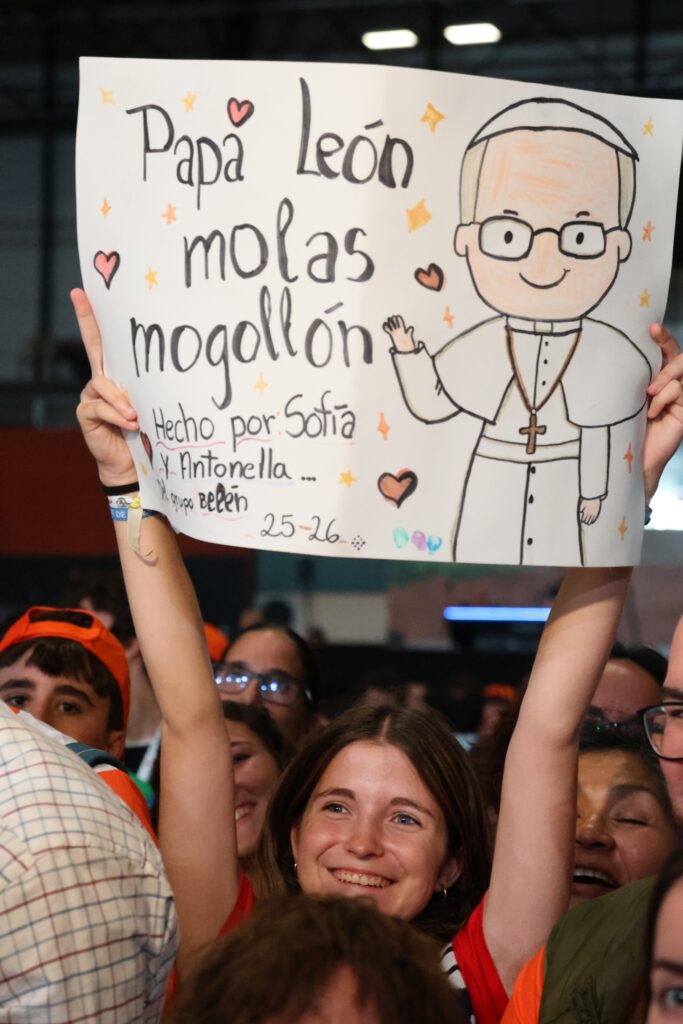
I look back with nostalgia and remember a kid yelling at a screen, well into the plot and enjoying what's going on there.

June 15, 2026-Reading time: 3 minutes

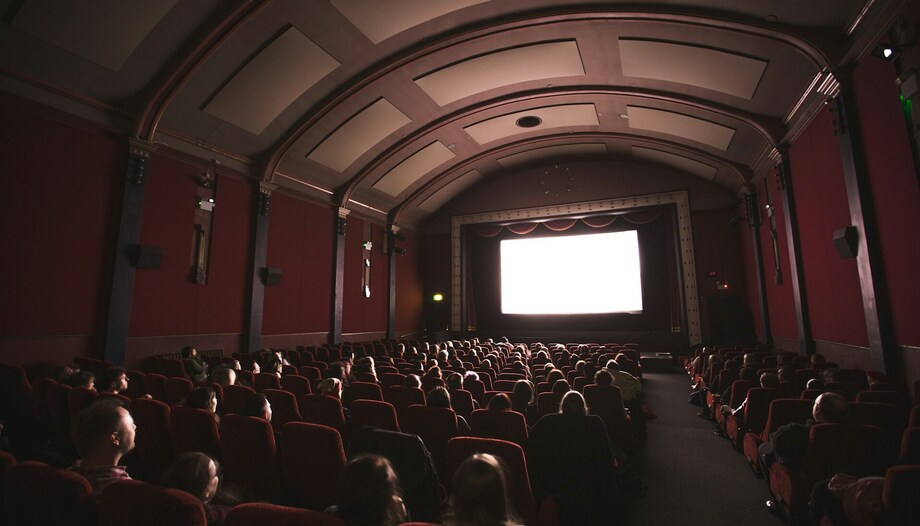
Technology acts as an extension of our capabilities, facilitating communication, learning and access to information. It has the potential to free us from tedious and repetitive tasks, allowing us to focus on creativity, empathy and social connection. If I want to go to the movies today, before I sit down in my seat I've already seen the movie trailer (and I think I might like it, so I go), I've bought tickets online, and I've even chosen the row of seats I like best. I have also been able to choose a more or less comfortable chair. My doubt comes when I do not see that this extension of my capabilities that technology offers me goes hand in hand with a greater humanity when it comes to relating to others.

When I was little, on Sunday afternoons, my father would take the four of us to the movies. We would watch two movies in a row to spend the afternoon at the parish movie theater, which was a huge theater that was packed with children. I remember that, in that crowded theater, there was no absolute silence: popcorn, chocolate cakes, jelly beans were eaten and strawberry or chlorophyll chewing gum was chewed. People also drank through straws, making a corresponding noise as they sipped. In the bar there was also a water jug with water. People talked loudly, laughed loudly or cried. Spectators got up to go to the bathroom, making a whole line stand up. There was no respect for strict silence and we spectators assumed it; it was part of the experience. That was the way it was and nobody in those days (I'm talking about more than forty years ago) could think that it could be otherwise.

Another characteristic of going to the movies in the eighties was that people would comment with the person in the seat next to them about aspects of the movie they didn't understand or they would tell each other “what had happened” in those minutes they hadn't seen when they went to the bathroom (watching two movies in a row is almost five hours). You could also hear the snoring of someone bored who had decided that this was a good place and time to take a nap. And there could be the case of a passionate person shouting to the protagonist of the movie on the screen to be calm, and that nothing bad was going to happen to her. “Calm down, now the boy is coming to save you”, shouted the little boy referring to the boy in the movie, without thinking, not even remotely, that he could be rude shouting like that.

Today these things are inconceivable, but others happen like phone calls or people who decide they read the newspaper on their screen while watching the movie at the same time. People who can't be relaxed watching a movie without checking their WhatsApp messages. The theaters are less crowded and no one watches two movies in a row in one theater, just as no one sucks through the straw making a lot of noise (what kid hasn't done that?). I look back with nostalgia and remember a kid shouting at a screen, well into the plot and enjoying what is happening there. Going to the movies was to get into a story and escape. Only a few families had television.

When yesterday, next to my seat, I see a guy reading messages and the newspaper on the screen of his cell phone and at the same time he is following the movie, I would like to go back to those cinemas of the eighties full of life, when at the end of the movie you could not get up because an invisible nail had fixed you in the seat and you left the theater commenting with your friend the things that had caught your attention and thinking that you would love to see it again, while someone you do not know is listening to you and thinking that the same thing has happened to him as it happened to you. In the end I notice that, although in the past I wouldn't have been able to get a ticket online, we established more human relationships when it came to this activity.

A balanced use of technology is the key, as overuse can lead to dehumanization, sedentary lifestyles and social disconnection. In fact, I feel very bad when, when asking someone a question, sometimes they don't even make the effort to think and search in their mental attic for something to answer you, but just blurt out: “Google it”. I miss, then, the excited child who shouted at a screen.

The authorMiriam Lafuente

The Vatican

Pope at the Angelus: “God bless Spain always!”

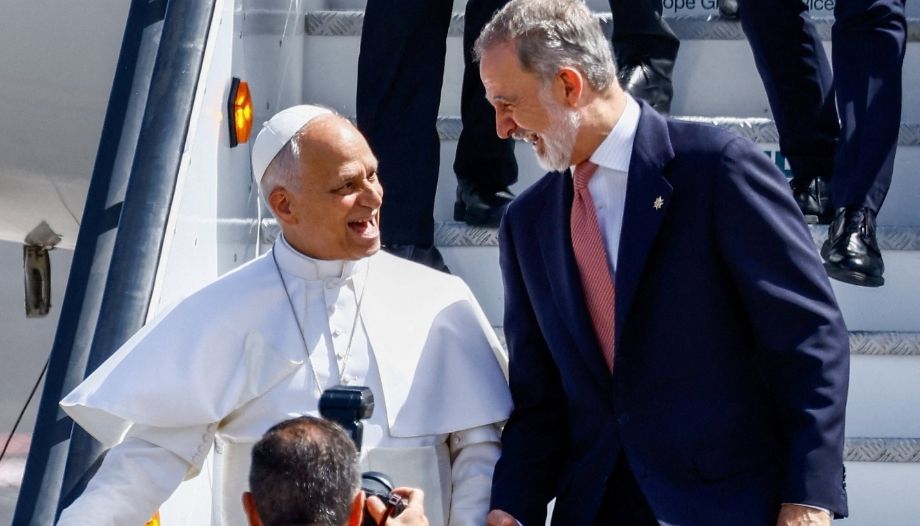
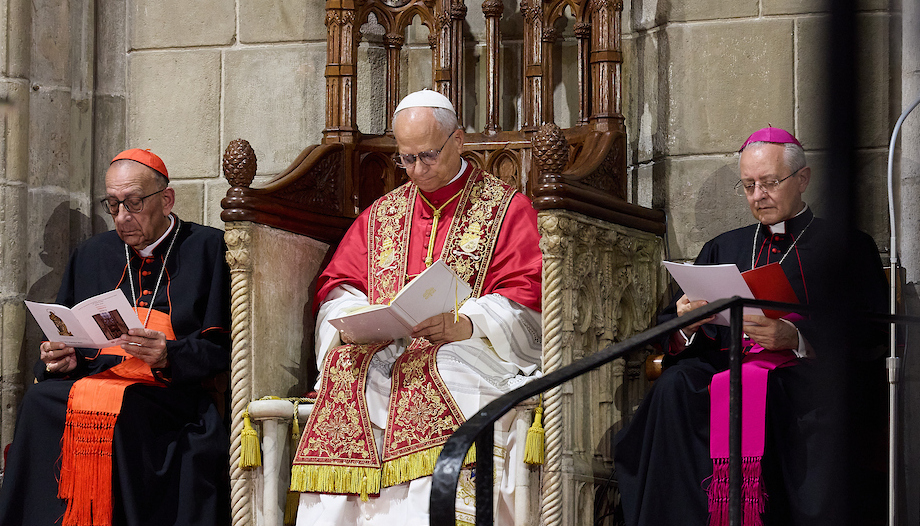
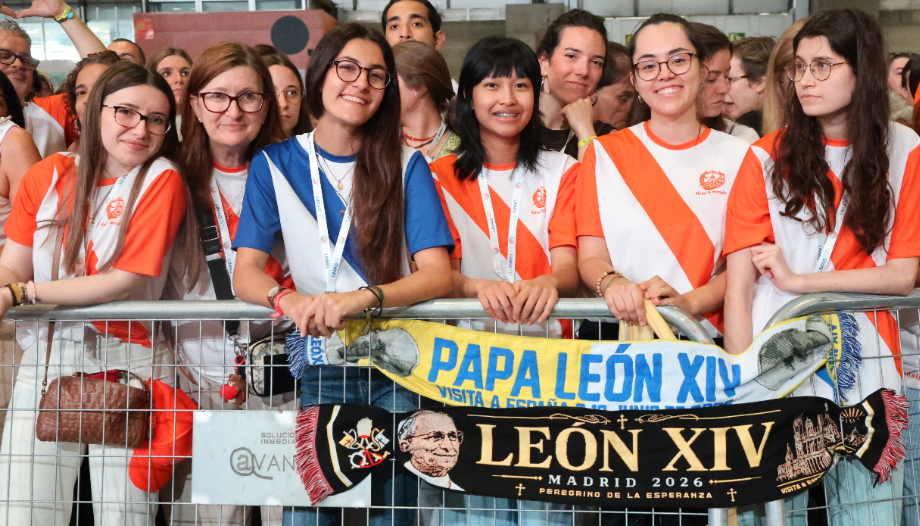
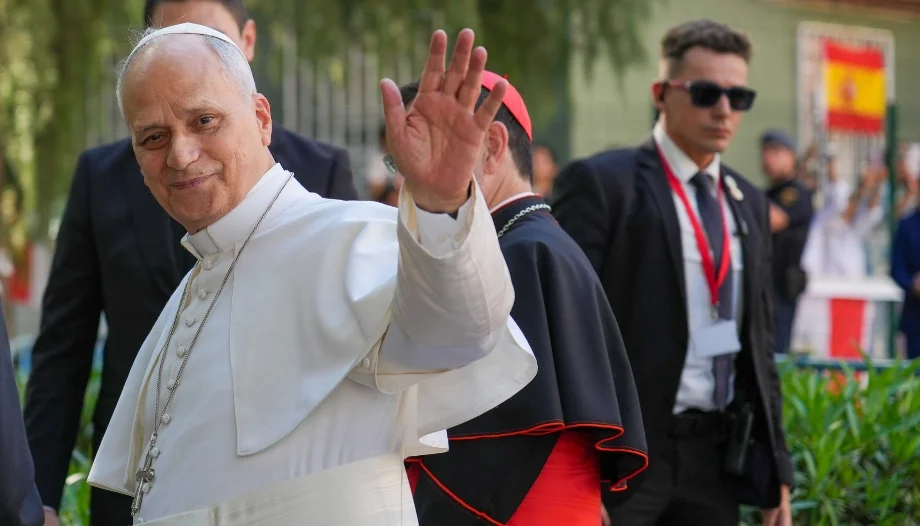
Leo XIV thanked the Lord at today's Angelus for his apostolic journey to Spain, and “the Spanish people, who received me with great enthusiasm and devotion. And he addressed in a special way His Majesty the King, the bishops, the communities he visited ”and the whole Church in Spain. May God always bless Spain!.

Editorial Staff Omnes-June 14, 2026-Reading time: 3 minutes

Pope Leo XIV has expressed his gratitude to the Lord and to the Spanish people for the apostolic journey from June 6 to 12 to Spain, in the Àngelus of this XI Sunday in Ordinary Time.

Before Romans and pilgrims from various countries who displayed banners and slogans, some of them Spanish, like a large group of nuns, the Pope thanked the trip in an affectionate and special way “to His Majesty the King, to the bishops, to the communities I have visited, and to the whole Church in Spain. May God always bless Spain,” he said after praying the Marian prayer of the Angelus.

New blessed martyrs, victims of totalitarian regimes

The Holy Father then recalled some of the newly beatified: the diocesan priests Wenceslas Drbola and John Bula, from Moravia; and John Šwierc and eight companions, Polish Salesian priests. All have been beatified as martyrs because they were victims of persecution by totalitarian regimes for their fidelity to Christ, the Pontiff noted.

Yesterday in Mato Grosso, Brazil, Nazareno Lanciotti, a Roman missionary priest, was beatified, “also a martyr, because in the name of the Gospel he defended the poorest. May the example and intercession of these courageous witnesses sustain the mission of priests and of the whole Church.

Proximity to the Philippines and other greetings

The Pope also showed his closeness to the people of the Philippines, affected a few days ago by a strong earthquake. I pray for the deceased and their families, for the injured and for all those who suffer because of this calamity.

He greeted the Romans and pilgrims from various countries, and in a particular way the members of the International Commission for Dialogue between the Disciples of Christ and the Catholic Church. “May your reflections help us to grow in communion”.

He also addressed pilgrims from the United States of America, in particular the faithful of New Jersey and the Carrollton School of the Sacred Heart in Miami, Florida, and various Italian groups.

Jesus had compassion on the multitudes

In his brief address, the Successor of Peter referred to today's Gospel (Mt 9:36-10:8), in which Christ “when he saw the crowds, he had compassion on them, because they were weary and desolate” (v. 36). 

The Son of God looks at people, he looks at humanity: he sees the oppression that crushes and the violence that takes away strength. He sees the wounds of wars and the emptiness of consumerism. He sees faces reduced to masks, families broken by evil and young people deluded by false ideals, the Pope said.

“Jesus sees and loves. He loves and suffers for us, with us: his compassion expresses not only fraternal closeness, but the will of redemption. 

Indeed, He knows our heart and cares for it; before so many people who seem to be “sheep without a shepherd” (v. 36), Christ dedicates Himself to all of them as a good shepherd and, as Lord of the harvest, sends out laborers into the field of the world (cf. v. 38)”.

What is the work they must do, he asked. His answer was: “To bring the consolation of God to those who suffer: to bring charity where there is misery, hope where there is affliction, faith where there is distrust”.

To the Virgin Mary: may we respond with joy and courage to the mission.

Jesus“ gaze transforms reality: filled with love, his initiative gives life to a new people, the Church, which is called to continue the mission of the apostles: ”Freely you have received, freely give“ (v. 8). Yes, the gift of Jesus is totally free, because its value exceeds every measure: it is impossible to deserve it or ”buy it," the Pope continued.

“Dear brothers and sisters, the task of evangelization is born of the gift of God that in Christ becomes forgiveness for the world, service to the least and the poorest, commitment to justice. Let us ask for the help of the Virgin Mary, full of grace, so that we may respond with joy and courage to the mission to which Jesus calls us,” he prayed in St. Peter's Square before thousands of pilgrims.

The authorEditorial Staff Omnes

ColumnistsAlmudena González Barreda

The paradox of care and a solution 

Europe is facing a demographic crisis due to the invisibility of family care in its economy, penalizing those who support society for free. The solution requires recognizing this value through tax and pension reforms.

June 14, 2026-Reading time: 3 minutes

Europe is undergoing one of the most profound transformations of its recent history: the demographic winter. The birth rate is below replacement level in most European countries, the population is aging rapidly and there are fewer and fewer workers to support pension systems designed for a social reality that no longer exists. Some governments are looking for solutions and migration policy seems to be accepted by leaders, but they rarely ask themselves whether the problem is not to be found in the very economic and cultural architecture on which our societies have been built.

For decades we have designed the economy as if care were an inexhaustible resource. We have assumed that there would always be someone willing to raise children, care for the elderly, support the sick and care for dependents. However, that which sustains has never found a place in national accounts, in quotation systems, or in metrics of economic success. The market has constantly needed care, but has treated it as an invisible reality.

The GDP paradox

The consequence is a paradox that is difficult to ignore. Societies need children to guarantee their future, but economically and professionally penalize those who have them and raise them, mainly their mothers. People are needed to take care of the elderly, but at the same time the time dedicated to accompanying them is considered unproductive when it is a child who does it. Society needs families capable of sustaining stable ties and support networks, but the State, institutions and companies organize work as if these responsibilities did not exist.

Care is not a problem to be solved by the economy, but the precondition that makes any economy possible. Without people dedicated to others, there are no workers, consumers, taxpayers or citizens. However, those who perform this work within the family continue to bear economic, labor and social security costs that are rarely recognized.

Women occupy a central place in this reflection, although men are gradually entering this field. Over the last few decades, women have conquered practically all the educational, professional and economic spaces that were historically denied them. This progress is one of the great social transformations of our time. However, precisely because women have conquered these spaces, it is also necessary to recognize those who continue to sustain life through care, upbringing and family accompaniment.

Valuing motherhood

Recognizing this reality does not mean reducing motherhood to an economic function or confining women to a specific role. It means admitting that engendering, raising and sustaining a family generates a social value from which parents, the State and society as a whole benefit. In the same way, accompanying parents in old age, caring for the sick or being present when vulnerability arises is an indispensable contribution to social cohesion.

In fact, when such care is provided by outside professionals, it immediately appears in the GDP and has a market price. However, when it is performed by family members out of love, responsibility or commitment, it disappears from the statistics. The paradox is evident: that which is essential for the survival of society becomes invisible precisely because it is free of charge.

It is not a question of questioning the work of professional caregivers, whose contribution is valuable and necessary, but of recognizing that there are forms of care, presence and dedication that can hardly be completely replaced by an employment relationship. There are situations that demand more than technical competence: they require time, affection, availability and, on occasion, the giving of an important part of one's own life.

Let's talk about social justice

Protecting the care of family, relatives and the community is neither a concession nor a privilege.

If the system benefits from entire generations of people who dedicated years to raising children or caring for dependents, it is reasonable that it recognizes these contributions through appropriate fiscal, labor and pension mechanisms: pension systems that adequately account for the years dedicated to caregiving, labor markets compatible with non-linear family trajectories, recognition of the so-called “biographical debt” accumulated by those who sacrificed professional opportunities to support others, and an economic culture that no longer considers unproductive anything that does not generate immediate benefits.

Treating care in this way, from all points of view, including the economic one, is justice.

Europe's demographic winter is forcing us to rethink many certainties. Perhaps the solution lies not only in encouraging births or increasing public spending, but in recognizing what has always been silently sustaining our societies: if we want more children, more social cohesion and more welfare for our elderly, we must stop treating care as a marginal reality and start including the caregiver, also when it is the father, the mother, a child or a sibling, in the national accounts.

It is time to put care at the center and recognize that the wealth of a society is not only what appears on its balance sheets, but also what is born from the people who care for, accompany and sustain the lives of others.


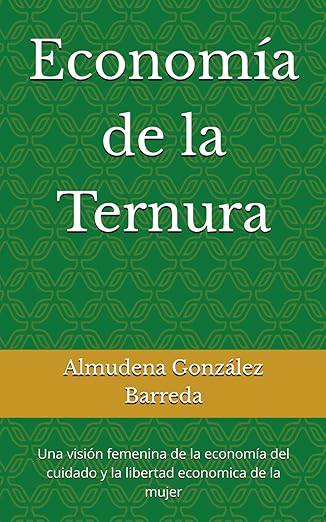
Economy of Tenderness: A feminine vision of the care economy and women's economic freedom.

Author: Almudena González Barreda
Editorial: Amazon
Year: 2026
No. of pages: 103
The authorAlmudena González Barreda

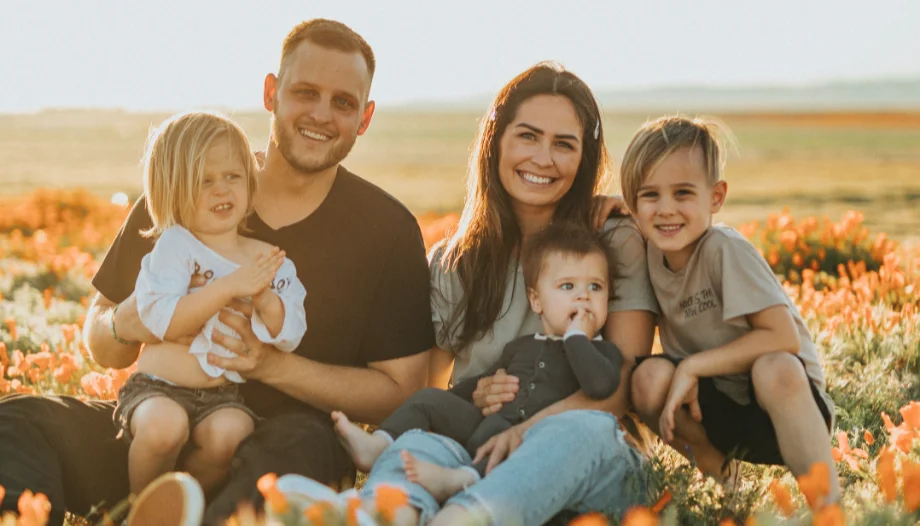
Journalist and mother of three children.

Lower your eyes

The papal trip has watered the furrows, but it is now up to us to enter in droves to sow and care for the land entrusted to our care.

June 14, 2026-Reading time: 3 minutes

After a week of raising our gaze following the invitation of Leo XIV during his visit to Spain, the time has come to lower it, to return to reality. It is in our hands now that this enormous effort of the Holy Father and the organization has been worthwhile.

Because, in the face of the unquestionable success of the event, the overwhelmingly positive response of society or the spectacular figures of participation in the events, we run the risk of remaining there, immobile, hallucinated by what we have experienced. Today I want to dress in white, like those two men in the book of the Acts of the Apostles who stood before the disciples when they were astonished, staring at the sky after the Ascension of the Lord, and said: «You (Spanish) Galileans, what are you doing standing there staring at the sky?.

Leo XIV's journey will undoubtedly be a monumental boost to the Church's mission, but we will no longer have him. His passage through Spain has been like the passage of the plow through a land hardened by our fears and sins. The papal trip has watered the furrows, has evened the clods, his drizzle has left them soft, but now it is up to us to enter in droves to sow and to take care of the land entrusted to us. And we have to do it with the keys that he has left us and that I would summarize in five.

First of all, let's take advantage of the «goal for good» to which the Pope referred to at the Bernabeu. Let us manage this goal well, let us rationalize the euphoria because the game is long. Many have changed their perspective of the Church in these days, there is a greater sensitivity towards the spiritual, the distant have felt a little closer, the close have felt stronger and united, many others who had not even heard of the possibility of a friendship with Jesus today do not see it as something far-fetched. Let's not wait for the next goal against us, which will come, let's run for another goal that will allow us to keep the advantage. And let us do it with the keys that he has reminded us of: a synodal Church, open to listening, not closed in on itself, and dedicated to the service of the poor and needy. 

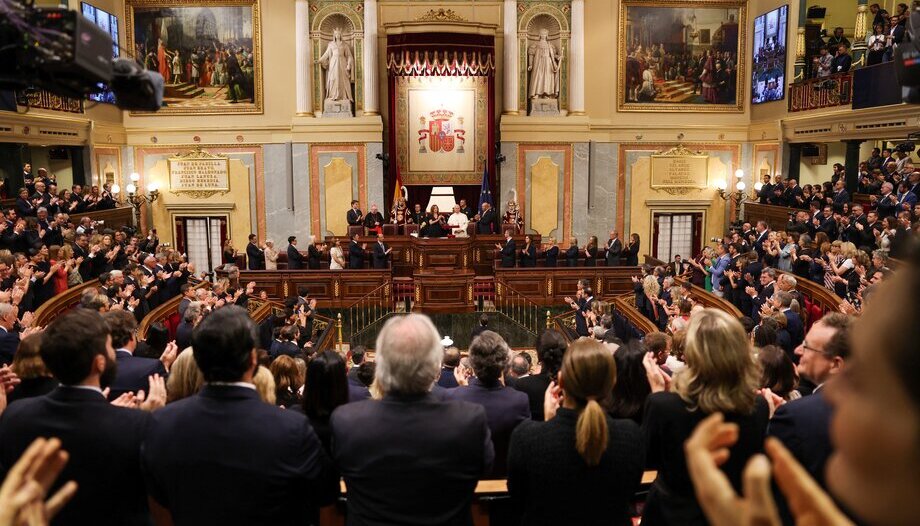
Secondly, to put forgiveness, dialogue and social friendship into practice. «A Church reconciled within can speak with greater freedom,» he reminded the bishops in his meeting with them at the EEC. Communion is a fundamental part of the mission. The Church that evangelizes the most is not the most traditional or the most progressive, but the most united, in the plurality of charisms. And as a society, we are also called to take great steps towards reconciliation, recovering dialogue, avoiding polarization, seeking what unites us, which is much more than what separates us. The seven minutes of applause for the Pope in the Congress was an example that common sense can bring us together beyond our ideological differences, however great they may be. 

Thirdly, attention to the dramas of our time. The service to the world of pain, migration, prison or violence against women is not an addition to the mission of the Christian, because the exercise of charity is not the fixation of some, as he pointed out in the meeting in the «Cedia 24 hours» project of Caritas, but «the incandescent core of the ecclesial mission». In the port of Arguineguín he reminded us that «the disciples of Jesus cannot consider the cry of those who cry out in the night as alien» nor «can we get used to counting the dead». And in Tenerife he invited us to imitate his prophetic cry against those who traffic and exploit migrants, shouting also we in our environments: «Stop! Convert!». It is about seeing Christ himself in the stranger who arrives in our country and «who needs to be welcomed, protected, integrated and promoted». 

Fourthly, to foster the dialogue of faith with culture, art, science... «In this time of the image, it is even more evident how art and beauty are eminent channels of evangelization,» said Leo XIV in his homily at the impressive inauguration of the tower of Jesus Christ of the Holy Family. We have had much music and art in this visit, let us continue to give voice to the artists who will undoubtedly find, in God, the source of their inspiration. Faith has much to contribute to the world of economics, sports, thought, because nothing human is alien to us.

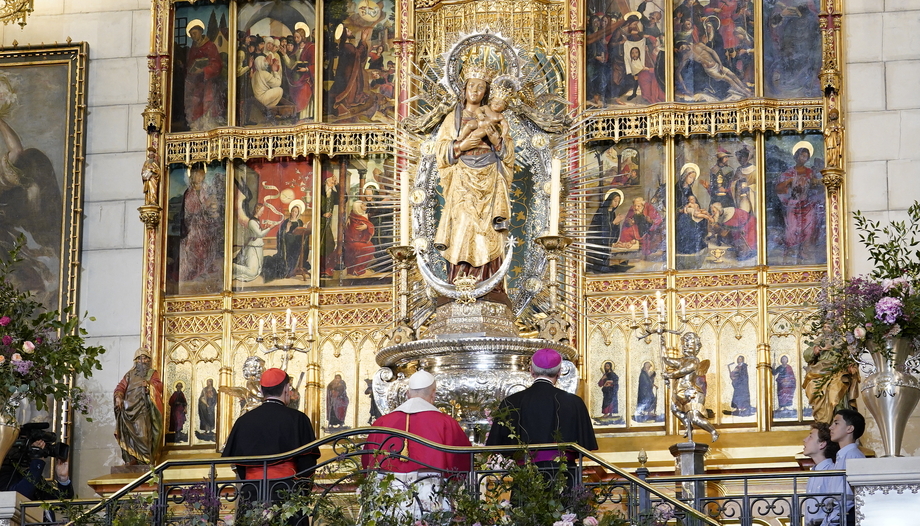
Finally, to do so hand in hand with Mary with the teaching she left us in her homily in the Cathedral of Madrid: «The Almudena tells us that to build something new, beautiful and lasting, we must be willing to destroy the walls» (the image was found when part of a wall was torn down). And the fact is that -he explained- although «at first, a falling wall causes noise, chaos, disorder; it also opens spaces, restores possibilities and promotes reestablishment». Let us not be afraid, therefore, to tear down structures that no longer serve us and let us rebuild again and again the Church that, like Gaudi's Holy Family still under construction, reminds us «how Christian life is always a journey, because it is a project that God carries out». 

The authorAntonio Moreno

Journalist. Graduate in Communication Sciences and Bachelor in Religious Sciences. He works in the Diocesan Delegation of Media in Malaga. His numerous "threads" on Twitter about faith and daily life have a great popularity.

Evangelization

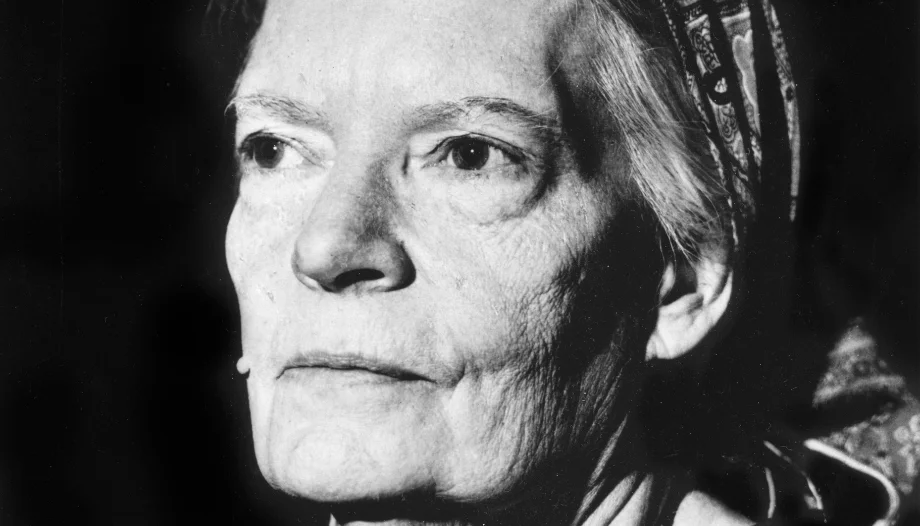
Dorothy Day: God's Anarchist

From militant socialist and anarchist to a reference point for American social Catholicism, Dorothy Day embodied an uncomfortable and radical faith that united contemplation, commitment to the poor and resistance to the dominant culture.

Gerardo Ferrara-June 14, 2026-Reading time: 5 minutes

Some time ago, we dedicated an article to the figure of Flannery O'Connor, who has always been a great inspiration to me. Later, while reading the works of Thomas Merton, I stumbled upon an essay by Paul Elie entitled The Life You Save May Be Your Own: An American Pilgrimage. In it, Elie draws a parallel between four central figures in 20th century American “Catholic” culture: O'Connor, precisely, Merton, Walker Percy and Dorothy Day.

I wrote “Catholic” in quotation marks because Flannery O'Connor, as well as the other authors cited, including Dorothy Day, would be better suited to the literal meaning of the term: “universal”. They present themselves, in fact, as artists and thinkers who speak to all men and women of this world, and they do so as simple men and women endowed with genius and talent, free from any other label of religious or political affiliation.

In his essay, Elie highlights how, although they did not form a group or a school among themselves (as was the case with Chesterton, Belloc, Lewis and others in England), they shared four fundamental aspects:

  • Consider life as a pilgrimage.
  • The vision of a faith that does not simplify but unsettles, that wounds before liberating (the grace that breaks into the flesh).
  • The juvenile reading of Jacques Maritain.
  • To be “apostles” of this grace in a secularized culture, each in his own way: Day with social commitment, O'Connor with literature, Merton with contemplation and Percy with philosophy.

A life full of contrasts

Dorothy Day used to repeat to those who defined her as a saint: “Don't call me a saint. I don't want to be dismissed so easily”, that is, “Don't call me a saint. I don't want to be dismissed so easily”. It is a phrase that encapsulates not only all its complexity, but also the saints“ view of sainthood. It also represents a certain ”embarrassment" with which she is spoken of in ecclesiastical circles.

Dorothy Day was born in New York in 1897, in a bourgeois Protestant family. From a young age she embraced atheism and radical socialism, frequenting anarchist environments and writing for left-wing newspapers, in a path very similar to that of her French counterpart Madeleine Delbrêl.

Her private life was marked by experiences that many would define as disordered, some traumatic such as an abortion. From her relationship with Forster Batterham her daughter, Tamar, was born in 1926.

Conversion to Catholicism

That grace that bursts «into the devil's territory» burst into Day's life precisely with the birth of this child, which confronted her with great existential doubts. Dorothy wanted Tamar to be baptized and realized that she too wanted a «home» to return to. In 1927 she received Catholic baptism. That decision led her to break with Batterham, hostile to any form of religiosity, a separation that Day described as «the most painful thing she had ever done.».

Dorothy Day's conversion is a complex and controversial issue, but isn't every human life with its myriad facets?

Undoubtedly, the birth of her daughter was the existential casus belli. Dorothy claimed that she could not keep her daughter away from God, but her path of drawing closer to the Christian faith, and to Catholicism in particular, had already begun. In particular, even before the child's birth, Day frequented the Catholic churches in the poor neighborhoods of New York, not so much for faith as for the atmosphere there. The sense of the sacred, the incense, the dim light, the candles and the liturgy with Gregorian chant impressed her so much that she even wrote that at that time she knelt and prayed without knowing to whom.

Those same churches were, unlike those of the Protestant bourgeoisie, in the front line when it came to helping the poor and the many Irish and Italian immigrants in the Big Apple, in that social commitment that mattered so much to him, but which was no longer enough to soothe his sense of «long loneliness», a loneliness that not even friends, romantic love or political activism had been able to fill.

In addition to the beauty of the liturgy and the closeness to the masses, what influenced Dorothy most in her choice of Catholicism was its sacramental tradition, especially the Eucharist as a real presence and not a mere symbol.

Pope Catholic Worker and the influence of Maritain

In 1933, Dorothy Day founded, together with Peter Maurin, the Catholic Worker, a newspaper that was sold symbolically at a penny a copy, which still exists and which, at the same symbolic price as then, sells 80,000 copies today.

The objective was already clear from the name of the newspaper: the defense of the interests of all workers, not as a Marxist invention, but as an evangelical idea.

In this, Day and Maurin were deeply influenced by Jacques Maritain (1882-1973), a French philosopher converted to Catholicism and leading Thomistic thinker of the twentieth century, whose work focused on personalism.

Maritain, in fact, was Dorothy's contemporary and befriended her during the long period he spent in the United States.

In Integral Humanism (1936), Maritain argued that modern humanism had erroneously separated man from God and proposed a third alternative way to socialism and capitalism, for a just society based neither on the State nor on the individual as consumer, but on the person, understood as a free being open to transcendence.

In addition to founding the newspaper, Day and Maurin created the Houses of Hospitality, shelters for the poor, unemployed and homeless in large American cities, precisely in that spirit of corporal mercy that is not welfarism, but fraternity.

Peter Maurin, for his part, was also deeply influenced by distributism, the socioeconomic theory developed by Gilbert Keith Chesterton and Hilaire Belloc, to which we devoted an article in this issue. previous article.

The Catholic Worker Movement, a movement that arose precisely from the commitment of Day and Maurin, was later characterized by its absolute pacifism. Dorothy Day, in fact, was strongly opposed to World War II and, for this reason, earned the antipathy of many, including Catholics, and was even arrested on several occasions for her non-violent protests.

Her position remains difficult to classify politically: anarchist but Catholic; radical but not Marxist; pro-poor but against abortion, which she herself had experienced firsthand.

Literary works: writing as an act of faith

Dorothy Day was not only an activist: she was a writer, and her writing was inseparable from her faith and commitment. Among her major works is the spiritual autobiography The Long Loneliness (1952), in which she narrates the existential drama of her own life, marked first by the loneliness of a man without God and then by that of a man who has found God, but whose path must sometimes continue even in the dark, as John Henry Newman would say.

Also worth mentioning Loaves and Fishes (1963), a history of the Catholic Worker Movement told from the inside, and the posthumously published diaries, which are valuable for understanding the inner life of a woman who never separated thought, faith and action.

A highly topical figure

Dorothy Day is, paradoxically, an American response to the current debate. President Trump and Catholic politicians such as Vice President Vance have found themselves in open opposition to Pope Leo XIV, the first American-born pontiff in history, on issues such as migrants, war and rights, but above all on two concepts: «unarmed and disarming» peace, at the center of the new pontiff's preaching, and hope understood as «taking a stand.».

Precisely in this regard, Leo XIV defined Dorothy Day as «a great little American woman who [...] saw that her country's development model did not create equal opportunities for all. She understood that the dream was a nightmare for too many people, that as a Christian she had to commit herself to the workers, to the migrants, to those marginalized by an economy that kills. She wrote and served: it is important to unite mind, heart and hands».

The cause for the beatification of Dorothy Day was initiated by John Paul II, but it is advancing extremely slowly precisely because of those vicissitudes that marked Day's life, from abortion to cohabitations and the «irregular» life prior to her conversion.

Perhaps, however, all these stages are precisely the sign of that grace that breaks into the territory of the devil, so dear to Flannery O'Connor, and that leads not to disavow darkness, mistakes and pain, but to integrate them into one's spiritual narrative as part of a path common to all human beings: a concept that, at times, is not easy to propose and understand when one desires an immaculate Christianity and a Church composed only of the pure.

ColumnistsJosé María Maldonado Casado

«Alsa» the look!

On Leo XIV's trip to Spain some commentators said that Madrid provided the people, Barcelona the beauty and the Canary Islands the soul.

June 13, 2026-Reading time: 2 minutes

I am still very excited after seeing the Holy Father on my beloved island. After witnessing the magnitude of the events in Madrid and Barcelona, Thursday's Mass at the Gran Canaria stadium felt almost familiar.

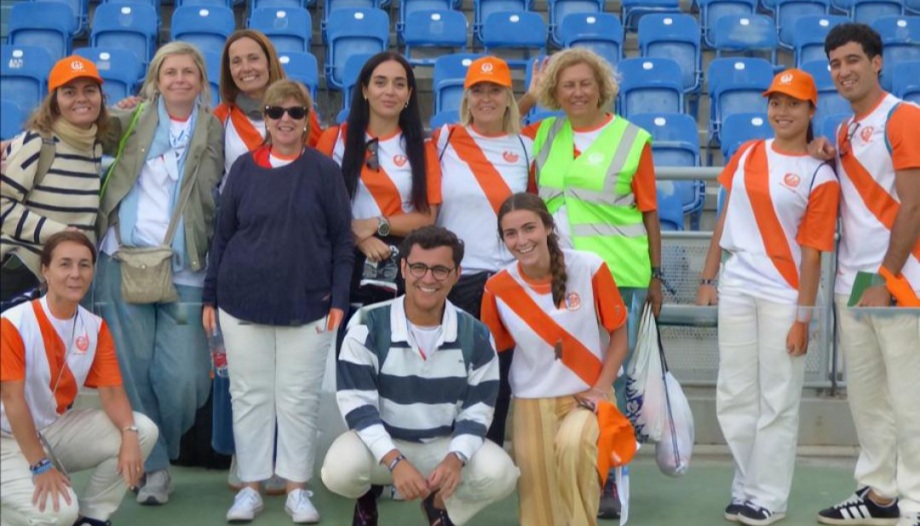
As volunteers, we were there from the morning and had the privilege of helping to prepare the chalice and the Pope's See. I met Monsignor Ravelli - master of ceremonies at the Vatican - and was able to explain to him our devotion to Our Lady of the Pine Tree.

In an event like this there are always many unforeseen events and a certain amount of tension. It so happened that I gave him the last booklet to follow the Mass for a lady and another lady who also needed it got annoyed with me. In her eyes there was a reproach (very canary-like, actually) towards the other lady and towards me. Minutes later, I returned with another copy that I had hidden. Looking at her, I said:

-Did you get a booklet yet?

-No," she said crestfallen.

-Alsa« the look,» I replied with a Canarian accent, while showing him the brochure.

She became happy and I was touched by the accomplice smile she shared with the other lady after the little «conflict of interest».

Helicopters arrived, snipers were posted on the balconies and the stadium was filled to capacity. When Leon XIV arrived, the roar was reminiscent of when UD Las Palmas goes up to the First Division (maybe next year). However, during the Mass, with the orchestra and the Canarian folklore, the silence was surprising -as in the Plaza de Lima, in Madrid- for a soccer stadium full to overflowing. For the people from Gran Canaria, being able to see next to St. Peter our beloved Virgen del Pino and the Santo Cristo de Telde was priceless.

In his homily, the Pope encouraged us to be more humble. He reminded us that the heart of Christ belongs to the simple and not to the know-it-alls, who, bewildered by an omnipresent «I», lack the silence necessary to listen to the heartbeat of love. The Holy Father insisted that true happiness does not consist in doing without others, but in «coming down from the arrogance that divides to find ourselves in the humility that makes us brothers and sisters». He concluded with a direct invitation to the heart:

«Where there is humility there is love, and where there is love there is peace. Only from humility can we love each other and find ourselves: to know who we are».

Surely we are not aware of all that the Pope has sown these days in Spain. Now it is time to reread his speeches and make them our own. And thus, as that lady did with an accomplice look, learn to make peace and let ourselves be surprised, as the Pope encouraged us from the port of Arguineguín:

«WHEN YOU ENCOUNTER DIFFICULTIES, LOOK UP».

The authorJosé María Maldonado Casado

4th year student of Law and Economics.

The World

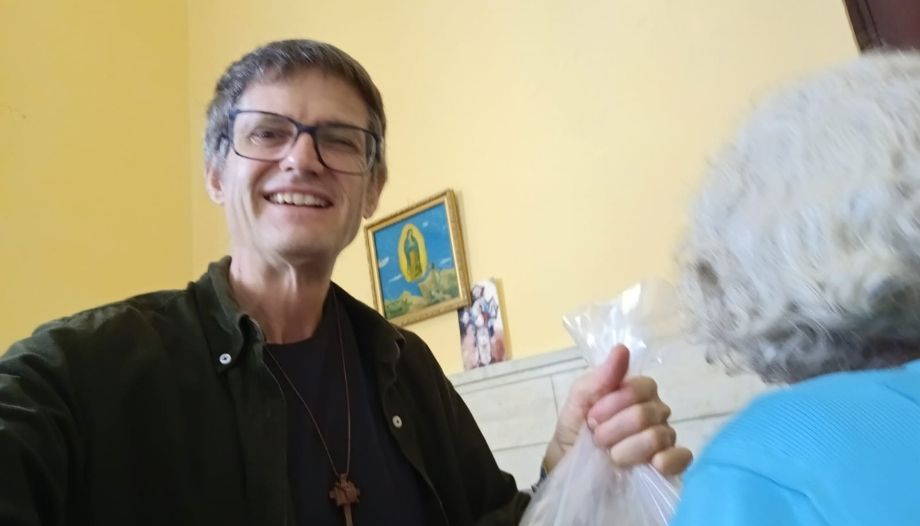
“Cuba is on the verge of collapse,” says Fr. Luis Reyes, an Augustinian priest.

Not so long ago, statements like those of missionary Fr. Luis Javier Reyes to Omnes were almost unthinkable. The Augustinian friar describes, from the neighborhood of Old Havana, the humanitarian collapse of Cuba, especially of the elderly, many without family abroad, and without medicine.

Francisco Otamendi-June 13, 2026-Reading time: 8 minutes

“Cuba is beginning to enter a phase of serious humanitarian crisis. A crisis aggravated not only by the economic blockade, but by a political blockade that from within does not recognize the collapse of things,” Fr. Luis Javier Reyes, OSA, told Omnes.

The friar Augustine, who joined the Order of St. Augustine in 1990 and has been a priest since 1997, has been in Cuba for a year and a bit, not a long time, but enough time to get to know the situation of the country and its people. The first thing he says is that “the fact that there are Augustinians in Cuba is due to the personal effort of Robert Prevost, now Leo XIV”.

Energy, food and health, especially for the elderly, take up most of the conversation. Many people, especially those without family outside, eat only once a day (some once a week), and outside Havana, there is only electricity for an hour a day, or two at most. And there is a lack of medicines, particularly mental health and the like.

Following Pope Leo XIV's recent Audience with U.S. Secretary of State Marco Rubio, the son of Cuban immigrants, the Vatican press office reported that “hot“ issues such as Cuba - in these days of high tension with the United States - were addressed, regarding which the need to support the Cuban people was reiterated“.

You are from Malaga, you have been stationed in Cadiz, Seville, 17 years in Portugal in a parish in the industrial belt of Lisbon. How was your arrival in Cuba?

- The Augustinians of Spain (Province of St. John of Sahagun), we are present in many places. When I arrived I found a diocese, the Archdiocese of Havana, which has many years, a whole history, few priests, we are in the neighborhood of Old Havana, although it is the center of Havana, are very unstructured neighborhoods, a community also very unstructured at the religious level.

You know you are going to a different place, to which you have to adapt, which has its peculiarities. There are some services in the city, but the deterioration can be seen at an accelerated pace. Eight months after arriving, I began to see things that I did not see when I arrived, in terms of misery, difficulties in day-to-day life, the price of things that skyrocket. 

There is galloping inflation, and right now working for the State solves fifteen days, no more, and I am referring only to being able to eat, no longer to buy shoes. 

The election as Pope of Cardinal Robert Prevost, an Augustinian, took place in May, a few months after your arrival in Cuba. A great joy for you.

- Yes, and especially here in Cuba, because when Pope John Paul II asked all the religious to come to Cuba, at the end of the 90's, when he made his visit, a first attempt was made from Spain, but the doors were closed to the Augustinians here, at the government level, and he was trying. He was General at that time, he started again the negotiations, and he managed to get us to come here. The fact that right now there are again Augustinians in Cuba is very, very, very much due to the personal effort of Robert Prevost, of Leo XIV.

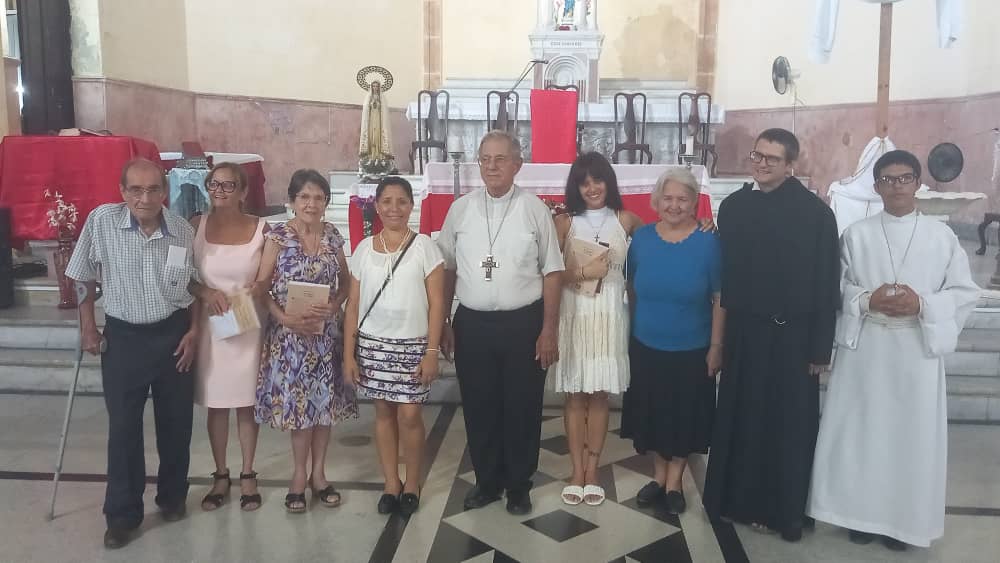
Confirmations in the parish on May 23rd. In the center, the Archbishop of Havana, Cardinal Juan de la Caridad. Luis Javier Reyes, in the habit, towards the right.

Are there other Augustinian missionaries in Cuba?

- I am currently alone in Havana, but there are other Augustinians in Cuba, specifically in Ciego de Avila, Chambas, where the Superior lives. It is a province in the center of the island, and there is a community that is completely different, in the countryside. The town of Chambas is well structured, and then they have many rural, agricultural communities. It is one of the few functioning camps in Cuba, Ciego de Avila.

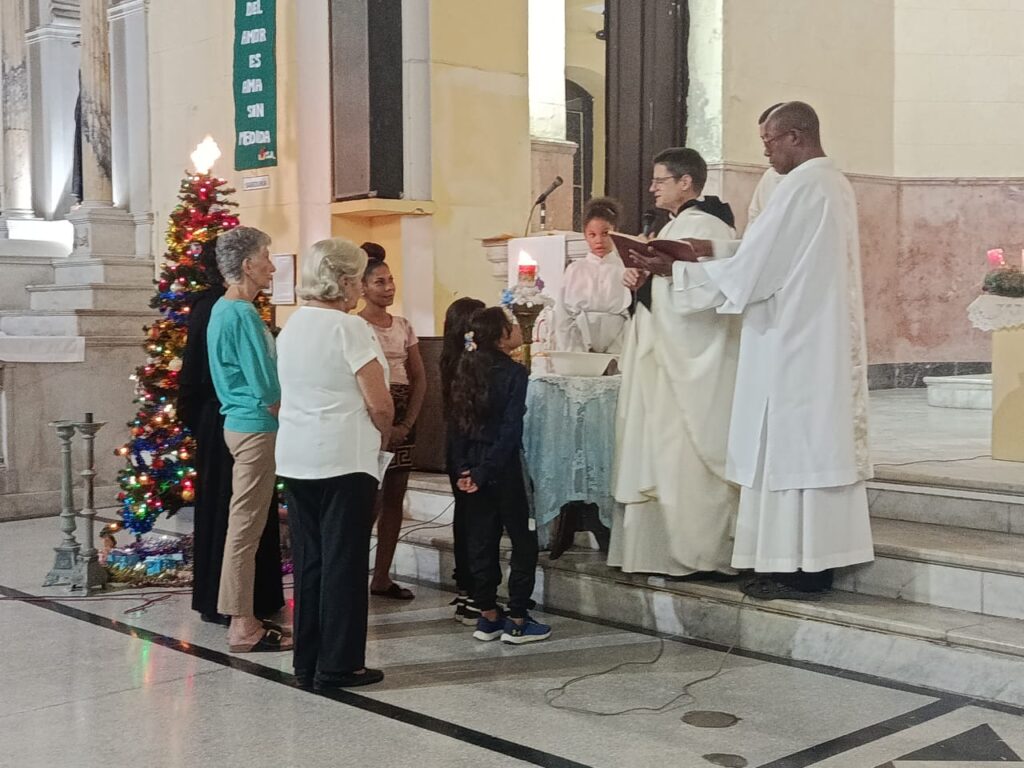
At a baptism, last Christmas, in the same parish.

The news that reach us are children without food and school, lack of fuel for buses, ambulances or garbage trucks, electrical blackouts, a lot of unemployment. Tell me...

- There are now two things here. On the one hand, the energy blockade to which the United States is subjecting Cuba. But before that, there is the fact that there is no fuel, or very little fuel. You go to Havana and you see very few -electric- cars circulating, even before that. 

And many, many hours of blackouts. Here, in Old Havana, we have two very good things: one, the electricity is underground, so there is light almost every hour of the day, which is only available in the event of a breakdown or when it is removed from one area and put in another. And two, the gas by conduction, that is to say, one has gas in the kitchen. Here there is a lot of electric cooking, it was promoted a lot in the 90's, even then there were electricity problems.

In Chambas, on the other hand, it is very difficult to contact them, because right now they have two hours of electricity. Or one. Just yesterday I was talking, and they had only half an hour all day.

In almost all the bars in Havana, except for two or three, gas is supplied by gas cylinder. For years, the distribution of gas cylinders has been controlled, and one or two per family, etc., are allocated per year. Now it is not available, only on the black market at exorbitant prices. And lately not even on the black market. It is practically no longer available. 

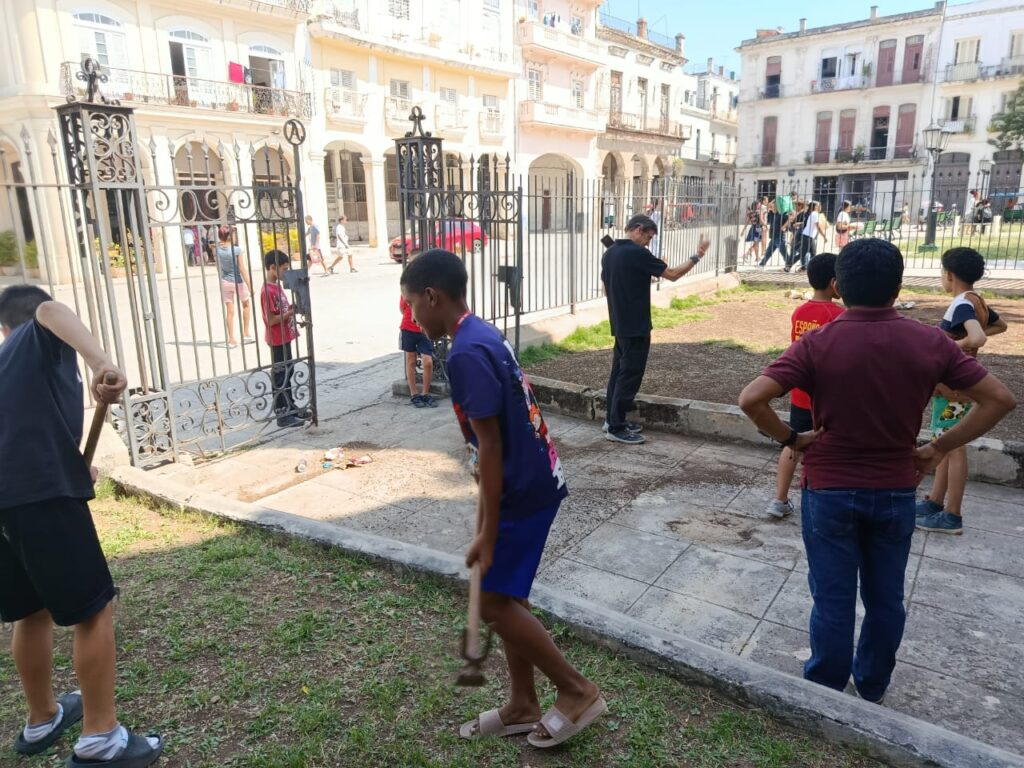
Frs. Luis and Roberto, fixing up the church garden with volunteers. The Augustinians accept the children from the plaza because it is a way for them to do something together, and they can show the results of their work, says Fr.

Can it be said that the farther one moves away from Havana, the fewer hours of electricity?

- Yes, as There are many power cuts, you can say that the farther away from Havana, the less electricity. Because many people live in Havana, and in order for people not to go out on the streets, as they are doing now... When I arrived, the electricity was out for 4 to 6 hours a day. With the existing data, in Havana people are having 4 to 6 hours of electricity a day, and outside Havana, one or two hours a day, no more. And that's when you have to put in for washing clothes and for cooking, those who have electric stoves.

In the countryside, outside Havana, firewood is easy to find, charcoal is more complicated, but in the city of Havana, the price is very expensive, and in a house, a person stands by the window or balcony to cook.

People tend to reduce meals. Adults start eating a loaf of bread with something at noon for lunch, and eat only dinner at the end of the afternoon. They want the children to always have lunch, but here, in the neighborhood of Old Havana, adults are on one meal a day, but not because they can't cook, but because the price has gone up so much that it is not possible.

You are talking about a serious humanitarian crisis, aren't you? An emergency situation.

- Yes, the economic issue here is in many cases an emergency. There are many people who have help from abroad, because they have family abroad, they manage to get by, more or less, and with difficulties. Let's think that most Cubans living abroad do not have big salaries, but here with 5 dollars a week you can provide food for 4 people. Now less, they have to send more. 

We are getting to the point of an emergency. The other day we had a meeting in the diocese. And on the issue of social pastoral, the main concern in almost all the parishes is to maintain, with volunteers, a dining room where there are people who can have at least one heavy meal a week. It continues to be a matter of concern.

The Church does not currently have a sufficient network to support all those who will eventually run out of means. 

The humanitarian food problem can be very serious if it is not addressed quickly, especially quickly.

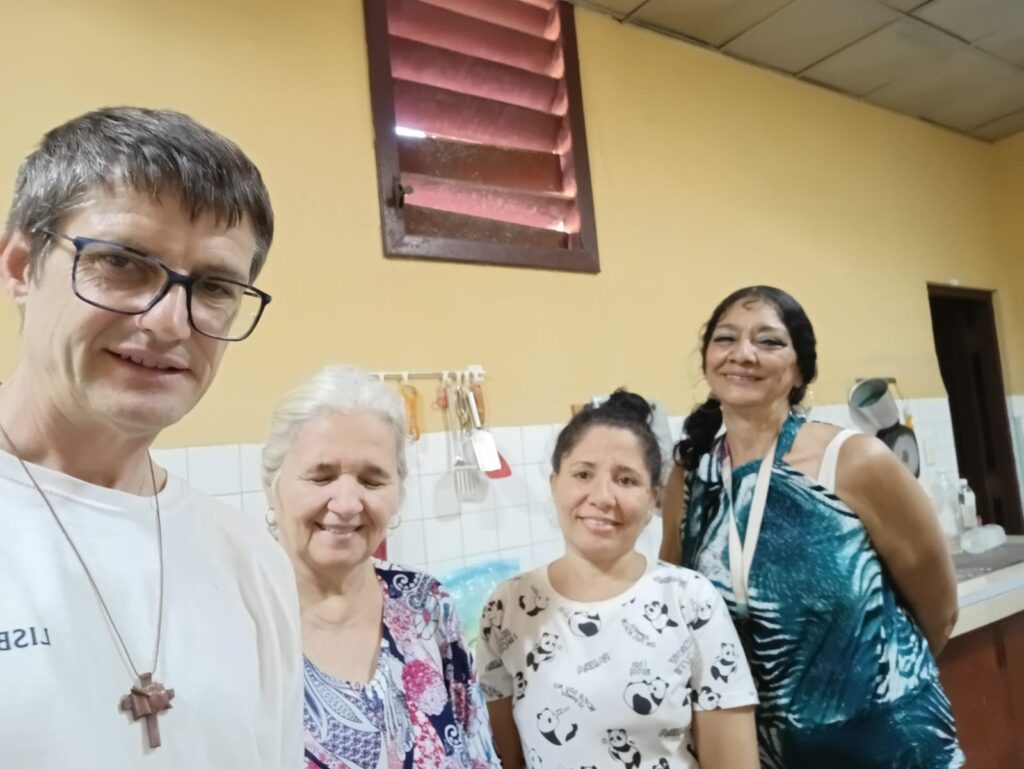
Reyes, with volunteers who make lunch on Saturdays for 35 people.

Is there a diocesan Caritas? You have a parish in Havana. 

- Yes, we are here in Old Havana, our parish is called El Cristo del Buen Viaje. There is a diocesan Caritas. But since the pandemic this help from within has become unfeasible. The purchasing power of many people has collapsed. There are a few people with a lot of money, some are owners of small businesses, but the majority of the people are getting poorer by leaps and bounds, very quickly.

What are the most pressing needs of the people, in addition to those mentioned above? There should be some channel to help...

- It is difficult, because at the official level, Cuba has no needs, the Cuban government does not have them. Any help that could come from any government, for example, in medicines, especially those related to psychiatry, mental health, could solve many needs and would do a lot of good, but... There are many patients with schizophrenia and other diseases that are untreated. And they are a problem for them, and also for the physical security of the family that accompanies them, because they are without medication.

Here, the people who are having the hardest time are the elderly who have no family outside, who live in a small house, and for whom a pound of rice - 460 grams - is now costing between 280 and 300 pesos, not to mention a pound of meat, that is unthinkable. They cannot even live on rice. This is what feeds the most.

How are the ecclesial communities in Cuba. And the total population of the country

- In the Church The communities are very small, because here there has been a very strong emigration, and mainly people of working age have emigrated. It seems that before the pandemic there were 12 million Cubans, now there are almost 9, about 8 million and a bit. The vast majority of those who have left have been people of working age, and there are therefore a large number of elderly people who are having a very hard time.

Within that great collective there are those who have been church people, and to those people, the Church of Cuba owes a lot. When it was forbidden to come to church, when all jobs were cut off -the State had them-... If you were a doctor, you would never have a position of responsibility, if you worked in a company you were never going to have an important position, no matter how good you were, because you went to church... Those people, in spite of the penalties they have had, never stopped participating in the Christian community. In the parish, the daily Mass is attended by 15 to 20 elderly people, these people deserve everything.

Finally, a message. What would you like to convey to the world about what we have discussed.

- Now, Cuba is beginning to enter a phase of serious humanitarian crisis. A crisis aggravated not only by this economic blockade, but also by a political blockade that is not taking action from within, action that should be taken, which I do not know if it is due to lack of interest -which it is, because if not, they would have already done something-, or because they do not recognize the collapse of things, which are on the verge of collapsing.

And when all this falls, the humanitarian crisis is going to be really serious. Right now, one way to help is by sending medicines.

We do not know what is going to happen a month from now. What we do know is that whatever happens, the humanitarian situation is going to be very serious, and we have to be very attentive to act as quickly as possible, because right now people are with the minimum, minimum, minimum, minimum, in many ways. We are talking about a lot of people.

We ended up talking about the Félix Varela Cultural Center, This is a “very interesting” cultural and dialogue initiative, which will be postponed for another time. Reyes says he has never found a place where young people ask him so many questions about the metaphysics of Aristotle, for example.

The authorFrancisco Otamendi

Evangelization

The Creed: what is it and where does it come from?

The Creed is one of the most repeated texts in history, but it is not a text that is read: it is a text that is declared or professed. It is not a doctrinal summary to study, but a public declaration of belonging and faith.

Juan Luis Lorda-June 13, 2026-Reading time: 4 minutes

Every person, whether he knows it or not, lives according to a creed. He has fundamental convictions about who he is, where he comes from and where he is going; beliefs that guide his decisions and give meaning to his existence. The Christian Creed is precisely that, but precisely formulated and shared in the Church: an articulated response to the most radical questions that human beings can ask themselves.

The Creed is one of the most repeated texts in human history. For almost two thousand years, millions of Christians have recited it at the Sunday liturgy, at baptism, on their deathbed. It is not a text that is read: it is a text that is declared or professed. In this difference there is something essential: the Creed is not a doctrinal summary to be studied, but a public declaration of belonging and faith.

Two Credos

The explanation we are going to offer does not pretend to offer a very profound theology -which would imply analyzing the history, the etymology of the different parts and the content of each word-, but something more accessible: by studying the articles of the Creed we will try to enter into the mysteries of the faith so that they may serve as a guide and focus us on the essential.

The Creed is a very important reference, as is the Catechism of the Catholic Church, but with a difference: the Catechism is a much broader work, while the Creed is a compendium. Moreover, the Creed is much older: it is the official confession of the Church.

In Spanish we call it Credo by its first Latin word: “Credo in unum Deum”.” -I believe in one God“. “Credo” means in Latin “I believe”.

In the liturgy we use two creeds: a longer one and a shorter one. The shorter one is very venerable and very old, probably from the second century or perhaps earlier. It is called Apostles' Creed and contains the general Christian doctrine in order. It is difficult to determine exactly when it was first used, but its antiquity is deduced from its ancient use and its doctrine; it is usually dated around the middle of the second century or much earlier, depending on the authors.

The longest, on the other hand, has a perfectly determined date. But before explaining it, it is useful to understand where the creeds come from.

The baptismal origin of the Creed

The Creeds are born spontaneously through the ceremony of baptism. In baptism, one is baptized in the name of the Father, the Son and the Holy Spirit, and the person to be baptized - especially if he/she is an adult - must be instructed beforehand.

In the first centuries of the Church, there was an abundance of adult baptisms, which followed a process of catechumenate that was organized and developed from the second to the sixth century. Later, when the population was massively Christian, baptisms became predominantly of children, and this preparation or catechumenate was reduced. Today, with the de-Christianization, we also have numerous adult conversions.

The structure of the catechumenate followed the Trinitarian scheme: what refers to the Father, what refers to the Son and what refers to the Holy Spirit. All the fundamental contents of the faith were organized around the three persons of the Trinity.

In the old catechumenate there was a ceremony for the delivery of the Creed: “Look, you are going to be Christians; we give you the Creed to be yours to learn and recite.”. This was done on the Sundays of Lent, before Easter, because the baptisms of adults were celebrated at the Easter Vigil. One Sunday in Lent the catechumens received the Creed, learned it, and the following Sunday recited it publicly.

Thus, the different churches scattered around the world were generating their own Creeds, copying each other or developing their own. A classic book on this subject is that of Kelly, Early Christian faiths, which collects some of them and explains in detail this baptismal function.

The Long Creed: Nicaea and Constantinople

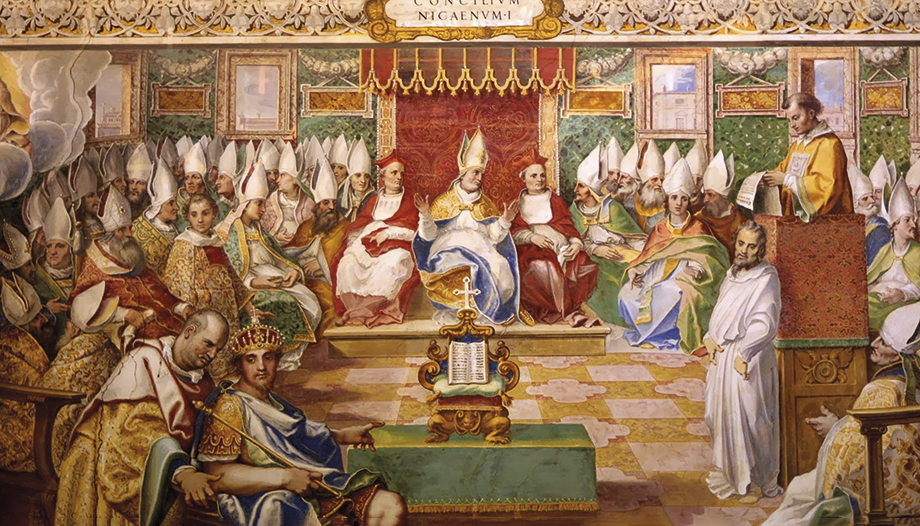
The long Creed, which we use today, is composed in two stages. The first takes place in 325, at the Council of Nicaea. By then, the Church had achieved a certain independence: it was no longer persecuted and was recognized as acceptable in the Roman Empire by Emperor Constantine, who had converted, although he was not baptized until the end of his life. In this climate of peace it was possible to confront serious internal problems, the most important of which was Arianism: a dispute about the figure of Jesus Christ, about whether or not he was equal to the Father. To resolve this question and to formulate a common and clear confession of faith, the Council drew up a Creed that was no longer only baptismal, but also doctrinal.

Nicaea is relatively close to Constantinople, on the other side of the sea. And it was precisely in Constantinople where, in 381, a second Council completed that Creed, developing the third part on the Holy Spirit, which in Nicaea was limited to the phrase: “I believe in the Holy Spirit.”.

What the Creed is for today

This long Creed is the one we will use to expound the main contents of the faith and to give them a theological basis. It is not that theology is more important than catechesis, far from it; but when we want to rethink the faith and have a well-articulated idea of what Christianity is, it is essential to have recourse to these sources.

The Creed, as the first ordination of Christian doctrine, serves as a reference for us to ask ourselves: what are the Christian mysteries, how do we explain them, what difficulties do they pose today? This path has been trodden by many before us. 

The then professor Joseph Ratzinger - later cardinal and then Pope Benedict XVI - wrote his Introduction to Christianity as an explanation of the doctrine based on the three parts of the Creed. St. Thomas Aquinas left a commentary on the Apostolic Creed. And the first part of the Catechism of the Catholic Church -the second universal catechism in history- is in fact an extensive commentary on the Creed, followed by an explanation of the liturgy, morals and prayer.

The Creed is not studied in order to know more, but to live better. Knowing who God is, who Christ is, what the Church is or what eternal life means are not data to be filed away: they are convictions that transform our way of being in the world. That is why the Church has always put the Creed in the mouths of her faithful, not in her libraries.

Read more
Spain

The Pope at his last Mass in Spain: «I return to Rome comforted by the testimonies of faith and love for the Church».»

Pope Leo XIV celebrated a multitudinous Eucharist in Tenerife, on the last day of his Apostolic Journey to Spain. Before the end of the Holy Mass, he dedicated a few words of farewell to all Spaniards.

Teresa Aguado Peña-June 12, 2026-Reading time: 6 minutes

In celebration of the Sacred Heart of Jesus, Pope Leo XIV celebrated his last Mass in Spain, in the port of Santa Cruz de Tenerife. Thus, his homily began by giving thanks «for the faith and charity of which I have received so many testimonies in this apostolic journey»He concluded the Eucharist with a few words to all Spaniards.

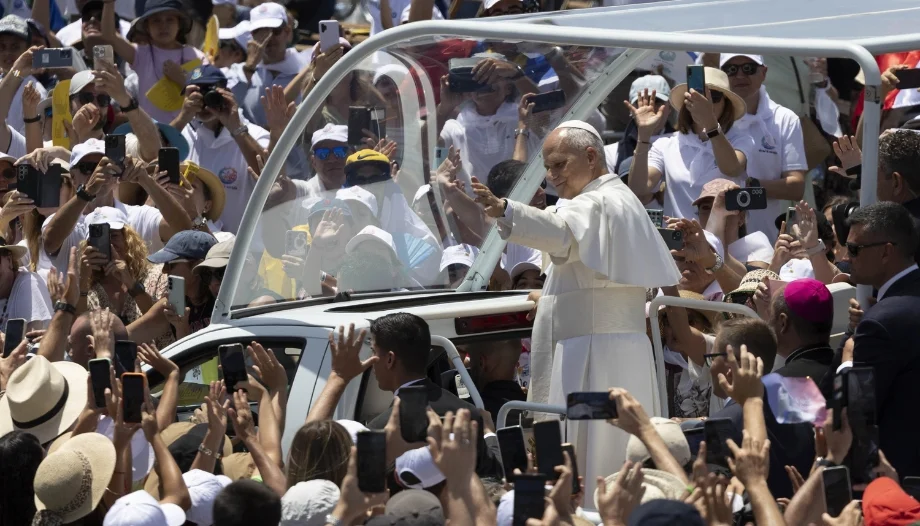
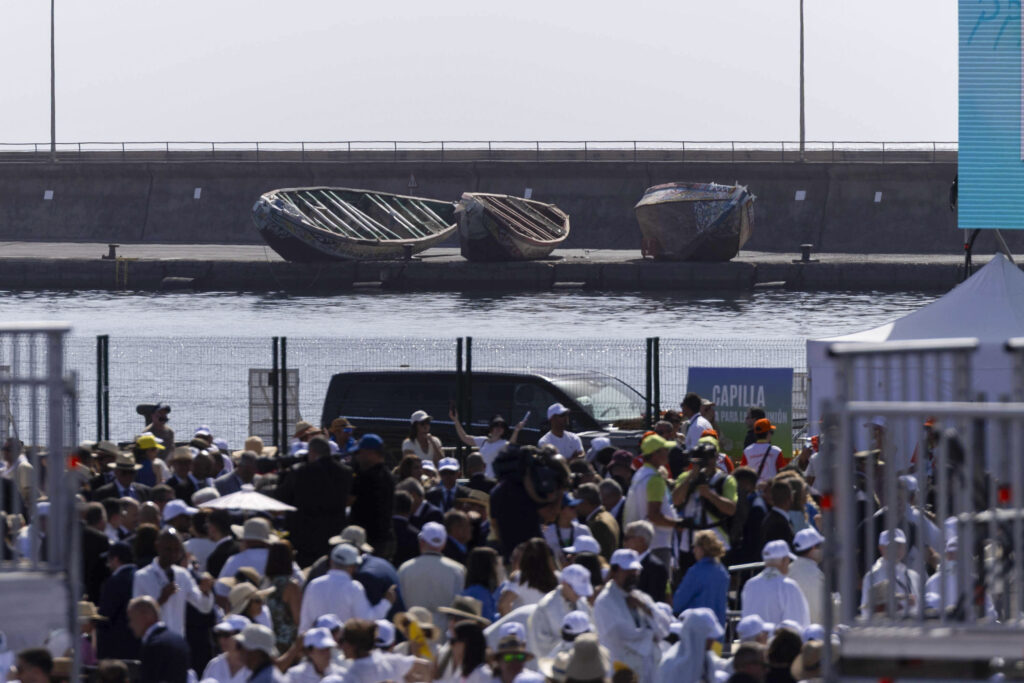
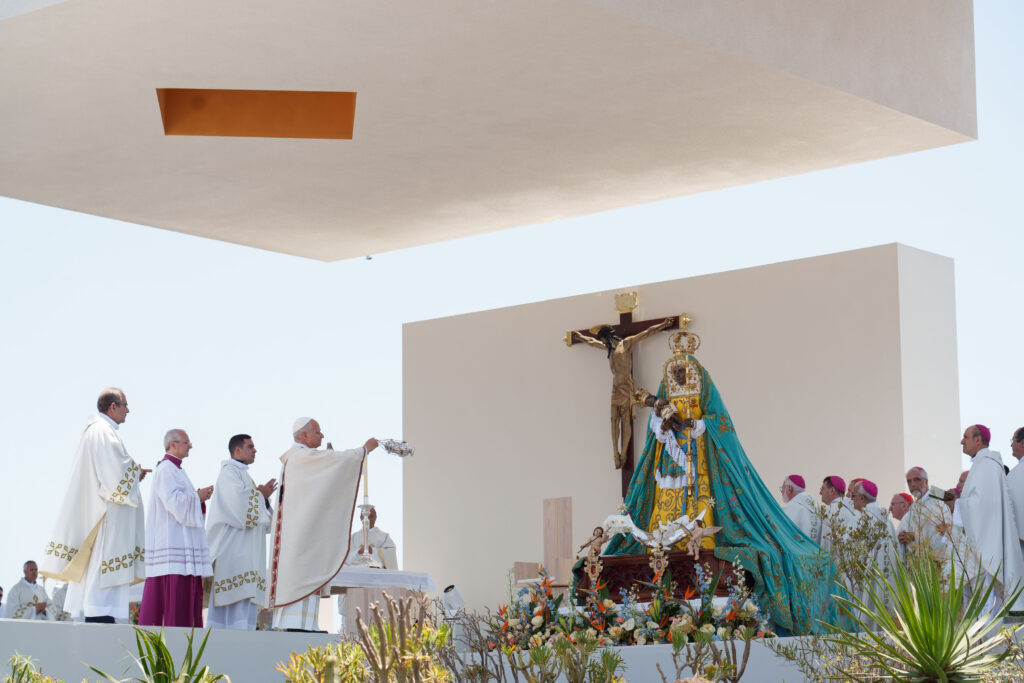
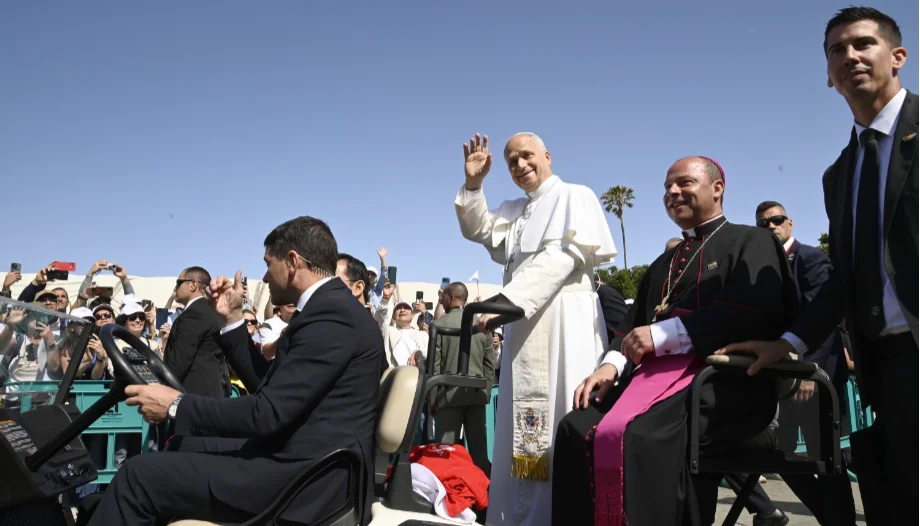
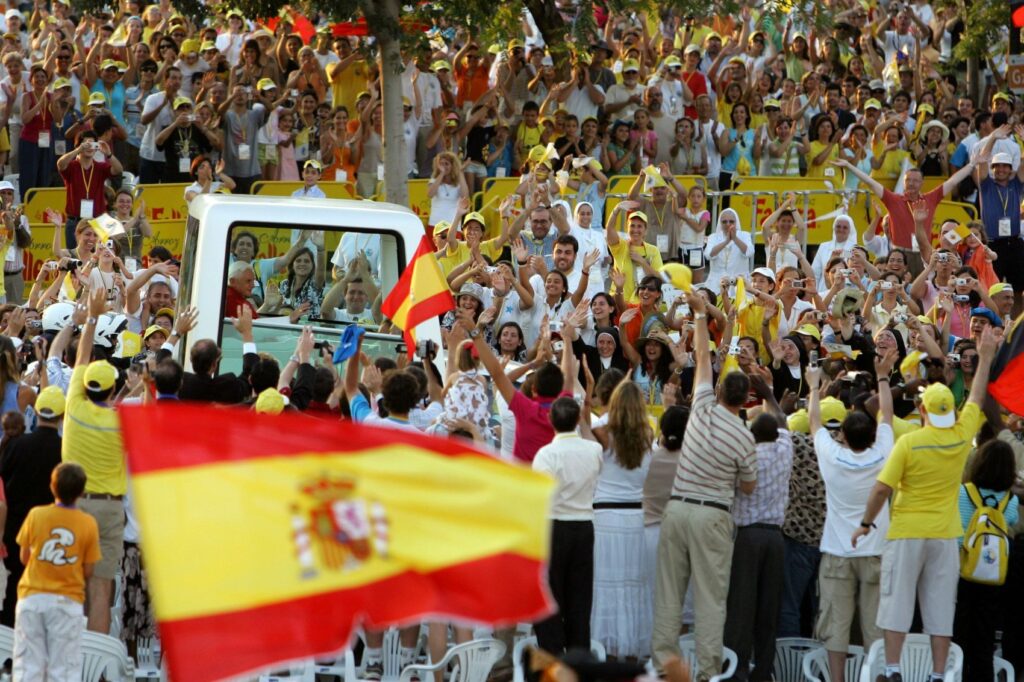
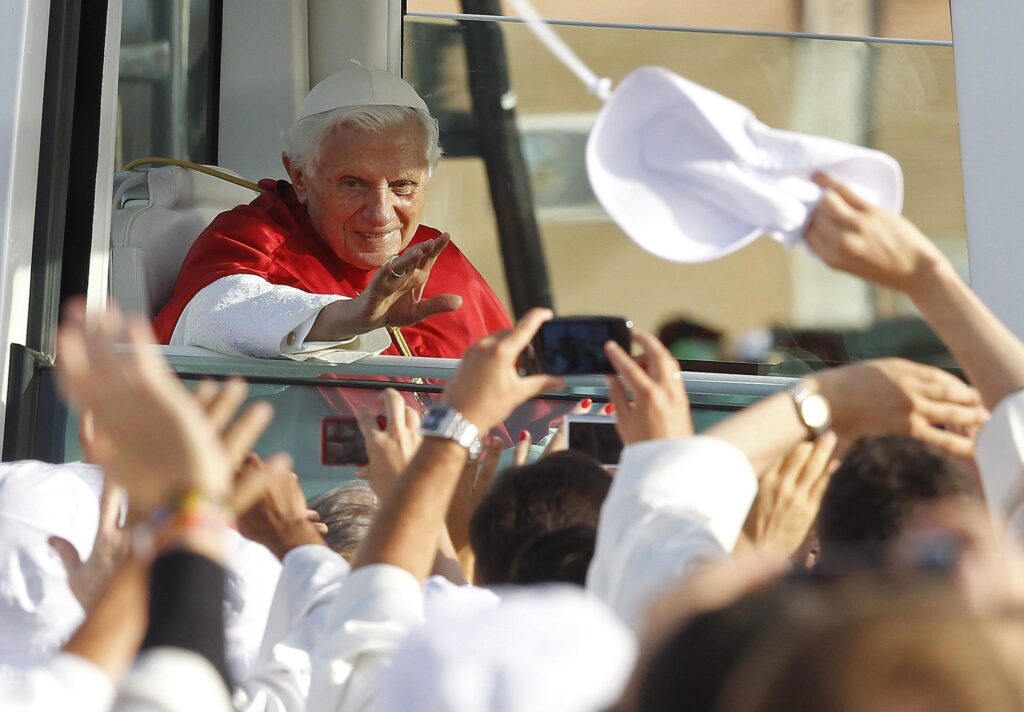
Before the Mass, Leo XIV traveled through part of the port area in a popemobile, greeting the thousands of faithful gathered. The altar was presided over by the Christ of La Laguna and the patroness of the Canary Islands, The Virgin of Candelaria, devotions that are rarely exhibited together. One of the most significant elements of the stage were three canoes placed next to the liturgical area, as a reminder of the thousands of people who have arrived to the Canary Islands crossing one of the most dangerous migratory routes in the world. Their silent presence accompanied the entire celebration.

©EFE/ Miguel Barreto

The Eucharist was also attended by a large number of faithful from the different islands of the archipelago. Marcos, a young man from El Hierro, proclaimed the first reading; Inés, from Tenerife, gave voice to the responsorial psalm; the second reading was given by María José, a native of La Palma and consecrated in the Order of the Virgins; while the Gospel was proclaimed by the permanent deacon Alejandro Manuel. In this way, the liturgy reflected the diversity of the diocese of Nivar and the insular character of a Church called to live communion and encounter.

Pope Leo XIV wanted to dedicate a few words to the people of the Canary Islands: «Thank you for what you are and for what you do, making this island a place where the heart of Christ can be found in the friendly and hospitable face of fraternal people and communities».

«Not reducing everything to trade and profit»

From the very beginning of his homily, Leo XIV placed the solemnity of the Sacred Heart as an invitation to contemplate God's love for humanity. The Pope used the image of the sea and the sky to speak of the infinite longing that dwells in the human heart and finds an answer in God: «this is the secret of the heart: the intimate call to exodus and encounter».

He recalls, from the first moment, the need to give one's life for God, for the other: «there is life when life is given. Otherwise, one turns into emptiness». Thus, as the Council says, the human being is called to communion with God and “cannot find his own fullness except in the sincere giving of himself»(Magnifica humanitas, 48). The Pontiff affirmed that «no human being is an island» and stressed that every person is called to encounter others.

The Pope stressed the importance of «not reducing everything to commerce and profit,» recalling the words of his predecessor: «Those who enjoy more and live better every moment are those who stop pecking here and there, always looking for what they do not have, and experience what it is to value each person and each thing, learn to make contact and know how to enjoy the simplest things. In this way they are able to diminish unsatisfied needs and reduce fatigue and obsession» (Laudato si', 223). In this way, dear brothers and sisters, interpret your vocation to welcome».

The wealth of the poor

Referring to the Gospel, the Pope spoke about the paradox of the wealth of the poor. They «have learned many things that they keep in the mystery of their hearts. Those among us who have not experienced similar situations, of a life lived on the edge, surely have much to draw from that source of wisdom which is the experience of the poor. Only by comparing our complaints with their sufferings and deprivations is it possible to receive a reproach that invites us to simplify our lives« (Dilexi te, 102).

The Pontiff then invited us to allow ourselves to be evangelized by those whom we help, «that we may recognize the mysterious wisdom of God written in his very flesh».

The Pope calls once again for mission: «pay attention to adolescents and young people, to the rich and the poor, to residents and guests: all of them need to be known with a gaze that looks beyond appearances and recognizes the depth of their restless hearts, which not infrequently is already oriented, perhaps unconsciously, towards the Kingdom of God and his justice. May it be breathed among you that «God is love, and he who abides in love abides in God and God abides in him» (1 Jn 4,16)».

His message concluded with an invitation to immerse oneself in the heart of the Gospel, the heart of Christ. For «those who immerse themselves in it no longer live for themselves»: «Open to all this sea of love! It is my wish and my prayer for you and for all those you meet on your way». 

The Eucharist

The celebration was presided over by various signs linked to the history and spirituality of the Canary Islands. Next to the image of Our Lady of Candelaria were placed the relics of the two great Canarian saints: Saint Brother Pedro -of whom this year marks the fourth centenary of his birth- and Saint Joseph of Anchieta, a missionary from La Laguna known as the Apostle of Brazil.

©EFE/ Ramón De La Rocha

The solemnity was prepared for weeks by numerous communities of the diocese. Among other works, the Poor Clare nuns of the Monastery of Santa Clara de La Laguna made the altar cloth and elaborated about 40,000 forms for the communion of the faithful. The distribution of the Eucharist was carried out by some 300 extraordinary ministers spread throughout the port area.

Before the end of the celebration there was also a symbolic moment. The chalice used by Leo XIV during the Eucharist was given as a pontifical gift to the Diocese of San Cristobal de La Laguna and received by Bishop Eloy Alberto Santiago Santiago, becoming from now on a historical piece linked to the first visit of a Pope to the diocese of Nivar.

The bishop appreciates an historic visit

The bishop of the diocese of San Cristobal de La Laguna, Eloy Alberto Santiago Santiago, thanked the Pontiff for his presence in a historic visit: the first visit by a Pope to the diocese of Nivar in its two centuries of existence.

The prelate highlighted the strategic position of the Canary Islands as a meeting point between Europe, America and Africa, and reaffirmed the commitment of the local Church with the poor, the migrants, the social fraternity and the care of creation.

In a particularly moving moment, he assured that the people of the Canary Islands already consider Leon XIV as «one of our own» and affirmed that «in these islands he will always have his home».

Pope's last words to Spaniards

Before the end of the Holy Mass, Pope Leo dedicated some final words to the Spanish people:

«Brothers and sisters, this Eucharistic celebration concludes my apostolic journey to Spain. I thank God and all those who have welcomed me and who in a thousand ways have collaborated in the preparation and realization of the various moments in Madrid, Barcelona and Montserrat and here in the Canary Islands. I return to Rome moved by the great affection with which I was received and comforted by the testimonies of faith and love for the Church, expressions of the great Catholic heart of Spain.

From this port that bears the name of the Holy Cross, my thoughts extend to the whole world and its wounds that cause entire peoples to suffer. I would like to repeat to all of you the motto of this journey: Lift up your eyes! Yes, let us turn our gaze to Christ crucified.

Her heart is the source of mercy, the only one that can save humanity in need of forgiveness, of reconciliation, in order to achieve true and lasting peace. Let us raise our eyes as Mary did, the mother of all those who suffer, and guided by her, let us take up again the path with hope. Dear brothers and sisters, thank you from the bottom of our hearts, let us remain united in prayer and communion in Christ and in the Holy Church».

Farewell Papa Leon. As we Spaniards say: «we love you very much».

© EFE/ Ramón De La Rocha
Newsroom

Free Ebook: Leo XIV in Spain

Editorial Staff Omnes-June 12, 2026-Reading time: < 1 minute

The new digital book «Leo XIV in Spain», published by Omnes, is now available for free download. It brings together, in full and chronologically, all the speeches and messages of Pope Leo XIV during his recent apostolic visit to Spain.

The e-book can be downloaded in .epub y .pdf

Through this e-book readers will be able to read and delve into the more than twenty speeches of the Holy Father, in which he has made appeals for hope, unity and renewal of faith in today's society.

Each text also includes a link to the Omnes news item on each of the meetings.

Evangelization

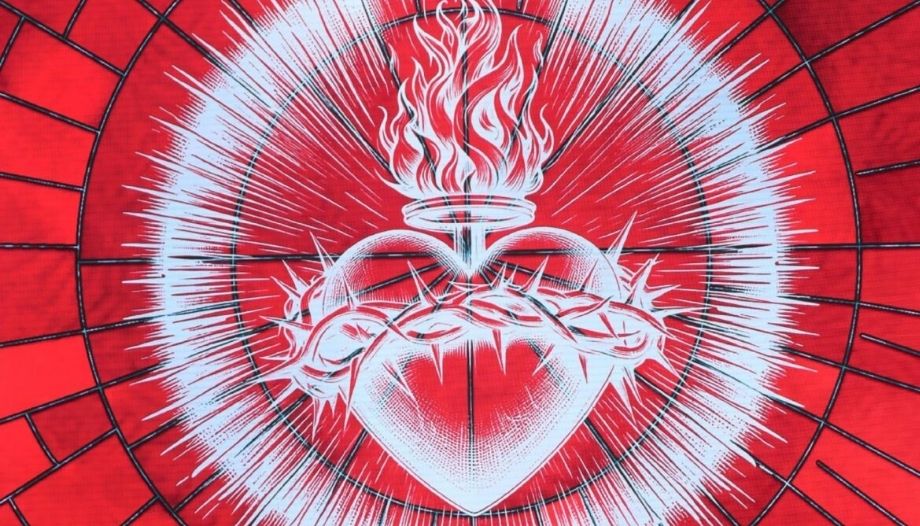
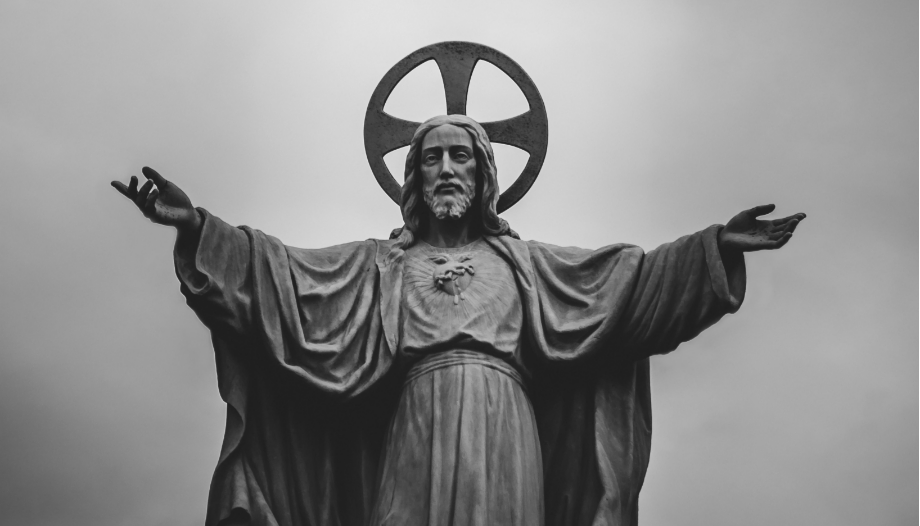
5 ways to foster devotion to the Sacred Heart of Jesus

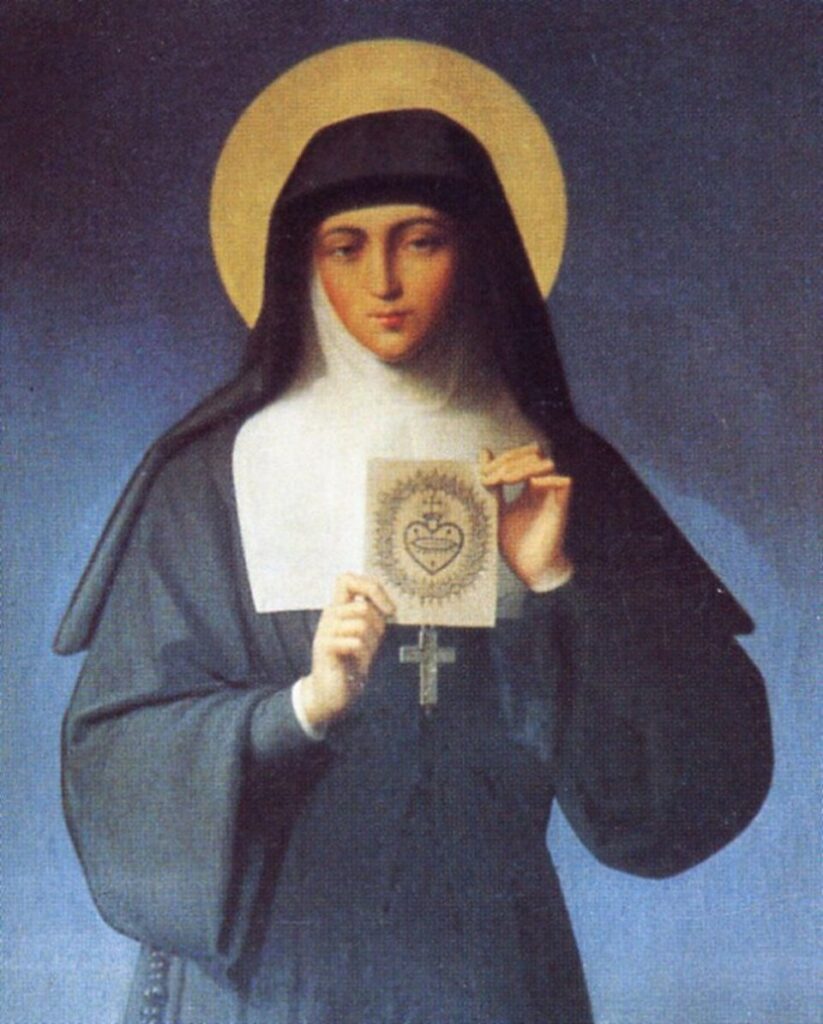
Devotion to the Sacred Heart of Jesus arose from the Lord's revelations to St. Margaret Mary Alacoque in the 17th century. During the second revelation, the Lord instructed Margaret Mary to receive Holy Communion on the first Friday of each month for nine consecutive months.

OSV / Omnes-June 12, 2026-Reading time: 6 minutes

- Leonard J. DeLorenzo, OSV News

Devotion to the Sacred Heart of Jesus has its origin in the revelations of the Lord to St. Margaret Mary Alacoque. But Our Lord not only instructed the nun to receive Holy Communion on the first Friday of each month for nine consecutive months, but also to prostrate herself on the floor before the Blessed Sacrament for one hour on the night of Thursday to Friday of each week.

In the third revelation, the Lord proclaimed his desire that a feast be instituted in honor of his Sacred Heart, which would incorporate this devotion into the common and universal practice of the Church.

Pius XI instituted the Solemnity of the Sacred Heart of Jesus.

Nearly two centuries later, in 1865, Pope Pius IX instituted the solemnity of the Sacred Heart of Jesus for the universal Church, which is celebrated on the second Friday after Holy Trinity Sunday (which is also the Friday immediately following the Feast of the Most Holy Body and Blood of Jesus in the United States).

In 1995, St. John Paul II added the World Day of Prayer for the Sanctification of Priests to the same date, so that the priesthood would be protected in the heart of Jesus.

Pope Francis published in 2024 his encyclical on devotion to the Sacred Heart of Jesus, gathering magisterial texts and reflections also on the human and divine love of the Heart of Jesus Christ, and the French nun St. Margaret Mary Alacoque. 

U.S. bishops plan to consecrate United States to Sacred Heart

On June 11, 2026, the U.S. bishops plan to consecrate the United States to the Sacred Heart as the nation prepares to commemorate its 250th anniversary.

The immense love of the Son of God is the particular object of devotion to the Sacred Heart. With this immense love, the Father gave us his Son, the Son gave himself to death for us, and the Father gives us his Son and the Son gives himself to us in the Blessed Sacrament of the altar. Devotion to the Sacred Heart is nothing other than devotion to the love of God poured out for us in Jesus, the Son.

Jesus Christ calls his disciples to adore and consecrate themselves to his Sacred Heart, similar to the way he called St. Margaret Mary. 

The motive and fruit of this devotion is, in the first place, that those who practice it may grow in gratitude and thanksgiving for the tender love that Jesus Christ has for us, especially that which is communicated in the Blessed Sacrament. 

A second motive and fruit is to participate in making reparation for the grave ingratitude and insensitivity that many multitudes show toward the love of Jesus poured out for us. Thus, devotion generates pious love and deep sorrow, all in response to the love of God in Christ.

Five best practices

The following five practices are among the most common ways to initiate and perpetuate devotion to the Sacred Heart.

A morning offering, for the Immaculate Heart of Mary

The first to consecrate herself to the love of God in Christ was the Blessed Virgin. Her heart is always united to His and nourished by it. Her heart leads to His, and His is offered to us through hers. A morning offering such as the following brings us closer, little by little, to the love of Christ through Mary:

“O Jesus, through the Immaculate Heart of Mary, I offer You my prayers, works, joys and sufferings of this day, in union with the Holy Sacrifice of the Mass throughout the world. I offer them for all the intentions of your Sacred Heart: for the salvation of souls, the reparation of sins, the union of all Christians. I offer them for the intentions of our bishops and all the apostles of prayer, and in particular for those that our Holy Father has entrusted to us this month. Amen.

2. Visit Jesus in the Blessed Sacrament frequently.

Devotion to the Most Holy Eucharist and devotion to the Sacred Heart of Jesus are ultimately one and the same devotion in two moments. The love that resides in the heart of Christ is offered to us in the Blessed Sacrament, and the Blessed Sacrament always points us to the love of God poured out for the world.

The Lord instructed St. Margaret Mary to consecrate herself to His Sacred Heart, in part, by keeping a Holy Hour each week, prostrate before the Blessed Sacrament. Keeping this Holy Hour on the night between Thursday and Friday places the devotee even more intentionally in the Garden of Christ's agony, when His passion began and His disciples abandoned Him.

3. A devotion for the first Friday of the month

Jesus revealed to St. Margaret Mary both the warmth of his human heart and the coldness of the ingratitude he suffered from many. Regular reception of Holy Communion gives us the warmth of Christ's love and, at the same time, allows us to express gratitude for the Lord's gift. 

The First Friday Devotion is a way for this exchange of love to become a habit and increasingly intentional. 

Attending Mass and receiving Holy Communion on the first Friday of each month (or for at least nine consecutive months) is offered in reparation for sins committed against the Sacred Heart of Jesus and the Holy Eucharist.

4. Make an act of consecration to the Sacred Heart.

Acts of consecration to the Sacred Heart take various forms. Consecration should be renewed at least once a year on the feast of the Sacred Heart, although it can also be renewed every first Friday of the month.

A simple consecration goes like this: «Lord Jesus Christ, today I offer/renew my consecration to your Sacred Heart. I remember your love for me. I promise to reciprocate you with my love, placing you at the center of my heart and my family. I desire to live my life in union with you and to participate in your mission of love for all. Lord, accept this consecration and keep me always in your Sacred Heart. Amen.

Saint Margaret Mary Alacoque, French nun of the Order of the Visitation of Saint Mary, Monastery of Paray-le-Monial (France) (Author unknown, Wikimedia commons).

Consecration of St. Margaret Mary herself

A more extensive and well-known form of this consecration is that which St. Margaret Mary herself offered to the Sacred Heart of Jesus:

“I consecrate and surrender to the Sacred Heart of our Lord Jesus Christ my person, my life, my difficulties and my sufferings, to live henceforth solely for his love and glory. It is my firm and unshakable resolution to be entirely his, to do everything for his love and to renounce with all my heart everything that could displease his divine heart.”.

“O Sacred Heart, I choose you as the only object of my love, protector of my life, pledge of my salvation, support in my weakness and redeemer of all the sins of my life. O kind and generous Heart, be also my refuge in the hour of death, my justification before God, and keep me from the punishment of his just wrath. O loving Heart, I put all my trust in you. Though I fear everything because of my own malice, I hope for everything from your goodness. Destroy in me all that displeases or opposes you, and may your pure love imprint you so deeply on my heart that it will be impossible for me to forget you or to be separated from you.”.

“O Sacred Heart, by your goodness, I implore you that my name be engraved on you, for in your service and in your love I will live and die. Amen.”

5. Celebrate the feast of the Sacred Heart with great preparation and reverence.

The party of the Sacred Heart is celebrated annually on the second Friday after Trinity Sunday. As a solemn occasion for the universal Church, the celebration of this feast with preparation and reverence allows each member of the body of Christ to participate in the Church's fervor for the love of Christ and to make reparation for the ingratitude of the disciples and others before the great love of Christ.

Guide by Fr. Croiset S.J.

In his book “Devotion to the Sacred Heart,” published in the late 17th century, Jesuit Father John Croiset offers straightforward guidance on how to observe this feast in a practical and spiritual way with due reverence:

“We should, if possible, consecrate the whole day of the feast to the veneration of the Sacred Heart of Jesus in the Blessed Sacrament. We should postpone for another time all unnecessary business and renounce all useless entertainment, for the smallest moments of the day are infinitely precious.”

Upon rising in the morning, we should prostrate ourselves and adore Jesus Christ (in the Blessed Sacrament). Then, we should prepare ourselves for a fervent Holy Communion, because this Communion is a Communion of reparation, first of all, for the faults of our own Communions, and then for the sins of others.

“Immediately after Holy Communion, compare the immeasurable love of Jesus Christ with your own extreme ingratitude; prostrate yourself humbly at his feet, humble of mind and with a heart pierced with sorrow at seeing so many offenses that Jesus receives.

“Then make the Act of Consecration to the Sacred Heart of Jesus and offer yourself unreservedly to him.

Frequent acts of love for Jesus Christ

“Therefore, the whole day should be devoted to good works, and especially to frequent acts of love for Jesus Christ, according to one's devotion.”

Through these five ways, and others, devotion to the Sacred Heart directs our hearts toward the love of Jesus' own heart. Little by little we become emissaries of his love and sharers in the reconciling work of Christ's body. In return, Christ offers twelve promises to those who consecrate themselves to his heart.

—————

- Leonard J. DeLorenzo is professor of practice at the McGrath Institute for Church Life and adjunct professor in the theology department at the University of Notre Dame. His writings can be found at leonardjdelorenzo.com.

The authorOSV / Omnes

Spain

Leo XIV: «Migrant brothers, it is up to you to open yourselves to the community that receives you, to learn its language, to respect its laws, to know its customs».»

The Pope encouraged immigrants to allow themselves to be evangelized by those who welcome them and also asked Catholics that integration should not be reduced to a social task.

Javier García Herrería-June 12, 2026-Reading time: 5 minutes

Pope Leo XIV met this afternoon in the emblematic Plaza del Santísimo Cristo in La Laguna with organizations dedicated to the integration of migrants, in a meeting that brought together volunteers, social workers, church representatives and migrants from different parts of the world.

The ceremony, held in the heart of this World Heritage City, included words of welcome from the bishop of the diocese, four testimonies and a pontifical address before the Pope bid farewell to the attendees.

Walking with those who walk

Monsignor Eloy Alberto Santiago Santiago, Bishop of San Cristobal de La Laguna, welcomed the Pope, stressing that the mission of the local Church goes beyond emergency reception. He highlighted the work of the diocesan Caritas, the Diocesan Delegation of Migration and various church organizations in the teaching of Spanish and occupational training, with the aim that migrants not only receive help, but also contribute to society. He also recalled that many of the faithful from Latin America, the Philippines and other regions are already an active part of the diocesan community, becoming, in his words, «new lifeblood for the communities that welcome them.

Testimonials. «What would our Lord do?»

Darwin Rivas, a Venezuelan priest who has been living on the island of El Hierro for seven years, described his experience accompanying the arrivals of African migrants to the coasts of La Restinga. Parish priest of four communities, he recounted how in 2021 he and his companions wondered what they could do in the face of the growing flow of arrivals, and how they set up a reception network together with neighbors, volunteers, the National Police and the mayor of the municipality. Frankly, he acknowledged moments of exhaustion and temptation to move away, «There were days and nights when I wanted to stay in the comfort of my home but thought, what would our Lord do?» That question, he said, was the compass that kept him on track.

Brotherhood beyond blood

Mbacke, a young Senegalese who has been living in the Fundación Canaria El Buen Samaritano for a year and a half, has spoken on behalf of this institution to thank those who did not look the other way. There he has learned Spanish, cooking, agriculture, masonry, carpentry, computers and sewing, among other disciplines. She expressed her relief at having found not only a roof over her head, but also people who told her «you are worth it, you can do it», and concluded her speech with a poem recited by the theater group in which she participates:

The story of a shipwreck

Khalid Allad, a 24-year-old Moroccan, gave the most harrowing account of the morning. He arrived in the Canary Islands in 2020 after two attempts by patera. In the first one, twenty people died. When he returned home, his father hugged him in tears: he had not slept because he had dreamed that the boat capsized. He forbade him to try again.

A year later, Khalid left again, this time without his knowledge, and after a second, equally painful journey, he arrived in Tenerife. Shortly after, when he was on the verge of homelessness, he found the Don Bosco Foundation, which became his second family: language, training in cooking, school monitoring, construction. A pre-employment contract allowed him to obtain a residence permit. Today he proudly works at the Salesian College. «Now every morning, when I leave my house, I go to work happy,» he said.

From migrant to Caritas volunteer

Thalia Johana Saldarriaga Diago, a 48-year-old Colombian who has lived in Tenerife for three years, told how she arrived with hope but soon found herself homeless with her brother. CEAR and Caritas gave her back, in her own words, «the dignity that life sometimes takes away from us». Thanks to the Don Bosco Foundation, he received professional training and became financially independent. But her story does not end there: today she is a Caritas volunteer, convinced that her experience can serve as a bridge for those who come to her in the same situation.

Pope: integrating is to avoid second shipwreck

Leo XIV delivered the longest and densest speech of the meeting, articulated around a central idea: integration is not an administrative task or a unilateral gesture of charity, but a reciprocal path that transforms those who participate in it.

The Pope began by evoking the image of La Laguna as a «city without walls,» a historical fact that he turned into a symbol: the most difficult barriers to break down, he said, are not always made of stone. «Sometimes they are in the look, in fear or indifference». From there, he developed a reflection on what it means to truly integrate.

Integrating: neither erasing the past nor creating parallel worlds

For the Pope, integration does not mean demanding that the newcomer abandon his or her history and memory. But neither does it mean tolerating that each community lives closed in on itself without any real encounter. «Integrating is a reciprocal path: those who arrive learn to inhabit a new land, and those who receive learn to expand their own home without diluting their identity or closing their hearts to encounter».

In this journey, he pointed out, those who arrive have an active and necessary part to play: learning the language, respecting the laws, knowing the customs and offering their own gifts with gratitude. And the host has duties towards the newcomer, but must also know how to receive. «Dignity recognized as a right flourishes when it becomes a responsibility and a sincere desire to build together with others».

Evangelization of immigrants

The Pope encouraged immigrants to allow themselves to be evangelized by those who welcome them, «for surely they bring with them gifts that Providence has wanted to bring to you through those who integrate».

He also asked Catholics that integration should not be reduced to a social task. Parishes must offer, along with bread, shelter and work, the possibility of knowing Jesus Christ, always with respect and freedom. «A Church that welcomes is also a Church that proclaims, offering Christ without imposing him and, at the same time, receiving the Gospel from the hands of the poor».

The silent shipwreck

One of the most powerful images of the speech was that of the «silent shipwreck. Leo XIV recognized that no human conscience, much less Christian, can remain indifferent to the deaths at sea, to »those cemeteries of the sea«. But he pointed out that there is another shipwreck, less visible and perhaps more widespread: the one that occurs after arrival.

«To be left alone in a city, without language, without ties, without work, without confidence and exposed to those who take advantage of one's vulnerability»: that is also to be shipwrecked. And integration, he said, is precisely the antidote to that second sinking. «To integrate is to prevent that second shipwreck. It is to help those who have been wounded not to remain fixed forever in their pain, but to be able to get back on their feet, recognize their gifts and offer them to the community».

A clear word to the traffickers

The Pope reserved his harshest words for those who profit from the desperation of others. From the square of La Laguna, he directly challenged «those who organize routes of death, traffic in people, withhold documents, exploit workers, threaten women, deceive families and turn the suffering of others into a business»: «Stop. Be converted. He reminded them that the tears and blood of migrants »cry out to God« and that »money torn from the vulnerability of the poor will not bring peace, honor or future«. He called on them to break these chains and to repair the damage caused while there is still time, invoking divine mercy, which can reach even the most hardened, but »only enters through the narrow door of truth, justice and conversion«.

The Pope concluded by commending the work of all those present to the Holy Family of Nazareth, which also had to migrate to Egypt to protect the Child Jesus, and proposed it as «model and protection for every refugee family, every migrant and every person who is forced to leave their land out of fear, persecution or need».

After the speech, Leon XIV was dismissed with a Peruvian song sung by the local Peruvian community.

Spain

Pope in Tenerife: «we are all migrants and pilgrims on the way to the heavenly homeland».»

During his visit to the "Las Raíces" center, the largest reception center in the Canary Islands, Leo XIV recalled that every person is on a journey and called for a fraternal gaze towards those seeking a better future.

Teresa Aguado Peña-June 12, 2026-Reading time: 4 minutes

Pope Leo XIV landed in Tenerife for a first meeting with migrants at the «Las Raíces» center, one of the main facilities for the care of migrants in the Canary Islands. There he was received by the Bishop of San Cristobal de La Laguna, Monsignor Eloy Alberto Santiago Santiago, representatives of the Government and those in charge of the center.

The «Las Raíces» center»

The Bishop of San Cristobal de La Laguna (Tenerife), Monsignor Eloy Alberto Santiago Santiago welcomed him warmly, explaining the context of the center: «we are in one of the shelters for migrants of the Government of Spain, managed by the association Accem. It is the largest camp in the Canary Islands which, at the height of the migratory crisis, at the end of 2024, housed almost 4,000 people, although today there are far fewer, due to the notable decrease in the migratory flow in recent months».

Thus, the bishop recalled that in recent years tens of thousands of people from Africa have arrived in the archipelago fleeing poverty, conflicts and lack of opportunities, while many others lost their lives trying to reach the Canary coasts.

Then, the director of the Las Raíces Center highlighted the work carried out in these facilities since its opening in 2021. As he explained, more than 54,000 people have been welcomed in the enclosure during this period and about 600 workers are currently involved in the tasks of care, accompaniment and assistance to migrants arriving by sea.

«Thank you for remembering that we are people.»

One of the most moving moments of the meeting came with the testimonies of two people welcomed at the center. A young migrant thanked the Pope for his closeness and assured that his words represent a support for those who have had to leave their home in search of a better life. “We come with simple dreams: to work, take care of the family and live with dignity,” he said. «Thank you for reminding the world that we are all people, that we all need love, peace and opportunities» he added.

For her part, a migrant woman recounted the difficulties experienced during the journey to the Canary Islands and remembered those who lost their lives at sea: «the road to get here was not easy. The journey was full of fear, pain and uncertainty». In his intervention he asked that migrants should not be seen as numbers or administrative files, but as human beings with history, family and hope. “We do not ask for privileges. We do not ask for compassion. We ask for respect, humanity and the opportunity to live with dignity,” he said.

After listening to these testimonies, Leo XIV addressed a message to those present, focusing on welcome, solidarity and the human value of migration.

Pope reminds that God knows no borders

During his speech, the Pontiff recalled that the Solemnity of the Sacred Heart of Jesus, which the Church celebrates this Friday, represents the universal love of God towards all people without distinction of origin, nationality or social condition: «beyond our place of origin, the love of God knows no borders, makes no distinctions, is given to all and gathers us together in unity.»

Leo XIV assured that the wounds and sufferings borne by many migrants can find consolation: «Seeing their faces, listening to their testimonies, I also think of their hearts, wounded by so many difficulties and also consoled by the love received thanks to other open, generous and merciful hearts. The Heart of Christ suffered and was pierced for love, and was also comforted by compassionate people who came to alleviate their pain».

A call to mission

The Pope also evoked the figure of saints linked to the Canary Islands, such as José de Anchieta and Brother Pedro, whom he defined as migrants and missionaries who set out for unknown lands driven by faith: «they too were migrants who went into the unknown, carrying as their main baggage faith, hope and charity».  

From this example, he encouraged migrants to think about the future of the generations to come, «to whom we want to bequeath the heritage of a civilization of love, and where migration has an important role to play, because «it can be an opportunity for encounter and mutual enrichment between peoples» (Magnifica humanitas, 81)».

«We are all migrants»

In another of the highlights of his speech, Leo XIV affirmed that, in a certain sense, “we are all migrants and pilgrims to our heavenly homeland. He called for fraternity: »Let us help each other to make this journey a more humane place for all, contributing what is within the reach of each one of us«. He also thanked the work done by public institutions, humanitarian organizations and volunteers who collaborate in the care of those who arrive to the islands.

Finally, the Pontiff referred to the very name of the center: «I was struck by the name of this welcome center, which is called “The Roots”. My Predecessor, dear Pope Francis, who longed so much to be with you, liked to use the image of roots to indicate the need not to forget one's origins, to remain united and to trust in the Lord. «For he who trusts in the Lord «is like a tree planted by the waters» edge, which puts down its roots in the current. He will not be afraid when the heat comes, and his foliage will be luxuriant"(Jr 17,8)» (Christus vivit, 133)».

«May this image of roots also help you to be firmly rooted in the Lord (cf. Col 2:7), so that no storm can keep them from his presence, which strengthens and gives life». With this message of hope, he concluded his visit by asking the migrants to remain firm in their faith and assuring them of his closeness and prayers.

Spain

Pope reminds that charity is more than mere assistance

Pope Leo XIV, in the Mass at the Gran Canaria stadium, highlights the value of humility in the Christian life.

Jose Maria Navalpotro-June 12, 2026-Reading time: 3 minutes

“Pope Leo, we love you very much!”, the cry of the Bishop of the Canary Islands, Monsignor José Mazuelos, at the conclusion of the Mass in the stadium of Gran Canaria, summed up the spirit with which the island lived the historic day in which for the first time in history a Pope visited the archipelago. In the Mass, Leo XIV spoke of the meaning of charity, beyond the welfare, and also looking for the spiritual dimension of the person, and of love, on the eve of the feast of the Sacred Heart.

Once again, the common feature of all the mass meetings of the Holy Father in Spain was repeated: an apotheosic entrance, with a people determined to show their affection. The Mass at the stadium where Las Palmas is playing (eliminated yesterday from the fight for promotion to the First Division) was attended by tens of thousands of faithful. A total of 41,000 tickets had been distributed, both for those attending at the soccer field and at the Gran Canaria Arena annex pavilion.

Shouts of “Pope Leo!” or even “Pio, pio” (the battle cry of the supporters of the Canary Island team) were repeated during the wait and especially at the entrance of the Holy Father.

About love

In his words to those gathered, the Pope insisted on his gratitude to the people of the Canary Islands for their efforts for the suffering people. He asked again to pray “for the brothers and sisters who have lost their lives at sea”.

He recalled a historical issue - his references to Christian roots are abundant in this trip -: the consecration of Spain to the Sacred Heart of Jesus, a feast celebrated on Friday.

Leo XIV assured that “our vocation to love is not founded on calculation, nor on mere sentiment, nor is it reducible to mere philanthropy, but it pervades our whole being: fire for the soul, light for the mind, irresistible impulse for freedom, peace and at the same time torment for the heart”. “To love is connatural to man, indeed, it is a condition for the fullness of his very existence,” he said.

The Gospel, he said, invites us to translate “the infinite measure of God's love in the generosity with which we serve him, every day, in the brothers and sisters he puts in our path. Especially in those who are most needy, helpless, unable to give something back in return. Precisely as it happens on this island, in the welcome, in the sharing, in the disinterested gift”.

It is not enough to help

The Holy Father clarified the meaning of true charity: “it should not be mere assistance, but the integration of people, for their full realization - spiritual, intellectual and physical - and their dignified and constructive insertion”. It is not enough to help, it is necessary to care for the person in his integrity, also for his spiritual needs, he said.

Another characteristic of the Heart of Christ that the Pope emphasized is humility: “The Heart of Jesus is humble, and for this reason the ‘learned’ and the ‘sapient’, that is, those who presume to be self-sufficient, to know everything, to have no need of God or of others, do not feel its beat. These, in fact, dazed by the noise of a bombastic, omnipresent and agitated ‘I’, lack the necessary silence to listen in themselves and in their brothers and sisters to the hidden palpitation of love”.

Jesus - he added - teaches that “to taste the true joy of life, which resides in love, it is necessary to come down from the pedestals of arrogance that divides, to find ourselves in the humility that unites us. Where there is authentic humility there is love, and where there is love there is peace”.

A warm welcome

Before starting the ceremony, Leo XIV had made an extensive tour in the popemobile on the stadium's lawn. He also picked up and blessed children (during his stay in Barcelona it is estimated that he took in his arms more than a hundred). And, just before concluding, he wanted to pray before the popular image of the Virgen del Pino, the local patron saint, and of the Cristo del Teide, whose carvings presided over the Mass.

Among the thousands of attendees most were from the island of Gran Canaria itself, with abundant presence also from Lanzarote and Fuerteventura, as well as visitors from Andalusia.

The Gran Canaria stage concluded with a feeling of closeness and gratitude to the Pope who wanted to be especially close to the drama of immigration that affects the islands. “Emotion” was the most repeated word among the attendees. The local bishop, Monsignor José Mazuelos, wept at each of the events he shared with the Pope. After the Mass, when the Pope retired to rest, a group of the faithful gathered in the vicinity of the archbishop's palace, where he resides, to express their affection with shouts and songs, until Leo XIV leaned out of the window, after 10 p.m. Canary Islands time.

In an impromptu meeting, the Pope listened to the neighbors“ arrorró canario (a lullaby) and then told them that ”the visit has been too short“ and expressed that he is ”very grateful for the welcome. Thank you very much for being so generous and welcoming,“ responded by the hundred or so attendees with a ”Pope Leon, we love you a lot!"

Books

A medieval revolution with a female voice

In the twelfth century, Mary of France drove the «courtly love» revolution, a precursor movement to feminism that linked true love to women's freedom and sovereignty. This ideal, which resonates with modern theology of the body, challenged the harsh mores of her time through generosity and nobility of spirit.

José Carlos Martín de la Hoz-June 12, 2026-Reading time: 4 minutes

In the twelfth century a revolution of great depth and impact took place in France, it is said that like that of 1789 or 1968, and that it was called the revolution of “courtly love”. It was promoted by Mary of France, a French noblewoman of whom we have little information, but who was endowed with a great poetic conscience and who enjoyed the protection of the life of the Court and the royal family, which at that time was essential.

As her life and writings denote, she would break, in a certain way, the laws and customs of the time with an unusual anthropological feminism (21). The authors point out, and no doubt exaggerate, that she would have raised in a certain way what John Paul II called in his famous theology of the body “the love of donation” (30) and, moreover, she would have done it in the vernacular language, with which she would have immediately reached the entire French society of her time (39).

Romantic love based on freedom

It is very interesting that what, according to this author, will solidly build the true family - the one that has always lasted, the one that works, the one that builds a luminous and joyful home - would be romantic love, that is, the one based on freedom (50). As Mary of France affirms: “to live of love is indispensable”. For this reason, she will emphasize: “there is no right to be loved in exchange for love, and to love is in any case a privilege. We should feel gratitude to those who are capable of awakening in us such a high and profitable feeling” (84).

This is very similar to what St. John Paul II affirms at the beginning of his extensive and continuous catecheses that would eventually converge in the magisterial body of the theology of the body: “you must fall in love with love”.

Then, he will explain to us in a very meaningful way: “When a spring gushes forth, the one who calculates the water it can give, who builds a dam, who intends to exploit the flow, is not a lover, but an engineer. The lover must concentrate on fighting so that the water of the spring will always remain crystalline” (84).

Nobility of spirit versus submission

The feminine outburst will appear many times in this work. For example, when the word submission appears: love requires nobility of spirit (87) and, above all, daily conquest, daily love (89). This is very important, because whoever considers himself a prisoner will always and constantly try to escape (90). In fact, jealousy “seeks to push into the abyss” (91). Whereas the one who loves will never seek the evil of the beloved (91).

Certainly, at that time, the responsibility for the children remained primarily with the woman, but not always and at all times (99), because “the law of love” will always be above, which could be translated as the solution to all problems is to love (115). Moreover: “only throbbing love is of interest” (120).

The twelve rules against heartbreak

Logically, it should be remembered, as Mary of France does, that “courtly love” is not a right, but something that must be conquered continuously, because true love, that which endures and grows, is not compatible with habituation or with asking for an account (121).

The most striking of the “twelve rules of love” (129) that the author of this work discovers is overabundance. The summary, therefore, of the matter is that it is necessary to exercise the virtues, each and every one of them: generosity, magnanimity, romanticism, respect for freedom, and in this way love can always offer itself to love without being invasive, and, moreover, always with the secret of nascent love.

In fact, evil is defined as the absence of due good; therefore, the rules of love are opposed to the rules of lovelessness, such as selfishness, superficiality, corporality or betrayal: affective coldness (132).

Apostolic celibacy is reflected in the dialogue of Jesus with the Samaritan woman (Jn 4:4-42), when the Lord tells her: “If you knew the gift of God and who it is that asks you ‘give me a drink’”. Indeed, our author tells us: “It consists in placing supernatural love above natural love” (137).

A democratic and generous gift

Mary of France will summarize, once again, the question with these words: “to love is first of all a religion, first of all faith is needed”; and then she will add: “love is democratic and transversal, it is an opportunity truly granted to all. Indeed, neither illness, nor physical imperfection, nor poverty, nor origin prevent one from being loved, but only the fact of lacking nobility of spirit (...). It is a constant training to give rather than to receive (...) Only those who are powerful by excess of generosity will receive the love they give. The lover must not only give, but he must do it with full hands, without taking into account what he has given and without expecting anything in return; otherwise it is not love, but vile mercantile barter” (140).

Interesting, as in the catechesis of St. John Paul II on the “theology of the body”, are the constant references to the “Song of Songs”, a book of Sacred Scripture that should be read by spouses and those who wish to advance and mature in their love for God and others.

The cultural context and the reality of women

In the last part of this work there are several texts of the time that refer to the books of chivalry and other glosses on the lives of the great kings and nobles of the time, such as Charlemagne, Alcuin of York or Eginardo (180-181). There are also extensive references to the palatine and cathedral schools, true centers of knowledge of the time.

Finally, we must refer to the harshness of the life to which women were subjected, always exposed to constant rape, abduction, rape and duels of honor. That is why María de Francia writes about the story of Lanzarote and Ginebra: “a woman always falls in love with the man who saves her from rape and abuse, because it is not possible for a woman to protect herself in a world of armed men. Roland's song is written by a man with the aim of convincing men to go to war” (180-181).

We will end with a brief reference to the world of relics, a sign of faith in prayer and of the abundance of superstition (199).

The revolution of courtly love. Mary of France and the birth of medieval feminism.

AuthorChiara Mercuri
EditorialAltamarea : Altamarea
Year: 2025
Number of pages: 245
Read more
Evangelization

Ángel Barahona: «community is fundamental to live the faith».»

Angel Barahona, author of numerous publications on family, love, anthropological and theological topics, shares his vision of the charism of the Neocatechumenal Way and reflects on the fruits that, after 60 years, continue to transform communities around the world.

Teresa Aguado Peña-June 12, 2026-Reading time: 6 minutes

This year marks the six-decade anniversary of the Neocatechumenal Way, a Christian initiation itinerary that was born in the humble shantytowns of Palomeras Altas, in Madrid, where Kiko Argüello and Carmen Hernandez began to share the Gospel with the poorest, following the example of the hidden life of Jesus in Nazareth. Conceived as a path of rediscovery of Baptism, it is based on three pillars: Word, Liturgy and Community. Today, it extends to more than 6,250 parishes in 1,400 dioceses around the world, forming more than 20,000 communities that live and witness to the Christian faith.

In this context, we spoke with Ángel J. Barahona Plaza (1957), PhD in Philosophy, Bachelor of Science in Education and Dogmatic Theology, Director of the Department of Humanities of the University of Navarra, and Director of the Department of Humanities of the University of Navarra. Francisco de Vitoria University and principal investigator of the International Research Group on Violence and Religion. Barahona is the author of numerous publications on family, love and violence, anthropological and theological themes. In this interview, he shares his vision of the charism of the Neocatechumenal Way, which he met in a parish of Discalced Carmelites in Castellón, and reflects on the fruits that, after 60 years, continue to transform communities around the world.

How would you describe the specific charism of the Neocatechumenal Way to someone who only knows it “from the outside”?

- It is a Christian initiation of adults that wants to recover baptism in the parish environment for those who have left the seed unwatered since they received it, or who have not received it yet. Many times it remained a mere social rite of belonging to a culture, but not having received an adequate formation in time, it lost the capacity to make it vital and existentially determining. The Way intends that “being baptized” embraces and implies our whole existence, in each and every moment and space in which we move.

In an increasingly individualistic society, the Way is committed to community. Tell us about your experience of this way of living the faith in small groups.

- Community life is a model rooted in Christianity from the very beginning. Christ chooses specific people but inserts them into a Way (as the Acts of the Apostles tells us, this is what the Christians were called: the people of the Way) in which the shared faith can be lived in community. The seductive power that Christianity exercised in the Roman Empire, in which everyone tried to survive in a hostile, individualistic world full of injustices, was the “look at how they love each other”. And that of loving each other is not experienced in narcissistic and self-referential or abstract relationships, but in a real relationship, where one learns to love the freedom of the other, to accept him in spite of his sins -knowing oneself-. A small group where the friction, the singularity of each one makes idealism difficult. It is the way to recognize oneself as a sinner, in the impossibility of loving the other as God did.

We always want to change those around us -children, spouse, relatives, partners, friends- because we do not accept them as they are, so when the other becomes a cross, we run away. When the other tells us what we do not want to hear, we separate ourselves from him. To love the other as he is, is to reproduce what Christ has done with us. Obviously this is not achieved by self-convincement, nor by moral will, but by placing the Word of God and the community celebration of the sacraments at the center of our daily life. To let oneself be denounced by the Word, to ask the priest for forgiveness of sins, to begin anew every day. It is absolutely miraculous and supernatural to live in a community in which I started 50 years ago and that I will be buried singing, or I will bury them (of which I have already had enough experiences), because I am the youngest of the first community of a parish in which there are already 18 communities.

In the Way, the catechist has a very important role. What exactly is a neocatechumenal catechist? 

- Simply someone who, like a caravan scout in the desert, has passed before the path that those others he accompanies are about to pass. The catechist has his own community, he has lived for some time before what the others are going to live. Although their professions are very varied, their theological formation is dense. They are chosen by the community itself. From the first day they begin to walk, the community begins to frequent the Word, which is prepared in groups by reading together the Fathers, the pontifical documents, the great books of the saints of the history of the Church, going through the Scriptures from cover to cover. During the first years, we scrutinize Sacred Scripture using Leon-Dufour's theological dictionary, looking for all the parallels that the author cites and reading and commenting on each reference together. What we call “steps” are the high points of community life in which we voluntarily and freely put into practice the word received: either with what we call “echo of the word” or landing in our own life what Holy Scripture says, or with the communion of goods, or with the monthly sharing that exposes the brothers to the truth that we are each one of us.

How can a catechist make a mistake and how can this be corrected within the Way?

- Of course. If the brothers receive, always in community, a particular word, the decision to accept or reject it is theirs and no one else's. No one asks for an account of anything, no one is obliged to anything and no one claims anything from them. No one asks for an account of anything, no one is obliged to anything and no one claims anything from them. As in any human group, there are those who are more or less clear about this, but this is what we have received from Kiko and Carmen: total freedom. If something you do does not come from gratitude, from your free will, we always say that it is better not to do it. The law does not save anyone. If the doctrine of the Church is proposed, it is to be taken seriously as a pedagogy, not as an obligation. That is why everything is done in community. Certainly there may be people, as in any social or even ecclesial reality, who are weaker or more affectively vulnerable, or who feel more in need of instructions from others, but acting in this way is not what we have received from our catechists. That is why whenever we visit a community we always go as a team to avoid abuses of authority or personalism. The team is made up of married couples, single men and women, and always with a priest at the head. We never listen to anyone who does not ask for it, and never alone. And it is the community and the team in communion who ratify the word and preach it.

If you had someone in front of you who was very critical of the Camino, what would you want them to be able to understand before judging it? 

- To know something truthfully, we must approach it without prejudice. When we assign labels, we often try to save ourselves the effort of searching for the truth. Community life is very healthy, there are no impositions, the catechist appears on rare occasions, the presbyter, the community and the Holy Spirit are the ones who educate in the faith, really, because they are the ones who are always there: in the liturgical celebrations, in the sacrament of confession, in daily life. Then I would tell him that the Holy Spirit is plural, very rich in creativity, and that not everyone fits in everything. Holiness is neither monolithic nor monochord... and the only one who can judge is God or Peter, in whom he deposited the authority to guide his boat. Let him see how throughout the history of the Church there have been various ways and means of living the faith and, therefore, let others have their own experience. The Way is endorsed by the statutes signed by Benedict XVI - the initiative came from St. John Paul II - it has been loved and encouraged by all the popes. When we are corrected, we accept Peter's correction, because they are gestures of love, like those of a father towards his children when he loves them, because no child is perfect, nor does he have to be. We are all poor sinners, but it is through this weakness that the Lord makes Himself present and strong, so that it can be seen that it is He who acts in earthen vessels. 

Those who dare to judge may think that it would be better to act differently, that the Way should adopt other ways, or that their perspective should become a universal criterion for defining what is Catholic or what is the work of the Spirit. But the Church's secular praxis educates us in discernment to know that there is not just one way to be holy. We see it in history: there is no single way of living the faith.

But it really wouldn't make much sense for me to tell him, because I could get into a dialectic of opposing arguments and the best thing would be to invite him to find out for himself. And I would pray for him in secret that the Lord would enlighten him and let the Spirit act in his mind and heart. As Wittgenstein would say, if one wants to play mus, even if it is the same cards as tute, one has to respect the rules of mus, not play with the rules of tute. And “our rule” has been recognized and signed by the Holy Catholic Church. And we have to respect it and not change it at the whim of those who may have good will but not the authority conferred by the Lord to Peter. There is only one Pontiff and he has said that the Way is a valid itinerary for the man of today. If we do not like this or that, it does not mean that it is not very good... the only one who can judge is God.

What do you think is the reason for the expansion of the road?

- Because man is a relational being, and community is fundamental to living the faith. People need to know that God loves them, that their life has meaning. And the preaching of the kerygma is the beginning of the journey: we have been proclaiming the kerygma and the Servant of YHWH (Yahweh) for sixty years when it was hardly spoken of except among theologians. From gratitude for this love received and lived in community comes the willingness to become evangelizers and leave everything to proclaim the risen Christ. Thousands of families with children who go on mission, who leave good jobs, homes and security, to go wherever the Spirit sends them; thousands of ordained priests, missionaries and itinerants, this is not the fruit of brainwashing, nor of an imposition, nor of obedience to anyone, but of gratitude. 

The Vatican

Backstage of Bad Bunny's meeting with Pope Leo XIV in Madrid

Pope Leo XIV met with Puerto Rican superstar Bad Bunny in Madrid on June 8, after joking a few days earlier that he would compete with the singer for the attention of Spaniards due to the coincidence of his tour in Madrid. The agreement was: meeting yes, but no photos.

OSV / Omnes-June 12, 2026-Reading time: 4 minutes

Maria Wiering, OSV News

Vatican spokesman Matteo Bruni confirmed to journalists on June 9 that Puerto Rican singer Bad Bunny, along with his family and some friends, had met Pope Leo XIV at the famous Bernabeu soccer stadium in Madrid.

Bad Bunny “comes from a Catholic family and wanted to meet the Pope, so the organizers found the venue inside the Bernabeu stadium, as it was the only day (while the Pope was in town) when there was no Bad Bunny concert at Atletico Madrid's rival stadium,” Yago de la Cierva, general coordinator of the papal trip to Spain, explained to OSV News.

On the papal flight to Madrid on June 6, Pope Leo was asked how he felt about the prayer vigil with young people that night coinciding with Bad Bunny's sold-out concert in the same city. 

Do you want to go see Bad Bunny or the Pope? Prediction of Leo XIV

Pope Leo responded, “If you put the question to them, ‘Do you want to go see Bad Bunny or the Pope,’ I think many will go to see Bad Bunny. But I think there will also be people there to see the Pope. And that also says something. So I think it's encouraging and I hope we encourage young people to keep looking.». 

Pope Leo's prediction that some young people would elect the Pope was remarkably fulfilled that night, as approximately 500,000 people joined him in Madrid's Plaza de Lima for a “festival of faith” that included music, testimonies and Eucharistic adoration. On June 7, the papal Mass and Eucharistic procession celebrating the Solemnity of Corpus Christi, the liturgical feast celebrating the body and blood of Christ, drew more than 1.2 million people to downtown Madrid (other sources put the attendance as high as 1.5 million).

On June 8, Pope Leo joined 80,000 people at the Bernabeu stadium for music, testimonies and prayer. The crowd roared with cheers and chants of praise, erupting repeatedly with shouts of “¡Papa León!” and “Olé, olé, olé!”.

Vatican confirmation, agreement

Pope Leo met briefly with Bad Bunny at the Bernabeu stadium along with his family and some friends, the Vatican spokesman said. Beyond confirming the meeting, the Vatican did not provide further details or images.

“The agreement was: meeting, yes, but no photos, and Bad Bunny respected that,” De la Cierva told OSV News.

“If photos of the meeting were to start circulating, it would ‘hijack’ the beautiful event with the archdiocesan community of Madrid,» he added, describing the meeting as “friendly and family-like,” adding that Bad Bunny greeted the Pope with his family.

According to Religion News Service, Bad Bunny attended part of the Papal event from a booth in the stadium.

Benito Ocasio Martinez, most listened to global artist, according to Spotify

Bad Bunny, the 32-year-old 2026 Super Bowl halftime performer whose real name is Benito Antonio Martinez Ocasio, is known as the «King of Latin Trap» for his innovative blend of Spanish-language reggaeton with Latin trap, a style of hip-hop. 

He is consistently among the most listened to artists worldwide, and Spotify has named him the platform's most listened-to global artist four times since 2020. He is the first and only artist to have earned this distinction.

Since 2021, he has won six Grammy Awards, including “Album of the Year” sung in a language other than English, and has had four of his albums, entirely in Spanish, reach number one on the all-genre U.S. Billboard 200 chart, defying the industry's language barriers. In 2025, Billboard named him “The Biggest Pop Star” of that year.

Although he generates controversy for his gender-defying style of dress, sexualized lyrics and outspoken defense of immigration, he is applauded for his commitment to his Puerto Rican identity and his promotion of Latino culture.

Raised in the Catholic faith, catechist mother

According to the Catholic Extension Society, the singer was raised in the Catholic faith and attended Holy Trinity Parish in Vega Baja, a church built in 1980 with Catholic Extension funds, where he first sang publicly in the parish choir. His mother is a volunteer catechist for children at the parish.

Bad Bunny concerts in Madrid: 60,000 people per night

Bad Bunny's June 6 concert in Madrid attracted some 60,000 people as part of his popular «DeBÍ TiRAR MáS FOToS» world tour. It was one of 10 scheduled in the Spanish capital that began on May 30, each of which attracted some 60,000 people per night.

Billboard magazine reported that this series of concerts is one of the biggest music events of the summer in Spain. Bad Bunny is expected to perform in Madrid on June 10, 11, 14 and 15 before continuing with the European leg of his tour.

Pope Leo arrived in Madrid on June 6 to begin a seven-day apostolic visit to Spain. After celebrating Corpus Christi on June 7 and meeting with the Spanish Parliament on June 8, he arrived in Barcelona on June 9, where he blessed the tower of Jesus Christ in the city's Sagrada Familia basilica yesterday, June 10, before visiting migrant reception centers in the Canary Islands. He is scheduled to return to Rome on June 12.

Mass in the morning, concert in the evening

«A few days ago, in a debate prior to the Papal trip, participants said that Bad Bunny could attract a total of 700,000 people in all his concerts in Madrid,» said the trip organizer. «I responded to them that that's great, but that the Pope will bring together three times as many people in a single event,» De la Cierva stressed.

“The two daughters of (Their Majesties) King Felipe and Queen Letizia attended the Mass in the morning and the Bad Bunny concert in the evening,” he added. “That is also a sign of the spirit of encounter and connection that we have had here in Madrid in the last few days.”.

——————–

- Maria Wiering is the editor of OSV News. Paulina Guzik, international editor of OSV News, and Margaret Murray, associate digital editor of OSV News, contributed to this story.

The authorOSV / Omnes

The charisma of John Paul, the depth of Benedict, the closeness of Francis

All of us - each one with his or her own nuances - are shaping the face of Christ in the Church, whose visible head on earth, “the sweet Christ on earth” in the words of St. Catherine of Siena is, and always will be, the Holy Father.

June 12, 2026-Reading time: 2 minutes

Barely a year ago, the media were trying to outline what the future Pope should be like, as if it depended on us. 

The truth is that every pontiff goes off script, in one way or another. But we, the media, always try to leave our opinion in print, in order to confirm our own perspectives, even by making verbal filigrees. Thank God, the Holy Spirit does not consult us. 

Leo XIV has visited Spain in what was his first long trip to a mostly Catholic European country. And so it seemed to be confirmed because, in each act, Leo XIV was accompanied by tens of thousands of people, reaching more than 1 million in the Holy Mass and Corpus Christi procession, which he presided in Madrid.

Leo XIV was “at ease” with the family. He skipped the script, he stopped with children and couples, he allowed himself to be embraced and he approached those who, because of age or condition, found it more difficult to see him.

There have been many who have said that Leo XIV reminded them of John Paul II, or Francis, or even Benedict XVI, in some of his gestures.

The Pontiff knows he is a link in the chain of succession of St. Peter and perhaps, for this reason, he reminds us of those who shepherded the Church in the past. Like those children who pick up gestures from their grandparents, or from their older siblings, almost without knowing it, Pope Prevost was reminiscent of his predecessors.

What we have been able to see, has been a Pope with a deep, thoughtful speech, The lecture, with a broad theological depth that, at certain moments, was reminiscent of the lucid words of Benedict XVI.

We have seen a Pope close to us, the Pope of children, of babies, who has blessed more than two hundred during these days.

A Pope who, like John Paul II, has not hesitated to go off script by making encouraging appeals to discover one's vocation, in whatever state of life, or to look more closely to the Lord in the Eucharist.

A Leo XIV who was young in the midst of young people, speaking their language and answering their questions.

And we have seen a social Pope, who weeps with those who suffer most, with those who have had to leave everything behind, with those who have been, for one reason or another, on the brink of death, with those who have despaired because God did not seem to answer their cries. 

Leo will always remind us of John Paul II, Benedict, Francis, Leo XIII, Paul VI... Or Peter. Because, in the end, the reality is that all of us - each one with his or her own nuances - are shaping the face of Christ in the Church, whose visible head on earth, “the sweet Christ on earth” in the words of St. Catherine of Siena is, and will always be, the Holy Father.

The authorMaria José Atienza

Director of Omnes. Degree in Communication, with more than 15 years of experience in Church communication. She has collaborated in media such as COPE or RNE.

Spain

Embrace the cross and cultivate a Eucharistic devotion, Pope asks at St. Anne's

The meeting with Pope Leo XIV in the Cathedral of St. Anne (with bishops, priests, deacons, religious, nuns, seminarians and pastoral workers), marked by closeness and fraternity.

Jose Maria Navalpotro-June 11, 2026-Reading time: 2 minutes

As soon as he entered the Cathedral of Santa Ana de Las Palmas to meet with the diocesan community, Leo XIV entered the chapel of the Blessed Sacrament, where he prayed for a few moments. It was more than significant. In his message he asked the faithful to cultivate the Eucharistic spirit.

The Holy Father immediately focused his words on two attitudes that a Christian must maintain. On the one hand, to embrace the cross; on the other, to cultivate a Eucharistic spirit.

The Pope and the sea

And that was because their first reference was the Atlantic Sea, so typical of islands that are the last land passage on the way to the Americas. The Canarian atmosphere was palpable by the warm welcome, and by details such as the Canarian pronunciation when singing the hymn of the visit: “Alsad la mirada”, which resounded powerfully in the cathedral.

The Pope spoke of the sea: “it can be synonymous with distance and separation, with challenge and the road to travel”. He quoted St. Augustine in recalling that Jesus “gave us the wood with which to cross the sea. No one is able to cross the sea of this world if he does not carry the cross of Christ. Therefore, “the first attitude that guides us to navigate the waters of life and reach our destination, the heavenly homeland, is to embrace the cross of Christ.

The cross and the Eucharist

He thanked those present for carrying the cross: “You do it daily, for example, like Cyrenians, accompanying and helping to carry the burdens of so many brothers and sisters crucified by the dramas of life. I thank you for this generous work of charity and mercy”.

He also asked to “cultivate a Eucharistic spirituality”. And he referred to a tradition that exists in the cathedral: the shower of flower petals before the Blessed Sacrament on Ascension Day. He recalled that the Eucharist supposes a spirituality of ecclesial unity in love. Unity again, one of the key themes of his magisterium these days”.

Before concluding, the Pope received some gifts from the diocese. Among them, a reproduction of his family tree. “We are hopeful that he has Canarian origins, I hope he will confirm it,” said the representative of the diocese.

He greeted representatives of the diocese, among them some elderly priests, in an atmosphere of fraternity and closeness.

A blessing

His farewell tour among the thousands of people gathered in the vicinity was an ecstasy of happiness for many. A young woman with cancer said: “I managed to get close to him and he blessed me. And he gave me a rosary. This gives me great confidence to continue my fight”.

A veteran nun, who had managed to shake his hand, commented humorously: “I don't wash it anymore”.

Some young women from the Bartimaeus and Effeta communities, before the beginning of the meeting, sang a song that summarized the welcoming spirit of the Canary Islanders on this day: “León, León, me mola mogollón, que llega a Canarias y alegra el corazón” (Leon, Leon, I love it so much, it comes to the Canary Islands and gladdens the heart).

Spain

Leo XIV calls on the international community to examine its conscience regarding immigration

The Holy Father, in the emotional meeting with immigrants at the dock of Arguineguín, recalls that “we cannot get used to counting the dead, human dignity has no passport”.”

Jose Maria Navalpotro-June 11, 2026-Reading time: 5 minutes

At 11:51 a.m. on Thursday the 11th, Leo XIV stepped on Canary Island soil. It was the first time in history that a Roman Pontiff did so. Received by the authorities, among them, a good part of the Spanish government, his first act was in the Port of Arguineguín. There he delivered one of the emblematic speeches of his trip, in which he insisted on the dignity of migrants and called for a fight against indifference and against those who take advantage of them.

The Pope's speech was preceded by several interventions. Among them, Tito Villarmea, captain of Salvamento Maritimo, who has saved more than twenty thousand people in 18 years. Or Blessing, a woman victim of trafficking, whose testimony he did not read in person for security reasons, logically. The Pope also blessed a cross, which will be left in place, made of wood from canoes.

Not to be oblivious to the cries of those who cry out

On a platform symbolically built facing the sea, and with a dike erected in a couple of days, the Holy Father elaborated from the testimonies, a nuanced speech on migration: it is about human beings and we must fight the causes that make them leave their countries. 

At the beginning, he made a reference to the island of El Hierro. “This island, small in size but great in humanity, has seen the arrival of thousands of people torn from their land and entrusted to the fragility of a cayuco. Here there are people recovered from the sea and lifeless bodies rescued from the waters”. And he cried out: “The Church cannot ignore these waters or any place where hunger, thirst, violence, fear or exile continue to wound human dignity”. With force, he insisted: “The disciples of Jesus cannot consider the cry of those who cry out from the night as alien”. 

Leo XIV had harsh words: “Even today there are monsters lurking in these seas: mafias that traffic in desperation, traffickers who enslave women and children, and the indifference of many who allow the poor to be swallowed up by exploitation or by oblivion. But faith is not paralyzed by the power of the sea”. 

Bowing to the dignity of the migrant

He referred to the need to do something for others, sometimes from the most humble: “Mercy begins with small gestures: sometimes with a few cookies and a little milk. It is not a matter of solving everything, but of putting everything in God's hands and being present where human beings suffer, where resources are not enough and there is no common language, but where gestures can still speak”. He stressed that “human life is a blessing from God. No one can buy it, sell it, use it or discard it”. Moreover, he affirmed: “Dear migrants: before saying any other word to you, I want to bow before your dignity. You are not numbers or files. You are people with a family and a home left behind; with dreams that no one has the right to despise. But I also want to tell you that your life must be protected.”. 

The situation of emigration demands solutions. Leo XIV asked that “This drama must become an examination of conscience: for the nations of origin, which must create conditions of peace, justice and development; for the nations of transit, called to protect and not to leave the weak in the hands of criminal networks; for Europe, which cannot proclaim human dignity and get used to the Mediterranean and the Atlantic being cemeteries without gravestones; for the international community, called to effective and persevering cooperation”. These words were particularly applauded.

A call for coherence in the Church

And also for the Church: “The reception of migrants cannot be something secondary or delegated only to a few volunteers. He asked for coherence: ”We kneel before the altar to adore Christ present in the Eucharist, from whom we receive the strength and the motive to live charity; for this reason, we cannot then “pass by“ in front of the canoes and the boats, because from prayer springs every service and every commitment returns to it”.

Pope Leo made an appeal to all those who face this drama: «from this island, I would like the voice of those who have spoken today to reach those who have decisive responsibilities in their hands - civil authorities, parliaments, governments and international organizations», and also the Christian communities: «it is not enough to manage arrivals, distribute numbers, reinforce borders or lament deaths when they have already occurred».

“We can't get used to it.”

Every boat that arrives does not only bring migrants; it brings with it a question: what kind of world have we built if so many brothers and sisters have to risk death to seek life? He called for “legal and safe ways, rescue and assistance, real cooperation against traffickers, effective protection for victims, serious processes of reception and integration.” He spoke of “While there is a right to seek refuge when life is threatened, there is also the right not to have to migrate: the right to remain in one's own home without hunger, without war, without persecution, without violence.” He claimed: “We cannot get used to counting the dead. Human dignity has no passport.

He concluded: “Every life that comes along asks us what remains of our humanity. Sooner or later, it will be known if we knew how to guard it or if we let indifference speak for us”.

An offering in «the port of shame».»

After the Pope's speech, a wreath was laid «for those who are no longer with us». The Pope went to the dock near the water to throw a wreath of flowers into the sea. After this gesture, there was an instrumental minute of silence, seeing an overwhelmed Pontiff. Then he blessed the cross, made with pieces of canoes.

Pope Leo XIV throws a wreath of flowers into the sea in memory of the migrants who died in the crossing during the meeting with more than a thousand immigrants from Africa, Latin America and with representatives of the main institutions and social organizations that work in the rescue, reception and integration services at the dock of Arguineguín, on the island of Gran Canaria, Thursday, on the sixth day of his trip to Spain. EFE/ Angel Medina G. POOL

The dock of Arguineguín, which many have called “port of shame”, “has witnessed the arrival of thousands of people fleeing hunger, war and despair”, recalled the bishop of the Canary Islands, Monsignor Mazuelos. Following the Atlantic Route, one of the most dangerous in the world, they have arrived in dinghies and small boats mainly from Senegal, Mauritania, Gambia, Mali and Morocco, making crossings that can exceed 1,600 kilometers. The Pope leaves the port to the shouts of «Thank you!» from the faithful. 

The expectation for the Pope's visit to the Canary Islands is tremendous. One of the 1,500 volunteers who have been working these days in the organization, explained to Omnes: “It is the greatest gift we could have. The Pope visiting the two islands. ”Expectations are very high, especially seeing how the reception in Madrid and Barcelona has been“.

Gospel

Collaborators of Christ. 11th Sunday in Ordinary Time (A)

Vitus Ntube comments on the readings of the XI Sunday in Ordinary Time (A) corresponding to June 14, 2026.

Vitus Ntube-June 11, 2026-Reading time: 2 minutes

Today we return to a Sunday in Ordinary Time. After more than three months marked by Lent and the Easter season, we return to the continuous reading of the Gospel of Matthew. Fortunately, this return is not only a liturgical transition; it is also an invitation to rediscover our identity and our call to be collaborators of Christ and to live the true soul of the apostolate.

Today's liturgy focuses on God's call. In the first reading, God calls Moses on Mount Sinai and entrusts him with a message for Israel: they are to be a holy nation, a kingdom of priests, a people set apart as God's personal possession. This call is about belonging entirely to God. 

In the Gospel, Jesus calls the Twelve Apostles. This choice is deeply symbolic. The Twelve represent the twelve tribes of Israel, rooted in the sons of Jacob. Thus, Jesus is reconstituting the people of God, forming a new Israel. These men are chosen to be close collaborators in his mission.

Significantly, however, they are not chosen because they are perfect. They are ordinary men, marked by weakness and sin. As they walk with Christ, their limitations become evident, but so does their growth. Their journey reminds us of an essential truth: Christ does not wait for us to be perfect before calling us. Rather, he calls us toward perfection. Holiness is not a prerequisite for the call; it is its goal. 

St. Paul expresses it beautifully in the second reading: “God demonstrated his love for us in that, while we were still sinners, Christ died for us.”. Christ loved us before we were worthy of being loved; He called us before we were worthy.

The Gospel also reveals what we can rightly call the soul of the apostolate: the compassion of Christ. Before calling the Twelve, Jesus looks at the crowds and is moved with compassion, because they were “..." (Mt. 5:15).“exhausted and abandoned, like sheep without a shepherd".

This compassionate gaze is the source of the mission. Jesus calls the apostles because he has compassion for the people. He sends them out with that same compassion. Their mission-to the lost sheep, to the sick, to the lepers, and even to the dead-is shaped by the very heart of Christ.

As Dom Chautard teaches in The soul of the apostolate, The foundation of all apostolic work is the interior life. The effectiveness of our mission does not depend primarily on our activity, but on our union with Christ. Only when our interior life is anchored in Christ can our work bear lasting fruit. In today's Gospel we see, so to speak, the inner life of Christ. His inner disposition is marked by compassion.

Finally, the Gospel reminds us that this vocation is a gift. It is freely given, not earned. And because it is received gratuitously, it must be shared gratuitously: “It is not earned.“Freely you have received, freely give”. The logic of grace and gift is a fundamental dynamic of Christian life and mission.

Spain

“The Sagrada Familia is the tallest church in the world, not to stand out in worldly rankings, but to guide the steps of God's people in Catalonia.”

The Pope presided over a mass in the Basilica of the Sagrada Familia and ended the ceremony by blessing the large cross that crowns the 172.5 meters of the new tower, a historic milestone for the most famous unfinished temple in the world.

Javier García Herrería-June 10, 2026-Reading time: 6 minutes

The night of June 10, 2026 will remain engraved in the history of Barcelona. Pope Leo XIV presided over a solemn Eucharist in the Basilica of the Sagrada Familia before the King and Queen of Spain and thousands of faithful, before blessing from the Nativity façade the tower of Jesus Christ, whose cross illuminates the city with its beams of light, just as Antoni Gaudí had dreamed almost a century ago.

The day began with a surprise that did not go unnoticed. At 7:15 p.m., Valentina, a blind girl, explained the architectural details of the new tower to the Pope and the King and Queen of Spain, with remarkable ease and using only her touch on a model of almost two meters. The moment, captured by the television cameras that transmitted it to the whole world, was very moving.

600 voices under Gaudí's vaults

The Holy Mass began punctually at 8 p.m., in which the Pontiff alternated between Catalan and Spanish, along with chants in both languages and in Latin, interpreted by a choir of more than 600 singers. The monumentality of the church, consecrated by Pope Benedict XVI in 2010, added to the splendor of the liturgy.

The number of authorities was very large, starting with the King and Queen, Pedro Sánchez and 14 government ministers.

Thousands of faithful followed the ceremony on screens from outside. Image: Basilica of the Sagrada Familia / Felipe Mondino

The homily: faith, beauty and responsibility before the world

In his homily, Leo XIV took as his starting point the eighth psalm - «Lord, our God, how wonderful is your name in all the earth»- to weave a reflection that covered theology, the history of art, the moral responsibility of believers and the profound meaning of the temple that welcomed him.

The Pope began by giving thanks for the basilica and linking his intervention with that of his predecessor Benedict XVI, who consecrated it in 2010, defining it as «a visible sign of the invisible God. In the same vein, Leo XIV presented the building not as a finished monument, but as a living image of the Christian community: »We are all the living stones of this work, which has Christ as its foundation and summit, its beginning and its end. A work that grows steadily following the same project, just like faith, which is always a journey and never a goal reached once and for all.

To substantiate this idea, the Pontiff turned to the Scriptures and recovered the dialogue between God and King David in the Second Book of Samuel. When David wishes to build a house for God, it is the Lord himself who answers him by reversing everything: it is not man who gives a place to God, but God who gives a place to man. And that place, Leo XIV stressed, is none other than his own heart: «the place of the Son, for us who were strangers; the place of the Beloved, for us who are sinners». A gratuitousness that, in the Pope's opinion, defines the entire logic of the Gospel.

This divine will, the Pontiff continued, is fulfilled through Jesus. Leo XIV dwelt with particular intensity on the words that the Lord addresses to the Pharisees in the Gospel of John: «If you do not believe that I am he, you will die in your sins». Far from interpreting them as a threat or blackmail, the Pope read them as an invitation to freedom: Christ wants for human beings «the definitive, eternal good,» and in the face of evil he always remains on man's side. The divine name «I am,» revealed to Moses from the burning bush, is in Jesus the source of grace, forgiveness and new life. Hence the cross is not an instrument of condemnation but a sign of hope: God transforms death into light.

Consistency in the works

It was precisely at this point that the Pope pronounced the words that resounded loudly inside the temple: «We cannot believe in Jesus and promote war. We cannot believe in Jesus and kill the innocent. We cannot believe in Jesus and abandon those who suffer, those who weep, those who flee from misery». Three resounding affirmations, pronounced under the vaults of the highest church in the world, that drew the profile of a faith that cannot be separated from its ethical and social consequences.

The Pontiff then looked up at the tower he was about to bless. The cross that crowns it, he said, is the summit of the Christian faith, as the inscription at its base proclaims: Tu solus Sanctus, Tu solus Dominus, Tu solus Altissimus. That cross shines by day with the light of the sun and by night illuminates the city like a lighthouse open to the Mediterranean. To be illuminated by the glory of the Risen One, Leo XIV explained, it is necessary to pass through the passion of the Crucified One: the Father has always taught to give life, and the Son receives it and gives it to all with the power of the Holy Spirit.

The homily also reserved a central place for art as a form of evangelization. It is faith, the Pope affirmed, that «gives form to the stones and meaning to the building we inhabit together». The artist turns talent into praise and creativity into a witness to the Creator. In this context, Leo XIV paid explicit homage to Antoni Gaudí - whose centenary of death is commemorated this year - whom he defined as «an ardent architect of faith» who conceived these spaces with the desire to narrate the mysteries of the Lord's life. The Pope extended recognition to all the promoters, benefactors, artists and workers who over generations have cooperated in the construction of a masterpiece that is, at the same time, «an eloquent catechesis made of stones, colors and light.» The Church, he pointed out, is thus renewing the ancient tradition of medieval cathedrals -the Biblia pauperum, The Bible of the poor - at a time when images are a more powerful channel of evangelization than ever before.

Leo XIV closed his homily with a call to action that united the contemplative and the committed: just as we look up to the Risen Crucified One, we must commit ourselves to «raise the faces of those who lie in the dust. The Holy Family, he concluded, is the highest church in the world not to stand out in worldly rankings, but to »guide the steps of the people of God who are on pilgrimage in this land of Catalonia, with the cross that lights the way, like a lighted lamp awaiting the return of the Bridegroom«.

Blessing and lighting of the cross

At 9:45 p.m., from the central point of the horseshoe of the Nativity façade, the Holy Father blessed the tower of Jesus Christ. With its 172.5 meters, the Basilica of the Sagrada Familia officially becomes the tallest church in the world. Gaudí decided not to make it two meters higher so that the work of man would not surpass the work of God in nature, represented in the nearby Montjuïc mountain.

The cross that crowns the tower is covered with glass and 15,000 pieces of white glazed ceramic. Its arms incorporate large windows through which light penetrates and from which, from 2028 - when the interior works are completed - it will be possible to contemplate the surroundings. Inside hangs the Lamb of God, the work of sculptor Andrea Mastrovito. On the outside, trencadís palms are inscribed in Latin with the phrase: «Tu solus Sanctus, Tu solus Dominus, Tu solus Altissimus.» -You are the only Holy One, You are the only Lord, You are the only Most High.

Tower of Jesus Christ. Image: Basilica of the Sagrada Familia/Marti Segura Ramoneda

The blessing was followed by the inaugural ceremony on the exterior of the tower, an artistic proposal created specifically for the occasion that combined music, choral singing and light, and culminated with the lighting of the great cross. Illuminated by powerful spotlights projected from the other towers, the cross shone over the city like a lighthouse open to the Mediterranean, thus fulfilling the vision that Gaudí himself had set forth in the Fourth Album of the Atonement Temple, In 1927: «The cross will be made of glass; during the day it will reflect the sunlight and at night, by means of powerful spotlights, it will project beams of light over the city».

The Sagrada Familia, whose construction began in 1882, is still a temple under construction. The new landmark does not close, but rather underlines that unfinished and living character that Pope Leo XIV himself celebrated in his homily: a cathedral that, like the Christian faith, «is always a journey».

Spain

Leo XIV gets emotional with Renzo, the child who asked him about pain and forgiveness

Leo XIV responded to the questions of a six-year-old child and to the testimonies of those who work with vulnerable people, reminding them that "evil does not have the last word".".

Teresa Aguado Peña-June 10, 2026-Reading time: 5 minutes

Pope Leo XIV met this Thursday with representatives of charitable and social assistance organizations of the Archdiocese of Barcelona in the church of St. Augustine, known as the “cathedral of the poor”. He visited the neighborhood of Raval, marked by poverty, immigration and social exclusion. It is one of the most multicultural areas of the city, with a strong presence of migrant communities, especially from Latin America, the Philippines and Pakistan.

The Pontiff was received by the Archbishop of Barcelona, Juan José Omella, and by the parish priest of St. Augustine, Father Faustin John Mlelva. Organizations dedicated to the care of people with addictions, entities that work with victims of trafficking in women and volunteers committed to the care of the most vulnerable gave their testimonies before the Pope, who responded emotionally, especially to the questions of Renzo, a 6-year-old boy.

Three testimonies on human peripheries

The first intervention corresponded to a representative of Caritas Diocesana de Barcelona, who recalled that during 2025 the entity accompanied more than 63,000 people in vulnerable situations. He denounced the persistence of problems such as job insecurity, difficulties in accessing housing and the loneliness of the elderly, while claiming the mission of «welcoming, defending and loving». He also expressed the helplessness felt by many workers and volunteers in not being able to reach all the people who need help.

A representative of OBINSO, an organization dedicated to accompanying people with addictions, then took the floor. He described a reality marked by loneliness, psychological suffering and loss of meaning in life. He explained that many of the people they serve come from contexts of exclusion, street or prison, and defended the importance of a constant presence based on listening and accompaniment: «it is not so much a question of resolving lives as of not turning away from them.» His intervention concluded with a question addressed to the Pope: «how to sustain hope when pain seems greater than our strength?»

The third testimony came from a nun of the Adorers, a congregation committed to assisting women victims of trafficking. The nun recounted the suffering of migrant women who left their countries fleeing violence or poverty and ended up being exploited by criminal networks. She vindicated the need to continue fighting for the dignity of these women and acknowledged «every strong and courageous woman, survivor of many shipwrecks who swim against all odds to overcome obstacles. Women capable of celebrating life by showing us that evil does not have the last word».

The meeting also included the projection of a video starring Renzo, a six-year-old boy from a poor neighborhood of Barcelona, who wanted to ask the Pontiff some questions, among others: «Do you like soccer? When you were little did you want to be Pope? Why do some people have bad things happen to them and not to others? Why are there many grandparents alone? Do we always have to forgive?». As little Renzo asked these questions, a Pope Leo could be seen full of tenderness nodding and smiling at every word uttered by the shy 6-year-old, whom he then embraced emotionally.

Pope tells an anecdote to thank for the welcome

Before answering the testimonies and questions, the Pope expressed his gratitude for the welcome he received: «Here, truly, I feel at home. Thank you for all that you represent. Perhaps you think that the reason is obvious, because it is St. Augustine, but let me tell you something.

Laughing, he added: «The first time I came to this church I did not have this archbishop sitting next to me. And he recalled an anecdote from 1984: »I was traveling by road from Rome to Leon and, upon arriving, I said: «Look, in Barcelona there is a church of St. Augustine; let's go visit it“.

However, that first visit didn't go as he had hoped. «It was closed,» he recalled. «Today it is open, and how beautiful it is to find a church with a community of Augustinians and with so many people who live the faith, praise God and find community, welcome and integration here, thanks also to this social pastoral work.».

Do you like soccer?

The Pope first responded to some of the questions raised by the child. He confessed that he likes tennis, although he also follows soccer, and used this sport as a metaphor for life «Soccer reminds us of something we must not forget: life is not a race to show off alone, but a path that we learn to walk together. Whoever does not know how to pass the ball, even if he has talent, has not yet understood the game. And whoever does not know how to live with others and for others, has not yet understood life».  

Did you want to be a pope when you were a child?

About his own vocation, he explained that he never dreamed of being Pope, «neither as a young man nor as an old man,» he said with a laugh, but he did feel from an early age the desire to give his life to God. He took the opportunity to recall that each person has a unique calling and that the most important thing is to cultivate friendship with Jesus.

Why do some people have bad things happen to them and not to others?

In addressing the problem of suffering and injustice, he acknowledged that there are no simple answers, but insisted that God never abandons his children. He recalled the passion and resurrection of Christ as a sign that evil and death do not have the last word: «through the life of Jesus Christ, God shows us that, although there is suffering, he never abandons any of his children, because he has prepared for us an eternal joy where there will be no more sadness or pain. Let us have confidence, Jesus is with us, he helps us and accompanies us, and gives us strength to go through the difficult moments we may encounter in life».

Why are there so many grandparents alone, if they are so important?  

The Pontiff also dedicated a few words to the situation of the elderly. He stressed that grandparents play a fundamental role in families and called for combating the loneliness that affects many of them. «Let us not allow loneliness and abandonment to become normalized in the lives of older adults. That is a very sad thing. Let's have our hearts open to all of them,» he demanded.

Must we always forgive? 

Regarding forgiveness, he responded that Christians are always called to forgive, although he clarified that forgiveness does not mean justifying evil or allowing injustice to continue. For Leo XIV, forgiveness is the path that frees the heart from hatred and allows wounds to heal: «It does not mean forgetting by force, as if nothing had happened. Forgiveness means not letting hatred become the master of our hearts. And he added: »our willingness to forgive is a condition for the forgiveness we receive from God«.»

An appeal to the social action of the Church

In the second part of his address, the Pope linked the testimonies heard with the Church's social mission. He recalled that the Christian, in addition to being kind and gentle, «must be compassionate, love without interest and seek the good of others, knowing that in every brother and sister who suffers it is the Lord himself who asks and receives, who is welcomed or rejected, loved or despised.».

He recalled that every person possesses an inalienable dignity because he or she is created in the image of God and denounced a culture that too often forgets this fundamental principle. The inalienable dignity of every human being, the Pope affirmed, «does not depend on the abilities he possesses, the wealth he accumulates or the role he plays, but on the gift that precedes and exceeds him, given by God as an expression of his love that never fails» (cf. Magnifica humanitas, 50).

Before representatives of social entities, volunteers and pastoral agents, he defended that charity should not be limited to material aid, but should include closeness, accompaniment and integral promotion of the person: «they need God, his friendship, his blessing, his Word, his Sacraments and the proposal of a path of growth and maturity in faith (cf. Evangelii Gaudium, 200)».

He encouraged the organizations present to continue working with those who suffer from poverty, marginalization, addictions or exploitation. »Be credible witnesses of Christian hope,» he urged, while calling on Christian communities to approach the wounds of the most vulnerable with «discretion, delicacy and perseverance».

The visit concluded with a blessing and the personal greeting of the Pontiff to several members of the attending entities, in a church that symbolizes the social commitment of the Church in one of the neighborhoods with the greatest human challenges in Barcelona.

Spain

Pope Leo XIV warns in Montserrat about the violence with which we cover up our wounds

In Montserrat, Leo XIV vindicates the transforming power of the Virgin and denounces the violence hidden in words and attitudes: "this hidden violence can often clothe itself in apparent armor with which we try to protect our wounds".

Editorial Staff Omnes-June 10, 2026-Reading time: 4 minutes

After a brief and emotional visit to the Brians 1 penitentiary center, Pope Leo XIV presided this Wednesday the prayer of the Holy Rosary at the Abbey of Our Lady of Montserrat.

As far as official apostolic journeys are concerned, Pope Leo is the second pontiff in the history of the Catholic Church to officially visit the Abbey of Montserrat, after St. John Paul II's visit in November 1982.

On his arrival at the atrium of the basilica, he was received by the bishop of Sant Feliu de Llobregat, Monsignor Xabier Gómez García, and by the abbot of Montserrat, Father Manel Gasch i Hurios, while the bells of the monastery were tolling. About a thousand children participated in welcoming the Holy Father.

After kissing the cross at the entrance of the church and blessing the faithful with holy water, Leo XIV went to the Blessed Sacrament Chapel for a moment of personal prayer before taking his place in the presbytery. The recitation of the Rosary was preceded by words of welcome from Bishop Gomez Garcia and Abbot Gasch.

Our Lady, capable of bringing about deep conversions

In his speech at the end of the Marian prayer, the Pope expressed his joy at being “at the feet of the Moreneta” to entrust to the Virgin of Montserrat his Petrine ministry and the mission of the Church in a world that, he said, “cries out for justice and peace”.

The Pontiff's reference to the patron saint of Catalonia takes on special significance in a sanctuary that, for centuries, has been one of the main spiritual centers of the region. Montserrat houses the image of the Virgin of Montserrat, popularly known as ‘la Moreneta’ and proclaimed patron saint of the Catalan dioceses by Leo XIII in 1881. The monastery, inhabited today by a community of about fifty Benedictine monks, receives thousands of pilgrims from all over the world every year.

In this context, Leo XIV evoked the spiritual tradition of Montserrat and underlined the role that the sanctuary has played for centuries as a place of devotion, conversion and hope. In this context, he recalled that «Mary, Mother of God, is fundamental in the life of every Christian» and quoted the words pronounced by Pope Francis during his visit to the monastery in 2023, when he affirmed that «before the Mother [...] the noblest feelings of a person are awakened».

The Pontiff also highlighted Our Lady's ability to «awaken in us profound conversions». He recalled the conversion of St. Ignatius of Loyola, who, after spending a night in prayer before the Virgin of Montserrat, surrendered his knightly arms, a moment that marked the beginning of a new life in the service of Jesus Christ.

On «hidden violence»

Pope Leo invited the faithful to accept Mary's message at the wedding feast of Cana: “Do whatever he tells you,” stressing that the will of Jesus is summed up in the commandment of mutual love. In this sense, he warned about violence that can be hidden in our words and attitudes: «the criticism that humiliates, the condemnation that destroys and the aggressiveness that divides. This hidden violence can often clothe itself in apparent armor with which we try to protect our wounds, our fears or the suffering caused by injustices».

“Let us lay at her feet today the breastplates that have gradually hardened our hearts,” the Pope urged, pointing to Our Lady of Montserrat as an example of trusting surrender and recalling that Christ saved the world with “the unarmed and disarming power of love.”.

A call to overcome divisions

Leo XIV also emphasized the symbolism of the sphere of the world that the image of the Virgin Mary holds in her hand, interpreting it as a sign of her maternal care for all humanity: «the whole world has a place in her heart,» he affirmed. In this context, he encouraged those present to recognize themselves as brothers and sisters, promoting a communion capable of overcoming any division.

«Let us ask Mary, Queen of Peace, to teach us to renounce hurtful words, immediate judgment, backbiting and slander. And may we learn to guard and cultivate love in the family, among friends, in the workplace, in social networks, in political debates and in Christian communities, so that hatred may give way to hope and peace», thus concluded Pope Leo XIV his speech in Montserrat, followed by some traditional verses dedicated to the patron saint of Catalonia:

Of the Catalans you will always be the Princess, 

of the Spaniards and the world all the love;  

say to us: “You are my treasure, I am your mother, do not be afraid”.” 

After the papal blessing and the singing of the Salve Regina and the traditional Virolai, Leo XIV retired briefly to the chapel of Our Lady before greeting the numerous faithful gathered in the square.

The words of a Pope full of enthusiasm

From the balcony he thanked the faithful for their manifestation of faith: «all united in one family under the Virgin of Montserrat». He also thanked the joy, enthusiasm, and deep sense of faith that we are living these days.

He thanked Catalonia for having received so many people from so many countries «to integrate everyone into a single family» and the community of faith of our brother monks who receive and welcome all the pilgrims who come to pray to Our Lady. He concluded by pronouncing with great enthusiasm: «thank you for those who come to remember that faith gives life; faith gives hope», recalling that the Virgin Mary accompanies us with her maternal expression.

The day continued with a private visit of the Holy Father to the Benedictine community, with whom he shared lunch, and with a meeting with the members of the Escolania de Montserrat, one of the oldest children's choirs in Europe.

Leo XIV's relationship with Montserrat

The Holy Father, Leo XIV, during his time as a missionary in the city of Trujillo (northern Peru) in the 1990s, was one of the promoters of the construction of the church of Our Lady of Montserrat, where he served as administrator and pastor of this parish located in the «Monserrate» urbanization.

As an Augustinian, and having been superior of this great religious order for more than a decade, he shares an affinity with monastic life, the Rule of St. Benedict and community life. In this context, when he was still superior of the Augustinians, it is recorded that he made a spiritual retreat in Montserrat.

Robert Prevost chose the name Leon, a fact that adds a curiosity to his relationship with Montserrat, since the last pontiff who had chosen this name, Leo XIII, was the one who declared the Virgin of Montserrat patron saint of Catalonia.

Spain

Leo XIV to the prisoners of Brians: “God loves you as you are, but he dreams you better”.”

After the moving testimony of one of the inmates, Pope Leo XIV gave her not one, but two hugs.

Javier García Herrería-June 10, 2026-Reading time: 3 minutes

At 10:50 a.m., Pope Leo XIV arrived at the Brians 1 Penitentiary Center, in Sant Esteve Sesrovires, to meet with about 80 inmates in the prison auditorium. A half-hour meeting that also brought together inmates from the Brians 2 and Wad Ras centers, along with chaplains and volunteers from the diocesan prison ministry of Sant Feliu de Llobregat.

Before the Pope took the floor, two inmates shared their testimonies before the Holy Father and the rest of the audience. Their stories, different in starting point but converging in essence, set the tone for the entire visit.

Two paths to the same faith

Montse, from Barcelona, spoke of a faith that was slow in coming. For years she tried to believe without succeeding: “Life had not allowed me to do so,” she explained. The hardest blow was the death of her son, a loss that confronted her with the silence of God and took her a long time to process: “I fought a lot with him, and it has cost me my life to understand that God is not to blame”. It was in prison where, paradoxically, she found what she was looking for outside: “I came back to believe in here and I am grateful for the gift of faith”.

After his testimony, he received not one, but two hugs from the Holy Father, who was moved by the simplicity of his words. 

Josefina, on the other hand, grew up in the Church. Baptized, communioned and confirmed, she always felt that “God was walking with me”. But she too was shaken: her son's accident shook her certainties. Unlike Montse, she did not lose her faith - “I don't want to ask for explanations,” she said - although she did see it tremble. Her son survived and she lives it as a miracle: “It is always God”. Today, in prison, she says that Jesus gives her strength: “If not, I don't know how I would have endured this”.

Two different trajectories - the one that came to faith from obscurity and the one that kept it despite the pain - which the Pope gratefully reflected at the beginning of his speech.

The Pope's words

Leo XIV began by greeting in Catalan -“Thank you all for your warm and friendly welcome!” - before addressing those present in Spanish.

“I am edified by the testimony that Montse and Josefina have shared with us,” said the Pontiff, also thanking the work of the chaplains and volunteers of the prison ministry.

The core of his message was the unconditional dignity of every person. Drawing on his recent document Magnifica humanitas, He recalled that every human being is “worthy” by the mere fact “of having been wanted, created and loved by God,” and that “there is no situation that makes the Lord look away from us. A love, he stressed, that ”is always above how much good or bad we have done“.

Addressing the inmates directly, the Pope acknowledged the weight of their situation and invited them not to let themselves be overcome by the temptation to feel lesser: “Raise your eyes to the One who, through the presence of so many people, never fails to show you his love and closeness.”.

He then turned to Saint Augustine and his Confessions to speak of the possibility of transformation: “If we trust in divine grace and allow ourselves to be guided and transformed by it, we discover how in our life the past does not condemn the future, but offers us the possibility of changing our decisions and choices”.

Leo XIV asked the inmates to make room for the Lord in their hearts: “Let us cling to Him, who continually invites us to hope and shows us a marvelous horizon that no physical barrier can prevent us from reaching”.

And he closed with a phrase that resounded in the prison auditorium like an embrace: “To each one of you I say: God loves you as you are, but he dreams you better! The Lord allows us all to start always anew, because being human and being a Christian does not consist in not making mistakes but in growing in the capacity to convert, repent, make amends and, above all, to reconcile and forgive”.

At the end of the ceremony, the Pope prayed the Our Father with those present and imparted the apostolic blessing. He received some gifts from the prisoners and gave them an image of Our Lady. Finally, he walked down the central aisle and calmly greeted the prisoners.

Spain

56 priests confess hundreds of faithful during the preview of the Pope's meeting with young people in Barcelona

The diocese of Barcelona organized a massive celebration of the sacrament of reconciliation in the Olympic Stadium Lluís Companys.

Javier García Herrería-June 10, 2026-Reading time: 2 minutes

During the three hours prior to the arrival of Pope Leo XIV at the Olympic Stadium Lluís Companys of Barcelona, 56 priests administered the sacrament of reconciliation to hundreds of faithful gathered for the vigil. An initiative promoted by the youth ministry of the diocese of Barcelona.

The priests were strategically placed in the interior corridor that connects the two levels of the stadium, so that everyone could see them as they entered, most of them perfectly dressed with alb and stole. In addition, volunteers from the organization went through the stands with grace and flair encouraging the faithful to go to confession with a sign.

Montse, one of the volunteers at the youth meeting.

From the moment the confessors took their seats, the lines did not stop forming. «From the moment I sat in the chair we have not stopped,» explained one of the priests who participated in the day, leaving evidence of the extraordinary demand for a sacrament that, in many cases, the faithful had not received for years.

A sacrament that shines again

Among those who came to confession, there were those who did so after a long period of absence from the sacrament of reconciliation. «Some confessions were more extended than usual,» explains the aforementioned priest, reflecting the depth and weight of that reunion with forgiveness.

In order to be able to attend to all the attendees, the 56 confessors were strategically distributed both on the playing field and in the stands of the stadium, adapting to the massive influx of pilgrims and ensuring that no one who wanted to confess was unable to do so.

The public address system, an ally of the sacrament

The initiative was announced over the stadium's public address system by the organization of the Diocese of Barcelona, which bet from the very first moment on turning the wait prior to the Pope's arrival into an occasion of grace. The announcement worked: the faithful responded with a massive response that exceeded expectations.

The scene - hundreds of people lined up in the stands and on the lawn of the Olympic Stadium to receive the sacrament of reconciliation - became one of the most striking and emotional moments of the day.

Priest Ferrán Parcerisa with a group of family members.

A unique opportunity to value reconciliation

The visit of Pope Leo XIV to Barcelona thus offered an exceptional opportunity to highlight one of the sacraments that, historically, has been losing presence in the lives of many Catholics. The image of dozens of priests distributed throughout a full stadium, listening and absolving, reminded many of the centrality of mercy in the Christian message.

In short, it was an afternoon in which forgiveness was the protagonist even before the Pope arrived on the field.

ColumnistsVictor Torre de Silva

A pizza for the Pope

Pope Leo XIV visits Naples and has a close encounter with the people, in a day marked by popular devotion, faith and the main sites of the city.

June 10, 2026-Reading time: 2 minutes

One of the many aspects that make Leo XIV similar to Pope Francis is the closeness to the people that he has shown, as we had the opportunity to see on the anniversary of the Pope's election. While the media devoted long articles to evaluating his first year as Pontiff, Leo XIV decided to spend that day in Naples.

The city is a marvel of life and color, where the narrow streets are intertwined in the shade of the laundry and on every corner there are images of the Madonna adorned with candles and flowers or small tributes to Maradona, also with candles and flowers. In this wonderful and chaotic city we were able to see the Pope going out to meet the people, approaching the places where the Neapolitan people live their faith.

He first visited the sanctuary of the Virgin of Pompeii on her feast day, and then went to the church where the most popular relic of the city is kept, the blood of St. Jenaro, which is liquefied every year in a phenomenon of great importance and which, according to the most superstitious, is the guarantee that in that year there will be no great misfortunes. He gave a blessing with the relic and then went to one of the most emblematic squares of the city for a meeting with more than fifty thousand people.

A peculiar episode, but one that shows the personality of the Neapolitans and the simplicity of the Pope, took place at various points along the route, where different people wanted to give a traditional pizza to the Holy Father. Two of these people managed to approach the popemobile and deliver their creations to Leo XIV, one of them with his name written on the pizza and the other with a design of the Pope's image on the dough. Both faithful were received by him with the smile of a shepherd who loves his sheep and is amused by their gestures of affection.

The authorVictor Torre de Silva

Read more
Spain

Leo XIV confronts the harshest realities in Barcelona: suicide, family violence and existential emptiness

In a spectacular prayer vigil with 40,000 young people at the Lluís Companys Stadium, Leo XIV answered very existential questions from several young people.  

Javier García Herrería-June 9, 2026-Reading time: 4 minutes

The Olympic Stadium Lluís Companys of Barcelona hosted last night a Prayer Vigil presided over by Pope Leo XIV before more than 40,000 people. The Pontiff arrived at the stadium shortly before 8:00 pm, after a private meeting with members of the Augustinian Order and the blessing of 30 ambulances bound for Ukraine, accompanied by Sister Lucia Caram.

Once at the stadium, he made a lap of honor in the popemobile amidst the cheers of the young people and was welcomed with one of the traditional castellers -The Catalan human towers, “a beautiful manifestation of what we human beings are capable of doing when we work together with the same purpose,” as Cardinal Omella explained in his welcoming remarks. 

Image: Basilica of the Sagrada Familia/Pep Daude

The vigil was followed by a dialogue between the Pope and three young people who shared their stories in front of the stadium in silence.

Existential void

The first recounted how, growing up in a culture that values only production, success and image, he found an immense emptiness that led him to search for answers until he was baptized at the last Easter. He asked the Pope how to keep his eyes raised to what really matters.

Leo XIV responded that the spiritual restlessness felt by that young man is in reality a gift: «We are made to measure for the infinite and therefore, every finite horizon, every step, every conquest, while satisfying us at the same time impels us forward.» The Pope encouraged us to cultivate that restlessness by «descending inwardly,» setting aside moments of silence, reading the Gospel and walking together with others in community, because «it is in this world that we must cultivate restlessness, not in another.».

Depression

The second testimony was the most shocking: a young woman confessed that one Friday night she tried to take her own life and that she is alive because, she said, God gave her a second chance. She put on the table the «silent disease» that is depression.

The Pope addressed the subject with gravity and tenderness. He affirmed that mental health is «increasingly threatened in the context of societies that consider themselves advanced» and that this «is a sign that there is something profoundly wrong.» He denounced that certain cultural models «always want us to be winners and perfect», confining pain «to the deafening silence of loneliness or even shame». And he assured that God does not abandon us in those moments: «The cross of Jesus tells us that God does not abandon us, that He continues crucified with us in the moment of pain and extreme loneliness».

Leo XIV demanded that the Church not spiritualize suffering: «We must not superficially redirect it to the ‘will of God’ or to some mysterious plan of his, because this runs the risk of minimizing this suffering, of silencing it, of wounding people».

Violence in the family

The third testimony was given by a young woman whose father tried to kill her mother when she was a child -saved by a young man who lost his life-, who grew up under the care of social services, found faith in a juvenile center, but who admitted to having rebelled against God many times. Her question was direct and painful: how to forgive her father, how to reconcile with God?

The Pope did not shirk the crudeness of the story. He noted that family violence and femicide remain a scourge, and he was clear not to hold God responsible: «We cannot attribute to God what has been entrusted to our responsibility.» On forgiveness, Leo XIV described it as «powerful medicine against evil that heals our inner wounds,» but insisted that it is a process, not an immediate mandate: «Forgiveness above all we must invoke it from the Lord; continue to ask - perhaps throughout our lives - that the Lord enlarge in us the space of love precisely where we have been wounded.».

Basilica of the Sagrada Familia/Pep Daude

The Pope's speech

In his address to the stadium, Leo XIV took the Gospel figure of Nicodemus - the Pharisee who went to see Jesus by night - as a common thread to speak of personal, ecclesial and social «nights».

The Pope called not to judge one's own nights or those of others, neither those of the Church nor those of society. In the darkness, he said, we must set out on the road like Nicodemus, continue to question the Lord and open ourselves to the Spirit, in order to «welcome the night no longer as a sign of failure but as the beginning of a new life. He invited to ask oneself honestly what are the nights that each one is going through - in personal life, in the ecclesial journey, in the cities of Spain, in their old and new poverties - and what do these darknesses suggest.

Leo XIV concluded with a call not to cease in the search and in dialogue, «with God and with each other, also in the heart of the night.», He urged us to open ourselves to the gift of the Spirit «in the certainty that we will experience in ourselves a new life, a gratuitous love that will help us to pass from night to light. His last word was one of absolute hope: »God wants nothing to be lost and already now wishes to give us eternal life, to lead us to the happiness that has no end.«

Spain

Leo XIV insists on unity on his arrival in Barcelona: «renounce the superfluous to build on the essential».»

Pope Leo XIV presided over the Midday Mass in the Cathedral of the Holy Cross and Saint Eulalia, highlighting in his homily the Christian tradition of Barcelona and urging the community to build unity and fraternity.

Editorial Staff Omnes-June 9, 2026-Reading time: 3 minutes

Pope Leo XIV bid farewell to Madrid after three intense days, arriving in Barcelona to continue his visit to the city. visit to Spain. Upon his arrival at Barcelona-El Prat International Airport, the Pontiff was received by representatives of the Generalitat of Catalonia and, after a brief private meeting in the VIP lounge, he blessed the tabernacle of the airport chapel.

Afterwards, he went to the Cathedral of the Holy Cross and Saint Eulalia to preside the Midday Prayer together with the Cardinal Archbishop of Barcelona, Juan José Omella, the chapter, the diocesan curia, volunteers, seminarians and formators. Before the celebration, the Holy Father prayed before the Blessed Sacrament. He then listened to Cardinal Omella's words of welcome and presided over the Midday Prayer, during which he delivered a homily that, alternating between Spanish and Catalan, focused on ecclesial communion.

The Holy Father's first homily in Barcelona

Taking as a reference the images of the Church as “Bride” and as “Body of Christ,” Leo XIV encouraged the faithful to walk together, pastors and laity, aware that the Christian community is born of God's love and grows by letting itself be loved by Him: «He has chosen you to represent today the “community of saints” (cf. 1 Co 1,2) that is in Barcelona». He also recalled the words addressed to the Church of Barcelona by Pope Francis, among them: «Never cease to savor and remember this love of predilection that is poured and will be poured abundantly into your heart [...]. Never extinguish this fire that will make you fearless preachers of the Gospel» (Speech to the Barcelona Seminary community, 10 December 2022). 

The Pontiff also dedicated part of his speech to the Christian tradition of Catalonia and Barcelona. Quoting St. John Paul II, he highlighted the welcoming character of the city and praised those who work for harmony and communion “beyond all polarization”. He also stressed the importance of preserving unity in an increasingly individualistic and fragmented society: «If Christ is the Bridegroom who first loved us, He is also the Head to whom we are united as members of a single organism, one at the service of another, «men of every tribe, language, people and nation» (Ap 5,9), all animated by the action of the same Spirit, all called to the same holiness».

Leo XIV insisted again on unity, recalling that Barcelona, known as “Cap i Casal de Catalunya”, has a special vocation to become a reference of cohesion and encounter. “Barcelona is called ‘Cap i Casal de Catalunya’. This gives this community a special vocation and responsibility to become, with God's help, builders of unity,” he said.

The Pope also invited Christians to be “witnesses and prophets of unity, welcome, harmony and peace” in a world marked by wars and divisions. Drawing inspiration from the example of St. Eulalia, patroness of the city, he called to «die to ourselves, to lose ourselves in order to find ourselves again, to renounce what is superfluous in order to build on what is essential and lasts forever».

The homily concluded with an invocation to Our Lady of Mercy, patroness of Barcelona: “May Mary, Mother of the Church and Mother of unity, help us to be faithful to this commitment and this mission: «Santa Maria de la Mercè, pregueu per nosaltres”.

At the end of the prayer of the Sixth Hour, the Pontiff went to the Archbishop's House, where he has lunch and meets privately with the President of the Generalitat of Catalonia, Salvador Illa, and with members of the Augustinian Order.

Spain

Three messages from Leo XIV to volunteers

The Pope met at Ifema with the 12,000 volunteers who have supported him during the first three days of his trip.

Javier García Herrería-June 9, 2026-Reading time: 2 minutes

A few minutes after 10 a.m., Pope Leo XIV made his appearance at the Ifema pavilion where the 12,000 volunteers who had accompanied him during the previous three days of events in Madrid were gathered.

After the shouts of emotion and the popemobile ride through the grounds while the hymn of the visit, «Alzo la mirada», resounded, the Pope listened to the testimony of two volunteers and was dismissed with a few words of thanks from Cardinal Cobo.

Image: Gabriel Gonzalez-Andrío

The Pope's words of thanks to the volunteers underscored three ideas:

1. The Pope's gratitude

Leo XIV opened his speech by distinguishing the volunteers with a singular thanks, because their service was not a professional task but an act of faith: «You volunteers deserve a very special ‘thank you’, because you have offered your presence and your service, and you have done it out of love for the Lord, the Church and the Pope. Thank you with all my heart!».

2. The yeast of gratuitousness

Faced with the culture of profit and growth measured only in economic terms, the Pope proposed the Gospel logic of integral human growth, quoting Luke: «Christians are called to bring to the world the leaven of gratuitousness (...) It is the logic of the Gospel, which says: ‘If you do good only to those who do good to you, what credit is that to you? Even sinners do the same. And if you lend to those from whom you expect to receive, what merit do you have?’».

With an evocation of the Acts of the Apostles, the Pope revealed the ultimate root of gratuitous service: «This is the secret: the love of God, which moves the sun and the stars, and moves the hearts of those who have encountered the Lord Jesus, who said: ‘There is more joy in giving than in receiving’».

3. The Gospel as a way of life

Leo XIV stressed that the Christian mission is transmitted more by the way of living than by doctrinal preaching. Volunteering is that visible incarnation of the Kingdom: «Jesus Christ came to bring into the world the leaven of the Kingdom of Heaven... through a way of life, a way of thinking and behaving that is that of the Gospel».

At the end of the ceremony, the Pope blessed the first stones of eighteen parishes to be built in the three dioceses of Madrid and, finally, presented the Archdiocese of Madrid with a chalice as a souvenir of his visit.

Spain

Pope calls for “tearing down walls” to build a new society

Leo XIV distinguished the patron saint of Madrid with the Golden Rose in an emotional ceremony in the Almudena Cathedral, accompanied by Queen Sofia and representatives of the Church of Madrid.

Jose Maria Navalpotro-June 9, 2026-Reading time: 2 minutes

In a moving act, Pope Leo XIV presented the Golden Rose to Our Lady of Almudena on the afternoon of June 8, in a ceremony in the cathedral where the Pontiff was accompanied by Queen Sofia. The Holy Father called for the tearing down of walls to build a new society.

The ceremony consisted of a prayer and homage to the Virgin of the Almudena, patroness of the capital. In the temple were three hundred nuns, representing all the communities of nuns that exist in Madrid; as well as the seminarians of the diocese, with their families. Also, the bishops of the dioceses of Madrid, Alcalá de Henares and Getafe. Among the civil authorities, Queen Sofia accompanied the Holy Father. Also present were the Minister Spokeswoman of the Government, Elma Sáiz, the President of the Community Isabel Díaz Ayuso and the Mayor of the capital.

The Almudena Cathedral was consecrated in 1992 by St. John Paul II, as the Archbishop, Cardinal José Cobo, recalled. Leo XIV brought the patroness of Madrid a very special gift: the Golden Rose, a distinction given by the Popes to certain images of the Virgin Mary, as “a symbol of the filial love of the Pope for the Virgin Mary».

According to the website of the Archbishopric of Madrid, the image wore the crown of the coronation, a set made in 1948 for the canonical coronation of the Virgin by Pope Pius XII and that the image wears exclusively inside the cathedral. It was made with contributions from the people of Madrid. Wedding rings, rings, earrings, diamonds... from people of all ages and conditions.

Pope's message of unity

After some words of Cardinal Cobo praising the union of the Patroness with the people of Madrid since she was found at the time of the Reconquest, the Holy Father gave a brief speech also mentioning the origin of the carving. He recalled - as in other interventions during his visit to Spain - that this Marian devotion “is a sign of the Christian roots that characterize you”.

Referring to the fact that “it was thanks to a demolished wall that the reunion of the Mother with her people took place,” he explained that “in our societies today there are still many walls that do not protect, but divide, alienate and isolate.” “Sometimes,” he continued, "thinking that tearing them down means having to face what we do not like, we prefer the comfort of just propping them up and, more often, of ignoring them.  

However, “Our Lady of Almudena tells us something else: to build something new, beautiful and lasting, we must be willing to destroy the walls, because to resume the route we need spaces that allow us to glimpse the horizon”.  

After the presentation of the Golden Rose in the shrine of Our Lady and a few moments of prayer, the Pope took his leave. Those present were warned that no shouts or cheers should be heard. But a somewhat timid “Long live the Pope!” was answered by the hundreds in attendance. As the shout had been weak, it was followed by another stentorian “Viva!” that made the audience in the cathedral explode in cheers and applause.

The Vatican

The most uncomfortable and most Christian gesture by a Pope: entering prison

Far from being a simple protocol gesture, the Pope's presence among the inmates expresses one of the central convictions of Christianity: no one is defined forever by his or her mistakes.

Teresa Aguado Peña-June 9, 2026-Reading time: 4 minutes

Among the most striking images of Pope Leo XIV's upcoming trip to Spain will not only be the Basilica of the Sagrada Familia or the Monastery of Montserrat. There will be another scene, much quieter and probably much more eloquent: the Pontiff's visit to the prison of Brians 1, in San Esteban Sasroviras, where he will meet with eighty prisoners.

At first glance, it may seem a minor gesture in an agenda loaded with institutional symbolism. Barely twenty minutes. No big speeches planned. No solemn ceremony. And yet, it is one of the most Christian gestures a Pope can make.

What does this gesture show?

At a time when much of the public debate is oscillating between exemplary punishment and the moral cancellation Christianity insists on something uncomfortable: no person is forever reduced to his or her worst act. The Christian tradition does not deny crime, harm or guilt. But neither does it accept that the human being is definitively identified with them.

That is why prisons occupy such a special place in the Gospel. Jesus Christ did not approach only the righteous, the pure or the respectable. Much of his preaching was directed precisely to those whom society considered lost: public sinners, outcasts, excluded or despised. “I was in jail and you came to see me”The Gospel of Matthew says in describing the final judgment. This is not a secondary metaphor. It is one of the central images of Christianity.

When a Pope enters prison, the Church visualizes exactly that idea: that even there, there is still human dignity, the possibility of redemption and hope.

It is not a matter of romanticizing crime or ignoring the suffering of victims, but of affirming that justice without mercy ends up becoming pure exclusion. And that a truly humane society must leave room for repentance, change and forgiveness.

Pope Leo XIV is not the first

In this sense, Leo XIV does not inaugurate a new tradition, but is part of one of the most constant and moving traditions of the contemporary papacy.

Pope Francis made prison visits one of the most characteristic signs of his pontificate. He did so since the first Holy Thursday of 2013, when he went to a juvenile prison in Rome to wash the feet of prisoners, including women and Muslims, breaking schemes even within the Church itself. Over the years he repeated that gesture in numerous prisons in Italy and abroad, always insisting on one idea: no one can be deprived of hope.

Pope Francis kisses the foot of a female inmate after washing it during the Mass of the Lord's Supper on Holy Thursday at the Rebibbia women's prison outside Rome, March 28, 2024. The pontiff washed the feet of 12 female inmates (Photo CNS/Vatican Media).

But before Francis, other pontiffs had already done so. St. John Paul II starred in one of the most shocking moments in the recent history of the Church when he visited Mehmet Ali Ağca, the man who had tried to assassinate him in 1981, in prison. That private conversation in Rebibbia prison became a universal image of Christian forgiveness. The Pope did not remove the gravity of the attack; he did something more difficult: he denied that hatred had the last word. Thus, he publicly forgave Agca and later declared that he did so «because that is what Jesus teaches. Jesus teaches us to forgive.

St. John Paul II is shown sitting next to his alleged assassin, Mehmet Ali Agca, in the Rebibbia prison in Rome in 1983. The Pope suffered serious injuries after the gunman shot him in St. Peter's Square on May 13, 1981.

Benedict XVI also visited prisons during his pontificate, stressing that prison overcrowding is like serving a «double sentence» and that detainees must be treated with respect and dignity. Long before that, John XXIII and Paul VI had already shown a special sensitivity towards prisoners and the outcasts of society.

An inmate greets Pope Benedict XVI during his pastoral visit to Rebibbia prison in Rome December 18, 2011(CNS/L'Osservatore Romano photo via Reuters).

In reality, this tradition has its roots much further back. For centuries, prison ministry has been one of the most concrete expressions of Christian mercy: chaplains, religious and volunteers accompanying those whom the rest of society preferred not to look at.

A different logic

That is why the future visit of Leo XIV to Brians 1 has so much symbolic force, and perhaps that is one of the most necessary contributions today. In a culture increasingly inclined to label people definitively, the visit of a Pope to a prison introduces a different logic: that of mercy. A mercy that does not eliminate justice, but refuses to believe that anyone is condemned forever to be only his or her sin.

The fact that Leo XIV wanted to include “in extremis” a stop at Brians 1 is not, therefore, a minor agenda detail. It is a silent declaration of priorities. Before power, prestige or solemnity, the Pope wants to stop for a few minutes with those who live behind walls and bars.

And this, in the end, connects with a Christian intuition: that it is precisely there, where many stop looking, that the Church believes that hope can still appear.

Guest writersDavid Torrijos-Castrillejo

Pope reminds Spain that it invented modernity

The Pope's speech at the Congress of Deputies enunciates the kind of institutional mentality that has always guided the Church: “Politics, too, needs to recognize a measure that precedes and surpasses it”.

June 9, 2026-Reading time: 2 minutes

On Monday morning, Monday 8, we had the opportunity to listen to the speech of Leo XIV in the Congress of Deputies, one of those that has generated more expectation in this visit to our country.

In it he referred, as could not be otherwise, to the immortal Francisco de Vitoria and the School of Salamanca: “In that university seat, five hundred years ago, when new worlds and immense possibilities were opening up in relations between peoples, some teachers understood that reason could not be invoked to clothe the legitimacy of what force or interest presented as convenient”. Precisely on the eve of the Pope's arrival, the university, honored with the privilege of the magisterium of this Dominican scholar, awarded him a doctorate “honoris causa”.

In fact, throughout this year 2026 the anniversary of the beginning of his teaching in the classrooms of the City of Tormes is being celebrated as the fifth centenary of the School of Salamanca, of which he is widely considered the founder. But all this is going unnoticed by the general public. Not even in the ecclesiastical sphere is this eminent figure of our intellectual past remembered too much. Just as the centenary of the canonization of St. John of the Cross, another glorious mind of the greatest century of Spanish history, is not being talked about as much as it should be, although he is still mentioned in the Pope's speeches.

God's law and human law

This neglect of our intellectual past contrasts with the Pope's wise desire to remind Spaniards where we can find the answers to many of our questions. To us, who so often look with self-consciousness to all sorts of novelties in an attempt to “bring ourselves up to date”, the Pope reminds us that Spain was the inventor of modernity. It was in our country where an unprecedented way of thinking emerged, capable of guiding people through previously unknown crossroads.

The solution of Vitoria and his school is at the antipodes of the type of thinking that governs our institutions. While nowadays legal positivism is at large, the School of Salamanca offers us another way of understanding coexistence. This positivism believes that justice is born of the law and the dispositions of the rulers. The Pope's speech, on the other hand, enunciates the type of institutional mentality that has always guided the Church and which the authors of Salamanca knew how to expose in a contemporary way: “Politics also needs to recognize a measure that precedes and surpasses it”. The law does not establish the good, but it is a way of recognizing it, welcoming it, protecting it and promoting it. The law is not primarily aimed at creating reality, but at actively accepting reality.

A good philosophy and the Christian faith recognize that all that reality, good, luminous, fruitful, at whose service the law is, comes from God. Therefore, Vitoria taught the world that the law of God is above the laws of men, and international law, like all law, is not at the discretion of the most powerful, but of a justice to which every human being and every people must abide.

The authorDavid Torrijos-Castrillejo

Assistant Professor, Faculty of Philosophy, San Daámaso Ecclesiastical University

Gospel

We will draw love from the fountain. Solemnity of the Sacred Heart of Jesus (A)

Vitus Ntube comments on the readings for the Solemnity of the Sacred Heart of Jesus (A) corresponding to June 12, 2026.

Vitus Ntube-June 9, 2026-Reading time: 2 minutes

Today we celebrate the last of the great feasts that the liturgy offers us after the Easter Season: the Solemnity of the Sacred Heart of Jesus. Tomorrow we will celebrate the Immaculate Heart of Mary. Together with the feasts of the Most Holy Trinity and Corpus Christi, today's solemnity brings together all that we have experienced during the forty days of Lent and the fifty days of Easter into a coherent whole. And that whole is this: God's love for us. In celebrating the Sacred Heart of Jesus, we come to the very center of this mystery: to the heart of divine love.

The Church does not invite us today to venerate a physical organ separate from Christ, as if we were looking at a part of his body in isolation. Rather, the Heart of Jesus is the living symbol and total expression of his love for humanity. One might ask: why not celebrate the sacred head crowned with thorns, or the hands pierced for our salvation? The answer is that, in the heart, more than anywhere else, we recognize a “heart of Jesus" as a symbol of his love for humanity.“natural sign or symbol of his immense charity”. The Sacred Heart, therefore, is not simply an image, but the reality of Christ's love poured out for us.

In the collect prayer of the Mass, we recognize that God the Father has granted us “....“infinite treasures of love”in the Heart of her Son. In the face of such a gift, the words of the prophet Isaiah come to life: “you will draw water with joy from the fountains of salvation" (Encyclical Haurietis aquas).

The Gospel deepens this invitation. Jesus says: “learn from me, for I am meek and humble of heart”. There are many things we can learn from Christ, but at the center of them all is love: a meek, humble and self-giving love. From the pierced Heart of Christ on the cross flows life for the world. What was pierced becomes a source.

For many in our world, especially in places where water has to be drawn every day, the image of a fountain is very real. When the water level is low, the effort becomes exhausting. One can resort to a pulley or even a pump, but no human effort can produce water if the fountain is dry. The real joy is not in the mechanism, but in the abundance of the fountain.

So it is with the love of Christ. Techniques, efforts and structures in our life are not enough if the source is missing. But the Heart of Jesus is never exhausted. It is inexhaustible. It is always full and overflowing.

The first reading reminds us that this love is a gift. Israel was chosen not because of its strength or greatness, but simply because God loved it. As Scripture says: “If the Lord fell in love with you and chose you, it was not because you were more numerous than the others, for you are the smallest people, but out of pure love for you and to keep the oath that he had sworn to your fathers.".

The liturgy invites us to approach this pierced Heart with trust. To drink from it. To remain close to it. And, having received so much, to become ourselves sources of love for others. As we heard in the second reading, we are called to love one another. Whoever drinks from the Heart of Christ is called to be an oasis of love in the family and in society.

Spain

The Bernabéu once again experienced an apotheosic night: Leo XIV «Today the Church of Madrid has scored a goal for all time».»

European nights at the Bernabéu are not simply soccer matches; they are rituals of faith, mysticism and collective epic. When the Champions League arrives at Chamartín and the score is against, soccer ceases to be a tactical sport and becomes a liturgy of survival.

Javier García Herrería-June 8, 2026-Reading time: 4 minutes

The city of Madrid lived this Monday an unrepeatable day. After a speech in parliament that will go down in history, the day ended with a diocesan meeting at the Santiago Bernabeu stadium, which this afternoon became the spiritual heart of Europe.

European nights at the Bernabéu are not simply soccer matches; they are rituals of faith, mysticism and collective epic. When the Champions League comes to Chamartin and the score is against, soccer ceases to be a tactical sport and becomes a liturgy of survival. An identical clamor resounded loudly with the presence of Leo XIV in the stadium, who called for an offensive of faith ready to overcome the scoreboard, just when many thought Christianity was dead in old Europe.

A Champions League preview

The stadium doors opened at 3:00 p.m., and at 4:30 p.m. a pre-show of an artistic quality that is hard to beat began. Hosted with ease and warmth by the married couple of journalists and presenters Christian Gálvez and Patricia Pardo, the pre-show was an authentic celebration with a marked spirit of faith.

Early arrivals to the stadium were treated to a first-class line-up that combined music, humor, magic and entertainment. Among the artists who performed at the Bernabéu were the singers and musicians Valiván, Íñigo Quintero, La voz del desierto, Laraland, and El Pulpo, who kept the rhythm and musical animation throughout the afternoon.

The humor was provided by Santi Rodríguez and the magic of Jorge Blass, who left the audience speechless with their performances. The show gained in dimension with the presence of the Family Choir Church of Madrid, a formation of more than 1,000 voices -300 of them children- under the direction of the priest and artist Toño Casado; the Cruz Diez Symphony Orchestra, with 70 musicians conducted by Manuel Jurado; the Salesianos Madrid Pop Band; and a dance troupe of 100 dancers with choreographies designed by Ismael Olivas.

The longest route of the popemobile in Madrid

At 7:30 p.m. the Pope made his entrance to the stadium aboard a golf cart. The crowd erupted in a standing ovation that inevitably recalled the entrance of John Paul II on that same stage in 1982. The image was thrilling: 70,000 people standing, applauding, cheering and singing in unison, accompanying the choral interpretation of the official hymn of the visit, «Alza la mirada», performed by David Bustamante, Daniel Diges and Diana Navarro, which culminated in a standing ovation from the entire stadium.

The Bernabeu stands with the entrance of the Pope. Image: Gabriel Gonzalez-Andrío

Testimonials

The Cardinal of Madrid, José Cobo, received the Holy Father with a speech in which he called on the diocesan community of Madrid, Alcalá de Henares and Getafe to walk in communion under the style of synodality. Drawing inspiration from a metaphor of St. Augustine, Bishop Cobo urged the Church in Madrid to act as a harmonious choir that evangelizes through love and mutual listening, avoiding individualities in order to build a «Church that goes out» capable of humbly integrating all social realities, from families to the most fragile and distant voices.

The Pope's intervention was preceded by several testimonies. The first to speak was Susana Arregui, from the Diocesan Council of the Laity, who vindicated the Pastoral and Economic Councils as a real channel of communion between movements and parishes. 

Jesús Moure, a father of two children with disabilities, told how joining the Pastoral Council brought him the joy of sharing his gifts with the community. 

Jorge Barco and Liliana Torres, a Peruvian couple who arrived in Spain four years ago fearing rejection, recounted how the Missionaries of the Precious Blood parish and Caritas welcomed them as part of the family from day one. 

And Alvaro, 33, closed the testimonies with the story of his conversion: an avowed atheist all his life, it was an old Bible from his school religion class that ignited a search that last year culminated in his baptism, confirmation and first communion; «this has been the greatest gift and blessing I have ever had in my life,» he told the Holy Father.

The Pope's words

The Pope gave a speech in which the biblical figure of Nehemiah - who summoned all the people to rebuild the walls of Jerusalem - served as the guiding thread of a message oriented towards unity and mission.

Relying on his encyclical Magnifica humanitas, the Pope recalled that the diversity of voices does not have to lead to dispersion. In his own words, there is «a luminous possibility: that of building together, transforming diversity into a resource and making listening and dialogue the common ground on which justice and fraternity can grow».

Leo XIV warned against the temptation to withdraw from the community-«not to disperse or close ourselves in the group or in the environment in which we already feel secure, among people who always sing the same melody»-and vindicated cordiality as an indispensable spiritual art: without it, he said, «even the proclamation of the Gospel runs the risk of becoming an impersonal repetition».

Diocesan community

The Pontiff also focused a significant part of his address on parish and diocesan councils, rejecting their reduction to «mere bureaucratic formalities» and presenting them as «spaces of mutual listening for the exercise of discernment». When these spaces are cared for, he affirmed, «worship becomes life and bonds of fraternity and projects of solidarity emerge among people».

With words of encouragement addressed specifically to the clergy, he invited priests to embrace community discernment as «one of the greatest opportunities that synodality offers to their ministry,» and encouraged them not to fear the turmoil that the Spirit can stir up: «Do not be afraid of all this, enjoy it.».

The speech concluded with a call to trust and openness: «Be ready to welcome new beginnings not as an exception, but as the rule of the mission,» the Pope exhorted, before invoking upon the assembly the words of St. Teresa: Let nothing disturb you, let nothing frighten you.

A final sentence

The ceremony concluded with a joint recitation of the Lord's Prayer, followed by the presentation of the first stones, the papal blessing and a final song that closed an evening destined to live on in the memory of all those present.

St. Augustine among us

"Certainly, one can be modern and live the Gospel, it is enough to live the Christian humanism that Pope Leo XIV recommended to us.".

June 8, 2026-Reading time: 4 minutes

Pope Leo XIV began his first trip He not only prepared himself spiritually and did all the necessary documentation, but he also talked to the journalists on the plane and went row by row to meet each one of them.

This has been the keynote of this long and intense journey: looking for people, getting close to people, to each person; authorities, members of the escort, the public in the street, politicians or people of culture.

Undoubtedly, the program of official events was very full, and above all very well thought out, but it must also be recognized that the private agenda was also very full of visits and attention to special cases, people in need and delicate problems.

The greetings and handshakes of the Holy Father were never formal; his conversations with the school children who received him at the airport or with Queen Leticia, were affable conversations, smiling hugs, open and endearing.

The Holy Father is very human and very divine, and he preached by example what was to come out in all his interventions: fraternal dialogue, learning from the other, being attentive to others. Certainly he has clearly reflected the heart of an Augustinian missionary who was always with the people and who lived with the indigenous people and that now continues to beat in a universal heart.

The Holy Father has come to Spain to meet each one of us and to give us his affection, his cordiality and his overwhelming sympathy. Leo XIV is the living figure of St. Augustine: a man touched by the love of God whose mission was simply to love every person he met and to teach love through his preaching, his life and his writings.

The most repeated phrase during these days was the framework-announcement of the visit: “raise your eyes”. This, certainly, could be done in many ways: as St. John Paul II, Benedict XVI, Francis, or as Leo XIV did: being Christ who passes through our land, who attracts with his gaze, with his smile, with his Augustinian and American naturalness.

After reading the book of the “Conversions“ of St. Augustine, his “De civitate Dei”, “de unico baptismo” or that of “bono matrimonii”, one certainly concludes that we are not in the oriental discourse of the Polish pontiff nor in the warm rationality of Ratzinger, nor in the thrust of Francis, but in the ardent heart of St. Augustine as reflected in the pontifical coat of arms of Leo XIV.

The ideas he was going to convey had already been announced in his Encyclical “Magnifica humanitas” (May 25, 2026), which certainly upset all those who had written their speeches in May to have everything prepared and controlled: speeches, newspaper articles or newspaper columns and jokes of the talk show hosts.

But it is one thing to see the speeches written, to hear them, to listen to them carefully with pen and paper, and quite another to realize that the Holy Spirit had decided on a change of gears of greater depth than we had imagined. We have returned to Plato, to the world of ideas, to the passionate heart. To the short sentences or to the beautiful speeches of the classical literature of the golden century of Castilian letters. We needed someone to give us a cultural shake-up and remind us of Spain's Christian roots.

Just as German Romanticism arose after Kant and Descartes, it was necessary for the heart of Augustine to emerge after the Thomism renewed by the School of Salamanca, which had already been the nerve of the Holy Father's discourse from the day he arrived.

Certainly, in the speech at the Palace of Oriente, the Holy Father began by thanking Spain for its contribution to international law and that upset some who did not see Vitoria and its law of nations, but thought of the Pontiff's diatribes with Trump and Sanchez.

We are celebrating the V Centenary of the beginning of the School of Salamanca and with them the beginning of teaching as Professor of Prima of the Faculty of Theology of the University of Salamanca.

The School of Salamanca, started by Francisco de Vitoria, brought together all the great thinkers of his time, Jesuits, Dominicans, Franciscans, Augustinians of his time, to invent Christian humanism, which was the transition from the pagan humanism of the Renaissance to an international humanism thanks to natural law, love of freedom and the defense of the dignity of the human person.

Certainly in Grotius and in the universal declaration of human rights of 1948 the principles of the Relections of Francisco de Vitoria were transcribed, but they were founded: those rights consistent with the dignity of the person were based on the fact that man is and will always be the image and likeness of God.

This morning the Holy Father presented to the politicians of this country a program identical to the one he later reminded the bishops gathered in the Spanish Episcopal Conference celebrating the sixtieth anniversary of its constitution.

Certainly, it is possible to be modern and live the Gospel, as he said John Paul II In Columbus, it is enough to live the Christian humanism recommended to us by Pope Leo XIV as he learned from the School of Salamanca and the virtue of charity as Pope Francis and St. Augustine taught us.

The authorJosé Carlos Martín de la Hoz

Member of the Academy of Ecclesiastical History. Professor of the master's degree in the Causes of Saints of the Dicastery, advisor to the Spanish Episcopal Conference and director of the office of the Causes of Saints of Opus Dei in Spain.

The longest applause of democracy

The Pope has clearly outlined the main lines of the Church's dialogue with the political powers today.

June 8, 2026-Reading time: 2 minutes

7 minutes and 5 seconds.

This is how long the applause of thanks to Papa lasted from the attendees of the historic Speech of Leo XIV in the Spanish Cortes.

7 minutes and 5 seconds.

Not even the proclamation of Princess Leonor as heir to the Spanish throne, or the signing of the Constitution that today governs the Spanish nation, had garnered more than four and a half minutes of applause. 

Leo had not entered the Spanish Congress as a political leader but “as Bishop of Rome and Pastor of the Catholic Church”.

The Pope has delivered, before the so-called ruling class, one of the clearest and most committed speeches of his pontificate (so far, evidently), and which has become, like those remembered speeches of John Paul II The report, which was presented at the United Nations, is part of the reference framework of the role of the Church in society, the defense of human dignity and the call to political responsibility. 

The Pope's words left nothing behind: the role of the Church as a voice of dignity respecting the powers and public exercises, the defense of life from conception to natural death, the need for freedom of choice of parents in the education of their children and the freedom of conscience, respect for the sacramental secrecy from the State.

He also addressed the problem of interference between the Church and politics; the dignity of those who seek a new life elsewhere; and peace. Peace is not the “absence of war,” but peace born of conscience. 

The Pope has clearly outlined the main lines of the Church's dialogue with the political powers today. But he has also left us, who serve society from other points: the clothing store, the bar, the chair or the media, the open question of our real commitment to the dignity of each person, to “social” peace, to the construction, no longer of a future, but of a present.

Perhaps that is why, even if we think that we “speak for the other”, we may think that we will always be the “other” of our neighbor.

And perhaps because of that, or in spite of that, we also join in those 7 minutes of applause that, when they end, will give way to the minutes, 7, or seventy times seven, that we have to start making these wishes come true.

The authorMaria José Atienza

Director of Omnes. Degree in Communication, with more than 15 years of experience in Church communication. She has collaborated in media such as COPE or RNE.

Spain

The Pope in the Spanish Cortes: “Can a community be called fully just that leaves in the shadows the unborn child, the elderly?”

Pope Leo XIV made history today by being the first Pontiff to speak in the Congress of Deputies, where he delivered his longest speech since his arrival in Spain.

Maria José Atienza-June 8, 2026-Reading time: 6 minutes

Pope Leo XIV made history today by being the first Pontiff to speak at the seat of the Spanish Cortes. 

The Pontiff was received at the main entrance of the Palacio de las Cortes by the President of the Congress of Deputies, Francina Armengol, the President of the Senate, Pedro Rollán Ojeda, and six other members of the Cortes. 

Before entering the Congress, the national anthems of Spain and the Vatican were played and then the Holy Father entered the Hall of the Lost Steps where he signed the Book of Honor. 

At the time of the gift exchange, the Papa presented silver medals of the Apostolic Journey to the President of the Senate and the President of the Congress. 

A Pope at the heart of Spanish politics 

A resounding applause accompanied the entrance of Pope Leo XIV to the Plenary Hall of the Spanish Congress of Deputies. 

The president of the Chamber, Francina Armengol welcomed the Pope with a speech in which she stressed the willingness of the House to “listen with the conviction that understanding is irreplaceable” and defending the “multilateralism as a condition for international peace”. Armengol described the political activity as the “fight against poverty, precariousness and violence” and expressed her wish that political activity be “the search for the dignity of people and the good of the people, not the power struggles that we are now witnessing”. 

The Pope addressed a plenary session in which, in addition to the current political representatives of the Spanish people, there were politicians of different political persuasions, the former presidents of the Government, except José Luis Rodríguez Zapatero, the Ombudsman, and various representatives of Spanish civil society. 

A long and comprehensive speech

In a long speech, the longest of those delivered by Leo XIV to date in Spain, The Pope introduced himself, “before all of you as Bishop of Rome and Pastor of the Catholic Church,” showing that, as he responded to Trump a few weeks ago, he is not a politician, but speaks from faith. 

The Church, the Pope recalled, “when she addresses herself to public life, she does so with respect for the proper mission of institutions and the legitimate responsibility of those who have received the mandate to legislate. She recognizes «the autonomy of earthly realities» and «the distinction between ecclesial community and political community»; and, precisely from this awareness, she offers a reflection”. 

What conception of man does the law translate?

“My presence among you wants to be a gesture of closeness to Spain, within the framework of mutual cooperation, and a word offered from the service to the human person,” continued the Pope, who praised the history of Spain and the humanist thought of which it has been the cradle, with examples such as the school of Salamanca, one of the Pontiff's favorite quotes.

In this line, Leo XIV defended that “every legislative task ends up facing a decisive question: what conception of the human person inspires the laws and what type of society builds those laws” and wanted to collect some of the answers that, historically, the Spanish nation has given to this question, emphasizing the defense of freedom and the recognition ”of the human being as something more than a piece of the social, economic or political order: it has recognized him as a creature open to the truth”. 

The humanist revolution of the School of Salamanca

One of the central themes of the papal speech in the Spanish Cortes was the profound and reflective memory of the Pontiff to the importance of the school of Salamanca in the development of the legislative and social order at the time when the world became bigger, when, with the arrival in America “Spain was placed before historical responsibilities of universal scope”. 

At that time, the Pope stressed, “some masters understood that reason could not be invoked to clothe with legitimacy whatever force or interest presented as convenient. They thus introduced into historical discernment the question of the irreducible value of every human being and the moral limits of power”. 

The Pontiff did not overlook the fact that “society and the Church itself were not always up to the task”, Leo XIV emphasized that “the reflection of the School of Salamanca - and in a particular way Fray Francisco de Vitoria, together with other Dominicans and Jesuits - contributed to the formation of a juridical and moral conscience capable of remembering that authority always carries with it a responsibility and that every human being must be recognized as a subject of rights and duties”. 

Updating this question, the Pope underlined how today, with technological advances and, in particular, Artificial Intelligence, the limits can also become blurred. He also recalled Benedict XVI's address to the German parliament to assess that human dignity “precedes every concession of the State and cannot be subordinated to social consensus”.

Can a nation be called just? Respect for life, family and freedom of education.

“It falls to me today to speak a serene and firm word to those who have the grave responsibility of juridically ordering social coexistence,” continued the Pope, who did not avoid mentioning some of the most serious issues that plague today's juridical and social systems. Can a community be called fully just if it leaves in the shadows the unborn child, the elderly, the sick, those who suffer in silence or those who depend entirely on the care of others? The defense of human life is not a partial question or a denominational interest: it is a goal of civilization: every human life must be recognized and safeguarded from conception to its natural end. 

The Pope referred to the family as “the first human reality and the natural foundation of the community”, and to educational institutions in which “many parents, desirous that their children learn to relate to one another, to think critically and to acquire solid values, place great hopes in them as valuable allies in their education”.

A particularly interesting point in the Spanish Parliament before which the Pope has defended “the ‘primary and inalienable right’ of parents to ‘choose the type of education and formation their children receive, in coherence with their own moral, cultural and religious convictions’.”.

The migration issue 

The migration issue, one of the fundamental lines of this trip, has entered fully into this speech in which Leo XIV has affirmed that “wherever a person is discriminated against because of his national, ethnic, religious or linguistic origin, or because of his economic or social condition, the universal principle of the equal dignity of all human beings is seriously violated”. 

In this line, the Pontiff defended the need to “strengthen prevention, rescue and assistance to victims, especially within the framework of regional and multilateral cooperation”. 

Prevost called for international cooperation in the face of a drama that cannot be tackled by a single nation. 

Plurality does not mean attacking the adversary 

“The world is going through a profound spiritual and cultural crisis,” the Pontiff said. “Peace requires diplomatic courage, ethical responsibility and a vision of the future grounded in respect for the identity of each people and in the obligation of States to resolve their disputes by the peaceful means offered by international law,” said the Pope, who expressed his concern over the advance of rearmament as “an almost inevitable response to the fragility of the international scene.”. 

Faced with this international scenario, the Pope called for “a rediscovery of the indispensable value of dialogue”.

Peace, internal and external, marked the last large part of the speech in which the Pope defended that “political plurality should not degenerate into permanent disqualification of the adversary”. 

Protection of and respect for religious freedom

The Pontiff went further, calling for a clear and firm protection of religious freedom and personal conscience: “The freedom on which the contemporary State is built, if it is authentic, recognizes the religious dimension of the human being, respects it and protects it legally; and prevents anyone from having to renounce contributing to the society in which he lives because of his faith”.

“In this context,” Leo XIV pointed out, “the sacramental seal of confession is of special importance for the Catholic Church. It falls within the broader sphere of religious freedom, which guarantees to believing communities a proper space of life, organization and internal discipline”. To protect it juridically, he indicated, “means preserving a sacred space of inner freedom, where the believer can open his soul before God without fear of external pressures”.

At the same time, he stressed that “faith is not intended to be imposed through privileges or coercion, but neither can it be relegated to silence as if it were irrelevant”. 

The law must appear before human dignity 

Making a visual tour of the images of the Spanish Chamber, the Pope pointed out forcefully that “a law does not reach its true greatness by the mere fact of having been formally approved; it reaches it when, in addition to being valid in its form, it can appear before the dignity of the person and emerge from that examination without embarrassment”, encouraging Spaniards whose “cultural, juridical and spiritual tradition has known how to put faith and reason, law and conscience, unity and plurality in dialogue” to be part of this path of social progress. 

The longest applause of democracy 

The Pope concluded this historic speech to the accompaniment of what could already be described as the longest applause of democracy. 

The applause began at the end of the papal speech and continued for about ten minutes until the Pontiff left the room, accompanied by the president of the chamber and various authorities. 

Several “Long live the Pope!” could also be heard, which were seconded by those attending this historic intervention.

During all this time Leon XIV has been especially moved. He thanked the deputies and guests with gestures for a token of affection that has gone down in the history of the Spanish Chamber.

Spain

Pope Leo XIV's complete speech at the Congress of Deputies

We publish the Pontiff's message to the Spanish Parliament in which he defends human dignity in the face of power. "Spain can offer much on this path," Pope Leo affirms.

Editorial Staff Omnes-June 8, 2026-Reading time: 13 minutes

Pope Leo XIV has pronounced a historical discourse This Monday, June 8, before the Cortes Generales, being the first occasion in which a Pontiff takes the floor in the Congress of Deputies. The head of the Vatican City State addressed deputies, senators and representatives of the main Spanish institutions during a joint session held at the Palace of the Cortes.

Upon his arrival from the Apostolic Nunciature, Leo XIV was received by the President of the Congress, Francina Armengol; the President of the Senate, Pedro Rollán; the President of the Government, Pedro Sánchez; and other State authorities. Before them, the Pontiff delivered a speech that will become one of the most significant moments of his official visit to Spain. This is the full text of his speech:

President of the Government, 
President of the Congress of Deputies, 
President of the Senate, 
President of the Constitutional Court, 
President of the Supreme Court and the General Council of the Judiciary, 
Members of the Congress of Deputies and the Senate, 
Ladies and Gentlemen:

I thank Madam President for her kind words, as well as for the invitation that the Apostolic See has received on the occasion of my trip to this country, and for the deference of welcoming me to this historic Palace of the Congress of Deputies, an eminent place in the institutional, juridical and democratic life of the Kingdom of Spain. I come before you all as Bishop of Rome and Pastor of the Catholic Church, aware that the mission entrusted to the Successor of the Apostle Peter as the principle and foundation of the unity of the Bishops and of the faithful (cf. Lumen gentium, 23) places the Holy See, in a special way, in dialogue with peoples and States. 

My presence among you is meant to be a gesture of closeness to Spain, in the framework of mutual cooperation, and a word offered in service to the human person. The Church “walks with humanity”, shares its hopes and its wounds, listens to the questions of every age and allows herself to be challenged “by everything that concerns the existence of men and women today”. For this reason, when he addresses himself to public life, he does so with respect for the proper mission of institutions and the legitimate responsibility of those who have received the mandate to legislate. It recognizes “the autonomy of earthly realities” and “the distinction between ecclesial community and political community”; and, precisely from this awareness, it offers a reflection born of the desire to serve the common good and to recall what makes living together truly human (cf. Magnifica humanitas, 18- 19). 

In this hemicycle, social coexistence is given legal form. Here differences are listened to, ordered and, when possible, converted into a shared decision. For this reason, beyond the legitimate diversity of positions, every legislative task ends up facing a decisive question: what conception of the human person inspires the laws and what kind of society these laws build. 

In this regard, Spain has a particularly rich memory. Its geographical and political identity has been interwoven with a history in which faith and reason, art and law, tradition and thought have met fruitfully. In its cathedrals and universities, in its immortal literature, in its legal institutions and in the very spirit of its people, a heritage remains alive that has shaped a way of living freedom, practicing justice and ordering the common life. 

From the universal pages of the Quixote, where Cervantes proclaimed that «freedom [...] is one of the most precious gifts given to men by the heavens» (Don Quixote of La Mancha, II, 58), to the spiritual depth of St. Teresa of Avila, and from the great Spanish juridical tradition to the metaphysical restlessness of Unamuno, who reminded us that man «does not resign himself to die completely» (Of the tragic feeling of life, I), Spain has been able to look at the human being as something more than a part of the social, economic or political order: it has recognized him as a creature open to truth, endowed with freedom and moved by a thirst for eternity that no temporal reality can extinguish; in a word, as someone whose dignity precedes all utility and to whose service legislative action is subject. 

That is why, when speaking today of the human person, this memory leads naturally to Salamanca and to the thought that matured there. The symbolic presence in this room of Kings Isabella and Ferdinand refers to that moment when Spain was placed before historical responsibilities of universal scope; a few years later, Salamanca would assume, with singular lucidity, the moral and legal reflection that this scenario demanded. In that university seat, five hundred years ago, when new worlds and immense possibilities were opening up in the relations between peoples, some masters understood that reason could not be invoked to clothe with legitimacy whatever force or interest presented as convenient. They thus introduced into historical discernment the question of the irreducible value of every human being and the moral limits of power. It must be recognized that society and the Church itself did not always live up to the intuitions echoed in their own Christian tradition. 

However, that question opened an intellectual and moral horizon that went beyond its own historical moment. The intuition of the totus orbis, The idea of a human community broader than any particular power allowed the existence of juridical and moral bonds between peoples to be affirmed. From Spain, the reflection of the School of Salamanca -and in particular Fray Francisco de Vitoria, together with other Dominicans and Jesuits- contributed to the formation of a juridical and moral conscience capable of remembering that authority always carries with it a responsibility and that every human being must be recognized as a subject of rights and duties. This yearning continues to speak even today: that dignity, justice and the common good be the measure of social relations, both nationally and internationally. 

This is one of Spain's great legacies: to have united historical action with the lucidity of moral reason. That contribution, born on the banks of the Tormes, transcended classrooms and libraries, and became part of a broader conscience, shared by the international community that continues to ask itself how to build peace on the recognition of the individual and not on the imposition of force. This legacy also lives on in these Courts, every time the legislator wonders how to make the possible just, the legal truly humane, and the will of the majority safeguard those goods that belong to all and respect that which no majority can legitimately violate. 

The Salamanca question continues to accompany the work of those who serve public life. Today, the new worlds opening up before us are no longer drawn on maps: they are unfolding in technology, in the economy, in biomedicine and in the digital universe, where human power reaches ever more delicate areas of personal and social life. 

Progress offers admirable possibilities, and today we see this in a singular way in the development of artificial intelligence and new technologies. As I recalled in my recent Encyclical, technology in itself is not neutral because it takes on the face of those who conceive it, finance it, regulate it and use it (cf. Magnifica humanitas, 9); therefore, in the face of the transformations of our time, our discernment must focus on the place of the human person in our decisions, and on how the dignity of work, solidarity, social policy and the common good are approached today in a new way. 

This discernment begins with a first affirmation: every authentically just society is built on the recognition of the inviolable dignity of the human person. Such dignity precedes every concession of the State and cannot be subordinated to changeable social consensus or to the whims of the majorities of the moment (cf. BENEDICT XVI, Speech to the German Bundestag, 22 September 2011). It belongs to every human being by the very fact of existence, and for this reason it must guide every positive juridical order. The Christian faith proclaims it on the basis of Revelation; human reason can recognize it as a requirement inscribed in the truth of man (cf.  ibid.). When this conviction remains alive, the law becomes a protection for all and a guarantee against the imposition of particular interests and agendas. 

On this basis, it is my duty today to speak a serene and firm word to those who have the grave responsibility of juridically ordering social coexistence. This coexistence can be threatened by the throwaway culture, as Pope Francis has so often warned (cf. Address to the Pontifical Academy for Life Plenary Assembly, 27 September 2021). In this sense, if life is no longer recognized as a fundamental value, what future can our societies have? Can a community be called fully just if it leaves in the shadows the unborn child, the elderly, the sick, those who suffer in silence or those who depend entirely on the care of others? The defense of human life is not a partial question or a denominational interest: it is a goal of civilization. Every human life must be recognized and safeguarded from conception to natural death, in every circumstance of its existence. When this certainty is obscured, the most vulnerable are the first victims and the law loses its deepest meaning: to serve and protect every person. That is why the moral greatness of a nation is manifested, above all, in its capacity to accompany, protect and love those lives that are most fragile.  

The common good is, in a certain sense, “the social form of human dignity” (cf. Magnifica humanitas, 59). It does not consist in the mere sum of particular interests, but in «the set of conditions of social life that make it possible for associations and each of their members to achieve their own perfection more fully and more easily» (Gaudium et spes, 26). When the common good ceases to be a shared horizon, public action runs the risk of fragmenting into partial interests, incapable of safeguarding what belongs to all. 

In this context, the family, the primary human reality and the natural foundation of the community, is of particular importance. In the home, generations are interwoven and a living memory is passed on that gives inner continuity to society. Wherever the family is sustained, the spiritual and social stability of nations is strengthened. The family will always be the first school of humanity in which one learns, before any other place, the elementary grammar of coexistence: to receive life, to care for others, to forgive, to serve and to belong. 

Educational institutions also have a decisive role to play in this task. In them, the new generations can learn to seek and love the truth, to question the meaning of life and the dignity of each person. For this reason, many parents, who want their children to learn to relate to others, to think critically and to acquire solid values, place great hopes in them as valuable allies in their education. This collaboration must always respect the «primary and inalienable right» of parents to «choose the type of education and formation their children receive, consistent with their own moral, cultural and religious convictions» (cf.  Magnifica humanitas, 143; cf. International Covenant on Civil and Political Rights, 18.4). 

The affirmation of human dignity cannot remain abstract when so many people are forced to leave everything behind in search of peace, security and a future. The tragic drama of migration today also challenges the conscience of nations and the ethical foundations of the international order. Many men, women and children are forced by often dramatic circumstances to leave their communities and leave behind loved ones, histories and ties. This reality goes beyond any purely demographic or economic reading: it is an eminently moral and legal issue. Wherever a person is discriminated against because of his or her national, ethnic, religious or linguistic origin, or because of his or her economic or social condition, the universal principle of the equal dignity of all human beings is seriously violated. 

The situation of migrants and refugees demands a response that looks at people, addresses the causes that force them to leave and goes beyond the mere management of flows. This gives rise to a twofold demand for social justice: to offer safe and legal channels, a respectful welcome and real possibilities for integration; and to promote, at the same time, the right to remain in one's own land, working to ensure that no one has to leave their home for lack of peace, security or decent living conditions, including economic inequalities and the effects of the climate crisis (cf.  Magnifica humanitas, 81). 

In recent years, increasingly dangerous routes have highlighted the high cost of this reality, so often hidden or ignored. Many people continue to fall prey to traffickers and smugglers who take advantage of their desperation. Prevention, rescue and assistance to victims must be strengthened, especially within the framework of regional and multilateral cooperation. 

No nation can face a challenge of this magnitude on its own. For this reason, a coordinated, supportive and effective response is indispensable, capable of guaranteeing protection, reception and real opportunities for the integration of those who migrate. When the institutional response is close, fair and coordinated, borders cease to be places of abandonment and can become spaces for the responsible protection of human dignity. 

Ladies and Gentlemen: 

The world is undergoing a profound spiritual and cultural crisis, manifested in multiple forms of violence, polarization and mutual distrust. In this context, peace appears as a political aspiration and, moreover, as a true moral demand. It calls for a public discourse that respects those who think differently, institutions at the service of encounter, a historical memory that seeks truth and reconciliation, and a social life capable of sustaining civic friendship and mutual respect in the midst of disagreement. 

At the international level, peace requires diplomatic courage, ethical responsibility and a vision of the future based on respect for the identity of each people and the obligation of States to resolve their disputes by the peaceful means offered by international law. Every war is ultimately a painful defeat of the capacity to negotiate and also of that common conscience of humanity which recognizes the bonds of justice between nations. Weapons can impose a temporary silence; but they can never build an authentic and lasting peace. 

It is therefore worrying that, in various parts of the world, and also in Europe, rearmament is once again being presented as an almost inevitable response to the fragility of the international scene. True security, on the other hand, is born of justice, patient dialogue, respect for international law and a policy capable of putting the lives of peoples above the interests that profit from war. The development of new technologies and artificial intelligence in the military sphere also calls for rigorous ethical vigilance, so that decisions about life and death are never left to automatism or removed from the moral responsibility of the human person (cf. Speech at the University “La Sapienza”.”, May 14, 2026). 

The international community is called upon to rediscover the indispensable value of dialogue as a patient path towards just and lasting agreements, based on respect for treaties, transparency in diplomatic action and a sincere desire to put peace before the use of force. This is the source of trust and hope. 

As the motto of the European Union reminds us, In varietate concordia, True unity does not unify, but unites in diversity, making cultures, sensitivities and traditions an opportunity for mutual enrichment. 

Likewise, within societies themselves, it is urgent to build a culture of reciprocity. Political plurality should not degenerate into permanent disqualification of the adversary. In a mature coexistence, even conflict can become a path to peace, when differences are mitigated by listening and are ordered to the recognition of the needs, desires and capabilities of all. 

But peace is not only a political or institutional reality. It is also born in the conscience, where resentment, indifference and hatred give way to reconciliation. For this reason, it is also established and protected through language. Words can open roads or close them; they can illuminate reality or distort it to the point of making it impossible to meet. Those who exercise public responsibility have, therefore, a special obligation to guard the word in order to «disarm language».» (Message for Lent 2026), 13 February 2026). Firmness does not require contempt; disagreement does not entail humiliation. 

From this respect for others is born also the duty to guard the space where their convictions, conscience and relationship with God mature. Attention to this inner sphere makes it possible to better understand a decisive issue for any truly democratic society: freedom of thought, conscience and religion, a fundamental right that protects the most intimate sphere of persons. The freedom on which the contemporary State is built, if it is authentic, recognizes the religious dimension of the human being, respects it and protects it legally, and prevents anyone from having to renounce contributing to the society in which he or she lives because of his or her faith. 

Without confusing the juridical plane with the moral plane, it is also important to remember that freedom requires a full understanding of itself. To be free does not only mean to be free from coercion or to have many possibilities of choice; it means to be able to recognize the good and to adhere to it responsibly. For this reason, every effectively free society also requires a just delimitation of public power, so that the freedom of individuals, communities and associations is not unduly restricted (cf. Dignitatis humanae, 1). From this perspective, the legitimate autonomy of the temporal order should never be interpreted as hostility toward the religious phenomenon. Faith does not seek to impose itself by means of privileges or coercion, but neither can it be relegated to silence as if it were irrelevant to public life. 

In this context, the sacramental seal of confession is of particular importance for the Catholic Church. It is part of the wider sphere of religious freedom, which guarantees believing communities a space of their own for life, organization and internal discipline (cf, Helsinki Final Act, 1 August 1975, Principle VII). To protect it legally, as happens in a similar way in some professions, means preserving a sacred space of inner freedom, where the believer can open his soul before God without fear of external pressures, as is also recognized by international norms (cf, Rules of Procedure and Evidence, Rule 73.3). 

Ladies and Gentlemen: 

Allow me to dwell for a moment on some of the images that adorn this Chamber. In this Chamber, natural light enters through the skylight that crowns the hall. That light coming from above can remind us that politics also needs to recognize a measure that precedes and surpasses it. 

The paintings that evoke, in the upper part of the main wall, the reception of the Gospel and the Decalogue are also a reminder of something essential. Without confusing the political order with the religious, these signs invite us to recognize that modern freedom has also been prepared by a long education of conscience, deeply marked by the Christian tradition. In this inner school, people have learned that law must serve the good, that justice sets limits to force, that power needs legitimacy, that the poor belong fully to the community, that the stranger must be welcomed according to his dignity and that human life can never be treated as a commodity. 

A law does not attain its true greatness by the mere fact of having been formally approved; it attains it when, in addition to being valid in its form, it can appear before the dignity of the person and emerge from that examination without embarrassment. 

I invite you to raise your eyes, therefore, not to look away from reality, but to remember that every decision made by public authorities touches real people, especially those who have the least power to make themselves heard. Because the height of vision consists precisely in taking a deeper look at what is at stake in every public decision. For this reason, along with technical responses and legal reforms, a moral renewal is also needed. 

Spain has a lot to offer on this path. It has a language that unites continents; a cultural, juridical and spiritual tradition that has been able to bring together faith and reason, law and conscience, unity and plurality. This historical experience is also a reminder of the value of harmony and of the patient effort to build a peaceful and just coexistence. 

May this noble nation never lose the memory of its roots nor the audacity to look to the future. May Spain continue to be a land of encounter, culture, solidarity and hope. And may its public life always know how to unite the firmness of its convictions with the nobility of dialogue and the greatness of service. 

May God grant peace to all the nations of the earth, harmony to families and serenity to consciences. And may days of prosperity, justice and lasting peace descend upon the Kingdom of Spain, marked by the apostolic footsteps of St. James and the maternal presence of the Virgin of Pilar. Thank you very much.

Culture

Catholic scientists: Martín de Rada

Martín de Rada, born in Pamplona, studied Greek, mathematics, physics, natural sciences, geography and astronomy.

Ignacio del Villar-June 8, 2026-Reading time: 2 minutes

Martín de Rada (July 20, 1533 - June 8, 1578) was born in Pamplona into a noble family who sent him to study with his brother at the University of Paris, where he studied Greek, mathematics, physics, natural sciences, geography and astronomy. De Rada proved to be an outstanding student and later continued his studies at the University of Salamanca. However, he finally opted to enter the Augustinian convent (1554). It was a great change of course, although he returned to the University of Salamanca, this time to study theology.

He then enlisted in the missions. Mexico and the Philippines were his destinations. It was in the latter place that he demonstrated his scientific knowledge. He had not completely abandoned what he had learned before becoming a friar. He took with him the book of Nicolaus Copernicus, De revolutionibus orbium coelestium, The Spanish had already conquered the islands and began their evangelizing work, but the Portuguese arrived claiming jurisdiction over them in accordance with the Treaty of Tordesillas. The Spaniards had already conquered them and started their evangelizing work, but the Portuguese arrived claiming their jurisdiction in accordance with the Treaty of Tordesillas. Then Martin de Rada, with the help of the work of the Polish astronomer, deduced that the Philippines, the Moluccas and Japan fell within Spanish territory.

With today's more precise astronomy, it is known that this is not so, but that scientific demonstration was useful at the time and showed the great knowledge of the Augustinian friar. In fact, one of his works is entitled “De latitudine et longitudine locorum invenienda”, “On how to find the latitude and longitude of places”. Martin de Rada also stood out as a defender of the rights of the indigenous peoples against the abuses of some colonizers, he was elected provincial of the Augustinians in Manila, and was even part of the first Spanish embassy to China in 1575, where he was received with honors and wrote a famous Relación del Reino de la China, in which he described its provinces, riches, customs and religion. This work was the first to identify contemporary China with Marco Polo's Cathay. He is also credited with pioneering attempts to create vocabularies of the Cebuano-Chinese languages.

The authorIgnacio del Villar

Public University of Navarra.

Society of Catholic Scientists of Spain

Spain

Pope encourages civil society to be “new threads to weave new networks that harmonize all spheres of life”.”

The meeting with representatives from the world of culture, business, sports and civil society was perhaps the most “novel” event on the papal agenda in Spain.

Maria José Atienza-June 7, 2026-Reading time: 6 minutes

The Movistar Arena today hosted 12,000 people, but not for a concert or a match. To see and hear the Papa. Leo XIV entered accompanied by a round of applause that did not cease throughout his greetings. The Pope showed his gratitude and emotion, even with his eyes shining at some point.

Personalities from the world of communication, art, culture and sports participated in this event, which the Cardinal Archbishop of Madrid emphasized as “our times present a dangerous crack: the lack of questions and meaning. Faced with this, Your Holiness, we are called to seek answers together. 

Christ, the heart of the creative impulse 

“The relationship between the Catholic Church and art has not only been fruitful: it has been decisive. We are not afraid of being wrong when we say that the Church has been the greatest producer of art in the history of mankind,” said the actor Antonio Banderas, who continued, “at the heart of this creative impulse is the one who crosses centuries, styles and cultures, and who has certainly been the most represented figure in the history of art: Jesus Christ. A Christ who, as the actor from Malaga wanted to point out, is ”a constant presence. Not as a repeated image, but as an icon of peace, love and sacrifice.

The actor concluded by arguing that “this meeting between the church and civil society is not only opportune: it is necessary. We need to continue to create and share, to continue to ask questions. And he closed his words by paraphrasing St. Augustine: ”You say that times are bad. Be better yourselves and times will be better. You are the time.

For his part, the Rector of the Complutense University, José María Coello de Portugal, focused his words on the need to safeguard an education that respects “diversity but also truth, with full respect for the ethics of research” and advocated for universities that are “academically excellent but socially inclusive, environments in which the culture of effort and competitiveness is developed but presided over by full respect for the dignity of each person”.

Coello de Portugal thanked the Pope for “the recent designation by His Holiness for the first time in history of a university professor as a doctor of the Church, in the person of John Henry Newman”, and presented the Pope with two challenges facing universities today: “how to contribute to building a peaceful society and how to lead through education and research the scientific changes inherent in the technological revolution in which we are immersed”. 

The academic's speech was followed by an exciting and complex performance by the dancer Sara Baras and her team. The Pope, who wanted to greet all the members of the tablao, showed his affection and admiration for the dancers. 

The need for a transformative and profoundly humanistic vision of the company

Antonio Garamendi, president of the Spanish Confederation of Business Organizations (CEOE); Unai Sordo, secretary general of the Comisiones Obreras; Pepe Álvarez, secretary general of the General Union of Workers (UGT); and Ángela de Miguel, president of the Spanish Confederation of Small and Medium Enterprises (CEPYME) shared with the Pope a broad reflection on the world of business, the economy, and the role of AI in the world of work.

In this area, they have defended that “in the social dialogue, Artificial Intelligence ceases to be a tool for labor substitution and becomes a collective project, of shared values, transparency in algorithms and useful to the just transition and respect for the dignity of working people”.

The trade unionists and businessmen have committed themselves to “face what is undoubtedly a real epochal change. Technological transformation, artificial intelligence and global competition are redefining the way we produce, work and relate to each other. And that is why we need to reinforce a transformative and profoundly humanistic vision of the company.

All agreed on the need for a new social pact in today's unstable and fragmented labor environment. 

“Accepting our fragility makes us human.”

Among the most awaited were the testimonies of Carolina Marin and Teresa Perales. Both athletes arrived happy. Both Marín and Perales have often declared their faith, especially in moments of victory but also of injury, or challenges, as in the case of the Paralympian, Teresa Perales, who said that “accepting our fragility and our difficult moments does not make us weak, it makes us human. True victory is not being invincible, but learning to get up with the help of others.

Along the same lines, badminton champion Carolina Marín explained that “the opponent is not an enemy; he is an indispensable traveling companion who, by giving his best, forces us to give the best of ourselves. To compete is to grow with the other, never against the other”.

The Pope went downstairs to greet, with great affection, Teresa Perales and Carolina Marin, who gave him a badminton racket.

“The Church wants to be in dialogue with the world.”

After the speeches of these personalities, the most awaited and central moment of the afternoon arrived: the speech of Leo XIV. 

The Pope, once again, did not hide his appreciation for Spain, emphasizing that in “this beautiful country it is impossible not to admire the trace of creativity that runs through its history”. 

Referring to Spain's rich historical heritage, the Pope asked “what kind of heritage are we leaving to the future and, therefore, what kind of community are we building? And he underlined how ”our society, in fact, possesses an extraordinary capacity to produce, innovate and communicate, yet it seems that we still need to learn to guard the soul of what it generates. Otherwise, we run the risk of being experts in the means and effective in producing, but uncertain about why, for what, with whom and for whom it is produced. In this context, the Church, aware of both her successes and her mistakes throughout history, longs to remain in dialogue with the contemporary world“. 

Christ answers the big questions 

The Church, the Pope recalled, is an expert in humanity in the face of the decisive question of our time: “What does it mean to be truly human? And it is so, the Pope said, because ”Jesus Christ answers the great questions about human life and its fullness“.

To respond to these questions of our time, the Pope advocated “a social dialogue that can be compared to the art of weaving networks, which involves meeting, listening, dialogue and respect”.

Weaving nets: its three meanings 

The image of weaving, the title of the meeting, was a constant theme in the Pope's speech, who wanted to explain that “weaving networks is a dialogue between institutions centered on human dignity that “entails, for example, that the university should not turn its back on the world of work or renounce the truth; that business activity should not see the employee as just another factor in the equation of its interests; that art should not be aimed only at the elite; that sport should not be reduced to a spectacle or turned into a mere business; that technological progress should take into account the elderly, the poor and those who have no voice.

“Our contribution to dialogue, from a Christian vision of life, knows that the Creator has woven human beings with threads of love,” stressed the Pope, who wanted to emphasize how “weaving networks means creating together. And he defended the union that art brings about ”between the material and the spiritual. Finally, the Pope pointed out that “weaving networks means, thirdly, to serve in a disinterested way. And so the Pope recalled the key importance of faith in the shaping of Europe.

As he did at the Vigil with the youth, the Pope recalled his predecessors with that call to audacity: “Do not be afraid, open wide the doors to Christ! Jesus Christ takes nothing from us and gives us everything”, referring to that first and recognizable speech of John Paul II, a memory accompanied by a great applause among the attendees. 

But he went further, asking “Who are being excluded in spite of their virtues and abilities? We cannot ignore that the condition of the poor represents a cry that, in the history of humanity, constantly challenges our lives”.

New threads to weave a new society 

“Christ restores the common good to its rightful place” emphasized the Holy Father, who ended his speech with a special appeal to sport as “a luminous witness of cohesion and peace”.

The Pope concluded with an appeal to those present to be “new threads to weave new networks that harmonize all areas of life, to weave a renewed society where time is imbued with eternity, culture safeguards memory and favors dialogue, education promotes the search for truth with a critical spirit, art awakens wonder and generates noble emotions, business recognizes the dignity of the person and work continues to be the engine of hope”.

Spain

Pope Leo at Corpus Christi in Cibeles: «He is alive and continues to pass in our midst!»

Before a crowd gathered in Cibeles, Pope Leo XIV vindicated the Eucharist as a source of transformation and hope.

Teresa Aguado Peña-June 7, 2026-Reading time: 4 minutes

The Cibeles square became the center of the life of the Church in Spain this Sunday with the celebration of the Holy Mass of the Corpus Christi presided over by Pope Leo XIV, a celebration that, according to the Pontiff, “is not just another feast in the liturgical calendar, but a return to the roots of faith to renew love and fidelity to God”.

Leo XIV traveled through the streets in a popemobile greeting the faithful, who awaited his arrival with enthusiasm and expectation. Once at the Palacio de Cibeles, seat of the Madrid City Hall, the mayor of the city, José Luis Martínez-Almeida, presented him with the Golden Key of Madrid. After signing the Book of Honor of the city, the Pope went to the sacristy to prepare for the liturgical celebration.

The Holy Mass began with the introductory rites and the greeting of the Archbishop of Madrid, Cardinal José Cobo Cano, who welcomed the Holy Father and the thousands of faithful gathered.

Pope invites us to live the Eucharist today

After the liturgy of the Word, Leo XIV focused his homily on the importance of the Eucharist as a transforming element and source of hope, pointing out that “it is not only a matter of taking out the monstrance, but of letting ourselves be taken out of selfishness, indifference, of a comfortable and private faith, to respond to his invitation to conversion, to change our gaze, to welcome his presence that transforms us and makes us builders of a new world”. 

Pope Leo emphasized that “the historical memory of the processions of the Corpus Christi does not allow itself to be imprisoned by a nostalgic memory; it becomes, instead, an invitation for today”. Thus, he commends to Spain “that the religiosity that for centuries has animated this country is not a museum of the past to visit, but a school of faith from which to draw today”.”

The Pope invites us to remember, as the first reading said, who the Lord is, the one who brought you out of Egypt, “so as not to fall into the temptation of trusting in other idols and feeding on bread that does not satisfy”. 

Leo XIV concluded his homily by naming Manuel Gonzalez, whose life reminds us that the Eucharist should not be lived only in great celebrations or occasionally, but also in the silent fidelity of one who accompanies the Lord with a humble and discreet friendship that is nourished day by day.

«Jesus the Eucharist is a fountain that flows and quenches thirst, but without dazzling, without imposing itself with external power, without presenting itself in a spectacular way,» the Pontiff affirmed before the faithful.

He also made a call to drink again from the fountain of the Eucharist “which does not enclose us in a private devotion, but sends us to water our brothers and sisters, families, the poor, those who suffer, those who have lost hope”.

Communion

The celebration was attended by about 500 concelebrating priests and a symphonic choir of about 400 musicians and singers.

One of the main logistical challenges was the distribution of communion. For this, the Archdiocese of Madrid prepared nearly 460,000 consecrated forms, distributed by 1,800 extraordinary ministers of communion, supported by hundreds of volunteers identified to facilitate the organization among the crowd.

In addition, several churches in the center of Madrid remained open throughout the morning to serve the faithful and facilitate the reception of communion, including the parish of San José, the basilica of Jesús de Medinaceli, San Jerónimo el Real, San Manuel and San Benito and Santa Bárbara.

A procession among floral carpets

After the Eucharistic celebration, the Corpus Christi procession began, which went along Alcalá Street to the vicinity of the church of San José and then returned to the Plaza de Cibeles for the solemn blessing with the Blessed Sacrament.

One of the highlights of the tour were the floral carpets made by the Association of Alfombristas do Corpus Christi de Ponteareas. More than 180 people participated in the making of 16 large carpets distributed along more than 500 meters of Alcalá Street.

The compositions, made with more than 30,000 white and yellow carnations, incorporated Eucharistic motifs and symbols linked to the Petrine ministry, including the Sacred Form and the Keys of St. Peter.

Faith takes to the streets

The procession went through one of the main arteries of Madrid amidst songs, moments of prayer and displays of popular devotion. Families, young people, religious, pilgrims and visitors accompanied the passing of the Blessed Sacrament in an atmosphere of recollection and joy.

Before concluding the celebration, Leo XIV said a prayer before the Blessed Sacrament and then imparted the Eucharistic blessing to the entire city and the faithful gathered.

ColumnistsÁlvaro Presno

The truth without effort

"We must recover the fertile Christian intellectual life and the discipline and grace that impel it to truth. Otherwise the great question will no longer be whether machines will one day come to think like men, but whether men will continue to want to think for themselves.".

June 7, 2026-Reading time: 4 minutes

Leonard Peikoff, one of the main continuators of Ayn Rand's objectivism, formulated years ago in one of his lectures an idea that is difficult to dismiss even from philosophical perspectives far removed from his own. Man can voluntarily disengage himself from the study of philosophy, but he cannot live apart from some philosophical conception of the world. He will always live “from” a philosophy. Giving up reflecting on the fundamental questions does not eliminate its influence; it simply leaves the individual exposed to passively incorporating the dominant intellectual categories of his time.

For centuries, this influence came through more or less formal education, the general cultural and domestic environment or the ideological currents of the moment.

– Supernatural artificial intelligence has introduced a substantial change. For the first time we are beginning to coexist with tools capable not only of providing information, but also of structuring, synthesizing, summarizing, ordering, suggesting and filtering. All this immediately and effortlessly. This is not trivial, there has always been a certain inner friction towards serious intellectual exercise: reading, studying, holding a long conversation, going through the difficulty of a dense book or delaying sufficiently before an idea demanded time, attention and previous training.

The main problem with artificial intelligence may not be that machines will come to think like humans, but that humans will end up accepting an increasingly passive relationship with the truth.

AI: optimization, not contemplation

The great Christian intellectual tradition has always held that human understanding is linked to something much deeper: a constitutive openness to Truth itself. Man does not know only in order to orient himself pragmatically in the world, but because he has been created for the Logos. There exists in human intelligence a natural orientation toward the intelligibility of being that refers, in the last analysis, to the rational character of creation and to its creator as the source of all truth.

The intellectual act inwardly engages the whole person because truth possesses a singular capacity to claim the subject. The human understanding not only manipulates information: it seeks to rest in something recognized as true. There is even a specifically intellectual joy in the very act of knowing, because the understanding then experiences a certain connaturality with the contemplated truth. 

St. Thomas precisely described contemplative happiness as one of the highest forms of human perfection: the intelligence rests partially when it participates, even if imperfectly, in that for which it was created.

Nothing similar occurs in artificial intelligence. A generative model can produce a mathematical truth, a rhetorical manipulation or a historical falsehood by means of exactly the same type of statistical operation. There is no love of truth, no desire to understand, no inner orientation towards being. There is optimization, not contemplation.

Has technology transformed the way we think?

Every epoch ends up imagining intelligence from the technologies that best represent its own world-transforming power. When the mechanical clock fascinated early modernity, the universe began to be conceived as an immense clockwork machine governed by precise laws. Later, in the midst of the industrial revolution, man began to describe himself frequently by means of energetic metaphors: impulses, tensions, discharges, inner forces. Freud himself thought of the psyche using a language marked by the thermodynamics of his time. 

Today it is difficult not to imagine the human mind according to the great dominant technology of our time: computation. Understanding appears to be progressively reduced to information processing, efficient data management and machine learning. It is something that has permeated the philosophy of mind and has served as a “metaphor” for intellect and consciousness since the irruption of cybernetics and the computational paradigm in the 20th century.

I myself, professional deformation, can't help but think of Bayesian models, or learning networks adjusting parameters when I watch my son cautiously moving his little fingers to carefully grasp a marker pen. It's natural. But not harmless. It slowly changes the very way humans understand themselves and invites them to blur boundaries.

Romano Guardini has already warned that every great technical transformation also ends up altering the spiritual experience of the world. And Benedict XVI repeatedly insisted that instrumental reason always runs the risk of progressively narrowing the very idea of man. What an incredible pair of ideas, if I may note.

The subject no longer appears as a rational creature called upon to understand the world but as an agent in charge of managing inputs, to produce answers and browse information flows.

Everything must come fast, simplified, summarized and cognitively digested beforehand. Sustained attention begins to be experienced almost as a form of physical discomfort.

The need to combat machine logic

The very logic of AI inevitably favors a passive relationship with knowledge. Intellectual effort begins to seem unnecessary when a machine immediately produces plausible answers to any question.

Important truth rarely appears instantly.

Precisely for this reason, a culture that progressively delegates its relationship with truth runs the risk of losing its inner freedom as well. Because those who stop thinking actively end up living from categories elaborated by others (be that otherness organic or digital). 

The recent encyclical Magnifica Humanitas of Leo XIV seems to point precisely to this anthropological wound when he warns against the temptation to translate human experience completely into categories of performance, calculation and functionality. The text still possesses a density that discourages hasty readings, but it is difficult not to perceive an underlying concern: the risk that modern man will end up understanding even his own interiority under instrumental logics.

It is necessary to recover the fertile Christian intellectual life and the discipline and grace that push it towards truth. Otherwise the great question will no longer be whether machines will one day come to think like men, but whether men will continue to want to think for themselves.

The authorÁlvaro Presno

D. in Engineering and PhD in Mathematics. He is a member of the Artificial Intelligence working group of the Society of Catholic Scientists in Spain.

Spain

Leo XIV, one more young man, who asks young people “Do not be afraid!

They came from Madrid, but also from Cordoba, Algeciras, Valencia and Santiago de Compostela. On the night of June 6, Madrid became the capital of youth with the Vigil presided over by Pope Leo.

Maria José Atienza-June 6, 2026-Reading time: 6 minutes

Madrid, capital of youth. This is how one could sum up the “mood” that was in the air on Saturday afternoon and evening. Hundreds of thousands of people, mostly young people, awaited the arrival of Pope Leo XIV in Madrid. Lima Square with songs, dances, prayers and, above all, a lot of emotion. 

From 5:00 p.m. onwards, there were many people walking the streets around the Bernabeu area, asking about their area. A huge white cross, visible from almost everywhere, presided over the vigil, next to the image of the Virgin of the Almudena.

Enric Chenoll and Estenez (formerly Grilex) were the hosts of the “preview” to the arrival of the Pope. A few moments in which fragments of previous papal visits, testimonial videos and the hymn were played on the screens, placed along the Paseo de Castellana. 

Preliminary music and animations 

The vigil with the young people began at around 6:40 p.m., led by Guillem Climent and Aysha Rua. Young people from all parts of Spain, and also some from nearby countries, filled the area around the Plaza de Lima, in Madrid. 

The music, by artists such as Lola Tuduri, Ignacio Serrano, Inazio, Besmaya + Malmö, Beret or Siloé, enlivened the wait, before the recitation of the Holy Rosary, the Marian prayer par excellence, which contemplated the Luminous Mysteries, included by St. John Paul II. 

The Pope arrived at the Plaza de Lima after 8:45 pm. Leo XIV received the affection of hundreds of thousands of young people as he took the stage set up in the heart of Madrid. Together with him, the Metropolitan Archbishop of Madrid, Cardinal José Cobo Cano, and about thirty young people, who have enjoyed the privilege of accompanying the Pope in these hours. 

Cardinal Cobo: “We want to learn to respond as a Church”.”

The Archbishop of Madrid, Archbishop José Cobo, presented the young people who “arrive with the thirst of those who seek Christ, his Church and the embrace of a fraternity that gives meaning to life”. 

The Cardinal asked the Pope that “from his hand we want to learn to respond as Church, walking together and offering paths of accompaniment and life” and ended by thanking the Pope “for coming to help us raise our gaze. Thank you for confirming us in our faith, encouraging us in our mission and reminding us that the Spirit continues to act and that the Church continues to be sent”. 

The Pope became young with the young people. With great joy he thanked the young people for the fact that they were sharing their faith “with all young people”. 

The Holy Father's dialogue with the young people touched on various topics, such as the missionary past of Pope Prevost, but, with special emphasis, the young people wanted to know from the Pontiff how to listen to the voice of God and the mission of young people in the world. 

A new Don't be afraid! 

The Pope wanted to share with young people the impact on their lives of three saints: St. John Chrysostom, St. Thomas of Villanova and St. Toribio of Mogroviejo. 

Here the Pope reminded himself of St. John Paul II, when he forcefully shared with young people a new “Do not be afraid! Do not be afraid to think about a vocation to the priestly or religious life or to any other service in the Church,” the Pope stressed.

Of the former, the Pope recalled that he was impressed by “his splendid catecheses, which unite love for the truth and righteousness of life, and his courage in speaking before the Emperor, always telling the truth”. 

As for St. Thomas of Villanova, an Augustinian who “undertook an intense work of reform of the Church, especially of the clergy, exhorting his brothers to perseverance in prayer, chastity and obedience”, the Pontiff wanted to highlight the influence of his “ardent charity” that “has encouraged me in times of trial”. 

Finally, Robert Prevost pointed out how the life of prayer, together with the commitment to justice of St. Toribio de Mogroviejo, are for him “a model of dedication to the people”.

His memory of Peru, the Pope wanted to share, is mainly, “the testimony of faith of the people, marked by many difficulties, but full of hope. The encounter “with the wounds and joys of the people made me grow in the way of following Jesus. 

“God knows you and will answer you.”

Then, questioned about how to recognize the voice of God, the Pope stressed the need to seek “silence, which favors attention and recollection. When we seek silence, we decide what not to listen to and what noises not to allow ourselves to be distracted by. 

In addition to the silence, He called for a search for the truth, because “in many things in the networks the truth is not there”. 

“Be certain that God knows your voice well: He hears you and will answer you,” continued the Pope, who encouraged young people to move from interior monologue to prayer: “Our interior speech becomes prayer, praise and supplication when it is entrusted to the only one who can hear it. Prayer is a free voice precisely because it does not speak to give an account, to show that we are ready or to make us feel important. When we ourselves become prayer, the Lord answers us with his Word, who became man for us, affirming that he loves us with his whole being”.

The Eucharist, the “place to free the heart”.”

Thirdly, he encouraged young people to “listen to his living Word” and to cultivate Eucharistic devotion. “Eucharistic adoration, which we share tonight, is precisely the right place to keep silence, free our hearts and “be” ourselves before the Lord, dialoguing with him, so that he becomes eloquent in his love, made food for humanity”. 

In a context that some call a Catholic turn and in which young and not so young people are multiplying and are not afraid to manifest their faith, the Pope invited them to share “your spiritual journey, bearing witness to it with coherence of life: the will to follow Jesus will constantly renew you, especially in the hour of fatigue”. “No one is alone in following Jesus,” the Pope encouraged “Look how many of you are here!”

And he added, “If you pray with love, young people will appreciate the importance of prayer. If you burn with faith, you will transmit its living fire. If you remain faithful to your vocation, you will reflect its attracting grace”.

Royal saints 

The Pope also made a defense of real holiness, with the falls and turns to God of all kinds of people: “The faces of passionate husbands and fathers, of wise priests, of religious men and women dedicated to God to serve their neighbor do not shine in an idea, but in the holiness of a life put to the test”. 

Finally, the young people asked the Pope how to live a committed life and what is the mission that the Pontiff gives to young people. The Pope called them to overcome “fashion”, stressing that Christians “are free from fashion, because we are disciples of the truth; we are open to the future, because we know that death does not await us”.

Our freedom has its source in faith 

The Pope was happy and it showed, especially in his amusing and endearing “exits from the script”, as when he congratulated Fernando, the last young man to ask about his marriage and reminded the young people that “marriage is a great Christian vocation! Do not be afraid of marriage!”

Leo XIV made an impassioned appeal to faith and unity: “To live in this way, it is necessary first of all to interpret present society, living wisely, so that we can then transform it as witnesses to the Gospel. The young Christian, in fact, becomes luminous both in joy and in trial, giving flavor to reality because he inhabits it as a person who enjoys life within himself, without waiting for the taste to be given to him by wealth, pleasure or power. This is our freedom, which has its source in faith”. 

“Be human!” The Pope asked the young people “men and women of flesh and blood. Not appearances, but reliable faces”, looking “to the Apostles, to the first Christians, inhabitants of a pagan world”. This faith is what changes history, concluded the Pope, who was almost “knocked down” by the applause, before the Blessing with the Blessed Sacrament. 

The Holy Father signed the back of the cross of the young people before the moment of adoration of the Blessed Sacrament and the blessing, which were the centerpiece of this meeting of young people.

The Holy Father signed the back of the cross of the young people before the moment of adoration of the Blessed Sacrament and the blessing, which were the centerpiece of this meeting of young people. 

A blessing in which we have been able to see the Pope moved, as well as the hundreds of thousands of people who have made an impressive silence when the priest entered with the Monstrance. 

The reading of the Gospel was followed by a moment of emotional prayer and the singing of the Augustinian song “Tarde te amé”. The prayer continued for several dozens of minutes until the Blessing with the Blessed Sacrament during which the sound of the security helicopters could be heard. A special and emotional night that concluded with the hymn “Alzo la mirada” after a long and heartfelt applause from all those present. 


Spain

Leo XIV: «It is not possible to forget the poor if we do not want to go out of the living current of the Church».»

The Holy Father spent an hour at the Caritas shelter in the Lucero neighborhood, listening to the testimonies of those who have found refuge and a second chance there.

Javier García Herrería-June 6, 2026-Reading time: 5 minutes

It was not a stage with a great protocol. It was a dining room, a courtyard and some rooms where every night dozens of people who have nowhere to go find shelter. And this Monday, between 18:00 and 18:40, the Pope chose that place -the CEDIA 24 Hours Center in the Lucero neighborhood of Madrid- for one of the most intimate meetings of his visit to the capital. A visit that lasted forty minutes and that left a mark difficult to erase in all those who lived it.

CEDIA: open 24 hours a day, 365 days a year

The CEDIA 24 Hour Center is the heart of Cáritas Diocesana de Madrid's emergency care network for the homeless. It never closes: it is available every day of the year, at any time, to offer basic services, social support and reintegration programs to those who find themselves on the streets.

Beyond immediate care, the project includes sheltered housing for people in the process of recovery, vocational training workshops, personalized intervention programs and comprehensive social accompaniment aimed at promoting the autonomy of each person. A model that has shown, year after year, that with the right resources and will, it is possible to help rebuild lives.

Arrival: welcome at the door of the hostel

At 6:00 p.m. sharp, the Pope arrived at the center. At the main entrance he was met by the Cardinal of Madrid, José Cobo, and the director of Madrid Diocesan Caritas, Luis Hernando Vozmediano, who welcomed him.

Once inside, one of the residents explained to the Holy Father how the center works and the type of assistance provided to the homeless. It was a simple and direct presentation, with the authority that only one's own experience can give. The project coordinator and four collaborators then accompanied the Pope to the dining room, where several residents were waiting. Before going out into the courtyard, the Holy Father signed the visitors' book and, finally, went up to the podium and took a seat next to the Cardinal Archbishop.

The courtyard of the Social Pastoral: almost 200 people and four stories of hope

In the courtyard of the Church of Our Lady of the Crucifixion, annexed to the CEDIA complex, Leo XIV held a meeting with representatives of the Social Pastoral of the Church in Madrid. Nearly 200 people were eagerly awaiting the Holy Father under a sun that gave no respite. 

Before the Pope's arrival, attendees were able to write their messages of hope in a space prepared for this purpose, enlivened with musical performances by Migueli and Chito Morales. The event was conducted by journalist Mario Alcudia.

With the Holy Father present, it was Niña Pastori who dedicated one of her songs to him - the artist who had already participated in a meeting with Pope St. John Paul II - in a moment that deeply touched all those present.

Greetings from Cardinal Cobo

During the meeting with the Holy Father, the Cardinal Archbishop of Madrid welcomed the Pontiff, recalling that the identity of the Spanish capital is defined by its capacity to welcome, affirming that «if you are in Madrid, you are from Madrid», and thanking him for also joining in this universal citizenship. 

Cobo stressed that the decision to begin the visitation in a socio-charitable environment is an authentic «confession of faith» based on the certainty that Christ is present in the most disadvantaged. 

Under the slogan «Raise your eyes», the cardinal invited the attendees to raise their eyes towards heaven, but with the unrenounceable condition of keeping «their feet firmly in the mud», that is, glued to the reality of the streets of Madrid where thousands of people continue to suffer from lack of housing, decent employment or simple companionship.

In a second part of his speech, Cobo translated this «far-sightedness» into concrete data to x-ray the immense network of fraternity that sustains the archdiocese in the face of the current challenges.

As proof of the real commitment of the Church in Madrid, he provided figures of great social impact: the balance of Diocesan Caritas, which last year accompanied nearly 90,000 vulnerable people through its parishes and more than 400 projects for families, migrants and homeless people, a work that is strongly supported by another 300 projects led by the consecrated life in the diocese.

Four stories that represent thousands

The Pope then listened to three testimonies to represent a few stories among many. Niurka's story is that of a mother who arrived in Madrid a year ago, alone, pregnant and in fear, was transformed into a testimony of hope thanks to the welcome of the Church at Hogar Santa Barbara. Listening to her story, it became clear how the daily care of nuns and volunteers not only took away her loneliness, but also provided a real family and a community of faith for her twins, Ares and Atenea, who were born and baptized in the warmth of this institution. «Today I look at my children and I know that we can have a future,» Niurka told the Pope.

Next, Khadry, a young Senegalese man who arrived in Spain in 2020 in the context of the pandemic, recounted how he initially felt lost and alone in an unknown country, until he met people who looked at him with respect and made him feel that his life mattered, culminating his intervention with a gesture of profound symbolism: the presentation to the Pope of a replica of his residence card. «It represents a long time of waiting and effort, but also a life that is back on its feet,» he said with gratitude, making his identity card the living reflection of regained dignity and the hope of a new beginning thanks to human solidarity.

Finally, Alicia, from the Hope Project of the Holy Father Adorers, spoke on behalf of the volunteers of the Social Pastoral of the Diocese of Madrid. 

Words of Leo XIV

During his speech at CEDIA, the Pope stressed that the Church's charitable work is not simply a philanthropic endeavor, but an evangelical path that follows in the footsteps of a Jesus who fully identified with human weakness. 

In elaborating on the motto «Lift up your eyes,» the Pontiff recalled that charity does not admit of delay, comparing it to a ripe harvest that is lost if it is not harvested in time. This responsibility, he explained, turns every encounter with the needy into a kairos He warned against the risk of allowing the ecclesial mission to be contaminated by worldly ideologies or economic interests that disregard the exercise of charity as something secondary. 

«It is not possible to forget the poor if we do not want to go out of the living current of the Church,» he said, placing love of neighbor at the incandescent center of faith.

Charity is a good for the one who exercises it.

In a second part of his address, the Pope called for the recovery of the human dimension and the personal encounter in the act of helping, urging those present to look into the eyes and touch the reality of those who suffer. Citing his own reflections on the true nature of almsgiving, he insisted that almsgiving is not mere charity, but an act where the donor receives the greatest grace by allowing himself to be «looked into the eyes of the Lord» through his brother or sister. 

For the Holy Father, to truly love implies going beyond material giving: it requires listening, dialogue and a commitment to the integral promotion of the person. Thus, the gaze he proposes is not distant, but one that seeks to understand the causes of need and to embrace both material and spiritual needs, consolidating aid as an embrace of universal fraternity.

Gift exchange and blessing

Before saying goodbye, an emotional exchange of gifts took place. The Pope presented the CEDIA Center with an icon of the «Face of Christ of Love», a gift full of symbolism for a place where every day they seek precisely that: the face of Christ in the most vulnerable. 

Spain

Leo XIV and Philip VI call for unity from the Royal Palace

During their speeches at the Royal Palace in Madrid, both Pope Leo and King Felipe VI stressed the importance of unity.

Paloma López Campos-June 6, 2026-Reading time: 4 minutes

The King and Queen of Spain, together with their daughters and the Diplomatic Corps, are the first to welcome Pope Leo XIV after landing in Spain.

The welcoming ceremony took place at the Royal Palace in Madrid, where, amid military honors and chants of the gathered faithful, King Felipe VI greeted His Holiness, highlighting “the immense joy” felt by all the Spanish people to receive the Holy Father.
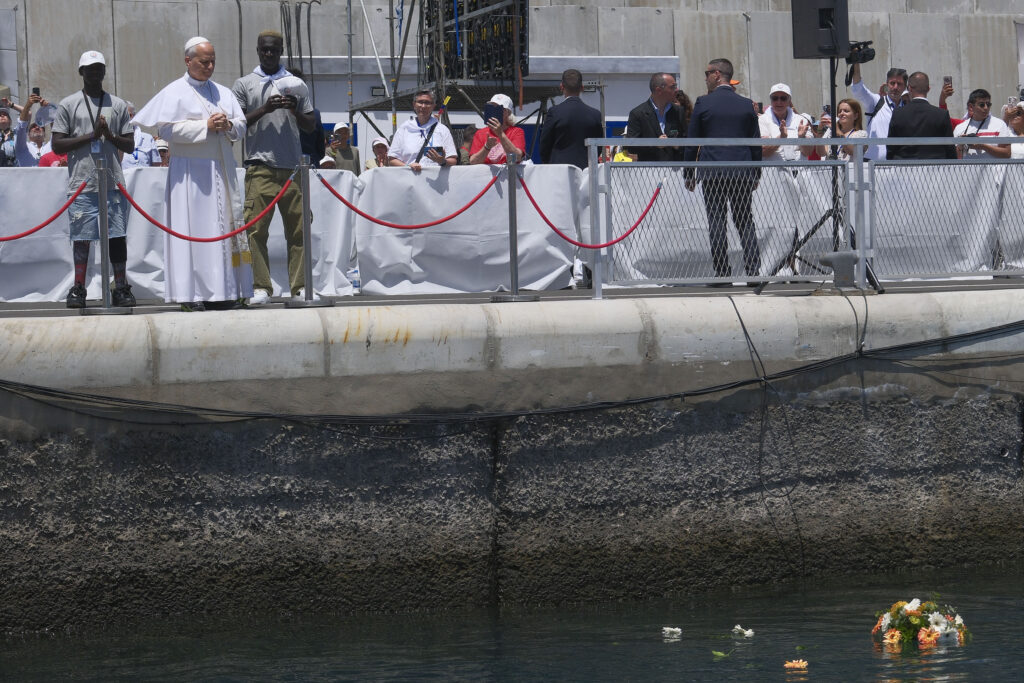
The Church in Spain

In his speech, the king highlighted “the enormous social work of the Catholic Church, fruit of the commitment of religious men and women, priests, deacons, young people who are involved in the life of the parish, volunteers who help in residences, shelters, soup kitchens and shelters”.
Likewise, Felipe VI mentioned “the thousands of missionaries of our country who carry out their social, educational, welfare and pastoral work in so many needy places in the world, often remote or still very disconnected”.

His Majesty also took the opportunity to recall “the cases of abuse, which are not and cannot be representative of the immense ecclesial community”.

A Pope for Today

The King then praised the Pope, “a man of solid scientific formation”. He also highlighted the Pontiff as a man “with a great social conscience and a profound attention to change”.

Felipe VI also made an analysis of current affairs, warning that “we run the risk of forgetting what really matters, of slipping into the mistaken belief that -abolished many of our references by the pulse of current affairs- anything goes, everything is admissible, negotiable and justifiable”.

However, His Majesty affirmed, alluding to the mathematical profile of Pope Leo XIV, “the dignity of the person, human rights, democratic values and international legality must continue to be our prime numbers... Because in them - in their multiple combinations - is the arithmetic of freedom, equality and justice; that which adds and multiplies, not that which subtracts and divides”.

Call for unity

Felipe VI concluded by affirming that “unity as an aspiration arises from the awareness of our fragility as individuals, of our contingency, of our limitations; but also of that inexhaustible capacity for good and beauty that reaches its peak when human beings love their neighbors, when they open up and give themselves to others”.

Spain and Christianity

Pope Leo XIV thanked the King for his words and began by highlighting “the very ancient bond between the Christian faith and this land”, which “although on the one hand does not exhaust the multifaceted identity of your people, on the other hand has deeply shaped its culture and represents a source of hope and guidance among the challenges that today, as a human family, we must face together”.
The Holy Father affirmed that his trip aims to “confirm, encourage and inspire a renewed fidelity of believers to the Gospel, as well as a deeper reconciliation and cooperation among the various forces of this Nation”.

Spiritual Search

For this reason, His Holiness referred to “two figures from this country who, for five centuries, have nourished the life of the Church and the spiritual search of many, even beyond its visible borders”: St. John of the Cross and St. Teresa of Avila.

Following the example of St. John, the Pope said, today “we need, also in public life, men and women who sense, in the darkness, the light; in the end, a possible beginning, almost the bursting forth of a truth as a light that still blinds but that - if we trust and find peace - will lead us gently towards itself”.

Leo XIV insisted that “we need culture, interiority, a free and quality education, we need transcendence”.

In this sense, “the Catholic Church is at the service of this thirst of the human heart”. For this reason, the Pope invited “everyone, for love of the truth, to abandon divisive and polarizing narratives of your social reality and its history, and to move from sterile simplifications to a fruitful appreciation of complexity”.

This, said the Holy Father, is “a specific vocation of Europe, of which Spain is the original and fundamental protagonist”. It is “the gift that the Old Continent can give to the world if it wants to remain young, because young is the one who feels that it has a future and a mission that still challenges”.

Investing in culture and dialogue

For this reason, the Pope affirmed that we must “make a qualitative leap, a change of direction in investments in schools, universities and research, in local communities and in civil society as a seedbed of participation and cultural mediation”.

In addition, the Holy Father alluded to “the presence of Islam in the Iberian Peninsula”, a time when “there was not only confrontation, but also an attempt to create a space for contact, conversation and dialogue on the meaning of truth between Christians, Muslims and Jews”.

Pope Leo concluded his address by encouraging the promotion and cultivation of “dialogue and social friendship, to take into account the perspectives of the poor and the young in imagining the future, to harmonize the demands for autonomy and unity, and to promote the process of European union, not in opposition to other powers, but as a gift for the whole human family.”.

Spain

The Pope is already in Spain

Their Majesties the King and Queen of Spain waited for the Pope at the foot of the stairs of the plane to welcome him to Spanish territory.

Editorial Staff Omnes-June 6, 2026-Reading time: 2 minutes

At 10:12 a.m. on Monday, the ITA Airways plane carrying the Holy Father from Rome touched down at Adolfo Suárez Madrid-Barajas International Airport. With that landing, the fourth International Apostolic Journey of His Holiness Pope Leo XIV, who has arrived in Spain with a message of faith, joy and hope for all, was officially inaugurated.

Reception by the King and Queen and the highest authorities

Their Majesties the King and Queen of Spain waited for the Pope at the foot of the stairs of the plane to welcome him to Spanish territory. Doña Letizia wore white, making use of the privilege enjoyed by Catholic queens to wear that color in the presence of the Pontiff.

Before leaving to receive the Holy Father, the King and Queen greeted the highest representatives of the Church in Spain in the authorities' lounge. The President of the Government, Pedro Sánchez; the President of the Community of Madrid, Isabel Díaz Ayuso; and the Mayor of the city, José Luis Martínez-Almeida, also came to the airport to receive the Pope.

Inside the authorities' pavilion at the airport, the Pope greeted several Spanish families with children with disabilities. He spent some time with each of them, along with the King and Queen of Spain.

Image: EFE:J.J. Guillén

A gesture to the press at 10,000 meters above sea level

During the flight, Pope Leo XIV came to greet the 88 journalists from 55 media outlets from around the world who are accompanying him on this Apostolic Journey. He thanked them personally for their service and for their work, a gesture that did not go unnoticed among the professionals present on board.

The Pope shared with journalists his joy at setting foot on Spanish soil once again, while underlining the character and purpose of this trip:

«I have come many times to Spain, but the first time in this, in this mission. An apostolic visit to come, to meet the faithful, to celebrate the faith, to announce the message of Jesus Christ, but at the same time to greet everyone, all of society, because the Church has a message for everyone, as you will have seen, I think, very clearly in the encyclical letter that was published on May 25.»

The Pontiff also pointed out that this trip will be an opportunity to discover much enthusiasm, especially that of young people; an occasion to live the faith and joyfully proclaim the message of God's love.

Thanks from the organization to the sponsors

This morning, the trip's organizers also released a video thanking the sponsors of the papal visit.

Books

The School of Salamanca and the French Revolution

The influence of the Christian humanism of the School of Salamanca and the ideas of freedom of Francisco de Vitoria served as a theoretical basis for the great liberal revolutions, including the French Revolution.

José Carlos Martín de la Hoz-June 6, 2026-Reading time: 4 minutes

Francisco de Vitoria began his career as a professor in the Faculty of Theology at the University of Salamanca in 1526 and, with this, he initiated what has been called the School of Salamanca. In other words, a new style of approaching humanistic, literary and scientific work; in fact, many international congresses on the subject are being held this year.

In fact, the School of Salamanca has gone down in history as the passage from Renaissance humanism to Christian humanism and, furthermore, thanks to Grotius, a faithful disciple of Vitoria, the human rights that had been emphasized by the School of Salamanca were internationalized.

The Enlightenment was able to spread very quickly because Christian humanism was based on man and, in particular, on everything that concerned the dignity of the human person and the balance between faith and reason.

Roots of liberal revolutions

Let us remember that in the face of extremes, the tendency of the human being always lies in the balance of the middle ground: thus, Lutheranism would be pure fideism and, at the other extreme, Voltaire would show a scientific and profoundly anticlerical Enlightenment, distrustful of God and the Church.

Certainly, the Christian humanism of the School of Salamanca managed to impose its love of freedom and human rights in order to offer theoretical coverage to both the Independence of the United States and the French Revolution and, finally, it would lead to a liberal humanism that crystallized in the Cortes of Cadiz of 1812 and in the Constitutions of other countries in Europe and America.

Precisely, the extensive work of Robert Darnton (New York, 1939), professor at Princeton and Harvard, will help us to discover Vitoria's ideas on freedom in the background and at the time of the French Revolution (1748-1789).

The «revolutionary temperament»

In fact, our author will begin by discussing the “collective conscience” that will be produced in Paris from the beginning of the war of succession in Austria in 1740 and in the successive events that will converge in 1789 with the beginning of the French Revolution. This is what our author will call “the revolutionary temperament” (17). Logically, the revolutionary temperament that will act in 1789 will be nourished by the ideas of freedom that Francisco de Vitoria set in motion in Europe when he confronted Emperor Charles V with his defense of freedom and the dominion of the Indians of America. The support for the independence of America in France was total and complete (245).

The power of public opinion

It is interesting the relation of the means of information used by the thinkers in the salons of Paris to create public opinion and to magnify or silence the news and rumors in operative ideas destined to change the course of events. The origin of the public opinions that had to be held should also be pointed out, for they forced Christian humanism to give accurate conclusions and criteria to the people who were to govern the country or important houses. We cannot fail to emphasize that music and literature were also means of information and formation of public opinion (22).
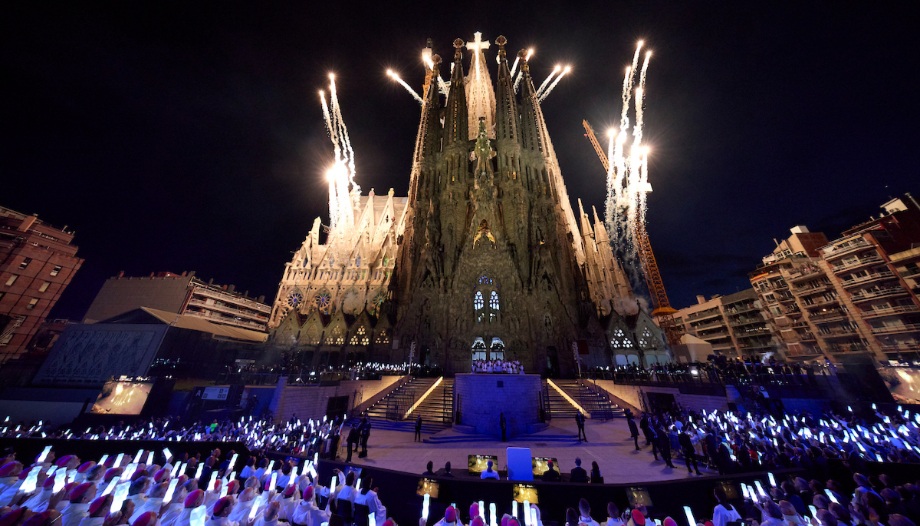
The exacerbated criticisms of the nobility and the life of the Court that ran through Paris, both from literary works, such as those of Voltaire, as well as those of other playwrights, operas or minor genres that, logically, made the Parisians exaggerate, who distorted the facts that arrived from the Court. Envy immediately appeared, mixed with fierce criticism against the Jesuits, who were the confessors of the kings and their court chaplains, and were accused of allowing such ravings of luxury and bad manners (51, 151). Much of the blame for the hatred of the monarchy comes from literary works and, above all, from Voltaire's theater (137).

Religious tensions and social unrest

We must also add the infighting within the French Church between the Jesuits, who persecuted to the death the “Jansenist saints” to the point of preventing them from being buried in cemeteries and sacred places as heretics, and, on the other hand, the Christian people, who saw the Jansenist “saints” as more consistent with the faith and more faithful to morals than the Jesuits, who were always in favor of probabilism and other moral entanglements (61). The hatred of the Jesuits among the people was in crescendo (124).
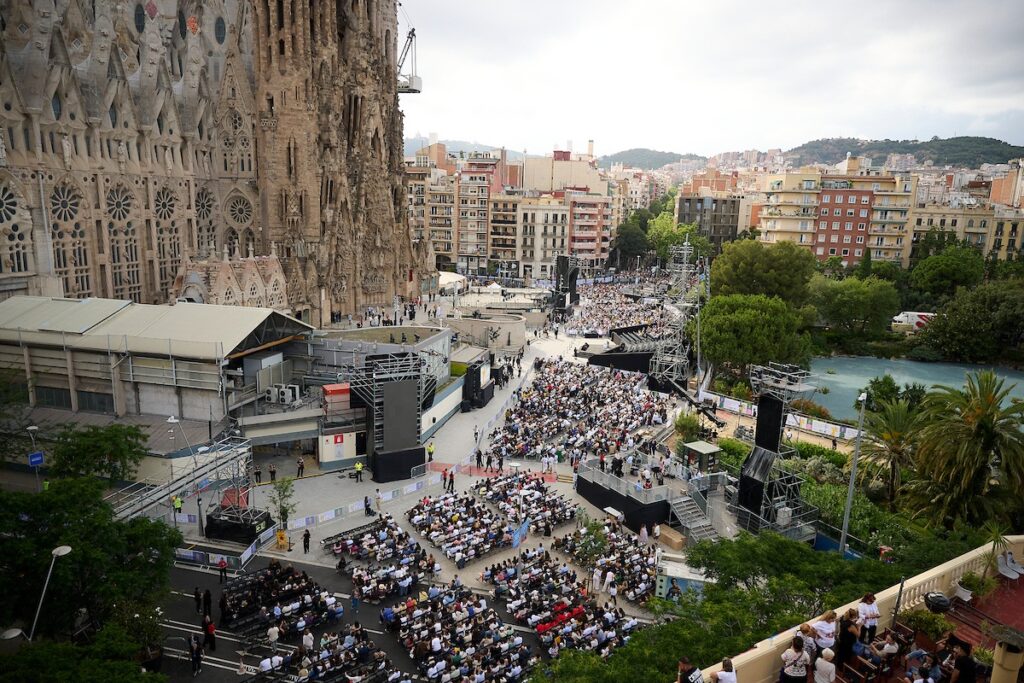
Interesting is the description of the seizure of the city of Paris by the people in 1750 in the face of rumors that the police were capturing lonely, abandoned and beggar children of 10 to 12 years of age from the streets of Paris to take them in ships to America (Mississippi) to work in a false silk business, as a way to clean the streets of needy and petty thieves (73). There is talk of masses of 15,000 people (75). It seemed like a rehearsal for the storming of the Bastille (485).
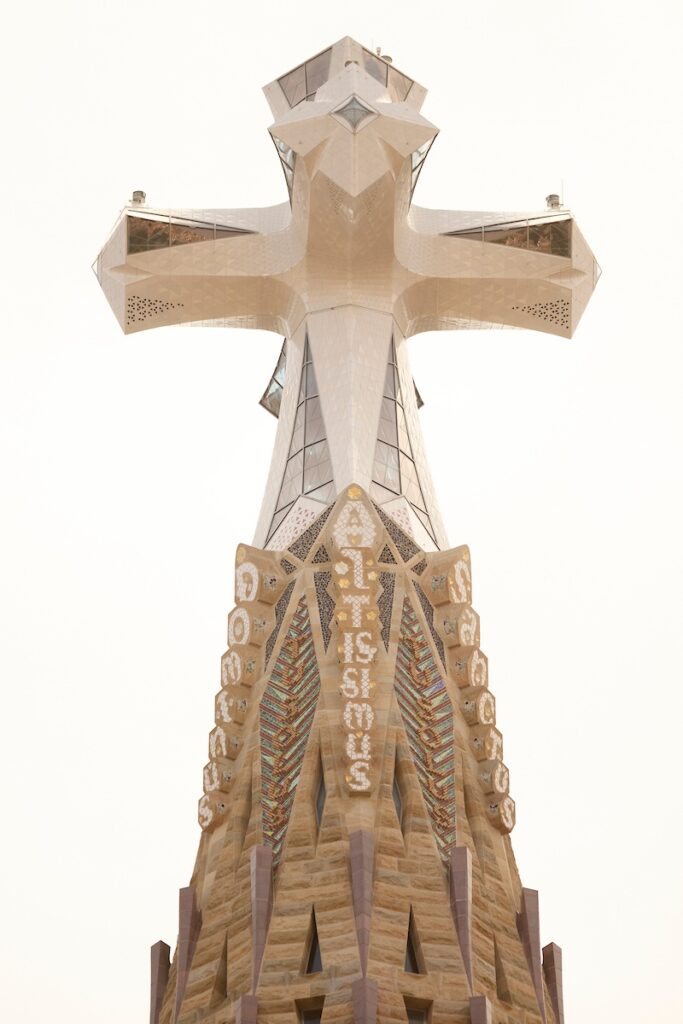
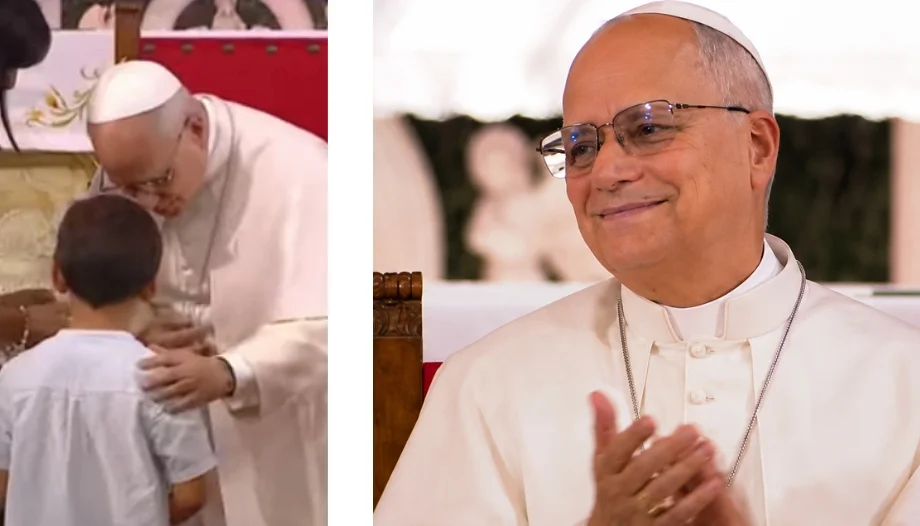
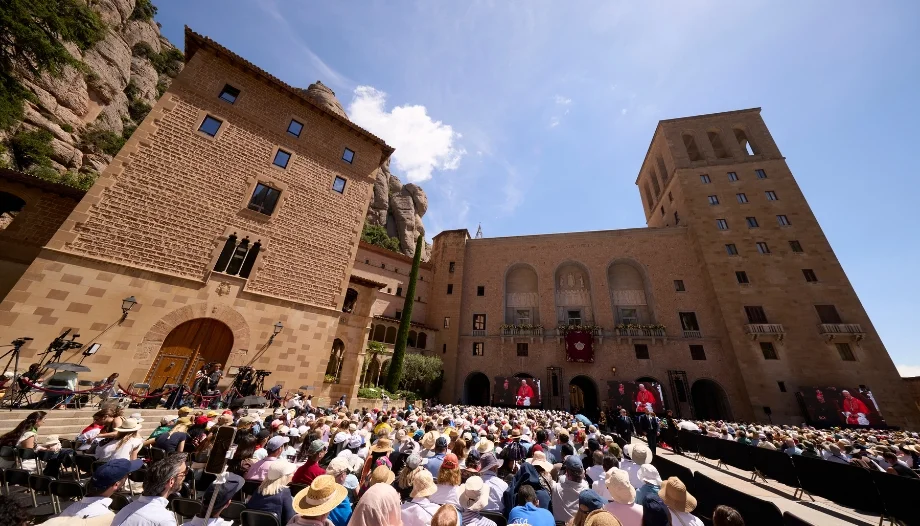
Tax justice and the impact of the Encyclopedia
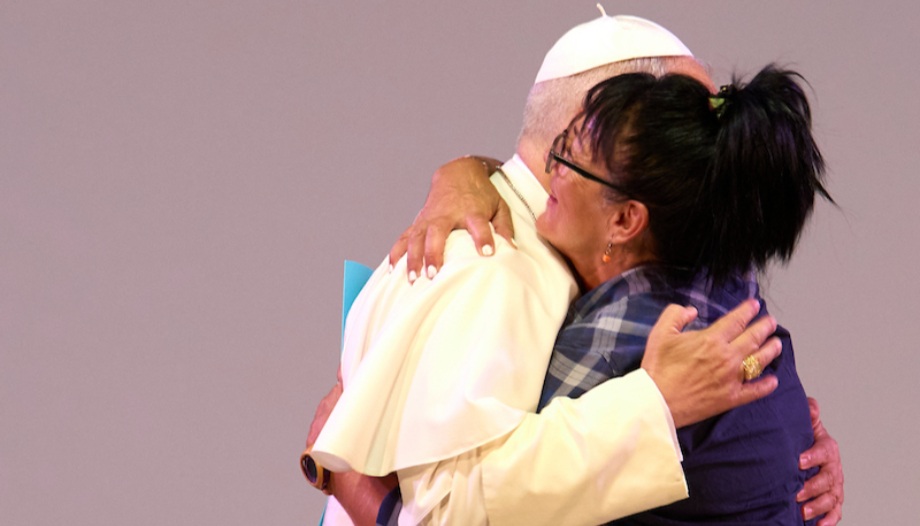
With respect to fiscal policy, we must remember the wise recommendations of Francisco de Vitoria in his relections on civil power regarding the excessive taxes that the monarchs imposed not only on the nobles of the kingdom but also on the sovereign people. One of the causes for which Vitoria admitted civil revolution was when taxes were excessive and redounded not to the common good, but to the particular good of the kings and the Court: this is precisely the case of France (80, 111).

With respect to the Encyclopédie and the sharing of new scientific and geographical knowledge during those years of the Enlightenment, there was an anticlerical mentality that accused the Church of having kept the people in ignorance with false dogmas and erroneous beliefs. As Blom has shown, the success of the Encyclopedia is not the science it describes, but the mentality it conveys (97).

It is worthwhile to read carefully the final chapters of this documented work, which narrates the beginning of the government of the people manipulated by heartless people who only sought their personal enrichment and to save their lives.

The revolutionary temperament

AuthorRobert Darnton
Editorial: Taurus
Year: 2025
Number of pages: 630

God or nothing

Brother Vincent's story invites us to reflect on the fundamental choice of life: God or nothing. It is a call to rediscover that only in God does the human heart find rest.

June 6, 2026-Reading time: 2 minutes

Vincent died at the age of 37. This monk, whose multiple sclerosis totally prostrated him during his last years and even deprived him of the ability to speak, had a strong impact on Cardinal Sarah, who, after meeting Brother Vincent de la Resurrection, wrote The power of silence

In this book, the purpure wondered: “Who was looking for Brother Vincent? Who came to take him away without a word? God. For Brother Vincent-Marie de la Resurrection the program was simple. It was summed up in three words: God or nothing.”.

God or nothing.

This is the essential dichotomy that marks our life: to choose God or to choose nothingness; eternity or our finitude (more or less long-lived and limited); the path to life or the sorrowful path to death. 

The logic of Christ's Incarnation, that of the God who shares our human condition, is what makes it possible for this choice not to be a chimera: it is inscribed in our nature. 

We have been created out of Love for eternal life and for human life. And one and the other start from the same creative root of God.

God or nothing.

God searches for us every day, as He did for Brother Vincent. “I am my beloved's, and he seeks me with passion.”, we read in the Song of Songs.

God is that creator who asks for us, as St. Josemaría Escrivá recalled in his Way of the Cross. In the hour of life, and in the hour of death, which is another step to life.

Perhaps, too often, we forget that God is greater than the God I imagine, who is everything.

Perhaps that is why we have reduced, not infrequently, the Church to a staff of more or less good (or more or less unbearable) people, and the sacraments to a kind of subway ticket that requires putting on a jacket. 

Perhaps that is why we think that our limited, pocket solutions are better. And we invent liturgies to “reach more people”, and “listeners” to try to heal the wounds of so many who, deep down and in form, are looking for the God of life, the God of the Eucharist, the God who is everything. Because: “You have made us for yourself, Lord, and our heart is restless until it rests in You.” (St. Augustine. Confessions, i, 1, 1).

The Vatican

Spain: a land visited by Popes

Spain has received eight papal visits since the beginning of modern apostolic journeys, with five trips by St. John Paul II and three by Benedict XVI.

Editorial Staff Omnes-June 5, 2026-Reading time: 3 minutes

Spain has been one of the nations that has most frequently welcomed the last pontiffs. Since the beginning of the custom of papal trips, With St. John Paul II, Spain has received John Paul II and Benedict XVI on 8 occasions in total, in different cities and for different reasons, including two World Youth Days. 

John Paul II: 5 visits

The custom of papal trips, it should be remembered, began with St. John Paul II. The Polish Pope visited Spain on 5 occasions: in 1982 with a 10-day trip in which the pontiff visited places such as Alba de Tormes, Salamanca, Zaragoza, Seville, Madrid, Barcelona and Valencia. 

In 1984, the Polish Pope landed in Spain for an almost «express» visit before continuing his apostolic journey to the Dominican Republic and Puerto Rico to inaugurate the novena in preparation for the V Centenary of the evangelization of America. On this occasion, Zaragoza was the Pope's host city and there he prayed before the Virgin of Pilar.

Seven years later, in 1989, St. John Paul II celebrated the IV World Youth Day. It was a trip in which the Pope made the last stage of the Way of St. James on foot, entering the cathedral as a pilgrim of honor and fulfilling the traditional rite of touching the mullion of the Portico de la Gloria. There he presided over the vigil on Monte del Gozo and the central mass of the WYD. In Covadonga, at the feet of the «Santina», one of the most memorable visits of a Pope to Spain would end.

St. John Paul II distributes communion to a young woman during World Youth Day at Monte do Gozo, near Santiago de Compostela, Spain, in August 1989 (Photo OSV News/L'Osservatore Romano, Arturo Mari).

The next visit of John Paul II was in 1993. It was a trip in which the Pope visited southern Spain in a special way to celebrate the V Centenary of the evangelization of America. On this occasion, the pontiff closed the XLV International Eucharistic Congress in Seville, and also visited Huelva and Madrid.

The last trip of Pope Wojtyla to Spain was in 2003 and, during that visit, the Pontiff canonized Pedro Poveda, José María Rubio, Genoveva Torres, Ángela de la Cruz and María Maravillas de Jesús. During those days, the Cuatro Vientos air base was the scene of the last meeting of the Polish pope with young Spaniards. 

Benedict XVI: 3 major events

Benedict XVI was in Spain three times as Supreme Pontiff.

The first time was on the occasion of the closing of the V World Meeting of Families. The Valencian capital welcomed more than one million people who accompanied the Bavarian Pope on that occasion. Benedict XVI He would return to Spain four years later, in 2010, on the occasion of the Compostela Holy Year and the consecration of the Sagrada Familia in Barcelona.

Pope Benedict XVI waves from the popemobile upon his arrival at the Fifth World Meeting of Families in Valencia, Spain, July 8. The pope urged parents to be open to life and to create a home based on love, acceptance and mercy (Photo by CNS/Marcelo del Pozo, Reuters) (July 10, 2006).

In 2011, Madrid hosted the World Youth Day presided over by Joseph Ratzinger. An event that brought together nearly two million young people from all over the world and that left iconic images such as the Pontiff praying with the young people in the midst of a strong summer storm and a gale that hit the venue.

Pope Benedict XVI waves from his popemobile upon his arrival at Cuatro Vientos airfield in Madrid to celebrate the closing mass of World Youth Day August 21, 2011. (Photo by OSV News/Andrea Comas, Reuters)