Evangelization

“The most a spiritual director can do is suggest and ask questions, but it is the person being guided who makes the decision.”

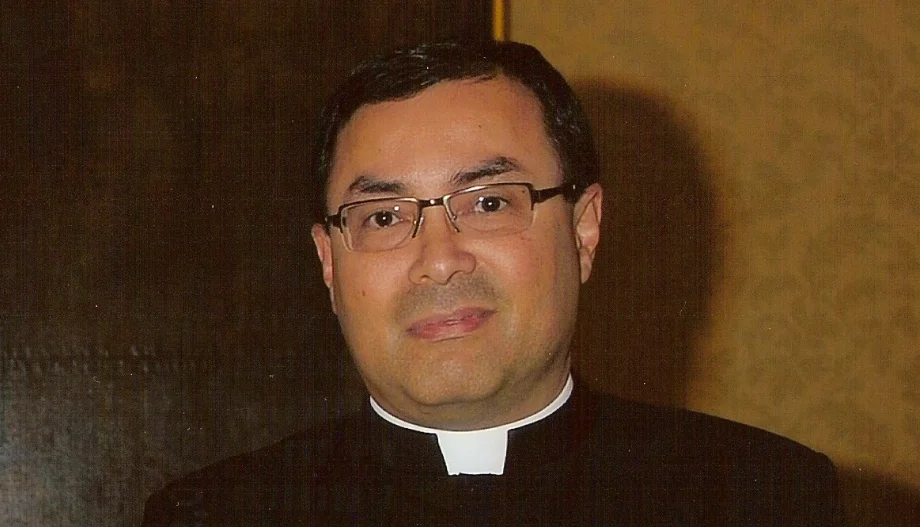
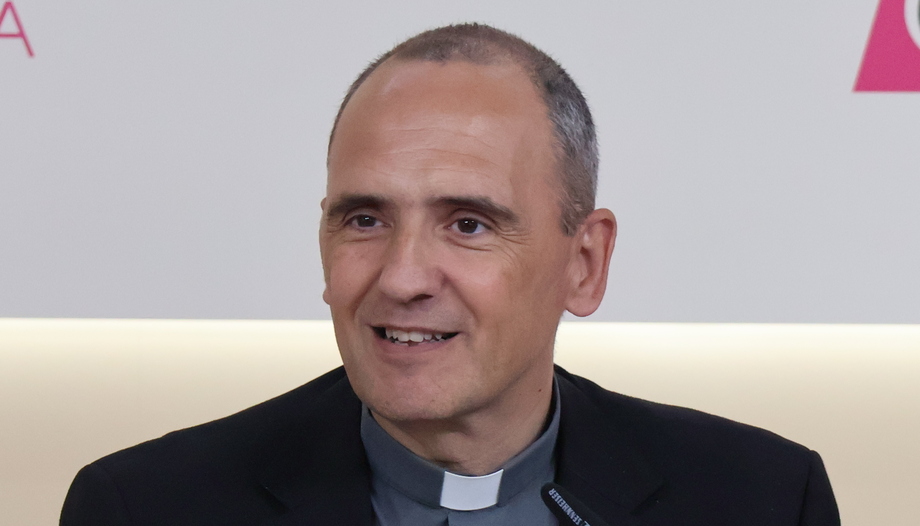
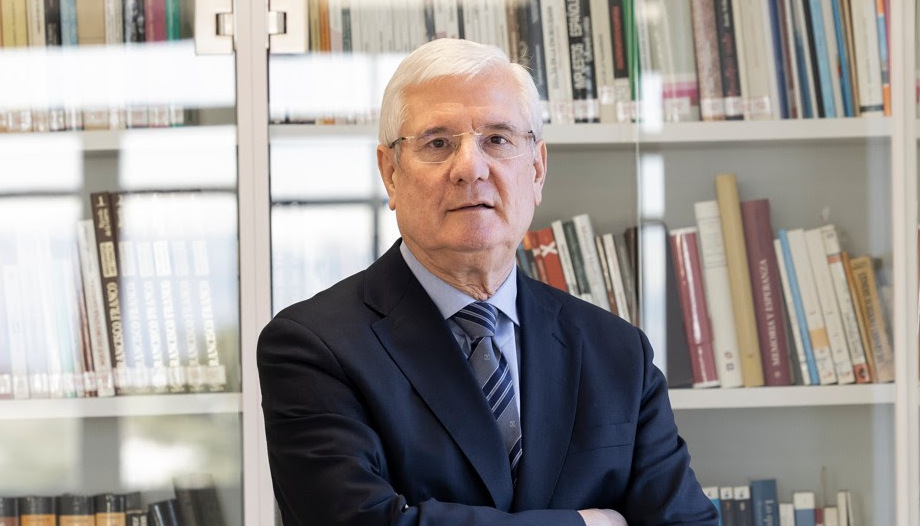
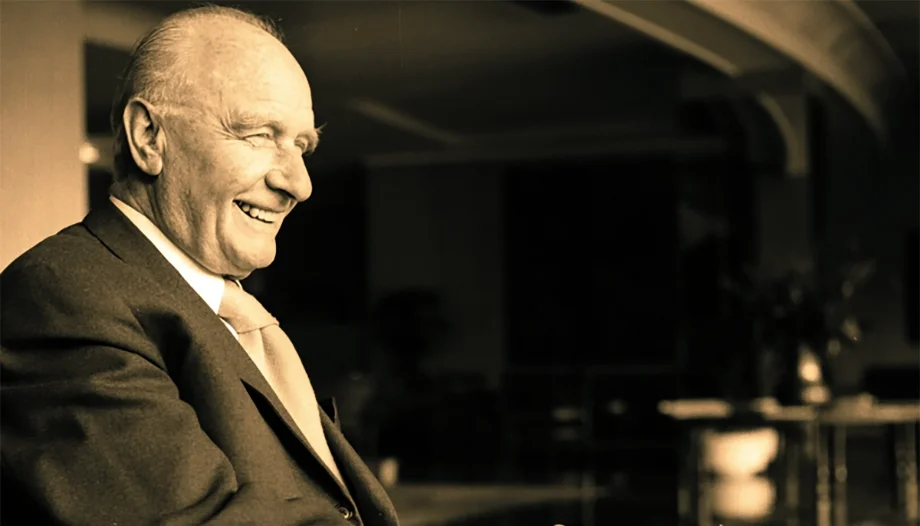
An interview with Manoel Augusto Santos, a priest from Porto Alegre, Brazil, who has just published a Manual on Spiritual Direction.

Javier García Herrería-July 28, 2026-Reading time: 3 minutes

In an age marked by hyperconnectivity, identity crises, and the constant search for quick answers, nurturing our inner life has become a challenge that goes against the grain. How can we find peace, discern God’s will in our daily lives, and move toward holiness amid the noise of everyday life? To answer this, the Church has for centuries safeguarded an immense treasure: spiritual direction.

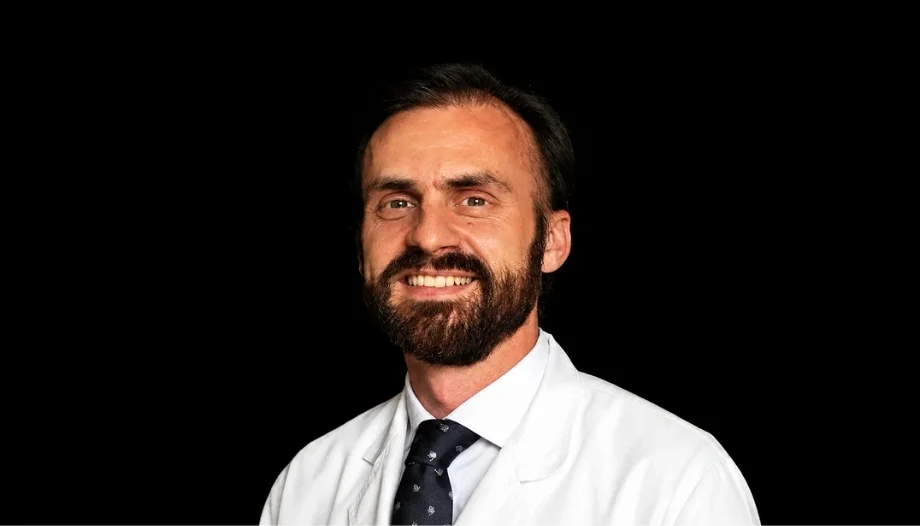
To explore this path further, today we speak with Father Manoel Augusto Santos, a priest of the Archdiocese of Porto Alegre (Brazil) who was ordained in 1990. Father Manoel is a chemical engineer and holds a doctorate in theology from the University of Navarra. Throughout his ministry, in addition to his work as a university professor, he has served the universal Church directly at the Vatican as an official of the Congregation for the Clergy.

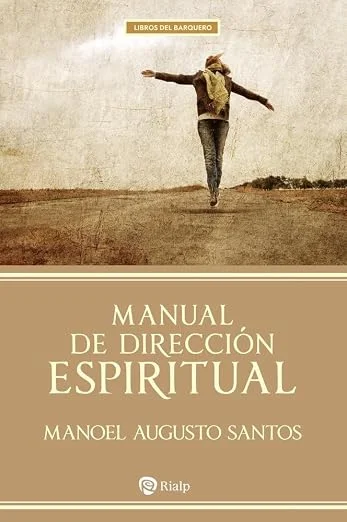
He has captured all of that perspective—both theological and rooted in pastoral experience—in his new book: Spiritual Direction Manual (Rialp), a practical and educational guide designed both for those who have the delicate task of guiding souls and for those being guided who seek to make the most of this means of sanctification.

What prompted you to put your experience into a manual?

–After teaching a course on spiritual direction organized by the National Conference of Bishops of Brazil to the rectors and spiritual directors of the seminaries in the Northeast III Region, the rector of the main seminary in that region, on behalf of the participants, asked me to put what I had presented in writing.

Who is the primary target audience for this book?

–This book is intended for spiritual directors and those receiving spiritual direction, as well as those who wish to become spiritual directors and even those who wish to be good candidates for spiritual direction.

If you had to summarize the main thesis of your manual in a single sentence, what would it be?

–Human beings are not born fully formed, but are shaped—with God’s grace and, in a special way, with the help of spiritual direction.

What are the most common mistakes or pitfalls that a spiritual director should avoid?

–Superficiality, insincerity, and a lack of commitment on the part of the subordinate. Failing to take seriously the fact that the subordinate is a human being; the need to be a good subordinate in order to be a good manager; the temptation to dominate and give orders; and self-sufficiency on the part of the manager.

It seems that, in recent decades, the Church has been shifting its approach to spiritual direction—from, shall we say, a perspective of blind obedience to the spiritual director to one of accompaniment that fosters inner freedom in accordance with God’s will. Is this assessment accurate?

–Yes, we should not try to create remote-controlled robots, devoid of the capacity for choice and opinion, through obedience, but rather to shape minds with discernment, capable of making use of freedom. The most a director can do is suggest, question, and draw attention to certain points, but it is the person being guided who makes the decisions, bearing full responsibility.

These days, many people turn to AI for advice on health or personal development. Some also do so in connection with their spiritual lives. What are your thoughts on this phenomenon?

–AI is becoming increasingly prevalent in academic, legal, medical, and family life, among others. And it’s here to stay. We’re already experiencing what was science fiction just a few years ago. There’s no point in trying to turn back the clock. It can be used prudently and judiciously, while continuing to seek out highly reliable sources. What does the future hold for us?

These days, there’s more talk about spiritual abuse. What are your thoughts on this phenomenon? Is it being properly contextualized?

–It’s a complex problem. Undoubtedly, there have been a number of situations that should have been avoided through training rather than just orders. There is also goodwill, but there is a lack of human and spiritual maturity.

For someone who has never had a spiritual director and feels the desire to find one, what advice would you give them to take that first step?

–Pray, asking the Holy Spirit for the wisdom to recognize someone who is learned and holy, and that he himself take spiritual direction seriously.


Spiritual Direction Manual

Author: Manoel Augusto Santos
EditorialRialp : Rialp
Year: 2026
No. of pages: 372
The Vatican

Pope Leo to Young People: «Jesus Doesn’t Want You to Be Idlers»

The Pope encouraged young people to use social media responsibly and to ask themselves what God's mission is for their lives.

OSV / Omnes-July 28, 2026-Reading time: 3 minutes

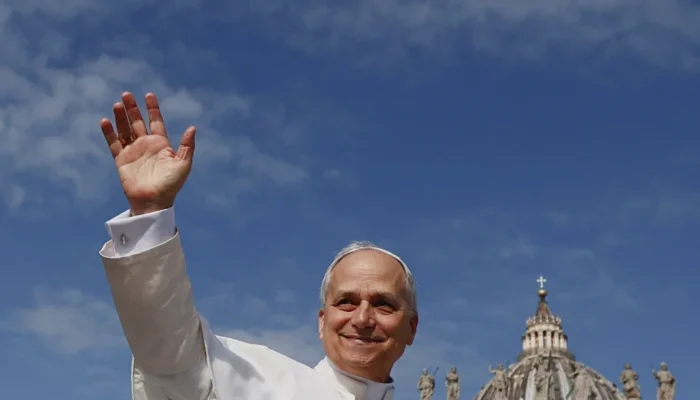
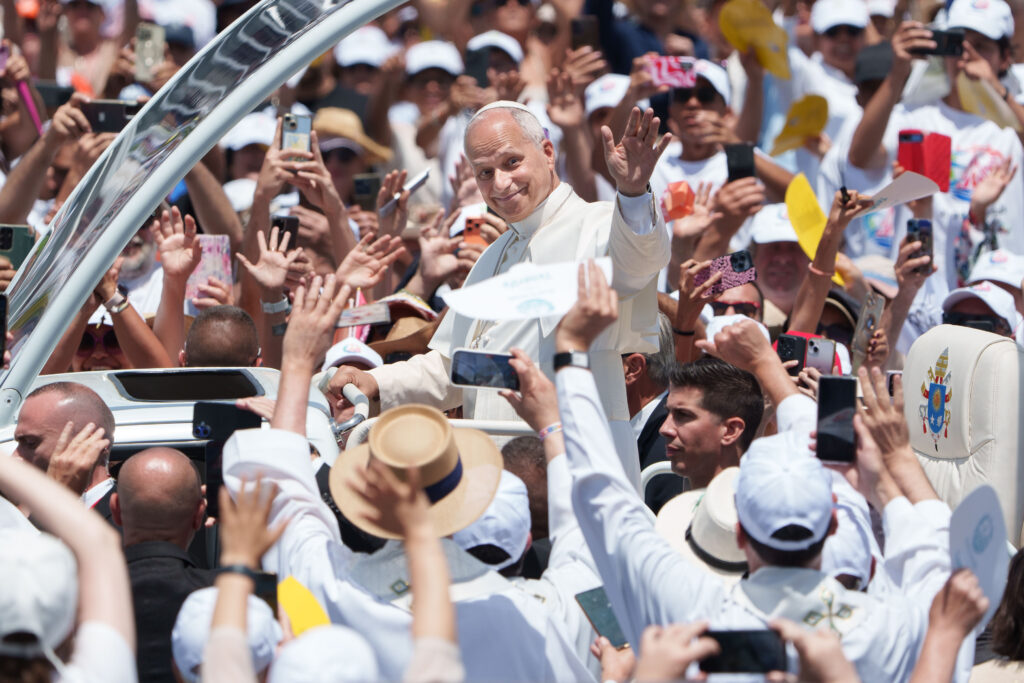
Pope Leo XIV urged young people not to be «TV addicts» in a video message on July 25, adding that the Church needs their missionary energy and their «holy rebellion.».

«Jesus does not want you to be ‘lazy young people,’ complacent, or content with the comfort of ‘that’s just the way it’s always been done,'» said Pope Leo, quoting the phrase in Spanish that Pope Francis used during his address at World Youth Day 2016 in Krakow.

The Church needs young missionaries

In a video message in Spanish sent to young people in Chota and Cutervo, Peru, on the occasion of their second Diocesan Youth Day, the Pope urged young people to «feel the call to be missionaries in their schools, their universities, on their streets, and in their fields.».

«The Church »needs your holy defiance, your pure energy, and your desire to transform situations of suffering into spaces of hope,«» said the Pope. "Serve with joy, especially the most forgotten, because that is where you will find the suffering face of Jesus.".

It was one of three video messages that Pope Leo XIV sent to youth gatherings around the world over the weekend.

In a video message dated July 26 addressed to the Aleluya Festival in Fortaleza, Brazil, Pope Leo XIV highlighted the example of St. Charles Acutis, encouraging young people never to lose the «missionary zeal that is essential for transforming this world, which desperately needs the Gospel.».

The Proper Use of Technology

«Even today, there are still many people who need to know that it is Jesus who answers their deepest longings, revealing to human beings the truth about themselves,» he said in Portuguese. «Therefore, proclaim with courage that a life without Christ is a life without grace. He is the way, the truth, and the life; it is he who gives meaning to existence and to all things.».

«Let us be inspired by the example of St. Charles Acutis: He shows us how to always keep Christ at the center, even in our use of technology,» Pope Leo told the young people of Brazil, urging them to use social media and artificial intelligence «in a moderate and disciplined way,» and warning that such tools can drag people into «an unreal world where the ephemeral, mere appearances, and deception end up taking the place of true values and what really matters.».

Enthusiasm

The Pope acknowledged that the enthusiasm felt during a celebration such as Easter can fade over time, and said that to maintain it, it is necessary to remain in God’s presence through prayer, with «constancy, perseverance, and the firm certainty that the Heavenly Father never abandons us.».

Quoting Pope Benedict XVI, he added: «Do not be afraid of Christ! He takes nothing away from you and gives you everything.».

In a third video message, sent to the young people gathered in Lamego, Portugal, on the occasion of the second National Youth Day «Rejoice,» Pope Leo reflected on his recent encounters with young Catholics—from the Youth Jubilee in Rome to a youth vigil during his apostolic trip to Spain—and expressed his excitement for World Youth Day, which will be held in Seoul, South Korea, in August 2027.

«It’s always special to be with young people, because the enthusiasm of your faith is contagious!» said the Pope.

Pope Leo encouraged young people to «channel their restlessness so that, in moments of prayer and silence, in dialogue with God, they may ask Him: “Lord, what do you want me to do in the Church and in the world? What is my vocation? Are you calling me to start a family through marriage? Or are you calling me instead to the priesthood? Or to religious life?”»

«Do not be afraid of the unease you feel! Make the most of that impulse to draw even closer to Christ and bear witness to the values of the Gospel,» said the Pope.

By Courtney Mares, OSV News

The authorOSV / Omnes

Read more

It's easy to get to know Jesus

Reading about the life of Jesus in just five minutes a day is much easier than it seems. Discover how to go through all four Gospels in less than three months using this simple method.

July 28, 2026-Reading time: < 1 minute

We may have thought that reading the Gospel is very complicated because it is so long, and that we will never have time to read all four accounts in their entirety. But appearances can be deceiving.

We can start reading the Gospel of Saint Mark, which is the shortest of them all. It has sixteen chapters, all of similar length. I’ve tried it myself: if you spend just five minutes reading one chapter a day, in barely sixteen days you’ll have read the entire life of Jesus. That way, we’ll learn about his miracles, his parables, his love for sinners, and who the apostles were. Finally, we’ll also discover how much He loves us in the Eucharist, and through His Passion, Death, and Resurrection, until He bids us farewell at the Ascension. But at the same time, He remains with us in the Eucharist, gives us His Mother as our Mother, and sends us the Holy Spirit.

Likewise, the other three Gospels show us what is essential, each with its own characteristics. The Gospel of St. Matthew has the most chapters, with twenty-eight; St. Luke has twenty-four, and St. John has twenty-one. In other words, if we add up the chapters of the four Gospels, they total eighty-nine.

If we continue reading—after St. Mark's— Five minutes every day, and in less than three months we’ll have read everything Jesus wants us to know through the four Gospel writers. And the more we read them, the better we’ll come to know Jesus. Reading the Gospels is always the best choice because they are the most important books, being inspired by God. Once again: good things, if brief, are twice as good.

Read more
Evangelization

Francisco Garcés: A Missionary in the Sonoran Desert

The little-known story of missionary Francisco Garcés is full of fascinating accounts of his experiences while spreading the Gospel.

OSV News Agency-July 28, 2026-Reading time: 5 minutes

– OSV News / Jeremy Beer

Enthusiasm for missions was a phenomenon that spread throughout Europe during the pious 17th century.

Eusebio Kino was born eight years after his colleague, the priest and explorer Jacques Marquette, in the Italian Tyrol. Like the famous Father Marquette, he joined the Jesuit order at a young age and soon felt a strong desire to become a missionary. Sent to Mexico City in 1681, this energetic, handsome, and charming priest went on to found two dozen missions in Baja California, Sonora, and present-day Arizona before his death in 1711. He was declared “venerable” in 2020.

But Kino, who spent little time within the borders of what is now the United States, is not the protagonist of this story; rather, it is his most capable successor at the remote mission of San Xavier del Bac: a Franciscan friar named Francisco Garcés.

A native of the Spanish province of Aragón, Father Garcés arrived in 1768 at San Xavier, located a few miles south of Tucson. Over the next eight years, he would undertake a series of incredible journeys—which the Spanish called “entradas”—into the unknown lands (at least to Europeans) to the north and west.

Like Father Marquette, he left behind a valuable documentary record of the lands he discovered and the indigenous peoples he encountered. Like Father Marquette, he also left a legacy of peaceful relations and deep respect for the indigenous peoples of the Southwest.

Collaboration with Saint Junípero Serra

Father Garcés’s first two “expeditions” took him north to the Gila River. As he continued westward, he discovered—thanks to the friendly peoples living there —tribes known today as the O’odham and the Piipaash—that there were trade and communication ties with the indigenous peoples living along the California coast, where his acquaintance and fellow Franciscan friar, Junípero Serra, had recently begun founding missions.

This was important because the Spanish did not know of a land route to Upper California from the northwestern border of New Spain—present-day Sonora and Arizona.

For this reason, Father Garcés set out to find one. In the summer of 1771, traveling with meager provisions, without any other Spaniards, and with indigenous guides whom he hired along the way, he made his way on the back of a mule through the scorching, arid Sonoran Desert until he reached the confluence of the Gila and Colorado Rivers.

He was greeted by a man known to the Spaniards as Salvador Palma, a powerful chief of the Quechua Indians who controlled the area. Against the advice of his hospitable hosts, Father Garcés continued westward through even more inhospitable territory until he caught sight of the mountain range that he correctly surmised stood between him and the coast.

Three years later, Father Garcés repeated the feat, this time as the lead guide on an official expedition that included 20 soldiers led by a frontier military officer named Juan Bautista de Anza.

Barely surviving, thanks mainly to water found in remote mountain jars, Anza’s expedition managed to make its way from the Spanish presidio at Tubac, Arizona, to Yuma, and from there to the Mission of San Gabriel, on the outskirts of present-day Los Angeles, where those emaciated, dirty, and ragged men were joyfully welcomed by four friars dressed in rags. Father Garcés celebrated Easter in 1774 with St. Junípero Serra at the San Diego Mission before returning to San Xavier del Bac.

Solo Exploration

The success of Anza’s expedition led Spain to organize another one in 1775. This time, Anza would lead nearly 300 men, women, and children to Monterrey and San Francisco to become the first true European settlers of Alta California. Father Garcés left that expedition at Yuma. From there, he undertook a truly extraordinary solo exploratory journey that, for the first time, revealed to European eyes much of what we now know as the American Southwest.

His goal was to identify a better route both from Sonora to Monterrey and from Monterrey to New Mexico. Over the next 10 months, he traveled down the Colorado River to its mouth, then traveled upriver to the vicinity of present-day Laughlin, Nevada (the first European to set foot in that state), then crossed the unforgiving Mojave Desert to the Mission of San Gabriel, entered California’s great Central Valley via present-day Bakersfield, returned through the Mojave and northwestern Arizona to the Grand Canyon (where he made a terrifying descent to visit the Havasupai, who lived—then as now—near the famous waterfalls that bear their name) and continued further east to the Hopi village of Oraibi, before finally returning to San Xavier del Bac.

In general, Father Garcés found both a receptiveness to the Gospel (he discovered that a banner depicting the Virgin and Child on one side and a man suffering the torments of hell on the other worked wonders in conveying his fundamental message) and a hospitality that saved souls (he often carried very little or no food in his luggage).

The locals“ hospitality wasn’t even reserved exclusively for human beings. One day, his mule got stuck in a muddy patch. The Cocopah Indians with whom he was staying ”all rushed to help him, carried the mule out in their arms, and took it to the fire so it could warm up.”.

Exchanging a horse for the freedom of female slaves

Father Garcés’s diary is full of heartening incidents like this one. However, there was also much darkness. Along the Colorado River, for example, Father Garcés encountered a group of Chemehuevi who were carrying two Halchidhoma girls captured as slaves. Slavery was practiced throughout the Native American world, and although it was illegal, the Spaniards on the frontier encouraged this trade by frequently buying and keeping slaves—a practice that religious figures like Father Garcés devoted much time and ink to denouncing and criticizing. As for the Halchidhoma girls, Father Garcés gave a horse in exchange for their freedom.

Intertribal warfare was as endemic as slavery among tribes. As humble as he was resilient, Father Garcés had a special talent for winning the trust and friendship of the natives (one of his fellow friars said that Father Garcés was “so well-suited to getting along with the Indians and moving among them that he seems very much like an Indian himself”), and wherever he went, he tried—sometimes successfully—to negotiate peace agreements. He dreamed of founding a dozen or more new missions in what is now Arizona and southern California, not only to save Native souls but also to spread what he saw as the manifest blessings of Spanish civilization, primarily civil peace.

It was not meant to be that way. Spain’s failure to keep its promises, reckless military leadership, and the Quechua people’s mistrust led to an uprising in Yuma in July 1781, during which Father Garcés and three other friars, along with 127 other Spaniards, were killed.

The monument to Father Garcés that stands today along the Colorado River, across from the San Tomás Indigenous Mission, is more impressive than the one honoring Father Marquette in St. Ignace, Michigan. However, it receives even fewer visitors.


This article was first published in English on OSV News. We are reprinting it on Omnes with permission. You can read the original article HERE.

The authorOSV News Agency

Spain

Bishop Alejandro Arellano will preside over Family Day in Torreciudad while awaiting the Vatican's decision

The Shrine is also highlighting the testimony of a couple who are digital missionaries, following last year’s success with Nachter and Rose.

Javier García Herrería-July 27, 2026-Reading time: 2 minutes

The Torreciudad Shrine is preparing to host the 34th Annual Marian Family Conference, a festive gathering that brings together thousands of families every year for a day of prayer, fellowship, and devotion under the protection of the Virgin Mary.

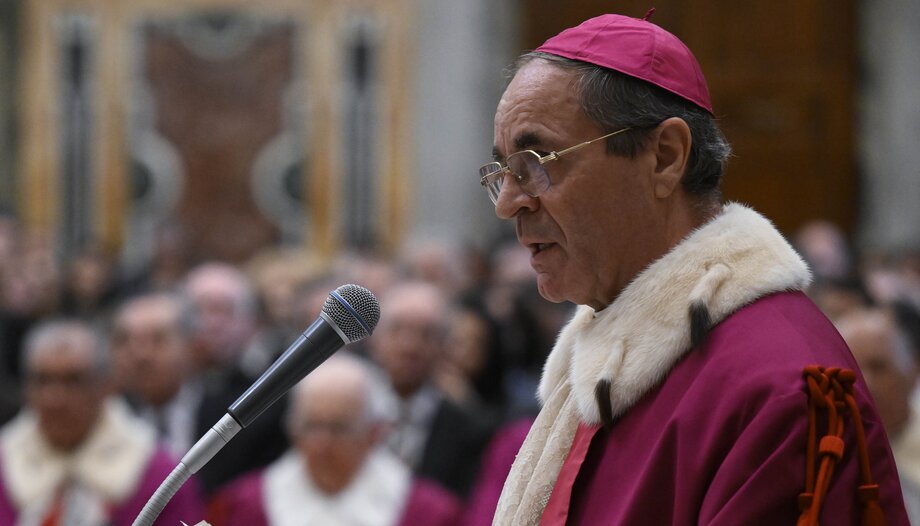
This year's event will feature a particularly significant ecclesiastical presence: the main Mass and the principal ceremonies will be presided over by Archbishop Alejandro Arellano Cedillo, titular archbishop of Bisuldino and Dean of the Tribunal of the Roman Rota.

A Key Figure at the Decisive Moment for the Shrine

Bishop Arellano’s participation in this large-scale event is drawing particular interest due to the role he is carrying out at the direct request of the Holy See. The prelate was appointed Pontifical Commissioner with full powers for the Torreciudad complex in order to investigate and resolve the legal and administrative dispute between the Diocese of Barbastro-Monzón and the Prelature of Opus Dei regarding the canonical status and regularization of the shrine.

While the parties involved and the church community await the final ruling and the proposed resolution being drafted by the Toledo-based jurist, Arellano’s presence as the principal celebrant underscores the atmosphere of institutional normalcy, pastoral closeness, and connection with the faithful that characterizes daily life at the Marian shrine.

A program packed with events for the whole family

The program on September 12 will begin at 9:00 a.m. with the opening of the grounds and confessions, followed at noon by prayer, the traditional offerings, and the Solemn Holy Mass at 12:30 p.m., followed by the children’s heartfelt presentation to the Virgin Mary.

After the lunch break, the afternoon will feature a combination of music and a performance by the Alborada School Choir, as well as a discussion on dating and marriage titled «Let’s Talk About Love… for Real,» led by Quique Mira and María Lorenzo, and the recitation of the Holy Rosary with a Solemn Exposition, which will bring the day to a close at 5:00 p.m.

Read more

The Trap of Victimhood: Why Do Believers Feel More Persecuted Than They Actually Are?

There is much to learn from converts like Ana Iris Simón and Ernesto Castro and the fresh perspective with which they view many aspects of Christianity.

July 27, 2026-Reading time: 4 minutes

Last week, at the Observatory of the Invisible, Ernesto Castro recounted, with his usual irony, his experience following his recent baptism. He had expected, he said, hostility, suspicion, some kind of attack commensurate with the step he had just taken. Instead, he found that daily life was continuing exactly as before. He joked that he was still waiting for “the stigmata,” wondering humorously what he had done wrong to avoid being persecuted.

A few months earlier, Ana Iris Simón—also a recent convert, raised in an atheist family—shared a similar story in the Catholics and Public Life Congress. What surprised her was the pessimism she often encountered among believers, as she found their discourse to be gloomy and hopeless—a stark contrast to what she herself felt. Coming from an atheist background that she described as “cold,” the faith community struck her, by comparison, as warm.

Both accounts point to the same paradox: those who have been part of a community for some time—whether religious, political, or of any other kind—tend to feel more under siege and to perceive their surroundings in a more bleak light than those who have just arrived. The newcomer, with a fresh perspective, perceives more clearly both the positive aspects of the place and the disproportionate nature of the prevailing pessimism. This is not an isolated observation by two intellectual converts; it is a pattern that social psychology has been documenting for decades.

Adaptation erases the good and leaves the bad

The first relevant mechanism is Harry Helson’s hedonic adaptation: when a stimulus remains constant, it ceases to elicit the same emotional response. For someone who has spent their entire life in a community, the benefits of belonging to it—the comfort, the meaning, the companionship—have become invisible through habit. 

What continues to stand out, however, are the friction, external criticism, and conflicts. The newcomer, unaccustomed to many things, perceives the stark contrast: he notices the warmth of the environment with the same intensity that a veteran no longer notices it.

Negativity bias: The bad things carry more weight

Added to this is what Roy Baumeister and his colleagues discovered: negative events, comments, or threats leave a deeper and more lasting psychological impact than positive ones of equivalent magnitude.

This negativity bias means that hostile criticism of a faith or negative news about an institution carries much more weight in people’s memories and in the collective mood than dozens of neutral or friendly interactions. Anyone who has been exposed for years to this steady stream of negativity—debates, headlines, social media comments—develops a sense of being under siege that does not necessarily correspond to the actual frequency of hostility, but rather to its emotional intensity.

Seeing enemies where others see indifference

There is also a well-documented phenomenon known as the “hostile media effect,” originally described by Vallone, Ross, and Lepper in 1985. In their classic experiment, supporters and opponents of the same cause were shown the same news material, and both sides, in a symmetrical manner, perceived it as biased against their own position.

This explains why the two teams have such different feelings about the same soccer game. Do we now understand why the Argentines felt they were treated unfairly in the World Cup?

When this bias is applied to matters of faith, it becomes clear that the more someone identifies with their group, the more they tend to interpret the general social climate—the tone of public discourse, popular culture, and secular society—as systematically hostile, even if that society is in fact largely indifferent. 

The Destruction of a Christian Heart

None of these mechanisms implies that hostility toward believers does not exist, nor that criticism of the Church is unfounded in some cases. What these experiments suggest is that the intensity with which one perceives the hostility is not a reliable gauge of the actual atmosphere, but rather the result of a set of cognitive biases—adaptation, negativity, group identification—that become more pronounced the longer one remains within that environment. 

That’s why, paradoxically, sometimes it takes the perspective of a newcomer to recalibrate the perspective of someone who’s lived there their whole life. 

It is worth pausing to consider something that is not merely a matter of misperception but a spiritual issue: these very biases, when they take root in the heart, make it materially more difficult to live out the core of the Christian message.

The commandment to love one’s neighbor presupposes, at the very least, seeing one’s neighbor as someone capable of being loved and of loving. But if negative biases have gradually created the impression that this particular neighbor—the long-time neighbor, the mocking coworker, the prevailing cultural climate—is fundamentally hostile, then loving one’s neighbor ceases to feel like a demanding commandment and begins to feel like something that directly contradicts one’s own emotional survival. 

Bias does not eliminate the commandment, but it makes it psychologically more difficult in a way that probably does not reflect reality.

Something similar happens with joy and hope, which in the Christian tradition are not optional additions but a distinguishing mark—St. Paul insists on joy even while in prison. If one’s attention is constantly captured by episodes of rejection, those few vivid moments of hostility end up weighing much more heavily on one’s memory than the thousand neutral or positive moments that surround them. The result is a Christian who, without meaning to, finds himself stuck in a defensive and gloomy state of mind—precisely the opposite of what his own faith calls him to embody before others. 

The despair that Ana Iris Simón felt upon entering church settings is a direct consequence of the fact that these biases, left uncorrected, end up taking the place that hope should occupy.

None of this is an accusation or a cause for blame: these are human biases, common to any group, and as such, they are not resolved through willpower but through an awareness that they exist. 

That is precisely why the perspective of the recent convert—that of an Ernesto Castro who expects stigma but finds none, that of an Ana Iris Simón who finds warmth—can serve as a helpful insight for those who have been part of the community for some time: a reminder that others, viewed without the filter built up over years of bias, are usually much kinder than selective memory would have us believe.

The authorJavier García Herrería

Editor of Omnes. Previously, he has been a contributor to various media and a high school philosophy teacher for 18 years.

Evangelization

Is the Catholic revival real?

News about baptisms, movies about vocational calling, or songs that yearn for transcendence. Is humanity once again seeking God? Why is there talk of a “Catholic turn”? What has changed in humanity to make it open to the possibility of God?

Mariano Crespo-July 27, 2026-Reading time: 4 minutes

For several months now, there has been discussion in our country’s press about an alleged “Catholic revival.” This is said to be supported by various developments, such as the significant increase in adult baptisms in France. According to a report by the French Bishops’ Conference (CEF), in 2025, 17,800 catechumens (adults and adolescents) were baptized in that country during Easter, representing a 45% increase compared to 2024. These figures are the highest ever recorded since the CEF began conducting this survey more than twenty years ago (in 2002). Furthermore, a trend already observed in last year’s study has been significantly confirmed and reinforced: the growing—and now majority—proportion of young people among all catechumens. In our country, this shift is illustrated by the rise of certain ecclesial movements focused primarily on young people and, more recently, by the success of the film Sundays, which centers on a 17-year-old girl who is seriously considering embracing a life of cloistered religious devotion.

These and other circumstances have led sociologists and thinkers to argue that we are witnessing a sort of “revival” of Catholicism. This is said to be occurring after years in which professing this faith was viewed as a private choice—comparable to a subjective and, therefore, irrational preference—that was even the subject of mockery and scorn. Thus, it would seem that Byung-Chul Han’s assessment at the beginning of his short book on God—in which he argues that “it is not God who has died, but the human being to whom God revealed Himself”—is excessively pessimistic.

Seeking God Once Again

Be that as it may, what is certain is that long before anyone spoke of this “Catholic turn,” we were witnessing, in the realm of thought, a sort of “theological turn” or a renewed interest in the question of God and the religious phenomenon. Certainly, throughout much of what is generally referred to as “Modernity,” there was a kind of self-limitation or self-mutilation of reason itself, as it focused exclusively on the realm of the empirical sciences. When we speak today of a rational demonstration or a scientific demonstration, we all automatically think of the work done, for example, in a laboratory. However, the view—which is, moreover, genuinely Catholic—that reason’s scope must be broadened has increasingly gained ground, as Josef Ratzinger/Benedict XVI maintained both in his theological work and in his Petrine ministry.

In this vein, prominent philosophical schools of thought have begun to consider the “phenomenon” of God and to analyze the way in which God and “the things of God” are revealed to us. Indeed, as the theologian Joseph Ratzinger already pointed out in his Introduction to Christianity, there is an infinite gulf between God and man. We have been created in such a way that our eyes can see only what is not God. God will always lie outside our field of vision. However, as Ratzinger himself acknowledges, the attitude expressed in the word credo It means “a fundamental way of relating to being, existence, the self, and all that is real.” It is a perspective that asserts that at the very core of human existence “there is a point that cannot be supported or sustained by what is visible and comprehensible.” In this way, the Christian faith regards the invisible as more real than the visible.

However, we might ask ourselves, along with St. Augustine, to what extent “the invisible things of God are understood and seen through created things”? Contemporary thinkers such as Jean-Luc Marion, among others, have pointed to what they have called “the phenomenological paradox.” By this expression, the French philosopher refers to the apparent contradiction of “the appearance of that which is preeminently unapparent—the visibility of the invisible as such, which remains as such in its visibility.” The central question raised here is: What do we see of the invisible? Or, to put it another way, what of the invisible is revealed to us in the visible? 

This highlights the fact that the realm of phenomena is much broader than that of perceptible entities. As Jean-Yves Lacoste points out, “to appear” is more than “to be present to us through our senses.” In fact, he goes so far as to say that “we perceive more than what our senses provide for us to perceive.” This lies at the heart of religious experience, insofar as in it the human heart can feel both the presence and the absence of God. 

A presence “in the heart”

In this way, contemporary philosophy opens itself up to modes of “giving” that differ from representation, in which the absent also plays a role. This is what Lacoste refers to when he mentions that the God “perceived by the heart” is at once present and absent, felt and not felt. As this author points out, God is infinitely greater than everything we feel and know about Him. However, what we do not feel and know about God is not, in reality, a lack or an absence, but rather a “surplus,” “too much presence.” This does not mean that we must set aside what we know about God. The fact that God is infinitely greater than our knowledge of Him makes it clear that His presence is not a presence in the manner of an object of representation. It is a presence to the “heart.”.

Consequently, this “Catholic turn”—or, at least, “Christian turn”—that appears to be evident in some of the most significant philosophical currents of recent decades goes hand in hand with a revival of affectivity as a central element alongside understanding and the will. In contrast to a certain tradition that holds that the affective sphere must be excluded from the spiritual realm—reducing it to the realm of bodily sensations, emotional states, or passions—contemporary philosophy has reclaimed the decisive role that this sphere plays in the human person. In fact, it has even been argued that in many respects, the heart is what constitutes our true self.

In short, the “Catholic turn” that seems to be evident in significant developments in contemporary thought has focused on the uniqueness of religious experience. In this experience, human beings lovingly open themselves to a personal God who dazzles them, yet whom they simultaneously feel is close to them. This is what Pascal was referring to when he wrote: “While, when speaking of human things, it is said that one must know them before loving them—which has become a proverb—the saints, on the contrary, say, when speaking of divine things, that one must love them in order to know them, and that one enters into the truth only through charity.”.

The authorMariano Crespo

Academic Director of the Master's Program in Christianity and Contemporary Culture. University of Navarra

Vocations

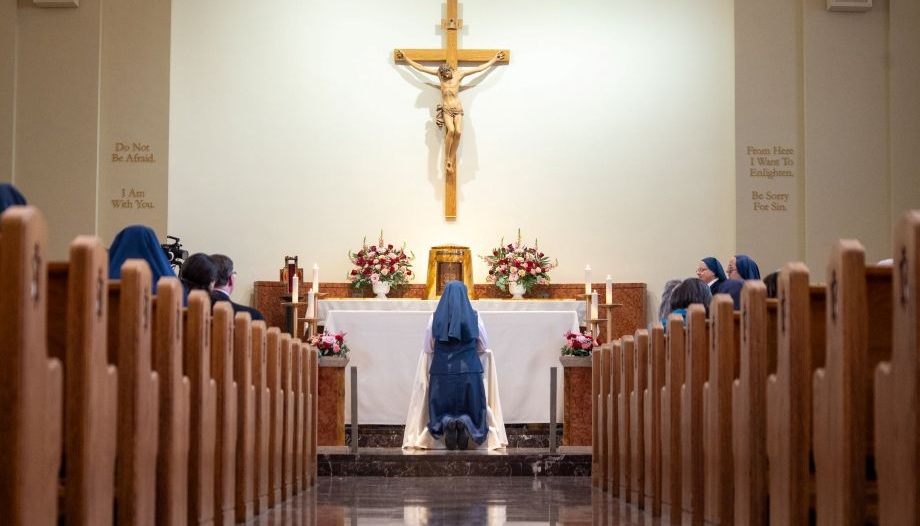
Meet four nuns who will dedicate their lives to God in 2026

Four women who will devote themselves entirely to God in religious life have similar stories. Prayer, the sacraments, and adoration played a key role in their decision.

OSV News Agency-July 26, 2026-Reading time: 6 minutes

– OSV News / Katie Yoder

Sister Catherine Lucia Phoebe Addington, of the Daughters of St. Paul, still remembers the first time she entered a convent chapel when she was in the fourth grade.

“I saw the lamp in the sanctuary lit, and that absolutely blew my mind,” she said, referring to her visit to the residence of the nuns who taught at her school. “I said, ‘Wait a minute, can nuns live with Jesus? I didn’t know that… Sign me up!’”.

Sister Phoebe is one of four religious sisters who will take their vows in 2026 and who have spoken with OSV News about the story of their vocation and what led them to dedicate their lives to God. Their journeys have been different: some grew up attending Mass regularly, while others did not. Some knew they were called to religious life, while others followed a more complicated path. One of them temporarily left the Church before joining her community. Another had wanted to become a nun since she was a little girl.

Their stories also share similarities. Prayer, the sacraments, and worship played a fundamental role. Many were drawn to God’s unconditional love and to the joy they saw in the Catholics around them.

All of them wanted to devote themselves completely to God.

Made for Something More

Sister María Trinity joined the Congregation of the Dominican Sisters of St. Cecilia in Nashville, Tennessee, after growing up in Gaithersburg, Maryland. Her parents came to the United States during the Lebanese Civil War and raised their three daughters in the Melkite Greek Catholic Church.

“I remember that, when I was younger, I felt as though I was destined for something greater than what this world had to offer me,” said the 30-year-old sister.

As she grew older, her family stopped attending Mass as regularly. She felt that something was missing, and she reconnected with her faith in 3rd year of ESO after participating in a volunteer project at a local Catholic church.

Around that time, she also attended a youth rally for the March for Life, during which those who were considering a religious vocation were asked to stand up. Her heart was pounding.

“I hadn’t given religious life any thought at all,” she said. “Inside, I kept telling myself, ‘No, no, no.’”.

“A ”radical desire” to proclaim God’s love

Sister María Trinidad embraced her faith while studying mechanical and computer engineering at the University of Maryland. Her friends at the Catholic student center told her about the sacraments. She attended Mass, adoration, confession, Bible study, and spiritual direction. She met religious sisters and prayed with Dominican friars.

A turning point came during a time of adoration at a silent retreat. She heard God calling her to give herself completely to Him. That moment came after she had also attended Steubenville Youth Days and FOCUS mission trips.

“I began to feel an intense desire to proclaim the truth of God’s love and how this world is passing away, but God’s love never, ever fades,” she said. “I realized that the Lord didn’t need what I could do for Him, but simply loved me just as I was.”.

When she visited the Dominican sisters during her senior year of high school, she felt at peace. She entered the order in 2018, at age 23, and currently teaches middle school at a Catholic school in Oak Ridge, Tennessee. She will take her perpetual vows on July 25.

“Something Stirring in My Heart”

When Sister Concepción Medina, of the Franciscan Sisters of Christian Charity, was about two years old, she told her aunt that she wanted to become a nun.

Born and raised in New Mexico, she grew up in a culturally Catholic environment alongside her five siblings. She received the sacraments but did not attend church regularly. She experienced a defining moment amid a series of small moments along her journey toward religious life. 

“I realized that, throughout my life, God had always been inspiring me in my heart to belong only to Him,” said the 32-year-old sister.

A Little Push from St. Francis

When I was in my early twenties, I remember experiencing “that profound sense of knowing” while singing the “Kyrie” during Mass.

“I knew with every fiber of my being that God was calling me to religious life and asking me to belong exclusively to Him… I felt shattered,” she said. “This feeling of desolation, of course, changed over time, and in reality, it was due to my own selfishness.”. 

God made it clear to her that she should join the congregation of the Franciscan sisters.

“After I came to visit, the Lord sent St. Francis to guide me on the right path,” she said, adding that she saw images and statues of the saint everywhere. “It wasn’t until I gave in and returned to this place that I experienced a deep sense of peace about everything.”. 

She entered the order at age 24. She is currently in Manitowoc, Wisconsin, at the sisters’ motherhouse. She is a nurse and cares for the sisters in the infirmary. She will take her perpetual vows on August 2, during the Jubilee Year of St. Francis of Assisi.

“I can give myself completely to Jesus”

Sister Joseph Lucia, of the Congregation of the Dominican Sisters of Mary, Mother of the Eucharist, spoke from her order’s motherhouse in Ann Arbor, Michigan. She is one of seven siblings and was raised in the Catholic faith in Spartanburg, South Carolina.

This 28-year-old woman said that the first time she seriously considered a religious vocation was during her Confirmation, in the 3rd year of ESO. The bishop gave a talk on vocations and said he was praying that her Confirmation class would follow the Holy Spirit.

“I remember thinking and praying, ‘Jesus, if you want me to be a nun, I’ll do it—you just have to tell me,’” she said.

She began to consider religious life more seriously at the end of her first year at Clemson University, while she was studying nursing and Spanish. She began her discernment process when her older sister entered the Congregation of the Dominican Sisters.

“That really inspired me to reconsider it, thinking, ‘My God, is this really what you’re calling me to do?’” she said, recalling her sister’s joy.

Her devotion to the Eucharist and to Mary led her to join the Dominican Sisters. Her love for both grew during her college years, when she attended Mass daily and devoted time to prayer and adoration. In addition, she realized she was drawn to Dominican spirituality after some Dominicans visited her school.

She left college to enter the convent at age 21. She currently teaches at a Catholic school in Findlay, Ohio. She will take her perpetual vows on July 28.

“I can give myself completely to Jesus in response to the absolute love he has shown me,” she said, referring to her role as the bride of Christ. “I can be a visible sign of how much Jesus loves his Church, of how much Jesus loves each and every soul.”.

“A Sense of Belonging to God”

Sister Phoebe grew up in Alexandria, Virginia, where she now lives as a Daughter of St. Paul. As a child, she used to visit the congregation's bookstore in that city. Now, she serves there as a sister.

She was raised in the Catholic faith alongside her two sisters and attended her parish school. This 32-year-old sister has experienced “that total and instinctive sense of belonging to God” throughout her life. At the same time, there were certain revelatory moments along her journey toward religious life. She loved learning about the saints as she prepared for confirmation and realized that many of them were nuns.

Her journey was not an easy one: she left the Church at age 18 because she was appalled by the abuse scandal. Around that time, some Orthodox Christian friends invited her to their church.

“Every day I’m inspired by the testimony of my Orthodox friends, who, upon seeing someone who was suffering, told them, ‘No pressure—you don’t have to join our church; we just want you to know that you’re welcome to pray here if that helps you stay close to Jesus,’” he said.

She returned to the Catholic Church three years later, when, among other things, Pope Francis visited the United States in 2015. His message about reaching out to the marginalized touched her personally.

“He has a plan”

The Daughters of St. Paul, whose mission is to make Christ known, taught her to pray during her discernment program. Through prayer, she fell in love with Christ. She entered the congregation in 2021, at the age of 27, after completing a Ph.D. in Spanish literature and translation at the University of Virginia. She made her first profession on February 14, Valentine’s Day.

“There are many people who, for one reason or another, tell themselves, ‘I can’t be happy,’” he said. “God loves you just the way you are, and He has a plan for you—and that plan is better than you can imagine.”.

The four sisters offered their advice to young women who are in the process of discernment. They recommended letting God guide them and spending time with religious women. They suggested praying, reading the Bible, and receiving the sacraments. They encouraged the women to trust in God.

“Above all,” said Sister Concepción Medina, “fall in love with God wholeheartedly, and everything will fall into place.”.


This article was first published in OSV News. It is republished on Omnes with permission. You can read the original article in English. HERE.

The authorOSV News Agency

Read more
United States

Fifty years later, the Steubenville conference continues to inspire vocations and strengthen faith

This summer, the Catholic university is celebrating the 50th anniversary of the Steubenville conference, which has changed the lives of many people.

Angelus News-July 26, 2026-Reading time: 5 minutes

– Angelus News / Francesca Pollio Fenton | Catholic News Agency

In 1976, Franciscan University of Steubenville held its first youth conference on its campus in Steubenville, Ohio. This summer, the Catholic university is celebrating the 50th anniversary of a conference that has changed the lives of many people.

Since their inception, the youth conferences have helped more than one million young people to encounter Jesus Christ through engaging talks, Mass, Eucharistic adoration, confession, prayer, and fellowship.

The idea of organizing a conference for young people arose after Father Michael Scanlan, TOR, former president of Franciscan University, held a conference for priests and asked them what the university could do for them. What was their response? They wanted some kind of event aimed at young people, specifically teenagers. The following year, the first youth conference was held.

“It is truly a beautiful testimony to God’s faithfulness,” Father Dave Pivonka, TOR, the current president of Franciscan University, told EWTN News.

“The other day I was thinking that the teenagers who attended the first youth conferences are now over 60, almost 70,” he added. “So that means half a century of young people whose hearts have been touched, who have encountered Jesus in the sacraments, who have encountered Him in the gathered youth community… It’s simply a tremendous milestone for young people. Now, the fact that Franciscan University was able to be a part of this and that we had the vision to offer this opportunity—I believe that is also a great grace for us.”.

The 2026 Conference

This summer, Franciscan University organized four sold-out lectures on its Steubenville campus, in addition to 15 other lectures that took place in various cities across the United States.

Speakers at this summer’s youth conference include Father Mike Schmitz, host of the podcast “The Bible in a Year”; Chris Stefanick, author, speaker, and television host; Father Leo Patalinghug, author, podcast host, and priest of the Archdiocese of Baltimore; Katie Prejean McGrady, author and Catholic radio host; Paul J. Kim, speaker, author, and musician; and many more.

Brian Kissinger, executive director of conferences at Franciscan University, told EWTN News that “at the heart of our conferences, at the heart of this experience for young people, is the Blessed Sacrament.”.

He explained that they also try to make the conferences “as exclusive as possible.”.

“We know that teenagers come from a million different backgrounds—not only geographically, but also emotionally, spiritually, and from a catechetical standpoint. Some have received an excellent Catholic upbringing and come from loving Catholic homes; others are not Catholic, but have simply come along with their Catholic friends,” he explained. “That’s why we really try to make the weekend as welcoming as possible, to preach the message of the Gospel—which never changes—but always approaching the presentation of the ‘kerygma’ on the understanding that a teenager doesn’t know the whole story.”.

According to Kissinger, one of the most moving moments of the conference takes place during the closing Mass, when the presiding priest invites the young people—both men and women—to come forward if they have felt God’s call to the priesthood or religious life over the weekend.

According to the 2026 survey conducted by the Center for Applied Research on the Apostolate (CARA) among newly ordained priests, 18 % of the priests ordained this year attended a Youth Conference at Franciscan University of Steubenville during their vocational journey.

Other CARA studies revealed that 21 % of the women religious and 15 % of the men religious who had recently taken perpetual vows had also attended a Franciscan youth retreat. Overall, 18 % of the newly professed men and women religious reported having participated in a Steubenville youth retreat, more than in any other Catholic retreat of this type in the United States.

So, what is the secret to the Steubenville Youth Conference's success among young Catholics?

“People often ask me, ‘What’s the secret to the success of these retreats?’ But, honestly, it’s not complicated at all,” said Pivonka. “What we do is bring young people together and offer them an environment where they can encounter Jesus. We do this through the sacraments. We do it through adoration. We do it through the sacrament of reconciliation. We do it through worship. And we do it as best we can, to break down, in a way, the barriers that may exist between them and that encounter.”.

“I’d like to say there’s some secret ingredient, but in reality, it’s simply a matter of creating an environment that fosters connections among young people,” he added.

“I also don’t buy into the idea that ‘young people aren’t fervent or that you can’t set challenges for them,’” he continued. “What I mean is that we present the Church’s teachings without any hesitation. And what we’re seeing is that young people respond to that.”.

From Reluctant Assistant to Enthusiastic Disciple

Elizabeth Feulner, an 18-year-old student from Syracuse, New York, has attended two Steubenville youth conferences.

In an interview with EWTN News, she said she was forced to attend the conference during her freshman year. Her parish’s youth group had just gotten started, and her mother received an email from the group’s leader providing details about the conference.

“My mom told me, ‘You have to go to this. ’It sounds like a great opportunity. I wish I’d had something like this when I was your age.‘ And I replied, ’Well, it’s on such short notice; I don’t know if this is going to be what I like best.” So the first year wasn’t really my decision,” Feulner explained.

However, when reflecting on that first experience, he said it helped him “grow in my personal relationship with Jesus and express it more openly, as well as have confidence in it in many ways in my life.”.

She noted that attending alone during her first year allowed her to “really sit there and feel Jesus” presence, as well as His work in my life,“ which in turn motivated her to seek ”God-centered” relationships when she returned home.

Feulner recalled the moment that made the greatest impression on him during that first conference: Eucharistic adoration.

That year, she attended the conference with a dislocated knee and had to walk on crutches. The worship service was held in the afternoon, but she had walked a lot during the day, was in a lot of pain, and by the time the afternoon came, she was exhausted.

“I was sitting there during adoration; I felt very moved, and the monstrance stopped right above me, and for a moment it seemed to me that it was just God and me, and He said to me, ‘I see you, and I am here,’” she said.

“I think that moment showed me—and I’ve continued to let it show me—that He is always there,” she added. “And that physical representation of Him there, looking at me through the monstrance, is as if it were just Him and me. And that has continued to shape the way I view my relationship with God, especially during difficult times and throughout my entire life.”.

When Feulner attended this year, she said she had a completely different perspective and felt immensely grateful for everything God had done in her life since she first attended the previous year.

Since then, she has started her own youth group, and as a result, she has formed Christ-centered friendships; her boyfriend, with whom she has been dating for two years, has converted to Catholicism; and her younger sister was able to attend the conference with her this year.

“I felt so grateful for this past year and for the community that, honestly, I never thought I’d have when I was younger,” she said. “This past year has been crucial in finally being able to have a community in Christ, in my faith, and with friendships that are simply unbreakable.”.

Feulner said he hopes that those attending the Steubenville Youth Conference will “at some point have an experience that shows them they are worthy of His love, no matter what they’ve done, and that they know He sees them—whether or not they’ve experienced that moment of worship—that He truly sees them every day and in everything they go through, and that He loves them not in spite of it, but precisely because of it.”.


This article was first published in Ángelus News. It is reprinted in Omnes with permission. You can read the original article in English. HERE.

The authorAngelus News

Culture

The Sainte-Chapelle of Reinforced Concrete

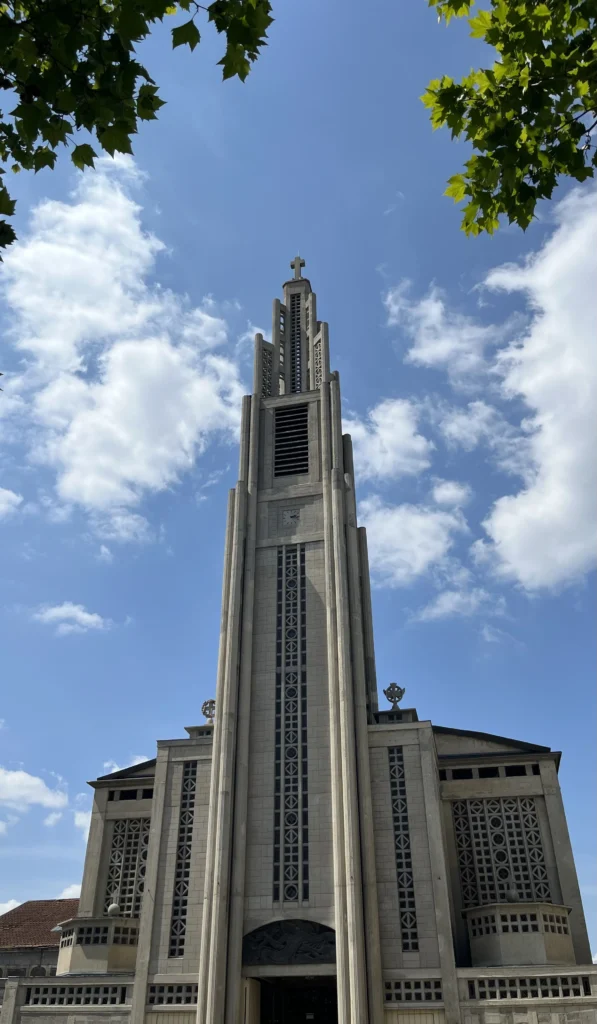
The Perret brothers revolutionized sacred art by using exposed reinforced concrete in the design of the church at Le Raincy (1923), a functional, economical, and light-filled space built after World War I.

Javier Ortiz-Echagüe-July 25, 2026-Reading time: 5 minutes

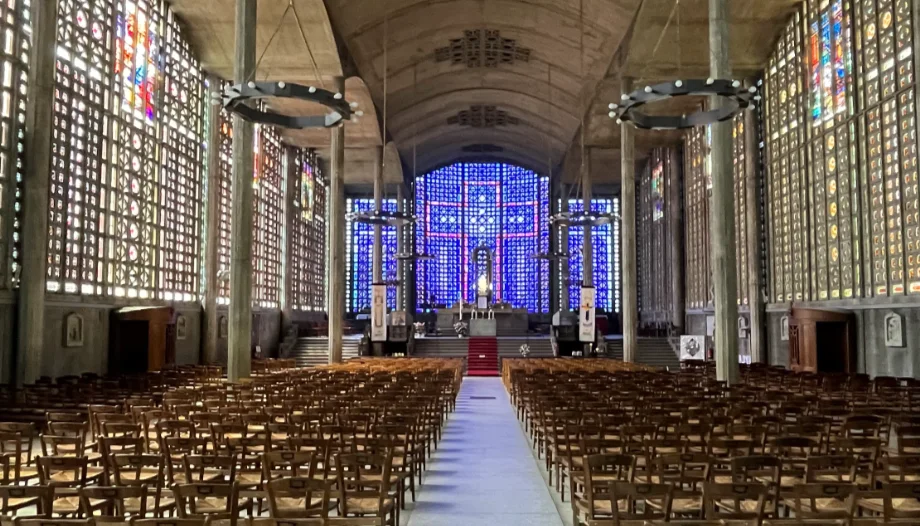
In 1923, a church was inaugurated in Le Raincy, near Paris, that some contemporaries found difficult to interpret. Built entirely of reinforced concrete, it resembled the industrial world more than what was expected of a Christian building. It was not just a matter of style. World War I had destroyed hundreds of churches, and the reconstruction required a rethinking of methods, costs, and forms. Concrete emerged at that time as a quick and economical solution, although many still considered it unsuitable for a place of worship.

A Church for the 20th Century

Its architects were Auguste and Gustave Perret, pioneers in the use of concrete in modern architecture. But the Perrets’ ambition was not to break with tradition, but to carry it forward using new materials. One of their principles was structural sincerity: a building should clearly express its own structure. Until then, prestigious buildings had concealed concrete beneath layers of stone or stucco. At Le Raincy, however, it appears exposed, treated as a noble material.

The debate sparked by the project speaks volumes. In the communist newspaper L’Humanité, Jacques Mesnil described it as an incoherent and arbitrary building, going so far as to ironically predict its own failure as a church: “Perhaps the Perrets acted in this instance like shrewd men who thought that, in light of the coming Revolution, it would be better to design a church in such a way that it could be transformed in a few years into a movie theater, or even a dance hall,” he wrote on August 17, 1923. In the Catholic media, however, it received a very different reception. In an earlier article, published in *La Croix* on September 7, 1922, A. Fulcran considered it a model of economical and functional construction. “Modern architecture will emerge from logical endeavors such as the church at Le Raincy, not from the fantasies of artists seeking a new form on paper,” he wrote.

The debate had been going on for some time. In 1914, Léonce Marraud (under the pseudonym Faber) had raised the issue in *La Vie et les Arts liturgiques*: if Notre-Dame were to be rebuilt, it would make no sense to do so “in the style of Viollet-le-Duc”; before choosing between Romanesque, Gothic, or Byzantine, one had to ask about the “current function of a church,” which could not be reduced to a historical monument or a mere practical space.

A Modern Sainte-Chapelle

The Perret Church seemed to address that problem right from the outset of its construction. Its form is surprisingly simple. A series of very slender columns supports the vaults, while the walls consist of nothing more than a concrete latticework pierced by a multitude of small windows. The building functions as a lightweight structure enveloped by an immense glass surface. The effect is reminiscent of the great Gothic churches, where the walls disappear to make way for the light streaming through the stained-glass windows. However, there is not a single pointed arch. The vault is a lowered barrel vault, almost flat. The historical reference stems not from the form, but from the light. Paul Jamot, in an article published by the *Gazette des Beaux-Arts* in 1923, summed it up with a phrase that would become famous: Le Raincy was “the Sainte-Chapelle of reinforced concrete.”.

Photo: Wikimedia Commons

But technical innovation was not the only key factor. By freeing the walls from their load-bearing function, reinforced concrete made it possible to organize the interior as a clear, open, and unified space. Unlike many historic churches, filled with side chapels and dark corners, here the gaze is not scattered: everything leads toward the altar. Fulcran believed that this visual effectiveness was the fundamental achievement: “Everyone will see the altar from anywhere, and the device of a sloping floor, as in amphitheaters, will further enhance this result of good visibility.” Mesnil interpreted that same design element in exactly the opposite way. For him, the church was conceived “as a kind of theater,” where the priests appeared “like actors on a stage” and the faithful as spectators watching
their “gestures and shouts.”.

Stained-Glass Windows and Memories of the War

The interior is dominated by stained-glass windows designed by Maurice Denis, a central figure in Symbolism and the revival of religious art in France. Denis sought to demonstrate that Christian art could draw on contemporary artistic languages without losing its spiritual dimension. This concern led to the founding of the Ateliers d’Art Sacré (Sacred Art Workshops) in 1919, together with Georges Desvallières. The goal was not only to create a school of modern style but also to restore a collective and liturgical dimension to religious art, as they imagined had been the case in the great medieval cathedrals. At Le Raincy, this aspiration took concrete form: Denis created the cartoons for the figurative scenes, while Marguerite Huré executed the stained-glass windows with the collaboration of young artists associated with the Ateliers.

The large windows run along the entire perimeter of the building, forming a color palette that ranges from yellow to the deep blue of the presbytery. In the center of many of them is a figurative scene: episodes from the life of the Virgin Mary, but also an unexpected image—the Battle of the Ourcq, fought nearby during World War I. Le Raincy was, in part, a memorial linked to the Battle of the Marne and the episode involving the taxis that transported French troops to the front in September 1914. Hence its popular nickname, “Saint-Taxi,” which was repeated with irony by the press of the time.

The stained-glass window dedicated to the victory at the Ourcq embodied the very blend that Mesnil found intolerable. The Virgin Mary appears against a backdrop of modern warfare, amid soldiers, military vehicles, and explosions. For Mesnil, this turned Denis’s design into a form of pious propaganda cloaked in conservative patriotism. But that tension also explains the historical uniqueness of Le Raincy. The church sought to answer a question facing postwar Europe: how to build a sacred space in a society marked by industrialization, modern warfare, and cultural fragmentation.

A 20th-Century Tribute to God

One of the artists who collaborated on the stained-glass windows was Pierre-Charles-Marie Couturier, then a twenty-five-year-old unknown, who expressed his enthusiasm in a letter from that time. The church had given him “the joy that one can feel
”an artist and a Christian, contemplating in the House of God the fruit of efforts that, for the first time, are worthy of Her.“ Although a lack of resources had forced him to simplify the decoration, the overall effect struck him as ”extremely modern,“ possessing a ”truly comforting dignity and solemnity.“ And this was more than just an individual reaction. ”For us young artists,” he wrote, “we see in it the first result of the efforts and doctrines we have loved and defended against all odds. The tribute of twentieth-century art to Our Lord and Our Lady: what a beautiful joy!” Over time, Couturier would become a key figure in the renewal of sacred art in France, an advocate for collaboration between the Church and avant-garde artists.

The Perret Church leaves behind a simple yet demanding legacy: beauty is neither inherited nor identified with a historical style. It is achieved through the techniques and questions of its time. There, new materials made it possible to rediscover one of the oldest principles of sacred architecture: building was also about organizing light.

The authorJavier Ortiz-Echagüe

Professor in the Master's Program in Christianity and Contemporary Culture

Family

Catholics and the Growing Phenomenon of “Divorce in Old Age”

The Catholic Church is facing a growing phenomenon: divorce among older couples.

Angelus News-July 25, 2026-Reading time: 7 minutes

– Angelus News / Elise Ureneck

The Beauparlants seemed like the kind of Catholic family parishes dream of: six children, regular attendees at weekly Mass, and deeply committed to their faith. Allison, who was 46 at the time, and Ted, 50, had been married for 19 years. Few of those who knew them would have foreseen that a crisis was looming.

Parishes, ministries, and courts are dealing with this reality as it unfolds. Since most of these marriages lasted for several decades, their dissolution has repercussions for adult children, grandchildren, the rest of the family, and friends.

With regard to divorce, the Church has focused primarily on prevention (through “Pre-Cana” marriage preparation programs) and on addressing the issue of annulment, which is resolved in its courts.

However, the rise in long-term divorce rates makes it clear that this is far from sufficient: more couples need help during the middle years of marriage, as well as an assessment of their situation when they reach a breaking point.

Divorce Among the Elderly: The Numbers

A 2025 report by the Institute for Family Studies now estimates that the failure rate for first marriages is 40 %—which, in fact, represents an improvement over previous years—and marriages in the early 21st century are already lasting longer than those of the previous generation.

However, there is one group that remains the exception.

Divorce rates among American couples over the age of 50 are twice what they were in 1990, and divorce rates among Americans over the age of 65 have tripled. In 2019, about 36 % of all divorces involved people aged 50 or older. That figure has remained stable so far.

In her book *Generations: The Real Differences Between Generation Z, Millennials, Generation X, Baby Boomers, and the Silent Generation—and What They Mean for America’s Future* (Atria Books), psychologist Jean Twenge speculates that the rise in the divorce rate among baby boomers is linked to their belief that marriage should go “beyond duty to meet the highest expectations of sexual pleasure and companionship.”.

Setting aside serious problems—abuse, coercion, a marriage entered into without true freedom—many decide to end their relationship when the marriage fails to meet that high standard, sometimes after decades of poor communication and growing apart.

And, as “The Wall Street Journal” recently reported, the cost of divorce after age 50 is high: the decline in standard of living and the division of assets leave many worse off, as do the deterioration of social networks and the loss of a partner with whom to face declining health and aging.

Generally speaking, the divorce rate among Catholics who attend Sunday Mass is lower than that of the general population, but Mass attendance among “baby boomers” has been steadily declining for decades, falling to 30 % in recent years. Only 22 % of Generation X, who are now in their 50s, attend Mass every week.

Although divorce is often portrayed as a personal decision, social science studies are clear: its effects extend across several generations, affecting both children and grandchildren who were not even born at the time of the separation.

A historical study conducted in 2005 revealed that divorce lowers educational attainment, increases marital conflict, and weakens the bonds between parents and children—specifically among the grandchildren of those who have divorced. A couple who divorce today more than doubles the likelihood that their own grandchildren will do the same someday.

The Causes of Marital Unhappiness or Separation

What leads so many middle-aged and older couples to get divorced?

For many, the “empty nest” is a major factor. When the youngest child leaves home, many couples find it difficult to regain their balance as husband and wife.

“Even the joy of raising children can lead to focusing exclusively on them, to the detriment of marriage,” said Father Jack Dickinson, judicial vicar of the Diocese of Portland, Maine.

As a parish priest and an expert in canon law, Dickinson is responsible for both preparing couples for marriage and overseeing the tribunal that adjudicates requests for annulments.

“I emphasize the need for couples to put their relationship with God before their marriage,” he said. By prioritizing their relationship over other obligations, including professional ones, “they create the space necessary to get to know and love their spouse, and to be known and loved by him or her.”.

Maintaining a friendship with your spouse is essential for keeping your marriage strong as it reaches its midpoint.

Ester Munt-Brooks, a Catholic speaker for “Faith with Joy Talks,” emphasizes how important it is for couples to maintain a sense of curiosity about each other.

She and her husband, Arthur Brooks, a Harvard professor and best-selling author, have spent decades leading “Pre-Cana” premarital preparation and marriage support programs in parishes, and they bring theological and social science perspectives on happiness to their ministry.

“There’s always more you can learn about the other person,” he said. “When we feel comfortable, we take certain things about our spouses for granted. But we should stop and ask ourselves, ‘Why does he (or she) do this?’”.

“We should keep asking questions,” she said.

Changes in health, especially the radical transformation that women undergo during the decade leading up to menopause, also influence marital conflicts.

Caroline Gindhart, a certified nurse specialist at the University of Pittsburgh Medical Center’s “Divine Mercy” Women’s Health Department, noted that while some women go through perimenopause without any problems, for others it disrupts every aspect of their daily lives.

“Hormonal changes cause hot flashes, insomnia, mood swings, weight gain, pain during sexual intercourse, and a decrease in sexual desire,” she said, all of which can strain intimacy and marital communication precisely when the empty-nest syndrome is already redefining a woman’s identity.

A few years after having adjusted to that change, a couple may face the challenge posed by the husband’s identity crisis when he retires. Upon losing their jobs, many realize that they have lost not only an occupation, but also their primary source of purpose, routine, and sense of belonging.

“I think that when you’re in your twenties and thirties, you feel a little invincible and you just keep going. You’re driven by energy,” said Allison Beauparlant. “When you reach your forties and fifties, you start to think, ‘What is my life? Is this all there is?’”.

The first lines

Will the rise in divorces among older adults continue, or is this a generational anomaly? The data are inconclusive. In the meantime, Catholics are among those trying to help turn the tide, one couple at a time and one person at a time.

Gindhart stated that Naprotechnology practitioners, many of whom are Catholic, are at the forefront of new treatments designed to help women during menopause.

According to Gindhart, hormone replacement therapy “can be very effective for some women.” Unlike the carcinogenic synthetic hormones that were administered to women in the past, today’s therapy uses bioidentical hormones to replace those that are lost.

“We’ve seen how many relationships improve when a woman has better control over her symptoms,” she said.

When their marriage was at its lowest point, Ted and Allison attended a weekend retreat with “Marriage Rediscovery” (formerly known as “Retrouvaille”), which is now a canonically recognized private association of the faithful.

“Those 48 hours in 2012 changed everything,” Ted said. “We became speakers, and we’ve already shared our story more than 60 times in 15 different states.”.

“‘Marriage Rediscovery’ is like ‘Alcoholics Anonymous’ for couples in crisis,” Allison said. “The reason Alcoholics Anonymous works is because people keep coming back. It’s not a one-time solution. You need ongoing support.”.

After an initial retreat, participants receive support through in-person or virtual meetings in small groups for as long as they need it.

After witnessing his parents' divorce, Meola sensed that there were others like him who needed help managing their anger, anxiety, and fear that they might not be able to maintain a lifelong vocational commitment.

“Most children of divorced parents don’t begin to come to terms with their trauma until adulthood,” he said. “Sometimes, all it takes is someone who will listen to you, share your pain, and help you take the next step in your life of faith and your vocation,” he added.

In 2020, Meola’s ministry—which was based on small peer groups and aimed at adult children of divorced parents—became a national nonprofit organization known as “Life-Giving Wounds.” The ministry is currently active in 31 dioceses. Demand is so high that Meola has set a goal of opening 50 college groups over the next five years.

The ministry helps participants address the self-protective behaviors they developed in response to their parents' divorce—habits that helped them survive at the time but now interfere with their own relationships as adults.

“We have seen people return to the faith. We have seen people who had given up on marriage find it possible to get married. We have helped priests and religious who were struggling to remain faithful to their vocation,” he said.

In a recent address to the Roman Rota, Pope Leo XIV warned canon lawyers not to grant annulments to divorced couples, calling it “false mercy”—a stance welcomed by those working on the front lines.

Dickinson pointed out that, as a canon lawyer by training, the Pope is aware of the problem posed by taking a lax approach when judging the validity of a marriage.

“A canon lawyer might be tempted to think that a divorced person has had a difficult life and therefore deserves the opportunity to have a healthy marriage by declaring that person free to remarry.” However, he continued, “the Holy Father is helping the entire Church recognize that the institution of marriage is greater than any of us.”.

The Beauparlants hope to reduce the stigma associated with asking for help. “We see a lot of recurring problems, such as money management, infidelity, spending too much time on social media, pornography, and addictions,” Ted said. “But a hardworking couple that has God in their lives is more likely to stick with the program and succeed.”.

When asked what gave them hope, Allison spoke of a couple in their 80s who had recently attended a weekend retreat.

“They told us that, basically, they had endured an unhappy marriage for more than 50 years and that they just wanted to ‘make things right’ before it all ended,” he said. “See? It’s never too late.”.


This article was first published in Angelus News. We are reprinting it on Omnes with permission. You can read the original article HERE.

The authorAngelus News

Books

«The Commandments of Jesus Christ,» a little spiritual gem

González de Ponshierro has published an original work that focuses on the commandments of Jesus Christ beyond the Ten Commandments of Moses.

Javier García Herrería-July 24, 2026-Reading time: 3 minutes

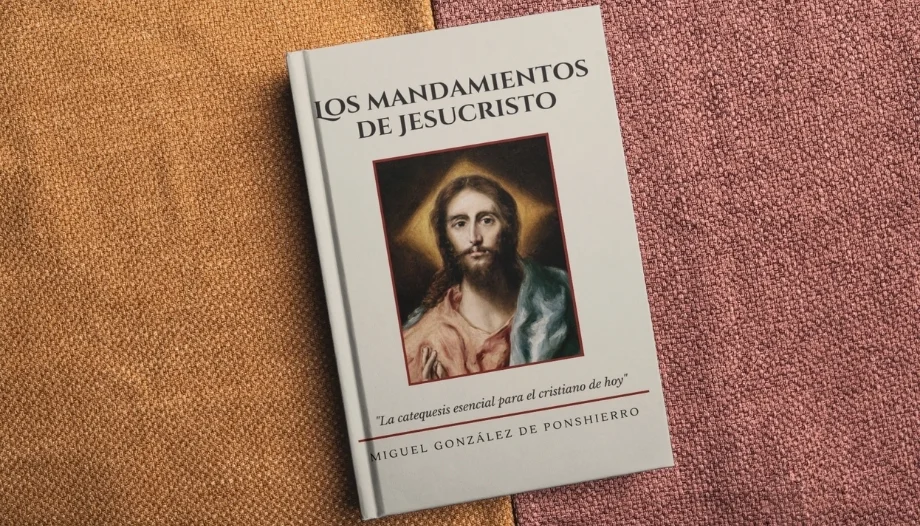
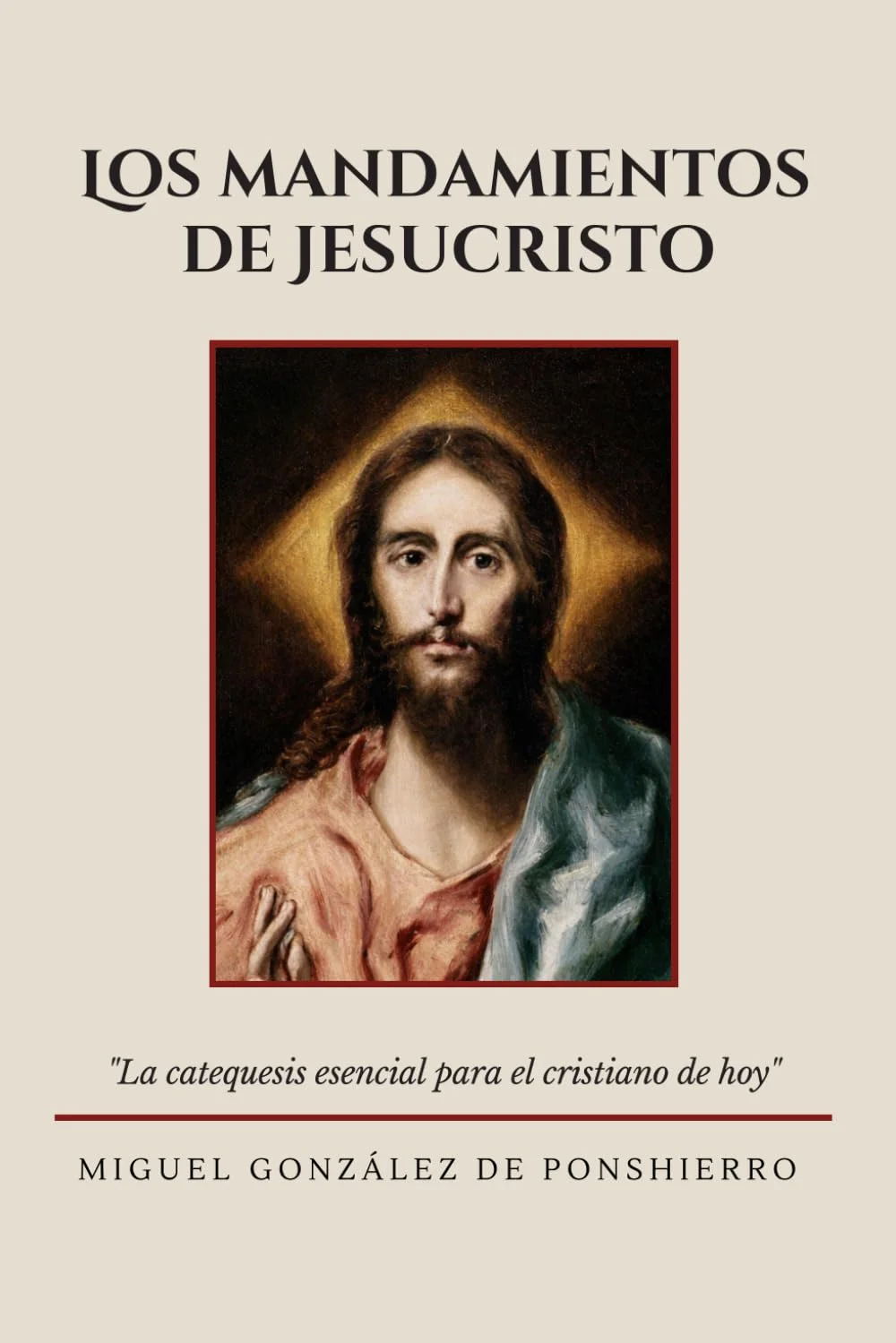
Could you list the commandments of Jesus Christ? Most Christians, if asked, would recite the Ten Commandments of the Law of Moses without hesitation. But few would know how to answer that other, far less obvious question: What exactly did Jesus command those who chose to follow him to do? From this gap—which, curiously, is widespread among practicing believers—arises The Commandments of Jesus Christ, the new book by Miguel González de Ponshierro, now available on Amazon.

A simple, almost uncomfortable idea

The book begins with a true story: at a conference on Christian living, the speaker describes an honest, generous man who is devoted to his family and has no apparent vices, and asks the audience if they consider him a good Christian. Almost everyone answers yes. The surprise comes when it is revealed that this exemplary man is, in fact, a practicing Jew: he observes the Law of Moses, but has never heard of the commandments of Jesus Christ.

Based on that distinction—between the Old Covenant and the New—the author constructs a journey that combines personal narrative, conversations among friends, and, above all, an exploration of the twenty-seven books of the New Testament to compile a list of fifty precepts drawn from Jesus’ own words, organized into three sections: our relationship with God, our relationship with fellow believers, and our relationship with the world.

In all, no fewer than 50 commandments are outlined, which spell out the 10 Commandments from the Tablets of the Law for Christians.

What's New

In a spiritual publishing landscape filled with reprints of classics and self-help books with a religious veneer, The Commandments of Jesus Christ It offers something different: a practical and well-organized tool, written in the first person by Jesus himself—a literary device, the book explains, already used by the Church Fathers and medieval spiritual writers—so that each commandment can be read as if Christ himself were explaining it directly to today’s reader.

Among its most notable contributions:

  • Clearly distinguish between the Law of Fear and the Law of Love. The book emphasizes that the Christian commandments are not binding out of fear of punishment, but are rather expressions of a filial relationship with God. This idea, which runs throughout the work, offers an alternative to the image of God as a «judge» that many readers will recognize from their own religious upbringing.
  • Translate the doctrine into everyday language. Everyday anecdotes—a cyclist, a businessman who misses a flight, a mother with her baby—serve as a bridge between the biblical texts and daily life, setting the book apart from the usual academic tone found in this type of essay.
  • It advocates a joyful spirituality. One of the most talked-about passages in the book argues that «there are no saints with sad faces» and questions the tradition of depicting saints with expressions of suffering, proposing a way of living one’s faith marked by good humor and trust, not by guilt.
  • Organize what was previously scattered into a manageable list. The book’s most practical contribution is also its simplest: it brings together, in fifty thematically grouped points, something that any believer could find on their own in the New Testament, but that practically no one does.

Self-published, but high-quality

The Commandments of Jesus Christ It is a self-published work on Amazon—a fact that the author himself does not hide and that is worth emphasizing: this is a self-published book, not a title released by a major religious publishing house. However, the result defies the usual prejudice against self-published works. Perhaps the only drawback is the font size, which is a bit small. This can be easily remedied by purchasing the digital version for €3 (and it’s free for Amazon customers).

The text features a well-crafted structure and style, sound theology, and a fresh, innovative presentation of Christian doctrine, making it a huge surprise for the reader.

You don’t need to be an expert in theology to engage with this book: its conversational tone and structure of short chapters make it accessible both to those seeking to deepen their faith and to those who are simply curious about a question that, after reading the book, is hard to ignore: if a Christian does not know Christ’s commandments, in what sense can they say they follow him?


The Commandments of Jesus Christ

Author: Miguel González de Ponshierro
Editorial: Amazon
Year: 2026
No. of pages: 173
Price: 12,48 €
Spain

Will we see the cup at the Episcopal Conference again?

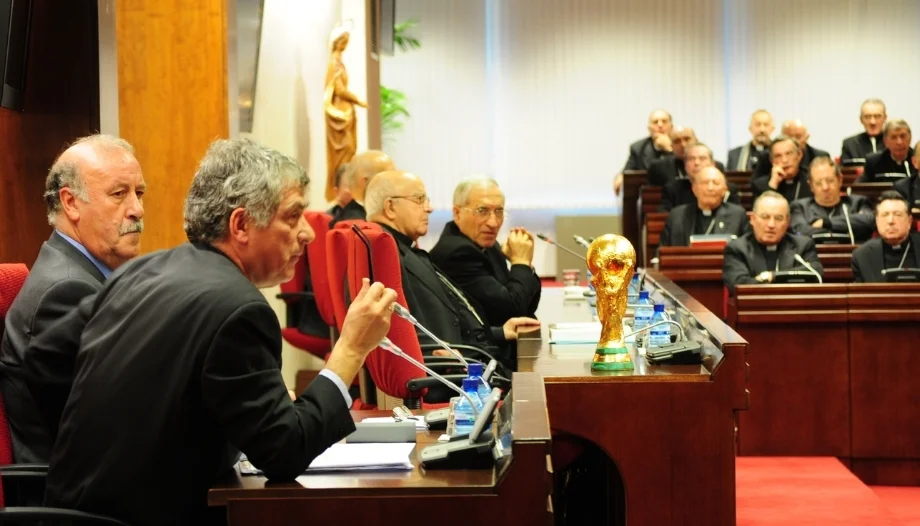
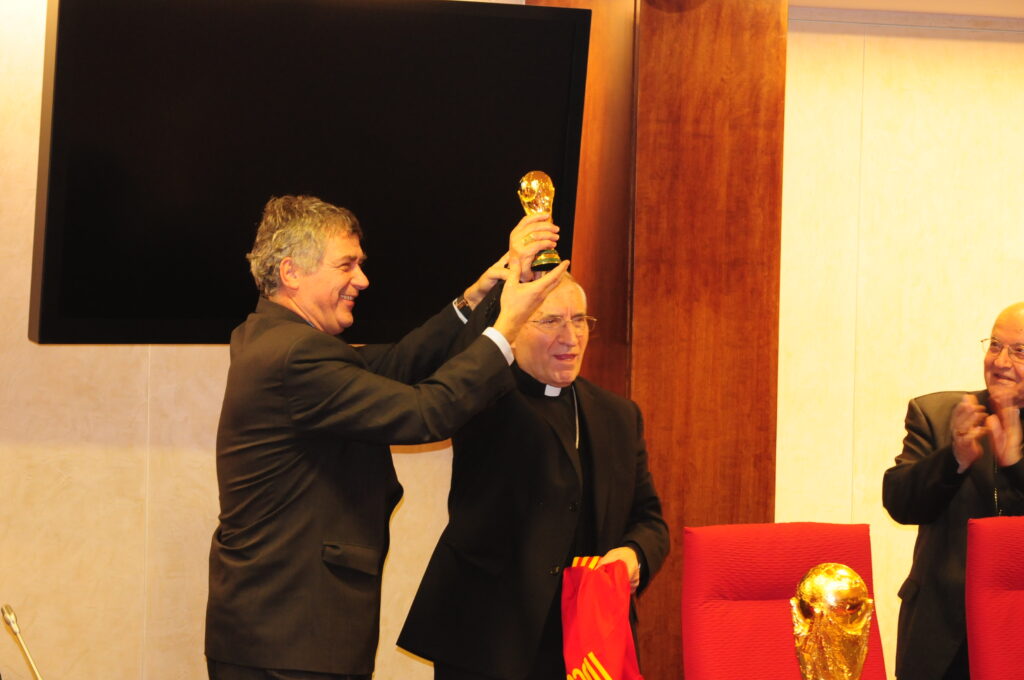
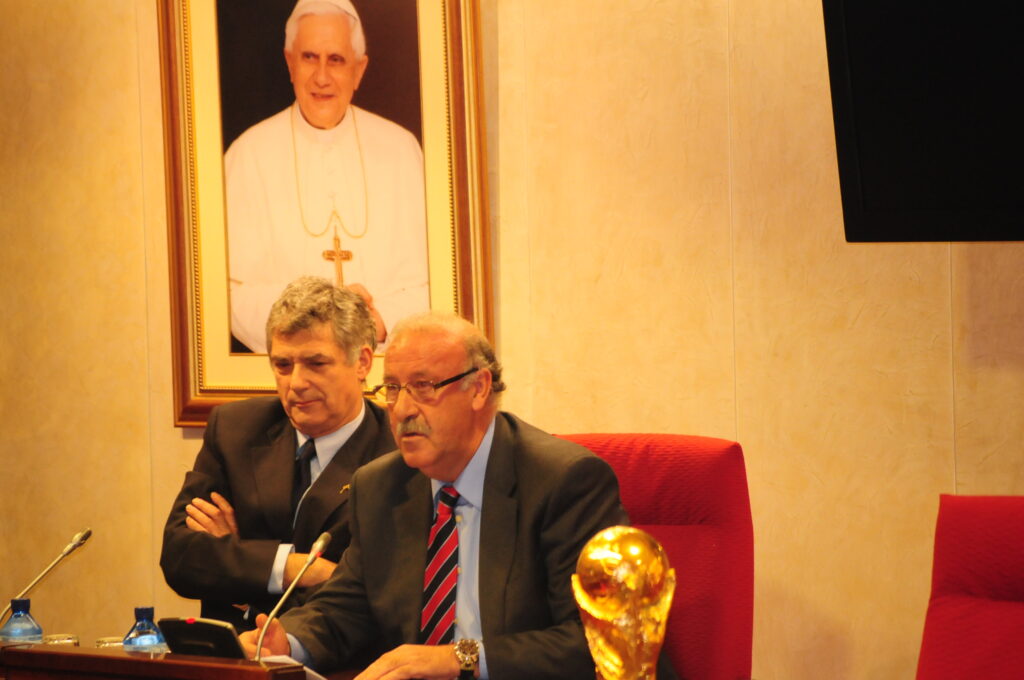
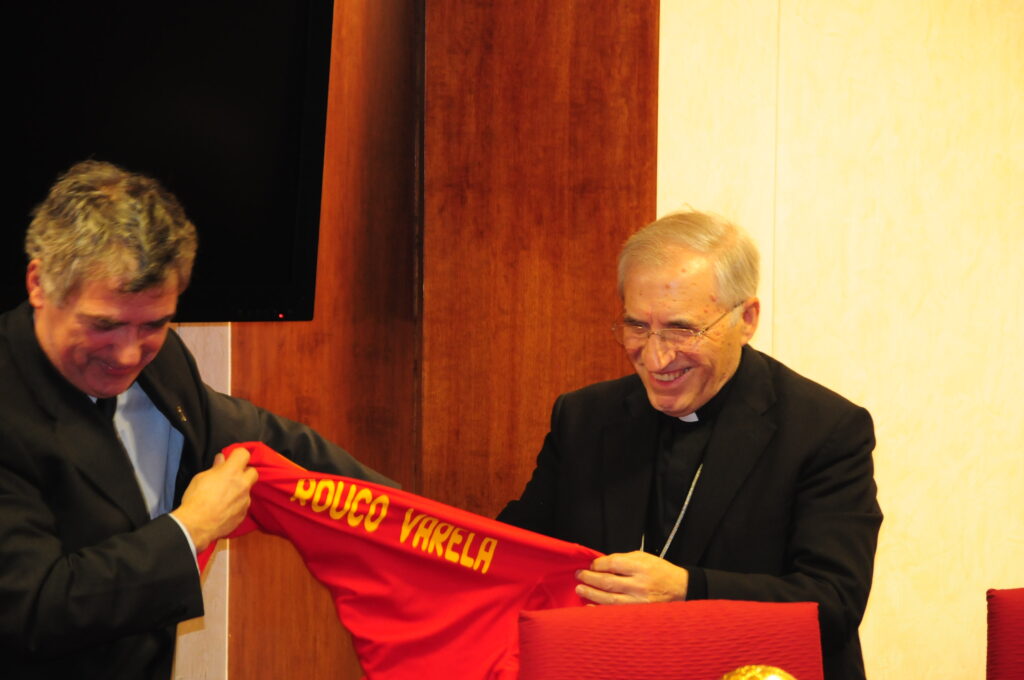
Let’s recall the visit in 2010 by the then-Spanish national team coach, Vicente del Bosque, and the president of the Royal Spanish Soccer Federation, Ángel María Villar, to the Spanish Episcopal Conference after winning the World Cup against the Netherlands.

Teresa Aguado Peña-July 24, 2026-Reading time: 2 minutes

In November 2010, the World Cup trophy that the Spanish national team had won in South Africa made a very special stop. The then-national team coach, Vicente del Bosque, and the president of the Royal Spanish Football Federation, Ángel María Villar, took the trophy to the headquarters of the Spanish Episcopal Conference (CEE), where they were received by Cardinal Antonio María Rouco Varela, then archbishop of Madrid and president of the CEE.

The Strengths of the National Team

Villar asked Cardinal Rouco to intercede with Pope Benedict XVI so that the national team could bring him the World Cup, and he stated that «soccer and faith go hand in hand.» The Federation president also defended Spain’s Christian roots and emphasized that the team’s victory had been achieved through «many qualities» that, in his view, the bishops «teach and practice»—such as «sacrifice, teamwork, solidarity, overcoming challenges, and above all, humility.» He thus emphasized that soccer is «at the service of society» and that it is «a wonderful tool for the well-rounded development of the human person.».

For his part, Rouco Varela highlighted the «human and Christian virtues» that, in his view, had shone through in that team. The cardinal particularly highlighted their team spirit, cooperation, and the humility with which the players had received their victory. He also reminded the champions that, if they had asked the bishops to pray for them, they themselves should pray as well. «Not just when they make the sign of the cross as they enter the field,» he added, while acknowledging that the bishops liked it when they did so.

For his part, Vicente del Bosque emphasized that, in his view, soccer is not just about winning, but also about conveying «ethics and personal conduct.».

The meeting also concluded with a reference to Our Lady of Almudena. Rouco Varela reminded the national team’s officials that they had not taken the Cup to Madrid’s cathedral and warned them: «If you don’t visit Our Lady, you’re in for trouble.».

The Cup, Once Again Before the Spanish Bishops

Now, sixteen years later, Spain is once again the world champion. The new national team, led by Luis de la Fuente, has once again lifted the most prestigious trophy in international soccer. This leaves one question unanswered: Will we see the World Cup trophy at the Spanish Episcopal Conference again? Will they present Luis Argüello with the national team jersey, just as they did back then with Cardinal Rouco Varela?

Culture

“The Catholic shift is real and surprising”

The role of believers in society has been the central theme of the CEU's summer courses.

José María Navalpotro-July 24, 2026-Reading time: 3 minutes

“The Catholic revival is real and surprising, and there is evidence of it,” stated journalist and historian José Francisco Serrano Oceja a few days ago in El Escorial. After the euphoria surrounding the Pope’s visit, that reality seemed like a given, but one might think there is perhaps a touch of excessive optimism in that statement. However, there is a growing body of evidence attesting to the so-called “religious resurgence.”.

That topic, along with the presence of Catholics in society, has been the focus of several summer courses held by CEU San Pablo University in El Escorial. “We have lived through a period in history when people have turned their backs on God, but it seems that is changing,” confirmed Teresa Herranz, CEO of “El Adelantado de Segovia.”.

Jose Francisco Serrano, during a panel discussion on “Faith and Public Life: A Matter of Consistency,” explained that this shift toward Catholicism is reflected in the data from a study conducted this year by the Pluralism and Coexistence Foundation, which is affiliated with the Ministry of the Presidency. According to the polls, this shift toward Catholicism is particularly evident among men aged 18 to 32. “This is a first in history,” Serrano noted, since until now, women have generally been the ones most closely tied to religion.

It is worth noting in this regard that in the Report Spanish Youth 2026, the tenth edition of the comprehensive study on youth conducted by the SM Foundation, shows that religion is gaining ground as an important value for young people. Having started from a marginal position, it has now reached its highest level of importance since these reports began: currently, 38.4 % of young people consider faith “quite or very important” in their lives.

In addition, the percentage of young people who identify as Catholic—including non-practicing Catholics—rises from 31.6 % in 2020 to 45 % in 2025, while explicitly non-religious views decline (agnostics and non-believers).

During another roundtable discussion as part of the CEU course “A Project for the Common Good in Spain,‘ Pablo Sánchez Garrido, secretary for causes of canonization at the National Association of Propagandists, provided further context regarding those figures. He noted that, while there is a resurgence of religious devotion, other figures remain concerning, such as the decline in canonical marriages, the practice of the sacraments, and the number of cases of abortion and euthanasia. Nevertheless, he noted: ’The fact that this resurgence of faith concerns newspapers like ”El País’ is not a bad thing.”.

Against Clericalism

Serrano, a professor of journalism at CEU San Pablo University, historian, and columnist, highlighted in his remarks the need for consistency among Catholics. “Do we believe in Vatican II? It speaks of the autonomy of temporal realities, of the Christian’s presence in society, and of their call to the apostolate, which stems from their status as baptized Christians.” However, he admitted, “I don’t know if this awareness has really taken hold.”. 

He explained that clericalism still exists, which amounts to a situation where “the faithful have been dispossessed. In other words, we used to live comfortably under a regime of Christendom, where society was religious by inertia. But that situation no longer exists.” He acknowledged that Spanish society remains fundamentally Catholic, “but the time has come for the laity, based on the autonomy of the laity’s actions.”.

Serrano highlighted two lessons he has learned about public life as a believer: “First, that the Christian life is a continuous ‘nunc coepi’—a constant beginning anew”; and second, that what matters is making friends. First, becoming friends with God. And creating a world of friendship.”.

Christian Consistency

Journalist and filmmaker Borja Martínez-Echevarría also spoke at that course, stating that he hoped the so-called “Catholic moment” would help “free us from clericalism.”.

He also pointed out that, when discussing the lack of religious practice, one must take into account data that qualifies that statement, such as the fact that in the municipality of Madrid alone, more than a thousand Masses are celebrated on Sundays.

When discussing the coherence between faith and public life, he explained his personal experience. After working as a journalist, he now makes films (he directed, for example, a documentary about Medjugorje and another about Eugenia, a girl with cerebral palsy), driven by a mission to evangelize. His latest film, for instance, focuses on healing from abortion. “Certainly, as an investment, it’s been a disaster,” he admitted. However, “I received a WhatsApp message from a Catholic girl who had become pregnant, and the film had helped her decide not to have an abortion. That makes up for everything,” he said.

Teresa Herranz, CEO of “El Adelantado de Segovia,” spoke about the challenges of maintaining Christian integrity in the current climate. In her case, she recalled, when she took the helm of the newspaper, she had to face resistance from some editors, who even filed a complaint against her with the press association, accusing her of censorship—precisely because she was trying to correct the anti-Catholic atmosphere that prevailed. She says she pressed on, undeterred by the opposition.

Read more
Resources

Legislation in Modern Times

Only by holding up the mirror of human dignity will it be possible to enact laws that are genuinely just, sound, and truly free.

Eloy Asenjo, Carpenter-July 24, 2026-Reading time: 4 minutes

The visit of the Pope Leo XIV to Spain June saw a parliamentary event that goes beyond mere political reporting or diplomatic protocol. Its speech before the Spanish Parliament, capped off by a stunning ovation lasting more than seven minutes, calls for a thorough analytical reflection.

In a legislative landscape marked by the immediacy of partisan debate, the Pontiff chose to raise the bar and delve into the realm of fundamental principles, focusing his address on a three-part framework that underpins Western civilization: Freedom, Law, and Democracy, under the indispensable umbrella of Human Dignity. 

The core of his warning was aimed directly at the foundations of peaceful and pluralistic coexistence. For the Pope, the health of a democracy is measured by how political power stops at the threshold of the citizen’s privacy, noting verbatim: “From this respect for others also arises the duty to safeguard the space where their convictions, their conscience, and their relationship with God mature. Attention to this inner realm allows for a better understanding of a decisive issue for any truly democratic society: freedom of thought, of conscience, and of religion—a fundamental right that safeguards the most intimate sphere of the person.”.

This statement positions respect for inner life not as a gracious concession by the state, but as a priority treasure that institutions must actively protect—and not merely tolerate with resignation.

Paradoxically, in a society obsessed with protecting its digital data, we often neglect the true foundation of all privacy. If we are so zealous about protecting our digital footprint, we should be infinitely more committed to safeguarding freedom of conscience.

The Anthropological Labyrinth: Consciousness Versus Consciousnesses

To understand the significance of the papal message, it is essential to conduct a serious anthropological study that prevents us from falling into a common error: confusing «freedom of conscience» with «the freedom of consciences.» Although this may seem like a mere semantic distinction, the conceptual gap is enormous. 

Freedom of conscience, in the singular, functions as an ontological principle linked to the very nature of being. It defines the intrinsic capacity of human beings to possess an inviolable inner sanctuary. At its core is the faculty to judge good and evil, allowing the individual to adhere to a worldview without any external agent being able to force that inner thought. From this perspective, human beings are sovereign subjects, endowed with reason and fundamental dignity. It is a freedom «by right» that every human being possesses by virtue of being born, and it serves as the driving force behind their moral responsibility.

However, the picture changes when language is embodied in the freedom of conscience. Here, anthropology moves beyond abstraction and turns its attention to real people. We move from legal theory to everyday practice, marked by cultural diversity and human frailty. At this level, the core issue is the right of every individual conscience—yours, mine, your neighbor’s, and so on—to exist, to make mistakes, to express itself, and to coexist in the shared space.

This view recognizes that consciousness does not arise in a vacuum; it is shaped by education, language, trauma, and culture. Therefore, it implies accepting that human beings are multifaceted and fallible.

These two dimensions are inextricably linked: anthropologically speaking, the first is the foundation of the second. It is impossible to defend freedom of conscience without first believing in the dignity of the individual conscience. But the former is reduced to a dead letter if it does not take shape in the latter: an active respect for the way in which each real individual navigates their existence. It is the ethical leap from applauding an abstract provision in the Constitution to defending your neighbor’s right to live according to their convictions, even if they do not coincide with your own.

The measure that transcends politics and the grandeur of the law 

Pope Leo XIV continued his address by calling on the legislative branch to oppose reductionist views of personal autonomy: “Without confusing the legal sphere with the moral one, it is also worth remembering that freedom requires a full understanding of itself. Being free does not mean merely being free from coercion or having many choices; it means being able to recognize the good and commit to it responsibly. For this reason, every truly free society also requires a proper delimitation of public power, so that the freedom of individuals, communities, and associations is not unduly restricted.”.

This solemn appeal calls on the members of Congress not to give up on the search for truth as they make laws. Far from being dogmatic, the Pontiff encouraged them out of empathy, recognizing that legislators and parliamentary groups, as human beings, are fallible and can make mistakes. Gazing up at the skylight that crowns the chamber of Congress, he offered a powerful reminder: “That light coming from above may serve as a reminder that politics, too, needs to acknowledge a higher standard that precedes and transcends it.”.

Referring to the paintings on the main wall depicting the reception of the Decalogue and the Gospel, and while upholding institutional secularism, Leo XIV argued that: “…these symbols invite us to recognize that modern freedom has also been shaped by a long process of education of the conscience, deeply marked by the Christian tradition. In that inner school, peoples learned that the law must serve the common good, that justice sets limits on force, that power requires legitimacy, that the poor are full members of the community, that the foreigner must be welcomed in accordance with his or her dignity, and that human life can never be treated as a commodity.”.

This premise undermines absolute legal positivism. A law does not attain its moral greatness merely by virtue of being passed by an arithmetic majority. Its true stature is demonstrated when, in addition to being valid in form, it can stand before the dignity of the person and pass that test without shame. 

An Ethical Mandate: To Look Up

The speech concluded with the invitation that served as the motto for his trip: “Look Up.” Not to turn away from reality, but to remember that every parliamentary decision and vote affects real, flesh-and-blood human beings—especially the vulnerable who have no voice.

A broad perspective involves taking a deep look at what is at stake in every public decision. That is why technical solutions and legal reforms are futile without moral renewal. The practical implication for the members of this House, regardless of their political affiliation, is the ethical imperative to maintain an open mind and a willingness to amend whatever laws are necessary. Only by holding ourselves up to the mirror of human dignity will it be possible to achieve a democratic society that is authentically just, healthy, and truly free.

The authorEloy Asenjo, Carpenter

The Vatican

The Vatican Responds to Rumors About Rupnik's Alleged Absolution

The Vatican categorically denied the rumors of an absolution, dismissing them as false, and confirmed that the canonical process remains under review.

OSV / Omnes-July 23, 2026-Reading time: 8 minutes

Paulina Guzik, OSV News / Omnes

The Vatican has denied reports claiming that former Jesuit Father Marko Rupnik was acquitted in his Vatican criminal trial. In a July 22 statement, the Vatican declared that rumors of an acquittal are «completely unfounded» and confirmed that the canonical trial is still under review. Authorities indicated that the judges are continuing to examine the evidence provided by the dioceses, the Jesuits, the alleged victims, and media reports. 

The press release came a day after Laura Sgrò, a civil and canon lawyer representing five women who have accused Father Rupnik of abuse, rebuked the Holy See’s Dicastery for the Doctrine of the Faith, saying that neither she nor her clients had any information about the case, and that they had not been informed whether the trial had even begun.

The review of the case is still ongoing

On July 20, the Italian website Messainlatino.it reported that Father Rupnik, a well-known mosaic artist accused of abusing several women, may have been acquitted.

“INCREDIBLE! We have learned from reliable and highly authoritative sources that the criminal trial being held at the Vatican against Father Marko Ivan Rupnik has concluded in his favor,” the website reported. .

On July 22, Matteo Bruni, director of the Holy See Press Office, told reporters that “with regard to certain reports that have appeared in the media in recent days, I reiterate that the reports concerning any decision by the judges presiding over the case of Reverend Marko Ivan Rupnik are completely unfounded,” and that “the review of the case is still ongoing, and the panel is examining the documentation provided by the dioceses involved, the Jesuits, the interested parties, and the press.”.

The statement responds not only to recent inquiries from the media—including one sent by OSV News on July 21 to the prefect of the DDF, Cardinal Víctor Manuel Fernández—but also to the questions raised in Sgrò’s letter.

On July 21, Sgrò told OSV News that she had not received confirmation from the Vatican regarding the start of the trial. She sent a letter, dated July 21, to Cardinal Fernández requesting this or other information. The Vatican’s July 22 press release confirmed, both to her and to her clients, that the trial is underway.

In his July 22 press release, Bruni stated that “During the proceedings, as in any legal proceeding, no information regarding the ongoing investigation may be shared out of respect for the process itself and to avoid harming all those involved, as has occurred in recent days. If the panel determines that it needs more information, it will take the necessary steps on its own initiative to obtain it.”.

Right to Know

Following the summit on protection organized by Pope Francis at the Vatican in February 2019, Archbishop Charles Scicluna of Malta told the National Catholic Reporter that «victims who file a complaint have the right to know how it is being handled.».

“We have a law and a system that empowers people to report abuse or misconduct, but they also have the right to know what happens to their reports,” he said. Since 2018, Archbishop Scicluna has served as deputy secretary of the DDF. 

Seven years after the summit, Pope Leo XIV, during the first extraordinary consistory held in Rome on January 7 and 8, strongly condemned the Church’s failure to welcome victims of sexual abuse, calling it a «scandal» that exacerbates their suffering.

The Church’s “door was closed,” and the victims “were not welcomed,” the Pope told the cardinals. The abuse itself “causes a deep wound that may last a lifetime,” the Pope said, “but often the scandal in the Church stems from the fact that the door was closed and the victims were not welcomed with the warmth of authentic shepherds.”. 

In his letter to Cardinal Fernández, Sgrò stated that his clients feel “abandoned and betrayed” and “victims, once again, of a system that has never welcomed, protected, or comforted them.”.

Sgrò stated that he had not heard from the DDF since July 2025, when the Vatican officially appointed the judges presiding over Father Rupnik’s canonical trial. In his letter to Cardinal Fernández, Sgrò claimed that the victims have not been heard by the judges nor have they received any communication, and that the attorney had previously written to the prefect «several times, without receiving a response.».

Under Pressure to Get Answers

The disgraced Slovenian priest and artist, whose studio has created notable mosaics for more than 200 shrines and churches around the world, is accused of sexually, spiritually, and psychologically abusing more than two dozen women.

On July 21, OSV News sent a request for comment to Cardinal Fernández and Bruni, director of the Holy See Press Office, asking about the status of Father Rupnik’s case, what has happened since Cardinal Fernández’s personal announcement regarding the establishment of the tribunal of judges in July 2025, and whether the trial has begun.

OSV News also asked the DDF whether the abolition of the statute of limitations, granted by Pope Francis, applies to all the crimes in question or only to the «delicta graviora,» and whether Father Rupnik’s trial is a judicial proceeding or whether it is being conducted solely by extrajudicial decree—that is, through administrative channels.

“Delicta graviora” (Latin for “more serious crimes” or “more serious offenses”) is a technical term in canon law that refers to a specific category of canonical offenses reserved to the jurisdiction of the Dicastery for the Doctrine of the Faith due to their exceptional gravity. 

These offenses include crimes against the faith (heresy, schism, and apostasy), certain offenses against the Eucharist and the sacrament of penance, and sexual offenses against minors and persons who habitually lack the use of reason. Sexual misconduct between adults of sound mind is generally not classified as such, unless it involves a crime against the sacrament of penance, according to canonists consulted by OSV News.

Although neither the prefect of the DDF nor the Holy See’s press office responded directly to OSV News’s questions, Bruni’s July 22 statement read: “This canonical criminal proceeding is judicial in nature and, as previously indicated, it is not subject to a statute of limitations for any offense and may determine guilt or innocence in accordance with Canon Law.”.

The statement adds that “Canon Law has the authority to adjudicate and impose sanctions in internal Church matters, while Reverend Marko Ivan Rupnik ”remains subject to the laws of the countries where crimes may have been committed, and the statute of limitations for such crimes is determined by the laws of each country, regardless of ecclesiastical authority.".

«More violence against my clients»

In his letter to Cardinal Fernández, Sgrò stated that what he perceived as a lack of communication was “a new form of violence against my clients, whose wounds are still open and have not healed even in the slightest.”.

“How can this be reconciled with the concepts of law, truth, justice, and fairness? With the words that the Holy Father continually uses in support of the victims of abuse?” he asked.

«Since yesterday,» she wrote in her July 21 letter to the prefect of the DDF, «rumors have been circulating that Father Rupnik has been cleared of the charge of violence. There has been no confirmation from reliable sources, nor even a denial» up to that point, and she added that the five women she represents «are deeply disheartened and saddened.».

“They have never received any news—not even from me—about this trial, which is nothing but rumors and about which, of course, nothing is known,” he added.

In the letter, Sgrò stated that his questions were «basic and minimal» given that this was «a criminal trial involving victims who had first reported the incidents more than thirty years ago.».

“Has the trial begun? If so, what is the current status? Who are the judges? What happened to my clients” requests to be admitted as injured parties in the trial? Why weren’t these women heard as witnesses?” Sgrò asked the day before the Vatican’s press release.

Although the Vatican's press release answered some of their questions, it did not directly state whether the alleged victims would be admitted as injured parties in the trial.

According to Canon 1729, “In the criminal trial itself, the injured party may file a civil action to seek compensation for the damages personally suffered as a result of the tort.”.

The Jesuits expelledl priest in 2023

Father Rupnik was briefly excommunicated by the Church in 2020 for granting absolution in the sacrament of reconciliation to an Italian novice with whom he had had sexual relations. The excommunication was lifted after the priest repented.

In December 2022, the Jesuits revealed that they had suspended the Slovenian artist following allegations of abuse. In June 2023, Rupnik was expelled from the Society of Jesus for refusing to comply with restrictions imposed in connection with the sexual, spiritual, and psychological abuse of some two dozen women and at least one man over a period of 30 years.

Despite the credibility of the allegations and his expulsion from the Society of Jesus, the Diocese of Koper, in Slovenia, the priest's home country, announced that it had incardinated Father Rupnik.

After the diocese confirmed in October 2023 that the priest had been there since August, the Vatican announced that Pope Francis had lifted the statute of limitations on the case, allowing the Dicastery for the Doctrine of the Faith to continue its investigation.

In a statement released in October 2023, the Vatican stated that the decision was made after «the Pontifical Commission for the Protection of Minors informed the Pope that there were serious problems in the handling of Father Marko Rupnik’s case and a lack of support for the victims.».

Meanwhile, the bishop emeritus of the Diocese of Koper—where Father Rupnik was incardinated in August 2023—told OSV News in February 2025 that the priest «continues his work around the world.».

In early June 2025, in a discreet but significant move, Vatican News began removing Father Rupnik’s artwork from its website. His mosaics, long used to commemorate major holidays online, have recently been replaced or left blank—a change that, according to many survivors, was long overdue.

Developments in Canon Law

OSV News consulted several canonists—who preferred to remain anonymous—about which canons might be used to judge Father Rupnik. The most likely is Canon 1395, which deals with sexual offenses committed by clergy, particularly violations of the Sixth Commandment («You shall not commit adultery»).

A cleric «who persists in any other external sin against the sixth commandment of the Decalogue that causes scandal shall be punished by suspension. To this, other penalties may be progressively added if, after a warning, he persists in the offense, until he may ultimately be expelled from the clerical state,» states the canon.

Experts in canon law explained to OSV News that one of the most significant aspects of the reform of Book VI of the Code of Canon Law, carried out by Pope Francis in 2021 and dealing with criminal law, was to update the law to criminalize the sexual abuse of adults committed through coercion or abuse of authority. 

“Any cleric who, through force, threats, or abuse of authority, commits an offense against the sixth commandment of the Decalogue or compels someone to perform or submit to sexual acts shall be punished with appropriate penalties, including, where warranted, expulsion from the clerical state,” the text states.

According to the fundamental principle «lex retro non agit»—«the law does not apply retroactively»—new laws and regulations must not be applied to actions, events, or legal relationships that occurred before their enactment. Experts in canon law told OSV News that, therefore, Father Rupnik cannot be tried for «abuse of authority,» a provision added in Pope Francis’s reform.

The authorOSV / Omnes

Read more
Cinema

35 Catholic Movies You Shouldn't Miss

These films trace the history of cinema through the lens of faith: from biblical epics to contemporary dramas about martyrdom, guilt, and the search for God

Javier García Herrería-July 23, 2026-Reading time: 7 minutes

This list isn't exhaustive, but it includes all the films that are here. A list of films with a strong religious theme. The selection combines Hollywood classics, European arthouse dramas, and recent religious films, and spans nearly eight decades of film history, from Bernadette's song (1943) through Hidden life (2019).

1. The Life of Christ and the Origins of Christianity

The Passion of the Christ (2004). Mel Gibson recounts the last twelve hours of Jesus' life. The film became a global box-office phenomenon despite its graphic content. It remains the definitive film portrayal of the Passion for Catholic audiences.

Paul, the Apostle of Christ (2018), Imprisoned in a Roman jail, the apostle Paul awaits his execution under Nero. Luke, a physician, risks his life to record Paul’s testimony and transcribe his letters. An intimate portrait of the final days of a persecuted convert.

Resurrected (2016). A Roman tribune is tasked with investigating rumors about Jesus’ resurrection. His search for rational evidence gradually brings him face to face with a faith he did not expect to find. An original take on the Easter story from outside the circle of the disciples.

The Man Who Performed Miracles (2000). An animated film that tells the story of Jesus' life. Intended for audiences of all ages, it summarizes the best-known episodes from the Gospels. It serves as a simple introduction to the Gospel.

Ben-Hur (1959). The Jewish prince Judah Ben-Hur is betrayed by his Roman friend and sent to the galleys. His story of revenge and redemption unfolds in parallel with the public life of Jesus. It won eleven Oscars and remains a classic of epic cinema.

2. The Old Testament and Biblical Epics

The Ten Commandments (1956). Cecil B. DeMille brings the life of Moses to the screen, from his childhood at the pharaoh's court to the liberation of the Hebrew people. A landmark epic of classic Hollywood biblical cinema. Its scene of the parting of the Red Sea remains iconic.

The Prince of Egypt (1998). A DreamWorks animated film based on the story of Moses and the Exodus from Egypt. It combines narrative accuracy with an acclaimed soundtrack. An accessible introduction to the story of the Exodus for families.

3. Lives of Saints, Martyrs, and Witnesses to the Faith

Hidden Life (2019). Terrence Malick recounts the true story of Franz Jägerstätter, an Austrian farmer who refused to swear allegiance to Hitler. His conscientious objection cost him his life and led to his rejection by his own people. A visual meditation on remaining true to one’s conscience in the face of power.

A Man for All Seasons (1966). Fred Zinnemann brings to the screen the moral dilemma of Thomas More, the English chancellor who chose the scaffold over swearing allegiance to Henry VIII’s Act of Supremacy. The film presents a sober argument for personal integrity, the rule of conscience, and the unwavering price of truth.

Of Gods and Men (2010). A group of Trappist monks in Algeria decided to remain with their community despite the jihadist threat of the 1990s. The film recounts the process of discernment that led them to martyrdom. It won the Grand Prix at Cannes.

Sophie Scholl: The Final Days (2005). Based on actual court records, it recounts the interrogation and trial of Sophie Scholl, a young German woman and member of the anti-Nazi resistance group The White Rose. Her moral resolve in the face of the regime made her a symbol of resistance. An almost documentary-style historical reconstruction.

Becket (1964). It depicts the friendship and subsequent conflict between King Henry II of England and his chancellor, Thomas Becket, after Becket was appointed Archbishop of Canterbury. The protagonist’s loyalty to the Church ultimately costs him his life. A classic exploring the tension between political power and spiritual authority.

Scarlet and Black (1983). Based on a true story, it follows Monsignor Hugh O’Flaherty, who, from the Vatican, organized a network to save thousands of Jews and other persecuted people during the Nazi occupation of Rome. Gregory Peck plays this Irish priest who became a silent hero.

Cristiada (2012). It recreates the Cristero War in Mexico, when thousands of Catholics took up arms against state-sponsored religious persecution in the 1920s. The film follows several of its protagonists, including real-life martyrs.

The Fisherman's Sandals (1968). An adaptation of Morris West’s famous novel about a Ukrainian bishop who, after years in the Gulag, is elected Pope in the midst of the Cold War. Caught between the weight of dogma and imminent geopolitical collapse, the film unfolds as a spiritual and humanistic drama about the audacity of leadership, the renunciation of power, and the value of peace.

Bernadette's Song (1943) It tells the story of the Marian apparitions to Bernadette Soubirous in Lourdes and the skepticism they sparked among those around her. Jennifer Jones won an Oscar for her performance.

Silence (2016) Martin Scorsese adapts Shūsaku Endō’s novel about two Jesuit missionaries searching for their mentor in 17th-century Japan, where Christianity is banned and persecuted. The film explores apostasy, God’s silence, and the price of bearing witness. It is one of Scorsese’s most personal works on the subject of faith.

Sundays (2025). Ainara, a brilliant 17-year-old, tells her family that she wants to become a cloistered nun instead of going to college. Her decision leaves her widowed father bewildered and is met with outright rejection by her non-believing aunt. Winner of the Golden Shell at the San Sebastián Film Festival and the Goya Award for Best Picture, the film portrays the process of vocational discernment with a perspective rarely seen in contemporary cinema.

4. Spiritual Drama and the Search for God

The Tree of Life (2011). Terrence Malick weaves together the story of a family in 1950s Texas with images of the origin of the universe. The film explores pain, grace, and the meaning of existence from an almost prayerful perspective. It won the Palme d'Or at Cannes.

Calvario (2014). An Irish priest receives a threat during confession that he will be killed in a week because of abuses committed by another priest years ago. He decides not to flee and to continue his ministry despite the danger. A harrowing drama about collective guilt and priestly devotion.

Babette's Feast (1987). In a Danish Protestant village, a French refugee prepares an extraordinary feast for her austere hosts. The meal becomes a metaphor for grace, generosity, and divine abundance. It won the Oscar for Best Foreign Language Film.

Gran Torino (2008). A widowed, gruff war veteran forms an unexpected bond with his Hmong immigrant neighbors. Clint Eastwood directs and stars in a story of redemption with a final twist that carries a strong sense of sacrifice.

A Forbidden God (2014). Set during the Spanish Civil War, it tells the story of the religious persecution suffered by a community of Claretian missionaries. The film reconstructs historical events of martyrdom that are little known outside of Spain.

5. Conversion and Apologetics

The Case of Christ (2017). Based on the true story of Lee Strobel, an atheist journalist who investigates the resurrection of Jesus in an effort to debunk his wife's newfound faith. The investigation ends up changing his own life.

The Cabin (2017). A father devastated by his daughter’s death receives a mysterious invitation to the cabin where the tragedy occurred, and there he experiences a symbolic encounter with the Trinity. An adaptation of the best-selling novel of the same name. A film about grief, forgiveness, and the image of God, which has sparked debate due to its unconventional theology.

6. Fantasy, supernatural, and a series with a Christian theme

The Lord of the Rings: The Trilogy (2001–2003). Peter Jackson’s adaptation of the work by J. R. R. Tolkien, a devout Catholic, is permeated by themes of sacrifice, providence, and grace. The struggle against evil and the renunciation of power have Christian moral echoes, though never explicitly so. One of the most frequently cited sagas in spiritual terms without being denominational.

The Chronicles of Narnia: The Lion, the Witch, and the Wardrobe (2005). An adaptation of C. S. Lewis’s novel, in which four siblings discover a magical world where a lion sacrifices himself to save a traitor. The Christian allegory of death and resurrection is explicit in the narrative structure. A family fantasy with a clear theological message.

The Exorcism of Emily Rose (2005). Loosely based on a real-life German case, it combines the horror genre with a courtroom drama about a priest accused of negligence following the death of a young woman during an exorcism. The film leaves open the question of whether the cause was medical or spiritual. An unusual blend of horror cinema and theological debate.

Nefarious (2023). An atheist psychiatrist must evaluate a serial killer on death row who claims to be possessed by a demon named Nefarious. The interview turns into a verbal duel over the existence of God, evil, and abortion.

7. Family Classics and Books Based on Christian Values

It's a Wonderful Life! (1946) A man on the verge of suicide is visited by an angel who shows him what the world would have been like without him. Frank Capra directs one of the most beloved Christmas classics in American cinema. A heartwarming celebration of the value of every life and of divine providence.

The Sound of Music (1965) A young novice becomes a governess to the seven children of an Austrian widower before the Nazi annexation. Music and faith intertwine in one of the most popular family films in history. It won five Oscars, including Best Picture.

Les Misérables (2012) A musical adaptation of Victor Hugo’s novel about Jean Valjean, an ex-convict who finds redemption after being forgiven by a bishop. The mercy he receives transforms the rest of his life. A grand-scale musical about grace and justice.

Until the Last Man (2016) Based on the true story of Desmond Doss, an Adventist military medic who refused to bear arms and saved dozens of lives during the Battle of Okinawa because of his religious convictions. Mel Gibson directs this story of conscientious objection and heroism. It won two Oscars.

8. The Priesthood, the Church, and Morality

I Confess (1953) Alfred Hitchcock directs the story of a priest who, during confession, learns the identity of the true murderer in a case for which he himself is accused. The seal of confession prevents him from defending himself. A moral thriller about sacramental secrecy.

The Cardinal (1963) It follows the rise of a young American priest over the decades as he grapples with dilemmas of faith, family, and social commitment, eventually becoming a cardinal. Otto Preminger portrays the internal tensions within the clergy of the 20th century. A sweeping epic about the priestly vocation.

Return to Brideshead (1981). A television series adapted from Evelyn Waugh’s novel about a young agnostic who becomes involved with an aristocratic English Catholic family. The Flytes’ faith, lived out amid contradictions, ultimately shapes his own life. A period drama about grace at work even in weakness.

The Mission (1986) A Jesuit priest and a reformed former mercenary join forces to protect a Guaraní mission in South America from 18th-century colonial and slave-trading interests. Ennio Morricone’s score accompanies one of the most memorable endings in religious cinema. It won the Palme d’Or at Cannes.

Read more
Education

Carlos Chiclana: «Parents know much more about sex education than they realize»

Psychiatrist and co-founder of TheFunSex, Carlos Chiclana Actis, advocates for the importance of restoring open communication at home and equipping families with the tools to educate their children about sexuality in a natural, confident, and thorough manner.

Teresa Aguado Peña-July 23, 2026-Reading time: 6 minutes

For many families, talking to their children about sexuality remains an unresolved issue. According to psychiatrist and psychotherapist Carlos Chiclana Actis, many parents know the answers to their children’s questions but lack the necessary tools to address them. Meanwhile, social media, pornography, and friends often fill that educational void.

This need gave rise to TheFunSex, a program that aims to train parents and educators to discuss sexuality with clarity, accuracy, and naturalness. It is an initiative that focuses on guidance rather than prohibition and on building a relationship of trust that allows children to turn to their parents when questions arise. To this end, it features 15 experts from various fields—psychiatry, psychology, sexology, medicine, anthropology, and education—including Rafael Lafuente, María Calvo, Alejandro Villena, Pep Borrell, Clara de Cendra and Nuria Ferrer, among others.

We spoke with Dr. Carlos Chiclana Actis, a leading expert in mental health and sexuality, about the challenges of sex education at home and in school, the impact of screens, and the importance of restoring dialogue at home. He is one of the founders of TheFunSex and the project’s scientific director.

What specific need did you identify that led you to believe TheFunSex needed to be created?

–One specific need was the practical experience of talking with many parents in casual conversations among friends and at gatherings, where they would share stories and ask you basic questions about sexuality, and bring up issues regarding their children—concerns and questions for which they had no answers or didn’t know how to respond, and which they therefore tended to avoid.

The goal was to provide them with practical, experiential content contributed by academic experts (the vast majority of whom are parents themselves), thereby addressing the questions parents had in everyday life—not in a clinical setting, but in a natural way.

The motto reads: «Not to prohibit, but to support.» What exactly does “support” mean in the context of sex education?

–The goal is to provide comprehensive sexuality education and guidance from the very beginning of a child’s life. When parents are present from the start, educating and guiding their children in this area as well, they provide support, set a practical example, and foster an atmosphere of trust. This allows boys and girls to acquire knowledge and feel supported in their discoveries, during the upheaval of adolescence, and later on, as they develop their own life plans.

Thus, the father is not merely a watchdog, nor is the mother a controlling observer, nor is sex education reduced to restrictive moral instruction or a focus on preventing STIs or pregnancies. It is a much broader, more comprehensive, and more natural form of guidance that takes place in an educational context, just as we educate our children in so many other areas of life.

What we want is for sexuality—as a central aspect of the human condition—to be naturally included in the education that a family wishes to provide for its children.

What is the most common mistake parents make when trying to address these issues?

–The first mistake is not doing it. And this isn't just my opinion—it's something the data shows: most parents don't talk to their children about sex education.

The second is not listening—not listening to their needs or the questions they have. This can lead to confusion and a certain degree of distrust in children—not necessarily a negative kind of distrust, but rather the feeling that their parents are not the people they should turn to for guidance and to resolve their doubts, so they will have to look elsewhere for answers.

And the third is to avoid getting personally involved when giving answers. Those would probably be the three main mistakes.

When it comes to pornography, what do you think should be the first reaction of parents who have just discovered that their child is viewing it?

–Your first reaction should be to give them a hug and ask them what they need, how they got to this point, how it makes them feel, and how you can help them get out of this situation. You should also explain that pornography does not represent the natural way of experiencing sexuality; rather, it offers a distorted and confusing view that can be harmful to both their nervous system and their sexual development.

The first message should be: «Son, you have a problem, but we can help you. This isn’t healthy for you. How can we help you? What do you need?».

Second, that pornography has likely been accessed through a device that the parents themselves provided: a cell phone, a tablet, a computer, or a video game console with an internet connection. That’s why this is also a time for parents to ask themselves how they are shaping their digital home.

Just as we try to keep excessive noise out of our home and ensure the temperature is comfortable, and we have alarms to protect it, it’s also worth designing a digital home where the family’s ethical, moral, and health «temperature» is well regulated, and where we set up alarms to keep out the bad guys who want to steal our innocence, sexuality, and money through pornography.

You say, “What TikTok Won’t Teach Your Kids.” How can we compete with TikTok?

–The first thing would be not to give them a cell phone or install TikTok. When faced with this, some people might think, «You’re out of touch; you don’t know what’s going on.» But maybe it’s the other way around: precisely because I’m so immersed in the world, I know what’s going on and I’m aware of the potential negative consequences.

The Spanish Association of Pediatrics strongly recommends that children not have their own cell phones and that, if they do use one—because we don’t want them to be digitally illiterate either—they do so in common areas, away from their bedrooms and bathrooms.

When I talk to parents, I tell them: The Spanish Association of Pediatrics recommends a vaccination schedule. It’s up to you whether or not to follow it. Well, it also offers guidelines on education, training, and cell phone use for your children. You can choose to follow them or not, but it’s important to know that these recommendations aren’t about your children’s morality, but rather about their mental health, neurocognitive development, ability to control impulses, mood, and anxiety.

Every family must decide how they want to raise their children, but it shouldn’t be because they lack the tools to do so. That’s why we’ve created a program where parents can learn to do so in a simple, natural, and confident way, alongside other parents. With short questions you can refer to at any time, straightforward topics we’ve tested in various focus groups to ensure they address parents’ real concerns, weekly live sessions, and a community where you can participate and ask new questions.

What we want is for parents to be able to say, «Now I know how, now I can, and now I’ll get there.».

What do parents need to be able to say, «That’s how I’ll get there»?

–Parents know a lot, and we want to reinforce this idea.

A few days ago, during a summer activity, the children—who were about ten years old—and their parents were divided into two groups. The children were asked to write down the questions they had about sex for their parents. And the parents were asked to write down the questions they thought their children had for them.

The parents came up with extremely complicated questions, while the children’s questions were very simple—and, in reality, the parents knew how to answer them. So, often, it’s about taking that leap of trust: learning to listen, knowing how to join the conversation, and knowing how to be patient. Because, in fact, many parents already have a good grasp of the subject matter. What they need are small tools to guide them, as well as ways and methods for approaching these conversations.

What role should schools play in sex education, and what role is the exclusive responsibility of the family?

–According to the latest National Survey on Sexual Health, which was just published after a 19-year hiatus in surveys of this kind, more than 90 % of the population believes that sex education should be provided in schools.

There’s a very positive side to this: it reflects a clear social awareness of the need for sex education. But there’s also a side to it that strikes me as somewhat negative, because it seems to leave parents out of the picture. It’s true that the survey didn’t ask whether people thought it was necessary for parents to receive sex education as well. Perhaps they simply forgot to include that question.

It seems to me that these two approaches complement each other very well. For example, at school, when a child is five years old, they can be taught that their body belongs to them, how to say no, and how to ask for help if they’re in danger. But by the time that class comes around, their parents should already have spent five years educating them about sexuality and explaining many things to them.

That is why I believe that sex education in school, in collaboration with families, is the best model. We have also confirmed this in an academic study we published this year, in which we interviewed parents, teachers, and students to learn about their perspectives.

This project is designed for both believers and non-believers…

–Yes. We’ve designed the course so that anyone can take it, regardless of whether they have religious beliefs or not, or whether they practice a faith or not. We’ve done this intentionally, ensuring that the material presented is grounded in truth, experience, and science.

That’s why it can be useful for anyone—parents or families alike. It’s true that many of the speakers are publicly known for their faith, but as the program’s academic and scientific director, I’ve taken special care to ensure that the answers aren’t based on faith or any specific moral code, but rather on experience and science. Our hope is that anyone can use TheFunSex.

Read more
Gospel

The Best Investment: Investing Everything. 17th Sunday in Ordinary Time (A)

Vitus Ntube discusses the readings for the 17th Sunday in Ordinary Time (Year A), corresponding to July 26, 2026.

Vitus Ntube-July 23, 2026-Reading time: 2 minutes

Today's liturgy is about investment. Financial experts may recommend something else, but those who understand the dynamics of the spiritual life know that the greatest investment is the one in which we give our all.

In today’s Gospel, Jesus compares the Kingdom of Heaven to a treasure hidden in a field, to a pearl of great value, and, finally, to a net cast into the sea. The first two parables are particularly similar, both in their message and in the response they require. The man who finds the treasure and the merchant who discovers the pearl both come to the same conclusion: what they have found is worth more than everything else they possess. Ordinary human prudence alone would lead them to sell everything they have in order to obtain something infinitely more valuable.

These parables appeal not only to our intellect but also to our freedom. They demand a decision. Once the treasure is discovered, neutrality is no longer possible. Either one turns away from it or gives up everything to possess it. The central question of today’s liturgy is, therefore, this: What is our response to our encounter with Christ? Are we willing to stake everything on Him? We cannot possess the treasure of the Kingdom while clinging tightly to lesser things. To attain the greater good, we must be willing to let go of false securities, selfish ambitions, and so on. 

At the same time, Jesus is realistic. Not everyone finds the treasure, and not everyone who finds it is willing to pay the price necessary to possess it. That is why the last parable speaks of the net that gathers fish of every kind and of the separation that will take place at the end of time. The Gospel reminds us that our decisions have eternal consequences. Therefore, we are encouraged not only to actively seek the treasure of the Kingdom, but also to have the courage to acquire it at any cost.

The figure of Solomon in the first reading is a beautiful example of someone who made the right investment. At the beginning of his reign, the Lord gave him what we might call a blank check: “Ask me for whatever you want me to give you”. Solomon could have asked for power, a long life, or the defeat of his enemies. However, he asked for something greater: “Grant, then, your servant a discerning heart to judge your people and to distinguish between good and evil.".

In Solomon’s request, we see the greatness of his soul. He recognized the true pearl of great value and refused to settle for lesser things. Solomon became famous throughout the world for his wisdom. God delights in a magnanimous heart—a heart that seeks the eternal rather than the fleeting. The only investment that never fails is a total investment in God. The Kingdom costs everything because it gives everything.

Latin America

One month after the earthquakes, the Church in Venezuela continues to serve the people

Following the twin earthquakes that struck Venezuela last June, the Catholic Church continues to assist victims throughout the country.

Paloma López Campos-July 22, 2026-Reading time: 2 minutes

It's been almost a month since the earthquakes that occurred in Venezuela. The double earthquake struck on June 24, 2026, and was one of the country’s worst natural disasters of the past century. In the aftermath, there were more than 5,000 confirmed deaths, thousands of injured, and just as many missing.

"Aid to the Church in Need” traveled to Venezuela to offer the full support of the Catholic Church. To discuss the current situation in the country, the Vatican organization held a press conference attended by its international executive director, Regina Lynch, and the Archbishop of Caracas, Monsignor Raúl Biord.

The executive president described the situation in Venezuela as “apocalyptic,” but she affirmed that the Church is present and providing significant assistance. She insisted that “we cannot forget Venezuela,” allowing other news stories to distract attention from the people in need who are still throughout the country.

For his part, the archbishop noted that there are still between 20,000 and 30,000 people missing, whose families continue to work to find them. In addition, thousands have died, and countless essential buildings—such as hospitals and schools—have been completely destroyed.

On the other hand, many survivors are living “on the streets in ‘tents’ made of plastic sheeting.” Furthermore, it is currently winter in Venezuela, which exacerbates the situation since it is a season with heavy rainfall.

The Church's Presence in Venezuela

Compounding this situation is the loss of jobs for thousands of people, which makes it difficult for them to get by. For all these reasons, the archbishop stated that “as a Church, we have been present on the streets from day one.”.

“The Church is the people, which is why we’re out on the streets helping people,” he said after explaining that many churches and parishes have been destroyed. He also confirmed that Pope Leo XIV contacted them on the day of the earthquakes to inquire about the situation and offer his prayers.

Monsignor Biord explained that one of the first things they did was provide psychological support to the various members of the parishes who are assisting those affected. “It’s important to take care of the caregivers,” he emphasized, noting that there are many parish volunteers working to provide comfort, food, and material and spiritual assistance to the victims, but they themselves also need support to cope with the disaster.

Now, nearly a month later, “it is time to rebuild lives and people,” the archbishop said. Next will come the time to rebuild all the buildings and infrastructure that have been destroyed.

Spain

A GAD3 survey confirms the significant spiritual impact of the Pope's visit among Spaniards

Of the 5,027 respondents, 98% reported a "positive" or "very positive" assessment of the visit.

Editorial Staff Omnes-July 22, 2026-Reading time: 2 minutes

Pope Leo XIV’s visit to Spain, which took place from June 6 to 12, left a deep impression on those who participated in its various events. This is reflected in a study conducted by the consulting firm GAD3 on behalf of the trip’s organizers, which was based on interviews with 5,027 people at the end of the visit; its findings align with those published by the Center for Sociological Research (CIS) in its July 2026 barometer.

An overwhelmingly positive assessment

According to the study, 89% of the participants rated their experience and the outcome of the visit as «positive,» while an additional 9% considered it «very positive,» bringing the overall rating to 98%.

The visit also transformed the attendees’ perception of Pope Leo XIV himself. Before the trip, 90% held a favorable opinion of him, his life story, and his message; after getting to know him up close, that percentage rose to 98%—an increase of eight points. Lack of knowledge about the Pontiff also decreased significantly: while 57% of those surveyed said they knew little about him before the visit, that figure dropped to 14% by the end of the trip.

Spiritual and Emotional Impact

The GAD3 study also delves into the personal and spiritual impact of the Pope’s visit to Spain. Among the goals that attendees set for themselves following the visit, the following stand out: the desire to help make the world a better place (92%), to deepen their personal relationship with God (91%), and to strengthen their commitment to the Church (87%).

On an emotional level, the feelings most commonly reported by participants were joy (99%), enthusiasm (97%), hope (97%), peace (95%), and a sense of connection with others (95%).

The messages that resonated the most

Among the Pope’s messages that resonated most strongly with those in attendance were the importance of prayer and a personal encounter with God (19%) and the call to live out one’s faith with joy and hope (17%). These were followed by the call to serve and help others (13%), fostering dialogue, listening, and reconciliation (12%), and welcoming and integrating migrants and vulnerable people (7%).

As a direct result of these messages, the participants expressed very specific personal resolutions: to live with more hope or joy (45%), to nurture their spiritual lives (41%), and to help others more (30%).

Positive assessment of media coverage and Instagram's prominence

Media coverage of the visit also received positive feedback: 91% of attendees felt that the media coverage accurately reflected—to a large or considerable extent—what they experienced during the various meetings.

As for social media, Instagram was the most widely used platform for following and sharing updates about the visit, with 55% mentions, followed by YouTube (24%) and Facebook (20%). However, 26% of the participants stated that they had neither followed nor shared the trip on social media.

When asked which words best summed up their experience, attendees particularly agreed on five terms: joy, wonderful, unforgettable, love, and Church—a reflection of the emotional and spiritual impact of Pope Leo XIV’s visit to Spain.

The World

The Church in Tanzania: Faith, Poverty, and Hope in the Heart of Africa

A Tanzanian seminarian and a Peruvian nun, who is a missionary in the country, explain the situation of the Church and their work there.

Javier García Herrería-July 22, 2026-Reading time: 10 minutes

The Catholic Church in Tanzania is, as Godfrey Mgusi Makoro—a Tanzanian seminarian who is currently completing his training at the Bidasoa International Seminary in Pamplona—explains, «a young Church that has been in existence for at least a century since its evangelization—the second evangelization—which took place in the late 19th century, in the 1860s.» It was the White Fathers, the Fathers of the Holy Spirit, and the Missionaries of Africa who sowed that faith which today, thanks to «their efforts and dedication deeply rooted in the love of God, Christ with his Gospel, and the Church,» has become a reality for millions of the faithful.

Today, at least 35% of the Tanzanian population is Catholic, spread across 37 dioceses, 7 of which are archdioceses. It is a large, vibrant Church, but one that—like any young Church—has its ups and downs.

The essential task: bringing souls to God

For Makoro, the Church’s mission in Tanzania is not limited to its social works, however important they may be. «The Church, as the people of God, has as its primary task bringing souls to God,» he writes. But he warns of a temptation he considers central: «There is a profound crisis in the Christian identity of Christians. And I say profound because it lies at the very root of what it means to be a Christian.» That crisis consists, in his words, of confusing faith with a transaction: «Above all, what we seek in the Church is not ‘favors from God’ in exchange for our pious deeds, but holiness, divine life—living with God.».

Sister Lizmendy, a Peruvian nun from the Congregation of the Keepers of the Reign of the Heart of Jesus who has been in the Diocese of Bunda, on the island of Ukerewe, for just over a year, agrees that the Church’s primary task is «to keep the faith and formation alive.» She acknowledges that «there is a strong pastoral commitment on the part of the missionaries and priests,» although conditions do not always make it easy: «There are few missionaries, few priests, the distances are quite considerable, the population is large, and yet, despite all this, we try to be present and to accompany them continually.» He adds an image that aptly sums up the missionary spirit: «Sometimes we have to make rather long trips, but we’re still there, because what matters to each community is seeing and feeling the presence of priests and religious sisters who are with them.».

Education and Health Care: The Legacy of the Missionaries

From the earliest days of evangelization, the Church in Tanzania has understood that proclaiming the Gospel also involves caring for the body and the mind. Makoro sums it up with a phrase that was repeated at every mission: «Ever since the time of the missionaries, the Church in Tanzania has focused on both aspects; wherever the missionaries lived, there was a parish, a school, and a hospital.» He sees this firsthand in his own parish, Our Lady of Good Hope in Kagunguli, which has a history spanning 132 years. When the country gained independence, the government took over most of its schools and health centers, though not all of them: «Currently, they are government-owned, except for the secondary school, which was returned to the church.».

Despite these divestitures, the Catholic educational network remains vast. According to data from Makoro, the Church currently operates «nearly two thousand schools, both elementary and secondary,» five Catholic universities—including Saint Augustine University of Tanzania (SAUT), the Catholic University of Health and Allied Sciences (CUHAS) in Bugando-Mwanza, Ruaha Catholic University (RUCU), Mwenge Catholic University (MWECAU), and Jordan University College—and nearly a hundred diploma-level training centers in fields such as health and education. «This shows that since independence, most people have been educated in Catholic schools,» the seminarian concludes.

In the health care sector, the Catholic presence is equally extensive. «At least every diocese in Tanzania has a hospital, and some have more than five,» explains Makoro, who cites Bugando Hospital as a national model. In total, the Church operates «94 health centers and 338 clinics,» in addition to numerous orphanages and centers for the most marginalized, most of which are run by nuns.

Sister Lizmendy confirms this commitment to service based on her specific experience in Bunda: «In this part of Tanzania, this diocese supports many schools, clinics, and social service projects thanks to the presence of the missionaries.» She adds a detail that reveals the extent to which the school makes up for basic family needs: «The schools provide breakfast and lunch to the children, which facilitates better learning and nutritional development.» She also highlights the specific care provided to a particularly vulnerable group in the region: «There are shelters, especially for the albino community, which is also quite large in this area.».

Poverty: The Challenge That Underlies All Others

If there is a common thread running through both testimonies, it is poverty. Makoro identifies it as the root of many other evils: «Currently, most citizens live in poverty, since its main causes are selfishness and corruption.» He also highlights youth unemployment with a striking statistic: «Of every ten university graduates, three are employed; one may have a job of his own; thus, the remaining six are unemployed.».

Sister Lizmendy, speaking from the field, offers an even more stark account of everyday poverty on the island of Ukerewe: «There is an extremely high poverty rate among families who lack the basic necessities for day-to-day survival. For example, many of them don’t even have one euro a day, which means they can only eat once or twice a day.» This precarious situation, she explains, has a ripple effect: «This also leads to issues of malnutrition and learning difficulties among children.» And when it comes to education, the scarcity of resources forces many families to pull their children out of school as soon as they finish elementary school, which «leads specifically to many girls starting families at a young age and having children at a young age.».

Speaking about her own way of life as a missionary, the nun confesses with simplicity: «We live with only what is necessary, because although we lack nothing, we have nothing to spare either. And that’s how you learn to live among them with that faith that is so beautiful, so growing, and so joyful.».

A Peaceful Town in Times of Social Tension

Makoro emphasizes an aspect of Tanzanian identity that he wants to highlight in the face of stereotypes about Africa: the peaceful coexistence among its more than 120 tribes. «Thank God, in Tanzania we have more than 120 tribes, but we don’t have tribalism; in Tanzania, anyone can live wherever they want without any problems.» He adds, speaking from personal experience: «To be honest, I don’t recall any violence among citizens in Tanzania. I grew up in Tanzania, but I’ve never heard of war among us citizens. Tanzanians are such peaceful people that it has become part of our identity.».

The tensions he does acknowledge are of a different nature: citizen protests against political power. «The violence we have experienced recently is that of citizens against the government, especially when they rise up against corruption, injustice, and the various problems people are facing,» he explains, framing it in spiritual terms: «It is an expression of the thirst for justice and change, as Pope Leo XIV said during his recent apostolic visit to several African countries.».

Vocations: The Fruit of the Family, the Community, and the Liturgy

One of the most striking features of the Tanzanian Church, in the eyes of a European, is its abundance of priestly and religious vocations. Makoro offers three keys to understanding this. The first is faith lived out in community: «Vocations are born in a Christian community and are for that community.» The second is the family, «like the church at home,» which instills the value of a vocation from childhood. The seminarian himself shares a fond memory of his mother: «I remember when I was a child, my mother would spank me if I wasn’t praying at home, especially during the afternoon and evening prayers, and she would make me say the prayer for vocations—even though I would say it while crying—but today I am a seminarian finishing my formation at the Bidasoa International Seminary in Pamplona. May my mother rest in peace.» The third key, which he attributes to one of his teachers, is a well-conducted liturgy, «because a vocation requires that those who are called encounter the One who calls.».

Sister Lizmendy offers a complementary perspective, one more focused on faith lived «at a visceral level»: «I believe that many young people choose religious life and the priesthood because of the faith that is palpable in each of their families.» She adds that the candidates themselves are driven by an almost missionary zeal: «I’m going to bring a little more of God to my family and my community; I’m going to be a conduit; I’m going to become a priest or a religious sister because I want to keep the faith alive in these families and in this community.».

Small Christian communities and faith groups

Makoro describes in detail a characteristic feature of Tanzanian Catholicism: small Christian communities—groups of between five and ten families organized around a patron saint—that meet weekly to read the Word and share in the life of faith. In his view, this structure «can be a good remedy for the individualism that continues to be a threat in Europe.».

Alongside these, there are communities of popular devotion—the Living Rosary, the Sacred Heart of Jesus, Saint Rita of Cascia, Regnum Christi—with very specific requirements for piety, such as daily recitation of the Rosary or monthly adoration vigils. Makoro, who grew up in the Sacred Heart of Jesus community, maintains that this kind of intense religious experience from childhood facilitates vocational discernment: «Imagine a fifteen-year-old boy who has spent every night in prayer from the age of 10 until he was 20; it’s easy for him to discern a priestly or religious vocation—and the same goes for girls.».

In addition to these are the major apostolic movements organized by age and gender, with a national structure, uniform, and their own constitution: the Union of Catholic Men of Tanzania (UWAKA), the Union of Catholic Women of Tanzania (WAWATA), the Catholic Young Workers (VIWAWA), Catholic high school students (TYCS), and college students (TMCS), and the Congregation of the Holy Children of Jesus for the youngest children.

The Family, the First Place of Faith, and the Threats It Faces

Both the seminarian and the nun agree that the family remains the primary setting for passing on the faith. Makoro describes an everyday scene: «They eat together at home, and in the evening, it’s very common to pray before bed. That’s where children learn to talk to God—by praying with their parents at home.» Attending Sunday Mass is practically mandatory in many families, to the point that «whoever misses Mass has to answer for it later.».

Sister Lizmendy clarifies that this is a faith that is lived out rather than purely doctrinal: «While we do not pass on a highly doctrinal faith, we do pass on a faith based on witness, a day-to-day faith.» She cites the scale of sacramental celebrations as an example: «In Tanzania, 250 young people are confirmed or 300 children receive First Communion in a single ceremony.».

But Makoro makes no secret of the fact that the family institution is facing a growing crisis: «The family in Tanzania is in danger right now. It has already become common for a child not to know his or her father or mother, or not to live with his or her parents.» He also points to a shift in mindset among young women, who «see not getting married as a form of liberation,» and mentions homosexuality as a reality that «socially remains a taboo» in the country.

Women: Poverty, Early Motherhood, and Lack of Opportunities

In both testimonies, the situation of women emerges as one of the deepest wounds in Tanzanian society. Makoro lists several issues: material poverty exacerbated by climate change and unemployment; the almost exclusive responsibility for caring for children, especially when the husband dies or abandons the home; teenage marriages and pregnancies, which derail the life plans of many young women; the risk—though not common—of sexual abuse; and the temptation to turn to other religions or superstition «in the hope of finding miracles and solving their problems.».

Sister Lizmendy confirms this based on her firsthand experience in Bunda: «As for women and girls, they really have very few academic and employment opportunities. Many of them, due to a lack of resources, leave school at a very young age to take care of the home or work in the fields, where they face a life of great hardship.» The Church tries to respond by providing training and support, although the nun is honest about its limitations: «From the Church, we try to offer some workshops and support to improve their situation, but the needs are enormous and our resources are very limited.».

Makoro adds a detail that puts this picture into perspective: despite the difficulties, «if you visit Tanzania, you’ll find that in many church institutions, more women than men hold leadership positions.».

Interreligious Coexistence and the Church's Social Contribution

Regarding relations with Islam, Makoro describes a climate of «fairly peaceful coexistence» between Muslims and Christians, although he acknowledges a certain institutional complexity due to the absence of a unified Muslim authority: «So even among themselves, some agree with certain things the Church affirms, while others do not. But in everyday life among the people, there is a great deal of peace.».

In summary, the seminarian sums up the Church’s contribution to his country as follows: «As a citizen, I can say that the Church in Tanzania is the voice of the voiceless. The Church is one of the few institutions that has contributed—and continues to contribute—to the country’s development through education since the country’s founding.».

A Foreign Missionary's Perspective: From Initial Fear to Contagious Joy

Sister Lizmendy’s testimony offers the perspective of someone who arrives from outside and must learn, almost from scratch, to navigate a different culture. She candidly admits to the confusion she felt during her first days: «Not speaking the language made me want to run away. ‘What am I doing here if I can’t speak, if I can’t reach people, if I don’t understand and they don’t understand me?’» She acknowledges that «she felt a little useless in Tanzania.».

She says she was able to overcome that difficult time through prayer, spiritual reading, and spiritual guidance, as well as a phrase from the apostolic nuncio that became her guiding principle: «Evangelization is not done only through words, but through love.» Today, more than a year later, his assessment is a joyful one: «I’m very happy, even though I understand very little Swahili… that doesn’t stop me from seeing the joy on the faces of those around me.» And he adds a reflection that sheds light on the ultimate meaning of his presence there: «Being in Tanzania is something special for me—a gift, something great—a gift from God that has allowed me to live and share.».

When asked about the difference between Tanzanian and European faith, she offers one of the most illuminating insights in the entire report: «A Tanzanian expresses what they feel, conveys joy and emotion, and shares what’s inside them. That immense faith, that love for God—it’s contagious. I think in Europe, that’s experienced a little more inwardly.» And she concludes with an invitation: «Perhaps we could learn from the Tanzanians» attitude when it comes to expressing and living out their faith: they show that they are Catholic and embrace it with joy, despite all the difficulties and hardships they face.”.

From the intersection of these two testimonies—that of a young Tanzanian man training for the priesthood and that of a Peruvian missionary who has made Tanzania her home—emerges the portrait of a young Church, vigorous in its vocations and in its faith, but one that walks alongside a people battered by poverty, youth unemployment, and the inequalities suffered especially by women. A Church that, as Makoro summarizes, continues to understand that its mission does not separate the proclamation of the Gospel from caring for schools, hospitals, and homes; and which, as Sister Lizmendy testifies, finds in the simple joy of its faithful one of the most profound lessons that Tanzania can offer to a Europe that has become more subdued in the way it lives out its faith.

United States

Nuns are suing the State of New York over a law that would require them to assist in the suicide of patients

Four religious orders dedicated to healthcare have filed a lawsuit against the state of New York over a law on assisted suicide.

OSV News Agency-July 22, 2026-Reading time: 3 minutes

– OSV News / Kate Scanlon

Four religious orders and Catholic organizations dedicated to healthcare filed a lawsuit against the state of New York on July 17 over a new law that allows doctors to help terminally ill adults die by assisted suicide.

In a lawsuit filed by Becket, a law firm specializing in freedom of religion, the Carmelite Sisters for the Elderly and the Sick, the Dominican Sisters of Hawthorne, the Missionary Sisters of St. Benedict, and the Little Sisters of the Poor argued that the law would compel them to facilitate such deaths, which would constitute a violation of their faith.

Mother Mary Rose Heery, prioress general of the Carmelite Sisters for the Elderly and the Sick, stated on July 20: “In our centers, we bring Christ’s infinite love to New Yorkers of all ages, backgrounds, and social statuses.”.

“We strive to bring His compassion to those in our care, ensuring that no resident has to die alone,” he said. “This law undermines the very essence of that calling.”.

The office of New York Attorney General Letitia James did not immediately respond to a request for comment.

Supporters of physician-assisted suicide argue that this practice protects the autonomy of people who are suffering in their final days, but its opponents argue that it undermines the dignity of human life and leaves sick or dying people vulnerable to coercion, among other concerns.

The Catechism of the Catholic Church explicitly condemns the practice of euthanasia and physician-assisted suicide, considering them “morally unacceptable” and a violation of the Fifth Commandment: “You shall not kill.”.

Governor Kathy Hochul, a Democrat from New York, signed the law into effect in February, arguing that she had “put in place” safeguards during the legislative process that ensured the “integrity of the patient’s decision and the preparedness of medical institutions.” The state’s Catholic bishops were among those who opposed the law.

“That is both unacceptable and unconstitutional.”

However, Mark Rienzi, president of Becket and lead attorney for the healthcare organizations, stated in a July 20 press release: “New York is forcing sick and dying people to consider suicide at their most difficult moment, regardless of whether they request it or not.”.

“And what’s worse, he’s recruiting the nuns who care for them into his suicide cult by threatening them with exorbitant fines and professional ruin,” Rienzi said. “That is both unacceptable and unconstitutional. We are confident that the federal courts will put an end to this situation.”.

Becket, which represents religious orders and Bishop John O. Barres of Rockville Centre, New York, has stated that religious institutions plan to file for a preliminary injunction against the law in the coming days.

In a statement, Bishop Barres added: “We will never submit to New York’s culture of death.”.

“Assisted suicide is a grave moral failure that exposes the elderly, people with disabilities, and those suffering from mental and emotional illnesses to the risk of abuse and manipulation,” said the bishop, whose diocese is also listed as a plaintiff. “Christ, the Divine Physician, calls us to accompany the sick and the dying with compassion, not to abandon them to death. The court should protect that age-old mission.”.

This lawsuit is the latest in a series of legal actions filed by Catholic nuns against recent New York State laws. Earlier this year, the Dominican Sisters of Hawthorne, who operate a 42-bed palliative care program for terminally ill individuals without financial means, challenged a law establishing requirements regarding gender identity accommodations for nursing home residents.

New York is one of 13 states, in addition to the District of Columbia, that have legalized assisted suicide.


This article was originally published in English on OSV News. We are reprinting it here with permission. You can read the original article HERE.

The authorOSV News Agency

Education

The Power of Words: Literature for a Better Life

Literature brings fulfillment and meaning to human existence by connecting the word with mystery and divine transcendence. Through literature, human beings explore everything from the void of absurdity to salvation through love.

María del Pilar Saiz-Cerreda-July 22, 2026-Reading time: 4 minutes

Many authors have attempted to answer the age-old question of what literature is, and among them, the French writer Charles du Bos offers a particularly thought-provoking and revealing perspective in his book Approaches: “[Literature] is nothing more than life itself, when […] it is combined with the fullness of expression”. Above all, she wants to make clear the intimate and inseparable connection between life and literature, in such a way that “Without life, literature would be devoid of content; but without literature, life would be nothing more than a waterfall—an unending waterfall in which each of us would be submerged, a waterfall devoid of meaning.”. 

Du Bos goes on to explain that “If literature owes its content to life, life owes its survival to literature; it owes it that immortality that stops only at the threshold of the eternal, that immortality beyond which eternal life begins.”. In other words, in literature we find the essence of life; we are constantly confronted with the great themes of human existence, with the profound questions that people throughout the ages—from antiquity to the present day—have asked themselves, and which Italo Calvino lists as follows: “the way of looking at others and at oneself, […] of attributing value to big things and small things, […] of finding the proper balance in life, the place love occupies in it, as well as its strength and rhythm, and the place that death deserves, the way of thinking about it or not thinking about it […], duration, compassion, sadness, irony, and humor”. Now, among all forms of artistic expression, literature is characterized by the word. Therein lies its power, its strength, and its irreplaceable role and mission, because, as Calvino says, the word “It connects the visible trace with the invisible thing”. 

The Mysterious Power of Words

Words allow us to access the mystery of life, the mystery of being. They are the key to everything. Words contain those “vibrations of the primordial”, the ones Steiner spoke of that draw us into the unknown, leading us to “Beyond the Shadow Line”, fleeing from emptiness and meaninglessness, longing for a paradise in which humankind was connected to God, or a mythological era in which gods and humans, for better or worse, coexisted and interacted. The words in literary works are neither arbitrary nor written at random; on the contrary, they are transformative, exploring unlimited possibilities in search of a truth—that truth which, at its deepest level, seeks to give life its fullness, transporting it to a metaphysical and, why not, religious order. 

God's Fingerprint

But when it comes to the written word, we must not forget something fundamental—something that acts as the driving force and power that elevates literature to the highest heights. I am referring to the following verse from the first chapter of the Gospel of St. John: “And the Word became flesh and dwelt among us”. This revolutionizes the way we relate to words. The Word becomes flesh, becomes man: God becomes incarnate; God takes on human nature to its very limits. 

Nothing human is alien to God. From now on, words become, all the more so, those vestiges of the divine that seek the profound meaning of life. It is no longer possible to conceive of any literary expression that disregards this reality. It is logical to affirm, in the beautiful words of Nicolás Gómez Dávila, that the “God’s fingerprint on human clay”. And despite countless attempts to erase that trace, they are all doomed to failure.

The Dead End of Absurdity

Indeed, when Samuel Beckett, after the end of World War II—with its trail of destruction, death, and dehumanization—wrote Waiting for Godot, the great question of the meaning of life is posed. He answers by revealing the absurdity of human existence, depicting and reflecting the failure of salvation, the questioning of God’s goodness and mercy, and the existential anguish that stems from all of this. Faced with the radical absence of God, Beckett invites us to imagine the world without Him. And in this staging—through characters reduced to their bare essentials, who lack the attributes necessary to be considered as such, nor do they even have names to humanize them, he reveals the dead end in which humanity finds itself—a humanity that has replaced hope with the agonizing wait that unfolds in a cyclical and immutable time. 

Through extraordinary technical perfection, he breaks with all established norms. The unfinished, repetition, and existential weariness—brought about by the crushing effect of binary structure and rhythm—become defining characteristics of this new man, who has no alternative but empty waiting or suicide. The words reflect the emptiness of existence; grammatical order abandons its function to reveal the failure of language, which no longer serves to communicate but rather to fill a deafening silence with sound. Therefore, every grammatical sequence, every word, becomes a thematic motif, dominated by allusions to the Crucifixion and its meaning, as well as to the image of God who is moving away from mercy to become cruel and violent, until reaching the most absolute indifference. 

Rediscovering Life's Essential Bonds

On the contrary, well into World War II, Antoine de Saint-Exupéry published The Little Prince, where the same question about the meaning of existence is also raised. However, the answer is radically different, for it speaks of ascension after the fall, of relationship, of love; of encounter and of reestablishing bonds with those who form part of our primary life circle. Only in this way can loneliness be overcome, and only in this way is love possible. Recovering lost unity becomes his life’s mission. With a distinctly poetic style, through the use of symbols, he suggests a sense of transcendence and the need for love—a source of light and water that quenches thirst—with clear evangelical resonances. 

Ultimately, literature draws us into the mysteries of life and of being, and in doing so, seeks to gradually reveal and shed light on a truth about humanity. Words unfold evocative meanings that point to something beyond—the Word, a Word that is Truth and Life. Life is, therefore, infinitely richer with literature, and without a doubt, as Tzvetan Todorov asserts, “It allows us all to better live out our calling as human beings”.

The authorMaría del Pilar Saiz-Cerreda

Professor in the Master's Program in Christianity and Contemporary Culture at the University of Navarra.

Spain

José Gabriel Vera: “The Church’s best form of communication is a holy life”

In this interview, the former director of communications for the Spanish bishops looks back on more than ten years of work and discusses the future challenges facing the Church's communications efforts

Maria José Atienza-July 21, 2026-Reading time: 9 minutes

On June 24, at the press conference marking the end of the 273rd meeting of the Permanent Commission of Spanish Bishops, José Gabriel Vera, –Josetxo announced that he was stepping down from his position as Director of Communications for the Spanish Episcopal Conference.

For twelve years, this priest from the Archdiocese of Navarra–Tudela—who holds a Ph.D. in Information Sciences and a bachelor’s degree in Philosophy and Theology from the University of Navarra—has led the communications efforts of the Spanish bishops.

During this time, Vera has faced difficult moments, such as managing communications regarding cases of abuse within church settings or the questioning of the Church’s funding model, but also moments of joy and “success,” if one can call them that: the creation of the Church’s Annual Galas de la Memoria, the election of the Pope Leo XIV, and the papal visit to Spain, which marked the end of his more than two lustros in this role. 

In this interview with Omnes, José Gabriel Vera breaks down the challenges the communications department of an institution as complex as the Spanish Episcopal Conference has had to face in recent years and emphasizes, above all, the importance of a genuine commitment to the Christian life in order to convey Christ’s message in today’s society. 

You have been in charge of communications for the CEE At a time when social, ecclesial, and—above all—communicational changes—in media and language—have been enormous, how has the institution had to adapt to these changes?

–All institutions are making an effort to adapt to a new playing field that has expanded in recent years, in part due to the emergence of social media, which has turned everyone into a media outlet with even greater influence than that of traditional media.

Institutions must adapt to this reality. Every person has become a media outlet—including the members of the institution itself. 

And, now that it has become a medium of communication, everyone thinks they’re capable of communicating effectively. That makes it harder to manage or forces institutions to adopt new management approaches. We experienced the revolution that was the Internet quite a few years ago, but during the time I’ve been at the information office, we’ve seen the social media revolution and the emergence of smartphones and, at the same time and more recently, the artificial intelligence revolution. 

All of this represents a huge change, one that all of our institutions are called upon to address in order to serve the public better. 

Ultimately, communication aims to serve the institution, serve the media, and serve as a meeting point: to bring together people from the institution and people from the media. 

It seems to me that the Church is going through a period of adjustment that I believe will never truly come to an end. 

We're always going to have to adapt to new media, new methods, and new formats. 

All members of the Church must recognize their responsibility to communicate what the Church is, what it does, and what its mission is

José Gabriel Vera

What areas of the Spanish Church's communication still need improvement?

–I believe that a very important point—in line with the idea that every person in the Church is a means of communication—is that all members of the Church must realize their responsibility to communicate what the Church is, what it does, and what its mission is. 

We all need to realize that we are responsible for the Church’s image. It’s not just a statement, an interview, or a newspaper headline—each of us can ask ourselves, “What am I personally doing with my friends, my family, and my coworkers to help them have a more accurate and appropriate understanding of the Church’s identity and mission?”. 

I believe that the Church’s communication is the responsibility of all its members and that each one must give an account of who they are, what they do, how they live, and how they feel as a member of the Church in Spain. 

It seems to me that there is significant room for improvement there. 

To develop a sense of belonging and to express that sense of belonging publicly, each in their own setting and environment. 

 What is your assessment of this work, after more than two lustros, each of which was very different from the other? 

–I can’t say whether it’s positive or negative. I think that assessment has to be made from the outside. From the inside, we’ve done some things right and some things wrong. I think we’ve done well in addressing certain issues, and I believe there are areas where we still need to improve and do better. 

We've joined the world of social media, though not without some difficulties. 

We have raised awareness of the life and mission of the Church. We have responded to all media outlets that have requested information. We have carried out the work expected of a press office, covering positive, negative, and neutral aspects. 

Of course, it has dealt with controversial issues: abuse within the Church, ownership of buildings, interfaith dialogue, Church funding, relations with governments… some of which continue to be a constant topic in the media. Has the Church been able to convey its position on these matters? 

–This brings to mind two ideas that I’ve already mentioned. On the one hand, the conviction that we are all the Church and that the responsibility for the Church’s communication rests with each and every one of us.

Everyone should be able to talk about how the Church is funded, interfaith dialogue, property registrations, or cases of abuse. But, obviously, to do that, you have to have a good understanding of what the Church is and be a part of it—with both your heart and your mind. 

It makes no sense to explain what the Church is if one does not experience it firsthand and deeply, if one does not live it with the radicality of one’s very being, if one does not live it with love—with joy at belonging to this people of God and with an awareness of its virtues and its flaws, and of those of each one of us.

If each of us knew the Church well and communicated it more effectively, that would be great. 

The second aspect of these difficulties is how much we know about the truth of the Church. How many people have a deep understanding of the life of the Church? And also, what is each of our individual stances regarding the Church? Ultimately, it comes down to deciding what takes precedence: my political opinion or what the Church says; my stance on these controversial issues or what the Church teaches. 

There will be people who have a legitimate way of seeing things, a way of understanding the world, and a political stance that will lead them to align themselves more or less closely with the Church’s position.

In recent years, some documents and statements issued by the CEE or one of its commissions have provoked negative reactions among the faithful themselves, leading to interpretations that may be far removed from their intended meaning. Do you think that the key message of these documents has not been clearly conveyed, or that the reaction to them was not properly gauged at the time they were published?

–At this stage of the communication process, all institutions must take into account three elements that have recently been incorporated and cannot be overlooked. 

First, the role of social media, which often amplifies, ridicules, downplays, or alters the meaning of what the Church is communicating. 

Ultimately, social media addresses complex issues—or complex ideas—in a very straightforward, very simple, and sometimes overly simplified way. There’s no doubt that this leads to many misunderstandings. 

By relying on social media, one might get the impression that the Church says the opposite of what it actually says. A photograph taken at a specific moment, a slight manipulation using artificial intelligence, or a tweet that attempts to summarize a two-hour lecture are clearly not the right ways to understand what the institution says, whatever that institution may be. 

The second factor at play—one that particularly affects the Church—is the mix of styles, content, and formats, so to speak. In other words, a lecture is not the same as a homily, which is not the same as a discussion group, which is not the same as a conversation with friends, which is not the same as a presentation in class.

However, because of social media and the very fact that everything is being recorded practically in real time and broadcast over the Internet around the world, context is often lost. What was originally a homily, preached to Catholics who attend Sunday Mass, when taken out of context or fragmented and heard by a politician—who is an atheist and hasn’t attended Mass in 25 years—is difficult for him to fully understand. 

Or, as they say in an academic context, when shared via a TikTok video, it's hard to understand properly. 

In that sense, the Church and all institutions must realize that communication is now global, that communication is happening all the time. You’re reaching—not just the audiences right in front of you, and in fact not even primarily those audiences—but rather, you’re reaching the whole world. That means you have to speak with greater caution, or it means you have to consider a much broader context than what you might initially see. 

The third factor that comes into play is the political variable. At a time when, let’s say, political stance—understood in the broadest sense—takes precedence over any sense of belonging or identity.

Politics has established itself as the valid framework for interpreting any institution. Therefore, a person who identifies with a particular political ideology interprets everything through the lens of that ideology.

This is a bit strange when it comes to the Christian life, because we tend to think that the Christian life is what gives meaning to everything we know; we believe that the proper perspective or lens through which to view reality is our Christian identity. But the reality is that today, people interpret reality through the partisan lens of one side or the other. Based on that perspective, they interpret what is said. 

If politics has become the framework for interpreting reality, I think that’s a somewhat reductive and misguided way of understanding things. 

Pope Leo XIV’s visit to Spain was a magnificent conclusion to his tenure at the EEC. How would you assess the communication strategy for this visit? 

–From the Pope's visit, I have simply been a small tool and a small piece of a very complex, very broad puzzle with countless pieces, in which each person has given everything they had. And in a way, the result is almost greater than the combined contribution of each of the pieces that have worked together to make the Pope’s trip a success.

I mean, from an outsider’s perspective, the trip has been a complete success. A great many people have been involved, and a great many people have done a great job. There have been countless professionals who have worked as volunteers. They have placed all their wisdom and knowledge at the disposal of the organization as volunteers. At the same time, there have been many volunteers who have worked like professionals—putting in the hours of a professional, with the commitment of a professional, and the dedication of a professional.

Among the volunteers who have worked as professionals and the professionals who have worked as volunteers, one learns a way of being in the Church that Pope Leo recognized very strongly—such as the value of selflessness, of being in a place not to receive but to give. It is a very concrete form of service in the Church, and it seems to me that it is one of the keys to the management—not only in terms of communication, but in all aspects—of this papal visit. 

Communication has been complex, but at the same time, the quality of the communications teams in each of the dioceses involved has made the overall effort a success. 

I think the overall picture is very, very positive. 

 What stands out to you about this visit? 

-“Without a doubt, through Pope Leo’s messages. I think we’ll need to study them for a long time, because they’ve shown that the Church has a message for everyone, and a specific one for each person.”. 

The Church is the only institution that can speak to everyone. It can speak to the art world, the world of dance, labor unions, politicians, bishops, the lay faithful, young people, the poor, migrants, and those served by Caritas.

He can speak to everyone, and he has a message for each and every one of them—a message full of commitment. That’s what stands out to me from the Pope’s visit, in addition to the countless hours of work I’ve seen the people around me put in to make sure everything went smoothly. 

In recent years, we have seen how “non-institutional” communications have a greater impact than corporate communications Are we witnessing a new paradigm of communication within the Church? What can an institution learn from this new language? 

–Rather than a new paradigm of communication within the Church, we find ourselves in radically new territory where change is the norm. A landscape in which we will constantly be confronted with new communication networks and new styles of communication, where everything will be constantly intermingling, where Artificial Intelligence has just begun to emerge, and this is going to change everything all over again in just a few short years. 

Truly, this is a new era in the life of the Church—and in communication—not just for us, but for all institutions. 

At this time, I believe we need to strengthen our targeted messages that highlight the Church’s identity. Messages that make it clear that we strive to be the people of God, that we are a people who have been saved, that we are people whom the Lord has redeemed and saved.

I believe that is the Church’s greatest source of appeal today: making it clear that death has been conquered, that sin does not have the final say, and that we must therefore incorporate this into our way of being and our way of acting. That will be the Church’s most effective message. 

The Church’s greatest message is that of holiness of life. This is always woven into the fabric of the Church’s growth, and it is also what is always within the reach of all Christians. It is always possible to be holy, and the greatest service one can render to the Church’s mission is holiness of life. 

So this is a mission that is within everyone’s reach. No matter how many technologies, difficulties, or problems there may be, it will still be the saints who ultimately fill the churches with the faithful. It is something that is within our power, but it is something we must demonstrate to others through the example of our lives.

«Everything Hallelujah»: When Soccer's Greatest Spectacle Became a Hymn of Faith

The 2026 World Cup comes to a close. A World Cup that showcased great faith in many different ways but lacked human decency, leaving us with memories of much more than just the goals.

July 21, 2026-Reading time: 2 minutes

The 2026 World Cup has been full of media headlines: racism, refereeing controversies, legends retiring, and faith—a great deal of faith. Faith not only that the best team would lift the trophy, but also faith in God, expressed more or less directly by various people.

Luis de la Fuente, for example, has had no trouble at all reaffirming his commitment to his Christian life. Ferrán Torres, the new hero of Spanish soccer, also wanted to declare to the whole world that his strength comes from God. But during the halftime show at the final (in true American style), Justin Bieber took the stage to sing a song that was a curious choice.

To express gratitude

The Canadian artist’s repertoire is extensive. It includes songs known around the world, some of which are very upbeat—perfect for livening up the halftime show at a sports event. But Justin Bieber opted for one of his most intimate songs: “Everything Hallelujah".

The song is nothing more than a thank-you to God for everything, from the new day to his wife and son. Someone skimming the lyrics might think they’re a bit “simplistic,” but Justin Bieber isn’t the kind of guy who gives thanks for anything. His life, spent mostly in the spotlight, hasn’t been easy. He’s gone through crises, breakups, and low points under the gaze of the entire world—which is not a compassionate judge.

Years after going through those struggles, Justin Bieber releases «Everything Hallelujah,» a song that reflects a shift in mindset: everything in life is a reason to be grateful, because God’s gifts are found in every aspect of life. Even brushing your teeth, as the song reminds us, is a moment to give thanks.

A World Cup of Faith

And there was Justin Bieber, right in the heart of New York City during one of the most-watched sporting events of the year, singing to give thanks to God. With a guitar and performing live, just like in his early days.

And so the 2026 World Cup comes to a close. A World Cup that showcased great faith in many different ways but lacked human decency, leaving us with memories of much more than just the goals.

The authorPaloma López Campos

Editor-in-Chief of Omnes

Read more
Evangelization

J. Carlos Martín de la Hoz: «Tomás and Paquita knew that the way to love each other more and more each day was to love God»

This July, the "Positio" for the cause for canonization of the Alvira couple was submitted, thus marking the beginning of the Vatican's review.

Javier García Herrería-July 20, 2026-Reading time: 6 minutes

The process of beatification and canonization of the married couple Tomás Alvira (1906–1992) and Paquita Domínguez (1912–1994) took place in the Archdiocese of Madrid and received the decree of validity from the Dicastery in 2016. This is one of the causes for canonization with the widest-spread devotion worldwide. Both sought holiness in their daily lives and in their marital and family love within the contemporary Catholic Church. Both, originally from Aragon, dedicated their lives to teaching and to their large family (they had nine children); they were also among the first supernumeraries of Opus Dei—Tomás joined in 1947 and Paquita in 1952.

Recently (in July 2026), the Positio of their cause for canonization, bringing them one step closer to being declared Venerable. José Carlos Martín de la Hoz was the diocesan postulator for the cause, which is currently in the Roman phase; he is intimately familiar with the couple’s life and offers us some insights into it.

With the recent release of the Positio In Rome, what are the next legal and theological steps at the Dicastery for the Causes of Saints so that they can be declared blessed?

–The news of the submission of the *Positio* to the Dicastery—that is, the preparation of a summary of the life, virtues, reputation for holiness, and graces of each of the two (since holiness is personal) for study by the consultors—historians, theologians, canonists, bishops, and cardinals—means that the voice of the People of God, which is the diocesan process, will be examined by the Dicastery and will reach its conclusion, God willing. The voice of the Church—if it is positive—will designate this married couple as models and intercessors for the People of God, and they will be called Venerable Servants of God.

For a beatification to take place, a miracle attributed to their intercession is required. What kinds of favors or graces do people who entrust themselves to the Alvira couple today typically ask for and report receiving?

–Indeed, in a cause for beatification and canonization, it is necessary to listen to the voice of the People of God; this includes both the collection of their writings and documents, as well as the testimonies of those who knew and interacted with the Servants of God. The Dicastery’s study of this documentation would clearly express the voice of the Church through the designation of Venerable Servants of God. But the final voice would still be missing: the voice of God.

A miracle is the voice of God, which would indicate that a person could be beatified and would mark the beginning of public veneration limited to a diocese, an ecclesial community, a particular setting, etc. A second miracle would lead to canonization and the worldwide extension of public veneration.

Logically, the occurrence of a miracle would be the culmination of years of fostering private devotion, in this case, to a Christian couple who were receiving graces from God as intercessors for the Christian people and, at the same time, serving as role models and friends to many Christians around the world who trusted them as friends of God and intercessors.

What anecdote about the Alvira couple do you think best illustrates their holiness?

–The fact that both the husband and wife are in the process of beatification and canonization implies that this is a cause involving a married couple, that is, that both have presumably come to live, with the help of the Holy Spirit, the fullness of the Christian life and have practiced the virtues to a heroic degree through their spousal love. Therefore, they can be proposed as models to the People of God

This was the remarkable story of this married couple: they fell more and more in love with each other every day, so that the immense love they shared spread to their children, relatives, friends, and coworkers. In this way, as Pope Francis said in *Fratelli Tutti*, they contributed to the revolution of love that is Christianity.

San Josemaría Escrivá used to say that they should make their house a «bright and cheerful home.» In their daily lives, given the financial hardships they faced at first, how did they manage to maintain that positive atmosphere at home?

–Tomás and Paquita realized that the only way to love each other more and more each day was simply to seek to love God above all else. By grounding their lives in love for God, they were able to love one another and, through that love, inspire those around them.

Their children often saw them praying throughout the day, attending Holy Mass, praying the Rosary as a family, gazing at an image of the Virgin Mary hanging on the wall, or praying when they woke up and when they went to bed. They always saw them smiling and trusting in God’s love, which sustains all love on earth; and above all, they saw them gazing lovingly at one another and looking at them with infinite tenderness.

One of the cornerstones of the Alvira family’s approach to education was respect for their children’s freedom. How can one balance discipline and the teaching of Christian values with fostering each child’s personal autonomy?

–The secret to raising their children lay in the immense love and trust with which they treated them. Little by little, they gave them more freedom until they trusted their word completely—more than if a hundred notaries had affirmed the opposite.

Certainly, they had to discipline them, just as all parents must do, but they always waited until the children were in a lighthearted mood to correct them, so they addressed issues one by one, always offering encouragement and hope, since it was clear that they would overcome that situation with God’s grace and the love and trust with which they were approaching it.

Tomás Alvira was not a conventional teacher; he introduced concepts that were revolutionary for his time at the Ramiro de Maeztu Institute and the Civil Guard Orphanage. What did his «Living Classroom» method entail, and why is he considered a pioneer of active learning?

–I remember that Tomás Alvira was my Natural Sciences teacher in my senior year of high school at the Ramiro de Maeztu High School. He was a close friend of my father’s and treated me with great affection, as if I were his own son. One day, as I was observing a piece of olivine under a microscope, he said to me, “If we are to praise God for the macroscopic beauty of nature, we must praise God even more for its microscopic beauty.”  One day I realized that he did the same with the other students: the secret to Tomás and Paquita’s teaching was their love for people’s souls and their desire to open up new horizons for them in life.

While Tomás excelled in public academic circles, Paquita carried out a tremendous amount of social and educational work, especially with domestic workers and women in her community. What was this ministry like, and what impact did it have on those women?

–Paquita had been a teacher in some villages in Huesca before she got married and devoted herself entirely to raising a large family, with practically no help for many years of her life. Just as she poured love and dedication into those children and their families at Bureau, she did the same for the domestic workers and the younger people around her. Paquita teaches us a very simple truth: a teacher never stops being a teacher.

Toward the end of their lives, both went through very difficult medical conditions (Tomás had cancer and Paquita had a brain disease). How did they experience this final stage of physical pain, and what messages did they leave for those who cared for them?.

–When you love deeply and build a family as beautiful and close-knit as the one they created, that school of love teaches you all of life’s lessons—both the seemingly pleasant ones and the seemingly unpleasant ones: life’s setbacks—and what they do is help us mature in love.

The school of suffering—the sanctification of physical limitations, fatigue, deafness, and our inability to fend for ourselves—makes us more humble, obedient, and simple: holiness is a gift from God that is expressed in the gift of the virtues, where God pours Himself out in response to the little effort we make—which is our freedom.

What theological and pastoral significance does the fact that the Church considers the holiness of Thomas and Paquita together, as a married couple, rather than individually, bring to the table?

–God wishes to teach us that the purpose of marriage is essentially the love between spouses. A love of such a nature that when the wedding day arrives and the sacrament of marriage is received, that natural love is transformed, through God’s grace, into a supernatural love that lasts for eternity.

Holiness is a gift from God, just as is the love that God instills in each of us and in Christian spouses. Discovering the fruitfulness of that love is the key to happiness. The Holy Father Benedict XVI expressed this very well in his first encyclical, “Deus caritas est.”.

The Vatican

Monsignor Pennacchio: “The Holy See’s diplomacy does not represent interests, but people”

In 2026, the Pontifical Ecclesiastical Academy will celebrate the 325th anniversary of its founding. Its president, Archbishop Salvatore Pennacchio, reflects on the significance of a tradition that, after centuries, remains a true sign of the Church’s mission.

Giovanni Tridente-July 20, 2026-Reading time: 7 minutes

Three and a quarter centuries of history, but with an eye toward the future. The Pontifical Ecclesiastical Academy This year marks the 325th anniversary of its founding, at a time marked by the renewal initiated by Pope Francis and by the recent visit of Pope Leo XIV.

For Archbishop Salvatore Pennacchio, president of the institution and a diplomat of the Holy See for more than forty years, the jubilee is not merely a commemoration, but an opportunity to pass on to future generations a living legacy: that of a diplomacy that is both pastoral and prophetic. 

He also recalls that the mission of the papal representatives is not to defend national interests, but to serve peace, justice, and human dignity in a world marked by conflicts, migration, and new cultural divides. From this perspective, the future nuncio must be, above all, a priest capable of listening, of being close to others, and of discerning—faithful to the task that Pope Leo XIV reminded the Academy of when he personally visited it recently: to be men of communion, builders of trust, and authentic messengers of Christ’s peace.

Your Excellency, the Pontifical Ecclesiastical Academy is celebrating its 325th anniversary. What does it mean today to preserve such a long-standing tradition without reducing it to a mere commemorative memory?

—The history of the “Alma Mater” of the papal diplomats continues to sustain the tireless work of so many who, yesterday as today, carry out with courage and dedication the mission of representing the Holy Father before nations and local Churches. The jubilee that our institution is celebrating this year is not, therefore, a mere celebration of memorable years past, but rather an opportunity to take up the torch of what has been, in order to pass it on to those who will come after us. It is a true traditio which is part of the broader context of that living Tradition which, as the Second Vatican Council teaches, expresses the life of the Church: walking the paths of time, always proclaiming the Gospel of salvation. 

Pope Leo XIV recently visited the Academy, just as Pope Francis had done. What continuity do you see between these gestures of goodwill? 

—By virtue of the unique service performed by the Ecclesiastical Academy, the Popes have always shown and reserved special care for it since its founding, in order to safeguard its mission. The structural and educational reforms that affected it—especially beginning with the pontificate of Pius IX and continuing through those of Pope Pius XII, thanks to whom it acquired its virtually unaltered structure—have enabled it to remain constantly up to date and to offer training better suited to the demands of the present. The focus of the institution, however, has always been on the individual—that is, on the generations of papal representatives who have been trained here. It is from this perspective that I interpret the gestures of the Popes toward this seminary. In more recent times, this applies in a special way to Pope Leo XIV, who visited the Academy while still a cardinal, and also to Pope Francis, of venerated memory, who established a An institute functioning as a faculty, as a center of advanced education in the diplomatic sciences. The continuity throughout various historical periods—as reflected in the recent reform—is therefore in keeping with the institution’s original mission, which it continues to faithfully uphold today: to serve the cause of Christ and the Church. 

What concept of ecclesial diplomacy do you aim to convey to students from the earliest grades? 

—The diplomatic service of the Holy See is a commitment that springs directly from the Gospel: it cannot exist unless it is rooted in this foundation and animated by divine strength. It is, above all, a responsibility that the papal representative matures spiritually through a sincere and daily relationship with the Lord. Pope Francis, in an address he gave to us a few years ago, clearly explained this dynamic, urging us to be shepherds endowed with inner strength, so that we may bear witness to the Lord Jesus before anyone else. Without a solid human and spiritual foundation, it is not possible to be shepherds, much less diplomats. The very heart of our mission is to continue to be shepherds in the image of the Good Shepherd, with the help we receive from the Eucharist, from prayer, and from listening to the Word of God. Formation at the Academy, which is therefore based on two fundamental pillars—the human and the spiritual—aims to ensure that the Good Shepherd remains the model for each of us, teaching us to accompany, sustain, and restore hope. 

“Papal diplomacy operates in two spheres: the pastoral and the political-diplomatic.”.

Monsignor PennacchioPresident of the Pontifical Ecclesiastical Academy

How does the mission of an apostolic nuncio differ from that of a diplomatic representative of a state?

—Papal diplomacy operates in two spheres—the pastoral and the political-diplomatic—which have no equivalent in the diplomacy of nation-states. My fellow nuncios do not represent national interests or power dynamics: they are priests, an expression of the Petrine ministry, at the service of peace, justice, and human dignity. I like to recall the words of Fabio Chigi—the future Pope Alexander VII—who, during the negotiations at Münster in 1648, described the diplomat’s task with sober and profound words: “Do a lot, say little”. What the Holy See offers the international community is not merely a technical solution to conflicts, as is often the case, but also a vision of peace based on the dignity of every person, on justice, and on fraternity. Our diplomats serve as the voice of the poor, of migrants, and of the victims of war—in places where often no other diplomatic mission is called upon to be present.

In this regard, how does a future papal representative prepare to listen to ecclesial, cultural, and social realities that are very different from one another?

—Encountering such diverse environments—such as those the papal representative is called to engage with during his service—reveals the beauty of a rich and multifaceted reality. And this is evident every time the nuncio, during his mission, visits the various local churches, listens to the bishops, welcomes the priests, and reaffirms the message to the faithful, who always hope to feel the Pope’s presence close at hand. It is certainly a delicate task, one that requires human skill and spiritual sensitivity. Preparing for such a task demands, above all, a formation that is not merely academic, but deeply human, spiritual, and pastoral; that is why I said earlier that these are fundamental pillars for every priest, even more so than for a diplomat. Only in this way can one develop the depth and subtlety of vision necessary to read and interpret the complexity of history without losing sight of what is essential. 

Pope Francis wanted the formation program to also include a year of missionary experience. How has this decision impacted life at the Academy? 

—With this proposal, the Pope intended, first and foremost, to enrich the curriculum proposed by the “Alma Mater”, but above all to offer those who will collaborate with the papal representatives a missionary experience of evangelization. This choice is significant because it helps the future diplomat to remain connected to the concrete reality of ministerial life and to genuine encounters with people, especially those most afflicted and wounded by life. Pope Francis’s repeated call to reach out to the human and existential peripheries also applies to those young people preparing to serve the Pope in the Nunciatures and international organizations. There is no doubt that this experience has brought to the Academy a spirit of greater closeness, listening, and service, often in situations of poverty, fragility, and ecclesial minority. 

Given the unstable international situation, what effective contribution can the Holy See’s diplomacy make?

—In this context, the mission of the Church, and therefore that of the papal representatives, is not limited to diplomatic mediation in the strict sense or to the pursuit of immediate agreements, but rather draws strength from a deeper effort aimed at overcoming mistrust and cultural, political, and religious barriers, thereby creating the conditions for authentic and lasting dialogue. What the Holy See can offer, in fact, to the international community is a perspective that is guided not by economic or geopolitical interests, but by the centrality of the human person, the defense of the dignity of all life, and the promotion of fraternity among peoples. And a privileged arena for this is precisely the multilateral sector, where these principles can be translated into concrete actions for peace, the protection of fundamental rights, and cooperation. 

“What the Holy See can offer the international community is the centrality of the human person.”.

Monsignor PennacchioPresident of the Pontifical Ecclesiastical Academy

Is it possible to be prophetic despite having a job that requires discretion, prudence, and consistency?

—I am convinced that there is no diplomacy without vision. The role of papal representatives demands, today more than ever, a capacity that cannot be limited to formal dialectics, but rather requires a proactive effort aimed at envisioning and building a future that is more sustainable from both a human and spiritual perspective. Prophecy, as a gift of the Holy Spirit, is the believer’s insight that, with ingenuity and skill, knows how to keep a moral and spiritual perspective on history alive. It is not an ideological stance, nor is it achieved through sensationalist stances, but rather through the ability to constantly recall the centrality of human dignity, peace, justice, and the common good—even when this seems to go against the tide. This requires, on our part, the strength to speak in a respectful and prudent manner, but which, at the same time, clearly draws attention to decisive issues such as peace, the rejection of fundamentalism, the welcoming of migrants, the protection of every person’s dignity, the abolition of the death penalty, and responsibility toward the poorest.

You have served in a wide variety of countries and contexts. Which of those experiences do you find most useful today in guiding the formation of the young priests at the Academy? 

—I have been traveling the world, without interruption, for forty-four years, first as a collaborator and then as an apostolic nuncio. In the various social and political contexts where I have been called to carry out my mission, I have always experienced the richness of very different international experiences. In Panama, my first assignment, I witnessed the Latin American Church’s commitment in the 1980s to addressing numerous social challenges. In Ethiopia, I witnessed the humanitarian commitment to helping hundreds of thousands of people affected by famine and water shortages. In Australia, I had the great opportunity to be part of the delegation accompanying Pope John Paul II on his pastoral visit. In Turkey, on the other hand, I had the opportunity to collaborate with the Ecumenical Patriarchate of Constantinople. I was in Egypt during the first Gulf War, in the context of the intervention against Saddam Hussein’s regime in Iraq. In Belgrade, I witnessed the early stages of the breakup of the countries of the former Yugoslavia. The list of countries is truly long: Ireland, Rwanda, Thailand, Delhi, Poland… It has been an indescribable experience, and today, from Rome, I look back with gratitude on a rich and fruitful journey. 

What human and priestly qualities do you consider necessary for a future nuncio to meet the challenges of the coming years? 

—I believe that the most essential quality is the ability to combine spiritual depth with genuine human closeness; in fact, it is from this perspective that formation at the Academy is being renewed. In this regard, I think it is helpful to recall the address that Pope Leo gave us at the recent meeting held at our institution. He reminded us that the most important reform consists in a constant exercise of conversion, aimed at cultivating closeness, attentive listening, witness, a fraternal approach, and dialogue—all lived with humility and gentleness. These are essential virtues for the papal diplomat, who will be called to serve in diverse cultural, ecclesial, and political contexts, where it will be fundamental to possess a manner capable of building trust, keeping channels of communication open, and fostering paths of reconciliation. The Pope has exhorted us to keep the Paschal gift alive within us, so that we may be true messengers of the Risen One, capable of bringing Christ’s peace to the world and becoming a bridge of dialogue between individuals, Churches, and peoples. This means living in the world without allowing ourselves to be absorbed by its logic of confrontation, but always maintaining a Gospel-inspired perspective on humanity and history.

Read more
Culture

The Incarnation by Gil de Siloé, Miraflores Altarpiece

The scene of the Annunciation, on the main altarpiece of the Miraflores Charterhouse, combines art, symbolism, and visual catechesis. Created by Gil de Siloé and Diego de la Cruz, it is one of the masterpieces of 15th-century Spanish-Flemish polychrome sculpture.

Eva Sierra and Antonio de la Torre-July 20, 2026-Reading time: 7 minutes

ARTISTIC COMMENTARY

Located in the lower section of the main altarpiece of the Church of the Cartuja de Miraflores (Burgos) is one of the most frequently depicted scenes in religious art: the Annunciation.

The figures are arranged in a semicircular space enclosed by four angels. In the upper right corner is a six-pointed star, alluding to the light that would later guide the shepherds and the Three Wise Men. The Virgin Mary is depicted in an imaginary setting, reclining before an open book—a symbol of meditation on the Scriptures. At her feet, a vase of white flowers symbolizes her purity.

Although the Gospels do not mention that Mary was praying at the time of the Annunciation, Christian tradition and many spiritual authors have interpreted her attitude as one of contemplation and openness to God’s will, consistent with the expression “full of grace.” The angel Gabriel, a divine messenger, appears accompanied by two other angels and reveals to Mary the mystery of the Incarnation. After the “fiat”, the “Let your word be done in me "”, the Holy Spirit descends upon the Virgin while rays of light emanate from the Father, carrying the Child toward his Mother’s ear; a vivid and deeply symbolic way of depicting the Incarnation of the Word.

The Altarpiece as a Visual Bible 

It is important to remember that this altarpiece was created in the 15th century, at a time when a large portion of the faithful were illiterate. Mass was celebrated in Latin, a language that many did not understand. The altarpiece, therefore, served an essential catechetical function: it was the “Bible of the poor,” a visual aid for contemplating and understanding the mysteries of the faith. The scene of the Annunciation also served as a reminder of the beginning of Redemption, linking the birth of Christ with the Eucharistic offering depicted in the central scene.

We can appreciate the richness of the Virgin’s and the angels’ garments, as well as the lavish use of gold. This pictorial language sought to bring the faithful closer to the heavenly realm through the use of the most valuable materials. Divine events were depicted using the most expensive pigments and materials, such as lapis lazuli—imported from Afghanistan—for the color blue (the Virgin’s mantle is typically rendered in this intense blue) or gold, as an evocation of heavenly light. The figures are depicted wearing clothing contemporary to the time of the painting’s creation, a common device used to make sacred scenes more accessible to late-medieval viewers. The faithful were not merely contemplating a biblical episode, but also a model of virtue and devotion, presented with the greatest possible realism.

A work of the Spanish-Flemish Gothic style

The altarpiece is a monumental wooden structure located in the sanctuary, organized into panels depicting scenes from the history of salvation. The central scene celebrates the Eucharist through the figure of Christ on the cross, surrounded by scenes from the Passion, the Nativity, and other key moments, as well as depictions of saints, evangelists, and notable figures.

The carving and design of this original altarpiece were carried out by Master Gil de Siloé and his workshop. A work of such magnitude required the collaboration of numerous artisans under the master’s supervision, which explains the stylistic differences in the execution of some scenes. Once the carving was complete, the painter Diego de la Cruz was responsible for the polychromy and embellishment, applying complex and costly techniques.

Among these techniques, the most notable are “estofado,” which involves applying gold leaf to the wood and covering it with tempera paint, then scraping away the paint to reveal the gold, creating patterns that mimic brocades, embroidery, or rich fabrics; and pastillage, which involves adding reliefs made of paste to simulate halos, the edges of garments, jewelry, flowers, and other ornaments, which were then gilded and polychromed. Late Gothic Spanish artists were true masters of these techniques, which lent a sense of luxury and spirituality to the sculptures.

The main altarpiece of the Miraflores Charterhouse was created between 1496 and 1499 as a commission from the Catholic Monarchs, driven in particular by Isabella the Catholic. It is considered one of the masterpieces of Spanish-Flemish polychrome sculpture and an exceptional example of the union between art, theology, and visual catechesis in 15th-century Spain.

CATECHETICAL COMMENTARY

At the center of the altarpiece at the Miraflores Charterhouse stands what constitutes the heart of the Christian faith: the Incarnation of the Son of God in the humanity of Jesus of Nazareth, who gave himself for the redemption and salvation of humanity. This wondrous event—a decision existing in the eternity of the Father, the Son, and the Holy Spirit (the three divine persons who form the horizontal axis of the altarpiece) is fulfilled at the time of the Annunciation, when the Word is incarnated in the virginal womb of Mary to devote Himself to God’s plan of salvation (the Cross and the Exaltation, situated on the vertical axis). 

From the very beginning, the Incarnation has been the central pillar of the Christian faith, the great mystery of piety: God became flesh. Hence, to properly honor this mystery—whose complex depth is expressed in the magnificent catechesis of the Miraflores altarpiece—Queen Isabella turned not only to the finest artistic workshop but also to the finest materials, techniques, and pigments. Ultimately, the Incarnation is the mystery of faith that lies at the very heart of the Creed: “For us men and for our salvation, He came down from Heaven, and by the power of the Holy Spirit was incarnate of the Virgin Mary".

The Purpose of the Incarnation

To understand the purpose of this eternal decree of the Holy Trinity is, therefore, to grasp at its very root the meaning and purpose of the entire Christian revelation. The purpose is not singular; rather, we can view it as unfolding in three broad stages, through which we come to see the immense richness of this central mystery of the faith.

God’s first goal is the salvation of humanity. To bring about salvation, He first frees us from sin, reconciling humanity to Himself. Second, also to save us, He reveals to us the immensity of His love for us (1 John 4:9–14). Both of these—reconciliation from sin and the testimony of divine love—are what shine forth on the Cross, the first stage of this work of salvation and the central figure of the Miraflores altarpiece. 

The second step is to instruct humanity, since the risen Christ presents himself to us as the way and model of perfect humanity and holiness. It is no coincidence that the central circle of the altarpiece, which encloses the divine mysteries, is surrounded by the four tondos depicting the Doctors of the Church, who are charged with instructing the Church in the teaching of the Incarnate Word. In fact, Christ is presented in the Gospels as the Teacher from whom we are to learn (Mt 11:29), the Way to follow (Jn 14:6), the divine Voice to be heeded (Mk 9:7), and the supreme Model of Love (15:12), expressed in the gift of himself.

The third step is to lead humanity—redeemed from sin and instructed by the Word—to share in the divine nature. The Incarnation is the path opened to humanity to share in the divine nature of the Word (2 Peter 1:4). Every human being who enters into communion with the incarnate Son becomes a child of God, receiving filial adoption from the Father and entering the path of deification through the gift of the Holy Spirit. The entire altarpiece is a summary of what God offers to humanity through the Incarnation of his Son.

Faith in the Incarnate Word

In short, faith in the Incarnation acknowledges that the Son of God has assumed a human nature in order to carry out, through it, the plan determined by the Trinity for our salvation. It also accepts the true reality of the Incarnate Word, without reducing Him to a sum of parts (divine and human) or a confused mixture of the divine and the human. The Incarnate Word is true God and true man, but the difficulty of rationally accepting this faith gave rise from the beginning to numerous heresies that distorted the faith in the Incarnate Word.

Deviations such as Docetism (Christ’s humanity is only apparent), Arianism (Christ’s humanity is real but united to a created god, not to the Son consubstantial with the Father), Nestorianism (in Christ there is one human person and one divine person), or Monophysitism (the human nature is absorbed and virtually disappears into the divine nature). In response to these, the Church progressively defined the true faith in the Incarnate Word through a series of dogmatic formulations, the best example of which is that formulated at the Council of Chalcedon (5th century): “We must acknowledge one and the same Christ the Lord, the only Son in two natures, without confusion, without change, without division, without separation".

That is why we must affirm that the humanity of Christ, the Incarnate Word, has no other subject than the divine person of the Son, who assumed it and made it his own from the moment of the Incarnation in Mary’s womb, as the scene from the altarpiece selected here illustrates in greater detail. Everything in Christ’s humanity must be attributed to his divine person—including his sufferings and death, not just his miracles and authoritative teaching. Truly God, the person of the Son, died in the sacrifice of the Incarnate Word on the Cross. This is the profound and awe-inspiring truth of the Incarnation, which strikes us powerfully as we contemplate the altarpiece as a whole.

The Incarnate Word, on the other hand, not only takes on a body, but also a human soul and heart—a complete human nature. Christ’s soul truly possesses human knowledge, which as such was capable of and required development (Lk 2:52), and at the same time, because it was united to the Word, knew everything, including the divine. This is where Jesus Christ’s intimate knowledge of his Father God (Mk 14:36; Mt 11:27) comes into play, as well as his knowledge of his saving plans. The soul of Christ also possesses a true human will, always cooperating with the Father’s will, thus demonstrating the perfect fulfillment of the will of a human being. The Son obeys the Father’s decree in eternity by becoming incarnate through the Holy Spirit, while the Incarnate Word obeys this decree even unto death on the Cross.

The human heart of Jesus Christ is depicted in the Eucharistic Pelican that crowns the altarpiece, tearing itself open to feed its young with its own blood. In the heart of Christ, throughout his life and passion, there is a knowledge of and love for every human being. That is why it is also the heart of the Incarnation, and the principal symbol of that love which gives meaning and purpose to the Incarnation—the love with which the Redeemer loves the Father and every human being.

Title of the work: The Annunciation
Author: Gil de Siloé and Diego de la Cruz
Century: XV
Material: Wooden sculpture + polychrome and gilding
Location: Miraflores Charterhouse, Burgos (Spain)
The authorEva Sierra and Antonio de la Torre

Art historian and Doctor of Theology

Evangelization

Discover the history of the 10 most influential religious orders in just 12 minutes

The YouTube channel "Entiende La Fe" has released a video that provides a map of the major Catholic religious orders.

Editorial Staff Omnes-July 19, 2026-Reading time: < 1 minute

The YouTube channel Understanding Faith has released a simple and interesting video titled «10 Catholic Orders Explained in 12 Minutes,» which offers an overview of the religious orders that have shaped the history of the Western Church. From the radical detachment of St. Francis of Assisi, to the intellectual discipline of the Dominicans and the strict silence of the Trappist monks. It also reveals fascinating facts that connect the past with the present, explaining details such as the scientific origins of modern genetics—thanks to an Augustinian monk—or why the famous cappuccino drink owes its name to the habit of a religious order.

Spain

José Masip, New President of the Catholic Association of Propagandists 

Masip succeeds Alfonso Bullón De Mendoza, who has led this association since 2018.

Maria José Atienza-July 18, 2026-Reading time: 2 minutes

José Masip Marzá has been elected the new president of the Catholic Association of Propagandists. The candidate who most closely follows the line of Alfonso Bullón de Mendoza It was endorsed by the Fifth Extraordinary General Assembly, held on July 18 in Madrid.

Until today, Masip was vice president of the ACdP and, along with María San Gil, director of the Catholics and Public Life Congress, one of the Association's flagship projects.

With this election, Masip becomes president of the Association's construction projects, «such as that of the San Pablo CEU University Foundation, in addition to the Abat Oliba Foundation, the San Pablo Andalucía CEU Foundation, the San Pablo University Residence Hall, the Ángel Herrera Oria Cultural Foundation, or the newspaper The Debate«, as noted in the press release announcing his selection.

A candidate for continuity

He is a close and trusted associate of Alfonso Bullón de Mendoza, and has been instrumental in the Association’s new phase, during which it has established itself as a leading social force in Catholic culture through initiatives such as the newspaper *El Debate*, the Resurrection Concert or its active participation in Spanish social life, as exemplified by its Christian-inspired float in Madrid’s Three Kings Parade.

Under this leadership, the ACdP’s university initiatives have also been consolidated and expanded, making the CEU, among other things, the private educational institution that awards the most scholarships in Spain, with more than 95 million euros distributed over the last six academic years.

With this appointment, the association will therefore be able to continue the initiatives it has carried out in recent years.

José Masip Marzá

Masip holds a law degree from the Complutense University of Madrid and currently practices law in Castellón. He is a licensed insurance agent and broker, real estate agent, and administrative manager. In addition, he is a trustee and a member of the Executive Board of the Fundación Independiente.

Masip served as vice president and, later, secretary general of the Organization of Professionals and Self-Employed Workers (OPA); he was also the founder of the Spanish Association for Friendship and Cooperation with Equatorial Guinea, where he also served as its first secretary. 

College Confirmands

This school year, for the first time at “Totus Tuus,” classrooms in the library were reserved to provide catechism instruction to students who wished to be confirmed.

July 18, 2026-Reading time: < 1 minute

It will never make the news, but a couple of Sundays ago, eighteen students from the Carlos III University from Madrid received the sacrament of Confirmation.

There is an association at this university called “Totus Tuus,” run by the students themselves, which organizes the apostolate on campus and helps students grow closer to the faith. Background: At UC3M, having a chapel is institutionally prohibited.

In secret, like the early Christians in the catacombs Roman Catholic, they began by celebrating Masses in classrooms, eventually filling the parishes closest to the Leganés and Getafe campuses. With activity also growing in Colmenarejo and even Puerta de Toledo, the association organizes Masses and adoration, along with talks, trips, sports events, volunteer opportunities, pilgrimages, and more…

And this academic year, for the first time at “Totus Tuus,” classrooms in the library began to be reserved for catechism classes for students who wished to receive the sacrament of Confirmation. With other university students serving as catechists and about twenty people attending the weekly sessions regularly, this initiative culminated in the Confirmations the other day at the parish of Our Lady of Butarque in Leganés.

It’s over, so to speak. Actually, it’s just beginning. Because when the Holy Spirit breathes upon us, our soul takes flight. How beneficial it is for us to have a relationship with the Holy Spirit: He is eager to make us happy.

I'm smiling now from the beach, because a child is flying his kite. And as the wind blows, the kite soars.

The authorGabriel Pérez-Miranda

Gabriel Pérez-Miranda Mata (Madrid, 2004) is the third of Juan and Cristina's six children. A university student, he is also a sports and reading enthusiast, and has published a book of poetry ("Envïdár", Loto Azul, 2025).

Integral ecology

War and Peace

Polarization, evident both in Spain and in numerous international conflicts—many of which have been forgotten and are outside the media’s spotlight—represents a collective failure to achieve the peace that Pope Leo XIV called for in the Spanish Parliament in June 2026.

Eloy Asenjo, Carpenter-July 18, 2026-Reading time: 4 minutes

Pope Leo XIV left the Spanish Parliament to thunderous applause, and entrusted their Excellencies with great and solemn duties amid an atmosphere of cordial discussion, free from paralyzing and stifling rhetoric. Before an expectant chamber, the Holy Father delivered a speech of profound political and moral significance, accurately diagnosing the ills that are suffocating contemporary global coexistence. The Pontiff was unequivocal in stating:

“The world is undergoing a profound spiritual and cultural crisis, which manifests itself in multiple forms of violence, polarization, and mutual distrust. In this context, peace emerges as a political aspiration and, even more so, as a genuine moral imperative. It calls for public discourse that respects those who think differently, institutions dedicated to fostering dialogue, a historical memory that seeks truth and reconciliation, and a social life capable of sustaining civic friendship and mutual respect even in the face of disagreement.”.

The Debate on Memory

The Pope showed courage by directly mentioning “Historical Memory” on the floor of the legislature itself: “Historical Memory that seeks truth and reconciliation… an arduous task when there is such great polarization.” Although this reflection transcends our borders and applies to any part of the world, his remarks at the seat of Spain’s legislative branch inevitably invite us to reflect on a series of realities that shape the current historiographical landscape: 

  • The sad “black legend” of Spain. Historians—curiously, most of them foreign—have already come forward to refute this regrettable event, from which we are still recovering, and which is currently being used to fuel populist rhetoric that is far removed from the reality of Spain’s role in Ibero-America.
  • Many young people today are unable to place, both in the present and historically, figures of great significance in the history of Spain during the 20th century.
  • The independence of the current Latin American states during the 19th century was achieved through highly personalized programs inspired by strong anti-Catholic sentiment; from the “mud, this mud” from which a deep polarization has emerged, aimed at severing the strong ties that bind Spain to all the countries of South and Central America.
  • The political system of the Second Republic is being held up as a model, (…) even though renowned historians denounce it and blame it for the Civil War that ravaged the country.

The Power of Words in the Face of Rearmament

The controversy is already brewing! However, the purpose of this article is not to focus on the dispute, but rather to find a way to discuss these issues calmly without using, as the Pope pointed out in his speech, “words [that] can open paths or close them; they can illuminate reality or distort it to the point of making encounter impossible.”.

This encounter is essential if we want a free, just, and truly democratic society. As the Pontiff recalled, “From this respect for others also arises the duty to safeguard the space where their convictions, their conscience, and their relationship with God mature. Attention to this inner realm allows us to better understand a crucial issue for any truly democratic society: freedom of thought, conscience, and religion—a fundamental right that safeguards the most intimate sphere of the individual.”.

The papal message also took a hard look at the current geopolitical landscape, warning that all war is a failure, since “it ultimately constitutes a painful defeat of the capacity to negotiate and also of that common conscience of humanity that recognizes bonds of justice among nations.”.

Furthermore, Leo XIV’s condemnation of “rearmament as an almost inevitable response to the fragility of the international scene” still resonates today. Faced with this tendency toward war, the Pope concluded firmly: “True security, on the other hand, stems from justice, patient dialogue, respect for international law, and a policy capable of placing the lives of peoples above the interests that profit from war.”.

This criticism is not unfamiliar to us: at the root of armed conflicts lie deeply personal interests—often economic—that make them morally deplorable, as they disregard the voices calling for a peace that is difficult to achieve. Hence the continued relevance of Leo XIV’s call to rediscover the value of “dialogue as a patient path toward just and lasting agreements, founded on respect for treaties, transparency in diplomatic action, and a sincere willingness to prioritize peace over the use of force.”.

Cohesion in Diversity

The Holy Father brought the European Union’s motto—“In varietate concordia»—to the forefront. Giving it contemporary meaning, he reminded us that “true unity does not standardize, but rather fosters cohesion amid diversity, turning cultures, sensibilities, and traditions into an opportunity for mutual enrichment.” Likewise, within societies themselves, it is urgent to build a culture of reciprocity. Political pluralism should not degenerate into the constant disparagement of one’s adversary.”.

This polarization, evident both in Spain and in numerous international conflicts—many of which have been forgotten and are outside the media’s spotlight—represents a collective failure. In this troubling global context, it is “important to reiterate the theory of just war, which is all too often invoked to justify any war, without prejudice to the right to self-defense, understood in the strictest sense” (cf. Francis, Encyclical Letter “Fratelli Tutti”, 258, October 3, 2020)”.

The reality is indisputable: “Humanity has at its disposal far more effective means of promoting human life and resolving conflicts, such as dialogue, diplomacy, and forgiveness. The use of force, violence, and weapons is evidence of a relational poverty that always has disastrous consequences for civilian populations” (Encyclical Letter “Magnifica Humanitas”192, May 15, 2026).". 

In short, the Holy Father has issued a stern warning—a call for dialogue! An insistent reminder that “words can open paths or close them; they can shed light on reality or distort it to the point of making encounter impossible.”.

This call is directed not only at the members of Congress who filled the chamber, but also at all people of good will and, most especially, at journalists, who bear an enormous responsibility in the exercise of their profession. In this new media ecosystem, ethical rigor and responsible behavior in the use of new technologies and artificial intelligence will determine whether the media become bridges for dialogue or amplifiers of division.

The authorEloy Asenjo, Carpenter

Read more
The Vatican

Between Babel and Jerusalem: The Future of Artificial Intelligence Will Be Decided in Castel Gandolfo

As artificial intelligence advances faster than the regulations designed to govern it, more than 200 world leaders, Nobel laureates, and experts have gathered at the Global Nobel Laureates Assembly on Artificial Intelligence and Nuclear War to pose a crucial question: Who will shape the future, and by what principles?.

Almudena Lago-July 17, 2026-Reading time: 5 minutes

Early in the morning, when the light begins to glide across Lake Albano and the olive trees of the papal villas still cast long shadows, the Borgo Laudato Si -A workshop where young people learn to care for our shared home while training for a trade- turns out to be too peaceful a place to talk about nuclear war. 

There are vegetable gardens, chickens, ponies, and greenhouses. Young people feed the animals, tend to the plants, and learn that reality requires daily attention. Everything speaks to the present, to care, and to the little things that depend on us. And yet, it is here that an important—perhaps historic?—conversation has unfolded about the future of civilization, artificial intelligence, and nuclear weapons. About the risk that technology will either serve humanity or end up controlling it.

More than two hundred people from different continents—including Nobel laureates, former heads of state, scientists, and experts in artificial intelligence—gathered at this Vatican-sponsored laboratory for integral ecology to discuss two forces that are redefining our era: the resurgence of nuclear risk and the rapid growth of artificial intelligence.

It’s not often that you see Nobel laureates like David Gross, Maria Ressa, and Muhammad Yunus; political leaders like Juan Manuel Santos and Romano Prodi; and researchers like Tristan Harris—who is affiliated with OpenAI, Anthropic, or Google DeepMind—all in the same room. That mix is a sign of the times.

– Supernatural artificial intelligence It has democratized questions that for a long time seemed reserved for a minority of experts: Who decides? Who is in control? Who takes responsibility? These are issues that no longer concern only government officials or engineers. They affect us all.

More Than Just the Absence of War

At the opening session, the cardinal Fabio Baggio, deputy prefect of the Dicastery for the Comprehensive Human Development Service and executive director of the Center for Advanced Training at the Borgo Laudato Si, he noted that peace cannot be reduced to the absence of conflict: “It is an order founded on justice, mutual trust, respect for the law, and the inviolable dignity of every human being,” he said.

At a time marked by open wars, nuclear threats, and a technological race whose pace seems to outstrip our capacity for political and ethical reflection, he emphasized the need for shared principles capable of guiding progress toward genuinely human ends.

Between Babel and Jerusalem

If there was one image capable of capturing the spirit of the gathering, it was the one presented by Cardinal Silvano Maria Tomasi. The veteran cardinal described humanity standing at a crossroads: either building a new ‘technological Babel,’ where power, data, and control become idols, or working toward a ‘new Jerusalem,’ where technology serves the cause of fraternity. “The language of deterrence has once again come to dominate international relations,” he warned.

During the discussions, concerns were repeatedly raised about a new arms race in which artificial intelligence and nuclear weapons could reinforce each other.

Regulating Artificial Intelligence

One of the most eagerly anticipated speeches was that of Juan Manuel Santos. The Nobel Peace Prize laureate and former Colombian president argued that it will be impossible to ensure that artificial intelligence serves the common good without effective governance based on accountability, transparency, and the rule of law.

Muhammad Yunus went even further. He asserted that we are simultaneously witnessing the end of one civilization and the birth of another, and he reminded us that the decisions we make today will shape the world that young people will inherit.

Romano Prodi also spoke. In an increasingly fragmented world, he warned, no nation will be able to tackle challenges such as artificial intelligence, global security, or the regulation of increasingly powerful technologies on its own.

For her part, Kerry Kennedy, who currently chairs Robert F. Kennedy Human Rights—an organization dedicated to the defense of human rights—and is the daughter of Robert F. Kennedy, the senator and former U.S. attorney general who was assassinated in Los Angeles on June 5, 1968, while campaigning for the presidency, called for “no automated system to be allowed to decide on the use of nuclear weapons”—an idea that was incorporated into the Rome Declaration through the requirement for effective human control over such systems.

A conversation that goes way back

The Vatican's concern about these issues, of course, did not begin this week. In July of last year, it laid the groundwork for this meeting by convening an international roundtable on artificial intelligence, whose discussions led to the document Fraternity in the Age of AI, featuring some of the most influential voices in the field. Among them are Yoshua Bengio, Stuart Russell, Max Tegmark, Geoffrey Hinton, Yuval Noah Harari, Maria Ressa, and other international experts. 

The starting point is to recognize that artificial intelligence can become an institutional actor: participating in markets, drafting contracts, influencing collective decisions, and managing complex systems without full human understanding. Harari, who has been in the news recently, argues that AI has begun to «hack the code of human civilization» by mastering language, the primary operating system of human societies. He also insists that AI is highly intelligent but not conscious: «intelligence is not the same as consciousness.» The question was essentially the same one that has been on everyone’s mind these past few days in Castel Gandolfo: how to ensure that artificial intelligence contributes to creating more humane, fairer, and more inclusive societies.

From Borgo to the Campidoglio: Peace, a Form of Intelligence

On the morning of July 16, the scene changed. The debates left the tranquility of the olive groves and moved to the Giulio Cesare Hall at the Campidoglio, the political heart of Rome. It was there that the Rome Declaration for a Disarmed and Disarming Peace in the Age of Artificial Intelligence, Nuclear Weapons, and Autonomous Systems, marking the conclusion of the Assembly held in Castel Gandolfo.

Cardinal Baldassare Reina presented the Declaration as a call to responsibility. He spoke of the need to educate new generations in critical thinking, ethics, and scientific responsibility because, as he stated, “peace requires both science and conscience.” He also reminded the audience that every technological, political, or economic decision must keep the dignity of the human person at its core.

The Declaration is intended as a call to uphold life, reason, brotherhood, and shared responsibility. At a time when security seems to be once again based on threats and deterrence, Reina argued that “peace is a form of intelligence.”.

Nobel Prize in Physics laureate David Gross issued an equally clear warning: “Our survival is at stake.” And Sharon Stone, the brand’s ambassador—and a nod to the media buzz—summed up the spirit of the day by declaring that “human dignity is not an algorithm,” as the meeting’s closing statement.

During the press conference that followed, Omnes She asked how we could measure, five years from now, whether we have truly made progress toward the future, whether the principles proclaimed in Rome have been translated into action—in short: what three specific indicators would be used to determine that AI is strengthening human dignity and not just economic productivity. Maria Ressa replied that the criterion will lie with people: determining whether citizens are receiving more reliable information, whether democracies are emerging stronger, and whether human beings retain a real capacity for decision-making in the face of increasingly influential systems. She also warned about the growing role of chatbots and conversational assistants. The question, she said, will not be how much machines know, but whether they help us think better or end up thinking for us.

No one has traveled all the way to Borgo Laudato Si’ just to talk about algorithms. The discussion has centered on freedom, responsibility, power, and the future. In the end, the image that remains is not that of the experts or the signed documents. It is that of brilliant minds gathered among chickens, ponies, vegetable gardens, and olive trees to debate the future of civilization while recognizing that everything begins with caring for small, concrete realities.

Machines are becoming increasingly intelligent. But the future will continue to depend on something much older than any algorithm: the human ability to discern what deserves to be protected and put to work for the common good. After all, the big question is no longer what artificial intelligence can do. The question is a different one: in whose hands are we?

The authorAlmudena Lago

The World

French bishops have denounced the vote legalizing «assisted dying» as a «turning point» in the country’s history.

French bishops have harshly criticized the “radical decision” made by French lawmakers to legalize “assisted dying”".

OSV / Omnes-July 17, 2026-Reading time: 4 minutes

A historic vote by the National Assembly on July 15 legalized assisted dying, including euthanasia and assisted suicide in certain cases.

Cardinal Jean-Marc Aveline of Marseille and president of the conference The Episcopal Church lamented that “members of parliament have enshrined in French law the possibility of causing death.”.

“This decision breaks with the long tradition of care aimed at alleviating suffering and accompanying each person to the natural end of their life,” he said on behalf of the bishops.

The statement, signed by Archbishop Vincent Jordy of Tours and Bishop Benoît Bertrand of Pontoise, vice presidents of the French Bishops« Conference, urged Catholic health care institutions to »refrain from behavior that is clearly morally reprehensible, that are contrary to the dignity of all human life.”.

For the French bishops, “July 15, 2026, marks a major turning point in our country’s history.”.

France's National Assembly Legalizes Euthanasia by Vote

This is the fourth time since May 2025 that French lawmakers have voted in favor of the bill to legalize «assisted dying.» Senators have overwhelmingly rejected it on three occasions, and the percentage of lawmakers supporting the bill has decreased significantly since the first vote, but the decline was not enough to prevent its passage.

On July 15, 291 members of the National Assembly voted in favor, while 241 voted against, with 29 members absent.

The law authorizes assisted dying and, in certain cases, allows a doctor or nurse to administer the lethal substance, thereby legalizing euthanasia in France. The legislation must be reviewed by the French Constitutional Council before it takes effect.

President Emmanuel Macron Celebrates the Vote

The French president enthusiastically celebrated the National Assembly’s vote—which was presented as final—in a post on X immediately after the vote. Emmanuel Macron had openly supported this law. In fact, he had promised to legalize euthanasia before the end of his second five-year term.

“In 2022, I pledged to pave the way alongside the French people,” he said on July 15. “That pledge has been fulfilled.”.

The bishops openly lamented that President Macron had arbitrarily sided with the National Assembly’s decision, despite the numerous controversies surrounding this bill.

“The President of the Republic had called for a calm, informed, and respectful debate, but it is clear that political, ideological, and undoubtedly even economic considerations—disguised as misleading rhetoric—have thwarted this ambition,” the bishops said.

“An issue so fundamental to our social contract warranted a full consideration of the human, medical, ethical, and social consequences of euthanasia and assisted suicide.”

French bishops warn of the ethical and social consequences

For the bishops, one of the greatest dangers of the law lies in the fact that the principle that death can be a medical response to suffering has become part of the country’s legal framework. The choice to die can then be claimed as a right that could be extended to others.

“Experience in other countries shows that the criteria for access to assisted dying tend to become more lenient over time, to the detriment of palliative care,” they noted.

Meanwhile, “the effects of this legislation have not yet been fully assessed, but they are already being felt,” the bishops warned. “Our relationship with vulnerability, old age, disability, and illness will change,” they added.

“The poorest are likely the first to suffer the consequences: to avoid being a burden on their children or grandchildren, older people in precarious situations may feel pressured to die,” the prelates warned.

Catholic healthcare providers could face legal challenges

For the bishops, the most immediate and concrete concern today is that, if the law takes effect, care facilities—primarily Catholic institutions—could face legal action if they refuse to allow euthanasia or assisted suicide on their premises. As currently drafted, the law will require the director of the facility or department to authorize external professionals to perform the lethal procedure.

Therefore, the bishops have announced that they «will closely monitor the referrals to the Constitutional Council» that were announced prior to the vote.

France's Constitutional Council will review the law

On July 14, as France celebrated Bastille Day—the country’s most important national holiday—Prime Minister Sébastien Lecornu surprised many by announcing that he would appeal to the Constitutional Council to review the text of this law, which he personally opposes. He justified this last-ditch effort by citing the lack of agreement between the two chambers, the National Assembly and the Senate. A few days earlier, Senate President Gérard Larcher had announced his intention to take the same step.

The Constitutional Council may approve the bill in its entirety, strike down certain provisions, or issue interpretive reservations before Macron enacts the law. The review requested by the prime minister will focus, in particular, on the absence of a conscientious objection clause that would allow healthcare facilities—such as Catholic nursing homes run by the Little Sisters of the Poor—to be legally authorized to refuse to provide «assisted dying» services on their premises.

While awaiting the outcome of the appeal, the bishops of France have reiterated their call to French Catholics to «bear witness that another path is possible: one of faithful presence and care that alleviates physical or psychological suffering, without ever abandoning anyone.».

Caroline de Sury writes for OSV News from Paris.

The authorOSV / Omnes

Read more
The World

Cardinal Sarah Denounces the «Ideological Colonization» of Africa at the European Parliament

The cardinal explained how the system of pressure works to get African countries to accept policies that run counter to their cultures.

Javier García Herrería-July 17, 2026-Reading time: 4 minutes

Cardinal Robert Sarah, Prefect Emeritus of the Congregation for Divine Worship, delivered a «Lectio magistralis» on July 15 in the SPAAK Room of the European Parliament on relations between Europe and Africa, at the invitation of the ECR Group (European Conservatives and Reformists), together with Sos Chrétiens d’Orient and Pro Vita e Famiglia.

In a speech with strong theological and political undertones, the Guinean cardinal posed a question that, he said, is «crucial to the future of our two continents»: «Can we still understand one another?».

A Crisis of Language and Reason

The central theme of the speech was a critique of the progressive hollowing out of the vocabulary shared by Europe and Africa. Sarah wondered whether words such as «human rights,» «dignity,» «development,» «freedom,» «health,» «gender,» or «family» «still mean the same thing to those who use them in Brussels, Strasbourg, Kampala, or Conakry.».

The cardinal cited a statement made by Pope Leo XIV in January before the Diplomatic Corps accredited to the Holy See: «We need words to once again unequivocally express true realities. Only in this way can an authentic dialogue, free from misunderstandings, be resumed.» Drawing on this quote, Sarah argued that the current crisis—geopolitical, regarding rights, and concerning multilateralism—is «at its root, beyond language: a crisis of logos, of reason.».

According to the cardinal, the dossier prepared for the meeting shows «with documented clarity» how, in the relationship between the European Union and Africa, «words are used today not to reveal reality, but to conceal it or even to invert it.» He gave several examples: when people speak of «sexual and reproductive health,» he said, what is meant is «access to abortion»; when they speak of «gender equality,» what is meant is «the deconstruction of the sexual difference between men and women inscribed in the human body»; people speak of «human rights» for African countries, and what is meant is «the imposition of legal categories alien to our history, our faith, our culture, and our anthropological vision.».

For Sarah, this is not «a matter of academic semantics,» but rather «a political issue, a matter of truth and honesty in human relationships.» Ambiguous language in treaties and resolutions, she asserted, becomes «instruments of perversion and silent power, of cultural and economic neocolonialism,» since «whoever controls the meaning of words controls, in fact, the outcome of the negotiation, without the other party realizing it.» The cardinal announced that he would attempt to «shed light» on this phenomenon «in the light of the Gospel and reason.».

Benedict XVI's Teachings on the Logos

Sarah recalled three speeches by Benedict XVI—in Regensburg (2006), at the Collège des Bernardins in Paris (2008), and before the German Bundestag (2011)—as an early assessment of this crisis. In Regensburg, Benedict XVI emphasized that God acts «with logos»—that is, with both reason and word—and warned that a reason «deaf» to the divine «becomes incapable of engaging in dialogue among cultures.» In Paris, he proposed the path of to seek God and warned that «a purely positivist culture […] would amount to the capitulation of reason.» In the Bundestag, he asked, «How can reason rediscover its greatness without slipping into the irrational?».

Ideological colonization, abortion, gender, and the self-determination of peoples

In the remainder of his remarks, the cardinal elaborated on these ideas in several specific areas:

  • «Ideological colonization.». Quoting Pope Francis—who coined the phrase in Manila in 2015 («Let us be on guard against new forms of ideological colonization […] that enter a people with an idea that has nothing to do with that people»)—Sarah argued that categories such as SOGI (Sexual Orientation and Gender Identity) or CSRHE (comprehensive sexual and reproductive health education), are systematically repeated in European treaties and action plans to the point of constituting «a system in its own right.».
  • Abortion and Reproductive Rights. The cardinal criticized the European Parliament’s 2022 resolutions calling for «prioritizing universal access to safe and legal abortion,» and cited the constitutions of Kenya and Uganda—which protect life from conception—as examples of «self-determination of peoples.».
  • Gender and Education. He denounced the Samoa Agreement and the EU’s «Gender Action Plan III» for imposing, as he put it, «comprehensive sexual and reproductive education» and a «gender-transformative» approach without «genuine consultation with the affected communities.».
  • The European cross-compliance system. Sarah described a «three-tiered» mechanism—normative, legal-conventional, and financial-commercial—which, in her view, circumvents the principle of self-determination, citing as an example the pressure exerted on Uganda in 2023 in the wake of its criminal legislation.
  • African Voices. He cited statements by African officials who speak of a «fait accompli» in the negotiations («If you don’t sign, there will be consequences») and recalled the words of Ugandan President Museveni at the Entebbe conference (May 2025): «We’ll have to withdraw from that absurdity and tell the European Union that we cannot be part of that injustice.».
  • Summary and Final Appeal. The cardinal insisted that his intention is not to reject cooperation with Africa, but to call for «the culture of power» to be transformed into «a civilization of love.» He also recalled his now-famous analogy, made at the 2015 Synod, likening gender ideology and Islamic fundamentalism to two «apocalyptic beasts.» He concluded by calling on the European Parliament to perform «an act of reason»: to verify whether the words it utters «truly honor the human person, the family, and the freedom of peoples,» warning that, if it fails to do so, «no treaty, however well-written it may be, will be able to bridge the gap that ‘betrayed words’ will have created» between Europe and Africa.
Evangelization

Rafael Aita: «There were Incas who were Catholic, spoke Spanish and Latin, and were allies of the king.»

The author debunks the myths of the "Black Legend" in the Americas, defending the Catholic legacy and the alliances between the Incas and the Spanish Crown.

P. Manuel Tamayo-July 17, 2026-Reading time: 3 minutes

An engineer by profession but a historian by vocation, Peruvian writer Rafael Aita—known on social media as Captain Peru— has become one of the most forceful and disruptive voices in popular history in Latin America. Through highly influential works such as The Hispanic Incas y The Catholic Incas, Aita combats the politicization of classrooms and the entrenchment of the «black legend,» rescuing from oblivion the alliances with indigenous peoples and the profound process of evangelization that united Spain and the Americas.

In this interview, the contributor to the acclaimed documentary Spanish America It invites us to rediscover a shared past free from ideological biases, where figures such as Santo Toribio de Mogrovejo laid the spiritual foundations for half a continent.

You're an industrial engineer with a master's degree in business administration. Why have you devoted yourself so wholeheartedly to writing history books??

–Because history is taught so poorly in our countries. Anyone who loves their country, regardless of their profession, should know its history and culture. When I began to do so, I found so many inconsistencies between the history in the books and the history that was being taught that I simply had to address the issue.

Peru's history is directly linked to Spain, which we often refer to as the “Motherland.” We owe our religion and culture to Spain. Is this acknowledged in history books??

–In many books, yes; there’s the great Peruvian historian José Antonio del Busto, who spoke out publicly against the removal of the statue of Francisco Pizarro from Lima’s Plaza de Armas. Unfortunately, these texts don’t make it into the school curriculum, which is highly politicized.

Where do anti-Hispanic sentiments originate? Are they directed against Spain or against religion?

–At first, the two went hand in hand: the “Black Legend” spread by England and the Netherlands was accompanied by the political war against Spain, as well as the schism with the Catholic Church. Today, however, this is not necessarily the case, and many Catholics have embraced the “Black Legend” against Spain.

What exactly are the so-called “black legends”?

–It is defined as the combination of exaggerations, manipulations, omissions, distortions, and historical biases intended to cast a single side—in this case, the Spanish and Catholic side—in a negative light.

I see that you've written several books, including *The Hispanic Incas* and *The Catholic Incas*. What do you mean by these books?

–The title itself is disruptive, since many people think that the Inca is the opposite of the Hispanic and incompatible with Catholicism, precisely because no one has explained to us that there were Incas who were Catholic, spoke Spanish and Latin, and were allies of the king. The purpose of both books is to dispel that prejudice.

I saw that you appeared in José Luis López Linares“ documentary ”Hispanoamérica.” What is the purpose of that documentary? Is it in line with your books?

–Not only is it along the same lines, but José Luis López Linares also purchased my book *Los Incas Hispanos* to help him with the section on Peru. I had the opportunity to film part of the documentary with him in Cusco—one of my fondest memories.

Do you think the story we've been told in Peru isn't true?

–During my last talk at a parish, I asked the parishioners the following question: How many Indigenous people were executed by the Inquisition? The answers ranged from hundreds to thousands. They couldn’t believe it when I told them that only 32 people were executed, and none of them were Indigenous. We’re talking about a Catholic audience—regular parishioners who have been attending educational talks for decades—so imagine what the rest of the population has been taught.

Am I correct in thinking that Spain's history with regard to Peru should not be called a "conquest," nor is it "colonialism," but rather the history of evangelization?

–That's right, and as Ramón Mujica Pinilla said, the conquest of Peru was achieved more through alliances than by force.

How are the projects for a new sister-city partnership between Spain and Latin America coming along?

–Although politically distant, I see that the scaffolding of the “black legend” is crumbling day by day, which is necessary before any kind of unity can be achieved. First, we must be united in thought, and then the rest will follow from that.

Pope Leo has mentioned Saint Toribio de Mogrovejo three times in Spain as one of his favorite saints. Do you think that Saint Toribio, as Archbishop of Lima, was the leader or a key figure in the evangelization of Latin America?

–Of course, Saint Toribio organized the Church’s structure in Peru and evangelized its people, baptizing and confirming around half a million people. Let’s remember that at that time, Peru stretched from Panama to Patagonia, so we can safely say that half of the American continent is Catholic thanks to the work of Saint Toribio.


Television Interview with Rafael Aita

The authorP. Manuel Tamayo

Peruvian priest

Read more
Culture

Catholic Scientists: Ricardo Cirera and Salse

Ricardo Cirera y Salse was a Jesuit astronomer who joined the Society of Jesus in 1880 and founded the Ebro Observatory in Tarragona.

Ignacio del Villar-July 17, 2026-Reading time: 2 minutes

Ricardo Cirera y Salse (Os de Balaguer, 1864 – Barcelona, 1932) was a Jesuit astronomer who entered the Society of Jesus in 1880. He moved to the Philippines seven years later to work as a scientist at the Manila Meteorological Observatory (Philippines), founded by the Jesuits in 1865. There, between 1888 and 1894, he headed the geomagnetism section, successfully producing the first magnetic map of the Philippine Islands and the coasts of China and Vietnam.

At the end of this period, he returned to Spain to complete his studies in theology. Later, in 1899, he founded the Ebro Observatory in Roquetas, Tarragona (the same town where fellow Jesuit Eduardo Vitoria would go on to found the Ebro Chemical Laboratory).

However, the observatory’s opening was delayed until 1904 because, between 1900 and 1903, he decided to visit the major observatories in Europe so that he could decide on the line of research to pursue, which ultimately became the relationship between solar activity and electrical and magnetic phenomena on Earth—a highly cutting-edge field for its time. A good example of this line of research was the observations of terrestrial magnetism and electricity that Cirera coordinated in 1905 at various locations throughout Spain during the total solar eclipse that occurred that year.

He also launched the magazine in 1914 Iberian, which became a leading publication in the scientific community in Spain and South America.

But his scientific work came to a halt in 1921, when he was appointed procurator general of the Jesuit mission in Bombay, a position he held until 1923. He also helped promote the Society of Jesus, spearheading the creation in 1925 of the Missions Pavilion for the 1929 Barcelona International Exposition.

Finally, it is worth noting that Ricardo Cirera was a member of the Barcelona Academy of Sciences and Arts beginning in 1904, as well as of other European scientific institutions, and that in 1914 he was awarded the Grand Cross of the Order of Alfonso XII.

The authorIgnacio del Villar

Public University of Navarra.

Society of Catholic Scientists of Spain

Evangelization

Luis de la Fuente, the national team coach who contradicts Marx and Nietzsche

The Spanish national team coach has become a Catholic who—if you'll pardon my boldness—is a source of pride.

Javier García Herrería-July 16, 2026-Reading time: 2 minutes

There’s always a risk when a public figure speaks about their faith: that of turning them, almost unwittingly, into an icon to be canonized—an idealized role model whom we applaud more for their fame than for their actual example. It’s wise to be cautious about that. But in the case of Luis de la Fuente, one can tip one’s hat to him with confidence, because what underpins the applause is not just media hype, but a rare combination: a well-understood doctrine, solid human virtues, and hard-earned professional prestige.

This week, at a press conference, he made it clear that his prayer life does not depend on the sports calendar: «I pray every day, but not because I’m at the World Cup,» he explained, making it clear that he doesn’t expect that to guarantee any particular result either. 

«I give thanks every day, every day I wake up,» he said, simply for the fact that he is well and has, in his own words, one more day to enjoy life. It is an unpretentious theology—that of someone who gives thanks before asking, and who understands faith as gratitude rather than a transaction.

When asked what he asks of God before a decisive game, he replied that «it would be unfair to ask God to help me and not my opponent.» In a sport that normalizes pleading for one’s own victory as if heaven were colored by team jerseys, that statement is, quite simply, sound doctrine: God is no one’s twelfth player. The only thing De la Fuente asks for himself is more modest—«I ask for good health, above all, and that He give me the chance to keep fighting»—because everyone else understands that victory is earned on the field.

That is where De la Fuente’s argument unwittingly diverges from the suspicion with which Marx and Nietzsche viewed believers. For Marx, religion was above all a self-serving consolation, a painkiller that the weak administered to themselves to endure earthly injustice without changing it; for Nietzsche, the common man’s faith concealed a way of seeking compensation for his own weakness. 

In both cases, belief was reduced to a disguised form of utility: people pray because it’s convenient, because it brings relief, or because it offers a form of retribution. De la Fuente does exactly the opposite when he explains that it would be unjust to seek an advantage over one’s rival and that his prayer seeks no result in return. His faith does not function as a tool that yields a benefit for him, but rather as gratitude that requires no return, which debunks—at least in his case—the utilitarian caricature that both thinkers projected onto the average believer.

You don’t have to canonize anyone to recognize the obvious: here is a consistent, hardworking, and down-to-earth Catholic who isn’t afraid to bear witness to what he believes. A Catholic we can be proud of. And whether Spain wins or loses the final, that alone is an example worth highlighting.

Guest writersLuis Miguel Bravo Álvarez

Elena's Eyes: A Way of Understanding Baptism

The sight of a child crying while a miracle is taking place in his soul makes me think that, perhaps, Jesus weeps with joy every time a baptism takes place.

July 16, 2026-Reading time: 3 minutes

It was a new, penetrating darkness. It was like stepping into an unexplored night, like visiting a familiar place but with the feeling of doing so for the first time. It was like coming home, but without ever having been there before. It was like looking into a mirror that doesn’t reflect, but instead immerses you.

It was, without a doubt, an immersive experience. It lasted only a few seconds, but so much happened. It was like seeing the world for the first time through the eyes of that little girl who was looking at me for the first time.

They were Elena’s gray eyes—I don’t know if they’ll still be gray as the years go by. But that shade of gray is already mine; it’s already etched in my memory, unforgettable.

If I had to describe them, I’d say they’re abyssal eyes. Not just because they’re big, but because they evoke an abyss. You peer into them and they draw you in: they hold a fascination steeped in mystery.

Surprise, admiration, curiosity, anticipation: an immense spectrum of grays, a whirlwind of sensations I’ve experienced before, but never quite like this.

Thought-Provoking Mysteries

I relearned a thousand things in just a few seconds, taken aback by the lash of grace ...which was looking into the eyes of my first niece for the first time. I say I relearned because, as the book of the psalms, “One abyss calls to another abyss”: those abyssal eyes made me think of so many mysteries that have already been contemplated, yet are so ineffable that we will never cease to return to them.

I thought about the abyss of beauty that is the Creator; I thought about what the Redeemer’s eyes must have looked like at that age—five months old; I thought that the Kingdom of Heaven probably belongs to those who are like children, because they are living proof that God makes all things new, and that two little girl’s eyes are enough to refresh a heart.

Daughter of God

A few hours later, I had no choice but to wake Elena up abruptly: by pouring water on her head. She had sat through her baptismal Mass very well, but the homily given by her uncle, the priest, probably helped put her to sleep early. When the moment came to baptize her in the name of the Father, and of the Son, and of the Holy Spirit, Elena was fast asleep.

It was the only moment during the entire ceremony when she cried: the exact moment when God made her His own, when He made her a child of God. The poor woman had no choice but to cry, taken aback by such an abrupt awakening. And I, moved to see her sobbing, somewhat contrite for contributing to her tears, but above all grateful to God, was leaping for joy inside at the thought that her baptism was literally a new birth—tears and all—just as is customary when a child is born.

The Tears of Christ

And I now think that the water of Baptism not only evokes the water that flowed from Christ’s side—as the Church has interpreted it for centuries—but perhaps, just maybe, that water can also remind us of Jesus’ tears, which are mentioned several times in the Gospel.

Contemplating the paradox that she weeps while a miracle is taking place within her soul makes me think that, perhaps, Jesus weeps with joy every time a baptism takes place. And that it is those tears of Christ that wash the soul.

A divine blessing

That is why looking into Elena’s gray eyes—those abyssal eyes—was a blessing I will hardly ever forget. God made her new through the water, and He made me new through the infinite shades of gray in that mysterious well that was her gaze. 

It will be one of those memories that pop up unexpectedly and, without warning, make me smile.

The authorLuis Miguel Bravo Álvarez

The Vatican

The Holy See's New Voice

The appointment of Montserrat Alvarado as head of the Dicastery for Communication marks a historic milestone for the Holy See and, at the same time, offers an opportunity to reflect on the true meaning of communication in the Church: to make communion the heart of every word.

José María Díaz-Dorronsoro-July 16, 2026-Reading time: 2 minutes

I found out about the appointment through a WhatsApp group, which is the channel through which news from the Holy See reaches us here in Rome immediately. “A woman, Mexican, under forty, and a leading expert in church communications”, ,“ the emissary summarized. Starting in November, Montserrat Alvarado will head the Dicastery for Communication: the first layperson to lead a Vatican ”ministry” and the youngest prefect to date. I recalled that Joaquín Navarro-Valls At the time, he proposed being replaced by a laywoman. 

He himself recounted that, in 1993, a British journalist reported that John Paul II had, at most, four years left to live. The spokesperson stepped in and said, with that fencer’s elegance of his: “”Sometimes news stories are published that reflect the writer's wishes more than they do reality.". And reality—which is never short on irony—decreed that the prophet would die two years later, while the terminally ill man would live on for twelve more years. That, too, is what communicating the faith is all about: reconciling hopes with reality—and always with a smile. 

Now Navarro-Valls's wish is coming true fact. The Vatican has entrusted its voice to a layperson, born in Mexico and bearing a Catalan Marian name. To me, she seems to be an extraordinary embodiment of Catholicism. The Church is not seeking propaganda; it seeks a simultaneous translation of the Gospel, and for that, it needs someone who, in addition to speaking several languages, speaks the language that allows people to hear its message.

The rest is revealed by etymology, which is the theology of the humble: “communication” belongs to the family of “communion.” When the latter is missing, the former becomes mere noise. Alvarado’s challenge is formidable, but the task remains the same as always: that the best news in history continues to arrive at the right time—even in a WhatsApp group.

The authorJosé María Díaz-Dorronsoro

Professor at the School of Ecclesiastical Communication at the Pontifical University of the Holy Cross.

Read more
Gospel

God's power is mercy. Sixteenth Sunday in Ordinary Time (A)

Vitus Ntube discusses the readings for the Sixteenth Sunday in Ordinary Time (Year A), July 19, 2026.

Vitus Ntube-July 16, 2026-Reading time: 2 minutes

This Sunday, we continue with Jesus“ teaching method, which we reflected on last week. Jesus continues to teach through parables; in fact, as the Gospel tells us, “Without parables, he couldn't get through to them at all”. Through this method, the Lord invites his listeners to actively participate in receiving the truth. 

Today, however, our attention is drawn not only to Jesus’ teaching method, but also to the content of his teachings. The readings reveal to us the true nature of divine power. Jesus, who is Lord, shows us what true power is like. In a world that often associates power with domination, force, or control, God reveals that true power is expressed, above all, in mercy.

This theme runs through all of today’s readings. In the first reading, from the Book of Wisdom, we hear these striking words: “And your majesty, above all, makes you forgiving toward everyone. But you, the holder of power, judge with moderation and govern us with great leniency”. These words reveal something profound about the nature of God. Divine omnipotence is neither harsh nor oppressive. His power is manifested precisely in his patience, his compassion, and his willingness to forgive. 

The opening prayer for the 26th Sunday in Ordinary Time beautifully expresses this very truth: “O God, who reveals your power over all things through forgiveness and mercy…” The Gospel presents us with three parables of the Kingdom: the wheat and the weeds, the mustard seed, and the yeast. However, the disciples return to Jesus particularly troubled by the parable of the weeds among the wheat. Perhaps they were troubled by the presence of evil, or perhaps they were puzzled by the patience of the owner of the field. The servants ask if they should pull up the weeds immediately. But the master replies: “No, because when you pull up the weeds, you might pull up the wheat as well. Let them grow together until harvest time.".

Here we see God’s wisdom and patience. The Lord does not act rashly. In His mercy, He grants time for repentance. He allows room for conversion. God’s patience is not indifference to evil; rather, it is His loving desire that sinners return to Him and live.

St. Josemaría Escrivá once used a beautiful image during a trip to Argentina. He said that God is not like a hunter seeking prey. He is like a gardener who lovingly cares for his flowers: he waters them, protects them, and tends to them with patience. And only when the flower reaches its full bloom and beauty does the gardener pick it. In the same way, God works patiently in our souls until they are ready for eternal life.

The Vatican

The IOR, or «Vatican Bank,» will have a new general director: Giovanni Boscia

Boscia succeeds Gian Franco Mammì, who is retiring due to age after eleven years at the helm of the Institute for the Works of Religion.

Editorial Staff Omnes-July 15, 2026-Reading time: 2 minutes

Pope Institute for the Works of Religion (IOR) has announced the appointment of Giovanni Boscia, who has served as deputy director general, as the next director general. Boscia will assume the position on October 1.

This appointment was decided by the Institute's Supervisory Board and approved by the IOR's Commission of Supervising Cardinals.

Giovani Boscia, a professional with «insider» experience»

Boscia is no stranger to the so-called «Vatican Bank,» where he has worked since 2019. At the IOR, Boscia has served as financial director and CFO; in 2021, he also took on responsibility for asset management as director of investments; and, since 2023, he has held the position of deputy director general.

According to the statement issued by the IOR and announced by the Vatican media, the appointment of Giovanni Boscia «reflects a solid governance structure based on a clear distinction between oversight, governance, and management bodies, and designed to ensure transparency and stability.».

In addition to his work at the IOR; Boscia has thirty years of experience in international financial markets at institutions such as Salomon Brothers, Citigroup, RBS, and Credit Suisse First Boston. He has spent most of his career in London, working at major investment banks and as a senior portfolio manager for alternative funds.

Before joining IOR, Boscia was Director of Fixed Income and Credit at Quaestio Capital SGR. He graduated with honors from Bocconi University and earned a master’s degree in finance and an Executive MBA from London Business School.

A «renewed and transparent» IOR»

The outgoing general director, Gian Franco Mammì, general director of the IOR, expressed his hope that his successor would «continue on the path we have shared thus far with unity, prudence, and vision, remaining faithful to the Institute’s mission.».

A path, according to Mammí, that is marked by the «intense and demanding process of renewal and alignment with international regulations in the financial sector.».

The outgoing director noted that he is leaving behind a «solid and transparent institute, fully recognized internationally,» and expressed his gratitude for the trust the popes had placed in his leadership.

The IOR

Known as the «Vatican Bank,» although it differs in some operational aspects from typical financial institutions, the IOR is the only institution authorized to conduct professional financial activities in the Vatican City State.

In this regard, «it offers its clients banking and investment services, managing the assets entrusted to it in accordance with the Social Doctrine of the Catholic Church and the highest international standards.».

It currently has more than 12,000 clients who are members of the Catholic Church or work for it, in more than 110 countries around the world.

Resources

Immanuel Kant's «Critique of Practical Reason»

This is the next installment in a series of articles on the major works of leading modern and contemporary authors, following the discussions of Descartes, Locke, and Hume.
 

Ignacio Sols-July 15, 2026-Reading time: 9 minutes

A longer version of this article can be here.


A) Presentation

It was Alfred North Whitehead who asserted that Western philosophy is nothing more than footnotes to the Dialogues by Plato. It may be an exaggeration, but I think the only thing missing from the Dialogues was the idea of the Critique of Practical Reason, and that if I were allowed to save only two philosophical books in a shipwreck, I would save the *Dialogues* and the *Critique*.

In the previous one Critique of Pure Reason, The reality of God was not ruled out, remaining a possibility since the idea of God is posited as an a priori principle or pure idea of our speculative reason. Perhaps the author was aware that he might not live long enough to write this second critique, which counters the apparent agnosticism of the first, since he announces his argument in the observation, toward the end, that it is not that this is my duty because God commands it, but rather that, because I know this is my duty, I know that there is a God and that He commands me to do so.”.

This second Critique begins with the obvious, that on which all schools of ethics agree: the will tends toward the good; that is, everyone who acts does so for the sake of some good, since even a murder is committed because reason, in its practical application, has determined the murderer’s will by presenting the potential crime as a good.

These determinations of our will in practical reason can be personal maxims—which we do not regard as binding on everyone—such as a resolution to exercise first thing in the morning, or they can be universal maxims or moral norms, which we understand to be binding on everyone. This is a form of practical reason that is pure—that is, a priori and therefore universal—since it is part of human nature, where “a priori” means that it precedes any specific arrangement of our practical reason, such as the resolution to exercise. And when we say that it is pure volition, we mean that it is present as a norm for all our concrete volitions. 

The dictates of pure practical reason are not provable; they cannot be deduced from prior knowledge, since, on the contrary, they serve as our starting point for demonstrating the morality of our specific actions.

The most universal of these maxims is the categorical imperative—the one that summarizes the moral law in our conscience as an a priori guide for our actions, that moral principle from which all others are derived:

 "”Act in such a way that the maxim of your will could always serve at the same time as the principle of a universal law." 

In other words, let your conduct be the universal standard. This is Jesus“ golden rule, which encompasses the Law and the Prophets, but in a philosophical version that emphasizes its universality, since Jesus” “as you would have others treat you” is equivalent to “as you believe everyone ought to act” in Kant’s formulation.

For example, regarding deceit: “Everyone knows that if he secretly allows himself to deceive, that does not mean he permits everyone else to deceive, or that if he behaves unkindly, without anyone noticing, that does not mean everyone will immediately turn against him with that same attitude. If the maxim of action is not of such a nature that it withstands the test of being a law of nature in general, it is morally untenable. Even the most ordinary mind judges this way, for the law of nature always underlies all its judgments, even the most ordinary ones.”.

The question that immediately follows is why the moral law is binding. Every man knows the answer: because it is my duty. Its coercive power is based on feeling: an inexorable feeling of self-contempt if one acts contrary to one’s duty, and an equally inexorable feeling of respect for others when they fulfill theirs: “In the presence of a man of low and ordinary standing in whom I perceive a rectitude of character to a degree of which I am not aware in myself, I will bow my spirit, whether I want to or not, even if I were to hold my head high to remind him of my superiority (…) Respect is the tribute we cannot deny to merit, whether we like it or not.” This last remark—“whether we like it or not”—is precisely the reason why this is an a priori principle of the will.

This raises the question that has historically distinguished ethical systems in philosophy: what is the Supreme Good—that is, what is the ultimate goal of human actions—the pursuit of virtue or the pursuit of happiness? Epicurus, three centuries before Christ, replied that humans strive—or should strive—for happiness, but he did not thereby diminish the importance of virtue, since he understood that a virtuous life is the way to achieve happiness. Shortly thereafter, the Stoics viewed virtue as the ultimate end, the Supreme Good toward which humans must strive, with happiness serving as a consequence—a kind of reward from nature—of a virtuous life.

Immanuel will vigorously oppose both schools of thought, rejecting the equation they both uphold—“a virtuous life = a happy life”—and to illustrate this, he cites the example of a courtier of Henry VIII. The king asked him to give false testimony against Anne Boleyn, so that he could have her executed and marry Jane Seymour. The courtier refused, and the king took his revenge by finding people who falsely testified against him with evidence so convincing that even his own family believed it. As that courtier climbed the steps to the scaffold, would he have considered himself to have acted virtuously? Yes, without a doubt. Would he consider his life to have been a happy one? Certainly not, and this proves that virtue does not always lead to happiness. But he would climb the steps “pleased with himself,” and he would do it all over again. (Emily Dickinson: “My soul—it accused me—and it was a torment—/ as if tongues of diamond were insulting me./ Everyone else accused me—and I smiled—/ My soul—that morning—was my friend—“)

This is how Kant believes that both Epicureans and Stoics, by equating virtue with happiness, lost sight of God and the immortality of the soul—that which man receives through his sense of duty and his innermost longing for happiness. This is how, in practical reason, Kant recovers the inner awareness of the reality of God—a God who legislates and rewards our free actions, to whom we are morally accountable: the God of religion. This explains why God, freedom (causality), and immortality remained only as possibilities when, in his earlier Critique, he dealt with speculative reason: “I cannot, therefore, accept God, freedom, and immortality in support of the necessary practical use of my reason without, at the same time, depriving speculative reason of its claim to exaggerated knowledge (…) So I had to delete the saber to make room for the faith” (the underlining is Kant’s own).

 “Make room for faith”—that is why God has appeared in our minds only as an a priori idea, in a Critique of pure reason in that nothing has been said about its reality, nor anything against it; it has simply remained a possibility. The same is true of the concepts of the Self and the World, and of the interaction between them known as causality: the world causes the impressions that give rise to my knowledge of it, and I am the true cause—and therefore responsible for my actions upon the world, and thus morally responsible. Thus, freedom, too, had remained a mere possibility in the previous Review and is now being revived in the Critique of Practical Reason. 

And at this point, the pious Prussian wonders whether nature has not acted like a stepmother by presenting to us the reality of God and the immortality of the soul solely through action, leaving them beyond the reach of our speculative reason. He responds in depth that nature has rather acted as a provident mother, for otherwise the driving force behind our actions would have been the desire for reward, rather than the noble and selfless sense of duty. 

This entirely new and remarkable ethical framework—which has defined the best of the German spirit—not, of course, the spirit that promoted National Socialism, but rather the spirit that had to endure it—concludes with a “methodology of practical reason” that is deeply inspiring for our work as educators. It observes that we all have an innate interest in morality (we doze off during a lecture on ethics, but as soon as a practical case is mentioned, we wake up, because that is what truly interests everyone). The methodology, then, for cultivating practical reason, should not consist of teaching what is moral and what is not—since young people already know that—but rather in telling morally charged stories. Take, for example, that story of King Henry, Anne Boleyn, and the courtier, in which the young person listening discovers—without anyone having to tell them—where good lies and where evil lies, where heroism lies and where ignominy lies, and will engrave this early in their heart.

The play ends. To the reader who read that Critique of Pure Reason where his knowledge of the outside world and its laws was examined, and he has now read this Critique of Practical Reason Having analyzed his inner world and his understanding of its laws, Immanuel Kant directs his unforgettable final words: 

“Two realities fill the mind with ever-new and growing admiration and respect, and all the more so the more frequently and carefully one reflects on them: above me, the starry sky; within me, the moral law.”.

B) Critique

It is difficult to criticize the only philosophy book on whose pages one has shed tears, but, like Socrates in that discourse on Love at the end of *The Symposium*, I will not remain silent about what I find negative in it—that would be praise, and here I seek only the truth—nor will I remain silent about the positive aspects, as if I were taking a stand against the integrity of the German philosopher.

To begin with, let us say that Kant’s proposal for accessing divinity, the immortality of the soul, and that freedom through which we are morally responsible—by means of a new philosophical path that is essentially distinct from those considered in ancient thought and Scholasticism. Beyond access to God through the realm of being and through the order we find in nature, we are faced with the knowledge we have of Him in the moral order. The path followed since antiquity had been the philosophical interpretation of Romans 1:20: ”When pagans, though without the Law, naturally fulfill the precepts of the Law, these people, though they do not possess the Law, remain within the Law. They demonstrate the reality of this law inscribed in the heart, attested to by the testimony of their conscience, as well as by the inner judgments of approval or praise that people make of one another.” The approach that Immanuel Kant now introduces into philosophy, however, will be an echo of Romans 2:14–16: ”When pagans, who do not have the Law, naturally fulfill the requirements of the Law, these people, though they do not have the Law, are under the Law. They demonstrate the reality of this law written on the heart, attested to by the testimony of their conscience, as well as by the inner judgments of approval or praise that people make of one another, and this will be evident on the day when, according to my gospel, God judges the secret things of men through Jesus Christ.”.

But I cannot deny that it has been devastating for philosophy that Kant—with a noticeable Lutheran bias—has declared the realities of God, the world, and of the self to be inaccessible to speculative reason, appearing in it as pure or preconceived ideas of reason, not as something conveyed to us by external reality. One might argue that this is not important, since Kant recovers these realities in practical reason, but this is not a zero-sum game between the positive and the negative: what remains at the end of his philosophical move is that being appears in the realm of the will, whereby the will comes to occupy the place of being. This will be the implicit move in the contemporary philosophers who follow him: when Schopenhauer views the world as will—with the will being that which is represented in knowledge—; when Marx states that the world must not be explained but transformed; and when Nietzsche discards philosophy in favor of the will to power.

A division has arisen among contemporary interpreters of Thomism regarding the Kantian conception of moral law as an a priori principle of the will—the law inscribed in our hearts, according to the Pauline quotation—depending on whether they view Aquinas as closer to the ancient Aristotle or to the modern Kant. The more Aristotelian Thomists maintain that natural law is in being—hence its name, since it is in nature—and that we recognize it by knowing being, as that which accords with the natural order of things, this being the guide for our moral discourse. Those closer to Kant, on the other hand—generally Thomists of German origin—view this position as pagan and at odds with the spirit of Romans 2:14–16. For them, Thomas speaks of natural law because it is in human nature as a light that illuminates what we know, enabling us to see its reason or moral species (just as the active intellect illuminates what we perceive to make it an “intelligible species”). They cite in support of this the *Summa Theologica*, 1-2, Question 94, Article 2:

“Many ask, “Who will show us what is good?“” And in answer to this question, [Psalm 4:6] says: ‘The light of your face, Lord, has been imprinted on our minds,’ as if the light of natural reason, by which we discern good and evil—such is the purpose of natural law—were nothing other than the imprint of divine light within us. It is therefore evident that natural law is nothing more than the participation of the eternal law in rational creatures.  

The International Theological Commission has weighed in on the issue, finding merit in both interpretations of Thomism: It recalls the distinction between first and second moral norms—that is, between the general dictates of conscience and those more specific ones in which conscience must determine the moral rationale for concrete situations. The former would indeed be the innate moral law inscribed in our hearts, but for the latter, we would have to reason about the specific applications of those general dictates, since there is no Jiminy Cricket in our conscience to tell us at every moment what we must do, without our having to stop and reflect. 

The authorIgnacio Sols

Complutense University of Madrid. SCS-Spain.
How shameless!

"Shamelessness has now become a profession. The success of individualism is evident in the fact that no action, no matter how shameful, puts you at risk, because there will always be a group that supports you unconditionally and will even pay you for it.".

July 15, 2026-Reading time: 3 minutes

I don't know whether to write this article or not. I'm embarrassed about making a mistake; I'm embarrassed about being wrong and exposing myself publicly; I'm embarrassed about not expressing myself well or not making myself understood. I'm embarrassed to talk about embarrassment and to say that there's no trace of it left.

Will I seem old-fashioned for talking about a sentiment that, for many, has served only to repress and control public morality? Or will I have to swallow my pride and talk about a subject that no one discusses anymore out of shame—if only so that a historian reading this a century from now will know that there was a small group that still believed in its social function?

Anthropologists say that shame has a clear evolutionary origin and that, thanks to it, the species has endured for hundreds of thousands of years. The reason is simple: human beings are social creatures, and outside the group, survival is very difficult—the chances of survival drop dramatically. Thus, antisocial behavior—such as an affront to the group, deception, or disrespect—would result in the individual’s ostracism and, most likely, death, as they could no longer rely on the group’s resources and protection. The best-adapted individuals would be those who, naturally and almost instinctively, knew not to expose themselves to the group’s negative judgment, thereby maintaining the group’s unity and increasing its survival rate. We see that this is part of human nature in young children. As soon as they are old enough to realize that they are not the only beings in the universe—but rather that they live in a community—they take refuge in their parents’ arms and lower their heads when they feel they are the center of attention in front of a group of adults they do not know. Rather than expose themselves to the group’s negative judgment, it is better to flee or hide.

Embarrassment is unpleasant for normal people. So much so that—I’m sure this has happened to you—after an accidental fall in public, we’re more worried about being seen than about the severity of any injury we might have sustained. We all go out of our way to downplay the fall as we try to compose ourselves as gracefully as possible, with a smile on our faces, and make a quick getaway while elegantly concealing our momentary limp. 

But that sense of shame felt by “normal” people—if you think about it—has gradually faded away in the West. I don’t know if it started with those home-video shows where people shamelessly submitted footage of their slips and falls, but the fact is that social media is now full of the most absurd challenges in which people put themselves at risk with all kinds of falls or humiliations for the sole purpose of making others laugh. There are also those who profit by shamelessly displaying all kinds of embarrassments (physical or emotional) on social media. We can accurately say that shamelessness has now become a profession. The success of individualism is demonstrated by the fact that no act, no matter how embarrassing, puts you at risk because there will always be a group that supports you unconditionally and will even pay you for it.

A fragmented society like ours loses its ability to react and to protest collectively, and we just put up with everything. 

Rulers take advantage of this by now shamelessly flaunting their shenanigans and corruption, knowing full well that no one will oust them because they have their «group» to cover up their shameful deeds. The prime example of this «new politics» is the President of the United States, who—among many other things—has brazenly recounted how he managed to cheat during the World Cup. There’s no longer any need to hide when doing something disgraceful; they tell us all about it at press conferences. And what about the situation of the Spanish government, besieged by corruption scandals at the highest levels? Do you see worried faces? How would you look if you were caught in that very same situation? Wouldn’t you wish the ground would swallow you up? Even among Christians, there are those who flaunt their utterly un-gospel-like ideological arrogance, without the slightest concern about being cast out of the family or the scandal that Jesus so seriously warned us about. And they do so publicly and defiantly. They’ve got some nerve!

I, however, stand with those who still have a sense of shame. Those who, with humility, acknowledge that they can make mistakes, recognize the authority of the group to which they belong, and ask for forgiveness when they—or those who depend on them—mess up. Even when the wrongs were committed many years or centuries ago. The most recent popes have done just that in the face of cases of abuse of all kinds. With their courageous attitude, they highlight what is important: that the common good takes precedence over the good of the individual (without negating it) and that we are not only children, but brothers and sisters—children of the same Father who sees each of our actions. They give me the courage to say this loud and clear: What a lack of shame!

The authorAntonio Moreno

Journalist. Graduate in Communication Sciences and Bachelor in Religious Sciences. He works in the Diocesan Delegation of Media in Malaga. His numerous "threads" on Twitter about faith and daily life have a great popularity.

Resources

Kant's «Critique of Practical Reason»

The series of articles on the major works of leading modern and contemporary authors continues, following the discussions of Descartes, Locke, and Hume.

Ignacio Sols-July 15, 2026-Reading time: 28 minutes

A shorter version of this article can be here.


"My soul," it accused me, "and I trembled—"

As Tongues of Diamond had reviled

Everyone else accused me—and I smiled—

My Soul—that morning—was my friend—

Her favor—is the best form of disdain

Toward the Artifice of Time—or Men—

But her disdain—it would be easier to bear

A finger of enameled fire—

Emily Dickinson

(My soul—he accused me—and it was a torment—

as if tongues of diamond had rebelled.

Everyone else accused me—and I just smiled—

My soul—that morning—was my friend—

Her favor—that is the greatest disdain

toward the artifice of time—or of men—

But his disdain—he'd rather put up with

a red-hot iron finger— )

“Act in such a way that the maxim of your will could at all times also serve as the principle of a universal law.” Immanuel Kant

(Act in such a way that the maxims of your will also serve as the basis for a general law)


A) Presentation 

It is a commonplace in philosophy that everyone who acts—even those who commit the gravest crimes—acts for the sake of some good, that is, for something that, in some way, they have understood—whether mistakenly or not—to be good for them.  The moral question, then, is not whether or not we tend toward the good—which is beyond doubt—but rather what we regard as good, that is, what our reason, in its practical use, presents to the will as its own good (the practical use of reason is contrasted with its speculative use—that is, the use by which we merely know the truth of things, without any reference to how we are to act upon them. The subtle distinction between practical reason and the will is rather Thomistic. In several passages of Kant’s book, it becomes clear that for this philosopher, “practical reason” is synonymous with “will.”)

The determinations of our reason, in its practical application to our will, are of two kinds: they can be personal maxims—that is, resolutions we adopt as our own ways of acting (Kant gives as an example the maxim of working and saving in youth so as not to suffer poverty in old age); or they can be moral norms, which we may also call moral laws, since they are universal: these are the modes of behavior that our practical reason holds every person ought to follow. These are, therefore, abstract and a priori; that is, they do not concern the desire for something concrete and known from our experience, but rather a determination by which practical reason directs our will toward a general way of acting. Their very form—by which they can be proposed as the principle of universal legislation—makes them, in and of themselves, practical laws, and the freedom of this pure will lies in its independence from the material conditions that distinguish one individual from another. It is, therefore, pure practical reason—that is, prior to any specific ordering of our practical reason. It is a pure will within us, in the sense that it is a norm that must govern our specific volitions. The dictates of this pure practical reason are not demonstrable, in the sense that we can deduce them from prior knowledge; rather, they serve as our starting point for demonstrating the morality of specific actions.  

The most universal of these maxims is what Kant calls the “Fundamental Law of Pure Practical Reason”—that is, the first moral law that our conscience imposes on us as a categorical imperative, meaning without any proof whatsoever; rather, all other moral laws can be derived from it, to the point that it can be considered the form of any moral law:

“Act in such a way that the maxim of your will may always, at the same time, serve as the principle of a universal law

In other words, act in such a way that your conduct can be held up as a universal standard—or, to put it simply: as you feel everyone else should act. To make this more familiar to us, let us note that this is simply another way of expressing the Golden Rule, which Jesus said sums up the Law and the Prophets: “Do unto others as you would have them do unto you.” In fact, this golden rule is found, exactly as stated, in the moral teachings of all the great religions, so that it is regarded as the foundation of every moral norm. St. Jerome explains it very well: “Justice is God’s judgment, which He inscribes in the hearts of humankind: Do not do to others what you would not want done to you.”  Who does not know that murder, adultery, theft, and all forms of greed are the evils we would not want inflicted upon ourselves? If we did not all know that these things are evil, no one would complain when they are done to them.”

However, Kant, of course, sets forth this principle in a way that reflects the universality of the norm as much as possible, since universality is a central theme throughout Kant’s thought. Indeed, when I ask myself whether I would want this particular course of action to be the way others always act toward me, what I am actually asking is whether I would want all people, in general and at all times, to act in this way. The answer we give to this question is the moral value of this action.

Regarding the way in which this first and general moral law serves as the form for all others, Kant asserts that when we ask ourselves whether a norm of behavior is universalizable, what we are actually asking is whether the very nature of human action would be destroyed if everyone acted in that way, for example, if everyone were to systematically lie. There is no doubt that this would destroy our relationships. Human society itself would be impossible. Lying is, therefore, immoral.

“What! But each person if one were to allow oneself to deceive others when believing it would provide an advantage, or were to consider oneself authorized to end one’s life as soon as one is overcome by a complete weariness of it, or were to view the misery of others with complete indifference—and if you were a member of such a society, would you find yourself there of your own free will?  Now, everyone knows that if they secretly allow themselves to deceive, that does not mean they permit everyone else to do so, or that if they behave without compassion, unnoticed, that does not mean everyone else will immediately share that same disposition toward them… If the maxim of action is not of such a nature that it withstands the test of being a law of nature in general, it is morally untenable. Even the most ordinary mind judges this way; for the law of nature always lies at the foundation of all its judgments, even the most ordinary ones…” 

Thus, it is not that the moral law tells us what is good or what is evil, nor that it inclines us toward the good or toward the evil, but rather that what is good or evil is what our conscience, in its moral judgment, dictates or commands us to reject, thereby ordering our multitude of desires.  

And why does the moral law bind me? Every man knows the answer: because it is my duty. Its coercive power lies in the fact that if I were to act otherwise, I could not help but feel self-contempt. Duty compels reason as an approval or disapproval of ourselves, depending on how we act; as a feeling, yes, but not one of pleasure, rather a feeling of respect for a certain way of behaving, for an example that is universal and humbles the particularistic selfishness of other behaviors. It is the behavior that, when seen in others—even in people of the humblest station, perhaps even in one’s own subordinates—inspires even in the most powerful ruler a feeling, perhaps unacknowledged, of respect. It is the inevitable respect we feel for the universality we perceive in that specific way of acting: this is how everyone—and I, too—should act.  It is the innate respect for that universality that our petty and self-serving behaviors cannot achieve—behaviors we may indeed dare to engage in, but would never dare to propose as universal, or to suggest that others do the same to us. It is the deep humiliation of the powerful figure who cannot help but acknowledge, in the depths of his heart—and perhaps very much against his will—the superiority of an action he cannot help but admire, even as he despises himself. 

In fact, not all of us can achieve happiness, but we can all fulfill our duty: “Fulfilling the categorical imperative of morality is within everyone’s reach; fulfilling the conditional, empirical precept of happiness is rarely possible, and even then only with regard to a single intention.” 

Kant also expresses all this in more philosophical terms—let those who can understand it do so—but these terms do not add much more to what has already been expressed in these plain terms. Let us recall that he had previously asserted, in his Critique of Pure Reason, that our speculative knowledge is achieved through a priori forms of our own faculty of cognition—forms that are therefore universal and equally valid for everyone, since we all possess the same faculty of cognition.  They are “a priori” because they are not derived from any experience but are innate in us, and they are “forms” because they in some way constitute the form—or rather, “give form”—to all experience. In the realm of sensuous knowledge—or knowledge through images or intuitions—these a priori forms, which must therefore be called pure intuitions, are space and time;  in the realm of the understanding—that is, knowledge through concepts—the a priori forms of that faculty, or pure concepts, are what philosophy had come to call categories, or modes of predication (kategorein = to accuse, to say something about something or someone);  among them was the philosophically primary category of causality, a bastion of classical philosophy that had been toppled in the philosophy immediately preceding Kant by David Hume; and finally, in that higher speculative cognition that is our reason—our cognition through ideas—there are also three a priori principles or pure ideas: The World—that is, the unity or harmony in everything external to me—the unity I presuppose and whose pursuit is my attempt at understanding. I, that is, my own unity, which exists within me, for I am one, not one hundred and fifty. And God, the guarantor of unity between the World and me—that is, the guarantor that the faculty of knowledge given to me has not been deceptive—Descartes’s favorite theme.  Well then, the argument of the book we are now discussing—Kant’s Second Critique—is that a priori knowledge also exists in practical reason, that is, in the human will. That a priori knowledge, or pure will, which exists within us without being directed toward any specific object but rather in a general sense, is the moral law.  

This is the categorical imperative within us, not deduced from anything nor subordinate to anything, but rather, on the contrary, it directs the will through the sense of duty that is innate in man—a sense of duty from which man cannot detach himself (and even at times, much to his regret); it is an a priori principle in practical reason, which also derives its universality from this; and it is the form of every concrete determination of our will.  Continuing with this parallel, Kant observes that the role of this a priori principle was passive in speculative reason, in the sense that it served us for that passive observation of reality which is the knowledge of what reaches us through the senses.  In contrast, the role of a priori reasoning now, in the realm of practical reason, is active, for it determines the will in that creation of reality which our actions constitute.   

Kant then addresses the question that has distinguished the major ethical systems proposed in philosophy. Generally speaking, there is agreement that the object of the will is the Good, by the very definition of this concept. In this sense, the primary object of the will must be called the Supreme Good—that is, the one whose pursuit as a final goal is the primary driving force behind all human action; it is that which the will seeks in every concrete action. However, the various moral schools have differed in their conception of the nature of this Supreme Good.

Kant recalls that the Epicureans identified Happiness as the Supreme Good of the will.  For them, happiness is what every person ultimately seeks through their actions, and this should not be interpreted as separate from the pursuit of virtue, for it is through a virtuous life that happiness is attained. 

The Stoics, on the other hand, identified the Supreme Good with Virtue, arriving at positions similar to those of the Epicureans, since they also equated the virtuous life with the happy life, viewing happiness as always the consequence of virtue. 

Both, then, agreed that Happiness is equivalent to Virtue, viewing the former as a consequence of the latter; but the Epicureans identified Happiness as the Supreme Good, and said that to attain it we must act virtuously; whereas the Stoics placed the Supreme Good in Happiness, understanding Virtue as a necessary consequence of it. There is, therefore, more nobility in Stoic moral philosophy than in Epicurean philosophy. 

But in any case, and in considering both moral schools, Kant believes that both were mistaken, for it is not true that a happy life necessarily follows from a virtuous life in this world: someone who has lived with complete integrity may in the end find themselves deprived of everything and even led to the gallows. Kant finds it helpful that in his own German language, “Good” is “Gute,” as opposed to “Böse,” or evil, and that a precise distinction is made between “Gute” and “Whol,” a word that comes to mean well-being. The fact is that, for Kant, the Supreme Good that our moral conscience proposes to the will is the Fulfillment of Duty, and if one wishes to call the fulfillment of duty a virtuous life, then let us say that the supreme good is the virtuous life—but purely and selflessly, without expecting anything in return, without expecting it to lead us to happiness in this life. 

It leads us, however, to a certain analogue of happiness, and Kant is pleased to find the expression in his own language: it leads us to “being content with oneself.”  Kant gives the example of a man who refused to be bribed by a king (Henry VIII), who wanted him to give false testimony so that he could execute someone (Anne Boleyn), and upon his refusal, stripped him of his office, his wealth, his fame, and finally even his life, for he was put to death while despised by friends and family, since everyone believed the witnesses the king had brought against him to exact revenge. It cannot be said that his integrity was rewarded with happiness, but what is certain is that deep in his heart he was pleased with himself. As he climbed the steps to the scaffold, he would have thought that he would have done the same thing all over again.

In fact, Kant points out that this ethical conception is consistent with Christian teaching, in which the Supreme Good of the will—the driving force behind all its actions—is love of God above all else, and in which every virtue is a virtue only if it is directed toward that selfless end, which is love. To help us see the connection with his ethical conception, he reminds us that love of God does not consist in a sensory experience, as can be the case with human love, but rather in a radical and profound movement of the will: according to the literal teaching of Jesus himself, it is not the one who says “Lord, Lord” who loves God, but the one who keeps his commandments. It is, therefore, a matter of fulfilling our duty.

In fact, already at the end of the *Critique of Speculative Reason*, when our idea of God had emerged as a mere a priori of speculative reason, this way of restoring the reality of God in *Practical Reason* was already hinted at: It is not that I know this is my duty because I know that God has commanded it of me. Rather, I know that there is a God who commands it of me, because I know that it is my duty. 

In the *Critique of Practical Reason*, however, he places greater emphasis—in comparison with other ethical systems—on the undeniable theme of the universal longing for happiness. Kant understands that the error of the Epicureans and Stoics was to equate a happy life with a virtuous life, which, as has been noted, is clearly not necessarily the case in this life. By doing so, the ancients lost the possibility of tracing back, precisely for that reason, to the existence of God, and they also lost the possibility of proving, precisely for that reason, the immortality of the soul, as the sole guarantee of the fulfillment of that longing for happiness in every human being.  The happiness of the soul beyond this life is the reward for a virtuous life governed by one’s conscience. Thus, although only in the end, the fulfillment of duty and happiness are identified with one another. And so in Christianity, where thes The Beatitudes—Jesus Christ’s great promise of happiness—are not something that will come to pass here on earth, but rather a hope for eternity. For Christianity, like any moral system properly understood, is not a doctrine about how to be happy, but about how to become worthy of happiness. And for Christians, the ultimate end of man is not primarily not its own happiness, nor even its ultimate bliss, but rather—like the purpose of all creation—the glory of God. 

We also recover, within the realm of speculative reason, the idea of freedom—which was the subject of an antinomy in the *Critique of Speculative Reason*, that is, a situation of perplexity that was resolved there by setting aside causality, and thus our freedom, as an a priori form of our knowledge, rather than a reality. In the Critique of Practical Reason, causality—which in the Critique of Pure Reason remained a mere possibility—is restored in all its reality, for without it there would be no moral responsibility, and one could not speak of good or bad acts; rather, everything would be of equal value: There would therefore be no merit in virtue, and thus no reason whatsoever for a virtuous life to be rewarded with happiness, in this life or the next.  Immanuel Kant, as an analyst of his own philosophy, observes that in the realm of practical reason, the three ideas of the Self, the World, and God, as well as the principal category of causality, are restored as realities. All of these had been left in the Critique of Pure Reason as mere “possible” realities, but not knowable in the speculative realm, where they appear only as a priori forms of our own cognition. (In this way, Kant understands that he has given Hume his due by removing the category of causality from speculative reason, but at the same time he has surpassed him by restoring it in practical reason.).

But he recommends proceeding with caution: it is not that now, in the realm of speculative reason, these are reclassified as “noumena”—that is, as something known through sensory experience— for God, the soul, and causality will always remain, so to speak, something hidden from us, something we do not see. 

At this point in his discourse, Kant wonders whether nature has not, in fact, acted toward us like a stepmother by concealing from our faculty of knowledge those realities—God and the immortality of the soul—that would guarantee a happy ending for those who fulfill their duty. But he immediately adds that, on second thought, it has been better this way, because in that case it would have been the desire for the reward that would have motivated us, and not the noble and selfless sense of duty. 

The last part of this work deals with the methodology of practical reason (I have not included it in the already very lengthy texts). It is a very brief appendix, with interesting recommendations on the proper cultivation of our moral conscience. No sermon on our moral duty would have any influence on us if that sermon were not already within us. In fact, an interest in moral judgment is innate in all people. This becomes evident when, for example, at a social gathering, the conversation turns to speculative topics: most people do not tend to take much interest in them. But if, suddenly, the conversation takes a turn and it comes to judging some action by a specific person, even the most disinterested are drawn into the discussion, and everyone feels compelled to offer an opinion. Young people express opinions on these matters—and often accurately—even if they have not previously sought a thorough education. And even children—if they are of sound mind—easily distinguish noble behavior from petty behavior. But the speculative question of what constitutes good or evil is problematic only for philosophers, since to the average person these notions are as natural as the distinction between the left hand and the right hand. Return to the example from the story of the attempted bribe to get someone to slander Anne Boleyn, so that she could be sentenced to death by the courts, allowing Henry VIII to get rid of her. When he refused to yield, he was stripped of all his possessions, and his friends—and ultimately even his own family—were persuaded to revile and abandon him, until he was finally led to his execution. This is not, then, exactly a pleasant or happy situation, and it therefore offers neither the child nor the young person any sentimental or flattering moral lesson about how life rewards those who fulfill their duty. But there is no doubt that the young person listening to it immediately understands which side represents duty, and which side represents pettiness and ignobility, and is filled with deep admiration and respect for that admirable example—respect and admiration that are innate in human beings. 

The method of a good moral education would therefore consist in recounting specific actions and judging them—and then assessing the intentions that motivated those who acted in that way. This would free the heart from those burdens that secretly enslave and oppress it, and elevate it above the facile sentimentality of the rewards that life offers for effort and virtue. The human heart, now free and no longer weary, would be left with no other motive than the fulfillment of its duty. 

He then concludes his two *Critiques*—of speculative reason and of practical reason—with those famous and unforgettable words:

“Two things fill the mind with ever-renewed and growing admiration and awe, the more often and the longer one reflects on them: The starry heavens above me, and the moral law within me" 

(Two things fill the mind with ever-new and ever-increasing admiration and respect, and all the more so the more frequently and carefully one reflects on them: the starry sky above me, and the moral law within me)

Note: I have consistently referred to the earlier work—which he titled *Critique of Pure Reason*—as the *Critique of Speculative Reason*, and I have done so for the sake of simplicity. The author himself acknowledges, at the beginning of the second work, that they should have been titled that way. The argument he offers to justify his confusing titling is flimsy. The fact is that in both spheres of reason—speculative and practical—Kant finds that pure reason, that is, a priori knowledge, is present (although my critique of both critiques will be that a priori knowledge is found only in practical reason: moral conscience).          

B) Texts

Practical reason, in and of itself and without being reconciled with speculative reason, endows a supersensible object of the category of causality—namely, freedom—with reality.

Practical principles are propositions that embody a universal determination of the will, a determination to which various practical rules are subordinate. They are subjective or maxims when the condition is regarded by the subject as valid only for his or her own will; conversely, they are objective or practical laws when the condition is recognized as objective—that is, valid for the will of every rational being.

This practical rule, for a being in whom reason is not the sole foundation for the determination of the will, is an imperative—that is, a rule designated by a “ought” that expresses the objective compulsion (Nötigung) of the action… Maxims are principles, but not imperatives… The rule is objective and universally valid only when it holds true regardless of the subjective and contingent conditions that distinguish one rational being from another.

If all matter—that is, every object of the will (as the basis of determination)—is separated from a law, nothing remains of that law but the mere form of a universal legislation.

Which form is most suited to universal law and which is not is something even the most ordinary mind can discern without any instruction. 

Thus, the moral law—of which we ourselves are immediately conscious (as soon as we formulate maxims of the will)—is what presents itself to us first and foremost, and reason presents it as a foundation of determination that no sensible condition can override—indeed, one that is entirely independent of such sensible conditions—which leads precisely to the concept of freedom… But how is the awareness of that moral law also possible? We are conscious of pure practical laws in the same way that we are conscious of pure theoretical principles, by observing the necessity with which reason prescribes them to us and the separation from all empirical conditions—a separation that reason points out to us. The concept of a pure will arises from the former, just as the awareness of a pure understanding arises from the latter.

Fundamental Law of Pure Practical Reason: Act in such a way that the maxim of your will could always, at the same time, serve as the principle of a universal law

The practical rule is, therefore, unconditional and, consequently, represented as a categorically practical a priori proposition, by virtue of which the will is determined, objectively, absolutely, and immediately (by the practical rule itself, which is therefore a law here)

Reason, which is incorruptible and bound by its own principles, always compares, in an action, the maxim of the will with the pure will—that is, with itself—regarding itself as a priori practice.

The sole principle of morality consists in the independence of all matter from the law (that is, from a desired object) and, at the same time, in the determination of free will by means of the universal legislative form alone… That independence, however, is freedom. 

A practical precept that involves a material (and therefore empirical) condition should never be regarded as a practical law. 

The exact opposite of the principle of morality is that the principle of one's own happiness is taken as the basis for determining the will.

Morality—the voice of reason in relation to the will—would be completely destroyed if it were not so clear, so difficult to stifle, and so perceptible even to the most vulgar of men. 

The boundaries of morality and self-respect are so clearly and distinctly drawn that even the most untrained eye cannot fail to distinguish whether something belongs to one or the other. 

The principle of happiness, while it may provide maxims, can never provide them in a way that is compatible with the laws of the will, even if universal happiness were taken as the object.

It is always within everyone’s power to fulfill the categorical imperative of morality; to fulfill the conditional, empirical precept of happiness, however, is possible for most people only rarely, and even then only with regard to a single intention.

The person who has lost the game may be angry at himself and his recklessness, but if he is aware that he cheated in the game (even if he won as a result), he must despise himself as soon as he measures himself against moral standards. 

More refined, though just as false, is the view held by those who acknowledge a moral sense… according to which the awareness of virtue is immediately intertwined with contentment and pleasure, and that of vice with restlessness of mind and pain. 

Thus, that contentment or uneasiness of mind cannot be felt before one becomes aware of the obligation, and that state cannot serve as the basis for it.

The very form of universal legislation—made possible by our maxim—must constitute the supreme and immediate foundation for the determination of the will.

Speculative reason was denied any knowledge beyond the objects of experience, and therefore any knowledge of things as noumena. However, speculative reason preserved the concept of noumena—that is, the possibility and even the necessity of conceiving them—and… thus, for example, freedom is entirely compatible with the principles and limitations of pure theoretical reason. [Freedom remained possible in the Critique of Pure Reason]

I always consider what [a particular maxim] would be like if it were a universal law of nature… [For example:] It is clear that, in this way, everyone would be compelled to be truthful… [Another example, considering the possibility of suicide:]The maxim I adopt, in light of my free disposal of my life, is immediately determined if I ask myself what it would have to be like for nature to be preserved in accordance with the law of that maxim… No one could arbitrarily end their life, since such a constitution would not be a lasting natural order, and so on in all other cases. 

Thus, the difference between the laws of a nature to which the will is subject and those of a nature that is subject to a will (with regard to what pertains to its free actions) lies in the fact that, in the former, objects must be the cause of the representations that determine the will, but in the latter, the will must be the cause of the objects, such that the causality of this cause has its basis of determination exclusively in the pure faculty of reason, which for this reason can also be called pure practical reason. 

Whether or not the causality of the will is sufficient for the reality of objects is left to the judgment of the theoretical principles of reason 

Reason has its cause in a rational being; that is to say, pure reason can be regarded as a faculty that immediately determines the will. 

Moral law is given, so to speak, as a fact of pure reason, of which we are aware a priori

Moral law is, in fact, a law of causality based on freedom, and therefore on the possibility of a supersensible nature

Theoretical reasoning was forced to accept at least the possibility of freedom

We have thus expanded our knowledge beyond the limits of the sensible world—an aspiration that the Critique of Pure Reason had declared to be futile in pure speculation

The objective reality of a pure will—or, in other words, of pure practical reason—is given a priori in the moral law.

I do not seek a theoretical understanding of the constitution of a being insofar as it possesses a pure will; it is enough for me simply to designate it as such, and consequently merely to link the concept of causality with that of freedom (and, inseparably, with the moral law, as the ground of its determination)

Whol [pleasant] or Übel [bad, unpleasant] always refers to our state of pleasure or displeasure… Good (Gute) or evil (Böse), on the other hand, always refer to the will, insofar as the will is determined by the law of reason to make something its object. … Good (Gute) or evil (Böse) thus properly refers to actions, not to a person’s state of sensation. 

What we must call good (gut) must, in the judgment of every reasonable person, be an object of desire, and evil (das Böse) an object of horror in the eyes of everyone; therefore, this judgment requires not only the senses but also reason.

The possession of reason does not elevate him above mere animality if that reason serves only to perform the functions that instinct performs in animals

The concepts of good and evil are, in a sense, consequences of the a priori determination of the will 

A priori practical concepts relating to the supreme principle of freedom can immediately become knowledge, without needing to await intuitions to acquire meaning, and this is for the remarkable reason that they themselves bring into being the reality of what they refer to

What! If everyone if one were allowed to deceive others when believing it would be to one’s advantage, or were considered authorized to end one’s life as soon as one is overcome by a complete weariness of it, or viewed the misery of others with complete indifference—and if you were a member of such a society, would you find yourself there of your own free will?  Now, everyone knows that if he secretly allows himself to deceive, that does not mean he permits everyone else to do so, or that if he behaves without kindness, without being noticed, that does not mean he will immediately have everyone else against him in that same disposition… If the maxim of action is not of such a nature that it withstands the test of being a law of nature in general, it is morally untenable. Even the most ordinary mind judges this way; for the law of nature always lies at the foundation of all its judgments, even the most ordinary ones… 

The driving force of human will (and of the rational being created by God) can never be anything other than moral law; consequently, the objective basis for determination must always be the sufficient subjective basis for the determination of action

Moral law inevitably humbles every person when he or she compares the sensual inclinations of his or her nature with that law

Fontenelle says: “I bow before a great lord; but my spirit does not bow.” I might add: Before a man of low and ordinary standing in whom I perceive a rectitude of character to a degree of which I am not aware in myself, I will bow my spirit, whether I wish to or not, even if I were to hold my head high to remind him of my superiority…. Far removed from the feeling of pleasure is the feeling of respect… Respect is the tribute we cannot deny to merit, whether we like it or not; we may, indeed, choose not to show it outwardly, but we cannot, nevertheless, fail to feel it inwardly.

Respect is a tribute we cannot deny to merit, whether we like it or not. 

The respect we show such a person (or, more precisely, the principle that his example embodies) is therefore not mere admiration. 

An action that is objectively practical according to that law—excluding all grounds for determination based on inclination—is called a duty, which, by virtue of that exclusion, encompasses practical compulsion (Nötigung) within its concept.

It is respect for the law as the sole means of determining one's will that gives rise to the awareness of acting in accordance with duty. 

Duty! A sublime and mighty name. You who contain nothing pleasant that carries with it insinuating flattery, but rather demand submission—though without anything that arouses natural aversion in the soul or frightens it… What is your noble origin?Where lies the root of your noble lineage, which proudly rejects any kinship with the passions?… It can only be that which elevates man above himself (as part of the world of the senses), linking him to an order of things that only the understanding can conceive.

Hasn’t every man, even one of only moderate integrity, sometimes noticed that if he has refrained from telling a lie—one that was otherwise harmless and would have extricated him from an unpleasant situation—it was only so that he could look at himself in private without despising himself?… To live and yet be unable to tolerate seeing oneself as unworthy of life… Such is the nature of the true driving force behind pure practical reason. 

Distinguishing the principle of happiness from that of morality does not imply that the two are opposed, and pure practical reason does not require that we renounce our pursuit of happiness, but only that, in matters of duty, we should not take it into account. 

Reason seeks the unconditional totality of the object of pure practical reason, under the name of the supreme good. Defining that idea is the doctrine of wisdom, and this, in turn, is philosophy, in the sense that the ancients attributed to this word

Consequently, although the supreme good is the sole object of pure practical reason—that is, of a pure will—it cannot for that reason be regarded as the foundation for the will’s determination; rather, only the moral law must be regarded as the foundation.

The Stoic maintained that virtue was the supreme and complete good, and that happiness was merely the awareness of possessing it… The Epicurean maintained that happiness was the supreme and complete good, and that virtue was merely the means of attaining it…. 

But the maxims of virtue and of personal happiness are, with respect to their highest practical principle, entirely heterogeneous. 

Happiness and morality are two distinct elements of the supreme good… It is morally necessary, a priori, to bring about the supreme good through the freedom of the will. 

We must be careful not to undermine and distort, through false praise, the moral foundation of our resolve—a kind of false madness that bases our resolve on feelings of personal joy. The true and proper driving force is the law itself.

But isn’t there any word that denotes—not a pleasure like the word “happiness,” but rather a satisfaction in one’s own existence, an analogue of happiness that must necessarily accompany the awareness of virtue? Yes, there is, and that word is “self-contentment.”. 

That pleasure cannot be called happiness because it does not depend on the positive occurrence of a welcome, nor can it be called, strictly speaking, bliss.

The principles of the pursuit of happiness cannot in any way produce morality. Therefore, morality constitutes the highest good (as the first condition of the supreme good), while happiness—though a secondary element of that good—is the morally conditioned but necessary consequence of the former. 

The immortality of the soul as a postulate of pure practical reason… The complete conformity of the will to the moral law is holiness, a perfection of which no rational being in the sensible world is capable at any moment of its existence. But since it is nevertheless required as practically necessary, it can be found only in a progression extending to infinity toward that complete conformity… An infinite progression that is possible only under the assumption of a lasting personal existence in infinity

The existence of God as a postulate of pure practical reason … That same law must also lead to the possibility of the second element of the supreme good, namely, the happiness appropriate to that morality … that is, to postulate the existence of God as necessarily belonging to the possibility of the supreme good. 

In moral law, there is not the slightest basis for a necessary connection between morality and happiness

It is also posited that there exists a cause of all of nature, distinct from nature itself, which contains the basis for that connection—that is, for the exact correspondence between happiness and morality

The supreme cause of nature—insofar as it must be presupposed for the supreme good—is a being who, by reason and will, is the cause (and therefore the creator) of nature; that is, God.

Those who see the purpose of creation as the glory of God (assuming that this is not conceived anthropomorphically as a desire to be exalted) have arrived at the best expression of this truth. For nothing honors God more than what is most precious in this world: respect for His command. 

The postulates of pure practical reason in general. These postulates are those of immortality, freedom… and the existence of God. 

Now, these are ideas of reason that cannot be derived from any experience, which I would have to think about in terms of categories in order to understand them. 

Of the concepts through which we conceive of a pure being of understanding, nothing remains but that which can be demonstrated as the possibility of conceiving a moral law… although knowledge of God exists only in the practical relationship. 

However, it is impossible to arrive at the concept of God and the proof of His existence through metaphysics as a certain conclusion based on our knowledge of this world, for to do so we would have to know this world as the most perfect whole possible. 

I see order and purpose in nature before me, and I do not need to resort to speculation to be certain of their reality; rather, I need only assume the existence of a divinity as their cause in order to explain them. 

Now then, is our knowledge truly expanded in this way by pure practical reason—so that what was transcendent in the speculative realm is now immanent in the practical realm? Undoubtedly, but only in a practical sense. For we do not, in truth, thereby come to know either the nature of our soul, or the intelligible world, or the Supreme Being, as they are in themselves; rather, we have subsumed their concepts under the practical concept of the supreme good—as the object of our hope—entirely a priori through pure reason, solely by means of the moral law, and also solely in relation to the moral law itself, in view of the object it prescribes.

[If God had made Himself present to our speculative reason, like any other reality—if He had allowed Himself to be seen], most actions in accordance with the law would be motivated by fear, few by hope, and none out of duty; and the moral value of actions—upon which alone the value of the person and even that of the world depends in the eyes of supreme wisdom—would not exist.

[In speculative reason], the Ruler of the world allows us to surmise his existence and majesty, but not to see or clearly demonstrate them; in contrast, the moral law within us, without promising or threatening us anything with certainty, demands selfless respect from us.”

[Thus], the inscrutable Wisdom through which we exist is no less worthy of veneration for what it has denied us than for what it has granted us. 

c) Criticism

My criticism is not directed at the content of Kantian ethics—a wise project by a man of integrity for whom I have nothing but praise (a truly admirable treatise)—but rather at its foundation, a point on which I will disagree. I agree that, once the Critique of Pure Reason has been written, once speculative reason has been deprived of the possibility of reaching God and human freedom—the foundations of religion (the bond between creature and Creator)—the best thing to do is to write the Critique of Practical Reason, that is, to recover them in the practical realm. That is why I raise my objection not to this Critique but to the two works as a whole—something I obviously could not have done until I had also outlined the content of the Critique of Practical Reason. It is the total philosophical project—the one described by the two books—that interests us and to which I am going to offer a critique, because it is this project that will ultimately influence subsequent philosophy, as we will discuss shortly. 

Said Aristotle that the skeptic doesn't bother him, because as soon as he starts saying something, he contradicts himself, and if he says nothing, he isn't a nuisance either, since he's right there beside him, quiet as a plant. Well, although I appreciate this humorous trait of the Stagirite, I don’t think he’s right, and in fact, history has proved him wrong. The skeptic can say something without contradicting himself: he can say “I’m going to do this,” just like that, without any justification whatsoever, since any justification he might offer would amount to a self-contradiction. In a word, the way out of all skepticism is practice. The replacement of theory with practice, of the norm with what I am going to do, of truth—grounded in the way things are—with my will. Ultimately, the will takes the place of being as the ultimate foundation. 

Well, I believe that Kant’s philosophical stance as a whole is that of a skeptic: with our speculative knowledge, we cannot prove the existence of God, nor the immortality of the soul, nor freedom. We can know nothing as it truly is, since what we know are the a priori forms of our own cognition, and even if one of these a priori forms is God, this is not the God who truly exists independently of us. Since we cannot know any forms other than those of our own cognition, we recover these fundamental realities through our practical reason—that is, we do not attain them in the realm of cognition but in that of the will. In Kant, this happens in a marvelous way: we arrive at God because we grasp the moral law as given in our will. But what will remain as a legacy for philosophy is the gesture: Being, as it is, has been wrested from cognition and recovered in the realm of the will—exactly the gesture of the skeptic. 

We will see this in the work of his foremost follower, Arthur Schopenhauer. In his work The world as will and representation Schopenhauer first treats the world as a mere representation, as something that undoubtedly appears in our knowledge. But, he then asks, what is it that is represented? What takes the place of the “thing-in-itself” in Kant’s work? What, ultimately, takes the place of reality when we know? And the answer is striking (though expected by anyone familiar with the skeptic’s line of reasoning). The answer is: What is represented is the will. 

What is represented in knowledge is not being, but the will! The will, then, placed precisely in the place of being! What was implicit in Kant, in the philosophical gesture of the two Critiques taken together, is now made fully explicit in Schopenhauer, who has not only restored coherence to Kant—as he himself states is his intention—but has made it explicit, the very core of his philosophy, and even the title of his book. The path toward Nietzsche’s philosophy of the will is thus now open. 

Nietzsche, for whom Schopenhauer was the greatest of philosophers in his youth, later renounced him and thereby rid himself of what he considered superfluous—representation—since the will alone was enough for him. That is the essence of the world, the will to live, and to that end, in the conflict of the wills to live among different individuals, the will to survive by imposing itself on others. In this way, the better individuals will survive the inferior ones, and the species will improve: *The Twilight of the Idols*. Nietzsche considered himself a posthumous author. And, unfortunately, he was. 

If we combine this critique from the *Critique of Practical Reason* with the earlier critique from the *Critique of Pure Reason*, we can see that Kant serves as a prelude to nineteenth-century philosophy, which in turn serves as a prelude to twentieth-century political history. For those of us familiar with that history, this is not the highest praise we could have bestowed upon Immanuel Kant’s two Critiques.

The authorIgnacio Sols

Complutense University of Madrid. SCS-Spain.

Read more
The World

Centenary of the Coronation of Our Lady of Mount Carmel, Patroness of Chile

The solemn coronation of the Virgin of Carmen in 1926 enshrined a deep-rooted historical devotion closely linked to Chile’s identity and independence. To commemorate its centennial, various religious and cultural activities and initiatives will take place from July through December.

Pablo Aguilera-July 15, 2026-Reading time: 2 minutes

The solemn coronation of Our Lady of Mount Carmel on December 19, 1926—performed by the Papal Delegate, the Apostolic Nuncio to Chile, by order of Pope Pius XI—was the visible expression of a faith deeply rooted in the national soul. By proclaiming the Virgin as Queen, Mother, and Patroness, the Church and the Chilean people recognized a spiritual truth that springs from God’s very plan.  

This devotion arrived in Chile early on and took deep root in the lives of the people. During the colonial era, Our Lady of Mount Carmel was invoked in homes, religious communities, and social life, shaping a Christian identity that would mark Chile’s development. This tradition bore fruits of holiness, such as Saint Teresa of the Andes, who embodied Carmelite spirituality through her total dedication to Christ. The presence of Carmelite monasteries throughout the country, dating back to early times, is a living expression of this spirituality.  

The Virgin Mary in Chilean History

At the decisive moment of independence, Our Lady of Carmen held a central place in the consciousness of the people—the men and women who were leading that process of emancipation. On the eve of the Battle of Maipú—in April 1818—the patriots entrusted themselves to her to achieve victory, and the Liberator Bernardo O’Higgins proclaimed her Patroness and General of the Chilean armed forces, promising to build a church in her honor.

Today, the National Shrine of Our Lady of Mount Carmel stands in Maipú, the center of Marian devotion in the country. Thus, the birth of the nation was sealed by an act of trust in God under the protection of Our Lady of Mount Carmel.  

Centennial Celebration

In each diocese, the bishop has designated Jubilee churches—primarily the cathedral, Marian shrines, and some parish churches—where the faithful may receive a plenary indulgence through a pilgrimage or a devotional visit, undertaken in a spirit of faith and conversion.

The following will be carried out various initiatives From July 16, the Solemnity of Our Lady of Mount Carmel, through December.

The Bishop of San Bernardo, Juan Ignacio González, has compiled a beautiful book of images for this commemoration: “Centenary of the Coronation of Our Lady of Mount Carmel: Images for a History,” which is available for purchase on Amazon.

Evangelization

What does Our Lady of Mount Carmel promise to anyone who wears her scapular?

On the occasion of the feast of Our Lady of Mount Carmel, which the Church celebrates next Thursday, July 16, we reflect on the origin of the scapular and the promises associated with this historic Marian devotion.

Rafael Mosteyrín-July 14, 2026-Reading time: 4 minutes

The scapular has its origins in an apparition of the Virgin Mary to Saint Simon Stock.

It happened in London in the year 1251. The Blessed Virgin, surrounded by countless angels, appeared to Saint Simon Stock of the Carmelite Order and promised him special protection for that Order, while at the same time presenting him with the Carmelite Scapular with this promise: “Receive, my most beloved son, the Scapular of your Order, a sign of my fellowship, a privilege for you and for all Carmelites; whoever dies wearing it will be spared from eternal fire. Behold the sign of salvation, salvation in times of danger, a covenant of peace and an everlasting pact.”.

Later, Pope John XXII confirmed with his authority the Scapular of the Carmelites and the Sabbatine Privilege, transcribing the following words of the Virgin Mary: “I, Mother of Graces, will descend on the Saturday after his death, and I will free all those who are in Purgatory and lead them to the holy mountain of eternal life.”.

The Conditions

The requirements set by the Church so that we may benefit from this promise are:

-Have the scapular blessed by a priest authorized to do so (once in a lifetime is sufficient) and wear it regularly.

-To remain chaste in accordance with one's state in life.

-Pray three Hail Marys every day.

Cardinal Tarancón's Testimony

Throughout history, there have been many miraculous events that demonstrate the Blessed Virgin’s faithfulness to her promise. Cardinal Vicente Enrique y Tarancón recounted what happened while he was bishop of Solsona in a pastoral letter on the Scapular of Our Lady of Mount Carmel:

“It was June 1938. It had been barely two months since the Nationalist forces had reached the Mediterranean, liberating the parish of Vinaroz, where we arrived seven days after the liberation and where we served as parish priests for more than five years.

A letter from the military authorities requested our cooperation in providing spiritual assistance to ten prisoners sentenced to death, who were to be executed at dawn. At eleven o’clock at night, the prisoners entered the chapel, and from that moment on, the three priests who were then in Vinaroz began speaking with them, offering them eternal life, since they could not save their temporal lives. Eight of them went to confession immediately, showing great and visible signs of repentance and fervor. One, who had been a political commissar in the Red Army, barely allowed us to approach him. All our attempts were in vain, and we were unable to get him to go to confession.

A convict who refused to confess

There was one among them all who really stood out. He was a man in his sixties, a native of La Galera in the province of Tarragona, dressed in the traditional attire of Catalan farmers: white stockings and short breeches, but with refined and distinguished manners that seemed to contrast with his rustic attire. One of the priests struck up a conversation with him, while the rest of us attended to the others. 

By the time eight of them had already confessed, and while I was talking with some of them—comforting them in that terrible ordeal and receiving their final wishes and messages to pass on to their respective families—the curate approached me and whispered in my ear:

"Father, I haven't been able to get through to that man—why don't you try?"

I went there, and he welcomed me very warmly; I spoke with him for quite a while and immediately realized that he was a cultured man who also had an unusual Christian upbringing. Those details encouraged me, and I became deeply convinced that it would not be difficult to get him to go to confession.

But I was terribly disappointed when, after talking with him for more than half an hour, he said these exact words to me:

-Look, Father, I am truly grateful for what you are doing for me. I understand that you’re having a rough night because of me, since you have nothing to gain from my going to confession. I’m extremely grateful to you, but I beg you not to insist; I can assure you right now that I will not go to confession. I was raised as a Christian, but I’ve lost my faith. 

I was momentarily stunned; I hardly knew what to say. But, undoubtedly inspired by the Blessed Virgin, I dared to suggest to her:

-Would you do me a favor?

"Whichever one you want," he replied, "as long as you don't ask me to go to confession.".

-"Would you allow me," I added, "to place the Holy Scapular on you?"

"I don't mind at all," he told me. "Things like that don't mean anything to me; but if it will please you, go ahead.".

«The Virgin Mary saved me»

I immediately placed the Holy Scapular of Our Lady of Mount Carmel on him and then went off to pray to the Blessed Virgin for him. He went and sat in a corner at the end of one of the benches in that room. Not even five minutes had passed when I heard a kind of roar and some loud, choked sobs, which alarmed me. I went back into the room and saw that man throwing himself at me, weeping unceasingly, and saying to me, amid his tears:

-I want to go to confession, I want to go to confession. I don't deserve this grace from God. The Virgin Mary has saved me.

To the admiration and amazement of everyone present, he confessed, without ceasing to shed tears for even a moment, with truly extraordinary and touching contrition. And when, at the very last moment, before they were taken to the place of execution, I said goodbye to them, she embraced me and kissed me, saying:

-Thank you, Father; thank you for the immense good you have done for me. I will pray for you in Heaven. Thank you, and see you in Heaven.

”I sincerely confess that I was deeply moved by that scene and that my tears mingled with hers, as I gave thanks to the Lord for that marvel and thanked the Blessed Virgin for allowing me to witness that splendid manifestation of her maternal and merciful love."
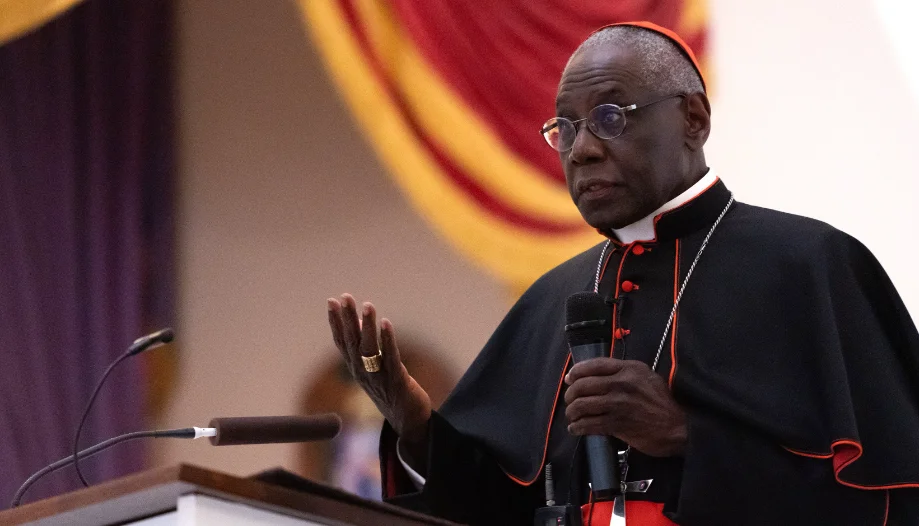
Evangelization

Josef Pieper: «Christianity is essentially reality, not mere doctrine!»

In July 1969, the magazine *Palabra* (No. 47) published an interview with Josef Pieper on the Christian anthropology of hope. We are republishing that interview here.

Jerónimo Martel-July 14, 2026-Reading time: 9 minutes

Josef Pieper’s biographical entry is as brief as his bibliography is extensive. He was born on May 4, 1904, in Elte, a village in Westphalia, and completed degrees in philosophy, law, and sociology at the universities of Berlin and Münster. He is currently a full professor—or, in German terminology, a “professor ordentlich”—of Philosophical Anthropology at the University of Münster and at the Essen University of Education.

Many of his works have been translated into Spanish—specifically in Spain—and this reference is limited to their titles, since it is intended for Spanish-speaking readers. These works are: *The Relevance of Thomism* (1952), *The Christian Catechism* (which corresponds to the German title *Christenfibel*, equivalent to the expression “Christian Primer,” and which he wrote in collaboration with Heinrich Raskop; it was translated in Spain in 1954), *On the End of Time* (1955), and *Leisure and Intellectual Life* (the latest, expanded Spanish edition from 1962), on the one hand. On the other hand, in addition to the works cited, there is a series of works that are very characteristic of Pieper and that address basic Christian and human virtues, set against the backdrop of modern man’s anguish: On Hope (1953), Prudence (1957), and Faith (1966).

In the second half of last year, two new books along the same lines were added to the list of works cited, published by Ediciones Rialp in Madrid and Sígueme in Salamanca, respectively: *Justice and Fortitude* and *Hope and History*. For all the works mentioned, the date of the first Spanish edition has been provided, even though some of them are now in their third edition. It should be noted that, at this time, Pieper has sold more than half a million copies of his books in the most important nations and linguistic regions, despite writing primarily for minority audiences.

Pieper began his theological work in 1934 with his study on fortitude, from which he moved on, the following year, to his study on hope. His work has consisted, from his clear stance as a layperson and philosopher, of adapting theology to modern thought in its conceptual and literary expression—but always with exquisite care not to alter the essential content of classical theological formulations. Existentialism and Hiroshima were not, for him, abstruse issues arising from another planet; rather, they were reasons to use the humanism studied in anthropology to lead the restless man of our time to an encounter with himself through God.

In the following conversation—held at his home in Münster—Pieper, who has so skillfully defended the existential roots of Thomism, by framing his anthropology through Thomistic ethics, discusses current issues of debate, concepts such as secularization and spiritualization, the synthesis of the human and the divine in the Christian as a human being, the relationship between traditional and modern culture, and even about that last bastion of the revolution against technology—against the absence of humanism—which is and represents the student rebellion.

How do you view the integration of Christian culture and that modern culture that has been called «secular»?

–I do not view Christianity as a monolithic entity. The Christian—every Christian—is first and foremost a human being, and must achieve that synthesis within himself: at the very least, he must try to do so. Precisely, what is non-Western is an anti-secular religion such as might be found, for example, in the Russian or Greek Orthodox churches, which are devoted solely to contemplation and liturgy, without any engagement with the world. However, there is also another danger at the other extreme, and that is secularization. Both poles are equally dangerous.

Nihilism and Secularization

The nihilistic stances taken by the standard-bearers of the revolution—regardless of their political affiliation—may call into question the relationship between modern and traditional culture. What would you say to our readers regarding this entire issue?

–I believe that the ancient culture of the West has always been—and continues to be—in a process of constant transformation, through which it interprets itself at every moment, which—as we know—involves the ongoing resolution of tensions or polar conflicts. Something else, something quite different, occurs, for example, in India, where traditional culture and modern culture are separate. But in the West, this duality does not exist; as I have said, it can instead be observed in the religious culture of the Hindu people, on the one hand, and, on the other, at the modern University of Calcutta. In this framework characteristic of India, the transition to modern culture entails abandoning tradition, because there is no such effort made there toward continuous interpretation or new interpretation. This clearly distinguishes the East from the West—from Western culture, which is, incidentally, based on the Bible, on the Word of God that shapes humanity. Here in the West, traditional culture is not spelled out by repeating its body of knowledge word for word each time, but rather is synthesized into conceptual phrases through the interpretation of theologians, who contrast it, for example, with evolutionism and paleontology, etc.

This Western way of understanding history constantly gives rise to new, apparent conflicts; but it is precisely because it is prepared to confront them that it preserves the essence of Western culture. I believe that if this difference between Eastern and Western culture were to disappear one day, we would be witnessing the end of Western culture.

And for that reason, I would also say that today even student protests are part of Western culture, although the possibility of the conflicts I have referred to—which stem from broader and more comprehensive social dynamics—arising should not be limited to the student world.

In any case, if one day there were only a secular culture—that is, one divorced from religious foundations—in the West, it would no longer be part of the Western spirit.

Specifically, what are your thoughts on this so-called «secularization» of Christian life that some people advocate?

–I would say that in Catholic theology, and consequently within the Church, there is a group or movement that advocates such secularization, but since this is not my view, I cannot support it.

In a book, translated in his homeland, he warned that there is an obstacle to be overcome—one that poses a significant challenge precisely for the people of our time. This is not something for which the people of our time are «to blame»; that is, it is not a difficulty they have arrogantly brought upon themselves. Rather, it is something that is inevitably linked to the change in our understanding of the natural world and its scope—a change that simply means our knowledge of created reality has been significantly corrected and enriched compared to ancient and medieval conceptions. Vox facta est de caelo—“A voice was heard from heaven”—: for Dante and his contemporaries, this was something intuitively conceivable, an act that could be carried out without question.

Such unquestionability is no longer available to Einstein’s contemporaries, now that even the material reality of the world has become increasingly less intuitive. «We cannot sense God’s presence in our world with the same naivety as previous generations did,» Rahner said. On the other hand, we must admit—whether we like it or not—that contemporary theology has provided few conceptual tools to overcome this difficulty, which has arisen legitimately. But I do not view the desacralization of life as legitimate.

Is the middle ground between the two dangerous extremes of extreme spiritualism and secularization the one that recognizes the legitimate relative autonomy of the temporal realm?

–Undoubtedly, that relative autonomy is part of the great tradition represented by St. Thomas. But that relative autonomy is one thing, and the autonomy sought by so-called secularization is quite another; the latter consists in severing the polar tension by conflating it with a separation between the Christian and the human, which is impossible.

Catholic intellectuals?

What you’ve been saying in your answers to these questions brings us to the topic of the layperson. What—or who—does “layperson” mean to you?

–The layperson is a baptized Christian who is not separated from the Church, but rather situated within that healthy polar tension. It is not easy to find a formula for this, but neither can we speak of a separation. If the layperson, who is a Christian, aligns with secularization, he or she thereby ceases to be a Christian. On the other hand, however, the layperson must confront this responsible relative autonomy, and this tension will never end.

Years ago, I wrote that what characterizes a Christian is Christian faith and the Christian life. Both faith and life are intertwined, just as knowledge and action are. Christian faith is the foundation of the Christian life, and the Christian life is the fruit and full realization of that faith. Christian life cannot exist without Christian faith, and Christian faith without Christian life is fruitless. Certainly, today it seems that Christian life can exist without Christian faith; it seems that one can have a Christian orientation in life without a living faith in Christ.

But, in reality, Christians who live this Christian life only in an external way are doing nothing more than enjoying and consuming the heritage bequeathed to them by their forebears: the living faith upon which they built their lives and shaped the customs and traditions of society. But this heritage is in danger of being completely nullified if it is not renewed by a faith that has been revitalized. Therefore, being a Christian in this day and age and among our people means returning to live the Christian life from its very foundation, guided and driven by a living and personal faith. The Christian «lives by faith.».

What is your opinion of a figure who is relevant to the context of this interview—that of the Catholic intellectual?

–Speaking of intellectual pursuits, I have written: «If one says that someone is Christian in their philosophy, this cannot simply mean that their worldview coincides with Christianity as a doctrine. For Christianity is essentially reality, not mere doctrine!”

The problem with a Christian philosophy does not lie solely in the fact that these must be linked, and how they should be linked, theoretically, between natural knowledge of the world and supernatural faith; rather, it is a matter of transforming philosophical inquiry into Christian philosophical inquiry by grounding the philosopher in Christian reality and understanding how that transformation is achieved.

Christian philosophy is thus enriched in its content of worldly knowledge, precisely because it is linked to the prior counterpoint of Christ’s truth. Provided, of course, that not only its Christian character but also its philosophical character is strong and true (this must be repeated constantly, for it is so far from obvious!).

A famous book on the history of medieval philosophy, by Maurice de Wulf, concludes with these words: «Scholasticism declined not for lack of ideas, but for lack of minds.».

I believe that, first and foremost, there are intellectuals, and among them there are those who are Catholic. Aside from that, I am strongly opposed to the concept of a «Catholic intellectual.» I think an intellectual is someone who participates politically and through the media in society, whereas a Catholic is someone who thinks globally about everything. In reality, the term «Catholic intellectual» was coined by politics and for a specific political direction—that of a political party.

Student Rebellion

As a professor and intellectual, you are surely in a position to offer your opinion on the student rebellion, which you touched on briefly when answering a previous question. What do you think is the cause of it? Is it rooted in humanistic reasons?

–In reality, there is much to be said about that student movement, as it is difficult to analyze its causes. That said, I see its ultimate origin, here in Germany, in the fact that the German university is no longer truly a university, but rather a collection of technical institutes, with the sole and simple purpose of training professionals. In any case, this fact constitutes at least one of the causes that have given rise to the movement.

What I understand as a university necessarily includes a theological and philosophical dimension, operating within society. This is how the university came into being in the Middle Ages. In the early days of the university, the discussion of contested issues was a reality. This very intellectual controversy is at the heart of the universality that defined the university itself and gave it its origin. Thanks to that contribution, students at that time were able to maintain a universal perspective—that is, they did not lose sight of the university’s point of view. Today, when that possibility for discussion and debate on universal topics no longer exists within the university, the resulting harm affects not only the student but also the professor.

Incidentally, one of the newest universities in Germany, the University of Bochum, recently opened its doors. And it has chosen to do so by responding to what I have called «offenheit für das Ganze»—a sense of openness to the whole. At that university, this universal sensibility—which goes beyond the technical—is even institutionalized as an academic element. Regarding that experience, I wrote: «The academic debate that extends across faculties and disciplines is embedded in the university’s organization. However, there are many difficulties; for example, the lack of a common language among the faculties; and also the fact that professors are afraid to express their personal opinions, since these cannot be scientific in the strict sense.».

The university should be open to everything. It must be an institution dedicated to free thought—a free space within society, a sanctuary of intellectual freedom. In other words, in that place that is—or should be—the university, direct attitudes and concrete stances must be set aside, left in abeyance. And it is in this sense that academic freedom is rooted in its very origin. Such freedom no longer exists in German universities, and even less so in American ones.

So, could the ultimate cause of the student rebellion lie in a desire to defend the university as an institutional bastion of free thought?

–In my opinion, students don’t rebel just for that reason. I insist that their rebellion stems from a very complex set of motivations. One of the causes lies in their reaction to what students here call «those idiot specialists»—that is, professors who solely cultivate and promote their own technical specialty. I’d already said that, because that’s what I thought.

I pointed out that the university cannot be divorced from the general philosophical idea that constitutes its essence. On the other hand, however, when students—who represent the working world as a whole—devote themselves to what they call the “politicization of the university,” they undermine that free intellectual space that constitutes the true essence of the university.

Is it, therefore, a bad thing for students to be interested in politics?

–In my opinion, students should not get involved in politics, whether theoretical or practical. It’s another matter entirely for them to discuss politics at the university, but only in a theoretical sense.

In short, students should not reject this theoretical discussion, as do those student groups that seek to introduce partisan politics into the university. It is one thing for students to discuss the arguments put forward by political parties at the university; it is quite another to turn the university into a arena for politics and partisan politics.

The authorJerónimo Martel

The Vatican

Pope Leo XIV at the Angelus: «God’s generosity is not naive, but wise, and He believes in us»

From Castel Gandolfo, Pope Leo XIV reflected on the parable of the sower and invited the faithful to use their vacation days to cultivate silence, prayer, and meditation alongside their summer rest.

Paloma López Campos-July 13, 2026-Reading time: 2 minutes

On Sunday, July 12, 2026, Pope Leo XIV presided over the Angelus prayer from Castel Gandolfo alongside the faithful and pilgrims gathered in front of the Apostolic Palace. In his address, the Holy Father focused his message on the parable of the sower, highlighting God’s patience, trust, and unconditional love for humanity.

God's Faithfulness in the Face of Human Weakness

The Pontiff explained that Jesus is the seed that the Father continues to sow throughout the world, even though He sometimes finds in people soil that is «hard and unresponsive» or «distracted,» like the trampled ground along the roads or the thickets of thorns.

However, the Pope assured us that God knows the human heart better than anyone else and never stops sowing, because the power of His love is stronger than our weaknesses: «God’s generosity toward us is not naive, but wise, and He knows how to discover within us the potential for good that, at times, even we ourselves are not aware of.».

Transformation of Hearts

During his reflection, the Holy Father cited a passage from St. John Chrysostom to illustrate how divine grace has the power to transform the most difficult terrain into fertile fields.

It is this openness and humility in receiving the divine seed that, according to the Pope, allows us to reap the fruits of the Holy Spirit in society. As he listed virtues such as «love, joy, peace, patience, kindness, goodness, faithfulness, gentleness, and self-control,» Leo XIV exclaimed, «How much our world needs these fruits—to be filled with them and transformed by them!»

A Meaningful Summer Break

Taking advantage of the vacation period, the Pontiff issued a direct appeal to the faithful not to neglect their spiritual lives during their days off. He encouraged them to make time to listen to, read, and meditate on the Word, as well as to cultivate rest and “wholesome recreation,” while also setting aside “meaningful moments of silence and prayer.”.

At the conclusion of his address, the Pope expressed his hope that this time of respite would allow the faithful to return to their usual activities «renewed in body and spirit,» ready to contribute to the growth of the Kingdom of God, entrusting this intention to the Virgin Mary.