Evangelization

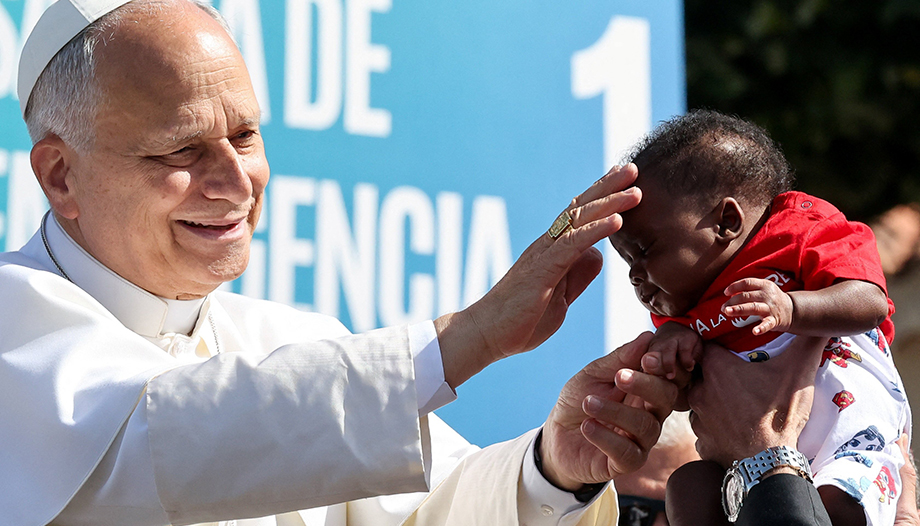
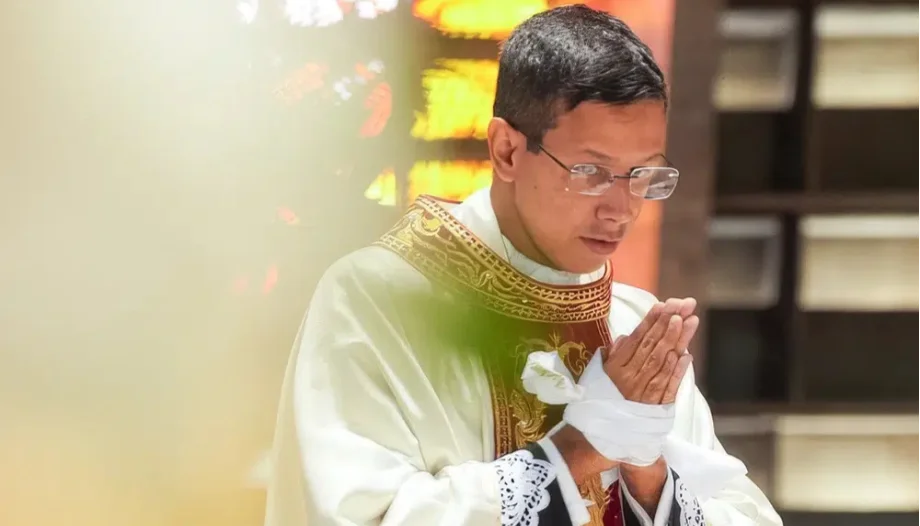
Manu, the young man who asked the Pope, «God always puts me on the top step»

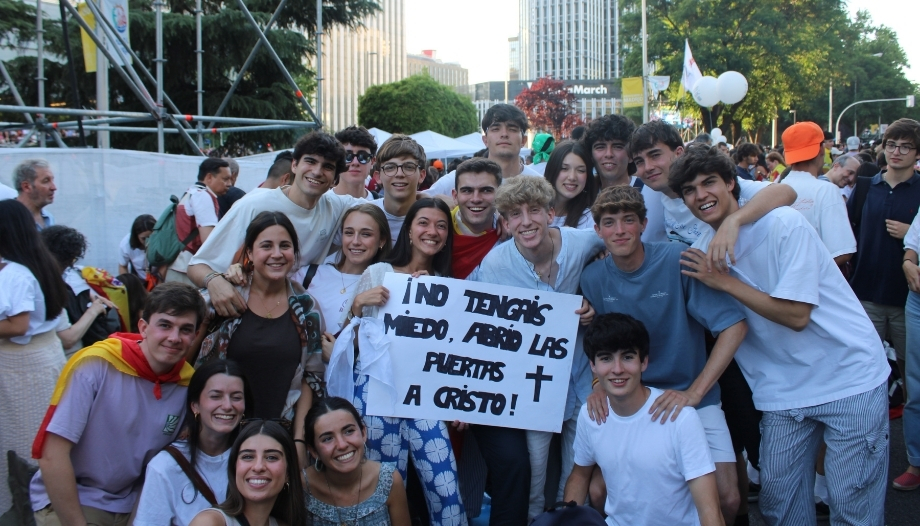
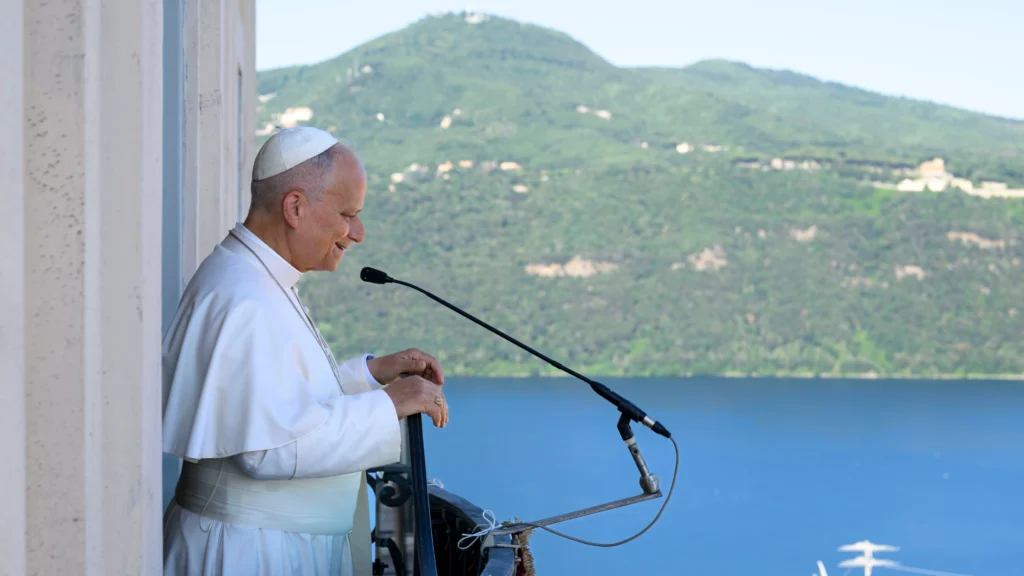
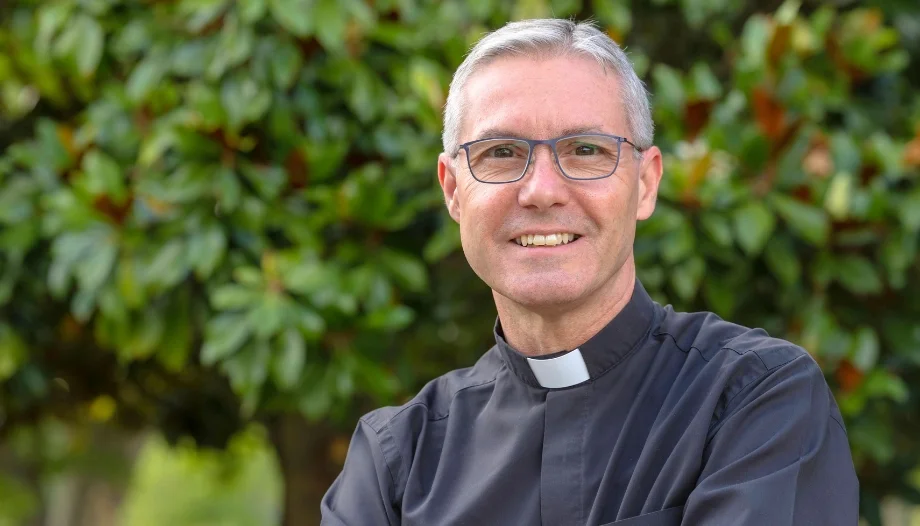
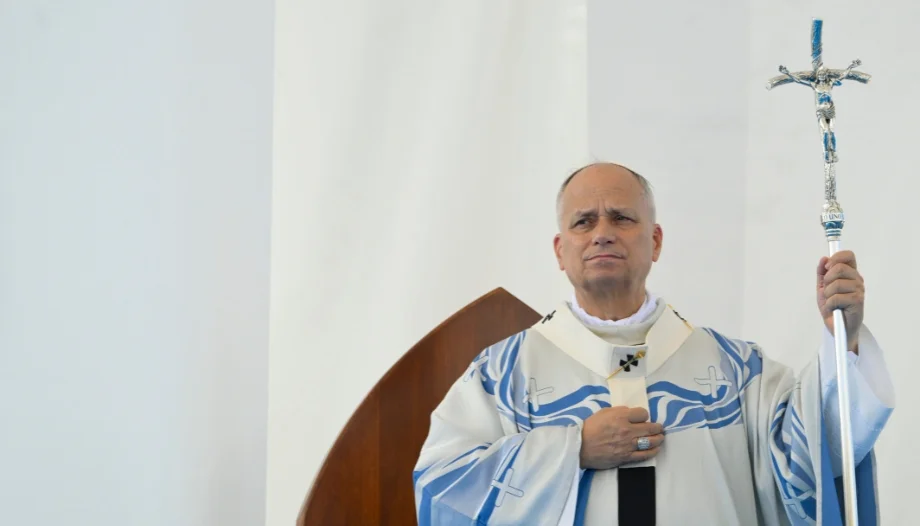
A month after the Pope’s visit to Spain, we spoke with Manu, a young man who had the opportunity to ask the Pope a question, speaking on behalf of all young Spaniards. He shares his story and how this experience continues to help him on his journey of faith.

Teresa Aguado Peña-July 13, 2026-Reading time: 3 minutes

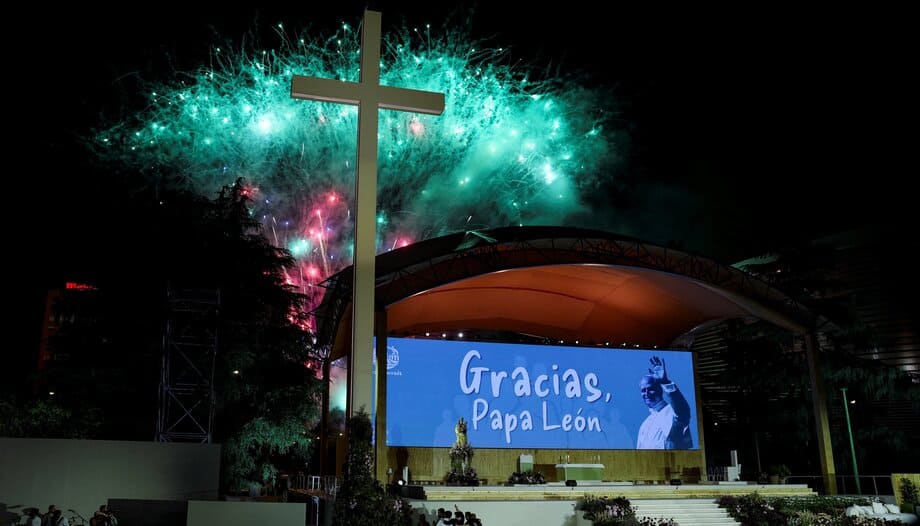
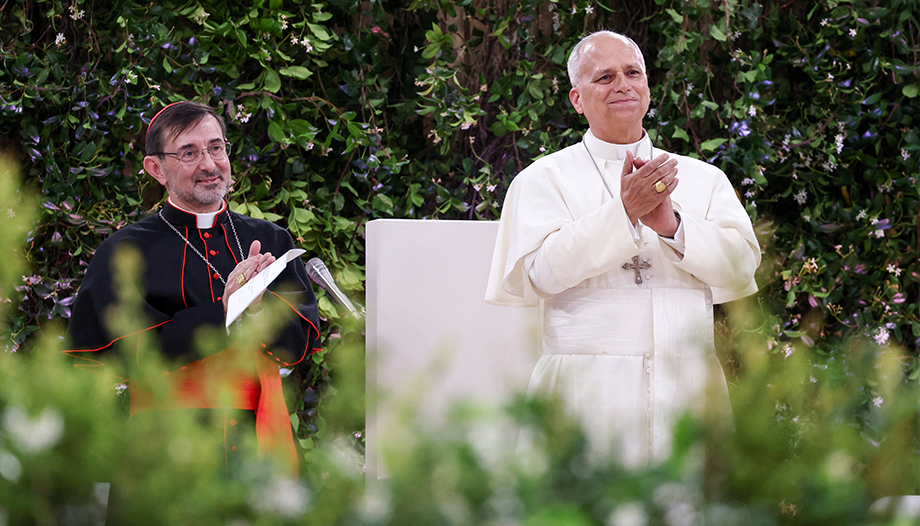
“Today there are many young people who are searching for God, others who would like to believe, and still others who don’t want to talk about God, but often we don’t know how to help them. How can we—who are also searching—accompany them as they discover the beauty of faith?” This was the question posed to the Pope by Manu, a 25-year-old man, at the youth vigil on June 6.

The Pope replied loud and clear: “¡We are not alone!”. That night, León XIV reminded Manu and all the young people that we have God and a wonderful community by our side. He also pointed out that it is through our experience and testimony that we must teach the beauty of faith to those who do not know the Lord.

Setting aside theories and moralizing, the Pope emphasized to young people the power of witness. Manu was deeply moved by his words, and in an interview with Omnes, he shares his experience with us.

Restless Youth

Manu was able to see with his own eyes and attest to the Pope’s statement that “we are not alone.” He says that, like many others, he was struck by the 600,000 people who knelt and observed a moment of silence during the vigil before the “one and only king.”.

The vigil made it clear that young people are taking action in search of answers: «I see a great deal of unease, both among young Catholics and among those who don’t believe. We’re all wondering about our future, our calling, and the meaning of life. And that’s precisely why so many people end up turning to the Church.»

For him, Christianity offers a different answer to the prevailing logic: «We live in a society where it seems that everything revolves around work or success. The Church reminds you that your vocation is much deeper. In my case, for example, my vocation is not my profession, but raising a family. Work is a means, not an end.»

How can we explain the «renunciations» involved in being a Christian?

During the conversation, a common question arises: how to explain concepts such as chastity or the demands of the Gospel to those who are distant from the faith.

His answer is surprisingly simple. «We often try to persuade people through reason. We explain why we make certain sacrifices, and people even understand our logic, but they don’t buy it.».

But for Manu, it must be the other way around: «First you have to experience God’s love. Only then does everything else make sense. If you start with the rules, it seems as though Christianity is nothing but prohibitions. But when you discover God’s love, those same things cease to feel like sacrifices and become a natural consequence.».

To be able to ask the Pope a question

Manu explains how the experience of standing before the Pope was a clear sign of God’s love for him: «When they told me I was going to ask the question, I was going through a pretty rough time. My self-esteem was very low, and I thought I didn’t deserve to be there.».

«For me, it was a reminder that, even though I might beat myself up because I’m a sinner and feel like I do things very badly, the Lord shows me how much He loves me. Even when I think I’m at my lowest point, He always lifts me up to the highest step because that’s how He sees me.”.

»That's what I'll take away from this: to try to see myself through God's eyes and to look at others that way as well—both our friends and those we find hard to love—because if He always lifts us up, even in our worst moments, we, too, should try to lift others up in the same way.".

A simple conversion

Although he has always been Catholic, Manu admits that for many years his faith was simply something he had inherited: «I always went to Mass because my parents raised me that way, but I didn’t really know God personally.».

The way he lived his faith changed when he became involved in his parish (Our Lady of Good Success) in 2022: «It wasn’t a dramatic conversion, but it was a very profound maturation. I stopped living my faith out of habit and discovered that God wanted to be a part of my life.».

Since then, he has been coordinating youth groups, participating in diocesan training, and next year he will also begin teaching catechism.

The momentum of the vigil continues

Weeks after the papal visit, he acknowledges that the initial enthusiasm has not faded: «It’s a moment I keep coming back to. When I feel like I’m about to break down, I remember the vigil, I remember everything I experienced, and I regain my strength.».

He also hopes that it has sparked questions in those who watched from afar as crowds of young people gathered around the Pope: «I think many people will wonder what motivates so many young people. What makes hundreds of thousands of people want to be there, experiencing it all with such joy, such silence, and such peace. I hope that question will be a starting point.».

Because, as he learned during those days, evangelization does not begin with grand speeches, but with the witness of a life transformed by God’s love.

Read more
Culture

«Dreams of Trains.» The Search for Meaning

Journalist and philosopher Rocío Montuenga has selected this film as one of the most important of the past year. It is a wonderful, slow-paced, meticulously crafted film that invites viewers to reflect on the meaning of life and, in particular, on suffering.

Rocío Montuenga / Jaime Nubiola-July 13, 2026-Reading time: 4 minutes

Although it had been nominated for four Oscars, the acclaimed film Dreams of Trains Netflix's film didn't win any awards at the ceremony on March 15. However, I asked Professor Rocío Montuenga to share her thoughts on this magnificent film with us. Here is what she wrote:

“During my college years, in Jaime Nubiola’s Philosophy of Language classes, I gained an insight that time has continued to confirm: there are realities that go beyond what can be verified. If we were to divide the world into that which can be verified and that which eludes sensory experience, on one side would be science, the tangible, and everything that can be explained; on the other, the universe of the ineffable. That realm of which, as Ludwig Wittgenstein wrote in his A Logico-Philosophical Treatise, ‘Whereof one cannot speak, one must remain silent’.

And yet, it is precisely there that some of the most crucial questions of existence lie. Love, suffering, beauty, God, hope, and the meaning of life can hardly be reduced to formulas or empirical verifications. They are realities that transcend us and, precisely for that reason, define us.

Questions such as ‘What is the meaning of my life?’, ‘Is there a purpose that can bring coherence to my decisions, my losses, and my longings?’, or ‘Why am I here?’ inevitably arise. Sooner or later, every human being faces these questions—not because they expect definitive answers, but because living means learning to live with mystery.

The Fragility of Life

These issues lie silently within the protagonist of Dreams of Trains (Train Dreams, 2025), a man whose life seems marked by loss and by the search for a sense of cohesion that would give his story a sense of unity. 

The film, directed by Clint Bentley and based on the novel by Denis Johnson, moves between the western and rural drama, with the unhurried pace of the slow cinema. More than just a genre story, it is a meditation on the mystery of meaninglessness and the ceaseless—and profoundly human—search for meaning.

From the very first bars, Dreams of Trains places the viewer alongside the voice in off from a narrator who tells the story of Robert Grainier, a laborer in the American West who, in the early 20th century, worked on the construction of the railroad. Orphaned as a child, he learned all too soon that life can be cut short without warning.

On the railroad, the unjust death of a fellow immigrant—exploited and despised for not belonging to the world of white American men—leaves a silent mark on him that is difficult to erase. 

The pain then takes root as a question, even in the form of recurring dreams in which his friend’s presence haunts him. Since then, Robert seems to live with a persistent question: why does life inflict pain in ways that are so difficult to understand?.

However, the film also shows that the meaning of life rarely appears as an abstract idea or as something that organizes a person’s life in a linear fashion; rather, it bursts onto the scene embodied in specific people, in glances, and in gestures. In Robert’s case, that first anchor comes through Gladys, whose company restores a sense of reconciliation with life. 

Love, the prospect of a home, and the arrival of his daughter bring an unexpected sense of fulfillment to his harsh existence. Happiness is found not so much in the where, when, or how, but in the with whom. 

Meaning and Loss

Here, it is impossible not to think of Viktor Frankl’s central exploration in Man in search of meaning. Frankl argues that human beings find meaning in three ways: through work or a task, through love and beauty—the ‘gift received’—and, finally, in suffering that is willingly accepted. 

Robert’s journey seems to follow, almost without his realizing it, these three paths: his work on the railroad and as a logger, the love of Gladys and his daughter, and later, the devastating experience of loss. Just when an abyss of meaninglessness seems to open up, the story suggests—with a delicacy reminiscent of Terrence Malick’s films—that even pain can slowly be transformed into a sacred place imbued with meaning.

To chronicle this journey of a broken heart—marked by grief, fragility, and the transience of life—Bentley turns to nature as a mirror and a source of continuity. Robert’s life is interwoven with images of wood, axes, falling logs, and forests cleared by human intervention. But also with flowing rivers, birds soaring over the landscape, flowers blooming in the open, nighttime bonfires, and sunsets that bathe the mountains of the American heartland in a sense of calm. 

Nature here is not merely a backdrop, but a living presence that suggests transformation, cycles, and permanence amid change.

Robert Grainier’s grief over the void left by his losses does not cause him to withdraw into himself, but rather, paradoxically, opens him up to a deeper understanding of life in all its uncertainty. Even in the midst of suffering, his existence is not reduced to what he has lost, but remains permeated by what he has received and what he has been able to give: his work, his presence, his friendship, his quiet love, and his ability to sustain the lives of others through discreet gestures.

Learning to receive

Perhaps this hints at a crucial insight: that not all meaning is constructed, but is also received. Life is not limited to what we do or achieve, but also to what we receive and how we receive it. And in that acceptance—of both the luminous and the wounded—a deeper form of meaning emerges.

In this vein, human beings often fail to find meaning because they reduce it to what they do, what they have, or what they produce. However, existence seems to transcend those limits: it cannot be explained solely in terms of action, but also in terms of reception.

The trees that appear in Dreams of Trains They serve here as a particularly eloquent metaphor. The felled tree trunk and the standing tree trunk coexist in the same landscape, reminding us that life simultaneously encompasses what is born, what falls, and what remains. In this coexistence of opposites, a deeper understanding of existence is implied: not as domination, but as acceptance of its own rhythm.

From this perspective, life is justified not only by what happens to us or what we achieve, but also by what we receive and by what we are able to give back selflessly from our very being in the present moment. In that selfless exchange, a deeper form of meaning emerges. And perhaps it is there—in a serene gratitude for what we have experienced—that human beings find the strength to continue inhabiting the mystery of existence.”.

The authorRocío Montuenga / Jaime Nubiola

Read more
Culture

Saydnaya and Maaloula: Where the Language of Jesus Is Still Spoken

Two iconic sites of Eastern Christianity, Saydnaya and Maaloula, still preserve millennia-old traditions, including a variant of Aramaic, the language associated with Jesus.

Gerardo Ferrara-July 12, 2026-Reading time: 6 minutes

I have already written in these pages about the Syria which was: a country at the crossroads of civilizations and empires, languages, religions, and alphabets—a lost world of peoples and communities that a terrible, protracted war has torn apart, and it is unclear whether it will ever be able to pull oneself together. 

Today I want to continue talking about this, with nostalgia and a desire to return there, to share a journey that, in August 2008, took me to visit two places that preserve the oldest heart of Eastern Christianity: the Saydnaya Monastery and the village of Maaloula, where a variant of Aramaic—the language of Jesus—is still spoken.

The Desert and the Border

Imagine you're in Lebanon. Three wonderful weeks traveling the country from top to bottom, taking in the mountains, the sea, ancient and modern monasteries, wonderful cities, incredible food, and people who are as welcoming as you rarely find anywhere else. 

But something was missing: the desert! I had always dreamed of seeing it, of setting foot on that expanse of ochre-colored sand that I had only ever seen in photographs. So I convinced my friends to contact a travel agency and organize a trip across the border: Saydnaya, Maaloula, and finally, Damascus. It was early August. It was hot, yes, but nothing compared to the heat waves we’ve been enduring lately. And first thing in the morning, we climbed into a van—two Lebanese Christian friends and I—with a Druze driver, also Lebanese, who would also serve as our guide.

I still remember the typical Middle Eastern nonchalance with which our driver navigated the roads winding up through the Lebanese mountain range, skirting the abandoned tanks on the sides of the road: silent remnants of the long Syrian occupation, which ended in 2005 after thirty years of military presence.

As I descended into the valley, with the Anti-Lebanon Mountains and the nearby border already in sight, the road became straighter, and at the border, as an Italian, I crossed without any problems: a cordial handshake, a few dollars for the visa, and a «see you later,» while the Lebanese and Syrians waited in line under the sun. A paradox—unacceptable in many ways—the same one that exists between Israel and the West Bank.

And then, once we crossed the border, the first breathtaking sight. My Lebanese friends, accustomed to green mountains, cultivated terraces, and cedars, couldn’t understand how I could be so captivated by the desert. And yet, that’s exactly how it was: that immense expanse, ochre-colored and scorched by the dazzling light of the August sun, the flat horizon stretching endlessly before the van—it won me over immediately. There is something mystical about the deserts in that part of the world: it is no coincidence that the three Abrahamic religions were born there. Clearly, there, people are more inclined to listen to God.

Saydnaya: The Virgin on the Rock

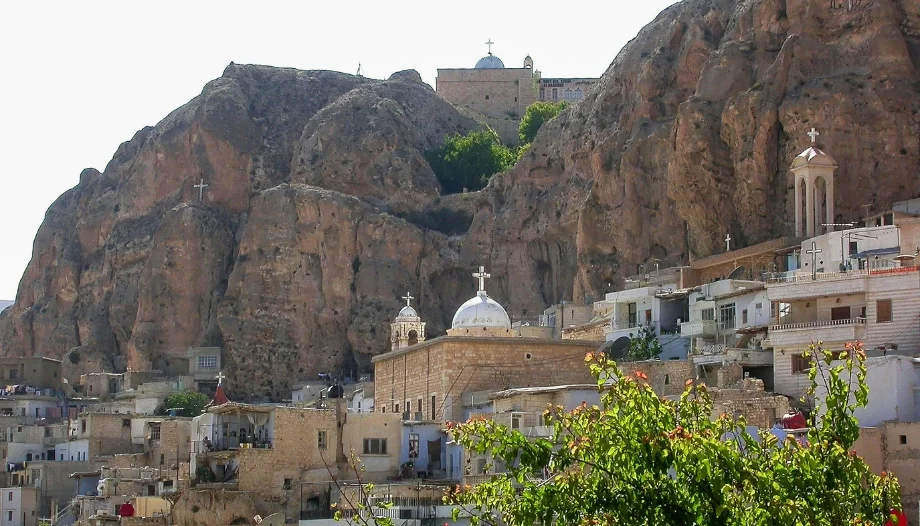
The first stop was Saydnaya (from the Aramaic Saidnāyā: «Our Lady»), a Greek Orthodox monastery founded, according to tradition, by Emperor Justinian in the 6th century, on a rock about 30 km north of Damascus, which houses one of the oldest and most venerated Marian icons in all of Eastern Christianity.

Arriving at the monastery felt like ascending to heaven: the steep climb, the August sun beating down on the structure that rose from the rock, almost merging with it. The thick outer walls, made of light-colored stone, discreetly protected what lay within: neither the flower-filled courtyard nor the quiet paths connecting the monastery’s various rooms—a small world unto itself.

Inside the main church, the gilded iconostasis stood like a wall guarding the holy of holies, and the candelabra, with their flickering light shining on the ancient icons, created an ethereal atmosphere. There were very few of us, and the silence—along with the coolness and the refuge offered by the church—made us want to stay there forever.

In the center, in a reliquary, was the icon of the Virgin of Saydnaya, which, according to tradition, was painted by the evangelist Luke and brought here from Byzantium. 

My Lebanese friends pointed out to me a small group of Muslims who showed great respect and reverence for that place, which is also sacred to them.

Once outside, I gazed at the valley that stretched out at the foot of the monastery, the expanse of ochre that embraced the horizon as the sun’s rays reflected relentlessly off the convent’s white walls. 

Now that I think about it, it moves me to realize that such a beautiful country would suffer an immense tragedy just a couple of years later.

Maaloula: The Language of Jesus

Maaloula made an even greater impression on me than Saydnaya, if that's possible.

I couldn't stop gazing in awe at the landscape through the window, while one of my Lebanese friends was suffering from terrible motion sickness (but I didn't really care!): How could anyone not be captivated by the beauty of that flat desert, which suddenly became rugged and then rocky, opening up into a gorge dominated by Maaloula?

That is how the village appeared to me, clinging to the rock—one of the few places in the world where Western Aramaic is still spoken: the language that Jesus spoke. 

It should be noted that there are several modern variants of ancient Aramaic, which—like Latin—has evolved, giving rise to languages such as Syriac, Palestinian Jewish Aramaic (spoken in the time of Jesus), and the Chaldean dialects (in Iraq).

In Maaloula, this language continues to echo through the streets, in the prayers at churches, and in the voices of children.

First, we visited the Monastery of Saints Sergius and Bacchus (Mār Sarkīs wa-Bakhūs), one of the oldest Christian places of worship in the world (4th century), built on the site of an ancient pagan temple. The fountain in the courtyard, the dark wooden doors, the silence of the cloister—everything conveyed a sense of being outside of time.

At the Greek Catholic church, our guide—a young woman from the area—gathered us in a square formation around the altar (which dates back to pre-Christian times) to recite the Lord’s Prayer in Aramaic. The emotion I felt at that moment mingled with the pain of having seen, in television reports, how that very same altar was smashed to pieces with hammers by Islamic fundamentalists during the civil war. Two thousand years of coexistence between pagans and Christians—and later, between Muslims and Christians—swept away with the blows of a hammer!

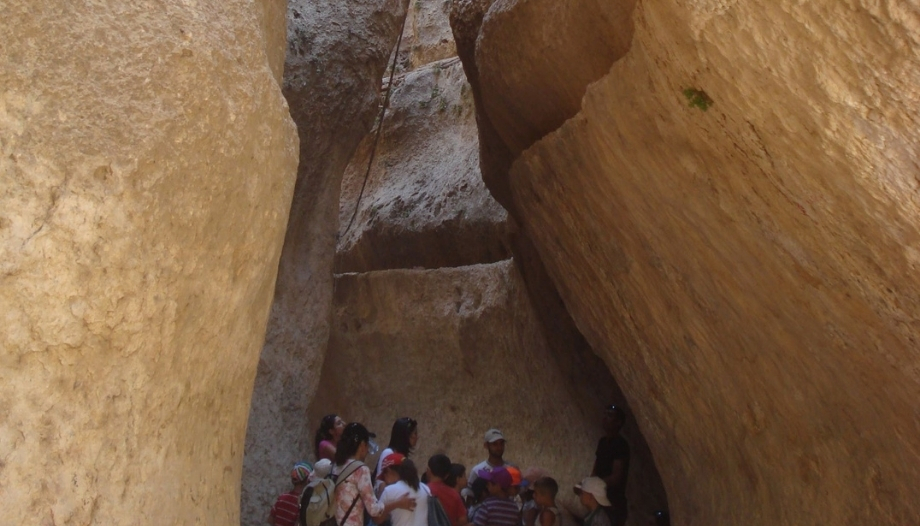
As we left the church, we made our way through the gorges and among the rocks leading to the shrine of Saint Thecla, one of the first Christian martyrs and a disciple of the Apostle Paul. Tradition has it that when Thecla was being pursued by her persecutors, the rock miraculously opened to give her refuge. The crevice is not very different from the one you walk through to reach Petra in Jordan, and at certain points, where it narrows, you find yourself literally trapped between the ochre color of the rock and, high above, the intense blue of the clear sky.  

What Remains

Without a doubt, that journey, which ended in Damascus at Ananias’s home, has been indelibly etched in my memory and in my heart.  On our return to Beirut, as evening fell, we left behind the vast outskirts of the Syrian capital, with the gigantic posters of Bashar al-Assad still standing everywhere, and the desert shifting in color toward orange and brown.

I may never see those places again just as I left them. 

In fact, in September 2013, Maaloula was one of the first Christian villages in Syria to be occupied by Jabhat al-Nusra rebels (linked to Al Qaeda), whose founder and leader was the current Syrian president so beloved by Trump, Ahmed al-Sharaa Al-Jawlani!

The clashes caused immense damage to historical and artistic heritage: the Monastery of Saints Sergius and Bacchus was ransacked, and some of its millennia-old icons were stolen or destroyed. However, it was the Convent of Saint Thecla that became the most poignant symbol of that era: the twelve nuns who lived there were abducted by militiamen and held hostage for nearly three months, between December 2013 and March 2014, before being released following lengthy and complex negotiations mediated by Qatar.

Saydnaya was also ravaged by the war. In fact, according to reports by Amnesty International, the Assad regime imprisoned thousands of people in the notorious prison located near the monastery. Many were tortured and killed; just as many never returned, disappearing amid the wounds and scars of a conflict that has destroyed a country.

The hope is that, as has happened so many times throughout history, Syria—and those places of enchanting beauty and immeasurable cultural value—will once again become a beacon of civilization, tolerance, and the good life.

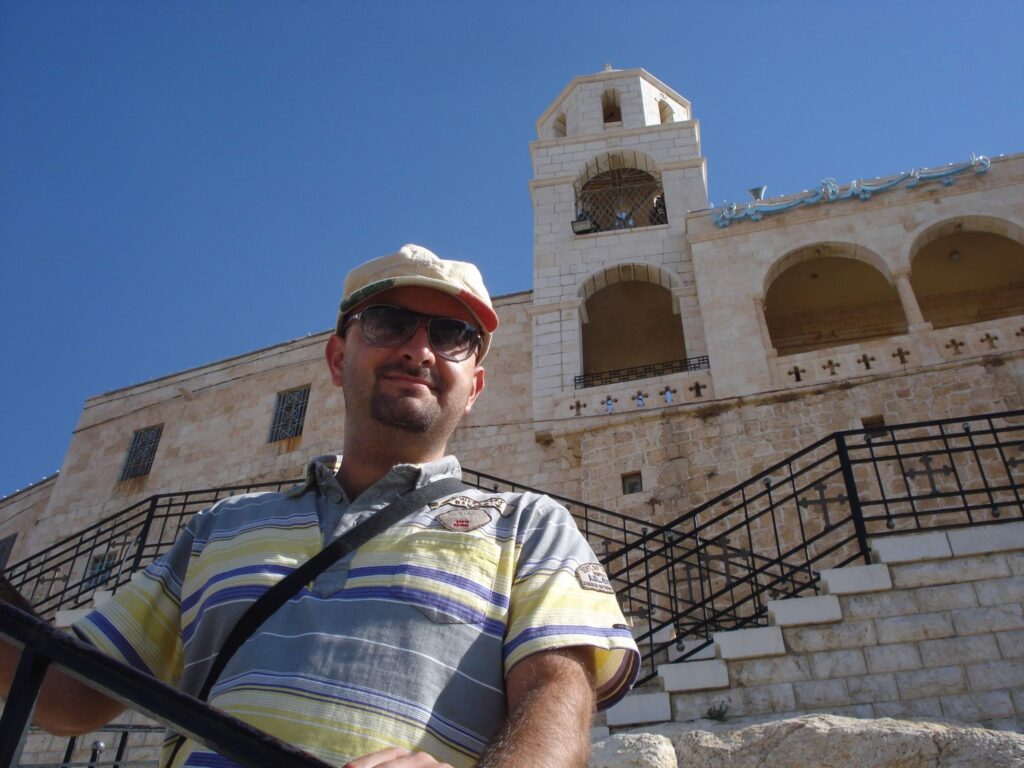
The author, Gerardo Ferrara, at the Monastery of Our Lady of Saydnaya
Read more
Cinema

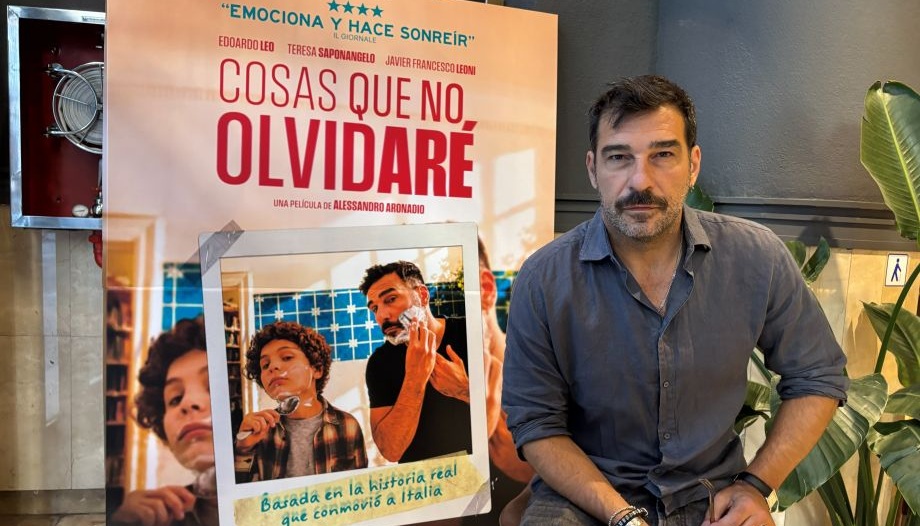
“Things I Will Never Forget,” a powerful look at Alzheimer’s

Edoardo Leo, star and producer of the film “Things I Will Never Forget,” explains how the film tackles the reality of Alzheimer’s with a sense of humor and without drama.

José María Navalpotro-July 12, 2026-Reading time: 5 minutes

Paolo is 40 years old and has been diagnosed with early-onset Alzheimer's. He begins to lose his memory and decides to live in the moment and enjoy time with his wife, Michela, and his 11-year-old son, Mattia. This is the story he tells in “Things I'll Never Forget”, which just premiered in Spain.

The story is based on the real-life experiences of Paolo Piccoli himself and his son Mattia, who were honored by the president of Italy. Edoardo Leo, the film’s lead actor and producer, has been in Spain and explains what motivated him to take on this deeply human drama, which explores themes of family, illness, and the meaning of life.

In 115 minutes, the film delves with humanity and humor into the world of Paolo, whose mind is beginning to fade due to Alzheimer’s. He decides to create moments worthy of being remembered—moments that help him enjoy his increasingly hazy life more fully. It’s not a tear-jerker, despite the gravity of the subject matter. The director and screenwriter is Alessandro Aronadio, who works with a sensational cast, especially Edoardo (Paolo in the film) and the young Javier Francesco (his son). It is produced by Bosco Films, and the website where you can find out which theaters are showing it is thingsIwillneverforget.com.

Where did the idea for the movie come from?

– It’s a fact of life, unfortunately. Because President Mattarella, the President of the Republic, presented this boy (Mattia) with an award for the way he took care of his father.

We discovered this story through this news article about the award ceremony. Then we found out that Paolo’s wife had written a book telling Paolo’s story. At that point, we bought the rights and decided to write the screenplay. This story really moved us. Because we saw the emotion of this young man, this kid, being honored by the President of the Republic—something incredible. 

Was a movie like this necessary? Alzheimer's isn't a topic that's often addressed in movies.

– For me, at my age, just making another comedy—just for the sake of it—didn’t make sense. So, together with Alessandro (the director and screenwriter), we took on this challenge: to make people smile and move them with such a dramatic subject. We might have been wrong, but we had to do it while respecting the family’s grief. It was a huge responsibility. But for me, that’s the primary purpose of comedy. 

What was the most difficult part of taking on this role?

– The hardest part is conveying that feeling. What I’m about to say may sound paradoxical, but it’s easier to portray the disease itself. The hard part is embodying something that only Alzheimer’s can cause—knowing that you’re sick, but having no awareness or perception of it.

That phase is the hardest to interpret. It has something to do with consciousness and memory. It's very complicated. Just as it's complicated to convey nuances, the gray areas make it harder to tell a story. 

What has your relationship with the royal family been like? 

– I didn't want to meet with them before. I didn't want to see Paolo before either because he was too sick.

Before the film screening, I met Michela and Mattia. And I told them: Don’t look for your father in the movie. Film has to distort or betray stories so they can become cinematic. Don’t look for your father’s biography, but rather the essence of your father’s story. Because it could have been a disappointment. And the beautiful part was the hug at the end of the screening. They told me that in that hug, I had the same smile as Paolo.

Was the purpose of the movie to touch the audience's hearts? To raise awareness about Alzheimer's?

– Yes, because movies don't teach; there's nothing that can be taught through film. I don't believe in films that convey messages; I don't believe in didactic films, because otherwise they become moralistic.

Movies, on the other hand, stand on their own; they tell stories. And if that story touches people’s hearts, it inspires them. It teaches each person something different—there’s no single message.

Perhaps one message it conveys is that you don't have to be someone special to be a hero. Even as an ordinary person, you can perform heroic acts in everyday life.

– That's right. Here, a child becomes a hero because he acts as a father to his own father. It's incredible—a child should never have to bear that kind of responsibility, ever—but it's wonderful. He's a kind of superhero of emotions.

This emotional scene is one of the most beautiful parts of the movie. 

Now that it has been released in Italy, what impact has it had?

– It was a hit—it's incredible. Because it's a movie about Alzheimer's; it's not a lighthearted comedy about a group of friends going on a trip. It's a movie that could have inspired a certain amount of respect for people. But that wasn't the case.

On a personal level, the most amazing thing is the number of messages, letters, and social media comments from people who have gone through or are currently going through this experience with an Alzheimer’s patient at home. They’ve thanked me because we try to highlight the only positive aspect of this disease: the memory of emotional bonds.

How did you manage to incorporate humor into the film? It's very difficult to strike the right balance between making jokes and dealing with such a dramatic subject.

– That’s the point of comedy. The hardest part is laughing in the face of pain and illness. But the thing is, you’re not laughing at them—you’re laughing with them, alongside them.

It’s the most complicated part, but it’s what has inspired us the most. Every day on set, Alessandro and I would ask ourselves, “Can we say this? Where’s the line?” We wondered where the line was so as not to offend the family.

When we wrote the script, we shared it with the family. We offered to use their real names only if they were okay with it—if they accepted the script. If not, we would use made-up names. And after reading it, they said, “Okay.”.

We didn't want to make a sad movie about the father's story. We wanted to make a fun, emotional movie. Paradoxically, it would have been easier to make a movie about the illness—a kind of emotional blackmail. 

On a personal level, how has the movie affected you?

– This film has reinforced ideas that we all think about but don’t put into practice. That is, focusing on the depth of memories, not the quantity of them. We don’t have to wait for special moments to come to us from the outside. Sometimes the most special moments are very, very small. But you have to go out and find them—you shouldn’t just wait for them to happen.

At its core, the film is a call to highlight the dignity of every person, including those who are ill.

– Today, Paolo—who is very ill—remains an incredible source of joy and love for his family.

I watch private videos of him, and even though he doesn’t recognize his children anymore, he’s still a source of joy for that family. It’s a matter of perspective—whether you choose to give in to the sadness of a story or try to find a way to survive. And one way is to hold on to that little bit of beauty that’s there to keep the family together, with care as a very powerful, very strong emotion.

Read more
Initiatives

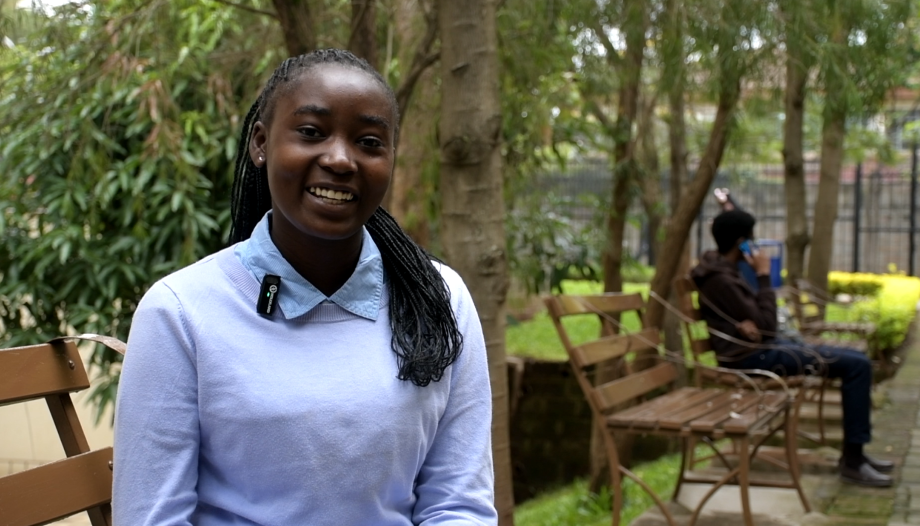
From the Kibera slum to law school: Valary’s success breaks the cycle of poverty

Otieno Valary Akinyi, an 18-year-old from the Kibera informal settlement in Kenya, has been admitted to Strathmore University thanks to her academic achievements and the MACHEO PLUS scholarship from Harambee ONGD.

Paloma López Campos-July 11, 2026-Reading time: 2 minutes

Otieno Valary Akinyi, an 18-year-old woman born and raised in the village of Raila, within the Kibera informal settlement (Nairobi, Kenya), has defied the odds by enrolling this June at Strathmore University to pursue a bachelor’s degree in law. This milestone—unattainable for many young people facing social exclusion in the neighborhood—has been made possible thanks to the MACHEO PLUS scholarship from Harambee ONGD, funded by a donor who will cover the full cost of the four years of her academic studies.

Valary’s journey to college began with a great deal of effort on her part. During her sophomore year of high school at the Kibera Girls Soccer Academy—a free school—she joined Strathmore University’s Macheo program, which focuses on preparing high school students for higher education. By attending classes and mentoring sessions every Saturday, her perseverance paid off: she was named the top student in the class of 2025 after earning a B+ average (honors) on the KCSE national exam.

A scholarship that means everything

However, financial barriers threatened to derail his future. With six children in the family, his parents’ income was insufficient to cover college tuition. His mother, who works at a cereal store, earns about 54 euros a month, while his father makes a living as a street vendor.

The arrival of the scholarship funded by Spain has been a «lifeline» for the family. In a letter addressed to the Harambee ONGD headquarters in Madrid, the young woman expressed her gratitude for the financial support, which will spare her from having to deal with the financial burden and allow her to focus on her goals. «I will devote myself fully and diligently to my studies to live up to this privilege and graduate within four years,» said Valary, whose goal is to become a lawyer to serve her community and uphold justice.

The news has also transformed her family. Her mother, Esther Apin, described the anguish she felt at not knowing how they would pay for Valary’s education—Valary had dreamed of becoming a lawyer since her final years of elementary school—and confessed that she now feels a great sense of relief and hope. Her father, John Otieno, expressed his deep gratitude for the generosity of the anonymous Spanish benefactor.

Spillover effect

This success is also having a significant «ripple effect» on her community, a place where young people face a severe shortage of schools. Claris Omondi, principal of Valary’s former high school, notes that this achievement serves as «enormous motivation» for the rest of the students, as they see that it is possible to attend a prestigious university.

Through scholarships like this one, which include annual progress reports for donors, Harambee ONGD aims to make a structural impact. By facilitating access to college for talented young people, the organization seeks to ignite the engine of development, enabling students like Valary—who is already enjoying her first days of campus life and interactions—to take charge of their own destinies and improve the future of their communities.

The Power of Imagination

We must ensure that our imagination stops distracting us and acting as an ally to our fears, and instead helps us navigate the present with greater joy.

July 11, 2026-Reading time: 3 minutes

St. Teresa of Ávila said that the imagination is the madwoman of the house and that no one can restrain her. Perhaps that is one of the best-known ideas from *The Interior Castle* and her entire body of work. However, St. Teresa acknowledged that, although the imagination It can lead us into distraction, but it can also help us in prayer. When used well, the imagination can become a path to contemplation, empathy, and love. In *The Way of Perfection*, she wrote, “Picture the Lord Himself alongside you,” and also, in one of her poems, “May I look upon my Beloved and my Beloved upon me; may He look after my affairs and I after His”—tasks that clearly require imagination.

The Importance of Imagination

Some philosophers have pointed out the importance of this cognitive capacity, which not only gives rise to fantasies but also serves as a bridge between sensibility and intelligence. Leonardo Polo asserted, for example, that what distinguishes us from animals is not only intelligence but also imagination, which allows us to remember, anticipate, give continuity to experience, and prepare for intellectual abstraction. Not only that, but imagination can also be trained, and we can then direct it toward good things, such as art or science.

As the American philosopher Charles S. Peirce said, there is no science without a “rather wild play of the imagination” preceding it. In general, we cannot advance our knowledge without imagination, which is precisely what presents us with possible novel hypotheses. “Complete reasoning and everything that makes us intellectual beings takes place in the imagination,” Peirce asserts.

But there is much more to it than that. Imagination is also essential to our social relationships; it helps us put ourselves in others’ shoes, seek the truth, devise possible solutions, explore different courses of action, make sense of what we do, and form new habits.

Knowing How to Focus Our Mind

Imagination, then, should neither be stifled nor reviled. We simply need to channel it properly so that it stops presenting us with all the misfortunes and calamities looming over us, so that it doesn’t go round and round in exhausting circles—what if I get sick and can’t go, what if my boyfriend breaks up with me, or what if I simply miss the early-morning flight I have to catch?.

We must ensure that our imagination stops distracting us and acting as an ally to our fears, and instead helps us navigate the present with greater joy. Because it’s true that day-to-day life can be difficult: we have to juggle everything and do our best to fulfill our roles as mothers or fathers, children, workers, students, friends, citizens, and so many other responsibilities—some against our will, others willingly, but often exhausting.

Small things may not be so small. Getting through an ordinary day can sometimes be harder than landing on Omaha Beach or climbing Mount Everest. And that’s where our imagination comes in. Let’s teach it to help us grab our rifle, pickaxe, and ice axe—instead of telling us, “I can’t.”.

Holding Out in the Trenches

That really did me a world of good the priest who used to tell me in my youth, “You’re a Valkyrie, a Chinese warrior, a true samurai—you can handle anything.” I learned from him to let my imagination run wild, because that’s what helps us hold out in the trenches while enemy planes fly overhead. It helps us hold out better than a Marine until the storm subsides. You behead the dragon. You hold out in the besieged city. You fall and get back up. You adapt to the Siberian steppes with a little vodka.

Life is often like that—it’s not exactly a walk through a field of sunflowers. There are many gray days and situations that seem to overwhelm us, but that doesn’t mean we have to complain, much less give up.

Sometimes life is more like an expedition through Antarctica with frozen feet, dressed in furs that don’t keep the cold from seeping into your bones, with crevasses, avalanches, and nights that seem to last forever—or at least feel that way— with the ship trapped in the ice, with food that’s gone bad and seal meat as your only sustenance, with blizzards and snowdrifts, and with a winter so deep that not even the penguins come to visit you. Suddenly, however, there are small moments of respite, and your weary heart finds comfort. For a few moments, you take flight, light as a feather, and see Antarctica from above, from a bird’s-eye view, amid the ice.

It’s about keeping going. That’s all. No one said it would be easy. Sometimes you can’t feel your feet, but your heart is still beating and pumping. Life is definitely not for cowards, and our imagination reminds us of that. It allows us to anticipate, interpret, and discover new meanings in our experiences. Thanks to it, we’ll see that it’s possible, and we’ll celebrate. We’ll take to the streets because, in a way, every day will be victory day. We’ll be surviving. And we’ll also be saving the world.

The authorSara Barrena

The World

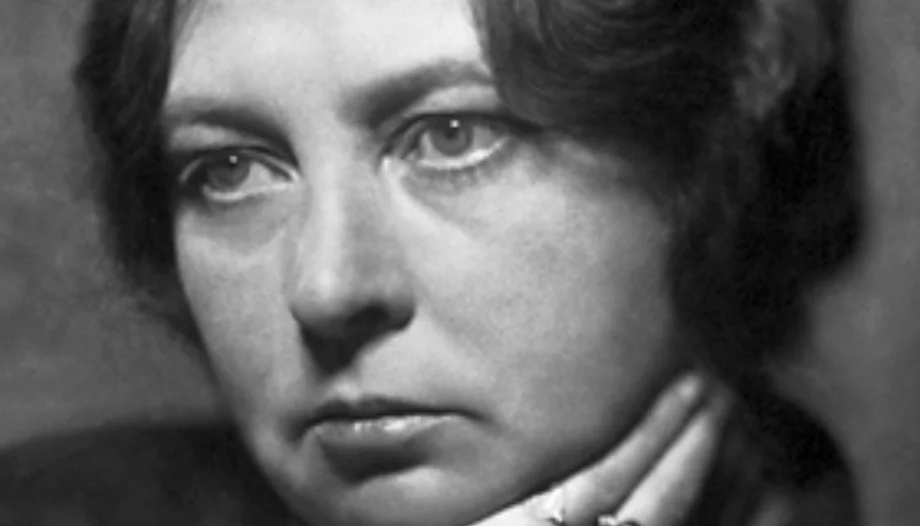
The process of beatification for novelist Sigrid Undset will begin this fall

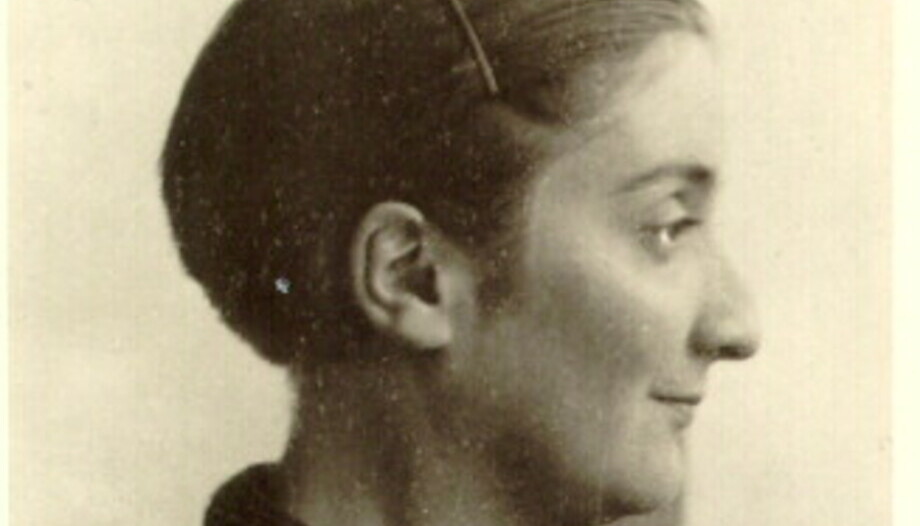
Sigrid Unset, winner of the 1928 Nobel Prize in Literature, was constantly concerned about the poor and the care of her daughter.

OSV / Omnes-July 10, 2026-Reading time: 2 minutes

Preparations are underway in Norway to open a cause for the canonization of Nobel Prize-winning novelist Sigrid Undset, according to an announcement by Bishop Fredrik Hansen of Oslo on July 8.

«She is much more than an author and a Nobel laureate. For us, she is a model of Christian faith, of a life lived in virtue, and of the pursuit of holiness,» Bishop Hansen said of Undset during a Mass in which he made the announcement.

«She demonstrated a constant and practical concern for the poor. She devoted herself entirely to caring for her daughter, to her commitment to life, and to the sanctity of life. Through her numerous books, she influenced countless believers, inspiring them to live in Christ and bearing witness to our medieval saints,» he said, according to a press release.

Biography

Born in Denmark in 1882 and raised in Norway, Undset is best known for her novel *Kristin Lavransdatter*, a trilogy that chronicles the life of its protagonist in the Middle Ages. This work earned Undset the Nobel Prize in Literature in 1928, «primarily for her powerful depictions of life in Northern Europe during the Middle Ages,» according to the Nobel Prize Committee.

Her research on medieval Catholicism led her to convert to Catholicism in 1924, and in 1928 she joined the Dominican Third Order. During World War II, she fled to New York, where she publicly advocated for the Norwegian resistance against Nazism. She returned to Norway after the war ended in 1945 and died in 1949 in Lillehammer.

Bishop Hansen's Initiative

Before announcing the initiative, the bishop Hansen He presented it to the Nordic Episcopal Conference, composed of the bishops of Denmark, Finland, Iceland, Norway, and Sweden, as well as experts on Undset's life. Her cause for canonization will formally open in the fall, he said.

Bishop Hansen shared the news during a Mass in honor of Saint Sunniva at the ruins of the Benedictine monastery on Selja, an island considered the cradle of Norwegian Christianity and the seat of its first diocese. According to legend, the 10th-century Christian queen, Saint Sunniva, fled Ireland to escape a marriage to a tyrant and eventually died on Selja, after which miracles were attributed to the site.

«Like Saint Sunniva and her companions, Sigrid Undset should also be a model for us of a life in Christ,» said Bishop Hansen. He encouraged the faithful to pray for the diocese’s work on her cause.

Following the formal opening of her cause, Undset will receive the title of «Servant of God.» If her cause progresses, the pope will grant her the title of «Venerable» in recognition of her life of heroic Christian virtue. Normally, her beatification would require an approved miracle attributed to her intercession, and her canonization would require a second approved miracle.

The authorOSV / Omnes

Our children don't need a comfortable childhood

In a culture of screens and instant gratification, teaching children to be diligent helps them rediscover a love of hard work, service, and true joy.

July 10, 2026-Reading time: 3 minutes

There are simple scenes that teach us profound lessons. A few days ago, I witnessed one that moved me. An elderly woman, over eighty years old, sat down next to her eight-year-old grandson, who was completely absorbed in the screen of his iPad.

“What are you doing?” she asked tenderly.

—Just… killing time.

“So why don’t you go out and play with the other kids in the yard?”

"Oh, no! What a hassle!"

Grandma smiled. Instead of scolding him, she decided to talk to him. She asked him what laziness meant, and, little by little, she began a beautiful explanation about virtues. She told him about the deadly sins and the virtues that help overcome them. “Diligence is the antidote to sloth,” she told him with the serenity of someone who knows that educating is like sowing seeds for the future.

I then thought about what an enormous treasure our grandparents are. With patience, experience, and love, they can pass on what no screen will ever be able to teach.

The word diligence comes from Latin diligentia, which means care, attention, and dedication. It is related to the verb diligere: to choose carefully, to appreciate, to love. A diligent person does not merely do things; they do them well, with responsibility, perseverance, and enthusiasm. In the Christian tradition, this virtue is closely linked to charity, because those who love do not remain passive: they act, serve, and work for their own good and that of others.

Today, this virtue is particularly urgent.

We are experiencing a veritable epidemic of sedentary lifestyles among children. The World Health Organization warns that most children and adolescents worldwide do not meet the recommended 60 minutes of moderate- or vigorous-intensity physical activity per day for their age group. At the same time, screen time continues to increase and is often accompanied by frequent consumption of ultra-processed foods and sugary drinks. This combination contributes to overweight, obesity, type 2 diabetes, high blood pressure, and other metabolic problems starting at increasingly younger ages. It is also associated with sleep difficulties, reduced attention span, symptoms of anxiety and depression, as well as lower academic performance.

But there is another, less visible—and perhaps more troubling—consequence: the loss of a taste for hard work.

The “click culture” offers instant gratification. Everything seems to be just a tap away. Without realizing it, some children begin to reject any activity that involves waiting, practicing, or persevering. Reading a book, learning to play an instrument, tidying up their room, helping out at home, or simply going for a walk seems like too much trouble to them.

That is why we as parents need to calmly reclaim our role as authority figures and guides. Parenting is not just about protecting our children or ensuring their comfort. Parenting is about building character. It is about teaching them that lasting happiness does not come from always doing whatever they want, but from developing habits that strengthen their willpower.

We need diligent children—children who step up to help before anyone asks them to; who discover the joy of serving; who experience the satisfaction of completing a difficult task; who play outdoors, run, jump, explore, interact with others, and learn to work as a team. An active child not only strengthens their muscles and heart; they also develop discipline, self-esteem, resilience, and social skills.

Perhaps the time has come for families to rediscover a genuine program for cultivating virtues. Rather than spending the day correcting isolated behaviors, we could set out to consciously cultivate the so-called seven cardinal virtues: humility, generosity, chastity, patience, temperance, charity, and diligence.

What are we doing to nurture the positive aspects of our children's personalities?

It would be wonderful to choose one virtue each month and practice it as a family. If our goal is to grow in generosity, we can organize visits to a nursing home, share food with those in need, or donate gently used clothing. If we want to strengthen our patience, we can commit to shouting less at home, learn to resolve conflicts without violence, and persevere together in activities that take time, such as learning music, playing a sport, or developing an artistic skill.

When children see their parents living out these virtues, they discover that they are not just theories, but a way of life.

And if we decide to focus on diligence this month, we can start with some very specific actions:

  • Reasonably limit screen time.
  • Remember that resting also means switching activities, not just staying still.
  • Involve everyone in household chores, according to their age.
  • Walk or ride a bike for short trips whenever possible.
  • Be attentive to the needs of others and offer help without waiting for them to ask for it.
  • Make sure to set aside some time each day for free play outdoors, physical activity, and socializing.
  • Recognize and praise effort much more than results.

Our children don't need a comfortable childhood; they need a childhood that prepares them for life. Diligence doesn't rob them of joy; on the contrary, it allows them to discover the satisfaction of achieving goals, serving others, and becoming strong, responsible, and generous people.

The authorLupita Venegas

Read more
Family

Leigh Fitzpatrick Snead: “Married couples are called to bear fruit beyond having children”

Leigh Fitpatrick Snead speaks about infertility in marriage with complete openness and sincerity, emphasizing that marriages are called to bear fruit beyond the children they may conceive.

Paloma López Campos-July 10, 2026-Reading time: 6 minutes

A few months ago, Leigh Fitzpatrick Snead published the book “Infertile but fruitful”. She has been traveling across the United States for years, speaking about marriage, family, and the Catholic Church. With her new book, she seeks to shed light on the reality of many married couples who are unable to have children, the challenges they face, and the support provided by the Church.

In this interview, she talks with Omnes about how these married couples can discover that they are still called to bear fruit in their lives.

In a world where some married couples have empty cribs and are unable to have children, you say that they can bear fruit. How do these childless couples discover that spiritual fruitfulness in their daily lives?

– It’s very difficult to achieve. Although it’s very easy to say, you have to bring that suffering to the foot of the Cross; you have to transform it and see that there’s something more to that pain. In those moments of revelation, you realize that we’re called to be fruitful and that there are other fruits besides babies.

But I think it's very, very hard when you're in a happy marriage and you're looking at that empty crib. It's very hard to understand why it's not happening, to step back from it all and realize this.

A lot of the time, you don't realize it because, unlike suffering from cancer or another illness that causes pain and discomfort, infertility often doesn't physically hurt, so you don't feel sick—you just feel like something isn't happening. I think we're always quick to equate suffering with pain.

Our bodies are designed for babies; we are called to the vocation of motherhood or fatherhood. And all the beautiful things that come with this actually create barriers that prevent us from realizing that there are other fruits of marriage beyond having a baby.

The way to discover this different kind of fruitfulness is to stay connected. We learn from the communion of saints that sometimes you just have to persevere and not turn your back, knowing that Jesus has not turned His back on you. And perhaps you won’t see or know the fruits, or maybe the fruit doesn’t have to be a goal in itself. I think you’ll be able to see what fruits you bear later on.

As long as you remain faithful to Jesus, to your spouse, to your vocation to marriage, and are open to life and parenthood, I think—well, it’s a promise, isn’t it? It’s the good news that everything is going to be all right. It’s very difficult, and I never want to say, «Just do this—it’s so easy,» because I’ve been there and I know it’s really hard.

Often, when infertility occurs, we assume it’s the woman’s fault. How can married couples have open conversations? How can they communicate and address the problem together, without placing the blame on one or the other?

– I think that’s very difficult, and there’s a reason why there’s a relatively high divorce rate among those who suffer from infertility. As Catholics, you often don’t discover these problems until you’re married, so it’s only once you’re together that they come to light. And given the way our Church teaches us about marriage, love, sexuality, and bringing children into the world, it can’t be viewed any other way than as a problem for «us.» Because it doesn’t matter if she were with another man or he were with another woman and they could have a baby; it is this specific marriage that has an infertility problem. Thinking about their own little ecosystem and the union of “one flesh” means that this is something they must face together.

But the reality is that they’re going to receive medical diagnoses and lab results, and they’ll find out if there’s something wrong with one person, the other, or both. And even though it’s obviously still a shared problem, you’re the one with the low sperm count, the defective ovary, or whatever it may be, and you’re going to feel guilty and start having dark thoughts.

It’s essential to remember from the start that you’re in this together as a married couple. It’s easy to avoid conversations in the hope that you’ll go to the doctor and they’ll simply give you a pill and fix the problem, but that doesn’t happen. So, as usual, the cure for many problems is simply to keep talking about it. I believe that our Church’s teachings are designed to provide that kind of support for couples, because it’s a problem for both of you.

Speaking of the Church’s teachings, how can a Catholic couple maintain this balance between their legitimate desire to have children and remaining faithful to the Church’s teaching against resorting to in vitro fertilization and other modern assisted reproductive technologies?

– That’s really the hard part right now for most people, because IVF is very common and is marketed as a product that seems guaranteed to work. It’s very tempting.

In my book, I recount how my husband and I went to see a doctor who performed IVF, thinking, «Oh, but we’re not going to do that.» However, it was like setting a place at your dinner table for the devil: «I didn’t invite you, but I set a place for you, and we’re ready.»

I think it really helps to receive solid Catholic medical care—from someone who treats you as a Catholic couple or at least respects those wishes—and to be able to see a fertility specialist who doesn’t perform IVF. Those are ways to protect yourself, because it’s going to be tempting; by the time you reach that stage, you’ve been trying for a long time, you’re sad, and you just want a baby—and that’s what they promise you.

But if you recall the reasons why we save sex for marriage, why we use natural family planning or restorative reproductive medicine, I think what we value about those things should also remind us why we don’t turn to IVF. It deliberately separates the procreative aspect from the unitive aspect, inviting many other people into the most private act, in addition to bringing all sorts of other problems.

One of the major objections used to be the number of embryos implanted and selective reduction abortions; and although clinics now apparently have much better embryo screening techniques (which is also terrible) and only transfer one or two embryos, the horror of IVF still exists.

Also, you need to surround yourself with your family; perhaps your family is Catholic but has never thought about infertility or IVF, and they may not know about it. They need to know why you’re going through this and why you’re not doing it, so they can support you, since you’re on edge and at your most vulnerable. It’s very easy to lose hope, and statistically speaking, there are many people in the church pews who have turned to IVF.

What do you think is the biggest disconnect today between the community around us, the Church, and the priests when they speak with Catholic couples who cannot have children?

– That was one of the reasons I wrote the book—not just for other women or couples like me, but also for priests and seminarians, so they could get a little glimpse of what this is really like. I tried to be truly honest without exaggerating, sharing details about what you’re up against.

Priests need to understand that earthly aspect of life; if you invite them over for dinner, they get a sense of what life is like with children, but obviously they don’t have as many opportunities to understand what life is like with infertility. I hope the book helps them. I think they need it, and young priests are making an effort to learn about these kinds of things, especially if they’re keeping up with current events, because IVF is in the news all the time and it’s hard to ignore. As long as they’re willing to learn and keep an open mind, I think that will help a lot.

But again, it’s such a private issue that, even if there’s a support group and kind priests, it’s very easy to isolate yourself. That’s also why I think it’s easier to learn about the subject by reading, in private, a book by someone you may not know. Some of my favorite letters are from strangers who tell me, «I was so ashamed to feel these things—to feel jealous of other women—or I didn’t know anyone else felt this way; I did, too.» It’s much easier to find that on a page, process it a bit, and then maybe want to talk to your sister, your mother, your close friend, or your priest. And then your priest might say, «Oh, I have an idea what that’s like—tell me more,» and be able to ask the right questions to understand the full complexity of it.

I think there should be a greater effort to help people simply learn the vocabulary and know what’s sensitive and insensitive to say. People always have good intentions, but you can put your foot in your mouth at any moment while trying to be kind. The topic of pregnancy and related issues is very sensitive, because you don’t know who’s going through a hard time. When I started writing about infertility, I found out that people I never would have imagined were suffering from it. I used to think they were just women focused on their careers or whatever, and then they’d confide in me that they’d been trying for six years and nobody knew. It’s a very taboo subject.

Evangelization

Popular podcaster Father Mike Schmitz talks about the faith of Generation X, teenage angst, and AI

Mike Schmitz filled the Broward Center for the Arts in Fort Lauderdale during his "Parábolas" tour, in a performance marked by warmth and a connection with younger generations.

OSV / Omnes-July 9, 2026-Reading time: 5 minutes

By Tom Tracy / Florida Catholic, OSV News

Father Mike Schmitz walked into the dressing room at the Broward Center for the Performing Arts in Fort Lauderdale with his characteristic warm smile and a spring in his step.

The priest from the Midwest and his support team for his current speaking tour had just returned from what they described as a large and lively gathering in Clearwater the night before.

He would find an equally large, sold-out crowd in the main concert hall of the Broward Center before his final performance in Florida, in Jacksonville.

Father Schmitz, one of the most popular and influential priests on social media, was recently in Florida as part of his «Parables» tour, during which he analyzed the parables from the Gospel of Christ and offered new perspectives.

Father Schmitz, a priest of the Diocese of Duluth, Minnesota, is the director of the diocese’s Ministry for Youth and Young Adults, as well as the chaplain of the Newman Center at the University of Minnesota Duluth.

Resounding Success for the «Parábolas» Tour»

The «Parábolas» tour has included stops in nearly two dozen U.S. cities in Arizona, California, Louisiana, and Florida over the past few months. The final scheduled date for this leg of the tour is an international show, set for July 20 in Dublin, although their website indicates that more dates in U.S. cities and other countries will be announced soon.

«In a way, young people are looking for authenticity; it’s incredibly important that a person or a group be who they say they are, and that’s true for all of us, isn’t it?» the priest asked at his event in Fort Lauderdale.

«We do not tolerate hypocrisy; in fact, this has been the case for generations, even throughout the entire history of humanity,» he said. «Even Jesus criticized hypocrites for saying one thing and then being unwilling to follow through on it.».

The 2018 Synod of Bishops on «Youth, Faith, and Vocational Discernment» took place at a time when the Church began to recognize that American Catholic youth increasingly view integrity and authenticity as a lived coherence rather than merely institutional conformity.

Clarity and Empathy in Doctrine

The working document for the synod, based largely on direct consultations with young people, states that young people want an «authentic» and «credible» Church whose leaders «speak in practical terms about controversial issues.» «That’s why I believe we must have integrity—we must be who we say we are,» Father Schmitz said at the event.

But in addition to integrity, the clarity and truthfulness of Catholic doctrine are other frequent topics for Father Schmitz, both online and in person. The human mind is made for truth and the human heart for goodness, he says, but «sometimes the way we present things and the way we say them makes a big difference.».

Regarding the challenges faced by adolescent boys and young adults in particular, Father Schmitz stated that indifference is the underlying problem—or the obstacle—to a less cynical life of faith during adolescence and young adulthood.

«You can tell when you work with young people,» he said, especially when it comes to encouraging young people to become more involved in church life.

A Lack of Purpose and Indifference

«One of the things I've seen more and more—especially among people who are tired of being told they have to meet certain expectations, that they have to do absolutely everything—is that they start to reject that.»

Although both sexes have much in common, the priest added, men may have been created to have a battle to fight—in the sense of a mission to pursue or a calling to live out—while women are more relationship-oriented.

«When we aren’t given a mission, or when it isn’t worth fighting for, that’s what (Harvard professor) Arthur C. Brooks says leaves us feeling a lack of meaning,» said Father Schmitz, noting that this is the main crisis Brooks has identified and that it must be overcome to fill the modern void and attain true joy.

Christian Hope Against Anxiety

Issues related to self-confidence, loneliness, and anxiety among young people continue to be a troubling crisis among today's students.

«On college campuses over the past 10 years, anxiety has surpassed depression as the leading mental health issue facing young people, and anxiety is fear of the future and is rooted in uncertainty,» said Father Schmitz.

The remedy, he added, is a widespread sense of Christian hope. «Christian hope isn’t just about wishing for a certain outcome, but about knowing that I can trust in God and project that trust into the future; I believe that is the answer to anxiety,» said Father Schmitz.

Refuge in the Mystery of Tradition

The return to Catholic tradition and genuine reverence among young people has been another antidote to today’s anxiety. «There is something truly moving about the mystery and the ancestral significance of the Mass—or the practices we carry out as Catholics—that transcends the individual,» said Father Schmitz.

He also addressed the topic of artificial intelligence, which Pope Leo XIV discusses in his historic encyclical «Magnifica Humanitas,» published on May 25. The Pope compares the attempt to build a future with AI that excludes God to the «Tower of Babel» and emphasizes the need to safeguard human dignity, which is «threatened by new forms of dehumanization.».

Humanity vs. Artificial Intelligence

«About a year ago, I was talking with some people from the McGrath Institute for the Life of the Church at the University of Notre Dame,» said Father Schmitz, «and one of the things they pointed out was that every time we invent some kind of technology, it represents an extension of some human capacity—such as our ability to get around in cars. And every time, we’ve limited our ability to use it.».

For example, in today's hypermobile society, people don't walk as much as they used to. AI presents a scenario similar to that of extending human mental capabilities to tackle problems that are both complicated and complex, Father Schmitz said.

«AI does a great job solving complicated problems, but it can't solve (all) complex problems,» said the priest.

«In the near future, I hope we can preserve our humanity by recognizing that there are some questions a computer cannot answer, no matter how advanced the program may be,» said Father Schmitz.

The Fort Lauderdale event drew a diverse audience of young people, young adults, and even older adults who likely know the priest through his popular YouTube videos and his podcast «The Bible in a Year.» Produced by Ascension Press, the podcast consists of 365 daily episodes that read through the entire Bible. In each episode, Father Schmitz reads and discusses biblical passages, adding his own commentary and prayers.

The «Parables» tour is being presented as part of a fundraising initiative to support the Newman Center at the University of Minnesota Duluth. About 700 students and faculty members are gathering to participate in the service led by Father Schmitz.

All funds raised at each event go toward financing the construction of a brand-new church and a dedicated space for students to gather, pray, study, and grow in their faith on campus.

The authorOSV / Omnes

Books

J. Aurell: «Every era has projected its own obsessions onto Opus Dei»

According to Jaume Aurell, the public image of the Work is based on three major narratives that have evolved throughout its history.

Javier García Herrería-July 9, 2026-Reading time: 6 minutes

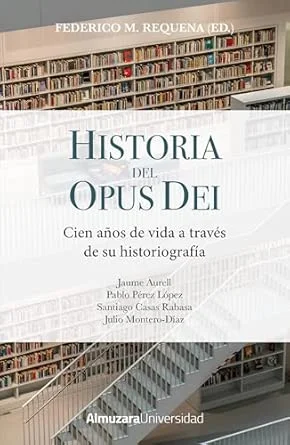
As it approaches its centennial, Opus Dei continues to be viewed in a distorted light by the public. What are the reasons for this perception? Is it the result of a “black legend” fueled from outside? Marking this centennial milestone, historian Jaume Aurell co-authors History of Opus Dei. One hundred years of life through its historiography., an analysis that seeks to shed light on various issues from a historical perspective.

We spoke with Aurell to trace the historical origins of these prejudices and understand why, a century later, the institution continues to face the challenge of explaining its identity and history to society.

Almost everyone in Opus Dei has been asked at some point why the public image of the organization is so different from the reality one experiences when getting to know someone from the Work. Why is this the case?

–Because Opus Dei’s public image has not been shaped by looking at what the institution truly is, but rather by projecting onto it the fears and obsessions of each era. I have studied this using the theory of metanarratives: these are narratives that act as a mirror, in which each generation sees reflected what obsesses it, projecting it onto the organization.

What exactly do you mean when you say those narratives are «presentist»?

–Because we judge the past using the standards of the present, rather than understanding it within its own context. It’s a phenomenon we see in many other areas: today, authors like Shakespeare, Mark Twain, and Agatha Christie are censored because their works contain expressions or stereotypes that we now consider offensive, but which were within the bounds of social convention in their time. Something similar has happened with Opus Dei, but over the course of a hundred years and through three different—and even contradictory—narratives.

Let's talk about those stories. Which one was the first?

–Opus Dei was viewed as a religious heresy between 1940 and 1957. And here’s the curious part: this view did not originate among anticlericals, but within the Church itself. Some Jesuit priests, such as Ángel Carrillo de Albornoz and Manuel María Vergés—who were linked to the Marian Congregations—began to characterize the institution’s doctrine as a dangerous heresy that had to be eradicated before it took root.

Why did such a hierarchical Church see a threat in something as simple as living out one's faith in daily work?

–Because in the pre-conciliar Church, the laity were second-class members of the faithful. The idea that ordinary young people, dressed in suits and ties, without any religious habit or distinctive mark, could claim to attain holiness through their ordinary work seemed strange and even suspicious. They were called «Enlighteners» and accused of stealing religious vocations.

And almost at the same time, political suspicion arose, with the Falange involved.

–That’s right. The Falange, which wanted to maintain its position as the sole political party, saw Opus Dei as a threat. In 1941, a formal complaint was even filed with the Special Court for the Suppression of Freemasonry and Communism, accusing Escrivá and his followers of plotting something «Judeo-Masonic.». 

Were there any other accusations against the Work before Escrivá moved to Rome?

–Yes, they were also accused of «taking over university professorships.» Between 1940 and 1945, 179 university professorship positions were filled in Spain. Of those, only 23 went to members of Opus Dei: 6%. This is far from the massive takeover suggested by the legend.

The story took a dramatic turn in 1957. What happened?

–Yes, a dramatic turnaround. Franco, forced to abandon the Falangist economic autarky, brought in experts such as Mariano Navarro Rubio and Alberto Ullastres—both members of Opus Dei—who designed the 1959 Stabilization Plan and the subsequent Spanish «economic miracle.» The Falangist factions, resentful of their loss of power, then coined the label «Opus Dei technocrats» and accused them of seizing power

From heretics to powerful allies of the dictatorship.

–Exactly, and that image spread worldwide through magazines such as The Economist o Time, and was reinforced by books written by anti-Franco authors such as Daniel Artigues and Jesús Ynfante, who coined the term «Santa Mafia.» Once again, politics and religion became intertwined. At the same time, within the Church, the Second Vatican Council politicized the debates between «progressives» and «conservatives,» and the institution was branded as «fundamentalist,» even though it had originally been considered too “innovative.”.

Was there also pressure from the Vatican itself?

–Yes, between 1967 and 1973, figures such as Giovanni Benelli and Jean Villot pressured Escrivá to have Opus Dei act as a political bloc aligned with European Christian Democracy. He refused, defending the individual political freedom of each layperson, and that cost him six years of estrangement and mistrust on the part of the Curia.

We've reached the third wave—the one involving the cult and the financial scandals.

–Starting in 1980, as societies became more secularized and individualistic, values such as lay celibacy and mortification began to be interpreted through the lens of a growing media phobia against Catholicism. In this context, Opus Dei was seen as a reactionary and conservative force.

Its establishment as a Personal Prelature in 1982 and the beatification of its founder in 1992 sparked a new wave of criticism, with testimonies from critical former members.

And that's where the word «sect» comes up, too.

–Exactly, the international press, with The Times At its helm, it abandoned the framework of political power and adopted the paradigm of sectarianism. In Germany and Italy, theories about «brainwashing» promoted by anti-cult organizations circulated to such an extent that they prompted an attempt by the Italian Parliament to launch an investigation in 1986, which ultimately did not take place because it was dismissed as baseless slander.

What about the financial scandals attributed to him?

–These are three distinct cases that public opinion loosely linked together: the Matesa case in 1969, the Calvi and Banco Ambrosiano case in 1982, and the Ruiz-Mateos case in 1983. These are very different episodes, but popular narrative linked them together as if they formed a single plot related to Opus Dei. When one studies these cases with even a modicum of seriousness, one realizes that they stem from completely different economic contexts and involve entirely different political actors. 

So why did they work?

–Because of something that happens very frequently with Opus Dei: people confuse the professional conduct of its members as if each one were following orders from the organization. Obviously, this is not the case for most members, who have ordinary jobs with no particular public relevance. However, if someone holds a high-level position in politics, banking, law, or the arts, then their actions come under the microscope of suspicion. Although it may be hard to admit, there is still an underlying clerical bias in many of these interpretations.

And it all culminates with Dan Brown.

-With The Da Vinci Code, in 2003, and its film adaptation in 2006. There, all the myths that had accumulated over decades are fused into a pop-culture caricature—the albino killer monk—which achieved enormous commercial success at the expense of reinforcing the dark legend.

The most striking aspect of your analysis is that Opus Dei has been accused of things that are completely contradictory depending on the era.

–This is proof that these narratives are artificial constructs. In the 1940s, he was accused of heretical innovation for defending the sanctity of laypeople without religious habits or vows; from the 1960s to the present, he has been accused of the opposite—of being ultra-conservative and reactionary. 

During World War II, some denounced Escrivá as pro-German to the Allies, while others denounced him as pro-British to the Germans and Italians at the same time. 

In Spain, he was accused of being the ideological pillar of Francoism, when in reality he was persecuted by the Falange itself, and some of his children were forced into exile to join the opposition. 

And from a sociological perspective, it has been described both as a modernizing form of «Catholic Calvinism» and, today, as an obscurantist stronghold opposed to individual autonomy.

Your analysis of the text stops in 2010. Why don't you analyze the last fifteen years, including all the recent controversy?

–Because I am a historian, not a journalist or a current affairs analyst. The historian’s craft requires temporal distance and perspective: archives must be opened, testimonies must be cross-checked, and the passions of the present must cool before we can judge rigorously. 

To write about what has happened in recent years without that perspective would be to repeat the very mistake I denounce in the book: getting carried away by the dominant narrative of the moment—however well contextualized—rather than analyzing the facts with the time needed to separate myth from reality. In twenty or thirty years, another historian may be able to do for this most recent period what I have attempted to do for the previous century.

In closing, what do you hope readers will take away from this journey through a hundred years of stories?

–Let them learn to be wary of easy labels. When an institution does not fit into the dominant ideological categories of its time, society tends to distort it in order to classify it. Understanding these mechanisms is useful not only for evaluating Opus Dei, but also for reading any historical narrative presented to us as definitive with a more critical eye and contextualizing it appropriately. In the text, I illustrate this with the absurdity of dividing the Spanish Civil War into fascists and communists, as many attempt to do today: this is manipulating the past, simplifying it, in order to to use it in today's political contests and create an unwisely unnecessary polarization.


History of Opus Dei. One hundred years of life through its historiography.

Author: Federico Requena (ed.)
Editorial: Almuzara
Year: 2026
Number of pages: 242
Gospel

Jesus' Method: The Parables. Fifteenth Sunday in Ordinary Time (A)

Vitus Ntube discusses the readings for the Fifteenth Sunday in Ordinary Time (Year A), July 12, 2026.

Vitus Ntube-July 9, 2026-Reading time: 2 minutes

The theme of the Word of God is at the heart of today’s liturgy. In the first reading, the Word is compared to rain and snow that fall from the sky to water the earth and make it fertile. In the Gospel, it is likened to a seed sown on different kinds of soil. The focus of the readings is not only the Word itself, but also the way in which it is proclaimed and received.

The Gospel presents us with the well-known parable of the sower. However, this parable is more than just a story with a moral lesson. As Pope Benedict XVI observes, it is in many ways “autobiographical”, because it reflects the very experience of Jesus and his preaching. Christ is presented as the sower who scatters the good seed of the Word of God, while at the same time showing that its fruitfulness depends on the receptiveness of those who receive it.

Today, special attention is given to Jesus“ teaching method. After hearing the parable, the disciples approach Him and ask, “¿Why do you speak to them in parables??” Jesus replies, “To you the secrets of the kingdom of heaven have been revealed, but not to them".

Why does Jesus choose to teach in parables? Throughout the Gospel, we see him teaching in various ways. He delivers the Sermon on the Mount in a direct and clear manner. Now, however, he adopts a different teaching style. This change surprises even the disciples, which is why they ask him about it. 

The use of parables teaches us that the Word of God requires effort, reflection, and interpretation. It challenges not only the intellect, but also the heart and the will. The Word cannot be received passively or indifferently. For it to bear fruit in our lives, we must personally commit ourselves to it. We must allow it to challenge and transform us.

Those who listen to the parable are called to become fertile ground: open, receptive, and willing to reflect deeply in order to grasp the meaning of the message. Humility and openness are, therefore, essential. Those who approach the Word as the disciples did when they approached Jesus to ask for an explanation gain a deeper understanding of the mysteries of the kingdom.

Today’s liturgy teaches us how to receive and spread the Word of God. The parable encourages us to engage deeply with Sacred Scripture so that the Word may bear fruit in us—thirty, sixty, and even a hundredfold. When we share the Word with others, we must do so in a way that appeals to their freedom and engages their intellect.

The Vatican

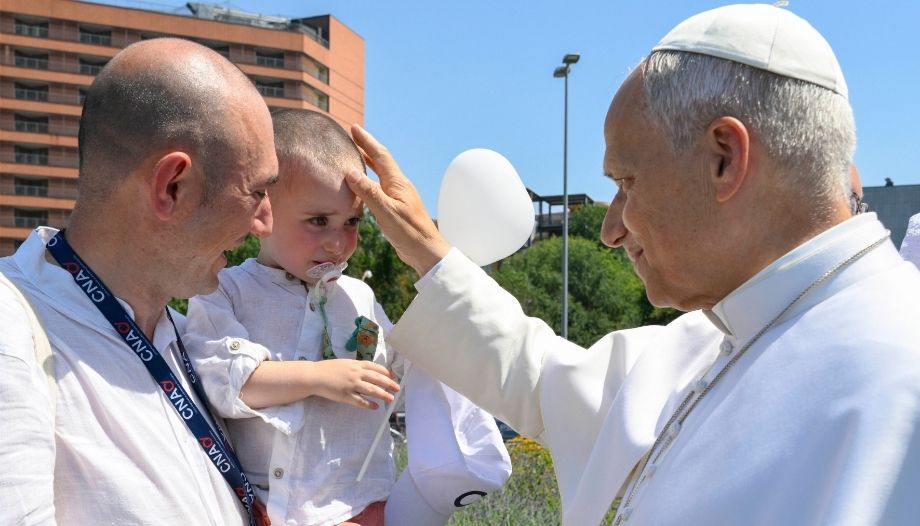
Pope Leo XIV will share a lunch with 200 people in vulnerable situations in Castel Gandolfo

Echoing the 2025 event, on Saturday, July 11, Pope Leo XIV will have lunch with 200 people in vulnerable situations at Castel Gandolfo.

Paloma López Campos-July 8, 2026-Reading time: 2 minutes

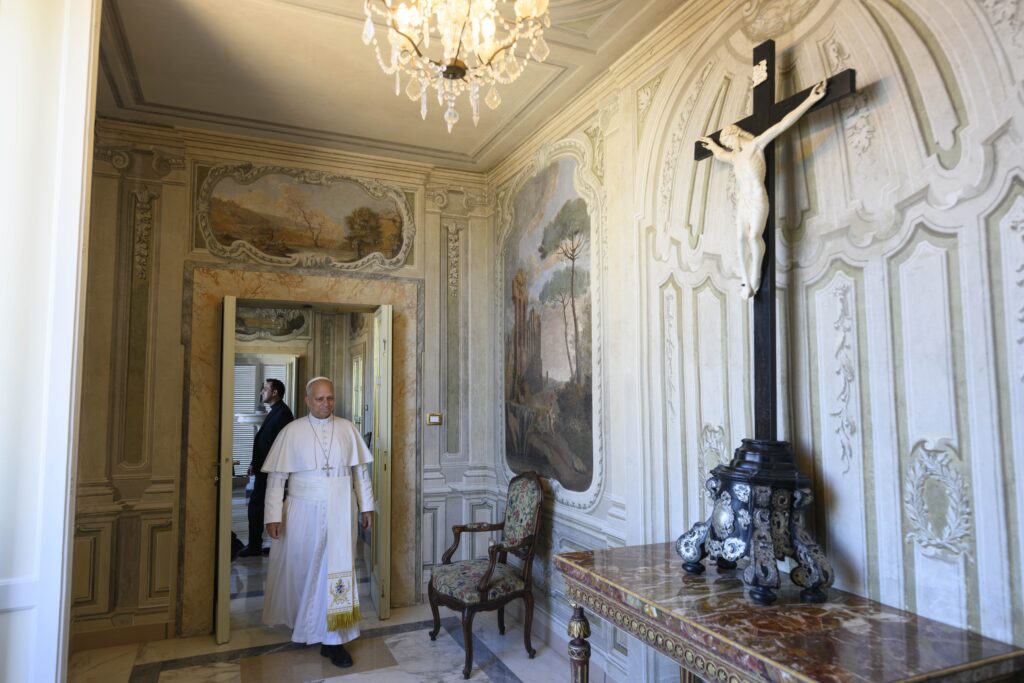
Next Saturday, July 11, 2026, the Borgo Laudato si’, located in the Pontifical Gardens of Castel Gandolfo, will serve as the venue for the “Lunch with the Pope” event.

As part of the the Pontiff's visit This month in that town, this day of welcome and fellowship will bring together nearly 200 socially vulnerable people from the Diocese of Rome, who will have the opportunity to share a meal with Pope Leo XIV.

Integral Ecology and Coexistence

The event features a program that weaves together faith, nature, and social inclusion. The day will begin with a Eucharistic celebration featuring the Liturgy for the Care of Creation.

Afterward, attendees will enjoy a time of welcome and fellowship, followed by a guided tour so that guests can explore the facilities and learn about the Borgo Laudato si’ project. Later, the event will formally conclude with a shared lunch with the Holy Father.

Pastoral Care for Those on the Margins

This event is not an isolated occurrence, but rather the culmination of an annual initiative promoted by the Laudato si’ Center for Advanced Formation. The project originated from the experience on August 17, 2025, when the Holy Father shared a similar meal with people living in poverty in the Diocese of Albano.

As a result of that meeting, it was decided to invite a different diocese each year to offer refugees, migrants, and people in situations of social vulnerability a day spent immersed in the beauty of creation and the opportunity to meet the Pope.

This year’s event holds great ecclesial significance, as it is the result of a joint collaboration between the Laudato si’ Center for Advanced Formation, the Dicastery for the Service of Charity, and the Diocese of Rome. Together, they have organized a unified pastoral initiative involving the leading organizations and parishes that provide daily support to the most vulnerable residents of the Italian capital.

Support and Statements from Authorities

Cardinal Fabio Baggio, Director General of the Laudato si’ Center for Advanced Formation, emphasized that they created this space to demonstrate that “care for creation and care for the person constitute a single mission.” Baggio added that, following the experience in Lampedusa, this day marks a new stage in Leo XIV’s journey toward the peripheries of our time.

For his part, Monsignor Luis Marín de San Martín, Prefect of the Dicastery for the Service of Charity, noted that the Pope’s election reaffirms that “charity is expressed through closeness, encounter, and sharing.”.

Likewise, Cardinal Baldassare Reina, Vicar General of His Holiness for the Diocese of Rome, concluded by explaining that the explicit intention was to make the people supported by Caritas and local associations the protagonists, restoring the leading role “to those who all too often remain on the margins.”.

Community and Business Collaboration

This event is made possible thanks to the support of an extensive network of organizations, including the Community of Sant’Egidio, Caritas of the Diocese of Rome, the Astalli Center, the ACLI of Rome, and numerous local parishes.

From a logistical standpoint, the organizing institutions expressed their gratitude to «Restaurante L’Isola della Pizza» in Rome, which provided lunch, as well as to «Bar Al Duomo» in Albano Laziale, which provided a welcome breakfast for the participants.

Family

The most-watched movies in Spain hardly reflect the desire to start a family, even though 70% of young people do want to do so

A report by The Family Watch reveals that 56% of the families profiled are depicted as being in conflict, while only 5% are portrayed as attractive and positive.

Javier García Herrería-July 8, 2026-Reading time: 3 minutes

The Foundation The Family Watch has presented the report «Families on Screen: Models of the Home in the Most-Watched Movies and TV Series in Spain in 2025», a study conducted by researchers at Nebrija University and Rey Juan Carlos University, with support from Methos Media, which presents a striking conclusion: the fiction that Spaniards consume the most barely reflects the desire to start a family, even though a majority of the country’s young people do aspire to have one.

The study analyzed 40 audiovisual productions—the ten most-watched series and the ten most-watched films on both linear television and streaming platforms in 2025—using a content analysis methodology applied to 158 characters representing different family dynamics.

Families Are There, But Almost Always in Crisis

According to the study’s data, 56% of the family systems depicted on screen are marked by conflict, fragmentation, or breakdown, while 33% portray the family unit as problematic or in crisis. In contrast to these figures, only 5% of the stories offer an aspirational or clearly positive family model.

The report points out, however, a paradox: although family structures appear to be weakened, many of the characters serve the narrative function of keeping them together. The 28% serves as the emotional backbone of the family group, ahead of authority figures (22%) and characters who generate conflict (20%).

«Fiction creates characters who provide emotional support to families that, narratively speaking, appear to be broken or in the process of breaking apart. It is one of the most interesting paradoxes revealed by the study,» explains Carmen Llovet, one of the researchers who authored the report.

Another notable finding is that nearly one in four characters (23%) lacks a recognizable family structure—an absence that, according to the authors, is not coincidental: it is often used as a narrative device to characterize the antagonist, justify certain behaviors, or simply render the character’s family environment invisible.

Care still has a woman's face

The report also highlights how caregiving responsibilities are distributed in fiction. The mother appears as the primary caregiver in 26% of the cases, compared to just 11% for the father. In contrast, family absence is mostly associated with male characters: 19% of men play this narrative role, compared to only 3% of women. Shared responsibility for caregiving appears in 221 out of every 3,000 productions analyzed, though it remains in the minority.

«Shared responsibility is beginning to appear in fiction, but it does not yet significantly challenge a model of care that remains closely tied to the maternal figure,» notes researcher Ernesto García, a co-author of the study.

Traditional family values endure

Despite the weight of these conflicts, the report notes that fiction continues to convey values historically associated with the family. Notable among these are sacrifice and family duty (23%), followed by individual autonomy (19%) and tradition and continuity (12%). Furthermore, the family remains a defining element in the construction of the characters’ identities: it has a decisive influence on who they are in 62% of the cases and shapes their decisions throughout the plot in 45%.

«The narratives reveal a constant tension between loyalty to the family and the pursuit of a personal goal. Even when the family barely appears on screen, it continues to shape the protagonists» motivations,” notes researcher Cristina Gallego.

The study also analyzes the context in which this fiction is produced and consumed. Spain accounts for 50% of the most-watched productions, with Netflix and RTVE Play as the leading platforms for consumption, at a time when the rise of streaming is profoundly transforming narrative formats.

Five Recommendations for Improving Family Representation

Based on these results, the report proposes five lines of action aimed at both the audiovisual industry and public administrations:

  1. Incorporate the desire to start a family as a legitimate narrative thread.
  2. Raise awareness of caregiving and distribute it more evenly between men and women.
  3. Show a greater diversity of family models, including from functional and positive perspectives.
  4. Incorporate criteria for family representation into public policies on audiovisual funding.
  5. Promote audiovisual literacy to foster a critical perspective on the family models portrayed in fiction.

For María José Olesti, executive director of The Family Watch, the report’s findings are «particularly relevant, since fiction shapes the collective imagination and represents what is normal, desirable, or possible.» In this regard, she emphasizes that data such as the persistence of women’s caregiving roles or the low prevalence of the desire to start a family among young Spaniards—even though a high percentage do want to—constitute «a very significant finding» for rethinking how fiction portrays family life.

Read more
Latin America

The «Sixth Continent» Gathers in Central America: Acts 29 and the Vanguard of Digital Mission

More than 100 missionaries from 20 countries are gathering in Costa Rica with the support of the Vatican and CELAM to strengthen a pastoral approach focused on connection in the digital environment.

Juan Carlos Vasconez-July 8, 2026-Reading time: 3 minutes

The «sixth continent» is no longer just a metaphor; it has become an inescapable pastoral reality. It is not merely a collection of technological tools, but a lived space where millions of people—especially young people—seek answers to their existential questions and form relationships. 

For the Church, engaging with this environment is not a secondary strategic option, but rather a requirement of its evangelizing mission. In this context of digital acceleration, there emerges Acts 29, the world's most important international gathering of digital missionaries and Catholic content creators—a space where faith and digital culture come together to build communion.

The very name of the gathering holds a profound theological significance. The biblical book of the Acts of the Apostles ends abruptly in chapter 28, leaving the narrative of the early spread of Christianity on a cliffhanger. «Acts 29» thus symbolizes the chapter that the Church continues to write today under the guidance of the Holy Spirit. It is not a matter of adding a page to Revelation, but of embracing the historical continuity of the apostolic mission: today’s content creators are the new evangelizers called to travel the information superhighways, bringing the first proclamation to the far reaches of the internet.

Costa Rica as a Global Hub

For its 2026 edition, Hechos 29 is coming to Central America for the first time, choosing Costa Rica as the host country from August 18 to 23. The event will bring together more than 100 content creators, priests, nuns, musicians, and podcasters from some twenty countries, including Italy, Spain, Mexico, Colombia, Peru, and Argentina.

Far from being a traditional conference, this event is conceived as a profound experience of fellowship and a vivid snapshot of the Church on mission.

The movement’s history shows organic growth since its founding in 2021 in Monterrey, Mexico. That first edition, launched in the midst of the pandemic and held virtually, brought together 45 pioneers. By 2022, Pope Francis had already sent a video message encouraging them to evangelize creatively. After its stop in Bogotá in 2024, the movement reached a milestone in 2025 by participating in the Jubilee of Digital Missionaries in Rome, where they received the exhortation to «mend the nets»—an invitation from the Successor of Peter to heal the digital fabric by promoting closeness and truth.

Disciples Before ‘Influencers’

The spirit of Hechos 29 is perfectly summed up by its general director, Father José Juan Montalvo («Father Borre»): «We do not seek quantity, but fellowship.» In an environment often dominated by the tyranny of algorithms and the competition for reach, this gathering subverts the logic of the world. 

The premise that unites these creators is clear: before being influencers, are disciples. The success of the digital mission is not measured by a video’s metrics, but by the authenticity of the testimony and the ability to accompany people through profound personal journeys, transforming screens into bridges for a genuine encounter with Jesus Christ.

Hope for the region

The event enjoys strong institutional support: the Archdiocese of San José, the Episcopal Conference of Costa Rica, CELAM, and the Dicastery for Communication of the Holy See all support the initiative. Church leaders such as Monsignor Lucio Ruiz, who will remain secretary of that Dicastery through September, will offer a perspective on the universal Church, reminding us that this task lies at the very heart of the Church today. 

The program will combine days of spiritual retreat and closed-door training—during which participants will share their pastoral successes and challenges—with a large Digital Mission Festival open to the public on August 23.

In Central America, where Catholicism accounts for just 32.6% of the region’s religious affiliation, Acts 29 stands as a beacon of hope. It reminds us that the Gospel also spreads through social media and that virtual spaces are fertile ground where the seed of grace can take root. 

Behind every Catholic account there is a story and a heart that prays; through this international network, the Church shows that it is willing to go the extra mile on the sixth continent, inhabiting the digital peripheries not merely as communication specialists, but as authentic and approachable witnesses to God’s love.

The World

“Jerusalem is the heart of the world”: a call to look beyond conflicts

Cardinal Pierbattista Pizzaballa affirms Jerusalem's universal vocation as "the spiritual heart of the world," a living heritage of faith and dialogue that transcends the current conflict.

Editorial Staff Omnes-July 8, 2026-Reading time: 4 minutes

“Jerusalem is the heart of the world.” With this phrase, Cardinal Pierbattista Pizzaballa, Latin Patriarch of Jerusalem, sums up one of the central ideas of the letter he addressed to the faithful of the diocese last April. 

At a time marked by conflict and uncertainty, his message invites us to view the Holy Land from a broader perspective: not merely as the scene of a war, but as a place whose spiritual, historical, and human significance transcends any temporary circumstance. “How can we, as Christians, remain in the midst of this conflict?” asks the Latin Patriarch of Jerusalem. 

The letter, Issued in a particularly difficult context for the region, it emphasizes the need to keep hope alive and not to lose sight of the unique mission of Jerusalem and of the Catholics living in the Holy Land. For the Patriarch, the Holy City remains a point of reference for millions of people around the world and a place where religious traditions, cultures, and histories—all part of humanity’s shared heritage—converge.

Jerusalem, a City for Everyone

Few cities carry a symbolic significance comparable to that of Jerusalem. Sacred to Jews, Christians, and Muslims, it has been a place of prayer, pilgrimage, and encounter for centuries. Its significance stems not only from its past but also from its ability to continue welcoming people from a wide variety of backgrounds.

In his letter, Pizzaballa recalls precisely that universal vocation. Jerusalem cannot be understood from an exclusively local or political perspective: “We are the Church of Jerusalem, and the Holy City is the heart—not only geographical, but also spiritual—of our ecclesial community”…

This universal dimension makes the city a privileged space for dialogue. Despite the difficulties and tensions that the region periodically faces, the Holy Land remains one of the few places where the major monotheistic religious traditions coexist in a unique proximity. Interreligious dialogue here is not limited to institutional statements; rather, it is part of the daily lives of those who live and work in the region.

The Holy Places: A Living Heritage

The Patriarch also emphasizes the importance of safeguarding the Holy Places and preserving their significance for future generations. These places are not merely historical monuments or tourist destinations. They are places where millions of people find a tangible connection to their faith and to the roots of Christianity, for “the mission of earthly Jerusalem, in a certain sense, is to become an image and mirror of the heavenly Jerusalem,” he states in his letter.

The Basilica of the Holy Sepulcher, the Basilica of the Nativity, the Mount of Olives, and the Sea of Galilee are all part of a spiritual landscape that continues to attract believers from around the world. Their significance transcends the borders of the Holy Land itself and constitutes a heritage shared by the entire Church.

In this context, local Christian communities play an essential role. They are the ones who keep the Christian presence alive in the places linked to the life of Jesus and who continue to welcome pilgrims arriving from different countries. For this reason, the decline in visitors in recent years has not only had economic consequences but has also affected a human and ecclesial reality deeply rooted in the region’s history.

Understanding the Holy Land Beyond the Headlines

Amid a news cycle dominated by reports of the conflict, various initiatives continue to work to help people understand the historical, cultural, and religious richness of the Holy Land. One of them is Saxum Visitor Center, located in Abu Ghosh, a few kilometers from Jerusalem.

Through audiovisual resources, interactive technology, and educational content, the center offers visitors a comprehensive overview of the biblical context and the reality of the places where the events recounted in the Holy Scriptures took place. 

“The Holy Land is not just a pilgrimage destination. It is a place where history, faith, and interfaith dialogue come together in a unique way,” explains Blanca Ramirez, director of the Saxum Visitor Center and representative of Saxum. “Those who visit Jerusalem discover that the Holy Places are living spaces that continue to bring people from all over the world together.” In fact, Cardinal Pizzaballa states in his letter that “its primary identity—the most important characteristic of the City and of the entire Holy Land—is that it is the place of God’s revelation, the place where religions are at home.”.

Blanca Ramírez adds that “understanding the Holy Land also helps us better understand the importance of coexistence and encounter. Even in difficult times, Jerusalem continues to remind us that it is possible to build bridges between people of different religious and cultural traditions.”.

These words resonate with the central message of Pizzaballa’s letter. Despite the current difficulties, the Patriarch urges us not to lose sight of what makes Jerusalem unique: its ability to bring together people from all over the world around a shared history.

Because, as the Patriarch himself points out, Jerusalem remains “the heart of the world,” and that is why “the international community has both the duty and the right to take an interest in Jerusalem, because it belongs to everyone.” A city whose significance depends not only on what happens within it, but also on what it represents for millions of people who continue to look to the Holy Land as a place of faith, memory, and hope.

Read more
The Vatican

Monsignor Luis Marín, OSA: “The priority of Leo XIV’s pontificate is Christ, with all that this entails.”.

The prefect of the Dicastery for Charity explains in El Escorial that the schism among traditionalists is not only about the liturgy, but also about their refusal to accept the entire Tradition of the Church.

José María Navalpotro-July 8, 2026-Reading time: 4 minutes

Monsignor Luis Marín de San Martín (Madrid, 1961) is one of the men in Leo XIV’s inner circle of collaborators. An Augustinian like him, before Robert Prevost was elected pope, they used to dine together frequently ever since both were called by Pope Francis to work in the Roman Curia. He was Undersecretary of the Synod, and for nearly four months now, he has been the Almoner to His Holiness and prefect of the Dicastery for the Service of Charity, one of the most influential dicasteries today.

Monsignor Marín, a good friend of To all, He is speaking to the magazine from El Escorial, where he participated in a CEU summer course on the first year of Pope Leo XIV’s pontificate. It is only natural to begin by asking him what the Pope’s recent trip to Spain has meant.

– First, to strengthen our faith; second, to sow the seeds of hope; and third, to foster a missionary spirit.

In other words, he has reminded us of the fundamental pillars of our faith: Jesus Christ, the Church, and the Gospel. At the same time, he has dispelled the mists of pessimism that sometimes envelop us and has pointed us toward a horizon of hope. He has also helped us see the urgency of evangelization, the need to take responsibility, and the beauty of bearing witness to the risen Christ in the midst of the world.

The response from people in general—and from young people in particular—has been impressive. There is a longing for Christ—or rather, I would say, for messages that are coherent, solid, and that provide answers to the questions and problems of today’s world. 

It has been a wonderful journey, one that I've been able to experience firsthand. 

And you, who are close to the Pope, what do you think this trip has meant to him? 

– First and foremost, to reconnect with Spain, a country he knows quite well and has visited many times. And also to gain a better understanding of our reality. 

On the flight, I told him, “I think there’s a lot of enthusiasm,” and he replied, “I hope so.” But that enthusiasm has far exceeded all expectations. He has felt very at ease, has connected very well with the people, has felt welcomed and heard, and at the same time, has been strengthened in his ministry as the successor of Peter.

What would you say is the priority of your pontificate? You have said that the priority was “the missionary conversion of the Church.” What does that mean?

– The priority of the pontificate is Christ; Christ is always at the center. To live in Christ, to identify with Christ, and to bear witness to Christ. 

One consequence of this reality is the Church’s missionary conversion. For it is clear that, if we live in Christ, we will feel the urgency to manifest and communicate him. Everyone who lives in Christ necessarily feels the missionary impulse, the evangelizing impulse, the call to be a witness to salvation in the midst of the world. 

The missionary impulse involves three realities. First, it arises from the experience of the risen Christ.

Second, the risen Christ unites us to the Church. It is a powerful testimony of communion. 

And third, the risen Christ brings his message to today’s world. We must bear witness to him in the culture in which we live, in our existential reality. We therefore need a missionary conversion—which means conversion to Christ and a willingness to bear witness to the Gospel in today’s world.

The Sad Split Among the Traditionalists

A few days ago, the Lefebvrians ordained four more bishops in Ecône, confirming their separation from the Catholic Church. What are your thoughts on this? To what extent does this decision hurt the Pope? 

– We are deeply saddened by this. Anything that breaks unity, as the Pope says, is like tearing Christ’s robe. And this is very painful, because it causes a deep wound. 

The letter that Leo XIV addressed to the prior of the Priestly Society of St. Pius X is very well structured and reasoned. It is clear that it was written from the heart as well as from the head. 

Robert Prevost has never been a man of confrontation or division. He has sought to appeal to Christ, to conscience, to Christian love, and to love for the Church. And he has clearly told those who disobey: “That is not the way.” The Pope is, always, the guarantor of unity.

At the same time, it is a very clear letter. Leo XIV does not compromise. He presents Christian doctrine through charity, affection, and closeness. And he does not seek agreement at any cost: this is not about compromises, but about Christian life and consistency. 

It is also clear that the problem with the so-called Lefebvrians is not merely liturgical, but much deeper. Benedict XVI attempted to reach an agreement, a major opening regarding the liturgy. It did little good. The fundamental problem is the rejection of the Second Vatican Council (ecumenism, religious freedom, the separation of church and state, interreligious dialogue, and the liturgy). A Council, incidentally, whose documents were all approved by more than 90% of the votes.

The Tradition of the Church is not limited to Trent. There was the Church before Trent, and there is the Church after it. The Tradition of the Church spans from the early centuries through the Second Vatican Council to the present day. It is a living reality that evolves. We must pray and ask the Lord to enlighten these brothers and sisters, but this is a very sad moment. Any schism in the Church causes enormous pain. It is a wound in the heart, in the soul. 

A pope like Leo XIV, for whom unity is one of his defining characteristics, must confront precisely this. And, on the other hand—in a different case—there is also the Church in Germany, which has shown signs of a lack of unity.

– Unity is one of the cornerstones of the pontificate: communion. That is, union with Christ and with his body, the Church.

Christians are united to Christ through an existential, experiential, and baptismal union. This union with Christ leads us to union with our brothers and sisters, to communion with the other members of the Church, as the Body of Christ. However, this unity is lived out and expressed through a variety of vocations, contexts, and sensibilities. The deposit of faith cannot change. But neither is it a matter of imposing a stifling uniformity. In this regard, we must be open, for there is room for different expressions and varied approaches on non-essential matters. Always grounded in unity within the Church and with the Church. Anything that breaks ecclesial unity means breaking unity with Christ. And this, as the Pope has said, is a grave sin. We are always with Peter and in Peter’s boat.

But the Pope also calls for hope.

– Yes, undoubtedly for a Christian, the horizon is always one of hope. The Holy Spirit acts within his Church, renewing and enlivening it. May we have enough humility and love to allow ourselves to be guided by the Spirit, who unites us to Christ and calls us to bear witness to the beauty and greatness of the Gospel here and now. This is the true and fundamental challenge—and, at the same time, the source of our hope. And of immense joy.

The Vatican

The Pope is going on vacation! And he's reviving the tradition of Castel Gandolfo

Leo XIV will remain at Villa Barberini until July 27; he will continue to lead only the Sunday Angelus prayer, and Castel Gandolfo will resume its role as the Pope’s summer residence following Francis’s interruption of that tradition.

Teresa Aguado Peña-July 7, 2026-Reading time: 3 minutes

Pope Leo XIV began his summer retreat this Sunday at the Pontifical Villas in Castel Gandolfo, where he will remain until July 27. With this stay, the Pontiff is reviving a century-old tradition that had been interrupted during the pontificate of Francisco, who chose to stay at Casa Santa Marta over the summer.

Leo XIV is staying at Villa Barberini, within the papal complex located 25 kilometers south of Rome. The custom of spending the summer in Castel Gandolfo dates back to the 17th century, when Pope Urban VIII turned the site into the popes’ summer residence—a tradition that most of his successors maintained until the arrival of Pope Francis.

©OSV News/Simone Risoluti, Vatican Media

Upon his arrival, Leo XIV greeted the faithful gathered in Liberty Square from the balcony of the Apostolic Palace and expressed his delight at returning to the town: «Good afternoon, Castel Gandolfo! Thank you. »I am very happy to be here among you, to be able to spend the next few weeks resting a little, praying a little, reading a little, and, hopefully, doing a little exercise,” he said.

No audiences, but with the Angelus

The Prefecture of the Pontifical Household has announced that, during this break, general, private, and special audiences are suspended. Regular activities will resume on Wednesday, August 5, with the first general audience following the summer break.

Nevertheless, Pope Leo XIV will continue his weekly meeting with the faithful for the Angelus prayer. On the first two Sundays in July (the 5th and 12th), he will preside over the prayer from the Piazza della Libertà in Castel Gandolfo, while on July 19, he will return to the Vatican to lead the Angelus from St. Peter’s Square.

In addition, the Borgo Laudato Si’ It will remain open every day from 10:00 a.m. to 6:00 p.m. to welcome pilgrims and visitors. From this space, the faithful have been invited to accompany the Pontiff in prayer during this time of rest.

The Change Compared to Francis

León XIV’s tenure marked a change of course from that of his predecessor. During the twelve years of his pontificate, Francisco chose not to move to Castel Gandolfo in the summer and preferred to remain at Casa Santa Marta, within the Vatican, even during the hottest months.

The Argentine pontiff felt he did not need a summer residence and chose to maintain a more consistent work schedule from Rome. His decision broke with a centuries-old tradition and allowed the papal complex to be put to a new use.

In 2016, Francis opened the private apartments of the Apostolic Palace at Castel Gandolfo to the public; they were transformed into a museum, allowing visitors for the first time to tour the rooms historically used by the popes during their vacations. He later also launched the Borgo Laudato Si’ project, a space dedicated to environmental education and the care of creation, inspired by his encyclical Laudato si'.

©CNS/Lola Gomez

With the arrival of Pope Leo XIV, Castel Gandolfo once again became the Pope’s summer residence, restoring a scene that had been common throughout much of the Church’s recent history and bringing a tradition back to the forefront that had been on hold during Pope Francis’s pontificate.

Read more
Spain

Banco Sabadell and tuTECHÔ Join Forces to Combat Homelessness in Spain

The partnership between Banco Sabadell and tuTECHÔ comes at a time when homelessness is rising sharply in Spain.

Editorial Staff Omnes-July 7, 2026-Reading time: 3 minutes

Spain is facing one of the most critical moments in its recent history in terms of housing and residential exclusion. According to the Survey of Shelters and Services for the Homeless conducted by the National Institute of Statistics (INE, 2024), an average of 33,758 adults stayed in shelters in Spain each day, an increase of 55.7 % compared to 2022. The INE survey itself found that of the 1,376 existing shelters, 26.2 % served exclusively homeless immigrants, compared to 20.0 % in 2022.

Compounding this reality is the economic vulnerability facing a large portion of the population: 25.8% of the Spanish population is at risk of poverty, according to 2024 data from the INE, in a context marked by the sustained rise in housing costs and the cost of the basic basket of goods.

It is in this context that partnerships between the financial sector and organizations specializing in addressing homelessness take on particular importance.

Banco Sabadell and tuTECHÔ Sign a Collaboration Agreement

Banco Sabadell, through its specialized unit for Religious Institutions and the Third Sector, and tuTECHÔ have signed a collaboration agreement with the goal of promoting joint initiatives that combine financial expertise, wealth management, and social impact.

The partnership was formed with the aim of creating synergies between the two organizations to support religious institutions, foundations, associations, social organizations, and other entities committed to the common good in identifying financial and wealth management solutions that contribute to the development of projects with a positive impact on society.

tuTECHÔ is developing an innovative model to help address one of our country’s major social challenges: homelessness. Through TECHÔ Hogar SOCIMI SBIC and the tuTECHÔ Foundation, the organization promotes solutions aimed at facilitating access to decent housing and fostering the social inclusion of people in particularly vulnerable situations.

A historic commitment to the third sector

This partnership reinforces Banco Sabadell’s commitment to organizations that play a vital role in serving people. The Religious Institutions and Third Sector unit has extensive experience working with congregations, dioceses, foundations, NGOs, religious brotherhoods, schools, and social organizations, offering specialized solutions and advice tailored to the characteristics and needs of each organization.

The signing of this agreement represents another step forward in Banco Sabadell’s commitment to promoting initiatives that generate economic value while also contributing to social progress. Both organizations share the conviction that financing, investment, and wealth management can play a significant role in finding sustainable solutions to today’s social challenges.

Statements from the Key Figures

“This agreement allows us to continue advancing in our mission to support organizations that work every day to serve people. tuTECHÔ’s proposal is an innovative initiative to help combat homelessness and reflects how collaboration among different stakeholders can generate a positive and tangible impact. For Banco Sabadell, it is a pleasure to explore new avenues of collaboration that add value not only to our customers and partner organizations but also to society as a whole,” says Santiago Portas, director of Religious Institutions and the Third Sector at Banco Sabadell.

“Major social challenges require partnerships capable of bringing together knowledge, experience, and commitment. ”Our collaboration with Banco Sabadell’s Religious Institutions and Third Sector unit will allow us to expand our capacity for action and continue to promote innovative solutions that facilitate access to decent housing and create new opportunities for people in vulnerable situations,” says Blanca Hernández, president and founder of tuTECHÔ.

Building Bridges Between Finance and Social Action

Through this partnership, Banco Sabadell and tuTECHÔ are reinforcing their commitment to building bridges between the financial sector, wealth management, and social action, promoting initiatives aimed at creating opportunities and improving the quality of life for the most vulnerable people.

A State Strategy to End Homelessness by 2030

The government, aware of the magnitude of the problem, approved a national strategy in July 2023 with the goal of ending homelessness by 2030, at a time when the number of homeless people exceeded 28,500, which has driven the transition from a traditional welfare model—based on shelters—toward a community-based model focused on stable housing solutions. Within this framework, various nonprofit organizations warn that structural shortcomings persist: according to HOGAR SÍ, even though the vast majority of homeless people (82%, according to the INE’s 2022 data) believe that shelters do not allow them to rebuild their lives, more than half of the available spots are still in these types of centers.

Education

How can we provide spiritual support to someone who is suffering? Navarra seeks to teach us how

José María Pardo, director of the University of Navarra’s new Continuing Education Program in Human and Spiritual Accompaniment in Complex Situations, explains why accompanying those who are suffering requires comprehensive training.

Teresa Aguado Peña-July 7, 2026-Reading time: 4 minutes

In a world filled with suffering, loneliness, and vulnerability, human and spiritual accompaniment is becoming increasingly important. However, providing effective accompaniment requires much more than a willingness to help: it requires training, the ability to listen, and a holistic understanding of the person.

It is with this conviction that the Continuing Education Program in Human and Spiritual Accompaniment in Complex Situations was launched by the Faculty of Theology at the University of Navarra in collaboration with the Core Curriculum Institute. Directed by José María Pardo, this new university-administered degree program aims to provide tools for those working in the health care, education, social services, or pastoral care fields who wish to support people going through particularly difficult times.

José María Pardo explains the reasons behind the creation of this program, the challenges of providing support today, and the need to train those who want to stand by those who are suffering with competence, sensitivity, and hope.

What specific need did you identify in society that led to the creation of this support program?

–We are living in a historic moment in which human suffering is becoming increasingly complex. Illness, mental health issues, addiction, family crises, loneliness, and the end of life present situations that deeply challenge those whose mission is to support others.

The Church has always considered accompaniment an essential aspect of its pastoral ministry. However, current circumstances highlight the need for increasingly solid and interdisciplinary training. Many situations require integrating the richness of Christian anthropology with the contributions of psychology, psychiatry, and other human sciences.

This program stems precisely from that conviction. We want to help form individuals who are capable of offering comprehensive guidance that addresses all aspects of the person and who know how to combine the depth of faith with a serious understanding of human reality.

What does it mean to provide effective support to someone in crisis? What are the key elements of providing support?

–True accompaniment means approaching the mystery of each person with respect, a willingness to listen, and prudence. Rather than offering answers, the companion must learn to understand the person in front of them, their story, and what they are going through.

True accompaniment begins with attentive listening and continues with discernment that takes into account all dimensions of the person: the spiritual, psychological, emotional, familial, social, and even biological. Only from this holistic perspective is it possible to offer appropriate help.

That is why our program structures its training around three main areas: anthropological and theological foundations, contributions from psychology and psychiatry, and the study of certain particularly complex situations, such as conflict resolution, addictions, and end-of-life care.

Ultimately, accompaniment means helping a person walk their own path, while always respecting their freedom and dignity.

What are some common mistakes people make—even with good intentions—when supporting those in vulnerable situations?

–The first is to assume that all situations can be resolved in the same way. Every person has a unique story and needs to be understood in their own way.

It can also happen that we reduce suffering to a single dimension, when, in reality, spiritual, psychological, family, social, and even medical aspects are often intertwined. Human reality rarely lends itself to simplistic explanations.

Finally, a good support person knows how to recognize the limits of their own expertise. There are situations in which the best way to help is precisely to work alongside other professionals or to refer the person to someone who can provide more specialized care. Far from being a limitation, this attitude is part of truly responsible support.

What specific contributions does theology make to providing support in situations such as illness, grief, or addiction?

–The first contribution of the Christian tradition is its understanding of the human person. Christian anthropology views the human being as a unity of body and spirit, of intellect, emotion, and freedom, and as one who is also called to communion with God and with others. This holistic view provides a solid foundation for any form of accompaniment.

Faith also sheds light on crucial issues such as the meaning of suffering, hope, forgiveness, and the ever-present possibility of starting over. These are profoundly human dimensions that help us cope with many painful situations.

However, precisely because the person constitutes a unity, theology does not operate on the margins of the human sciences. On the contrary, it engages in dialogue with them. Psychology, psychiatry, medicine, and sociology provide knowledge that is essential for better understanding the complexity of human experience. The goal is not to juxtapose different fields of knowledge, but to integrate them in the service of the individual.

What specific skills do you expect students to acquire by the end of the program?

–Our goal is not to train specialists in psychology or psychiatry, nor is it to offer solely a theological exploration.

Our goal is to provide a holistic view of the individual and tools that enable a better understanding of complex human situations. We hope that students will learn to listen deeply, to make an initial assessment of each situation, to offer support with discretion, and to recognize when it is appropriate to collaborate with other professionals.

Ultimately, we want to train people who are capable of providing better care for those who are going through particularly vulnerable times.

In your opinion, what distinguishes someone who is «well-intentioned» from someone who is truly trained to provide support?

–Goodwill is essential, but it must be guided by knowledge and prudence.

Training provides insight. It teaches us to listen before speaking, to avoid hasty responses, to understand the complexity of certain situations, and to discern the most appropriate course of action in each case.

In this sense, training does not replace human qualities; it refines them. The better we understand a person, the better we can serve them.

Are we all meant to be companions?

–We are all called, in one way or another, to be neighbors to those who suffer. Caring for others is part of the human vocation and, for Christians, constitutes a privileged expression of charity.

However, good accompaniment is also something that can be learned. Like any task of responsibility, it requires training, experience, and a continuous exercise of discernment. The Gospel offers us a particularly eloquent image in the parable of the Good Samaritan. Not only because he knows how to stop and help someone who is suffering, but also because he cares for him competently and, when necessary, entrusts him to those who can continue that care. Accompaniment also requires humility to recognize one’s own limitations and to work with others for the benefit of the person.

This program is intended to be a first step on that path. It does not aim to cover every aspect of such a broad reality, but rather to provide a solid foundation from which to continue growing. Our hope is to help build a community of people committed to providing support that is increasingly humane, competent, and deeply Christian.

Read more
Books

A guy with one leg, in the hospital, but lucky 

There are books you read, and others you simply keep by your side. Nothingness is everything, by Pablo Delgado de la Serna, belongs to the latter category: a luminous and deeply human testimony that shows how, even in the midst of illness and frailty, hope and love can have the final say.

Maria José Atienza-July 7, 2026-Reading time: 2 minutes

“It’s when we think we’ve lost everything that we find the perfect place for God to fill our hearts. By shifting our perspective, nothingness can be the starting point for receiving everything.”. This statement by Pablo Delgado de la Serna, which gives the book its title, appears nearly halfway through the volume. By that point, we’ve already spent months alongside this “transplant,” through the pages of the book, in which he shares confidences, thoughts, reflections, and small, everyday details of a life that is anything but “normal.”.

Nothingness is everything It takes the form of a short diary—it compiles a series of posts in which Delgado de la Serna recounts his daily routine and his fears, and inspires so many people to pray (and he prays himself). 

Pablo Delgado de la Serna’s life has been marked by illness since birth. However, if there’s one thing he repeats throughout these pages, it’s that he feels like “a lucky guy.” A lucky guy who spent years on dialysis (until April 2026, when he received his long-awaited kidney transplant), who has had one leg amputated and faced the uncertainty of losing the other, who has spent months in the hospital, and who has had to spend his vacations apart from his wife and daughter…. 

By today’s standards, this situation wouldn’t be called luck, but Pablo has made lemonade, ice cream, and cake out of lemons, because he’s been able to channel his pain into a path of dedication and helping many other people. The book also highlights the cornerstone of his life: his family—especially his wife, Sara, and his daughter, Amelia (his “SAP team”)—without whom he would not have been able to face life in the same way. 

The book covers the period from August 2024 to November 2025, perhaps one of the most difficult times for Pablo and his family. In these brief diary entries, Pablo does not hide his pain, the despair that creeps in, or his exhaustion… He does not “spiritualize” his pain but faces it head-on. He does not drag his cross or his burden along. 

If there is one feeling this book leaves you with, it is hope, confidence, cum fide, with faith, of one who has entrusted himself to God—and to the doctors—and who finds love, above all else, in life.

Book

Title: Nothingness is everything
Author: Pablo Delgado de la Serna
Pages: 108
Editorial: EUNSA
Read more
The Vatican

What Concerns the Church About the Family? The 5 Reflections Proposed by Leo XIV

The Vatican has released the roadmap for the meeting convened by Pope Leo XIV, which will address the challenges facing families, marriage, young people, and support for those in vulnerable situations.

Teresa Aguado Peña-July 6, 2026-Reading time: 4 minutes

The Dicastery for the Laity, Family, and Life and the General Secretariat of the Synod published on Monday the Thematic Itinerary of the meeting convened by Pope Leo XIV with the heads of the Eastern Catholic Churches and the presidents of the episcopal conferences, to be held at the Vatican from October 7 to 14, 2026.

The initiative coincides with the tenth anniversary of the apostolic exhortation Amoris laetitia (on love within the family) and aims to discern, in an atmosphere of mutual listening and in a synodal spirit, the steps the Church must take to proclaim the Gospel to today’s families, taking into account the experience of the local Churches and the current challenges facing families.

The meeting, which was announced by the Pope in March On the occasion of the anniversary of Pope Francis’s document, this is a profoundly pastoral journey that views families not only as the recipients of the Church’s ministry, but also as key players in its mission—through whom the Gospel takes shape in everyday relationships, in decisions, in vulnerability, and in hope.

During the workshop, participants will hear testimonies from families, engage in dialogue with experts, and reflect on the support initiatives already underway in various local churches. The goal is «to discern the direction in which the Holy Spirit is guiding us today, to recognize, support, and promote what He is already doing in families, and to value their contribution to the Church’s mission.» Thus, the program of reflection is structured around five main themes.

1. Families Today: Reality, Beauty, and Challenges

The first, «Today’s Families: Reality, Beauty, and Challenges,» proposes drawing on the concrete experiences of families and the commitment of today’s Church to discern the signs of the times. It invites us to recognize both the beauty of family love and the difficulties families face—job and housing insecurity, illness, raising children, emotional loneliness, and caring for the elderly, people with disabilities, or those who are dependent— and explores how to respond pastorally to the cultural and social changes affecting marriage, the transmission of the faith, and family life. 

Thus, the Church asks itself: What signs of hope, what challenges, and what critical issues arise today from the lives of families in diverse cultural and social contexts? How do the transformations of our time affect the experience of love between a man and a woman, procreation, care, the transmission of the faith, and the Church’s mission? What pastoral experiences most help us to recognize God’s action in the concrete lives of families and to value human and spiritual resources? What do we learn from listening to families and from the experience of local Churches? How can dialogue between lived experience, ecclesial discernment, theological research, and the human sciences help us to understand the reality of families more deeply and to accompany them?

2. Young People and the Discovery of Their Vocation to Marriage

The second theme, «Young People and the Discovery of the Vocation to Marriage,» focuses on the younger generations, many of whom have lost confidence in the possibility of building a stable marriage and family life. The meeting will address how to support children, adolescents, and young adults in rediscovering the value of Christian marriage through educational and spiritual journeys, the witness of other families, and guidance that fosters mature discernment regarding emotional life and the welcoming of children.

The following questions will be raised: What languages, experiences, and educational and spiritual journeys help children, adolescents, and young people today to recognize the value of marriage? What witness can couples and families offer? How can they support them in their emotional, relational, and sexual growth? What steps in pastoral care and conversion can help the Church support cohabiting couples as they discern a path toward a loving and family-oriented life, maturing in their choice of marriage and their readiness to welcome children? 

3. Married Life. The First Years of Marriage: A Crucial Time

The third section, «Married Life: The First Years of Marriage—A Decisive Time,» will focus on supporting married couples during the early stages of their life together. The document emphasizes that these early years are crucial for strengthening the marital bond and addressing challenges such as the birth of children or balancing family life and work. It also proposes strengthening support networks among families and promoting greater shared responsibility within church communities.

«What forms of support are most helpful to couples, particularly in the early years of marriage? How can we foster neighborly relationships among families, experiences of mutual support, and concrete forms of shared responsibility in the life of the church community? »What experiences demonstrate the fruitfulness of networks of families capable of supporting one another and, in turn, becoming a source of accompaniment and witness for others?” These will be the topics to be discussed.

4. In the face of life’s challenges: to accompany and support

The fourth theme, «In Life’s Difficulties: Accompanying and Supporting,» will address pastoral care for families facing situations of vulnerability, poverty, violence, separation, or divorce. The goal is to reflect on how to build Christian communities capable of offering a listening ear, closeness, discernment, and hope, helping those who are suffering to feel like active members of the Church and to rediscover God’s mercy.

You may ask yourselves: What steps have been taken to support those living in situations of vulnerability or difficulty? What resistance has arisen? How can we build Christian communities in which those who have experienced suffering, abandonment, separation, and divorce can truly feel heard, included, and shared in responsibility? What concrete examples already reveal a Church that is increasingly capable of closeness, discernment, accompaniment, and appreciation—helping individuals and families to regain trust, recognize themselves as part of the community, and experience God’s mercy? 

5. Christian Families: Agents of the Church’s Mission

Finally, the fifth section, «Christian Families: Agents of the Church’s Mission,» emphasizes that families are not merely the recipients of pastoral care, but active participants in evangelization. The document underscores their role in passing on the faith, supporting other married couples, participating in the life of Christian communities, and building a more compassionate society, recognizing marriage and family life as a path of human, spiritual, and missionary growth.

They will reflect on the following: How can we value the experience of couples and families as a place of human, spiritual, ecclesial, and social maturation? How can we accompany them on a journey in which their relationship as a couple becomes a living experience of growth in faith and social life? How can we recognize and support the contribution of families to the mission of evangelization and the pastoral renewal of Christian communities? 

Read more
The World

The European Parliament Takes a Closer Look at Addictive Design on Online Platforms

A report by the European Parliament's Research Service once again highlights the addictive design of platforms such as TikTok. The authors, Mar Negreiro and Öykü Dilara Anaç, analyze the European Commission’s preliminary findings regarding violations of the Digital Services Act (DSA) and future regulation.

Francisco Otamendi-July 6, 2026-Reading time: 5 minutes

The study analyzes the European Commission's preliminary findings regarding TikTok, which reported "Omnes" in February: the U.S. case against Meta and YouTube; the legal basis of the Digital Services Act (DSA); the concept of "addictive design"; and the relationship between algorithms, dark patterns, and the protection of minors. It is dated May.

One of the main theses According to Mar Negreiro, a Spanish legal expert specializing in digital law and consumer protection, and her colleague, the legal problem lies not only in the content disseminated by the platforms, but also in the very architecture of the service, which is designed to maximize user engagement through behavioral mechanisms.

Risk to Mental Health

“The Commission preliminarily finds that TikTok needs to change the basic design of its service” (“The Commission preliminarily finds that TikTok must modify the basic design ”of their service"). The analysis of this statement largely summarizes the report's main contribution. 

The legal issue no longer lies solely in illegal content or the processing of personal data, but also in the very design of digital platforms, when it encourages addictive behavior and puts mental health at risk, especially for minors and vulnerable individuals.

The text analyzes a paradigm shift in the regulation of large digital platforms. Until a few years ago, regulatory action focused on the removal of illegal content, data protection, and anti-competitive practices. 

Maximize dwell time

However, the most recent research shows that the design of certain apps can lead to compulsive usage patterns that affect users’ psychological well-being. According to the author, platforms base their business model on maximizing user engagement time to increase advertising revenue. To do so, they employ mechanisms that stimulate the release of dopamine through constant, personalized rewards, encouraging repetitive and prolonged use.

It is against this backdrop that the European Commission’s preliminary conclusions on TikTok, published in February 2026, should be viewed. The Commission considers, following an investigation that is still ongoing, that certain features of the platform—such as infinite scrolling (infinite scroll), automatic video playback (autoplay), ongoing notifications (push notifications) and highly personalized recommendation systems—pose systemic risks to the mental health of minors and vulnerable adults. 

Objective Indicators of Compulsive Use

It also criticizes the company for failing to take sufficient account of objective indicators of compulsive use, such as the amount of time minors spend online at night or how often they open the app. If these findings are definitively confirmed, TikTok could face significant financial penalties and, above all, be forced to modify essential aspects of its service’s architecture.

The report highlights that this action by the Commission is based on the Digital Services Act (DSA). Although the Regulation does not expressly use the term addictive design, it does provide sufficient tools to address these risks. 

Meeting between Yann LeCun (AMI Labs) and Henna Virkkunen, Executive Vice President of the European Commission, at Vivatech in Paris on June 17, 2026 (Nicolas Kovarik / European Union, 2026 / EC – Audiovisual Service, Wikimedia Commons).

Legal obligations, risk assessment, protection of minors

In particular, Article 34 requires very large platforms to identify and assess systemic risks that may affect public health, the physical and mental well-being of users, and the protection of minors. For its part, Article 35 requires the adoption of effective measures to reduce such risks. 

In addition, Article 25 prohibits manipulative designs in digital interfaces, known as dark patterns, which impair or limit users' ability to make free and informed decisions. Finally, Article 28 establishes specific obligations regarding the protection of minors in the digital environment.

Encouraging habits that are difficult to control, vulnerability 

The author explains that the concept of addictive design It refers to deliberate design choices aimed at maximizing user engagement with the platform through psychological techniques that foster habits that are difficult to control. It is not just about capturing attention, but about creating dynamics of continuous interaction that encourage constant content consumption. 

This issue is particularly concerning among adolescents, whose cognitive and emotional development makes them more vulnerable to these types of persuasive strategies. Several studies cited in the report link excessive use of social media to higher levels of anxiety, depression, sleep disturbances, decreased attention span, and poorer impulse control.

U.S. Case

The report also draws an interesting parallel with the evolution of U.S. law. In March 2026, a U.S. jury found Meta and YouTube liable for the addictive nature of their platforms’ design. Although the monetary damages were relatively small, the legal significance of the decision lies in the fact that it sets the first precedent in which a court has deemed the very design of a social media platform to be negligent. 

According to the author, this ruling may encourage changes in how platforms are configured to avoid future legal liability both in the United States and under other legal systems.

‘Dark patterns’ make it difficult to leave the app

Another key aspect of the analysis is the close relationship between recommendation algorithms and the dark patterns and the protection of minors. 

Algorithms select highly personalized content to keep users engaged for as long as possible, while dark patterns make it difficult to exit the app or interrupt continuous content consumption. The combination of these two techniques significantly increases the risk of compulsive behavior. 

For this reason, Negreiro argues that the effective protection of minors cannot rely exclusively on age restrictions or parental control mechanisms, since these solutions shift the responsibility onto families without addressing the structural problem: a business model designed to maximize user retention.

Future Regulations: What Constitutes “An Acceptable Design”

Finally, the report concludes that future European regulation should move toward a “fairness by design” model, in which the protection of consumers—and, in particular, minors—is built into the very design of the platforms’ technology. 

In this regard, the future Digital Fairness Act could strengthen the obligations already set forth in the DSA and impose stricter limits on manipulative features. 

As the legal scholar summarizes, “the challenge of this research is to assess what constitutes an acceptable design.” This issue goes beyond the technological sphere and raises a fundamental debate about the compatibility between the current business models of large digital platforms and the effective protection of the fundamental rights of the most vulnerable users.

The European Parliament, which is actively involved in this matter

The European Parliament has been active on this issue. In a December 2023 resolution on addictive design in online services, it called for an end to “shady practices” and gaps in consumer protection on the Internet. 

This issue has also been addressed more recently in the own-initiative report by the Committee on the Internal Market and Consumer Protection (IMCO) on the protection of minors online, and in another report on the impact of social media and the online environment on young people currently being drafted by the Committee on Culture and Education.

The authorFrancisco Otamendi

ColumnistsAntonio Ruiz Valverde

Friends, not projects

In times of polarization, we need to learn how to talk about what matters without losing friends and conversation partners.

July 6, 2026-Reading time: 6 minutes

The conversation started off innocently enough: a comment about children, another about how hard it is to balance work and family life, or how expensive life is. When someone mentioned a family with seven children and a mother facing her fifth C-section, opinions began to fly:

—That's just irresponsible.

—We also have to think about our children; it's not just about having them.

No one spoke harshly. We were reasonable friends, concerned about that woman’s health and the difficulties of raising such a large family. As a father of several daughters, I listened in silence. I knew what it was like to juggle expenses, fit impossible schedules together, and reach the end of the day feeling like I hadn’t taken good care of anyone. But I also knew that my daughters aren’t an obstacle to living; they’re an essential part of my life.

I thought about speaking up. I could explain that a large family isn’t the result of recklessness, that many decisions—which may seem incomprehensible from the outside—are made freely and generously, and that not every sacrifice impoverishes one’s life: some sacrifices actually enrich one’s existence far more than they diminish it. But I also knew that any response might sound defensive or morally superior. I hesitated: should I speak up or stay silent?

The Danger of Respect That Creates Distance

This issue would be the same whether we were talking about marriage, money, sexuality, success, suffering, or God. In many friendships, there is sincere respect for the other person’s faith, as long as it does not seek to dictate how others should live their lives. Our era values that respect; it protects freedom and prevents differences from turning into aggression. But it doesn’t always mean listening. Sometimes we respect the other person by keeping them at a distance: we accept that they live as they wish, but we avoid asking them about the reasons behind their life choices. We often hear, “I respect that you think that way,” which sounds civilized but can conceal an unspoken agreement: you can think that way, as long as you don’t expect me to listen too closely.

When faith speaks of marriage, forgiveness, suffering, sexuality, or money, it ceases to seem like a private experience and begins to offer a vision of life. And that’s when many conversations become uncomfortable. Even as believers, we adapt to this unspoken agreement: we talk about work, children, or politics, but we hide our true reasons for fear that others’ perception of us might change. Do people respect us for who we are, or do they respect us only as long as a part of us remains silent? Don’t we sometimes choose not to speak up, convinced in advance that it’s not worth the effort?

Talking about what we consider to be true in a friendship requires prudence. We confuse sincerity with spontaneity and believe that being honest means immediately saying what we think without considering the effect it will have. But a truth spoken without discretion can hurt the other person and cause them to shut down. And out of fear of making them uncomfortable, we reduce our convictions to mere opinions: “It helps me,” “That’s how I see it,” “Everyone has their own truth.”.

Between imposing and watering down lies a challenging path: offering the truth as something received and lived. That’s why it’s not the same to say, “Having so many children is irresponsible,” as it is to respond, “I understand that from the outside it might seem difficult; we, too, have our doubts and get tired, but we’ve never felt that our children prevent us from being happy.” The second response does not turn the experience into a universal norm, but neither does it shy away from it nor judge the other person. Sometimes the truth comes through as a question or a confidence. It may be enough to ask, “What leads you to see it that way?” or “Have you experienced something that influences your view?” Listening does not mean giving up on the truth, but rather recognizing that the other person’s experience deserves to be understood before offering one’s own.

Truth needs the home of friendship

There are times when silence is necessary. A friend may not be ready or may be hurt, and remaining silent in such moments is an act of love. But there are silences that stem from the fear of seeming old-fashioned or of ceasing to be liked. Prudence discerns when to speak; fear tries never to speak at all. The Christian’s task is not to produce results, but to be ready to speak a word of truth when friendship and the occasion call for it—neither too soon out of impatience nor too late out of cowardice.

Truth needs friendship. It is not enough for a statement to be true: to be accepted, it must find a place within the relationship. Friendship does not alter the truth, but it transforms the way we communicate it. It allows us to understand the other person’s wounds and resistance. It prevents us from responding to isolated statements and helps us look at the person speaking them. Behind an opinion about motherhood there may be fear; behind a criticism of the Church, a wound. Listening attentively requires time and patience. And accompanying someone does not mean directing their inner process or calculating the spiritual return on our presence: it means accepting that the person may move forward, pause, or take a step back; asking questions we do not know how to answer; and recognizing that we, too, have much to learn and correct.

If our spouse does not share our vision, consistency ceases to be a matter of individual logic. It’s not about proving who is more consistent, but about loving and listening without compromising one’s own conscience; it’s about recognizing that the person we promised to love is not a territory to be conquered, but someone with whom to walk—even at different paces.

Health, rest, financial stability, and professional success are real assets, and enjoying them is not in itself suspect. The problem arises when they become ends in themselves. Two people may follow the same diet or work to secure their children’s future; one may direct those goods toward generosity, and the other toward control. Even the family can become a source of pride. The Christian life is not measured by the number of visible sacrifices, but by the love with which they are lived. To love means accepting that the presence of another will disrupt our plans; to be a friend means being available even when the relationship is no longer comfortable; and to believe in God is to accept that life is not organized solely by the desire to maintain control.

Supporting Others Without Expecting Results

The desire for a friend to come to know God can be distorted if we turn the relationship into a to-do item. We may end up measuring the friendship by its results: whether they return to Mass, accept an invitation, or show themselves to be receptive. The other person’s freedom is not an obstacle to the apostolate, but an essential part of it. We accompany them because we love them, not because we expect to see them reach a destination we have set for them. The challenging question is whether we would continue to love that person if they never changed their mind or shared our understanding of freedom or happiness. To love in a Christian way does not mean ceasing to desire their good, but rather loving them without possessing them; offering without forcing; speaking without manipulating. A friend is not a project.

As I listened to my friends, I realized that their silence might suggest that judging family life solely in terms of exhaustion, money, or loss of freedom didn't affect me. I chimed in:

“I understand what you’re saying,” I began. “From the outside, it might seem difficult. We’ve given up a lot of things, and sometimes we struggle to get everything done, but we’ve never felt that our daughters are holding us back; they’re an essential part of our lives.”.

There were no dramatic reactions. One looked down; another clarified that he wasn’t referring to all cases. The conversation continued. No visible transformation took place, but something had changed. Not necessarily in them, but in their relationship. For a few seconds, their friendship ceased to rely solely on cordiality and had to weather a real difference of opinion. Perhaps a deep friendship isn’t measured by the absence of disagreements, but by the ability to navigate them while still recognizing each other as friends.

Telling the truth can make people uncomfortable. Hearing it can be, too. But discomfort isn’t always a threat: sometimes it indicates that the conversation has moved beyond the surface and touched on something important. The apostolate of friendship begins with respect, but it isn’t limited to cordial coexistence in which each person keeps their convictions in a private, inaccessible space. Sharing life includes talking about what sustains it. For a Christian, God is not a hobby reserved for certain moments, but the source through which one seeks to understand family, work, suffering, rest, and happiness. Always excluding that dimension from conversation leaves out something essential.

Sharing that source does not mean turning a friend into the target of a strategy. It is not about recounting one’s progress or keeping track of visible decisions. A friend is a free person whose path ultimately belongs to God. That is why the apostolate of friendship demands a twofold fidelity: fidelity to the truth, so as not to hide it for fear of causing discomfort, and fidelity to the friend, so as not to use it as a weapon or a means of pressure.

There are no foolproof formulas for knowing when to speak, when to remain silent, or when to wait; prudence comes from knowing the other person, from prayer, and from the humility to acknowledge one’s own mistakes. Evangelization does not consist in winning an argument about family, money, sexuality, or sacrifice; it consists in showing that life reaches its fullest potential when the gifts we have received do not end with ourselves. Perhaps the apostolate of friendship begins precisely there: when we stop choosing between the truth and our friend and learn to care for both at the same time.

The authorAntonio Ruiz Valverde

Read more
Resources

What is the role of Confirmation godparents?

Being a confirmation godparent is not just an emotional role—it is a role within the Church. Your specific role is to present your godchild to the bishop, who is the head of the community, so that he or she may be fully integrated into that community.

Claus Erik Jacob-July 6, 2026-Reading time: 4 minutes

The moment they ask you to be the godfather of Confirmation It’s usually accompanied by a certain surprise, a bit of pride, perhaps, but also—and this is the most revealing part—a certain tension when asking the question. It’s not easy to ask for it, and when someone offers it to you, you can clearly sense that sense of embarrassment. But why does this happen? It happens because that person has just revealed a very private aspect of their mind: the confession that they have great admiration for you.

That is why surprise, pride, and tension arise all at once. Realizing that someone views you in a special way among all others reminds you that you are good and worthy, since they are entrusting you with the responsibility of watching over their soul and their desire for salvation.

A genuine commitment

In those early moments, there’s a danger that you, as a newly chosen godfather, might focus solely on that healthy sense of pride. With that in mind, I wanted to take the time to share my thoughts on the true greatness of this role. My point is that the pride of being a godfather does not stem from mere social praise, but is rooted in the profound responsibility that this choice entails.

Being a godparent is not just an emotional role—it is a role within the Church. Your specific role is to present your godchild before the bishop, —who is the head of the community—so that they can become fully integrated into that community. Ultimately, you’re introducing someone to a life that you yourself are living. And that’s the question that’s really worth asking before you agree: Am I interested in living with Christ and being an active part of his Church? It’s not about being perfect—because nobody is—but about genuinely caring about it. After all, you can’t invite someone into a home that you yourself don’t enter.”.

The Rugby Analogy

Since all of this might sound a little simplistic and may not be entirely clear, I'm going to try to explain the dynamics of the godparent role using an analogy.

A while back, I happened to watch two groups of brothers play a rugby match side by side for the first time. It’s worth explaining the context: at the school where I work, there’s a rugby club that students can join once they graduate; in other words, it’s an alumni club. That’s how, over time, brothers from different generations at the school end up playing together on the same team.

The scene was surprising in and of itself. Seeing the pride they felt for their younger brother, who was beginning to participate alongside them, brought them genuine joy. More than anything, because that pride reflected not only the affection one could have for the other, but—and this is the most interesting part—the fact that now the younger brother will be able to take part in something that has made his older brother so happy. Being part of that rugby team isn’t just about playing a sport; it’s about being part of a community of people who are pursuing the same goals as you. In this way, the younger brother joins a community in which his older brother already has a role and is valued.

The Integration Process

If you look closely at the dynamics between siblings, certain natural roles begin to emerge. To start with, it’s very likely that the younger sibling started playing rugby because the older one did. So, that’s the initial invitation. However, as the two continue to play, the older brother will have taught him things, sharing the «tips» that he himself learned over time, and in the process, he will have fostered a love for the game in him.

Furthermore, without the younger brother knowing it, the person inviting him to join will likely speak highly of him to the coach and the other team members so that they will accept and welcome him. As this process unfolds, the brothers« worlds will begin to converge: their friends already know »whose brother he is« and celebrate, precisely, that connection. And when the younger brother finally starts playing side by side with his older brother at the same club, it’s seen as the natural culmination of a plan that had been taking shape for some time. It’s simply the fulfillment of a process. The moment they go to their first game together serves to »sanctify” a relationship that had been developing for years.

However, it doesn’t end there. Now that the younger brother is part of the club, the advice that follows takes a different turn. The older brother will teach him the inner workings of the team. Corrections and advice will be offered in a different tone, because they’re now on equal footing. They’ll stand up for each other, speak highly of one another to the coach, and make sure they’re both happy playing rugby together at the club.

From the Court to Confirmation

Confirmation involves exactly these same dynamics. A godparent is not chosen simply because you get along well, nor to fulfill a social obligation. You are chosen because they see in you a good Christian who has inspired the other person to live a more elevated life. They are asking you to bring to fulfillment what was once merely a project: to introduce them to the fullness of Christian life so that this young person may fully share in the treasures of the Church.

The godfather is expected to guide and correct his godson in the same spirit that a rugby-playing brother does with his younger brother: because he loves his club and wants his brother to be the best. In our analogy, «talking to the coach» means praying for him; that is, speaking to God about your godson to ask Him to pay attention to him and help him become better. He will also lead him to participate in the life of the Church—perhaps through a work of mercy or a pilgrimage—but always with the spirit of someone who invites others to share in the joy he himself is experiencing. Just as the brother proudly takes the other to his rugby club, the godfather should proudly lead his godson to the fullness of the Church.

An opportunity to renew one's faith

For all these reasons, being a godparent leads to a new reflection on one’s own Christian vocation, which requires maturity. It is a new opportunity to start over in your own Christian life.

That pride in being chosen must reach its fullest potential through fulfilling your role well. This simply means wanting to be holy, making the most of the gifts you already have—and that your godchild will receive—loving your godchild deeply (but wanting him or her to be holy), and never ceasing to pray for him or her.

The authorClaus Erik Jacob

Read more
The Vatican

"Jesus never leaves us alone when we are overwhelmed," the Pope encourages us

“How can the weight of the cross be ”light“ and ”gentle“?” the Pope asked this Sunday during the Angelus. His answer: “For one reason alone: because the Lord carries it first (...), never leaving us alone in the face of what overwhelms us.” Pope Leo XIV once again prayed for the victims of the earthquakes in Venezuela.

Editorial Staff Omnes-July 5, 2026-Reading time: 3 minutes

Pope Leo XIV has praised this latest Angelus in St. Peter's Square before his summer retreat in Castel Gandolfo, humility and simplicity, in keeping with the Gospel from today's liturgy (Mt 11:25–30), which invites us to join in the praise that Jesus offers to the Father, “Lord of heaven and earth.”.

Furthermore, he has asked: How can the weight of the cross be “light” and “gentle” (cf. v. 30)? For one reason alone: because the Lord carries it first and together with all of us, never leaving us alone in the face of what overwhelms us. As a true teacher, Jesus takes charge of humanity, wounded by evil, to care for it.”.

"The wisdom He bestows upon us is, therefore, a proclamation of salvation, and His yoke lifts us up every time we fall," he remarked.

Following Christ, “a school of freedom”

Following Christ, our path is not one of mortifying asceticism, the Pontiff emphasized. “It is a school of freedom, one that takes the drama of history seriously and always sheds light on its meaning, especially in the darkest moments. In fact, evil is redeemed only on the cross of Jesus: only in his passion does our mortal weariness find comfort and redemption.”.

Christ is liberation, hope, and forgiveness

“In slavery, Christ is liberation. Under the scourge of war, Christ is hope. In the hour of sin, Christ is forgiveness. This is true wisdom—that is, the path we wish to walk together, united in his name as disciples,” the Pope said before some 20,000 faithful and pilgrims in St. Peter’s Square, one day after returning from Lampedusa.

“Jesus teaches us this as the Son, by becoming our brother: through the power of the Holy Spirit, He Himself reveals to the Church the truth about God and man, because “no one knows the Father except the Son and those to whom the Son chooses to reveal Him,” he continued, before the Marian prayer of the Angelus,

True Wisdom: Jesus' Teaching to Those Who Face the Greatest Hardships

At the beginning of his address, the Holy Father commented on Jesus“ praise. “The simplicity of such a spontaneous and joyful gesture is in keeping with God’s way, for He loves to reveal Himself ”to the little ones,‘ while remaining hidden ’from the wise and the learned.””.

“They are, in fact, so full of their own ideas that they fail to recognize the presence of Christ, the Messiah who visits his people. Human wisdom then turns into arrogance, and doctrine degenerates into pride.”.

God’s true wisdom, on the other hand, is revealed—as the Successor of Peter has emphasized—“in the humility of the flesh,“ and his teaching is directed toward those who face the greatest difficulties: ”Come to me, all you who are weary and burdened” (v. 28), says the Lord.”. 

Turning to Jesus means responding to his love and sharing in his life, even to the cross, just as he himself explained to us: “If anyone wishes to come after me, let him deny himself, take up his cross, and follow me” (Mt ”16.24)," he said. 

Self-sacrifice for love: the essence of Jesus' teaching

It is precisely this self-giving out of love that is Jesus“ ”yoke” (cf. Mt 11.29), that is, the essence of his teaching, the heart of his wisdom, ablaze with love for all.

"Dear friends, as we give thanks to the Lord for this loving expression of trust, let us ask for the intercession of Mary, Queen of Peace, for the good of the Church and the whole world," the Pope concluded.

A Prayer for the Victims and All Venezuelans

After the Angelus prayer, Leo XIV opened his heart to say, “I always remember the victims of the earthquake and all the Venezuelan people in my prayers: may the Lord sustain them during this very difficult time.”.

Beatification of a Vietnamese Priest

The Pope also reported that last Thursday, at the Tac Say Shrine in Vietnam, Father Francesco Saverio Tru’o’ng Bǚu—who was murdered in 1946 out of hatred for the faith—was beatified. 

“Amid an atmosphere of abuse of power and violence, he became a defender of people’s rights and did not abandon his parishioners,” said Leo XIV.

“May their intercession and prayers sustain the servants of the Gospel who, even today, find themselves facing persecution,” he concluded.

The authorEditorial Staff Omnes

Read more
The Vatican

On U.S. Independence Day, Pope Leo XIV Pays Tribute to Migrants in Lampedusa

Pope Leo XIV’s visit to Lampedusa shed light on the migration crisis in the Mediterranean, upholding the dignity of the victims and calling on Europe and the international community to respond with solidarity and responsibility.

OSV / Omnes-July 5, 2026-Reading time: 6 minutes

For more than 30 years, Dr. Pietro Bartolo has examined more than 350,000 people and performed autopsies on those who died during the journey to Lampedusa, the first place where migrants rescued from the Mediterranean arrived.

One story, he said, has really stuck with him.

After a shipwreck near Malta, a father told Bartolo how he had tried to keep his family alive in the water. As he swam, he held his youngest son against his chest, his wife with one hand, and his three-year-old son with the other. When he realized he no longer had the strength to save everyone, he let go of his oldest son.

«If I had held on for just one more minute, my son would still be here,» Bartolo recalled the father telling him. Rescue teams arrived moments later.

«Understand,» Bartolo said in an interview with Catholic News Service on June 3, «how terrible it is for a parent to have to choose which child to let go.».

According to him, stories like this explain why Pope Leo XIV visited Lampedusa.

Lampedusa, a symbol of solidarity

For Bartolo, who spent decades as a doctor on Lampedusa and is a former member of the European Parliament, these human tragedies explain why Pope Leo chose this small Mediterranean island for one of the most important visits of his pontificate.

«People ask why the pope is coming to Lampedusa,» Bartolo told CNS. «Because this is a symbol of solidarity.».

When the first American pope commemorated the 250th anniversary of the United States Declaration of Independence on July 4, he did not do so to celebrate his homeland, but rather at a point of entry for European migrants, praying for the migrants buried in the island’s cemetery, meeting with survivors, and celebrating Mass in a place where tens of thousands of people are fleeing war, persecution, and poverty.

Before delivering a single public speech, Pope Leo XIII laid flowers on the graves of migrants who died trying to cross the Mediterranean. He met with a migrant family at the «Gate of Europe» monument, blessed a plaque naming the Favaloro pier in honor of Pope Francis, and later celebrated Mass beneath an image of Our Lady of the Safe Harbor.

The visit was deliberately intended to evoke Pope Francis’s first trip outside Rome in 2013, when he visited Lampedusa to denounce what he called the «globalization of indifference.».

Compassion and Responsibility

«I thank the Lord for the opportunity to visit you, following in the footsteps of Pope Francis,» said Pope Leo XIII in his homily at the Arena sports field in the Salina district of Lampedusa.

But while he reiterated the emphasis his predecessors had placed on migrants, Pope Leo gave the message his own theological emphasis.

Reflecting on the parable of the Good Samaritan, he said that Lampedusa today finds itself «on a road as dangerous as the one leading down from Jerusalem to Jericho.».

«Those who have lost their lives in this sea are victims both of decisions that were made and of decisions that were not made,» he said.

The Pope praised the fishermen, volunteers, rescue workers, civil authorities, and ordinary residents of the island who have been taking in migrants for years, thanking them for demonstrating «the miracle of compassion.».

«There is no love for God without love for one’s neighbor,» he said, «and there is no neighbor unless I reach out to him.».

«Indifference toward the common good and corruption in their countries lead to poverty and exclusion,» said Pope Leo XIII. However, citing his first encyclical, «Magnifica Humanitas,» he added: «No one is exempt from responsibility.».

Pope Leo XIII also urged Europe to go beyond emergency responses, calling for long-term policies capable of «receiving, protecting, supporting, and integrating migrants,» while helping developing countries so that «no one is forced to emigrate.».

His message spread beyond the borders of Europe.

Migration: A Priority of the Pontificate

In addition to his homily on July 4, Pope Leo XIII issued a message on the occasion of the 250th anniversary of the United States, in which he praised the nation’s founding ideals of liberty and religious freedom, while reminding Americans that immigrants «have been part of this country’s history since its inception.».

«Defending human life also means welcoming, protecting, and helping immigrants,» he wrote, describing such hospitality «not only as an act of charity, but also as a recognition of the dignity inherent in every human person.».

For the first American pope, immigration has been a priority as a matter of human dignity. Pope Leo XIII took advantage of his visit to a migrant entry point to celebrate Immigrants« Day in the United States, stating that immigrants »have been part of this country’s history since its inception.”.

«Welcoming them with compassion and generosity is not only an act of charity, but also a recognition of the dignity inherent in every human person.»

Pope Leo XIII stated that the 250th anniversary of the signing of the Declaration of Independence is not only an invitation to celebrate, but also to reflect on the responsibilities that the sons and daughters of this country have toward one another.

That message resonates deeply in Lampedusa.

The Numbers and Faces of the Tragedy

According to Mediterranean Hope’s annual report on the Lampedusa Migration Observatory, nearly 40,000 migrants arrived on the island in 2025, of whom more than 80% had departed from Libya. The observatory documented at least 1,314 deaths along the Central Mediterranean route during that year, although it noted that the actual number is likely higher, as many shipwrecks go unreported. 

For Bartolo, however, the statistics tell only part of the story. The retired doctor said that performing autopsies on drowned children and families «completely changed my life.» Now, he spends his time traveling throughout Europe, giving talks at schools and universities about what he witnessed during his years at the migrant entry point.

Remembering the dead has also become the life's work of Tareke Brhane, an Eritrean refugee who crossed the Mediterranean before arriving in Italy in 2006.

Restoring a Name to the Victims

After surviving the crossing, Brhane founded the October 3 Committee in the wake of the 2013 shipwreck off the coast of Lampedusa, in which more than 360 people lost their lives. The organization works to identify those who die at sea and restore the identities of victims buried as unidentified migrants.

«Most of them just have numbers,» Brhane said.

As he told CNS, his committee has helped identify approximately 100 bodies and has successfully led a campaign to have Italy designate October 3 as a national day of remembrance for migrants who died trying to reach Europe. 

For Brhane, Pope Leo’s decision to begin his visit at the cemetery was the most significant gesture of the day. Brhane has dedicated his life to identifying migrants buried without names. 

Historically, many bodies recovered from the Mediterranean have been buried with only a case number, since authorities were unable to identify them. The October 3 Committee has worked with forensic experts, Italian authorities, and the victims’ families to change this situation. As he told CNS, there is a huge difference between the graves of local residents and the unmarked graves of migrants. 

«People will talk about the port,» he said. «But the real message is that he went to the cemetery first to pray for those who died.».

He described Lampedusa as «a place of suffering and a place of hope.».

As he explained, many immigrants who later become British, Swedish, or Dutch citizens return simply to set foot once again on the island where they first arrived alive.

«They say this is where we were reborn,» Brhane told CNS. 

Conveying a similar message, Mayor Filippo Mannino told the pope during his visit that the island is like a lighthouse that «does not judge» and «does not choose whom to illuminate,» but rather remains lit throughout the night for anyone seeking the shore.

«No one is too small to lead the way,» he said.

A Challenge for Europe and the World

The visit echoed the Pope’s apostolic trip to Spain in June, where he made some of his strongest statements on migration regarding the Canary Islands, another major entry point for migrants seeking to reach Europe. There, he urged Europeans not to allow tourism to obscure the human suffering experienced along migration routes and encouraged visitors to «have the courage to think differently,» stating that a true vacation should lead people to rediscover the meaning of life and solidarity with others.

Pope Leo reiterated this point in Lampedusa, once again using the image of the Good Samaritan to argue that Christian discipleship requires reaching out to those in need rather than «passing them by.».

«Have the courage to think differently,» the Pope urged those vacationing on the island, encouraging them not to ignore the suffering taking place in the surrounding sea.

«From this »remote corner of Europe,'" he said, "the challenge facing both Europe and the rest of the world can be seen with unusual clarity.".

«All of this must be done with care, ensuring respect for the dignity of every person,» the Pope said on July 4. «This is a task not only for public institutions, but also for civil society as a whole and for the Church.».

The authorOSV / Omnes

Read more
Culture

Catholic Scientists: Antonio Ulloa

Antonio Ulloa was born in Seville into a deeply religious family and was a pioneer in science and Enlightenment-era exploration.

Ignacio del Villar and Alfonso V. Carrascosa-July 5, 2026-Reading time: 2 minutes

Antonio Ulloa (January 12, 1716 – July 5, 1795) was born in Seville into a deeply religious family. Two of his sisters became nuns, and another brother became an Augustinian friar. As for him, he studied at the Colegio de Santo Tomás, run by the Dominican Fathers.

He joined the Spanish Navy at a very young age, and at just eighteen he was commissioned as a lieutenant. At that age, he set out alongside Jorge Juan on the famous expedition organized by the Paris Academy of Sciences to measure the arc of the meridian at the equator, in what was then the Viceroyalty of Peru. After completing the main measurements, Ulloa remained in South America for more than a decade, compiling valuable astronomical, geographical, and natural data. There, he became the first person to scientifically document platinum, a metal he later introduced to Europe, and it appears he was also the first to observe the southern auroras.

His reputation as a scientist grew rapidly: he was admitted to the academies of sciences in London, Paris, Berlin, Stockholm, and Bologna. Upon his return to Spain, he held prominent positions in the Navy and in scientific administration, organizing the first Cabinet of Natural History and Metallurgy, the precursor to the current National Museum of Natural Sciences. He also promoted the modernization of the printing press and the production of highly accurate maps and nautical charts, which were essential for Spanish navigation.

Ulloa always displayed a clear Catholic identity. He was a knight of the Orders of Santiago and Calatrava, and he knew how to interpret natural discoveries in harmony with the faith. For example, he interpreted the marine fossils found in the Andes Mountains as part of a gradual process of natural history compatible with the Bible, in line with other enlightened Catholics such as Father José Torrubia. Ulloa, a key figure within the 18th-century Spanish Universalist School, embodies the synthesis of a sailor, a scientist, and an enlightened Catholic: a man who served his country and contributed to the progress of science without ever abandoning his faith, convinced that both pursuits—the pursuit of human knowledge and the pursuit of God—complement one another.

The authorIgnacio del Villar and Alfonso V. Carrascosa

Public University of Navarra and SCS-Spain / Researcher at the CSIC.

Integral ecology

The line between work and family is blurred, warns a Pew report

Working parents feel that the line between work and family is blurred and not clearly defined. Furthermore, half of full-time working parents (52%) say their jobs make it difficult for them to be good parents, according to Pew Research. Many say that balancing work and family is difficult.

Editorial Staff Omnes-July 5, 2026-Reading time: 7 minutes

– Rachel Minkin, Luona Lin, Dana Braga, and Kiley Hurst

For many American parents who work full time, the line between work and family is not clearly defined, according to a Pew Research report based on a survey of 2,242 working American parents conducted between March 2 and 15, 2026.

 – The 70% states that she handles child-rearing responsibilities while working.

– 59% states that he handles work-related tasks when he is with his children.

– The 54% group says they find it difficult to balance their work and family responsibilities.

The Special Burden on Mothers

Parents—especially mothers—often bear the mental burden of trying to balance their families’ needs with the demands of their jobs. And with so many responsibilities, it’s no wonder they sometimes feel they can’t give 100% at home or at work.

As one mother commented in the survey on the difficulty of balancing work and family: “I’m supposed to work as if I didn’t have children and be a parent as if I didn’t have a job.”.

For this project, Pew surveyed 2,242 working parents between March 2 and 15, 2026, to understand how they manage these aspects of their lives. Their responses give us food for thought.

Full-time working mothers are more likely than fathers to feel that they cannot give 100 % either at home or at work.

Key Findings

Approximately half of parents who work full time (52%) say that their job makes it difficult for them to be good parents. On the other hand, 45% say that being a parent makes it difficult for them to advance in their careers.

Compared to fathers, working mothers take on more responsibilities at home and find it more difficult to strike a balance. 62 % of full-time working mothers say they find it difficult to balance work and family responsibilities, compared with 47 % of fathers. 

In heterosexual couples where both parents work full-time, 52 % state that the mother takes on more parenting responsibilities, while a smaller percentage indicate that the father does more (10 %) or that these tasks are shared equally (39 %). 

Access to employee benefits for working parents varies depending on income.

Parents who work full-time and have lower household incomes are consistently the least likely to report having access to benefits such as paid time off (PTO), paid leave separate from PTO, and employer-provided health insurance (among those who are not self-employed). 

This group is also the most concerned about losing their pay—or their job—if they miss work because their child is sick or they cannot arrange childcare.

The Benefits of Working from Home When Necessary 

Most parents who work full time say that having the flexibility to work from home when necessary would be extremely or very helpful to them (among those who are not self-employed). However, only 24 % of these parents say they have a great deal of flexibility to work from home. 

People who regularly work from home see some advantages to this arrangement, such as being able to attend their children’s activities when they overlap with their work schedule. Even so, they are no more likely than those who work from home less frequently to say that they find it easy to balance work and family life. Read more about the Experiences of parents who work from home.

Child Care: The Costs

Across all income levels, parents say that cost is the biggest obstacle to finding child care. Low- and middle-income parents are more likely than those with higher household incomes to rely on family members, friends, or neighbors to care for their children. Most high-income parents use paid child care services, such as daycare centers or preschools. 

This analysis focuses primarily on the experiences of parents who work full time, who account for 73 % of U.S. parents with children under the age of 18 (including 89 % of fathers and 59 % of mothers, according to a Pew Research Center analysis based on data from the U.S. Census Bureau) for 2025. Read more about the Experiences of parents who work part-time and how The work arrangements of American parents have changed.

Balancing work and family life affects mothers and fathers differently.

“My work responsibilities are never-ending…”

Working parents don't always see a clear distinction between their work and family lives. As one father wrote in the survey: “I feel like my work responsibilities are never-ending, which makes it hard for me to disconnect at night and focus on my family.”

For most parents who work full-time, work responsibilities follow them home, and parenting responsibilities stay at work. 

This overlap is particularly noticeable among mothers. Approximately eight out of ten mothers who work full-time (81%) report taking care of parenting tasks during their workday at least occasionally. This includes 38% of mothers who say they do so very frequently—nearly twice as many as the fathers who say the same (17%).

However, many parents also feel this tension. Most parents who work full time say they handle parenting tasks while at work (62%) and work tasks while with their children (57%), at least occasionally.

When Work Interferes with Parenting

Most parents who work full time (60%) believe they spend very little time with their children, and many more say this is due to work obligations rather than other reasons.

In addition, nearly half (47%) say that their work responsibilities prevent them, at least sometimes, from attending activities in which their children participate, such as school concerts or sporting events.

Mothers are particularly likely to say they feel upset when they miss their children’s activities due to work: 65% feel extremely or very upset, compared with 45% of fathers. Even so, most parents say they feel at least somewhat upset when this happens.

Many parents feel very or extremely sad when they miss their children's activities because of work.

They don't have enough time for hobbies, relationships, and self-care

Among parents who work full-time, about half or more say they don't have enough time for things like hobbies, seeing friends, exercising, or relaxing.

Mothers are much more likely than fathers to say they do not have enough time for each of these activities. For example, 65 % of mothers say they do not have enough time to exercise, compared with 52 % of fathers. Similarly, mothers are more likely than fathers to say they don’t have enough time to relax (67 % versus 53 %).

How They Share Household Chores parents who work full-time

We also found differences in the way mothers and fathers who work full time manage parenting responsibilities and household chores. (This analysis focuses on families in which both parents work full time, as this is the most common employment situation among heterosexual couples with children.).

Among parents who are married or living together in this type of family, 52% states that the mother performs more parenting tasks than the father, while 39% believes that both contribute equally. A similar percentage indicates that the mother performs most of the household chores (43%) or that they are divided equally (40%). A much smaller percentage states that the father performs more parenting or household tasks.

PDifferent points of view

Mothers and fathers often have very different views on how parenting responsibilities and household chores are divided. Most mothers say that themselves take on more responsibilities than their spouse or partner. Parents, on the other hand, tend to say that these tasks are share equally.

With regard to paid work, similar percentages of parents in these families report that the father works longer hours on a typical day (41%) or that both parents work approximately the same number of hours (39%). 

About one in five (21%) say that the mother works longer hours. But even in families where the mother works more time that the father—parents are much more likely to say that the mother does more parenting and household chores than the father.

Part-time working parents: Most are women (79%)

Parents who work part-time share certain characteristics. Most are women (79%). In addition, most (58%) live in low-income households, while 33% have middle incomes and 6% have high incomes.

The nature of their work schedules also differs, as parents who work part-time are more likely than those who work full-time to say the following:

– Work hours are unpredictable (23% compared to 11% for parents who work full-time).

 – A great deal of flexibility in choosing when to work the required hours (41% vs. 26%).

The Same Challenges for Full-Time and Part-Time Working Parents

Parents who work part-time are less likely to have access to employment benefits such as health insurance, paid vacation, and other paid leave. For example, 37 % of parents who work part-time have access to health insurance through their jobs, compared with 87 % of those who work full-time.

Despite their different work styles, Parents who work part-time face many of the same challenges as those who work full-time. 

A similar percentage of parents who work part-time (51 %) and full-time (54 %) say they find it difficult to balance work and family responsibilities. 

Similarly, similar percentages indicate that, over the past year, they felt they could not perform at 100 % at work due to the need to balance both responsibilities (42 % and 46 %, respectively).

Photo: Jessica Rockowitz/Unsplash.

The authorEditorial Staff Omnes

Father S.O.S

To touch the Pope is to touch God

Our affection for Peter's successor stems precisely from what he represents. We want to touch the Pope because it brings us closer to Christ.

José Gorgas-July 5, 2026-Reading time: 3 minutes

The images from Pope Leo XIV’s recent visit to Spain will remain in our memories for a long time. These were days of shared faith and ecclesial joy. But among so many memorable moments, one detail in particular caught my attention: how eager the people were to touch the Pope.

It wasn’t curiosity, nor a desire to be the center of attention. There was something deeper. You could see it in the faces of those waiting patiently behind the barriers and in the emotion of those who managed to brush the Holy Father’s hand for just a moment. It was as if that physical contact were the visible expression of an affection that had long been waiting for an opportunity to manifest itself.

Contributors to Tenderness

The scene with the young children was particularly moving. It inevitably brought to mind those passages from the Gospel in which mothers brought their children to Jesus so that he might lay his hands on them and bless them. Over the past few days, we have seen security personnel pick up small babies and bring them close to the Pope.

We must give credit to those bodyguards. Accustomed to ensuring security, they also knew how to become partners in tenderness. Thanks to them, many parents were able to experience a moment they will never forget.

It was equally beautiful to see how the crowd shared in that privilege. No one seemed to want to monopolize the moment. One hand would touch the Pope and then immediately make way for another. There was a collective thoughtfulness, a kind of silent agreement so that everyone could share in that treasure.

The Signs That Love Needs

Why this need to touch? Perhaps because we humans need love to be visible. We need signs. Affection seeks to express itself through the senses. We touch what we love, and we want to get physically close to those who mean a great deal to us. However, during this visit, there was another, even deeper form of contact.

The two great Eucharistic moments experienced in Madrid left an indelible impression. At the vigil with the young people, the silence of adoration was striking. Thousands of people had gathered, and yet there was such an intense stillness that it seemed as though one could hear grace passing through their souls. Something similar happened during the celebration at Cibeles. After Communion came the time of thanksgiving. Then the voices, the singing, and the hubbub faded away. All that could be heard was the singing of the birds. That immense crowd remained silent before a Presence infinitely greater than that of any human being.

A Parable of Invisible Heat

I had the opportunity to distribute Communion that day. We priests were given some unusual containers. They were metal hemispheres covered by a transparent methacrylate lid that protected the consecrated hosts from the wind.

It was a good idea, but the organizers hadn’t anticipated one detail: the blazing sun that morning in Madrid was heating the metal to surprisingly high temperatures. Many priests wrapped their stoles around the containers to protect them from the heat. Their hands could clearly feel the rising temperature.

As I held the chalice, an unexpected thought came to me. The physical heat we were experiencing was nothing compared to the invisible warmth that the Body of Christ transmits to the soul. That fiery hemisphere became a small parable for me. Touching God always warms us from within.

The Christian faith is, in a sense, the story of a God who allows himself to be touched. Jesus’ contemporaries touched his hands, his clothes, and even the wounds on his resurrected body. Today, we can still touch him sacramentally in the Eucharist.

That is why, as I watched so many people eager to touch the Pope, I thought that gesture concealed a deeper truth. Our affection for the successor of Peter stems precisely from what he represents. We want to touch the Pope because he brings us closer to Christ. We are moved to shake his hand because we see in it the visible continuity of the mission that the Lord entrusted to Peter.

But a Christian’s heart cannot stop there. Every closeness to the Pope is meant to lead us toward a greater closeness. Every human emotion must lead to an encounter with God.

Thousands of people wanted to touch the Pope over the past few days. And it was beautiful to see. But it is even more beautiful to remember that, at every Communion, it is God who touches us. And when that happens, the soul reaches the true warmth of grace.

The authorJosé Gorgas

Priest

Read more
Books

«Padres Guardametas»: the website that provides in-depth reviews of children's and young adult books

Unlike other platforms, this one offers the latest and most commercially successful titles, which are usually the ones children ask for the most.

Javier García Herrería-July 4, 2026-Reading time: 2 minutes

Marta realized it almost by chance. While tidying up her 13-year-old son’s room, she found a young adult novel that was very popular among his classmates. She had bought it herself a few weeks earlier, drawn in by the good reviews and the fact that her son had finally started reading again. But as she leafed through it, she discovered scenes and dialogue she hadn’t expected to find in a book intended, in theory, for his age group. «If someone had warned me, I’m not saying I wouldn’t have let him read it, but at least I could have talked to him about it first,» she says.

Stories like Marta's are common in many households. Parents control what TV shows their children watch, check the apps they use, and monitor their diets, but the content of the books they read often falls off their radar. It is precisely to fill that gap that Goalkeeper Parents, a new platform powered by Alexia Publishing.

A database that grows every day

The tool functions as a reference catalog: for each book included, it provides a fact sheet with detailed information on the presence of violence, sexual content, profanity, drug or alcohol use, and ideological content such as references to gender ideology or the occult. 

The database already contains 400 titles that are completely up-to-date, but any user can request an analysis of a title that does not yet appear in the catalog by filling out the contact form available on the website.

Analysis Criteria

Rafael Martínez-Echevarría, the initiative’s founder, explains that the project stems from a question that, according to him, people have stopped asking: not whether children read or not, but exactly what they read. In his view, “for a long time, it has been taken for granted that any reading is positive simply because it is reading, and that has led many families to stop paying attention to the specific content of each book.”. 

Martínez-Echevarría insists that “the tool is not intended to judge the literary quality of the works or to act as a moral filter that decides what can and cannot be read.” His approach, he says, is different: “Every family has its own way of raising children and its own boundaries, and all the platform does is present concrete, verifiable data so that parents themselves can decide, without anyone else deciding for them.”.

For the project’s founder, freedom of choice depends on having enough information to make that choice. Buying a book without knowing what’s actually in its pages, he argues, is like making a decision blindly. That’s why he sums up the mission of Padres Guardametas as an effort to bring transparency to an area where, until now, there has been virtually none.

A small publishing house with a specific mission

Alexia Editorial describes itself as a growing publishing house whose goal is to support parents in the—not always easy—task of raising their children. The publisher also invites families themselves to participate in expanding the catalog by suggesting titles and sharing their own reviews, with the goal of ensuring that the database continues to grow through user collaboration.

Read more
TribuneJosé Mazuelos Pérez

When a Pope Leaves Hope in the Land That Welcomes Him

Pope Leo XIV’s visit to the Diocese of the Canary Islands was an event that left its mark on the history of this particular Church. Not only because it was the first time a Successor of Peter had set foot on this land, but also because his presence provided a true experience of communion, hope, and spiritual renewal.

July 4, 2026-Reading time: 3 minutes

I still find it hard to put into words everything I experienced. The excitement of those days still lingers within me. Seeing thousands of people spontaneously pour into the streets to greet the Holy Father, watching entire families wait for hours for him to pass by, discovering the sincere affection with which the people of the Canary Islands welcomed him… these are images that will remain etched in my heart forever.

But if there was one thing that particularly impressed me, it was seeing how the Pope never stopped looking at people. Every greeting, every gesture, every blessing sprang from a genuine closeness. Even while traveling, whenever he spotted someone waiting by the roadside, he would roll down the car window to greet them. These are seemingly small details, but they reveal a profoundly evangelical way of exercising the Petrine ministry.

The entire visit was structured around three main themes that, in my opinion, perfectly summarize the pontificate of Leo XIV: evangelization, beauty, and charity. Madrid showcased the richness of the faith passed down over the centuries; Barcelona reminded us how beauty leads to God; and The Canary Islands embraced the powerful message on the dignity of every human person, especially those who are forced to leave their homeland in search of a better future.

It was no coincidence that the Holy Father chose to stop in Arguineguín. There, he did not merely deliver a speech on the phenomenon of migration. He invited us to contemplate the real faces of men, women, and children whose dignity can never depend on a document, a border, or a political interest. He listened to heartbreaking testimonies, embraced real suffering, and reminded us that no person can be reduced to a problem or a statistic.

The migration issue requires political, legal, and social responses, but above all, it demands a moral response. Europe cannot grow accustomed to watching human suffering from a distance. We must work to combat human trafficking syndicates, facilitate legal migration channels, and promote development in countries of origin. Defending human dignity must never become an ideological issue.

Indeed, one of the great values of this visit has been its ability to once again place the person at the center. The Pope spoke about life in all its breadth. He did so in Parliament, he did so in the Canary Islands, and he did so at each of his meetings. He reminded us that the defense of human dignity does not allow for fragmentation or self-serving interpretations. Every life deserves to be protected, from its beginning to its natural end, and every person deserves to be respected, regardless of their circumstances.

I’ve had the opportunity to share moments of casual conversation with Leo XIV during our travels. We talked about many topics, including everyday matters. That closeness allowed me to discover a man who is deeply human, serene, cheerful, and an extraordinary listener. One only had to look at his face to see that he was happy to be among us.

I was also deeply moved by the affection he showed toward the people of the Canary Islands. He was aware of the efforts made over the years to welcome thousands of migrants and wanted to publicly thank our society for its generous response. He was well aware of the difficulties we have faced, and precisely for that reason, he wanted to acknowledge the greatness of a people who, far from letting fear get the better of them, responded with solidarity and brotherhood.

At the Cathedral, I experienced another particularly meaningful moment when he referred to our traditional Ascension flowers. It was a gesture of immense pastoral sensitivity. He had sought to understand our expressions of faith and knew how to integrate them naturally into his message. He did not come simply to deliver speeches; he wanted to engage with the history, culture, and spirituality of this pilgrim Church in the Canary Islands.

If I had to sum up in a single sentence what Pope Leo XIV has left behind after his visit, I would say that he has restored our hope. We live in times marked by polarization, disillusionment, and mistrust. However, the Pope reminded us that Spain possesses immense spiritual and human wealth; that we are heirs to a tradition capable of enlightening the world; and that we cannot resign ourselves to pessimism or fruitless conflicts.

The visit has come to an end, but now the most important task begins: bringing to life all that we have received. A pope comes and goes; the Gospel remains. And the greatest tribute we can offer to Leo XIV is not to preserve the memory of these historic days, but to turn his words into a daily commitment.

The Canary Islands are already part of the history of apostolic journeys. But above all, I hope that this event will become part of the history of our Church’s conversion. For the hope that the Holy Father has sown among us will bear fruit only if we are able to live it out and pass it on to future generations.

The authorJosé Mazuelos Pérez

Bishop of the Canary Islands. President of the Episcopal Subcommission for the Family and Defense of Life.

When Art Challenges Faith

Every work of art presents something to our eyes. What we discover depends less on the work itself than on the heart of the viewer.

July 4, 2026-Reading time: 3 minutes

The performance of “Godspell”during the vigil The performance of *With Pope Leo XIV* in Madrid left a question hanging in the air amid the applause and criticism. What was it that really bothered people? Was it the musical, its aesthetic, its language, or the fact that the Gospel was presented in a way that some did not expect?

The controversy was nothing new. The people involved changed, but the human reaction remained the same.

Norman Rockwell seemed to have anticipated that reaction decades earlier. In one of his paintings, he juxtaposed a classical portrait by John Singer Sargent with an abstract one by Picasso. In front of them, he placed three female viewers. A mother and her daughter correspond to Sargent’s figurative portrait. The third, with her back turned, focuses all her attention on the Picasso. Each stands in front of the work in which she recognizes herself. None of them seems curious about the other.

Rockwell does not depict a conflict between artistic styles; he depicts the ease with which we seek out what confirms our way of understanding the world. He contrasts two ways of seeing: one that seeks to confirm what it already knows, and one that accepts standing before what it does not yet understand.

Knowing How to Look

Looking is not merely a matter of directing one’s eyes toward something. Looking involves taking the time, setting aside judgment, and allowing what is before us to transform us. When we give up that possibility, we cease to encounter the work of art, the person, or the Gospel. We encounter only our own expectations.

The theme of Pope Leo XIV’s visit to Madrid was “Lift Up Your Eyes.” This expression invites us to turn our gaze toward Christ, but also to reexamine the way we view reality. Because lifting up our eyes is not just about looking upward. It also means looking beyond our categories, our prejudices, and what we expect to find.

That was precisely what Rockwell painted: three people looking at the same works of art, yet unable to see the same thing. Perhaps he didn’t paint a museum. He painted a vigil. Not because he was anticipating a specific musical, but because he understood that every truly new proposition forces us to choose between two attitudes: protecting our certainties or letting reality broaden our perspective. Even when that reality comes with a gospel twist.

Languages

During the vigil, “Godspell” took the place of Rockwell’s Picasso. Not because the two works are comparable, but because they raised a similar question. Some stood in front of it with curiosity; others reacted with suspicion before even allowing themselves to be challenged.

While some people felt comfortable with pop music, rock, and ballads and saw in them creativity, joy, and a new way to proclaim the Gospel, others saw them as a break from what they consider to be characteristic of the religious sphere.

This wasn’t the first time gospel music had faced such rejection. When Thomas A. Dorsey began incorporating the blues and jazz into Christian music, many felt those rhythms had no place in worship. Today, it is difficult to understand the history of gospel music without that initial break. Each generation seems to need to be reminded that the Gospel endures, even as its forms of expression may be renewed.

The vigil, in a way, echoed Rockwell’s scene. Each person found a language in which to recognize themselves. The question is how many of us also reached out to a language that was not our own. The Gospel itself is full of surprises that throw off those who think they know in advance how God should act.

Let ourselves be surprised

Every work of art presents something to our eyes. What we discover depends less on the work itself than on the heart of the viewer.

Perhaps the question raised by “Godspell” is not whether that musical had a place in a vigil’s program. The question might rather be: Are we still capable of looking up before we judge? Because only those who are willing to truly look can allow themselves to be surprised by the Gospel.

The authorPeca Macher

Peca Macher is an architect and art curator, founder of Präsenz, a project that integrates art, education and conscious leadership through pausing, looking and listening. With more than 25 years of experience in cultural management and reflection, she writes and researches about memory, aesthetic experience and art as a tool for personal and social transformation. She is the author of the book Präsenz. Art as a tool for human and educational transformation.

Read more
Evangelization

Madeleine Delbrêl. God Is Not Dead!

Madeleine Delbrêl was not a nun, a founder, or a theologian, but a laywoman, artist, and activist immersed in difficult realities, who found her mission (and God) on the street—literally.

Gerardo Ferrara-July 4, 2026-Reading time: 7 minutes

They say the French are Italians in a bad mood. Since I’m Italian and often in a bad mood, I guess I could call myself French! Joking aside, I’ve always loved the culture, language, way of thinking, and spiritual legacy of this great country, France, and of its people, whom we Italians call “our cousins on the other side of the Alps.” That’s why I want to dedicate an article to a great Frenchwoman: Madeleine Delbrêl.

Madeleine, just like Dorothy Day —with whom she has often been compared— and Flannery O'Connor, she was not a nun, a founder, or a theologian, but a laywoman, an artist, and an activist immersed in difficult realities, who found her mission (and God) on the street—literally: the street, with its “existential peripheries,” was her “territory of the devil”—that place where, as O’Connor would say, grace bursts in where it is least expected.

Madeleine has often inspired me with her reflections, which are echoed in the messages of the last two popes. That is why, in this article, I would like to share some of her writings, accompanying her story with the lyrics of “Dio è morto” (God Is Dead) by the great Francesco Guccini.

God is dead…

I've been told that my generation no longer believes in what has often been disguised as faith—in the timeless myths of the homeland or the hero.

Because the time has come to reject everything that is false: beliefs based on custom and fear, politics that is nothing more than a means to advance one’s career, self-serving hypocrisy, empty dignity, the hypocrisy of those who are always right and never wrong…

And a god who has died. In the extermination camps, God has died. With the myths of race, God has died. With partisan hatred, God has died. (F. Guccini)

Madeleine Delbrêl was born on October 24, 1904, in Mussidan, France, into a family that we would today describe as “dysfunctional.” Her father, Jules, was a stationmaster—a frustrated intellectual, anticlerical, proud, and temperamental—who frequently changed jobs, forcing the family to move constantly. Her mother, Lucile, was the complete opposite: conformist, conventional, and from a bourgeois family.

Family tensions had a profound impact on the young Madeleine, who, influenced by her father and a stifling environment, sought refuge in the intellectual world of the capital when the family moved to Paris. At the age of fifteen, she declared herself “strictly atheist,” going so far as to write, two years later: “God is dead; long live death.”.

But “the populated desert they call Paris” (as defined in *La Traviata*), where Madeleine studied philosophy and art at the Sorbonne, balancing her studies with poetry (in 1926 she won the Sully Prudhomme Prize from the French Academy), the piano, and the nonconformity of a free spirit, had something else in store for her: two “happy encounters.”.

The first was Jean Maydieu, with whom she fell in love. A devout Christian, he left her in 1924 to enter the Jesuit novitiate. Madeleine’s reaction was one of deep despair. However, a doubt began to take root within her: she felt deep respect for Jean; they were united by an intellectual journey; and she knew he could not have gone mad. And so she began to read and search, until she, too, experienced her second encounter—the encounter with God—which was no longer, as she herself stated, a hypothesis to be refuted, but a Presence that overwhelmed her.

Along the sides of the roads

I’ve seen people my age drift away down paths that never lead anywhere, chasing the dream that leads to madness in search of something they can’t find in the world they already have, on nights drenched in wine, down paths transformed by pills, amid the clouds of smoke from a world made of cities, refusing to swallow our weary civilization. And a god who has died. On the margins of the streets, God has died. (Guccini).

After her conversion, Madeleine felt a profound need that became the central focus of her life, as she herself wrote:

It has been clearly explained to us that on earth we must love God. And so that we have no doubts, nor think that we don’t know where to begin, Jesus has told us that the only way, the only recipe, the only path is to love one another. Perhaps we might be satisfied with achieving extraordinary humility, or unsurpassed poverty, or unwavering obedience, or unshakable purity; but if that humility, poverty, purity, and obedience have not led us to discover goodness—if those in our homes, on the streets, and in our cities continue to go hungry and cold, and if, moreover, they remain alone—then perhaps we are heroes, but we will not be among those who love God.

In 1933, she moved, along with some fellow women, to Ivry-sur-Seine, on the working-class outskirts of Paris—an industrial neighborhood marked by class struggle and governed by a Communist council. She trained to become a social worker and was hired by that very same anticlerical administration, which held her in high regard. Her home on Rue Raspail became a shelter for the poor, the homeless, and—during the Resistance—for Jews and refugees.

He lived like that, on the outskirts of Ivry, until October 13, 1964, when he died of a sudden brain hemorrhage. He was working at his desk.

In 2018, the Pope Francis’ He granted him the title of Venerable.

God has risen

But I believe my generation is ready for a new world and a newly born hope, for a future that is already in its hands; for an unarmed rebellion, because we all know by now that, if God dies, it is only for three days, and then He rises again. In what we believe, God has risen. In what we desire, God has risen. In the world we will build, God has risen (F. Guccini)

Madeleine’s spirituality is imbued with mysticism and pragmatism. Her writings are collected in several volumes, including “La joie de croire” (“The Joy of Believing”) and “Nous autres, gens des rues” (“We, the People of the Streets”): the compassion and wisdom of a woman who knew that true devotion is lived out every day through work, relationships, and respect for oneself and others.

For example, write:

A Christian cannot love God without loving humanity; and one cannot love humanity without loving all people; furthermore, one cannot love all people without loving those one knows—but with a concrete love, with an active love. This is the only law of good and evil, the law that allows humanity to choose between good and evil.

Or also:

Let us open our hearts to the small moments of solitude in our day. For our small moments of solitude are vast, moving, and holy, just like all the deserts of the world; they are inhabited by God Himself, the God who sanctifies solitude.

The loneliness of the black asphalt that separates our house from the tram stop; the loneliness of the long hallways through which flows the continuous stream of all the lives heading toward a new day; the solitude of the kitchen as I stand over the pot of beans; the small moments of solitude on the staircase that I climb up and down a hundred times a day; the solitude of the long hours spent washing clothes, mending, and ironing.

Lonelinesses we might fear, which empty our hearts: loved ones who leave and whom we wish were by our side; friends we wait for but who never come; things we’d like to say but that no one hears; the feeling of alienation in our hearts amidst other people.

Within each of us there is something that no one will ever fully understand. That something is the very cause of our loneliness—the loneliness that is innate to us. It is this primal loneliness that we must accept above all else.

There are various ways of not accepting it. For some, it will be withdrawing into themselves, silence (but not the good kind), the classic «misunderstood» attitude. For others, on the contrary, it will be the determination to explain it to themselves or, more often, to make others understand even the slightest nuance of their way of thinking. In both cases, each person will crystallize—whether in silence or in speech—which will give them the impression of a discord; in reality, it is a note from within ourselves that no human ear will ever be able to understand.

The day we realize that the unbridgeable gap between us and others is—through all our loves, all our influences, all our trials—the very place where what makes us who we are lies; when we have understood that it is in that very place that God speaks to us, calling us by name, we will have brought about the great transformation that turns painful loneliness into a blessed solitude.

And I'll conclude with another passage of his that, to me, is monumental:

Sometimes, throughout the day, we eagerly look forward to our passions—our greatest passions…

Those people will be called heroes—and that makes it worth sacrificing one's life…

Instead, tests of patience lie ahead.

Patience—those crumbs of passion, whose purpose is to kill us slowly for your glory, O God, to kill us without our glory.

First thing in the morning, they’re already there: our nerves—either too jittery or too sluggish; the crowded bus passing by, the spilled milk, the chimney sweeps arriving, the kids who ruin everything.

They are the guests our husband brings home and that friend who—ironically—doesn't show up; it's the phone that won't stop ringing; they are the ones we love but who no longer love us.

It is the desire to remain silent and the need to speak,

It is the desire to speak and the need to remain silent;

It's wanting to go out when we're cooped up,

is staying home when we should be going out;

He's the kind of husband we'd like to lean on

and who becomes the most fragile of all the children;

it's the disgust we feel toward our daily lives,

It is the feverish desire for what does not belong to us. 

That's how our tests come—in tight rows or single file—and they always forget to tell us that they're the ordeal that awaits us.

And we let them pass us by with disdain, waiting—

to give our lives—an occasion worth living for.

Because we have forgotten that, just as there are branches

that are destroyed by fire; there are also boards that

Footsteps slowly wear them down until they eventually turn into sawdust.

Because we have forgotten that, although there are strands of wool

Cut off at the root by the scissors, there are strands of yarn that, day

Day after day, they take their toll on the backs of those who carry them.

All redemption is a form of martyrdom, but not all martyrdom is bloody:

There are some whose lives fray from one end to the other.

Read more
The Vatican

9 Things You Should Know About the FSSPX's Excommunications

On July 1, the Society of St. Pius X, known as the FSSPX, illicitly consecrated four new bishops without authorization from the Holy See, leading Pope Leo XIV to declare its bishops, clergy, and lay members formally in schism with the Catholic Church.

OSV / Omnes-July 3, 2026-Reading time: 6 minutes

By OSV News

On July 1, the Society of St. Pius X, known as the FSSPX, unlawfully consecrated four new bishops without authorization from the Holy See, prompting Pope Leo XIV to declare its bishops, clergy, and lay members formally affiliated with schism with the Catholic Church.

Below is a brief summary of the FSSPX, what happened, and its significance.

1. The FSSPX was formed in response to the Second Vatican Council. 

Archbishop Marcel Lefebvre (1905–1991), a Frenchman who, as a bishop, had been a key leader of the Church in French-speaking Africa, founded the Society of Priests in 1970 in Fribourg, Switzerland. Its priests celebrate the sacraments according to the 1962 Roman Missal, published before the Second Vatican Council but replaced by revised liturgical texts in 1969. The society has been excommunicated twice for consecrating bishops without the authorization of the Holy See.

The congregation is headquartered in Menzingen, Switzerland, and operates an international seminary in Écône, also in Switzerland, where the ordinations took place on July 1. In the United States, about 100 priests of the FSSPX reside in 20 houses, or «priories,» and carry out their work in approximately 120 locations, referred to as «missions» or «chapels,» according to its website. Its U.S. headquarters is located in Platte City, Missouri, about 50 kilometers north of Kansas City.

According to the FSSPX, Archbishop Lefebvre chose St. Pius X, who served as pope from 1903 to 1914, as the society’s patron saint because of that pope’s commitment to the integrity of the priesthood.

2. Before the most recent schism, the FSSPX had an irregular status with respect to the Catholic Church, a situation that dates back decades. 

Apparently, the society lost its ecclesiastical authorization to exist from the competent ecclesiastical authority in 1975. A year later, Archbishop Lefebvre was suspended after ordaining priests against the express will of the ecclesiastical authorities.

In 1988, St. John Paul II excommunicated Archbishop Lefebvre and four bishops whom he himself had consecrated that year without papal authorization. Their episcopal ordinations were valid but illicit or unauthorized.

All subsequent acts based on orders issued by those bishops have been affected. Acts of jurisdiction are invalid, such as the celebration of marriages and the absolution of sins. Other sacramental acts are considered valid, though unlawful.

In its decree of July 2, in which it imposed excommunication, the Holy See explicitly declared that the sacraments of penance and marriage celebrated within the society are invalid.

3. The FSSPX should not be confused with other communities that celebrate the Traditional Latin Mass. 

Many communities Catholic In communion with the Holy See, they celebrate Mass according to the 1962 Roman Missal, commonly known as the Traditional Latin Mass.

In 2007, Pope Benedict XVI issued «Summorum Pontificum,» which expanded the authorization for priests to celebrate the pre-conciliar Mass. In 2021, Pope Francis issued «Traditionis Custodes,» a law that restricted the use of the pre-conciliar form of the Mass. However, many bishops, even in the United States, have continued to offer this form of the Mass within the new parameters.

Priests who belong to the Priestly Fraternity of St. Pius X, for example, celebrate the sacraments exclusively according to the 1962 Missal and are in communion with the Holy See. (The society was founded in 1988 by priests who left the FSSPX following Archbishop Lefebvre’s illicit episcopal consecrations that same year.) FSSP priests are active internationally and exercise their ministry in 39 dioceses in the United States.

Other examples of religious orders dedicated exclusively to the celebration of the liturgy and the sacraments according to the Roman rite as practiced before the Second Vatican Council, which enjoy regular status within the Church Catholic, are the Institute of Christ the King, High Priest, and the Institute of the Good Shepherd.

4. The leaders of the FSSPX assert that the congregation is not in schism and believe that all sacraments and jurisdictional acts are valid. 

However, among Archbishop Lefebvre's disagreements with the Church Catholic This is reflected in its refusal to adopt the post-conciliar reform of the rite of the Mass, which the FSSPX considers flawed or containing «heretical elements.».

Archbishop Lefebvre and his followers also questioned—and in some cases publicly rejected—the very orthodoxy of the teachings of the Second Vatican Council, especially the Declaration on Religious Freedom, «Dignitatis Humanae.» While some argued that this declaration amounted to a change in doctrine, the Church recognized it as a development of the doctrine on the dignity of the human person.

In a statement that included a 28-page «Statement of Faith» published On June 24, the FSSPX stated that the Church Catholic faces internal and external pressures «that are pulling it in every possible direction, except—in our view—the right one.» Other doctrines Catholic The issues that the FSSPX rejected in that statement included aspects of ecumenism, post-conciliar liturgical reforms, synodality, and religious freedom.

5. The Holy See has sought a path toward full reconciliation. 

For decades, Vatican officials have been seeking ways to fully reintegrate members of the FSSPX into the life of the Church Catholic. Talks between the Holy See and the congregation began during the pontificate of St. John Paul II and continued during the pontificates of Benedict XVI and Francis. Benedict XVI lifted the excommunication of the four bishops in 2009, which allowed for more regular dialogue. The Vatican made it clear that, at that time, the congregation was in a state of canonical irregularity but not in schism.

During the Year of Mercy 2015–2016, Pope Francis established special provisions to validate the absolution granted by priests of the FSSPX through the sacrament of confession. After the Holy Year ended, he extended this provision «so that no one may ever be deprived of the sacramental sign of reconciliation through the Church’s forgiveness.».

In April 2017, the late pontiff continued to promote initiatives aimed at reconciliation with the FSSPX, allowing its bishops to guarantee the validity of marriages celebrated in their traditionalist communities.

St. John Paul II’s 1988 apostolic letter, «Ecclesia Dei,» published in response to illicit ordinations, established a pontifical commission of the same name with the «task of collaborating with the bishops, the departments of the Roman Curia, and interested parties, in order to facilitate full ecclesial communion for priests, seminarians, religious communities, or individuals» who were associated with the FSSPX and «who wish to remain united to the Successor of Peter in the Church Catholic ".

In 2019, Pope Francis dissolved the «Ecclesia Dei» commission and transferred its responsibilities to the Dicastery for the Doctrine of the Faith.

6. The Holy See ordered the leaders of the FSSPX not to consecrate new bishops. 

In February, Father Davide Pagliarani, Superior General of the FSSPX, announced that the Society would proceed with the consecration of new bishops on July 1, following a breakdown in communication with the Vatican after requests for an audience with Pope Leo XIV went unanswered.

Cardinal Víctor Manuel Fernández, prefect of the Dicastery for the Doctrine of the Faith, offered to continue the dialogue with the FSSPX on the condition that the congregation suspend its decision to consecrate new bishops. Following the FSSPX’s refusal, Cardinal Fernández stated that the consecration of bishops without a papal mandate would be considered a schismatic act and would result in excommunication.

The Church's Code of Canon Law defines schism as «the refusal to submit to the Supreme Pontiff or to receive Holy Communion with the members of the Church subject to him» (Canon 751).

7. Pope Leo XIV issued a public appeal to the FSSPX asking it not to proceed with the consecrations. 

On June 30, Pope Leo XIV appealed to the FSSPX not to proceed with the consecrations. «I beg you to carefully consider the spiritual good of the faithful, because the schismatic act you are about to undertake would deprive them of the lawful—and in some cases, even valid—reception of the sacraments, which they love and seek for their sanctification,» wrote Pope Leo XIV. Father Pagliarani’s response indicated that the Society planned to proceed with the ordinations, insisting that the group «was neither schismatic nor hostile to the Church.».

After the FSSPX went ahead with the illicit ordinations on July 1, the Vatican’s Dicastery for the Doctrine of the Faith, or DDF, declared on July 2 that the six bishops of the FSSPX were excommunicated and warned clergy and laity not to «adhere to the schism» and, consequently, not to incur excommunication themselves.

8. One of the four bishops who were illicitly consecrated on July 1 is from the United States. 

A native of North Dakota, Bishop Michael Goldade grew up in St. Marys, Kansas, a hub of the FSSPX community. He is the rector of the FSSPX’s St. Thomas Aquinas Seminary in Dillwyn, Virginia.

9. The DDF has published procedures for those who decide to leave the FSSPX and restore communion with the Catholic Church. 

The instructions detail the specific steps that an ordained priest in the FSSPX community or affiliated with it must take following his lawful ordination. The procedures for laypeople are more complex, since the steps they must take to regain communion depend on their degree of involvement with the community and the FSSPX’s teachings.

The authorOSV / Omnes

Read more
The Vatican

"Respect for Human Life," the Pope's Prayer Intention for July

In this month’s prayer intention, Leo XIV invites us to pray that every person may be welcomed, protected, and cared for, from conception until natural death. The Pontiff denounces the throwaway culture and calls for the Church to be a home where no one feels left out, and that dignity be respected and protected.

Editorial Staff Omnes-July 3, 2026-Reading time: 3 minutes

“For respect for human life” is Pope Leo XIV’s prayer intention for the month of July. Through the Pope’s Worldwide Prayer Network, the Holy Father invites us to pray that every human being may be welcomed, protected, and treated with respect for their dignity at every stage of their life.

In early June, during his apostolic trip to Spain, Pope Leo he said this to the Congress of Deputies: “Every human life must be recognized and protected from conception to its natural end, under any circumstances of its existence.”.

“A Goal of Civilization”

Then, he added: “The defense of human life is not a matter of personal or religious interest: it is a goal of civilization. Every human life must be recognized and protected from conception to its natural end, in all circumstances of its existence. When this certainty is eroded, the most vulnerable are the first victims, and the law loses its deepest meaning: to serve and protect every person.”. 

”That is why a nation's moral greatness is manifested, above all, in its ability to support, protect, and love those whose lives are marked by greater vulnerability.".

Every person is a sacred gift

In his prayer, Leo XIV is headed to the “Lord of Life” and acknowledges that every person is “a sacred gift that reflects your face.” It also asks for the grace to recognize and safeguard “the unique and irreplaceable value of every human being,” “learning to welcome life unconditionally, to tenderly support fragility, to respectfully accompany every stage of life, and to courageously defend those who have no voice.”.

The Pope asks the Lord—in the plural—for forgiveness “when we fall into indifference or the culture of discarding others, when we fail to see in others beings worthy of love. Grant us a new heart, capable of always choosing life, and generous hands that protect it through concrete actions.”.

And he prays that “your Church” may be “a living witness to the Gospel of life, an open home where every life is celebrated, where no one feels left out, and where dignity is always respected and cherished.”.

Handprints in a screenshot from the video of Pope Leo XIV’s prayer intention for July 2026, “For respect for and protection of human life.” (Illustration by OSV News/Pope’s Worldwide Prayer Network).

73 million induced abortions worldwide each year

– Supernatural Global Prayer Network, led by Fr. Cristóbal Fones, reports that, according to data from the World Health Organization, there are approximately 73 million induced abortions worldwide each year. At the same time, the debate over euthanasia And assisted dying continues to gain ground worldwide, just as the death penalty does.

The WHO also noted in 2024 that one in six people over the age of 60 is a victim of abuse.

Father Cristóbal Fones, S.J., explains that the Pope's intention Above all, it invites us to rediscover the sacred value of every human life, to promote the dignity and development of every person, and to share in the mission of Christ, who showed compassion toward all and called for the building of an authentic culture of life in the face of the “throwaway culture,” as Pope Francis has put it.

For the sake of respect for human life

(Prayer (from Pope Leo XIV's video message, in Spanish)

In the name of the Father, and of the Son, and of the Holy Spirit. Amen. 

Lord of Life, You created us out of love and called us to live life to the fullest. 

Every person is a sacred gift that reflects your image, from the very first moment of their existence to the last breath of their journey on earth. 

Today we ask you for the grace to recognize and protect the unique and irreplaceable value of every human being. 

May we learn to embrace life unconditionally, to tenderly support its fragility, to respectfully accompany it through every stage, and to courageously defend those who have no voice. 

Forgive us, Lord, when we fall into indifference or the culture of discarding others, when we fail to see in others beings worthy of love. 

Give us a new heart, capable of always choosing life, and generous hands that protect it through concrete actions. 

Make your Church a living witness to the Gospel of life, an open home where every life is celebrated, where no one feels left out, and where dignity is always respected and cherished.

Lord Jesus, may we love life as You love it: with tenderness, faithfulness, and devotion. 

May we proclaim, through words and deeds, that every human life is worth the total gift of oneself. Amen. 

The authorEditorial Staff Omnes

Evangelization

Leandro doesn't let his attraction to the same sex define him

Leandro shares how he has reconciled his Catholic faith with his same-sex attraction, arguing that freedom can also mean choosing a path of fidelity to the Gospel.

Teresa Aguado Peña-July 3, 2026-Reading time: 4 minutes

Amid Pride celebrations, and surrounded by a social discourse that often presents freedom as ‘always doing whatever one wants,’ Leandro’s testimony offers a different perspective. He does not seek to impose his views on anyone, but rather to share the path he has chosen to follow as a Catholic who experiences same-sex attraction (SSA) and has decided to live in accordance with the Church’s teaching.

His story is not that of someone who claims the path is easy. Nor is it that of someone who claims to have answered all the questions. Rather, it is the story of a reconciliation built on knowledge, faith, and the conviction that a person’s identity runs much deeper than their inclinations.

Understanding as a Path to Reconciliation

For Leandro, the starting point was realizing that reconciling his faith with his same-sex attraction could only begin with understanding. «You can’t have faith in what you don’t know,» he explains.

For years, he was unaware of what the Church actually taught about this issue. It was around the age of 25 or 26 that he learned about the apostolate Courage and attended one of their meetings for the first time. There he found an explanation that would change the way he understood himself: “God loves the sinner infinitely, but never the sin.”.

From that perspective, Leandro explains that his reconciliation was made possible by the realization that “feeling AMS is not a sin, but by acting in accordance with AMS, we distance ourselves from God and His divine plan.” “In recent years, Church teachings such as St. John Paul II’s Theology of the Body have given meaning and motivation to this reconciliation,” he adds.

The Strength of a Spiritual Life

When asked where he finds the strength to persevere, Leandro singles out three sources of support in particular: “devotion to certain saints, the presence of his guardian angel, and the Eucharist.”.

For him, faith is not merely about accepting moral standards, but about maintaining a living relationship with God that sustains him on his daily journey.

His experience within parish communities has not always been the same. He acknowledges that there are places where he has felt welcome and others where he has not felt quite as welcome. However, he avoids letting that experience become a source of resentment.

«The Church is imperfect,» he says, “and I believe that the most important thing is to learn along the way that it is up to us to welcome and value others with the love we receive from God Himself.”.

When faced with rejection, choose empathy

Leandro doesn't deny that there are comments or attitudes of rejection, but, as he says, “they don't keep me up at night.” «There are more comments and attitudes of support than of rejection,» he explains.

He even believes that some negative reactions can become an opportunity to develop greater empathy, since many stem from ignorance or fear—feelings that, he acknowledges, we all experience at some point when faced with something we don’t understand.

For those who are going through the same struggle

Leandro believes that fewer and fewer young people are experiencing an internal conflict between their sexual orientation and their faith. “Today’s world and society have worked to eliminate that conflict through moral relativism,” he says. “But if I were to meet someone in that situation, I would tell them that the teaching of the Catholic Church is the only one that truly gives meaning to both faith and sexual orientation.”.

In his view, the Church’s teaching does not seek to deny or repress human sexuality, but rather to lead it toward its fullness: “It is generally thought that the Church advocates castration or a ban on sexual orientation, but nothing could be further from the truth. It is the Church’s teaching that brings human sexuality—including sexual orientation—to its fullness.”.

In his conversation, he refers to the documentary The Third Way (La tercera vía), produced by Blackstone Films, which serves as a good introduction to understanding this vision.

He never felt rejected by God

One of the most striking aspects of his testimony is that, even during the times when he had drifted away from the practice of his faith, he never thought that God had rejected him. Quite the contrary: «I knew that I was the one who was unfaithful and who was rejecting God.»

Leandro shares a great truth: God's mercy endures, even when the human response is imperfect.

A Shared Calling 

Leandro also makes a point he considers important regarding language. He prefers to speak of a «person with same-sex attraction» rather than a «homosexual person,» because he understands—in accordance with the teachings of the Catechism and the Courage apostolate—that such attractions do not define a person’s deepest identity.

As for a possible specific mission within the Church, he acknowledges that he has not yet discovered it—“if there even is one,” he remarks. In the meantime, he embraces the common vocation of all Christians: “to strive and aspire to live in holiness, whatever my circumstances and reality may be.”.

Along the way, he finds special guidance in the five goals proposals within the Courage ministry, which is understood as a journey of spiritual growth and fidelity to the Gospel: living chastity according to the Church’s teaching, strengthening one’s relationship with Christ through prayer and the sacraments, cultivating genuine fellowship with those who are walking the same path, relying on chaste friendships that help one grow in faith, and offering, through one’s own life, a consistent witness to the Gospel.

Freedom?

Leandro’s story is not intended to settle a debate that continues to rage both within and outside the Church. His intention is much simpler: to share how he experiences that reality through his faith.

In a cultural context where freedom is often equated with the absence of limits, his experience raises a different question: Can freedom also consist of choosing a demanding path out of fidelity to what one considers to be true?

His answer is yes. Not because that path is easy, but because he is convinced that following Christ gives meaning even to those aspects of life that require self-sacrifice, perseverance, and trust.

That, in short, is the heart of his testimony: a faith that does not ignore personal reality, but seeks to shed light on it through the Gospel.his testimony: a faith that does not ignore personal reality, but seeks to shed light on it through the Gospel.

Evangelization

Isaac Hecker: Father of American Evangelization

As part of a series exploring the lives of great American Catholics to mark the 250th anniversary of the United States, writer Russell Shaw discusses Father Isaac Hecker, founder of the Paulist community, in this article.  

OSV / Omnes-July 3, 2026-Reading time: 6 minutes

– Russell Shaw, OSV News

In late spring or early summer of 1842, Isaac Hecker had a vision. At his side, it seems, stood “an angelic, pure, and beautiful being,” whose presence filled him with “heavenly joy.” This life-changing experience prompted the young man, barely 22 years old, to seek a way of life that would somehow reflect it.

Although there is no record of Hecker having any other visions after that one, in a broader sense, the founder of the Paulist Fathers He remained a visionary throughout his life.

A grand dream: the conversion of Protestant America to Catholicism

His main goal was to convert Protestant America to Catholicism, something he believed was possible. After all, he said, in the United States, “the true religion will find the welcome it has sought in vain elsewhere.”.

If he is ever canonized (the process began in 2008, and he currently holds the title of ‘Servant of God’), it is understandable that he would be designated the patron saint of the Americanist movement within U.S. Catholicism. 

‘Sponsor of the Americanist Movement’

On an ideological level, no one—neither before nor since—has done more than my father Isaac Hecker to promote the integration of Catholicism into the secular culture of the United States.

He was born on December 18, 1819, in New York, the third child and youngest son of a family of German-American immigrants. The Heckers were bakers, a trade that Isaac also pursued. But from an early age, despite having little or no connection to the church, he showed an unusual interest in religion.

Over time, this led him to the loosely religious movement of New England intellectuals known as Transcendentalism and to the experimental communities of Brook Farm and Fruitland. 

Moving in these stimulating circles, the young man was initially influenced by Ralph Waldo Emerson, the most prominent American thinker of the early 19th century. However, over time, he became disillusioned with Emerson’s beliefs, complaining that the great man “had no idea what the church was.”.

Friendship with Orestes Brownson. Baptism, priesthood, missionary work 

Around this time, he met and became friends with Orestes Brownson, a well-known writer and lecturer on religion and social issues, and a religious seeker like Hecker.

Brownson, who was sixteen years his senior, guided him toward Catholicism. As early as April 1843, Hecker wrote in his diary: “Only the Catholic Church seems to satisfy my longings.” On August 1, 1844, he was baptized by Bishop (later Cardinal) John McCloskey of New York. Brownson was baptized shortly thereafter.

Feeling a calling to the priesthood, Hecker joined the Redemptorist Order and, after studying at a seminary in Belgium, was ordained a priest in October 1849 by Cardinal Nicholas Wiseman of Westminster.

“Matters of the Soul.” A Catholic America

Upon his return to the United States, Father Hecker worked as a Redemptorist missionary. As his vision of a Catholic America grew and took shape, he also began to put his ideas into writing. The result was the book *Questions of the Soul*.

Published in 1855, the work was widely debated and earned its author a national reputation. Arguing that Protestantism did not meet the needs of seekers like himself, he wrote that the time was approaching when the Catholic Church would be seen as the only satisfactory answer. “Hecker advocated for nothing less than a Catholic America—not for the sake of the Church, but for the sake of the nation and its people,” according to biographer David O’Brien.

Evangelistic Zeal

Quickly capitalizing on the success of his book, Father Hecker published *Aspirations of Nature* two years later, a volume that outlined his vision for evangelization in the United States and the reasoning behind his conversion to Catholicism.

Much to his chagrin, “Aspiraciones” received far less attention than the previous one. The author found Orestes Brownson’s review in his own magazine, the *Quarterly Review*, particularly disappointing.

Brownson dismissed the idea that the United States was fertile ground for Catholic missionary work. He argued that the number of “sincere seekers” was much smaller than Hecker assumed, and that, in fact, “there was scarcely a trait of the American character… that was not more or less hostile to Catholicism.”.

Meanwhile, Hecker grew increasingly dissatisfied with the Redemptorists, whom he considered more interested in conducting parish missions for German immigrants than in converting intellectuals like his former friends at Brook Farm. 

In August 1857, he made an unauthorized trip to Rome to present his case to the superior of the Order. However, as a result, he was expelled.

Foundation of the Paulist Fathers

But the trip was by no means a failure. During his stay in Rome, he met Pope Pius IX and secured his support for his ambitious evangelization project. 

Upon returning to the United States the following year, he and four other former Redemptorists joined forces to found a new order: the Congregation of the Missionary Priests of St. Paul the Apostle, better known as the Paulist Fathers. 

In the years that followed, Father Hecker was very busy, constantly traveling to give lectures to a predominantly non-Catholic audience. On one such trip, he traveled 7,200 kilometers and spoke to some 30,000 people—a considerable number in the days before radio, television, and social media. “He is modernizing the system and preparing to power it with steam,” remarked one writer.

Publications. First Vatican Council. Papal Infallibility

In 1865, he launched the magazine *The Catholic World*, which would be published for more than a century. The following year, he founded the publishing house Paulist Press.

During the First Vatican Council (1869–1870), Father Hecker secured a position on the periphery as a representative of the bishop of Columbus, Ohio, who did not attend. At first, he sided with the group that opposed issuing a formal definition of the doctrine of papal infallibility at that time, but after the Council defined the dogma anyway, he welcomed it and even saw it as a potential boost for evangelization in the United States.

Religion and Society 

In early 1870, he sent his friend Brownson an extraordinary letter from Rome that elicited an equally extraordinary response. Rarely have the terms of the debate over the situation of the Church in the United States been set forth as clearly as in Father Hecker’s letter and Brownson’s reply.

Father Hecker wrote with his characteristic enthusiasm about the warm reception he had received from Europeans who envied the American-style separation of church and state. This confirmed something he had long believed: American democracy was “extending the influence of the Church, adding a new reason for gratitude for its services, and showing, in a new light, the absolute necessity of religion for civil society and good government.”.

Brownson was not convinced. Although he supported the American system as “the only legally viable option,” he said, he believed it was fundamentally at odds with Catholicism.

“Both Catholics and the rest of the population are imbued with the spirit of the country… freedom from all restrictions, boundless license. We are so far from converting the country that we cannot even stand firm.”.

Entangled in the heresy of “Americanism”

Shortly after the First Vatican Council, Father Hecker’s health deteriorated. He spent his final years in a state of partial incapacity, becoming increasingly isolated within the community he had founded. Worn down by illness and dashed hopes, he passed away on December 21, 1888, after blessing the Paulists with whom he lived.

Inevitably, the name of Father Isaac Hecker is linked to what is known today as “Americanism.” The story, which is quite complex, can be summarized as follows: in 1896, the book *Life of Isaac Thomas Hecker*, written by a man from São Paulo named Walter Elliott, was published in French, with a lengthy introduction by a liberal French priest who extolled Father Hecker’s virtues.

Catholicism à la carte?

Meanwhile, Rome was concerned about trends in liberal Catholic thought in Europe, which it associated with the Church in the United States and with the founder of the Paulists. In 1899, Pope Leo XIII published a document—addressed nominally to the head of the American hierarchy, Cardinal James Gibbons of Baltimore—in which he specifically condemned the ideas he summarized under the heading “Americanism.”.

Historians who support the Americanization of U.S. Catholicism tend to downplay the papal criticism and dismiss the Americanization as a “phantom heresy.”. 

However, Pope Leo XIII’s document contains a surprisingly prescient warning against attitudes common in American Catholicism today. Among these is the arbitrary selection of Church doctrines, often referred to as “à la carte Catholicism.”.

What does that have to do with Hecker?

Even so, it’s natural to wonder to what extent all of this has to do with Father Isaac Hecker. Today, just as during his lifetime, he is known above all as a passionate visionary and a staunch optimist who wanted Catholics to integrate into mainstream American society in order to convert it. If that has not yet fully happened, it can hardly be Hecker’s fault.

——————–

– Russell Shaw, a longtime journalist and writer, authored more than 20 books, including three novels. He passed away in January 2026.

– Editor's note: This article is part of a series that explores the lives of prominent American Catholics in celebration of the 250th anniversary of the United States.

– Originally published in OSV News in English; you can read it there here.

—————–

The authorOSV / Omnes

Integral ecology

I saw him die

The solution to the current situation in our society cannot be the quick fix of euthanasia; it must be a priority investment in palliative care that upholds the dignity of so many people in situations of great fragility and vulnerability.

Eloy Asenjo, Carpenter-July 3, 2026-Reading time: 3 minutes

Pepe was a lively man, a brilliant public administration professional, and a lover of music, the accordion, and hunting with his dog Perla. Despite a difficult medical history—which included essential tremor, heart surgeries, and the aftereffects of several cancers that required him to be catheterized—he always kept a smile on his face and maintained a normal life, guided by his steadfast Aragonese stubbornness. However, in September 2024, the cancer returned. Faced with a hospital prognosis that offered him only six more months to live in exchange for aggressive chemotherapy and radiation treatments, Pepe found himself overcome by anxiety, sadness, and a sense of helplessness.

That was when he made a firm decision: he refused treatment, requested to be discharged voluntarily, and as a family we made the best decision we could: to admit him to the Laguna Palliative Care Center. This completely transformed the final stage of his life. From day one, the medical team was committed not only to easing his pain but also to caring for him with the utmost affection.

Thanks to this environment, Pepe regained his playful and lively spirit. He wasn’t alone because we took turns being with him; he was able to say goodbye to friends and coworkers. He even led a moving musical moment at Christmas, singing an adapted Christmas carol (set to the tune of “On My Way”) at the top of his lungs in front of the ward’s nativity scene, bringing together family members of other patients in a celebration of life. On January 17, 2025, Pepe passed away peacefully and without suffering. His final three months were not a time of agony, but a period of reconnection, forgiveness, gratitude, and farewell. Those of us who witnessed his passing did not weep out of grief, but out of deep emotion and gratitude that, without those palliative care, they would have been stolen from us. 

Political Debate and the «Culture of Discard» 

This testimony takes on special significance in light of the Speech by Pope Leo XIV to the Spanish Parliament. Addressing a chamber that had passed the euthanasia law, the Pontiff reminded the lawmakers that: “Every human life must be recognized and protected from conception until its natural end.”. 

He also emphasized that the defense of life is neither a religious nor a partisan issue. Although his remarks were met with a prolonged round of applause lasting more than seven minutes, it is worth asking whether lawmakers have carefully considered the true impact of these words. 

The fact that there are people who suffer and feel that their lives lack meaning should not push society toward what Pope Francis called the “culture of discarding.” The real problem lies in the lack of support, in the absence of gazes that restore dignity and of care that alleviates pain. When I think of those who suffer in loneliness and abandonment, my heart breaks; these are people who often have no one to look them in the eye and restore their human dignity, nor anyone to offer them the support necessary to alleviate their suffering. 

Humanizing Healthcare: Resources Over Euthanasia 

It is disconcerting that the institutional response to human frailty is euthanasia, rather than sufficient budgetary and resource allocations for palliative care services. It is only fair to acknowledge that in our healthcare system (at least in the Community of Madrid), these services are on the rise. A clear example of their benefits was the home care provided to a friend of mine—Rodrigo—during the final months of his life, a form of support that his family and friends deeply appreciated. 

It is imperative to commend the work of the professionals—doctors and nurses—who provide these services. Their day-to-day work is psychologically and emotionally extremely demanding, as they go about their duties knowing that they will not be able to cure their patients’ illnesses. However, their dedication is rewarded by the boundless gratitude of the patients and their loved ones. 

A Call for Responsibility 

A country’s legislation must be judged by its ability to protect the most vulnerable. As the Pontiff rightly pointed out to public authorities: “Laws do not achieve their greatness merely by being formally enacted, but when they respect the intrinsic dignity of the person. Public authorities must remember that each of their decisions affects real, flesh-and-blood citizens, especially those who have no voice to make themselves heard.”. 

It is time for political leaders to show the courage needed to change course. The solution cannot be the fast track to euthanasia; it must be a priority investment in palliative care that upholds the dignity of so many people in this state of great fragility and vulnerability.

The authorEloy Asenjo, Carpenter

The World

5 Facts About Religion in the Philippines: According to Pew, 90 % Is Vital

The percentage of people who believe in God and pray daily in the Philippines is among the highest recorded by Pew Research in recent surveys conducted around the world. Religion is very important in the lives of 90 percent of the Philippine population.  

Editorial Staff Omnes-July 2, 2026-Reading time: 3 minutes

– Jonathan Evans and Kirsten Lesage

According to various indicators, the population of the Philippines tends to be very religious. Nearly all Filipino adults profess a religion, and about 90% say that Religion is very important in their lives.

Most Filipino adults—more than 90 million—are Catholic. The country is home to the third-largest Catholic population in the world, behind only Brazil and Mexico, according to the Vatican’s 2021 Statistical Yearbook of the Church. .

Millions of Protestants, other Christians, and Muslims also live in the Philippines, an archipelago of approximately 7,600 islands in Southeast Asia. This analysis focuses on Christians because our recent surveys do not include enough Filipino Muslims to report separately on their attitudes, beliefs, and practices. As always, all religious groups are included in our findings regarding the adult population as a whole.

Here are five facts about religion in the Philippines, based on survey data from the Center.

92 % Christians, 76 % Catholics

1. Most Filipino adults (92%) identify as Christians, including 76% who identify as Catholic. A smaller percentage (12%) identify as Protestant, according to a survey conducted by the Center in the spring of 2026.

According to a survey conducted by the Center in 2024, most Filipino Catholics are for life, which means they were raised in the Catholic faith and continue to identify as such as adults.

Pope Leo's Favorable Opinion (79%)

2. The vast majority of Filipino Catholics (79%) say they have a favorable opinion of Pope Leo XIV, sAccording to our 2026 survey. Of these, 43% expressed an opinion very favorable.

Catholics between the ages of 18 and 49 are more likely than those over 50 to say they have an opinion favorable o very favorable view of Pope Leo. However, 19% of Filipino Catholics over the age of 50 say they have never heard of Pope Leo or prefer not to answer, compared with 7% of those between the ages of 18 and 34.

99 % of Filipino adults say they believe in God

3. CThus, all Filipino adults (99%) say they believe in God,  according to our 2024 survey. EThis includes the 100% for Protestants and the 99% for Catholics.

However, Filipino Protestants and Catholics differ more in their beliefs about the spirits of their ancestors. While 56% of Catholics believe that the spirits of their ancestors can help or harm them, 26% of Protestants share this view.

8 out of 10 adults pray every day

4. The Philippines has one of the higher prayer rates among the thirty-six countries we surveyed in 2024. About eight out of ten Filipino adults (79%) say they pray every day, including the majority of Catholics (77%) and Protestants (88%).

However, more significant differences are observed in other religious practices. For example, Filipino Catholics are approximately three times more likely than Protestants to say that they light incense or candles for spiritual or religious reasons (76 % versus 27 %).

The Bible should have a great deal or a fair amount of influence on the laws (82%)

5. Most Filipinos (82%) say that the Bible should have much o quite influence on Philippine law. This view is shared by large majorities of both Catholics and Protestants.

However, the groups differ on how to proceed when the Bible and the will of the people conflict. When we asked those who believe that the Bible should have at least a considerable influence on national laws how they think this type of conflict should be handled, 63% of Protestants stated that the Bible should have more influence than the will of the people.

Only 31% of Filipino Catholics share this view, while 49% assert that the will of the people must prevail. 

Note: Here You will find the questions and answers from the Pew Research survey, as well as the most recent data on religious affiliation in the Philippines, from a survey conducted in 2026. 

The authorEditorial Staff Omnes

The Obedience of God's Children

Christian obedience does not arise from fear or coercion, but from the trust of one who knows he is a child of God and discovers that God’s will leads to true freedom.

July 2, 2026-Reading time: 8 minutes

There are words that seem to have aged poorly. Just saying them is enough to stir up a certain unease. «Sacrifice,» «chastity,» «sin»… and also «obedience.» For many, obeying means giving up one’s own freedom, letting someone else think for us, or resigning ourselves to carrying out someone else’s will.

It is not surprising that this is the case. Throughout history, there has been no shortage of examples of authority being exercised abusively, nor of people who, in the name of obedience, have ended up justifying arbitrary decisions. Even today, both within and outside the Church, we continue to ask ourselves what it really means to obey and what its limits are.

Jesus' Obedience

But perhaps the problem isn't obedience. Perhaps the problem is that we have forgotten how Jesus Christ obeyed. Because there is one fact that is truly baffling: The freest man who ever lived was also the most obedient. And that seems like a contradiction.

How can obedience coexist with freedom? Shouldn’t it be exactly the opposite? Perhaps we’ve been asking ourselves the wrong question for too long. When we think about obedience, we usually ask ourselves: Why should I obey? The Gospel, however, begins much earlier: the real question isn’t why we should obey, but whom we obey. And that changes absolutely everything.

Jesus never speaks of his obedience as if he were bearing a burden. Nor does he speak of it as if he were simply following orders. His entire life revolves around a relationship. A relationship so deep that he goes so far as to say, «My food is to do the will of the one who sent me…» (John 4:34). Or again, «The one who sent me is with me; he has not left me alone, for I always do what pleases him» (John 8:29).

There is one detail that is easily overlooked. Every time Jesus speaks of obeying God’s will, he also speaks of the Father. He never presents God as a master from whom one must defend oneself. Never as someone who limits one’s freedom. Always as a Father whom he knows, loves, and trusts completely. The entire difference between Christian obedience and any other form of obedience may lie, perhaps, in that single word: Father. Christ does not obey because He has a master. He obeys because He has a Father. And that difference is not merely a nuance. It is the very heart of Christianity.

Because we are children

Through Baptism, we, too, have received that same sonship. We are not merely creatures striving to keep commandments. We are children called to share in the same relationship that Jesus Christ has with the Father. That is why our obedience cannot be based on fear, but rather on trust.

Perhaps it’s worth pausing for a moment. When I think of God, what image first comes to mind? Is it that of a Father who wants to guide my life toward its fullest potential? Or is it that of someone who is constantly asking for things, making demands, or restricting my freedom? The answer to this question completely changes the way we understand obedience. 

Monsignor Fernando Ocáriz, a prelate of Opus Dei, expresses this in a phrase as simple as it is illuminating: «Only God is worthy of obedience, because only He fully knows the path that leads each of us to happiness.» It’s worth savoring this slowly. He isn’t saying that God is worthy of obedience simply because He has authority. He’s saying something much deeper: that only He fully knows the path that leads to our happiness. And here a crucial idea emerges. God does not ask for obedience because He needs to be obeyed. He asks it of us because He loves us.

To obey, to trust

Only the One who created us also knows the purpose for which we were created. Only He knows that path—and we might even say, that «path within the path»—through which each person attains the fulfillment for which they were intended from all eternity. For this reason, perhaps many of our struggles to obey do not stem from a lack of generosity. Perhaps they stem from something much deeper. What if, deep down, we still haven’t fully come to believe that God wants our happiness?

Because only when that certainty takes root in the heart does something surprising happen: obedience ceases to feel like a threat and begins to resemble, more and more, an act of trust.

But what does it really mean to trust?

We often think of trust as a feeling. However, in everyday life we discover that it is much more than that. To trust is to decide to place one’s own life, at least in some respect, in the hands of another.

We do it all the time: a patient who accepts the treatment recommended by their doctor. A student who allows their teacher to instruct them. A mountaineer who listens to their guide’s instructions. None of them experience that trust as a loss of freedom. On the contrary, it is precisely because they trust that they can reach a place they would have had a hard time reaching on their own.

Something similar happens with God, though infinitely more profound. Let’s imagine a child walking hand-in-hand with his father along a mountain trail. At a certain point, the father says, “Don’t go that way!” The child might think his freedom is being taken away. However, the reality is quite different: the father has simply spotted a cliff that the child cannot yet see.

Perhaps Christian obedience resembles this scene much more than we imagine. Obedience does not mean walking with our eyes closed. It means walking hand in hand with the Father. It does not mean giving up our own intelligence, but rather humbly accepting that there is a broader perspective than our own. A perspective that can see what we cannot yet see.

We’ve all had similar experiences. How many times have we discovered, only as the years have passed, that what at first seemed like a loss ended up becoming one of the greatest blessings of our lives? How many times have we realized too late that God was saving us from a precipice we were unable to see at the time? Perhaps that is why Christian obedience can never be separated from trust. 

God guides us through mediators

But this immediately raises a new question. If only God is worthy of obedience, why has He chosen to continually make use of human mediators? Why doesn't He just speak directly?

The entire history of salvation seems to be built precisely on this logic. God calls Abraham to bless a people. He uses Moses to free Israel. He sends the prophets to remind the people of His covenant. He chooses Mary to bring His Son into the world. He entrusts the Apostles with the mission of proclaiming the Gospel. And He continues to do so today through the Church. It might seem strange. If God is omnipotent, why does He need mediators? The answer is simple: He doesn’t need them—He wants them.

Because this is how He has chosen to teach us that salvation is never experienced in isolation. God created us for communion, and that is precisely why He often comes to meet us through other people. However, it is important to make a crucial clarification here. The mediator never takes God’s place. He merely helps us discover Him.

All authentically Christian mediation possesses admirable transparency. That is to say: it does not draw attention to itself, but to the One from whom it proceeds. That is why Jesus Christ is the perfect Mediator. He did not come to replace the Father. He came to reveal Him. His entire life consists of leading us to the Father. «Whoever has seen me has seen the Father» (John 14:9). And perhaps no scene in the Gospel expresses this truth better than the wedding at Cana. There, Mary offers a single instruction. And that single phrase is enough to sum up the entire spirituality of Christian mediation: «Do whatever he tells you» (John 2:5). It is hard to imagine a more beautiful definition of what it means to be a mediator. Mary does not draw attention to herself. She does not take the place of Christ. She does not occupy His place. She simply leads us to Him. 

Every Christian leader should be able to recognize themselves in these words—a father, a mother, a priest, a bishop, the Pope, a catechist, a teacher, a friend. And you and me, too. Because perhaps, as we read this list, we were thinking only of other people. However, we, too, are constantly acting as mediators in small ways: every time we give sincere advice to a friend; every time we guide a child; every time we explain the faith; every time we carry out our apostolate… In all those moments, we become, in a way, mediators. And then the question is no longer: «Whom should I obey?». The question becomes much more challenging: When someone approaches me, do they end up listening more closely to my voice… or to the voice of Christ? 

Because that is the difference between authority and authoritarianism. Authoritarianism is self-centered. True authority steps aside so that God may be revealed. Any authentically Christian mediator could sum up his mission with Mary’s words: «Do whatever he tells you» (John 2:5).

Obedience is tested in times of difficulty

At this point, there is still one question left to answer. If obedience stems from trust, and trust stems from knowing that we are children of God, why is it still so often difficult to obey? 

Because being children does not mean that we always understand the Father’s ways. Jesus Christ, too, experienced that darkness. The scene in Gethsemane is, perhaps, the most illuminating passage in the Gospel for understanding Christian obedience: Jesus knows what awaits him. He knows suffering, abandonment, and the cross. And, as a true man, he is not indifferent to it. That is why he prays with moving sincerity: «Father, if you are willing, take this cup from me; yet not my will, but yours be done.» These words reveal something deeply human to us: obedience does not consist in ceasing to feel, nor in denying suffering, nor in pretending that everything is easy. Christ does not suppress his human desire to avoid pain, but he immediately adds: «yet not my will, but yours be done» (Luke 22:42). These are not the words of someone who has resigned himself to his fate. They are the words of the Son who, even without fully understanding the reason for this path, continues to trust in the Father’s heart. As we can see: trust does not consist in understanding everything; it consists in knowing in whom we have placed our lives. 

The Letter to the Hebrews expresses this mystery with a surprising phrase: «Although he was a Son, he learned obedience through what he suffered» (Heb 5:8). These words might puzzle us. How can the eternal Son of God «learn» to obey? Not because he was disobedient before, but because obedience is not a theory that can be learned from a book. Obedience is learned only by walking the path of love. Only those who love discover, little by little, that trusting is worth more than controlling. That giving oneself is worth more than clinging. That losing one’s life for love is, mysteriously, to find it.

We, too, learn this way. No one is born knowing how to trust God completely. We’re all learning as we go. We learn when our plans change unexpectedly. When illness strikes our home. When a project fails. When a door closes without us understanding why. When God remains silent… That’s precisely when obedience ceases to be just an idea and becomes a concrete way of loving. 

Perhaps we can all ask ourselves honestly: Do I continue to trust even when I don’t fully understand? Because as long as everything goes according to our wishes, it’s relatively easy to say that we trust in God. True trust emerges when His ways no longer align with our own. And yet, even then, we continue to say, «Father….» That word changes everything. Because a Christian never obeys fate. Never obeys an impersonal force. Never simply obeys a law. A Christian obeys a Father. And that makes all the difference.

Perhaps that is why Saint Paul describes Christ’s obedience as the path to his exaltation: «He humbled himself, becoming obedient to the point of death—even death on a cross. Therefore God exalted him…» (cf. Philippians 2:8–9). The cross was not a failure of obedience. It was its most perfect manifestation. In it we discover that the Father’s will was never to destroy the Son, but to give his love to the whole world. Only after the Resurrection were the disciples able to fully understand that path.

And perhaps we, too, experience something similar. Often, we only understand God’s faithfulness when we look back on our history. Only then do we discover that what once caused us suffering ultimately turned into an immense blessing. That God’s «no» hid a much greater «yes.» That the path we would never have chosen was, in fact, the one we needed to take.

Obedience and Freedom

Perhaps now we can return to the question with which we began this article. How could Jesus Christ have been the freest man and, at the same time, the most obedient?

Because he never saw obedience as a threat to his freedom. He saw it as the most perfect expression of his love for the Father. And we, through Baptism, have received that same calling.

Perhaps the next time the word «obedience» stirs up some resistance within us, we should refrain from immediately asking ourselves what God is asking of us. Maybe there’s a question that comes first—a much more important one. Do I truly trust Him?

For only those who know they are children discover that the Father’s will never conflicts with their happiness. It is, in fact, the path that makes it possible. Ultimately, the obedience of God’s children does not mean giving up their freedom. It means discovering that freedom reaches its fullness when, like Christ, they learn to rest trustingly in the Father’s hands.

The authorHugo Elvira

Guatemalan engineer with a degree in Dogmatic Theology from the Pontifical University of the Holy Cross (Rome). President of Amivalle Foundation.
The Vatican

The Holy See excommunicates the bishops of the FSSPX and confirms the schism

The Dicastery for the Doctrine of the Faith considers the schism to be complete following the illicit episcopal consecrations, declares the ministers of the FSSPX to be schismatics, and warns that ""Those who formally join the Fraternity shall be considered schismatic and excommunicated.".
Teresa Aguado Peña-July 2, 2026-Reading time: 3 minutes

The Holy See has excommunicated Bishop Alfonso de Galarreta and the four priests who were consecrated as bishops without a papal mandate, following the episcopal ordinations celebrated by the Priestly Fraternity Saint Pius X (FSSPX) despite repeated warnings from Rome and Pope Leo XIV’s appeal for them to abandon that plan.
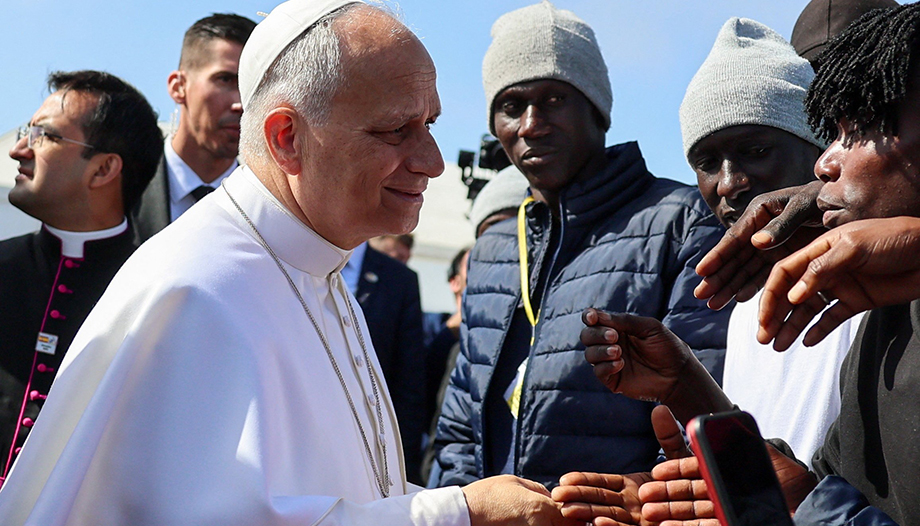
The decree, signed by the prefect of the Dicastery for the Doctrine of the Faith, Cardinal Víctor Manuel Fernández, states that Alfonso de Galarreta, «having committed an act of a schismatic nature through the episcopal consecration of four priests, without a papal mandate and against the will of the Supreme Pontiff,» has incurred ipso facto in accordance with the penalties provided for in the Code of Canon Law.

Consequently, the Dicastery declares «for all legal purposes» that Alfonso de Galarreta, as well as Pascal Schreiber, Michael Goldade, Michel Poinsinet de Sivry, and Marc Hanappier, have incurred ipso facto in excommunication latae sententiae reserved for the Apostolic See.

Furthermore, the decree states that Bishop Bernard Fellay has also been excommunicated latae sententiae, having participated as a co-consecrator in the celebration and having publicly endorsed the act that the Holy See describes as schismatic.

The document concludes with a warning addressed to both the clergy and the lay faithful not to join the schism of the Priestly Fraternity of St. Pius X, since, if they did so, they would likewise incur the penalty of excommunication latae sententiae.

An explanatory note elaborates on the scope of the decision

Along with the decree, the Dicastery for the Doctrine of the Faith has published a explanatory note in which it sets forth the reasons for the decision and details its canonical and pastoral consequences.

The document begins by noting that, from the pontificate of St. Paul VI to the recent discussions held by the Dicastery itself, «the many attempts to bring the followers of the movement founded by Archbishop Marcel Lefebvre back into full communion with the Catholic Church have been unsuccessful.».

According to the Note, the situation has definitely worsened with the recent episcopal consecrations carried out «without a papal mandate, against the will of the Holy Father, and in open violation of canon law.».

For this reason, the Dicastery considers it necessary to declare that these consecrations «have constituted the crime of schism,» recalling that St. John Paul II had already stated in the apostolic letter Ecclesia Dei that the consecration of bishops without a papal mandate constitutes «a schismatic act,» as it implies «a practical rejection of the Roman Primacy.».

The ministers of the Fraternity are now considered schismatics

The Note states, as a first consequence, that «sacred ministers belonging to the Priestly Fraternity of St. Pius X are in schism and, therefore, must be considered schismatics,» and are subject to the excommunication provided for in canon 1364 §1 of the Code of Canon Law.

The Dicastery bases this assertion on both the apostolic letter Ecclesia Dei as in the Explanatory Note published in 1996 by the then Pontifical Council for Legislative Texts, whose doctrine it considers to be fully in force.

The Situation of the Lay Faithful

With regard to the lay faithful, those who formally join the Priestly Fraternity of St. Pius X under the conditions set forth in the Explanatory Note to the Pontifical Council for Legislative Texts, 1996 (see ibid., 7), which is still in force and which this Dicastery endorses:

«In the case of other faithful, however, it is clear that occasional participation in liturgical acts or activities of the Lefebvrian movement—without adopting the attitude of doctrinal and disciplinary disunity characteristic of that movement—is not sufficient to constitute formal membership in it. In pastoral practice, it may be more difficult to assess their situation. It is necessary to take into account, above all, the individual’s intention and how this inner disposition is translated into action. Consequently, the various situations must be evaluated on a case-by-case basis by the competent bodies of the external and internal forums.».

A Note on the Sacraments

The Note also devotes a section to the administration of the sacraments by the Fraternity.

In it, he warns the People of God that their ministers «administer the sacraments unlawfully» and expressly states that both the sacrament of penance administered by them and the marriages solemnized by their ministers «are invalid.».

For this reason, it urges the faithful to refrain from participating in the celebrations and activities organized by the Fraternity.

An Invitation to Return to Full Communion

In addition to canonical measures, the Dicastery emphasizes that the purpose of these decisions is not solely disciplinary.

«The Church, as a caring mother, will welcome with sincere affection and deep concern all those who wish to return to full communion,» states the Note, announcing that the apostolic nuncios will establish the procedures that the ordinaries may follow in each case to facilitate that return.

Finally, the document urges all the faithful to remain steadfast in communion with the Roman Pontiff, with the bishops in communion with him, and with the entire Church, recalling that ecclesial unity is an essential element of the life of the Church.

May God be the focus

Pope Leo XIV’s visit to Spain has defied predictions of secularization and placed faith at the center of public debate. Beyond the large turnout, the trip has highlighted a new approach by Spanish society toward religion, characterized by a sense of normality, joy, and renewed confidence in the cultural and spiritual role of Catholicism.

July 2, 2026-Reading time: 2 minutes

For years, sociological commentary has insisted on an unchanging diagnosis: the West was advancing by leaps and bounds toward a silent secularization, in which faith was confined to the strictly private sphere. However, the events of early June have shattered all preestablished paradigms. The Pope Leo XIV's apostolic visit to Spain—his first major seven-day trip to a European democracy with Catholic roots—has not only been a huge success in terms of attendance but has also confirmed a phenomenon that can no longer be ignored: the existence of a “Catholic turn” in Spanish society or, at the very least, a new—and positive—positioning of faith in the social sphere.

During an intense week, God, the Church, and the lived experience of faith have stepped out of the sacristies to become the focal point of gatherings, dinners, and debates. What was truly revolutionary was not only the Pope’s presence, but also the impressive positivity and ease with which the country embraced this moment.

León XIV’s time in Spain has left a profound legacy that resonates directly in the soul of a society that seems to have awakened from a state of inertial lethargy. This “Catholic turn” rests on three fundamental pillars that the Pope has successfully catalyzed:

A Faith Without Complexes: Fortunately, we have overcome that old social inertia that dictated that expressing one’s beliefs was either rude or an anachronism. The papal visit has fostered an atmosphere of mutual respect and genuine interest in Catholicism, even influencing those who do not share the faith but recognize its anthropological and cultural value.

Joy as a Response to Detachment: In contrast to the stale media stereotype that associates believers with bitterness or a stern expression, Spanish youth have responded with an overflowing, natural, and contagious joy. In an era marked by an epidemic of loneliness, depression, and existential emptiness, Leo XIV has reminded us that faith is not a burden, but an anchor that never fails.

The Maturity to Accept Imperfection: One of the most honest and powerful messages this visit leaves us with is the ability to overcome our mistakes. The Church is learning to walk with its wounds still open, coming to terms with the past—painfully, yet with a firm resolve to make amends. The Pope has reminded us that the goal is not arrogant perfection, but greater closeness to those who suffer and the humility to move forward.

For believers, the success of these seven days cannot be reduced to a media sensation or a fleeting mass phenomenon; the real challenge is to transform that excitement into something lasting. Now that the echoes of the crowds are fading, the most profound task remains. As this journey has taught us, it is not simply a matter of temporarily putting God in the spotlight, but of making God the focus.

The Sacrilegious War in Ukraine

Today, it is Ukraine itself—the victim of aggression—that is showing Russia the way to the light. The Ukrainian people have become a moving example of the defense of their national identity, rooted in a love of freedom rather than in the subjugation of their neighbors.

July 2, 2026-Reading time: 3 minutes

On June 20, I had the privilege of listening to two young people whose eyes reflect both the weight of a tragic history and the light of unwavering hope. They are Ihor Chikhman and Marta Kostyk, members of the Youth Council of the Embassy of Ukraine in Spain. There was no hatred in their words, but rather a deep thirst for truth and justice. At the end of our meeting, they gave me a gift that I have been reflecting on ever since: the excellent book *Chronicle of a Sacrilegious War*, written by His Beatitude Sviatoslav Shevchuk, Major Archbishop of Kyiv-Halyć and Primate of the Ukrainian Greek Catholic Church.

The title of Shevchuk’s work is not merely a literary device; it is an accurate spiritual diagnosis. Why call this war «sacrilegious»? Because the Russian authorities have crossed a red line that transcends geopolitics: they are using the Christian religion to justify crimes against humanity and, therefore, crimes against God Himself. Blessing missiles, sanctifying the invasion of a sovereign nation, and brandishing the cross to justify the destruction of hospitals and parishes is the very definition of sacrilege. It is taking God’s name in vain to cover up barbarism.

Nationalism Adorned with Ornaments

Nothing exposes this falsehood more starkly than the suffering of the youngest among us. The heart-wrenching abduction of nearly 20,000 Ukrainian children by Russian troops—torn from their homes and parents to be confined in re-education camps in Russia—is a cry to Heaven. Attempting to erase these children’s identity, memory, and language is an atrocity that stands in direct opposition to every Gospel value. Anyone who tears a child away from his mother’s love cannot, under any circumstances, present himself to the world as a defender of family and Christian values.

When observing the Kremlin’s rhetoric and actions, it becomes clear that Russia has not undergone a genuine reckoning with its totalitarian past. Rather, it appears to have replaced the ideological apparatus of communism with a political and tactical form of Christianity. The forms have changed—the hammer and sickle often share space with Byzantine icons—but the criminal practices, repression, state-sponsored lies, and subjugation of its own people and neighboring peoples remain intact. It is imperial nationalism dressed in liturgical garb.

Faced with this reality, we Western Christians must not allow ourselves to be deceived. There is a temptation, in some circles, to look to Moscow as a bastion of resistance against the secularization and moral decay of the West. But the Russian government’s displays of religiosity are nothing more than a pretext, a mirage designed to seduce the unwary and keep citizens subjugated. There is no possible defense of Christian morality where human dignity is systematically trampled upon and one’s brother is murdered.

Ukrainian Christians

Today, it is Ukraine itself—the victim of aggression—that is showing Russia the path toward the light. The Ukrainian people have become a moving example in the defense of their national identity, rooted in a love of freedom and not in the subjugation of their neighbors. Their struggle is, moreover, a heroic defense of religious freedom. The accounts reaching us are harrowing: in the Ukrainian territories currently occupied by Russia, fierce religious persecution has been unleashed. Greek Catholic priests, Latin Rite faithful, Protestant pastors, and members of other denominations are being harassed, kidnapped, and tortured for refusing to submit their consciences to the invader’s political dictates. Wherever the Kremlin’s model is imposed, genuine freedom of spirit is crushed.

The courage and daily sacrifice of Ukrainian Christians, their peaceful resistance, and their faith—tested in the crucible of suffering—open our eyes. They remind us that true faith is manifested in love, in the defense of life, and in service to the truth.

The testimonies of young people like Ihor and Marta and the prophetic voice of pastors like Sviatoslav Shevchuk help us see that Russia needs, now more than ever, to be converted. And we are not talking about a mere change of political allegiance, but a conversion of the heart. Russia’s freedom—its liberation from this ideological and imperialist captivity—is a necessary condition for Europe’s freedom and peace throughout the world. To achieve this, Russia needs to repent authentically before history and before God, and to abandon once and for all that religious guise that serves only as an alibi to continue inflicting profound harm on humanity.

The Freedom of the Ukrainian People

Perhaps the best way to understand this hope is to look to the very soul of the Ukrainian people, as captured in the verses of their great national poet, Taras Shevchenko, who as early as the 19th century spoke out against imperialism with unshakable faith:

“Fight, and you will win!”

May God help you!

You have the strength on your side,

”freedom and holy truth.".

Gospel

The humility it reveals. Fourteenth Sunday in Ordinary Time (A)

Vitus Ntube discusses the readings for the Fourteenth Sunday in Ordinary Time (Year A), July 5, 2026.

Vitus Ntube-July 2, 2026-Reading time: 2 minutes

Today's readings present Jesus Christ to us as the truly humble one. In the first reading, we find the image of a humble Messiah; in the Gospel, Jesus himself declares that he is meek and humble of heart.

What is unique about Christ’s humility? What can we learn from it? Christ’s humility is inseparably linked to the truth: to the truth of revelation that shows us who God truly is. God reveals Himself in humility, and those who receive this revelation must also approach Him with a humble heart. God’s revelation takes place within a context of humility.

In the first reading, the Messiah enters Jerusalem in a profoundly humble manner: “Look, here comes your king—righteous and victorious, poor and riding a donkey, a young donkey”. The Messiah does not come with worldly power or splendor, but with simplicity and meekness. Humility is inseparable from truth. There is no greater truth than the knowledge of Christ. The Gospel highlights the conditions necessary to receive this revelation.

Jesus praises the Father for the way in which He has revealed His mysteries: “You have hidden these things from the wise and learned, and revealed them to little children”. The wise and learned, in this context, are not condemned for their knowledge, but for the pride that prevents them from embracing a truth that goes beyond their own frameworks and expectations. Since God reveals Himself in humility, the proper disposition for receiving Him must also be humility. Jesus Christ, the sole revealer of the Father, comes in humility and can only be truly understood by those who are simple as children.

Christ’s humility is also a source of rest. Jesus invites us to learn from his heart, because in him we discover the deepest truth about God and about ourselves. The worries of daily life become bearable when we carry them with Christ and in the same spirit with which He carried His own cross. When we share in that same inner disposition, even life’s burdens are transformed. That is why Jesus says: “Take my yoke upon you and learn from me, for I am gentle and humble in heart, and you will find rest for your souls.”. Christ’s yoke does not crush us; it lightens our burden. It does not oppress us; it lifts us up. It is the yoke of love, the yoke of humility.

However, to learn Christ’s humility, we must possess the Spirit of Christ. The second reading reminds us that the “Spirit of God” dwells within us, and that without it “Spirit of Christ” We do not belong to Him. We must allow the Holy Spirit to shape and guide us, for He teaches us humility and opens our hearts to receive the truth revealed in Christ.

Artificial Intelligence and Journalism

In the age of Artificial Intelligence, there is an irreplaceable responsibility that applies to us as newspapers: to never compromise our own authority, to ensure the transparency of our sources, to respect the dignity of our readers, and to cultivate the human dimension of storytelling.

July 2, 2026-Reading time: 2 minutes

March 2026 marked the 150th anniversary of the founding of the Italian newspaper Corriere della Sera. Pope Leo has always shown great sensitivity toward the work of journalists; in fact, it was to media professionals that he dedicated his first audience. On the occasion of the anniversary, he wrote a brief letter to the newspaper congratulating them on their work and reminding them that the human dimension must always be protected and nurtured.

At a time when AI seems poised to revolutionize the world, it’s good to remember what a journalist is. A journalist is a professional tasked with investigating, gathering, analyzing, synthesizing, and disseminating information of public interest, ensuring accuracy and rigor. They work across various media platforms—print, radio, television, and digital media—to provide context for current events and enable the public to make informed decisions.

With the advent of AI, the responsibility of newspapers is even greater, if that is possible. Newspapers—the Pope notes—in addition to reporting current events—that is, informing us of what is happening in a given country and around the world—are also a vehicle for culture, serving as a living force within society to whose creation they contribute. The technological revolution we are experiencing is a challenge to keep pace with our times and is, moreover, a test that concerns each and every one of us, the pontiff notes in his letter to the Italian newspaper.

In the age of AI, there is an irreplaceable responsibility that affects us as newspapers: to never compromise our own authority, to ensure the transparency of our sources, to respect the dignity of our readers, and to cultivate the human dimension of storytelling.

The human mind and a clear conscience are up to this challenge, far more so than AI, which can assist in journalistic work but has neither freedom nor conscience—instead, it spits out information that has been fed to it beforehand. AI is a tool without ethics, a machine that, if it doesn’t know something, makes it up; a journalist is someone who knows that in their daily work, they cannot make things up. AI is, in my view, a very helpful tool, but it must not think for me.

The authorMiriam Lafuente

Christ's Wounds and the Seamless Tunic

Two popes have pleaded for the same thing thirty-eight years apart: one for Christ’s wounds, the other for his seamless robe. The wounds and the robe convey a single message: that unity is paid for with blood and cannot be torn apart without pain.

July 1, 2026-Reading time: 4 minutes

Today, July 1, 2026, in Écône, the Priestly Fraternity of St. Pius X consecrated four bishops without a papal mandate. Thirty-eight years earlier, Marcel Lefebvre did the same, in the same place. A bridge spans these two dates, built on two letters and a single plea: do not break the unity.

The first was written by John Paul II on June 9, 1988, shortly before those consecrations. It was not a legal document, but a father’s letter: he asked Lefebvre, «by the wounds of Christ our Redeemer,» not to take a step that could only be understood as schismatic, and reminded him of the Lord’s prayer on the eve of his Passion: «that they may all be one.».

Weeks later, in the motu proprio Ecclesia Dei, John Paul II identified the root of the problem where it truly lay: not in the love for the ancient liturgy—which is legitimate and respected—but in «an incomplete and contradictory notion of Tradition.» That is the crux of the matter, then and now. Tradition is not a relic to be safeguarded in opposition to the Pope; it is a living reality that is handed down with him and under his ministry. No one is faithful to Tradition if they sever the bond with the one to whom Christ entrusted the unity of his Church. Anyone who pits Tradition against the Papacy has misunderstood both.

The Fraternity cites a «state of necessity»: aging bishops, the urgent need to ensure ordinations and confirmations, and the duty not to abandon a work that sustains the faith of many souls. Their superior general, Father Davide Pagliarani—who is not a bishop—maintains that they are not seeking to separate from Rome, but rather to serve «a mother who is going through a serious difficulty»; and they insist that this is not the whim of each community, but rather an exceptional and objective crisis within the Church. It is a sincere but invalid objection: determining when necessity excuses one from communion with Peter is, precisely, something no one can decide on their own.

Rome has not stood idly by since 1988. Benedict XVI authorized the traditional Mass in 2007 and, in 2009, lifted the excommunication of the four bishops; years of doctrinal discussions followed. Pope Francis granted the priests of the Fraternity the authority to hear confessions (in 2015, on a permanent basis starting in 2016) and regulated attendance at their weddings (2017), to protect the faithful. For nearly four decades, the hand was extended. That is why a new unilateral consecration hurts so much: it slams the door shut in the face of an open one.

On May 13, 2026, Cardinal Víctor Manuel Fernández, prefect of the Dicastery for the Doctrine of the Faith, warned that consecrating bishops without a mandate would constitute «a schismatic act,» with excommunication of both the consecrator and those consecrated already provided for in Ecclesia Dei (based on the former canon 1382, now 1387). On June 29, 2026, Leo XIV addressed Father Pagliarani in language identical to that of John Paul II: «Filled with Christian affection, I beg and implore you with all my heart: Turn back!» And he added, without closing any doors: «The Church is open to a path of dialogue and understanding.» Only then does the image that gives these lines their title appear: «Tearing the seamless Tunic of Christ is a sin of the utmost gravity.».

What is most revealing is that the Fraternity responded by appropriating that very image. Father Pagliarani thanked the Pope for his «paternal concern» and, far from retracting his statement, wrote that he felt a duty to «mend Christ’s tunic, torn by forces and pressures incompatible with an authentically Catholic spirit»; and asked that the sincerity of his intention be recognized: «It is not too late yet.» It is a clever argument: both sides claim to defend the seamless robe. But that robe is not mended by tearing off a shred to keep it separate, nor is it sewn from the outside. Whoever truly wants it whole does not consecrate bishops against the Pope: he remains at his side, even while suffering. Communion is not the price of Tradition. It is its home.

The Fraternity puts forward yet another, more subtle argument: that the Pope’s writing to them «as a father to his son» would prove that there is no schism, since no one treats a stranger that way. But this reasoning is turned on its head. The fact that Rome continues to treat those who have broken away as children does not prove that there is no rupture, but rather demonstrates the father’s patience—a patience that does not legitimize the son’s disobedience and is therefore a source of sorrow. Nor does the fact that some bishops have recognized the Fraternity’s Catholic spirit resolve anything. One can love the doctrine and yet break communion in the very act of consecrating without a mandate.

In 1988, many priests who shared that same love for Tradition heeded the call of John Paul II and founded the Priestly Fraternity of St. Peter. They preserve the traditional liturgy in its entirety, along with the same formation and the same reverence, and they do so in peace, in full communion with the Successor of Peter. They are living proof that Tradition does not require schism.

Two popes have pleaded for the same thing thirty-eight years apart: one for Christ’s wounds, the other for his seamless robe. The wounds and the robe speak of one thing: that unity is paid for with blood and cannot be torn apart without pain. This is not an internal matter for the Church: Jesus asked that all may be one «so that the world may believe» (Jn 17:21), and every schism makes the Church less credible. May this plea be heard this time, and may many choose to live out the Christian tradition alongside the one who is their true rock: Peter.

The authorRafael Domingo Oslé

Professor of Law, University of Navarra, Spain

The World

Spain, the second-largest provider of aid to persecuted Christians

The 2025 annual report from Aid to the Church in Need (ACN) details an investment of 145.8 million euros in pastoral projects, support for priests, church construction, and the defense of religious freedom.

Teresa Aguado Peña-July 1, 2026-Reading time: 4 minutes

«Supporting the Church most in need.» That is the goal that guides the work of Aid to the Church in Need (ACN), as highlighted by its leaders during the presentation of the pontifical foundation's 2025 annual report.

The president of ACN Spain, Walther von Plettenberg, presented the results of ACN International’s activities in 2025. Thanks to the support of 363,176 benefactors and the work of its 24 offices around the world, the foundation was able to fund 5,368 projects in 141 countries across five continents, always in collaboration with local dioceses, benefiting a total of 1,251 dioceses.

Main beneficiaries

Over the past year, ACN raised 145.8 million euros from donations and bequests, which were used to support the Church’s pastoral work in places where it suffers most from persecution, poverty, or conflict.

The ten countries that received the most financial support in 2025 were India (7 million euros), Ukraine (6 million), Lebanon, Syria, the Democratic Republic of the Congo, and Nigeria—where projects increased by nearly 50 %—, Tanzania, Iraq, Burkina Faso, and Pakistan.

Among the main beneficiaries of this aid are priests, dioceses, bishops, and laypeople. Von Plettenberg noted that one in ten priests worldwide received some form of support from ACN over the past year. In addition, the foundation made it possible to celebrate nearly two million Masses for the support of priests and funded the construction or renovation of 791 church buildings.

«A Church without a church building—unable to celebrate the Eucharist in a dignified setting—is a Church that is severely handicapped,» said the president of ACN Spain, emphasizing the importance of providing Christian communities with suitable spaces for worship.

During the presentation, the private audience that Pope Leo XIV granted to a delegation from ACN International on October 10, 2025, was also recalled. During that meeting, the Pontiff expressed his gratitude for the foundation’s work with these words: «Your mission proclaims that, as one family in Christ, we do not abandon our persecuted brothers and sisters. Rather, we remember them, support them, and work to guarantee the freedoms that God has granted them.».

Where does their income go?

For his part, the director of ACN Spain, José María Gallardo, presented the figures for the Spanish office. He explained that 81.9 % of the revenue came from donations and 18 % from inheritances and bequests. Of the total funds received, 88.3% was allocated directly to the foundation’s own purposes, while 11.7 % covered operating expenses. In addition, 82.2% of the foundation’s activities were specifically dedicated to funding projects.

Africa once again received the largest share of aid, accounting for 34.5 % of all projects. The growth of the Church on this continent, reflected in the increase in the number of faithful and vocations, coexists with major challenges such as poverty and the spread of Islamist terrorism in a growing number of countries. In particularly hard-hit areas, such as Burkina Faso, Niger, and Mali, ACN was able to increase its aid by 30 %, while support for the Church in Nigeria grew by 47 %.

Gallardo noted that revenue grew by 0.3 % compared to 2024. «We’re holding our own; however, there has been tremendous generosity in the form of inheritances and bequests,» he said.

In 2025, the Spanish office accounted for 11.9 % of ACN’s international revenue, ranking as the second-largest contributor among the 24 offices worldwide, behind only France. Following Spain are Germany, the United Kingdom, the United States, Switzerland, and Italy.

Religious freedom

The defense of religious freedom was another key theme of the presentation. Gallardo recalled the words of Pope Leo XIV: «Religious freedom is not a privilege, but a right.» In this context, ACN is promoting a manifesto to ensure the effective implementation of Article 18 of the Universal Declaration of Human Rights. The initiative has already gathered more than 8,000 signatures in Spain, and the organization hopes to reach half a million signatures worldwide.

Likewise, the director of ACN Spain highlighted the foundation’s spiritual dimension. «Without prayer, we could not achieve all that we have achieved,» he said. In this regard, ACN Spain promotes more than 500 prayer initiatives, including the «One Million Children Praying the Rosary» campaign, in which 45 schools and more than 10,000 children participate.

The presentation concluded with a message of thanks to all the benefactors, also recalling the words of Pope Leo XIV: «Do not grow weary of doing good, for your service bears fruit in countless lives and glorifies our Father who is in heaven.» In that spirit, the foundation’s leaders chose to close with a simple expression of gratitude: «Thank you for helping the Church that suffers the most.».

The World

The CARF Foundation supported 1,960 seminarians and priests from 85 countries in 2025

One of the most notable figures in the 2025 Annual Report is that the CARF Foundation was able to allocate approximately 25 % of its revenue—2,615,974 euros—to the endowment fund, a permanent endowment that reduces the foundation’s reliance on one-time annual donations.

Editorial Staff Omnes-July 1, 2026-Reading time: 2 minutes

The institution, which has operated for 37 years without relying on public subsidies, allocated more than 6.1 million euros to scholarships and financial aid for students at the Pontifical University of the Holy Cross and the Ecclesiastical Faculties of the University of Navarra

The CARF Foundation has presented its 2025 Annual Report, a year in which the institution supported 1,960 students from 85 countries, divided between the Pontifical University of the Holy Cross (PUSC) in Rome and the Ecclesiastical Faculties of the University of Navarra in Pamplona.

Of the total number of beneficiaries, 1,201 studied in Rome and 759 in Pamplona. To support their education, the Foundation allocated 3,145,765 euros to the Rome campus and 2,183,040 euros to the Pamplona campus, in addition to 794,681 euros in other grants.

A foundation without public funding

The CARF Foundation was established on February 14, 1989, five years after St. John Paul II encouraged Blessed Álvaro del Portillo to found the Pontifical University of the Holy Cross. The goal of the new Roman university was to offer an intellectual, human, and spiritual education of the highest quality to seminarians and priests—both diocesan and religious—from anywhere in the world, without allowing a lack of financial resources to be an obstacle. The PUSC thus joined the educational work already being carried out by the Ecclesiastical Faculties of the University of Navarra.

Since its founding, the institution has not received any public subsidies. Its operations are supported by some 5,200 annual donors, whose contributions ensure the project’s independence and continuity.

More than 10 million euros raised in 2025

In 2025, the CARF Foundation received a total of 10,474,834 euros from various funding sources: one-time donations accounted for 42.68 % of revenue; wills and bequests, 23.41 %; income from assets, 20.73 %; and recurring donations, 13.18 %.

One of the most notable figures in the annual report is that the Foundation was able to allocate approximately 25 % of its revenue—2,615,974 euros—to the endowment fund, a permanent endowment that reduces dependence on one-time annual donations and improves the institution’s long-term financial sustainability.

Residences and seminars for students from around the world

The CARF Foundation’s grants provide residential and training opportunities in both Rome and Pamplona. In Rome, the Sedes Sapientiae International Seminary has a capacity for one hundred seminarians and fifteen instructors.

In Pamplona, students at the University of Navarra’s Ecclesiastical Faculties have access to the Bidasoa International Seminary and several residences—including Aralar, Echalar, El Sadar, Los Tilos, Ciudadela, and Albaizar—which provide housing for more than 150 priests and candidates for the priesthood from all over the world.

You can view the full 2025 Annual Report here

There's an AI there that says, «Ouch!»

"Thank you, Holy Father, for *Magnifica Humanitas*, for pointing out every "woe" in the AI. We must try to ensure that they reach the people they are meant to reach.".

July 1, 2026-Reading time: 3 minutes

The phrase we used to learn the spelling differences between the three words that sound the same but have different meanings is a good summary of the message that Leo XIV has shared with us in his encyclical «Magnifica Humanitas» regarding the protection of human life in the age of artificial intelligence.

Just like the mnemonic phrase we were taught as children, the Pope is pointing out something important, drawing our attention to a reality that is already among us: Artificial Intelligence. The now-famous AI—short for Artificial Intelligence—is here to stay and will transform our lives, marking not merely an era of change, but a true «turning point in history» in which we are immersed, just as Francis prophesied. 

There is an AI out there that is already making decisions for you and influencing who you are as an individual and as a society—no matter how “analog” you are or how far off the grid you live.

Although the encyclical is not technophobic by nature and acknowledges that «the advantages in terms of efficiency and the potential for improving certain services thanks to AI are evident,» the truth is that, faithful to his mission as a shepherd who must protect his sheep from wolves, the Pope warns us of many very serious dangers that are already beginning to bare their digital fangs. Each warning from the Holy Father resonates like one of those «Woe to you» cries that Jesus hurled at the scribes and Pharisees, who took advantage of their position of religious dominance to subjugate the people. To paraphrase some of the most prominent themes—not as a condemnation but as a warning about the paths down which we are being led—we could say, with Leo XIV:

Woe to the technocrats and digital oligarchs, «endowed with resources and the capacity to act”

»greater than those of many governments,« owners »of new forms of property—patents, algorithms, digital platforms, technological infrastructure, and data,« because, »when these goods are concentrated in the hands of a few, without adequate means of exchange and access, a new imbalance is created that contradicts the universal destination of goods and widens the gap between the included and the excluded”!

Woe to those AI developers who, in their race to be first, don’t really know where they’re leading us! The encyclical explains that AI systems «are more “cultivated” than “built,” since developers do not directly design every detail, but rather create an architecture on which the AI “grows.”» For this reason, they carry «significant ethical and spiritual weight, since every project choice expresses a vision of humanity, and it is necessary to «verify that what is being cultivated is truly a good.»”.

Woe to the proponents of ideologies that have emerged in the wake of the digital revolution—such as transhumanism or posthumanism—«which suggest that every person must earn or justify their own worth, to the point of attributing greater value to those who are more efficient and productive,» because «from such a perspective, the person ends up being reduced to a means for obtaining results, a resource to be used and exploited, and is not recognized as an end in itself»!

Woe to the leaders of the states who, in the midst of this global crisis caused by the owners of AI, are tasked with «ensuring cohesion, unity, and a just organization of civil society, (…) seeking a balance between individual interests and the common good, without leaving the most vulnerable behind,» because «when politics abandons a long-term vision and reduces itself to short-term calculations or fruitless polarization, discourse on the common good loses credibility, and at the same time, inequalities and social divisions grow»!

Woe to the warlords who entrust lethal decisions to artificial systems, because «there is no algorithm that can make war morally acceptable»! After all, «the decision to use lethal force cannot be delegated to opaque or automated processes, but must remain under effective, conscious, and responsible human control.».

Thank you, Holy Father, for *Magnifica Humanitas*, for pointing out every «woe» in the AI. We must strive to ensure that these messages reach their intended audience.

The authorAntonio Moreno

Journalist. Graduate in Communication Sciences and Bachelor in Religious Sciences. He works in the Diocesan Delegation of Media in Malaga. His numerous "threads" on Twitter about faith and daily life have a great popularity.