The Vatican

Vatican finances, the balance sheets of the IOR and of the St. Peter's Obligation

There is an intrinsic relationship between the budgets of the Oblates of St. Peter's and the Institute for works of Religion.

Andrea Gagliarducci-July 12, 2024-Reading time: 4 minutes

There is a close relationship between the annual declaration of the St. Peter's obolus and the balance sheet of the Istituto delle Opere di Religione, the so-called "Vatican bank". Because the Obolo is destined to the charity of the Pope, but this charity is also expressed in the support of the structure of the Roman Curia, an immense "missionary budget" that has expenses, but not so many incomes, and that must continue to pay salaries. And because the IOR, for some time now, has been making a voluntary contribution of its profits precisely to the Pope, and these profits serve to lighten the budget of the Holy See. 

For years the IOR has not had the same benefits as in the past, so that the portion allocated to the Pope has decreased over the years. The same situation applies to the Obolo, whose income has decreased over the years, and which has also had to face this decrease in the IOR's support. So much so that in 2022 it had to double its income with a general divestment of assets.

That is why the two budgets, published last month, are somehow connected. After all, the Vatican finances have always been connected, and everything contributes to helping the Pope's mission. 

But let's look at the two budgets in more detail.

The St. Peter's Oblong

Last June 29, the St. Peter's Oblates presented their annual balance sheet. Revenues were 52 million, but expenses amounted to 103.4 million, of which 90 million were for the apostolic mission of the Holy Father. Included in the mission are the expenses of the Curia, which amount to 370.4 million. The Obolo thus contributes 24% to the budget of the Curia. 

Only 13 million went to charitable works, to which, however, must be added donations from Pope Francis through other dicasteries of the Holy See totaling 32 million, 8 of which were financed directly through the obolo.

In summary, between the Obolus Fund and the funds of the dicasteries financed in part by the Obolus, the Pope's charity financed 236 projects, for a total of 45 million. However, the balance deserves some observations.

Is this the true use of the St. Peter's Obligation, which is often associated with the Pope's charity? Yes, because the very purpose of the Obligation is to support the mission of the Church, and it was defined in modern terms in 1870, after the Holy See lost the Papal States and had no more income to run the machine.

That said, it is interesting that the budget of the Obolus can also be deducted from the budget of the Curia. Of the 370.4 million of budgeted funds, 38.9% is earmarked for local Churches in difficulty and in specific contexts of evangelization, amounting to 144.2 million.

Funds earmarked for worship and evangelization amount to 48.4 million, or 13.1%.

Dissemination of the message, that is, the entire Vatican communication sector, represents 12.1% of the budget, with a total of 44.8 million.

37 million (10.9% of the budget) was allocated to support the apostolic nunciatures, while 31.9 million (8.6% of the total) went to the service of charity - precisely the money donated by Pope Francis through the dicasteries -, 20.3 million to the organization of ecclesial life, 17.4 million to the historical heritage, 10.2 million to academic institutions, 6.8 million to human development, 4.2 million to Education, Science and Culture and 5.2 million to Life and Family.

Income, as mentioned above, amounted to 52 million euros, 48.4 million of which were donations. Last year there were fewer donations (43.5 million euros), but income, thanks to the sale of real estate, amounted to 107 million euros. Interestingly, there are 3.6 million euros of income from financial returns.

As for donations, 31.2 million came from direct collection by dioceses, 21 million from private donors, 13.9 million from foundations and 1.2 million from religious orders.

The countries that donate the most are the United States (13.6 million), Italy (3.1 million), Brazil (1.9 million), Germany and South Korea (1.3 million), France (1.6 million), Mexico and Ireland (0.9 million), Czech Republic and Spain (0.8 million).

IOR balance sheet

Pope IOR 13 million to the Holy See, compared to a net profit of 30.6 million euros.

The profits represent a significant improvement over the €29.6 million in 2022. However, it is necessary to compare the figures: they range from the 86.6 million profit declared in 2012 - which quadrupled the previous year's earnings - to 66.9 million in the 2013 report, 69.3 million in the 2014 report, 16.1 million in the 2015 report, 33 million in the 2016 report and 31.9 million in the 2017 report, to 17.5 million in 2018.

The 2019 report, meanwhile, quantifies profits at 38 million, also attributed to the favorable market.

In 2020, the year of the COVID crisis, the profit was slightly lower at 36.4 million.

But in the first post-pandemic year, a 2021 still unaffected by the war in Ukraine, it returned to a negative trend, with a profit of only €18.1 million, and only in 2022 did it return to the €30 million barrier.

The IOR 2023 report speaks of 107 employees and 12,361 customers, but also of an increase in customer deposits: +4% to €5.4 billion. The number of clients continues to fall (they were 12,759 in 2022, even 14,519 in 2021), but this time the number of employees also decreases: they were 117 in 2022, they are 107 in 2023.

Thus, the negative trend of clients continues, which should give us pause for thought, bearing in mind that the screening of accounts deemed not compatible with the IOR's mission ended some time ago.

Now, the IOR is also called upon to participate in the reform of Vatican finances desired by Pope Francis. 

Jean-Baptiste de Franssu, president of the Council of Superintendence, highlights in his management letter the numerous accolades the IOR has received for its work in favor of transparency over the past decade, and announces: "The Institute, under the supervision of the Authority for Supervision and Financial Information (ASIF), is therefore ready to play its part in the process of centralizing all Vatican assets, in accordance with the Holy Father's instructions and taking into account the latest regulatory developments.

The IOR team is eager to collaborate with all Vatican dicasteries, with the Administration of the Patrimony of the Apostolic See (APSA) and to work with the Investment Committee to further develop the ethical principles of FCI (Faith Consistent Investment) in accordance with the Church's social doctrine. It is crucial that the Vatican be seen as a point of reference."

The authorAndrea Gagliarducci

Spain

Leo XIV to the prisoners of Brians: “God loves you as you are, but he dreams you better”.”

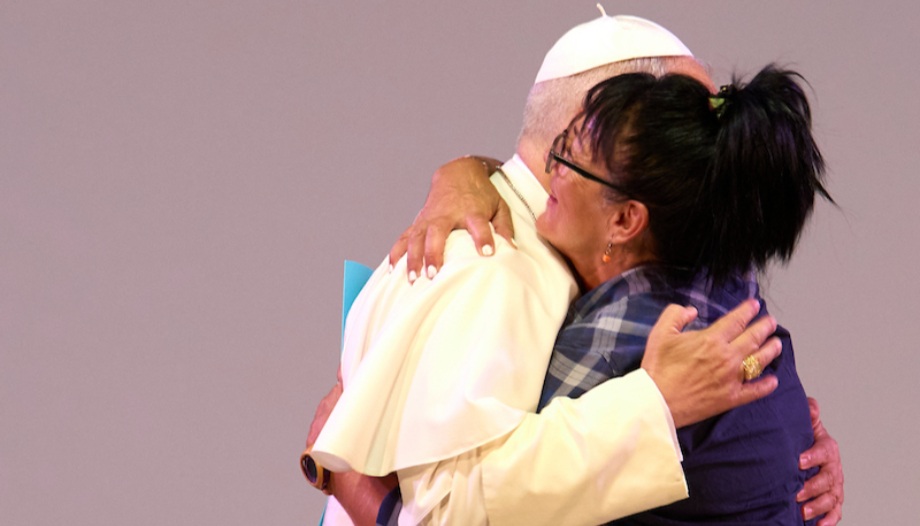
After the moving testimony of one of the inmates, Pope Leo XIV gave her not one, but two hugs.

Javier García Herrería-June 10, 2026-Reading time: 3 minutes

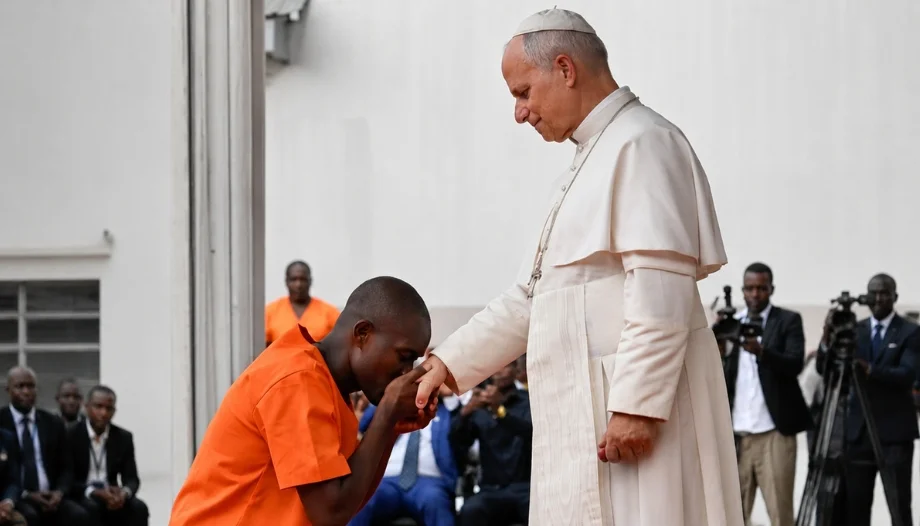
At 10:50 a.m., Pope Leo XIV arrived at the Brians 1 Penitentiary Center, in Sant Esteve Sesrovires, to meet with about 80 inmates in the prison auditorium. A half-hour meeting that also brought together inmates from the Brians 2 and Wad Ras centers, along with chaplains and volunteers from the diocesan prison ministry of Sant Feliu de Llobregat.

Before the Pope took the floor, two inmates shared their testimonies before the Holy Father and the rest of the audience. Their stories, different in starting point but converging in essence, set the tone for the entire visit.

Two paths to the same faith

Montse, from Barcelona, spoke of a faith that was slow in coming. For years she tried to believe without succeeding: “Life had not allowed me to do so,” she explained. The hardest blow was the death of her son, a loss that confronted her with the silence of God and took her a long time to process: “I fought a lot with him, and it has cost me my life to understand that God is not to blame”. It was in prison where, paradoxically, she found what she was looking for outside: “I came back to believe in here and I am grateful for the gift of faith”.

After his testimony, he received not one, but two hugs, at the initiative of the Holy Father himself, who was moved by the simplicity of his words. 

Josefina, on the other hand, grew up in the Church. Baptized, communioned and confirmed, she always felt that “God was walking with me”. But she too was shaken: her son's accident shook her certainties. Unlike Montse, she did not lose her faith - “I don't want to ask for explanations,” she said - although she did see it tremble. Her son survived and she lives it as a miracle: “It is always God”. Today, in prison, she says that Jesus gives her strength: “If not, I don't know how I would have endured this”.

Two different trajectories - the one that came to faith from obscurity and the one that kept it despite the pain - which the Pope gratefully reflected at the beginning of his speech.

The Pope's words

Leo XIV began by greeting in Catalan -“Thank you all for your warm and friendly welcome!” - before addressing those present in Spanish.

“I am edified by the testimony that Montse and Josefina have shared with us,” said the Pontiff, also thanking the work of the chaplains and volunteers of the prison ministry.

The core of his message was the unconditional dignity of every person. Drawing on his recent document Magnifica humanitas, He recalled that every human being is “worthy” by the mere fact “of having been wanted, created and loved by God,” and that “there is no situation that makes the Lord look away from us. A love, he stressed, that ”is always above how much good or bad we have done“.

Addressing the inmates directly, the Pope acknowledged the weight of their situation and invited them not to let themselves be overcome by the temptation to feel lesser: “Raise your eyes to the One who, through the presence of so many people, never fails to show you his love and closeness.”.

He then turned to Saint Augustine and his Confessions to speak of the possibility of transformation: “If we trust in divine grace and allow ourselves to be guided and transformed by it, we discover how in our life the past does not condemn the future, but offers us the possibility of changing our decisions and choices”.

Leo XIV asked the inmates to make room for the Lord in their hearts: “Let us cling to Him, who continually invites us to hope and shows us a marvelous horizon that no physical barrier can prevent us from reaching”.

And he closed with a phrase that resounded in the prison auditorium like an embrace: “To each one of you I say: God loves you as you are, but he dreams you better! The Lord allows us all to start always anew, because being human and being a Christian does not consist in not making mistakes but in growing in the capacity to convert, repent, make amends and, above all, to reconcile and forgive”.

At the end of the ceremony, the Pope prayed the Our Father with those present and imparted the apostolic blessing. He received some gifts from the prisoners and gave them an image of Our Lady. Finally, he walked down the central aisle and calmly greeted the prisoners.

Spain

56 priests confess hundreds of faithful during the preview of the Pope's meeting with young people in Barcelona

The diocese of Barcelona organized a massive celebration of the sacrament of reconciliation in the Olympic Stadium Lluís Companys.

Javier García Herrería-June 10, 2026-Reading time: 2 minutes

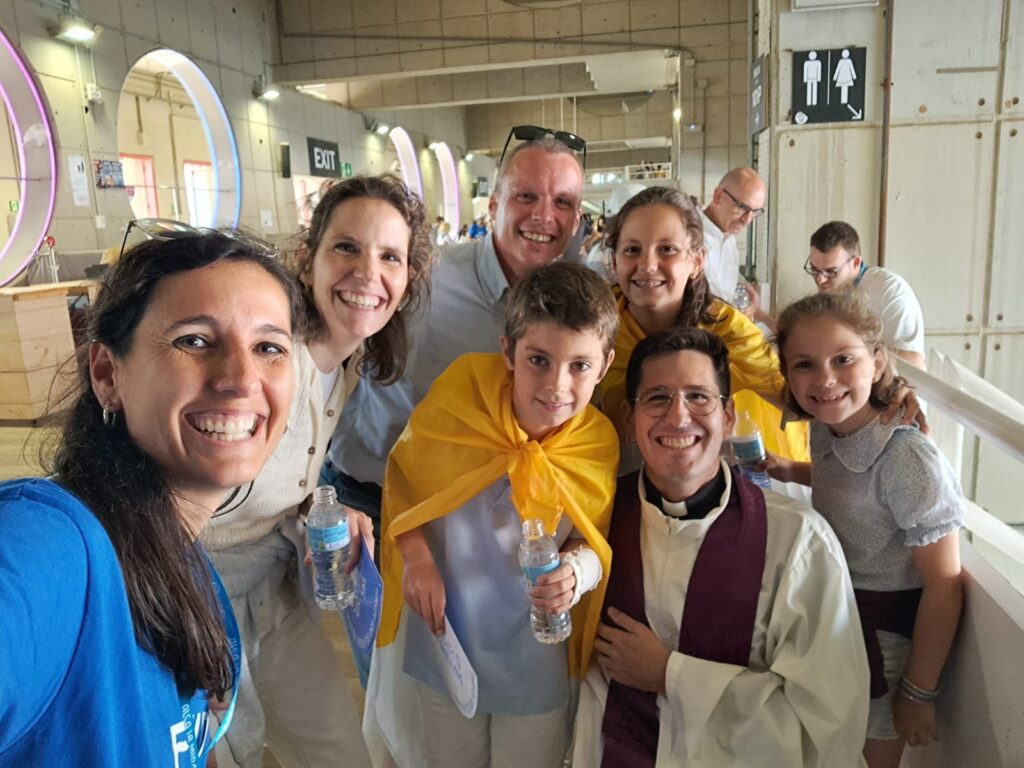
During the three hours prior to the arrival of Pope Leo XIV at the Olympic Stadium Lluís Companys of Barcelona, 56 priests administered the sacrament of reconciliation to hundreds of faithful gathered for the vigil. An initiative promoted by the youth ministry of the diocese of Barcelona.

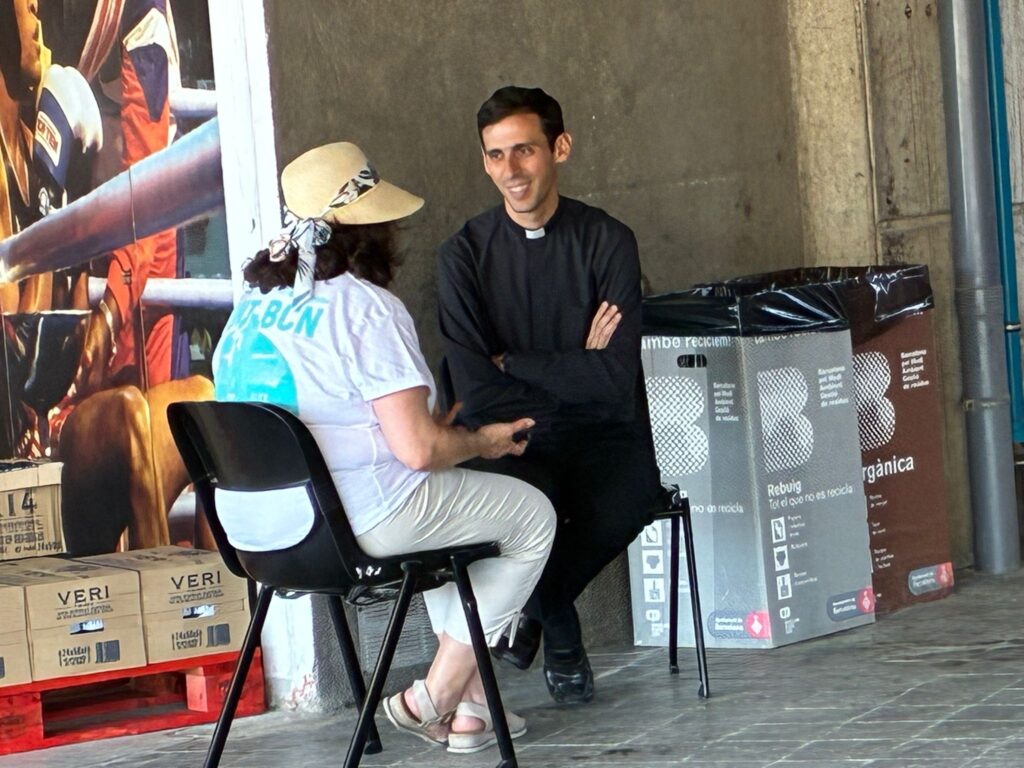
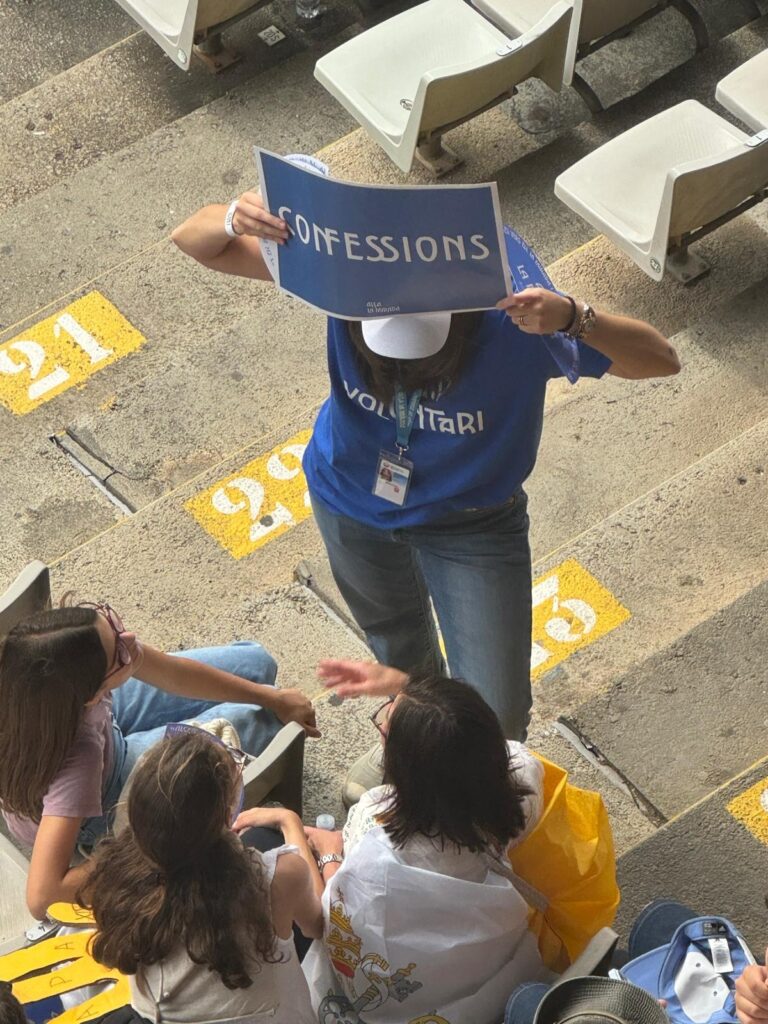
The priests were strategically placed in the interior corridor that connects the two levels of the stadium, so that everyone could see them as they entered, most of them perfectly dressed with alb and stole. In addition, volunteers from the organization went through the stands with grace and flair encouraging the faithful to go to confession with a sign.

Montse, one of the volunteers at the youth meeting.

From the moment the confessors took their seats, the lines did not stop forming. «From the moment I sat in the chair we have not stopped,» explained one of the priests who participated in the day, leaving evidence of the extraordinary demand for a sacrament that, in many cases, the faithful had not received for years.

A sacrament that shines again

Among those who came to confession, there were those who did so after a long period of absence from the sacrament of reconciliation. «Some confessions were more extended than usual,» explains the aforementioned priest, reflecting the depth and weight of that reunion with forgiveness.

In order to be able to attend to all the attendees, the 56 confessors were strategically distributed both on the playing field and in the stands of the stadium, adapting to the massive influx of pilgrims and ensuring that no one who wanted to confess was unable to do so.

The public address system, an ally of the sacrament

The initiative was announced over the stadium's public address system by the organization of the Diocese of Barcelona, which bet from the very first moment on turning the wait prior to the Pope's arrival into an occasion of grace. The announcement worked: the faithful responded with a massive response that exceeded expectations.

The scene - hundreds of people lined up in the stands and on the lawn of the Olympic Stadium to receive the sacrament of reconciliation - became one of the most striking and emotional moments of the day.

Priest Ferrán Parcerisa with a group of family members.

A unique opportunity to value reconciliation

The visit of Pope Leo XIV to Barcelona thus offered an exceptional opportunity to highlight one of the sacraments that, historically, has been losing presence in the lives of many Catholics. The image of dozens of priests distributed throughout a full stadium, listening and absolving, reminded many of the centrality of mercy in the Christian message.

In short, it was an afternoon in which forgiveness was the protagonist even before the Pope arrived on the field.

ColumnistsVictor Torre de Silva

A pizza for the Pope

Pope Leo XIV visits Naples and has a close encounter with the people, in a day marked by popular devotion, faith and the main sites of the city.

June 10, 2026-Reading time: 2 minutes

One of the many aspects that make Leo XIV similar to Pope Francis is the closeness to the people that he has shown, as we had the opportunity to see on the anniversary of the Pope's election. While the media devoted long articles to evaluating his first year as Pontiff, Leo XIV decided to spend that day in Naples.

The city is a marvel of life and color, where the narrow streets are intertwined in the shade of the laundry and on every corner there are images of the Madonna adorned with candles and flowers or small tributes to Maradona, also with candles and flowers. In this wonderful and chaotic city we were able to see the Pope going out to meet the people, approaching the places where the Neapolitan people live their faith.

He first visited the sanctuary of the Virgin of Pompeii on her feast day, and then went to the church where the most popular relic of the city is kept, the blood of St. Jenaro, which is liquefied every year in a phenomenon of great importance and which, according to the most superstitious, is the guarantee that in that year there will be no great misfortunes. He gave a blessing with the relic and then went to one of the most emblematic squares of the city for a meeting with more than fifty thousand people.

A peculiar episode, but one that shows the personality of the Neapolitans and the simplicity of the Pope, took place at various points along the route, where different people wanted to give a traditional pizza to the Holy Father. Two of these people managed to approach the popemobile and deliver their creations to Leo XIV, one of them with his name written on the pizza and the other with a design of the Pope's image on the dough. Both faithful were received by him with the smile of a shepherd who loves his sheep and is amused by their gestures of affection.

The authorVictor Torre de Silva

Read more
Spain

Leo XIV confronts the harshest realities in Barcelona: suicide, family violence and existential emptiness

In a spectacular prayer vigil with 40,000 young people at the Lluís Companys Stadium, Leo XIV answered very existential questions from several young people.  

Javier García Herrería-June 9, 2026-Reading time: 4 minutes

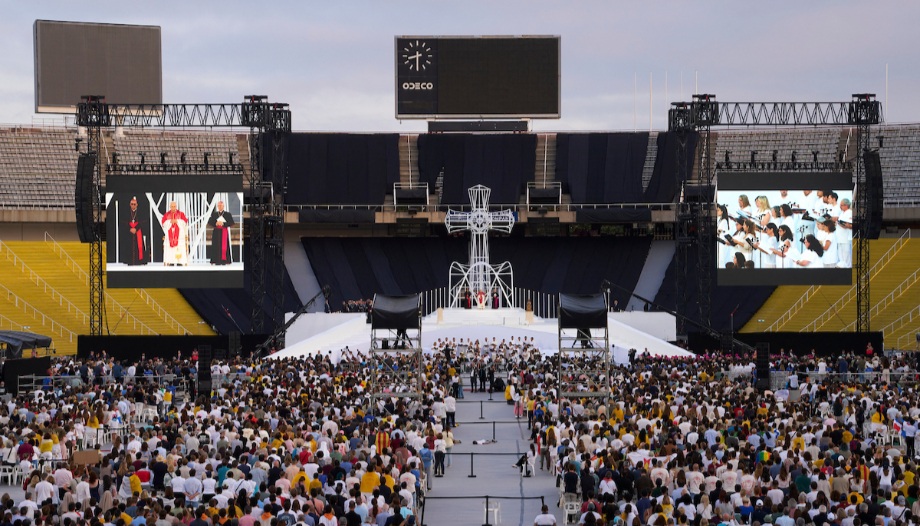
The Olympic Stadium Lluís Companys of Barcelona hosted last night a Prayer Vigil presided over by Pope Leo XIV before more than 40,000 people. The Pontiff arrived at the stadium shortly before 8:00 pm, after a private meeting with members of the Augustinian Order and the blessing of 30 ambulances bound for Ukraine, accompanied by Sister Lucia Caram.

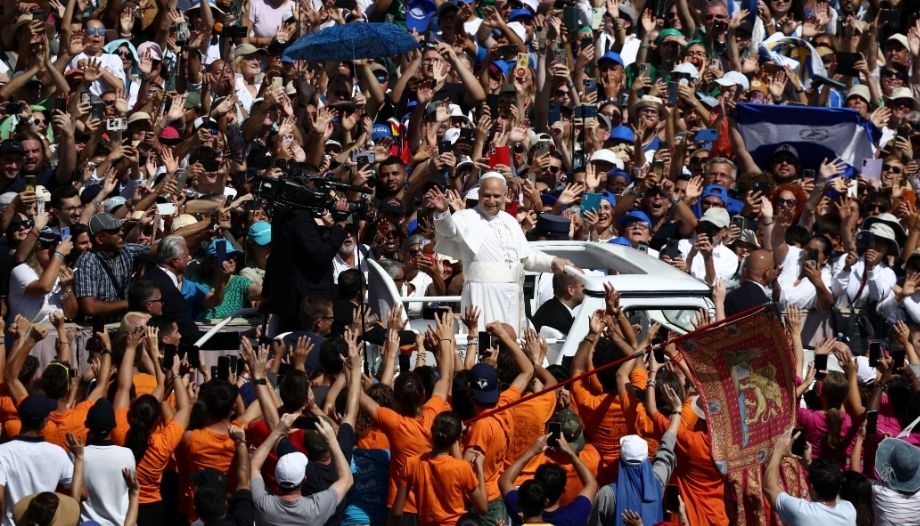
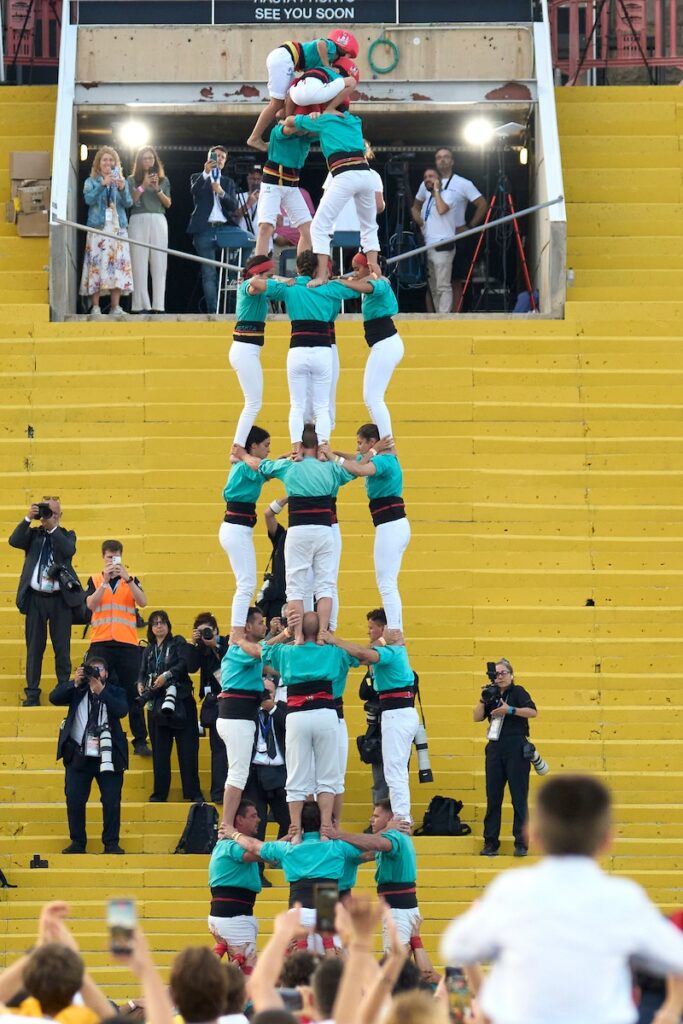
Once at the stadium, he made a lap of honor in the popemobile amidst the cheers of the young people and was welcomed with one of the traditional castellers -The Catalan human towers, “a beautiful manifestation of what we human beings are capable of doing when we work together with the same purpose,” as Cardinal Omella explained in his welcoming remarks. 

Image: Basilica of the Sagrada Familia/Pep Daude

The vigil was followed by a dialogue between the Pope and three young people who shared their stories in front of the stadium in silence.

Existential void

The first recounted how, growing up in a culture that values only production, success and image, he found an immense emptiness that led him to search for answers until he was baptized at the last Easter. He asked the Pope how to keep his eyes raised to what really matters.

Leo XIV responded that the spiritual restlessness felt by that young man is in reality a gift: «We are made to measure for the infinite and therefore, every finite horizon, every step, every conquest, while satisfying us at the same time impels us forward.» The Pope encouraged us to cultivate that restlessness by «descending inwardly,» setting aside moments of silence, reading the Gospel and walking together with others in community, because «it is in this world that we must cultivate restlessness, not in another.».

Depression

The second testimony was the most shocking: a young woman confessed that one Friday night she tried to take her own life and that she is alive because, she said, God gave her a second chance. She put on the table the «silent disease» that is depression.

The Pope addressed the subject with gravity and tenderness. He affirmed that mental health is «increasingly threatened in the context of societies that consider themselves advanced» and that this «is a sign that there is something profoundly wrong.» He denounced that certain cultural models «always want us to be winners and perfect», confining pain «to the deafening silence of loneliness or even shame». And he assured that God does not abandon us in those moments: «The cross of Jesus tells us that God does not abandon us, that He continues crucified with us in the moment of pain and extreme loneliness».

Leo XIV demanded that the Church not spiritualize suffering: «We must not superficially redirect it to the ‘will of God’ or to some mysterious plan of his, because this runs the risk of minimizing this suffering, of silencing it, of wounding people».

Violence in the family

The third testimony was given by a young woman whose father tried to kill her mother when she was a child -saved by a young man who lost his life-, who grew up under the care of social services, found faith in a juvenile center, but who admitted to having rebelled against God many times. Her question was direct and painful: how to forgive her father, how to reconcile with God?

The Pope did not shirk the crudeness of the story. He noted that family violence and femicide remain a scourge, and he was clear not to hold God responsible: «We cannot attribute to God what has been entrusted to our responsibility.» On forgiveness, Leo XIV described it as «powerful medicine against evil that heals our inner wounds,» but insisted that it is a process, not an immediate mandate: «Forgiveness above all we must invoke it from the Lord; continue to ask - perhaps throughout our lives - that the Lord enlarge in us the space of love precisely where we have been wounded.».

Basilica of the Sagrada Familia/Pep Daude

The Pope's speech

In his address to the stadium, Leo XIV took the Gospel figure of Nicodemus - the Pharisee who went to see Jesus by night - as a common thread to speak of personal, ecclesial and social «nights».

The Pope called not to judge one's own nights or those of others, neither those of the Church nor those of society. In the darkness, he said, we must set out on the road like Nicodemus, continue to question the Lord and open ourselves to the Spirit, in order to «welcome the night no longer as a sign of failure but as the beginning of a new life. He invited to ask oneself honestly what are the nights that each one is going through - in personal life, in the ecclesial journey, in the cities of Spain, in their old and new poverties - and what do these darknesses suggest.

Leo XIV concluded with a call not to cease in the search and in dialogue, «with God and with each other, also in the heart of the night.», He urged us to open ourselves to the gift of the Spirit «in the certainty that we will experience in ourselves a new life, a gratuitous love that will help us to pass from night to light. His last word was one of absolute hope: »God wants nothing to be lost and already now wishes to give us eternal life, to lead us to the happiness that has no end.«

Spain

Leo XIV insists on unity on his arrival in Barcelona: «renounce the superfluous to build on the essential».»

Pope Leo XIV presided over the Midday Mass in the Cathedral of the Holy Cross and Saint Eulalia, highlighting in his homily the Christian tradition of Barcelona and urging the community to build unity and fraternity.

Editorial Staff Omnes-June 9, 2026-Reading time: 3 minutes

Pope Leo XIV bid farewell to Madrid after three intense days, arriving in Barcelona to continue his visit to the city. visit to Spain. Upon his arrival at Barcelona-El Prat International Airport, the Pontiff was received by representatives of the Generalitat of Catalonia and, after a brief private meeting in the VIP lounge, he blessed the tabernacle of the airport chapel.

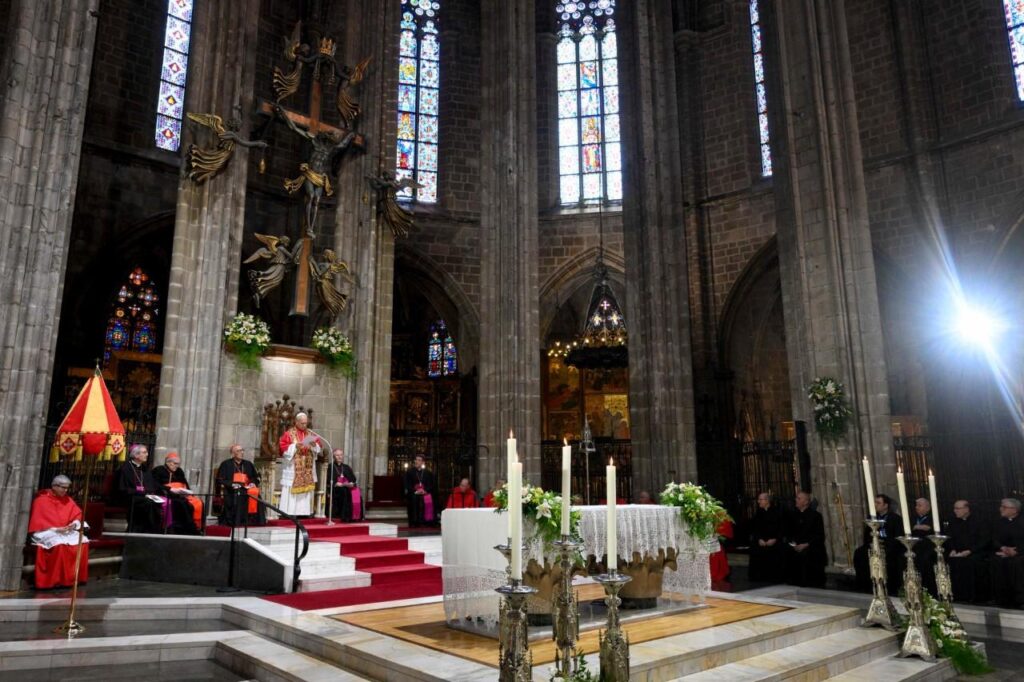
Afterwards, he went to the Cathedral of the Holy Cross and Saint Eulalia to preside the Midday Prayer together with the Cardinal Archbishop of Barcelona, Juan José Omella, the chapter, the diocesan curia, volunteers, seminarians and formators. Before the celebration, the Holy Father prayed before the Blessed Sacrament. He then listened to Cardinal Omella's words of welcome and presided over the Midday Prayer, during which he delivered a homily that, alternating between Spanish and Catalan, focused on ecclesial communion.

The Holy Father's first homily in Barcelona

Taking as a reference the images of the Church as “Bride” and as “Body of Christ,” Leo XIV encouraged the faithful to walk together, pastors and laity, aware that the Christian community is born of God's love and grows by letting itself be loved by Him: «He has chosen you to represent today the “community of saints” (cf. 1 Co 1,2) that is in Barcelona». He also recalled the words addressed to the Church of Barcelona by Pope Francis, among them: «Never cease to savor and remember this love of predilection that is poured and will be poured abundantly into your heart [...]. Never extinguish this fire that will make you fearless preachers of the Gospel» (Speech to the Barcelona Seminary community, 10 December 2022). 

The Pontiff also dedicated part of his speech to the Christian tradition of Catalonia and Barcelona. Quoting St. John Paul II, he highlighted the welcoming character of the city and praised those who work for harmony and communion “beyond all polarization”. He also stressed the importance of preserving unity in an increasingly individualistic and fragmented society: «If Christ is the Bridegroom who first loved us, He is also the Head to whom we are united as members of a single organism, one at the service of another, «men of every tribe, language, people and nation» (Ap 5,9), all animated by the action of the same Spirit, all called to the same holiness».

Leo XIV insisted again on unity, recalling that Barcelona, known as “Cap i Casal de Catalunya”, has a special vocation to become a reference of cohesion and encounter. “Barcelona is called ‘Cap i Casal de Catalunya’. This gives this community a special vocation and responsibility to become, with God's help, builders of unity,” he said.

The Pope also invited Christians to be “witnesses and prophets of unity, welcome, harmony and peace” in a world marked by wars and divisions. Drawing inspiration from the example of St. Eulalia, patroness of the city, he called to «die to ourselves, to lose ourselves in order to find ourselves again, to renounce what is superfluous in order to build on what is essential and lasts forever».

The homily concluded with an invocation to Our Lady of Mercy, patroness of Barcelona: “May Mary, Mother of the Church and Mother of unity, help us to be faithful to this commitment and this mission: «Santa Maria de la Mercè, pregueu per nosaltres”.

At the end of the prayer of the Sixth Hour, the Pontiff went to the Archbishop's House, where he has lunch and meets privately with the President of the Generalitat of Catalonia, Salvador Illa, and with members of the Augustinian Order.

Spain

Three messages from Leo XIV to volunteers

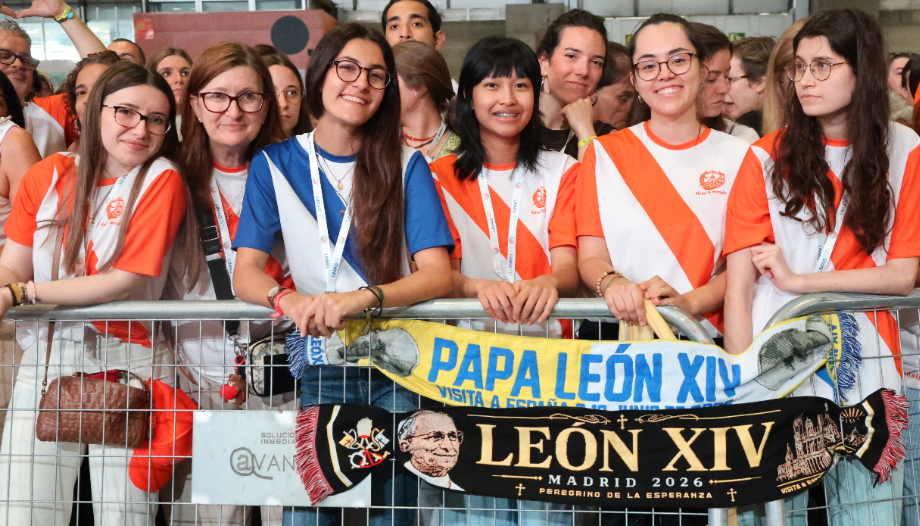
The Pope met at Ifema with the 12,000 volunteers who have supported him during the first three days of his trip.

Javier García Herrería-June 9, 2026-Reading time: 2 minutes

A few minutes after 10 a.m., Pope Leo XIV made his appearance at the Ifema pavilion where the 12,000 volunteers who had accompanied him during the previous three days of events in Madrid were gathered.

After the shouts of emotion and the popemobile ride through the grounds while the hymn of the visit, «Alzo la mirada», resounded, the Pope listened to the testimony of two volunteers and was dismissed with a few words of thanks from Cardinal Cobo.

Image: Gabriel Gonzalez-Andrío

The Pope's words of thanks to the volunteers underscored three ideas:

1. The Pope's gratitude

Leo XIV opened his speech by distinguishing the volunteers with a singular thanks, because their service was not a professional task but an act of faith: «You volunteers deserve a very special ‘thank you’, because you have offered your presence and your service, and you have done it out of love for the Lord, the Church and the Pope. Thank you with all my heart!».

2. The yeast of gratuitousness

Faced with the culture of profit and growth measured only in economic terms, the Pope proposed the Gospel logic of integral human growth, quoting Luke: «Christians are called to bring to the world the leaven of gratuitousness (...) It is the logic of the Gospel, which says: ‘If you do good only to those who do good to you, what credit is that to you? Even sinners do the same. And if you lend to those from whom you expect to receive, what merit do you have?’».

With an evocation of the Acts of the Apostles, the Pope revealed the ultimate root of gratuitous service: «This is the secret: the love of God, which moves the sun and the stars, and moves the hearts of those who have encountered the Lord Jesus, who said: ‘There is more joy in giving than in receiving’».

3. The Gospel as a way of life

Leo XIV stressed that the Christian mission is transmitted more by the way of living than by doctrinal preaching. Volunteering is that visible incarnation of the Kingdom: «Jesus Christ came to bring into the world the leaven of the Kingdom of Heaven... through a way of life, a way of thinking and behaving that is that of the Gospel».

At the end of the ceremony, the Pope blessed the first stones of eighteen parishes to be built in the three dioceses of Madrid and, finally, presented the Archdiocese of Madrid with a chalice as a souvenir of his visit.

Spain

Pope calls for “tearing down walls” to build a new society

Leo XIV distinguished the patron saint of Madrid with the Golden Rose in an emotional ceremony in the Almudena Cathedral, accompanied by Queen Sofia and representatives of the Church of Madrid.

Jose Maria Navalpotro-June 9, 2026-Reading time: 2 minutes

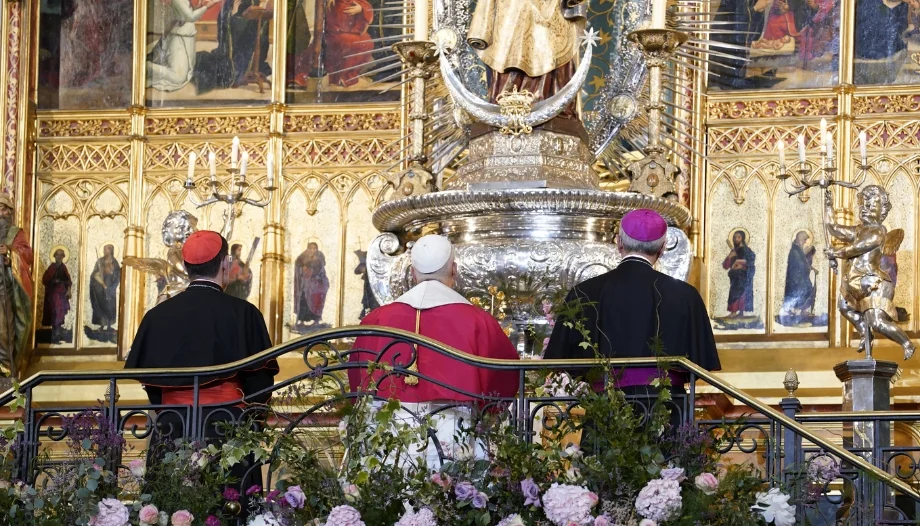
In a moving act, Pope Leo XIV presented the Golden Rose to Our Lady of Almudena on the afternoon of June 8, in a ceremony in the cathedral where the Pontiff was accompanied by Queen Sofia. The Holy Father called for the tearing down of walls to build a new society.

The ceremony consisted of a prayer and homage to the Virgin of the Almudena, patroness of the capital. In the temple were three hundred nuns, representing all the communities of nuns that exist in Madrid; as well as the seminarians of the diocese, with their families. Also, the bishops of the dioceses of Madrid, Alcalá de Henares and Getafe. Among the civil authorities, Queen Sofia accompanied the Holy Father. Also present were the Minister Spokeswoman of the Government, Elma Sáiz, the President of the Community Isabel Díaz Ayuso and the Mayor of the capital.

The Almudena Cathedral was consecrated in 1992 by St. John Paul II, as the Archbishop, Cardinal José Cobo, recalled. Leo XIV brought the patroness of Madrid a very special gift: the Golden Rose, a distinction given by the Popes to certain images of the Virgin Mary, as “a symbol of the filial love of the Pope for the Virgin Mary».

According to the website of the Archbishopric of Madrid, the image wore the crown of the coronation, a set made in 1948 for the canonical coronation of the Virgin by Pope Pius XII and that the image wears exclusively inside the cathedral. It was made with contributions from the people of Madrid. Wedding rings, rings, earrings, diamonds... from people of all ages and conditions.

Pope's message of unity

After some words of Cardinal Cobo praising the union of the Patroness with the people of Madrid since she was found at the time of the Reconquest, the Holy Father gave a brief speech also mentioning the origin of the carving. He recalled - as in other interventions during his visit to Spain - that this Marian devotion “is a sign of the Christian roots that characterize you”.

Referring to the fact that “it was thanks to a demolished wall that the reunion of the Mother with her people took place,” he explained that “in our societies today there are still many walls that do not protect, but divide, alienate and isolate.” “Sometimes,” he continued, "thinking that tearing them down means having to face what we do not like, we prefer the comfort of just propping them up and, more often, of ignoring them.  

However, “Our Lady of Almudena tells us something else: to build something new, beautiful and lasting, we must be willing to destroy the walls, because to resume the route we need spaces that allow us to glimpse the horizon”.  

After the presentation of the Golden Rose in the shrine of Our Lady and a few moments of prayer, the Pope took his leave. Those present were warned that no shouts or cheers should be heard. But a somewhat timid “Long live the Pope!” was answered by the hundreds in attendance. As the shout had been weak, it was followed by another stentorian “Viva!” that made the audience in the cathedral explode in cheers and applause.

The Vatican

The most uncomfortable and most Christian gesture by a Pope: entering prison

Far from being a simple protocol gesture, the Pope's presence among the inmates expresses one of the central convictions of Christianity: no one is defined forever by his or her mistakes.

Teresa Aguado Peña-June 9, 2026-Reading time: 4 minutes

Among the most striking images of Pope Leo XIV's upcoming trip to Spain will not only be the Basilica of the Sagrada Familia or the Monastery of Montserrat. There will be another scene, much quieter and probably much more eloquent: the Pontiff's visit to the prison of Brians 1, in San Esteban Sasroviras, where he will meet with eighty prisoners.

At first glance, it may seem a minor gesture in an agenda loaded with institutional symbolism. Barely twenty minutes. No big speeches planned. No solemn ceremony. And yet, it is one of the most Christian gestures a Pope can make.

What does this gesture show?

At a time when much of the public debate is oscillating between exemplary punishment and the moral cancellation Christianity insists on something uncomfortable: no person is forever reduced to his or her worst act. The Christian tradition does not deny crime, harm or guilt. But neither does it accept that the human being is definitively identified with them.

That is why prisons occupy such a special place in the Gospel. Jesus Christ did not approach only the righteous, the pure or the respectable. Much of his preaching was directed precisely to those whom society considered lost: public sinners, outcasts, excluded or despised. “I was in jail and you came to see me”The Gospel of Matthew says in describing the final judgment. This is not a secondary metaphor. It is one of the central images of Christianity.

When a Pope enters prison, the Church visualizes exactly that idea: that even there, there is still human dignity, the possibility of redemption and hope.

It is not a matter of romanticizing crime or ignoring the suffering of victims, but of affirming that justice without mercy ends up becoming pure exclusion. And that a truly humane society must leave room for repentance, change and forgiveness.

Pope Leo XIV is not the first

In this sense, Leo XIV does not inaugurate a new tradition, but is part of one of the most constant and moving traditions of the contemporary papacy.

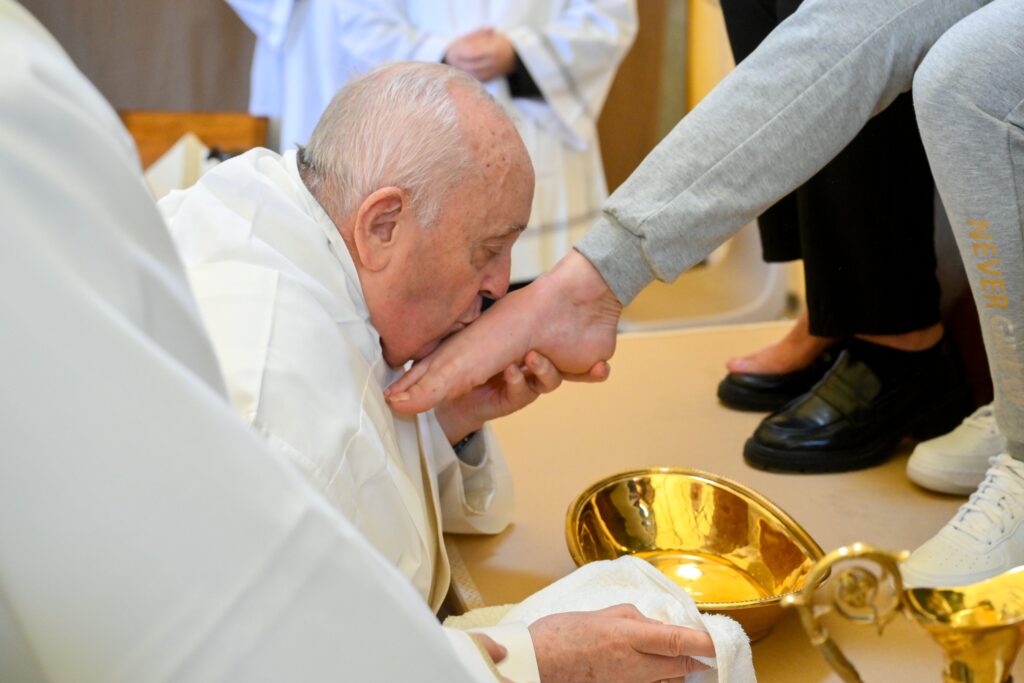
Pope Francis made prison visits one of the most characteristic signs of his pontificate. He did so since the first Holy Thursday of 2013, when he went to a juvenile prison in Rome to wash the feet of prisoners, including women and Muslims, breaking schemes even within the Church itself. Over the years he repeated that gesture in numerous prisons in Italy and abroad, always insisting on one idea: no one can be deprived of hope.

Pope Francis kisses the foot of a female inmate after washing it during the Mass of the Lord's Supper on Holy Thursday at the Rebibbia women's prison outside Rome, March 28, 2024. The pontiff washed the feet of 12 female inmates (Photo CNS/Vatican Media).

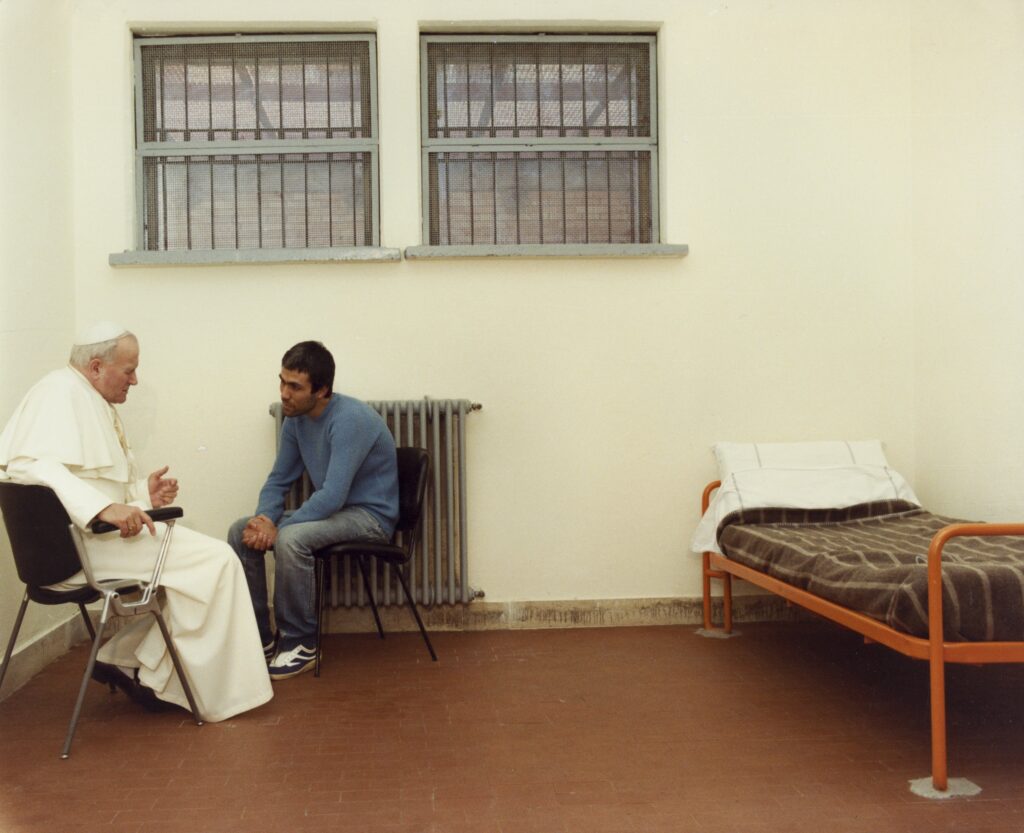
But before Francis, other pontiffs had already done so. St. John Paul II starred in one of the most shocking moments in the recent history of the Church when he visited Mehmet Ali Ağca, the man who had tried to assassinate him in 1981, in prison. That private conversation in Rebibbia prison became a universal image of Christian forgiveness. The Pope did not remove the gravity of the attack; he did something more difficult: he denied that hatred had the last word. Thus, he publicly forgave Agca and later declared that he did so «because that is what Jesus teaches. Jesus teaches us to forgive.

St. John Paul II is shown sitting next to his alleged assassin, Mehmet Ali Agca, in the Rebibbia prison in Rome in 1983. The Pope suffered serious injuries after the gunman shot him in St. Peter's Square on May 13, 1981.

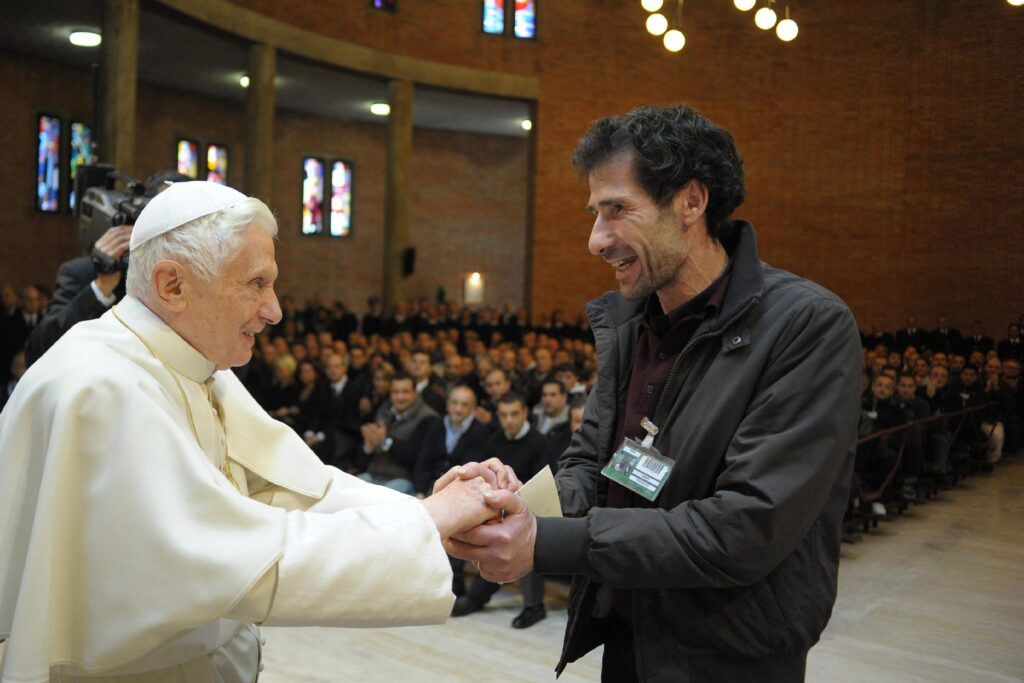
Benedict XVI also visited prisons during his pontificate, stressing that prison overcrowding is like serving a «double sentence» and that detainees must be treated with respect and dignity. Long before that, John XXIII and Paul VI had already shown a special sensitivity towards prisoners and the outcasts of society.

An inmate greets Pope Benedict XVI during his pastoral visit to Rebibbia prison in Rome December 18, 2011(CNS/L'Osservatore Romano photo via Reuters).

In reality, this tradition has its roots much further back. For centuries, prison ministry has been one of the most concrete expressions of Christian mercy: chaplains, religious and volunteers accompanying those whom the rest of society preferred not to look at.

A different logic

That is why the future visit of Leo XIV to Brians 1 has so much symbolic force, and perhaps that is one of the most necessary contributions today. In a culture increasingly inclined to label people definitively, the visit of a Pope to a prison introduces a different logic: that of mercy. A mercy that does not eliminate justice, but refuses to believe that anyone is condemned forever to be only his or her sin.

The fact that Leo XIV wanted to include “in extremis” a stop at Brians 1 is not, therefore, a minor agenda detail. It is a silent declaration of priorities. Before power, prestige or solemnity, the Pope wants to stop for a few minutes with those who live behind walls and bars.

And this, in the end, connects with a Christian intuition: that it is precisely there, where many stop looking, that the Church believes that hope can still appear.

Guest writersDavid Torrijos-Castrillejo

Pope reminds Spain that it invented modernity

The Pope's speech at the Congress of Deputies enunciates the kind of institutional mentality that has always guided the Church: “Politics, too, needs to recognize a measure that precedes and surpasses it”.

June 9, 2026-Reading time: 2 minutes

On Monday morning, Monday 8, we had the opportunity to listen to the speech of Leo XIV in the Congress of Deputies, one of those that has generated more expectation in this visit to our country.

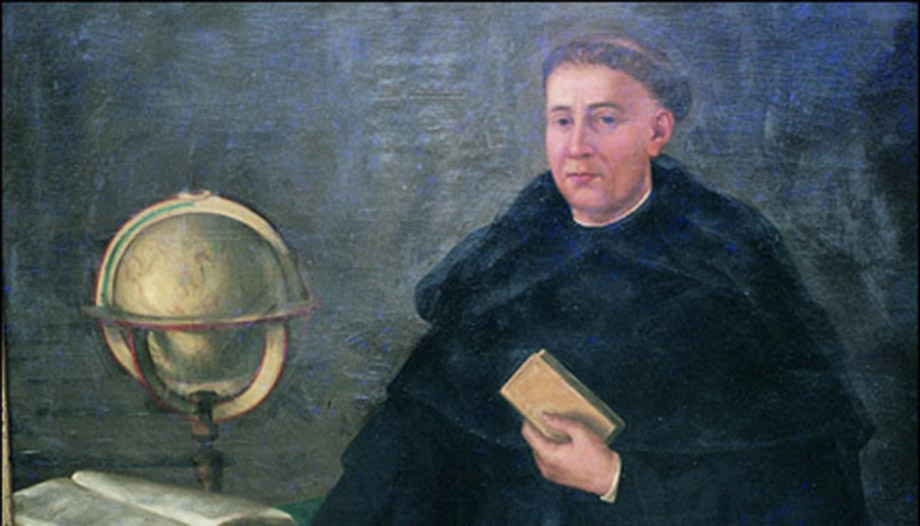
In it he referred, as could not be otherwise, to the immortal Francisco de Vitoria and the School of Salamanca: “In that university seat, five hundred years ago, when new worlds and immense possibilities were opening up in relations between peoples, some teachers understood that reason could not be invoked to clothe the legitimacy of what force or interest presented as convenient”. Precisely on the eve of the Pope's arrival, the university, honored with the privilege of the magisterium of this Dominican scholar, awarded him a doctorate “honoris causa”.

In fact, throughout this year 2026 the anniversary of the beginning of his teaching in the classrooms of the City of Tormes is being celebrated as the fifth centenary of the School of Salamanca, of which he is widely considered the founder. But all this is going unnoticed by the general public. Not even in the ecclesiastical sphere is this eminent figure of our intellectual past remembered too much. Just as the centenary of the canonization of St. John of the Cross, another glorious mind of the greatest century of Spanish history, is not being talked about as much as it should be, although he is still mentioned in the Pope's speeches.

God's law and human law

This neglect of our intellectual past contrasts with the Pope's wise desire to remind Spaniards where we can find the answers to many of our questions. To us, who so often look with self-consciousness to all sorts of novelties in an attempt to “bring ourselves up to date”, the Pope reminds us that Spain was the inventor of modernity. It was in our country where an unprecedented way of thinking emerged, capable of guiding people through previously unknown crossroads.

The solution of Vitoria and his school is at the antipodes of the type of thinking that governs our institutions. While nowadays legal positivism is at large, the School of Salamanca offers us another way of understanding coexistence. This positivism believes that justice is born of the law and the dispositions of the rulers. The Pope's speech, on the other hand, enunciates the type of institutional mentality that has always guided the Church and which the authors of Salamanca knew how to expose in a contemporary way: “Politics also needs to recognize a measure that precedes and surpasses it”. The law does not establish the good, but it is a way of recognizing it, welcoming it, protecting it and promoting it. The law is not primarily aimed at creating reality, but at actively accepting reality.

A good philosophy and the Christian faith recognize that all that reality, good, luminous, fruitful, at whose service the law is, comes from God. Therefore, Vitoria taught the world that the law of God is above the laws of men, and international law, like all law, is not at the discretion of the most powerful, but of a justice to which every human being and every people must abide.

The authorDavid Torrijos-Castrillejo

Assistant Professor, Faculty of Philosophy, San Daámaso Ecclesiastical University

Gospel

We will draw love from the fountain. Solemnity of the Sacred Heart of Jesus (A)

Vitus Ntube comments on the readings for the Solemnity of the Sacred Heart of Jesus (A) corresponding to June 12, 2026.

Vitus Ntube-June 9, 2026-Reading time: 2 minutes

Today we celebrate the last of the great feasts that the liturgy offers us after the Easter Season: the Solemnity of the Sacred Heart of Jesus. Tomorrow we will celebrate the Immaculate Heart of Mary. Together with the feasts of the Most Holy Trinity and Corpus Christi, today's solemnity brings together all that we have experienced during the forty days of Lent and the fifty days of Easter into a coherent whole. And that whole is this: God's love for us. In celebrating the Sacred Heart of Jesus, we come to the very center of this mystery: to the heart of divine love.

The Church does not invite us today to venerate a physical organ separate from Christ, as if we were looking at a part of his body in isolation. Rather, the Heart of Jesus is the living symbol and total expression of his love for humanity. One might ask: why not celebrate the sacred head crowned with thorns, or the hands pierced for our salvation? The answer is that, in the heart, more than anywhere else, we recognize a “heart of Jesus" as a symbol of his love for humanity.“natural sign or symbol of his immense charity”. The Sacred Heart, therefore, is not simply an image, but the reality of Christ's love poured out for us.

In the collect prayer of the Mass, we recognize that God the Father has granted us “....“infinite treasures of love”in the Heart of her Son. In the face of such a gift, the words of the prophet Isaiah come to life: “you will draw water with joy from the fountains of salvation" (Encyclical Haurietis aquas).

The Gospel deepens this invitation. Jesus says: “learn from me, for I am meek and humble of heart”. There are many things we can learn from Christ, but at the center of them all is love: a meek, humble and self-giving love. From the pierced Heart of Christ on the cross flows life for the world. What was pierced becomes a source.

For many in our world, especially in places where water has to be drawn every day, the image of a fountain is very real. When the water level is low, the effort becomes exhausting. One can resort to a pulley or even a pump, but no human effort can produce water if the fountain is dry. The real joy is not in the mechanism, but in the abundance of the fountain.

So it is with the love of Christ. Techniques, efforts and structures in our life are not enough if the source is missing. But the Heart of Jesus is never exhausted. It is inexhaustible. It is always full and overflowing.

The first reading reminds us that this love is a gift. Israel was chosen not because of its strength or greatness, but simply because God loved it. As Scripture says: “If the Lord fell in love with you and chose you, it was not because you were more numerous than the others, for you are the smallest people, but out of pure love for you and to keep the oath that he had sworn to your fathers.".

The liturgy invites us to approach this pierced Heart with trust. To drink from it. To remain close to it. And, having received so much, to become ourselves sources of love for others. As we heard in the second reading, we are called to love one another. Whoever drinks from the Heart of Christ is called to be an oasis of love in the family and in society.

Spain

The Bernabéu once again experienced an apotheosic night: Leo XIV «Today the Church of Madrid has scored a goal for all time».»

European nights at the Bernabéu are not simply soccer matches; they are rituals of faith, mysticism and collective epic. When the Champions League arrives at Chamartín and the score is against, soccer ceases to be a tactical sport and becomes a liturgy of survival.

Javier García Herrería-June 8, 2026-Reading time: 4 minutes

The city of Madrid lived this Monday an unrepeatable day. After a speech in parliament that will go down in history, the day ended with a diocesan meeting at the Santiago Bernabeu stadium, which this afternoon became the spiritual heart of Europe.

European nights at the Bernabéu are not simply soccer matches; they are rituals of faith, mysticism and collective epic. When the Champions League comes to Chamartin and the score is against, soccer ceases to be a tactical sport and becomes a liturgy of survival. An identical clamor resounded loudly with the presence of Leo XIV in the stadium, who called for an offensive of faith ready to overcome the scoreboard, just when many thought Christianity was dead in old Europe.

A Champions League preview

The stadium doors opened at 3:00 p.m., and at 4:30 p.m. a pre-show of an artistic quality that is hard to beat began. Hosted with ease and warmth by the married couple of journalists and presenters Christian Gálvez and Patricia Pardo, the pre-show was an authentic celebration with a marked spirit of faith.

Early arrivals to the stadium were treated to a first-class line-up that combined music, humor, magic and entertainment. Among the artists who performed at the Bernabéu were the singers and musicians Valiván, Íñigo Quintero, La voz del desierto, Laraland, and El Pulpo, who kept the rhythm and musical animation throughout the afternoon.

The humor was provided by Santi Rodríguez and the magic of Jorge Blass, who left the audience speechless with their performances. The show gained in dimension with the presence of the Family Choir Church of Madrid, a formation of more than 1,000 voices -300 of them children- under the direction of the priest and artist Toño Casado; the Cruz Diez Symphony Orchestra, with 70 musicians conducted by Manuel Jurado; the Salesianos Madrid Pop Band; and a dance troupe of 100 dancers with choreographies designed by Ismael Olivas.

The longest route of the popemobile in Madrid

At 7:30 p.m. the Pope made his entrance to the stadium aboard a golf cart. The crowd erupted in a standing ovation that inevitably recalled the entrance of John Paul II on that same stage in 1982. The image was thrilling: 70,000 people standing, applauding, cheering and singing in unison, accompanying the choral interpretation of the official hymn of the visit, «Alza la mirada», performed by David Bustamante, Daniel Diges and Diana Navarro, which culminated in a standing ovation from the entire stadium.

The Bernabeu stands with the entrance of the Pope. Image: Gabriel Gonzalez-Andrío

Testimonials

The Cardinal of Madrid, José Cobo, received the Holy Father with a speech in which he called on the diocesan community of Madrid, Alcalá de Henares and Getafe to walk in communion under the style of synodality. Drawing inspiration from a metaphor of St. Augustine, Bishop Cobo urged the Church in Madrid to act as a harmonious choir that evangelizes through love and mutual listening, avoiding individualities in order to build a «Church that goes out» capable of humbly integrating all social realities, from families to the most fragile and distant voices.

The Pope's intervention was preceded by several testimonies. The first to speak was Susana Arregui, from the Diocesan Council of the Laity, who vindicated the Pastoral and Economic Councils as a real channel of communion between movements and parishes. 

Jesús Moure, a father of two children with disabilities, told how joining the Pastoral Council brought him the joy of sharing his gifts with the community. 

Jorge Barco and Liliana Torres, a Peruvian couple who arrived in Spain four years ago fearing rejection, recounted how the Missionaries of the Precious Blood parish and Caritas welcomed them as part of the family from day one. 

And Alvaro, 33, closed the testimonies with the story of his conversion: an avowed atheist all his life, it was an old Bible from his school religion class that ignited a search that last year culminated in his baptism, confirmation and first communion; «this has been the greatest gift and blessing I have ever had in my life,» he told the Holy Father.

The Pope's words

The Pope gave a speech in which the biblical figure of Nehemiah - who summoned all the people to rebuild the walls of Jerusalem - served as the guiding thread of a message oriented towards unity and mission.

Relying on his encyclical Magnifica humanitas, the Pope recalled that the diversity of voices does not have to lead to dispersion. In his own words, there is «a luminous possibility: that of building together, transforming diversity into a resource and making listening and dialogue the common ground on which justice and fraternity can grow».

Leo XIV warned against the temptation to withdraw from the community-«not to disperse or close ourselves in the group or in the environment in which we already feel secure, among people who always sing the same melody»-and vindicated cordiality as an indispensable spiritual art: without it, he said, «even the proclamation of the Gospel runs the risk of becoming an impersonal repetition».

Diocesan community

The Pontiff also focused a significant part of his address on parish and diocesan councils, rejecting their reduction to «mere bureaucratic formalities» and presenting them as «spaces of mutual listening for the exercise of discernment». When these spaces are cared for, he affirmed, «worship becomes life and bonds of fraternity and projects of solidarity emerge among people».

With words of encouragement addressed specifically to the clergy, he invited priests to embrace community discernment as «one of the greatest opportunities that synodality offers to their ministry,» and encouraged them not to fear the turmoil that the Spirit can stir up: «Do not be afraid of all this, enjoy it.».

The speech concluded with a call to trust and openness: «Be ready to welcome new beginnings not as an exception, but as the rule of the mission,» the Pope exhorted, before invoking upon the assembly the words of St. Teresa: Let nothing disturb you, let nothing frighten you.

A final sentence

The ceremony concluded with a joint recitation of the Lord's Prayer, followed by the presentation of the first stones, the papal blessing and a final song that closed an evening destined to live on in the memory of all those present.

St. Augustine among us

"Certainly, one can be modern and live the Gospel, it is enough to live the Christian humanism that Pope Leo XIV recommended to us.".

June 8, 2026-Reading time: 4 minutes

Pope Leo XIV began his first trip He not only prepared himself spiritually and did all the necessary documentation, but he also talked to the journalists on the plane and went row by row to meet each one of them.

This has been the keynote of this long and intense journey: looking for people, getting close to people, to each person; authorities, members of the escort, the public in the street, politicians or people of culture.

Undoubtedly, the program of official events was very full, and above all very well thought out, but it must also be recognized that the private agenda was also very full of visits and attention to special cases, people in need and delicate problems.

The greetings and handshakes of the Holy Father were never formal; his conversations with the school children who received him at the airport or with Queen Leticia, were affable conversations, smiling hugs, open and endearing.

The Holy Father is very human and very divine, and he preached by example what was to come out in all his interventions: fraternal dialogue, learning from the other, being attentive to others. Certainly he has clearly reflected the heart of an Augustinian missionary who was always with the people and who lived with the indigenous people and that now continues to beat in a universal heart.

The Holy Father has come to Spain to meet each one of us and to give us his affection, his cordiality and his overwhelming sympathy. Leo XIV is the living figure of St. Augustine: a man touched by the love of God whose mission was simply to love every person he met and to teach love through his preaching, his life and his writings.

The most repeated phrase during these days was the framework-announcement of the visit: “raise your eyes”. This, certainly, could be done in many ways: as St. John Paul II, Benedict XVI, Francis, or as Leo XIV did: being Christ who passes through our land, who attracts with his gaze, with his smile, with his Augustinian and American naturalness.

After reading the book of the “Conversions“ of St. Augustine, his “De civitate Dei”, “de unico baptismo” or that of “bono matrimonii”, one certainly concludes that we are not in the oriental discourse of the Polish pontiff nor in the warm rationality of Ratzinger, nor in the thrust of Francis, but in the ardent heart of St. Augustine as reflected in the pontifical coat of arms of Leo XIV.

The ideas he was going to convey had already been announced in his Encyclical “Magnifica humanitas” (May 25, 2026), which certainly upset all those who had written their speeches in May to have everything prepared and controlled: speeches, newspaper articles or newspaper columns and jokes of the talk show hosts.

But it is one thing to see the speeches written, to hear them, to listen to them carefully with pen and paper, and quite another to realize that the Holy Spirit had decided on a change of gears of greater depth than we had imagined. We have returned to Plato, to the world of ideas, to the passionate heart. To the short sentences or to the beautiful speeches of the classical literature of the golden century of Castilian letters. We needed someone to give us a cultural shake-up and remind us of Spain's Christian roots.

Just as German Romanticism arose after Kant and Descartes, it was necessary for the heart of Augustine to emerge after the Thomism renewed by the School of Salamanca, which had already been the nerve of the Holy Father's discourse from the day he arrived.

Certainly, in the speech at the Palace of Oriente, the Holy Father began by thanking Spain for its contribution to international law and that upset some who did not see Vitoria and its law of nations, but thought of the Pontiff's diatribes with Trump and Sanchez.

We are celebrating the V Centenary of the beginning of the School of Salamanca and with them the beginning of teaching as Professor of Prima of the Faculty of Theology of the University of Salamanca.

The School of Salamanca, started by Francisco de Vitoria, brought together all the great thinkers of his time, Jesuits, Dominicans, Franciscans, Augustinians of his time, to invent Christian humanism, which was the transition from the pagan humanism of the Renaissance to an international humanism thanks to natural law, love of freedom and the defense of the dignity of the human person.

Certainly in Grotius and in the universal declaration of human rights of 1948 the principles of the Relections of Francisco de Vitoria were transcribed, but they were founded: those rights consistent with the dignity of the person were based on the fact that man is and will always be the image and likeness of God.

This morning the Holy Father presented to the politicians of this country a program identical to the one he later reminded the bishops gathered in the Spanish Episcopal Conference celebrating the sixtieth anniversary of its constitution.

Certainly, it is possible to be modern and live the Gospel, as he said John Paul II In Columbus, it is enough to live the Christian humanism recommended to us by Pope Leo XIV as he learned from the School of Salamanca and the virtue of charity as Pope Francis and St. Augustine taught us.

The authorJosé Carlos Martín de la Hoz

Member of the Academy of Ecclesiastical History. Professor of the master's degree in the Causes of Saints of the Dicastery, advisor to the Spanish Episcopal Conference and director of the office of the Causes of Saints of Opus Dei in Spain.

The longest applause of democracy

The Pope has clearly outlined the main lines of the Church's dialogue with the political powers today.

June 8, 2026-Reading time: 2 minutes

7 minutes and 5 seconds.

This is how long the applause of thanks to Papa lasted from the attendees of the historic Speech of Leo XIV in the Spanish Cortes.

7 minutes and 5 seconds.

Not even the proclamation of Princess Leonor as heir to the Spanish throne, or the signing of the Constitution that today governs the Spanish nation, had garnered more than four and a half minutes of applause. 

Leo had not entered the Spanish Congress as a political leader but “as Bishop of Rome and Pastor of the Catholic Church”.

The Pope has delivered, before the so-called ruling class, one of the clearest and most committed speeches of his pontificate (so far, evidently), and which has become, like those remembered speeches of John Paul II The report, which was presented at the United Nations, is part of the reference framework of the role of the Church in society, the defense of human dignity and the call to political responsibility. 

The Pope's words left nothing behind: the role of the Church as a voice of dignity respecting the powers and public exercises, the defense of life from conception to natural death, the need for freedom of choice of parents in the education of their children and the freedom of conscience, respect for the sacramental secrecy from the State.

He also addressed the problem of interference between the Church and politics; the dignity of those who seek a new life elsewhere; and peace. Peace is not the “absence of war,” but peace born of conscience. 

The Pope has clearly outlined the main lines of the Church's dialogue with the political powers today. But he has also left us, who serve society from other points: the clothing store, the bar, the chair or the media, the open question of our real commitment to the dignity of each person, to “social” peace, to the construction, no longer of a future, but of a present.

Perhaps that is why, even if we think that we “speak for the other”, we may think that we will always be the “other” of our neighbor.

And perhaps because of that, or in spite of that, we also join in those 7 minutes of applause that, when they end, will give way to the minutes, 7, or seventy times seven, that we have to start making these wishes come true.

The authorMaria José Atienza

Director of Omnes. Degree in Communication, with more than 15 years of experience in Church communication. She has collaborated in media such as COPE or RNE.

Spain

The Pope in the Spanish Cortes: “Can a community be called fully just that leaves in the shadows the unborn child, the elderly?”

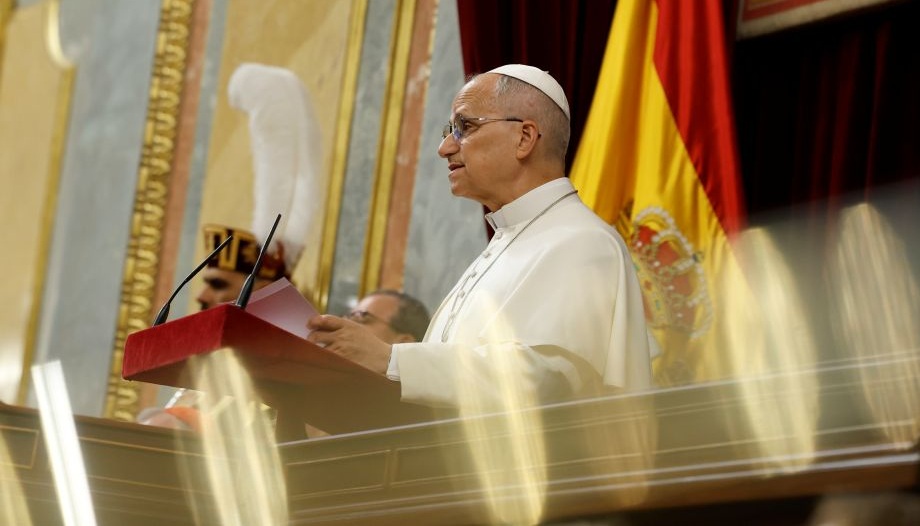
Pope Leo XIV made history today by being the first Pontiff to speak in the Congress of Deputies, where he delivered his longest speech since his arrival in Spain.

Maria José Atienza-June 8, 2026-Reading time: 6 minutes

Pope Leo XIV made history today by being the first Pontiff to speak at the seat of the Spanish Cortes. 

The Pontiff was received at the main entrance of the Palacio de las Cortes by the President of the Congress of Deputies, Francina Armengol, the President of the Senate, Pedro Rollán Ojeda, and six other members of the Cortes. 

Before entering the Congress, the national anthems of Spain and the Vatican were played and then the Holy Father entered the Hall of the Lost Steps where he signed the Book of Honor. 

At the time of the gift exchange, the Papa presented silver medals of the Apostolic Journey to the President of the Senate and the President of the Congress. 

A Pope at the heart of Spanish politics 

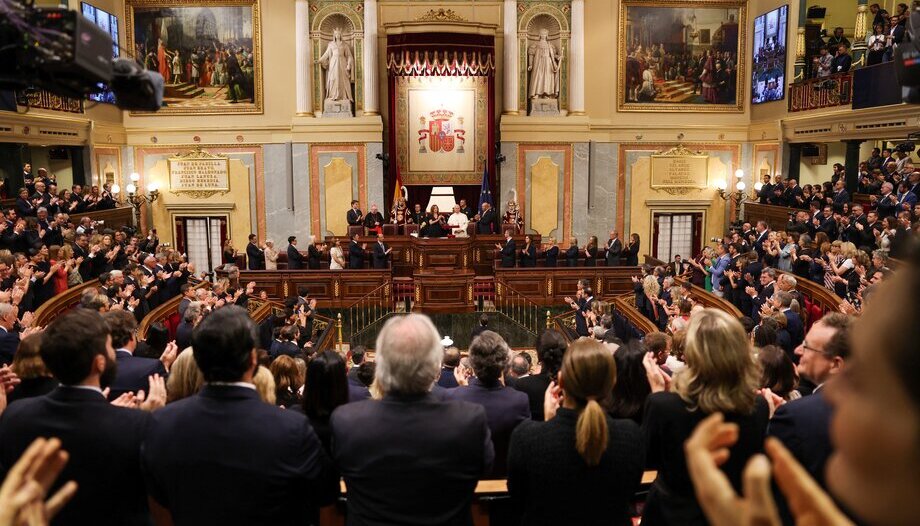
A resounding applause accompanied the entrance of Pope Leo XIV to the Plenary Hall of the Spanish Congress of Deputies. 

The president of the Chamber, Francina Armengol welcomed the Pope with a speech in which she stressed the willingness of the House to “listen with the conviction that understanding is irreplaceable” and defending the “multilateralism as a condition for international peace”. Armengol described the political activity as the “fight against poverty, precariousness and violence” and expressed her wish that political activity be “the search for the dignity of people and the good of the people, not the power struggles that we are now witnessing”. 

The Pope addressed a plenary session in which, in addition to the current political representatives of the Spanish people, there were politicians of different political persuasions, the former presidents of the Government, except José Luis Rodríguez Zapatero, the Ombudsman, and various representatives of Spanish civil society. 

A long and comprehensive speech

In a long speech, the longest of those delivered by Leo XIV to date in Spain, The Pope introduced himself, “before all of you as Bishop of Rome and Pastor of the Catholic Church,” showing that, as he responded to Trump a few weeks ago, he is not a politician, but speaks from faith. 

The Church, the Pope recalled, “when she addresses herself to public life, she does so with respect for the proper mission of institutions and the legitimate responsibility of those who have received the mandate to legislate. She recognizes «the autonomy of earthly realities» and «the distinction between ecclesial community and political community»; and, precisely from this awareness, she offers a reflection”. 

What conception of man does the law translate?

“My presence among you wants to be a gesture of closeness to Spain, within the framework of mutual cooperation, and a word offered from the service to the human person,” continued the Pope, who praised the history of Spain and the humanist thought of which it has been the cradle, with examples such as the school of Salamanca, one of the Pontiff's favorite quotes.

In this line, Leo XIV defended that “every legislative task ends up facing a decisive question: what conception of the human person inspires the laws and what type of society builds those laws” and wanted to collect some of the answers that, historically, the Spanish nation has given to this question, emphasizing the defense of freedom and the recognition ”of the human being as something more than a piece of the social, economic or political order: it has recognized him as a creature open to the truth”. 

The humanist revolution of the School of Salamanca

One of the central themes of the papal speech in the Spanish Cortes was the profound and reflective memory of the Pontiff to the importance of the school of Salamanca in the development of the legislative and social order at the time when the world became bigger, when, with the arrival in America “Spain was placed before historical responsibilities of universal scope”. 

At that time, the Pope stressed, “some masters understood that reason could not be invoked to clothe with legitimacy whatever force or interest presented as convenient. They thus introduced into historical discernment the question of the irreducible value of every human being and the moral limits of power”. 

The Pontiff did not overlook the fact that “society and the Church itself were not always up to the task”, Leo XIV emphasized that “the reflection of the School of Salamanca - and in a particular way Fray Francisco de Vitoria, together with other Dominicans and Jesuits - contributed to the formation of a juridical and moral conscience capable of remembering that authority always carries with it a responsibility and that every human being must be recognized as a subject of rights and duties”. 

Updating this question, the Pope underlined how today, with technological advances and, in particular, Artificial Intelligence, the limits can also become blurred. He also recalled Benedict XVI's address to the German parliament to assess that human dignity “precedes every concession of the State and cannot be subordinated to social consensus”.

Can a nation be called just? Respect for life, family and freedom of education.

“It falls to me today to speak a serene and firm word to those who have the grave responsibility of juridically ordering social coexistence,” continued the Pope, who did not avoid mentioning some of the most serious issues that plague today's juridical and social systems. Can a community be called fully just if it leaves in the shadows the unborn child, the elderly, the sick, those who suffer in silence or those who depend entirely on the care of others? The defense of human life is not a partial question or a denominational interest: it is a goal of civilization: every human life must be recognized and safeguarded from conception to its natural end. 

The Pope referred to the family as “the first human reality and the natural foundation of the community”, and to educational institutions in which “many parents, desirous that their children learn to relate to one another, to think critically and to acquire solid values, place great hopes in them as valuable allies in their education”.

A particularly interesting point in the Spanish Parliament before which the Pope has defended “the ‘primary and inalienable right’ of parents to ‘choose the type of education and formation their children receive, in coherence with their own moral, cultural and religious convictions’.”.

The migration issue 

The migration issue, one of the fundamental lines of this trip, has entered fully into this speech in which Leo XIV has affirmed that “wherever a person is discriminated against because of his national, ethnic, religious or linguistic origin, or because of his economic or social condition, the universal principle of the equal dignity of all human beings is seriously violated”. 

In this line, the Pontiff defended the need to “strengthen prevention, rescue and assistance to victims, especially within the framework of regional and multilateral cooperation”. 

Prevost called for international cooperation in the face of a drama that cannot be tackled by a single nation. 

Plurality does not mean attacking the adversary 

“The world is going through a profound spiritual and cultural crisis,” the Pontiff said. “Peace requires diplomatic courage, ethical responsibility and a vision of the future grounded in respect for the identity of each people and in the obligation of States to resolve their disputes by the peaceful means offered by international law,” said the Pope, who expressed his concern over the advance of rearmament as “an almost inevitable response to the fragility of the international scene.”. 

Faced with this international scenario, the Pope called for “a rediscovery of the indispensable value of dialogue”.

Peace, internal and external, marked the last large part of the speech in which the Pope defended that “political plurality should not degenerate into permanent disqualification of the adversary”. 

Protection of and respect for religious freedom

The Pontiff went further, calling for a clear and firm protection of religious freedom and personal conscience: “The freedom on which the contemporary State is built, if it is authentic, recognizes the religious dimension of the human being, respects it and protects it legally; and prevents anyone from having to renounce contributing to the society in which he lives because of his faith”.

“In this context,” Leo XIV pointed out, “the sacramental seal of confession is of special importance for the Catholic Church. It falls within the broader sphere of religious freedom, which guarantees to believing communities a proper space of life, organization and internal discipline”. To protect it juridically, he indicated, “means preserving a sacred space of inner freedom, where the believer can open his soul before God without fear of external pressures”.

At the same time, he stressed that “faith is not intended to be imposed through privileges or coercion, but neither can it be relegated to silence as if it were irrelevant”. 

The law must appear before human dignity 

Making a visual tour of the images of the Spanish Chamber, the Pope pointed out forcefully that “a law does not reach its true greatness by the mere fact of having been formally approved; it reaches it when, in addition to being valid in its form, it can appear before the dignity of the person and emerge from that examination without embarrassment”, encouraging Spaniards whose “cultural, juridical and spiritual tradition has known how to put faith and reason, law and conscience, unity and plurality in dialogue” to be part of this path of social progress. 

The longest applause of democracy 

The Pope concluded this historic speech to the accompaniment of what could already be described as the longest applause of democracy. 

The applause began at the end of the papal speech and continued for about ten minutes until the Pontiff left the room, accompanied by the president of the chamber and various authorities. 

Several “Long live the Pope!” could also be heard, which were seconded by those attending this historic intervention.

During all this time Leon XIV has been especially moved. He thanked the deputies and guests with gestures for a token of affection that has gone down in the history of the Spanish Chamber.

Spain

Pope Leo XIV's complete speech at the Congress of Deputies

We publish the Pontiff's message to the Spanish Parliament in which he defends human dignity in the face of power. "Spain can offer much on this path," Pope Leo affirms.

Editorial Staff Omnes-June 8, 2026-Reading time: 13 minutes

Pope Leo XIV has pronounced a historical discourse This Monday, June 8, before the Cortes Generales, being the first occasion in which a Pontiff takes the floor in the Congress of Deputies. The head of the Vatican City State addressed deputies, senators and representatives of the main Spanish institutions during a joint session held at the Palace of the Cortes.

Upon his arrival from the Apostolic Nunciature, Leo XIV was received by the President of the Congress, Francina Armengol; the President of the Senate, Pedro Rollán; the President of the Government, Pedro Sánchez; and other State authorities. Before them, the Pontiff delivered a speech that will become one of the most significant moments of his official visit to Spain. This is the full text of his speech:

President of the Government, 
President of the Congress of Deputies, 
President of the Senate, 
President of the Constitutional Court, 
President of the Supreme Court and the General Council of the Judiciary, 
Members of the Congress of Deputies and the Senate, 
Ladies and Gentlemen:

I thank Madam President for her kind words, as well as for the invitation that the Apostolic See has received on the occasion of my trip to this country, and for the deference of welcoming me to this historic Palace of the Congress of Deputies, an eminent place in the institutional, juridical and democratic life of the Kingdom of Spain. I come before you all as Bishop of Rome and Pastor of the Catholic Church, aware that the mission entrusted to the Successor of the Apostle Peter as the principle and foundation of the unity of the Bishops and of the faithful (cf. Lumen gentium, 23) places the Holy See, in a special way, in dialogue with peoples and States. 

My presence among you is meant to be a gesture of closeness to Spain, in the framework of mutual cooperation, and a word offered in service to the human person. The Church “walks with humanity”, shares its hopes and its wounds, listens to the questions of every age and allows herself to be challenged “by everything that concerns the existence of men and women today”. For this reason, when he addresses himself to public life, he does so with respect for the proper mission of institutions and the legitimate responsibility of those who have received the mandate to legislate. It recognizes “the autonomy of earthly realities” and “the distinction between ecclesial community and political community”; and, precisely from this awareness, it offers a reflection born of the desire to serve the common good and to recall what makes living together truly human (cf. Magnifica humanitas, 18- 19). 

In this hemicycle, social coexistence is given legal form. Here differences are listened to, ordered and, when possible, converted into a shared decision. For this reason, beyond the legitimate diversity of positions, every legislative task ends up facing a decisive question: what conception of the human person inspires the laws and what kind of society these laws build. 

In this regard, Spain has a particularly rich memory. Its geographical and political identity has been interwoven with a history in which faith and reason, art and law, tradition and thought have met fruitfully. In its cathedrals and universities, in its immortal literature, in its legal institutions and in the very spirit of its people, a heritage remains alive that has shaped a way of living freedom, practicing justice and ordering the common life. 

From the universal pages of the Quixote, where Cervantes proclaimed that «freedom [...] is one of the most precious gifts given to men by the heavens» (Don Quixote of La Mancha, II, 58), to the spiritual depth of St. Teresa of Avila, and from the great Spanish juridical tradition to the metaphysical restlessness of Unamuno, who reminded us that man «does not resign himself to die completely» (Of the tragic feeling of life, I), Spain has been able to look at the human being as something more than a part of the social, economic or political order: it has recognized him as a creature open to truth, endowed with freedom and moved by a thirst for eternity that no temporal reality can extinguish; in a word, as someone whose dignity precedes all utility and to whose service legislative action is subject. 

That is why, when speaking today of the human person, this memory leads naturally to Salamanca and to the thought that matured there. The symbolic presence in this room of Kings Isabella and Ferdinand refers to that moment when Spain was placed before historical responsibilities of universal scope; a few years later, Salamanca would assume, with singular lucidity, the moral and legal reflection that this scenario demanded. In that university seat, five hundred years ago, when new worlds and immense possibilities were opening up in the relations between peoples, some masters understood that reason could not be invoked to clothe with legitimacy whatever force or interest presented as convenient. They thus introduced into historical discernment the question of the irreducible value of every human being and the moral limits of power. It must be recognized that society and the Church itself did not always live up to the intuitions echoed in their own Christian tradition. 

However, that question opened an intellectual and moral horizon that went beyond its own historical moment. The intuition of the totus orbis, The idea of a human community broader than any particular power allowed the existence of juridical and moral bonds between peoples to be affirmed. From Spain, the reflection of the School of Salamanca -and in particular Fray Francisco de Vitoria, together with other Dominicans and Jesuits- contributed to the formation of a juridical and moral conscience capable of remembering that authority always carries with it a responsibility and that every human being must be recognized as a subject of rights and duties. This yearning continues to speak even today: that dignity, justice and the common good be the measure of social relations, both nationally and internationally. 

This is one of Spain's great legacies: to have united historical action with the lucidity of moral reason. That contribution, born on the banks of the Tormes, transcended classrooms and libraries, and became part of a broader conscience, shared by the international community that continues to ask itself how to build peace on the recognition of the individual and not on the imposition of force. This legacy also lives on in these Courts, every time the legislator wonders how to make the possible just, the legal truly humane, and the will of the majority safeguard those goods that belong to all and respect that which no majority can legitimately violate. 

The Salamanca question continues to accompany the work of those who serve public life. Today, the new worlds opening up before us are no longer drawn on maps: they are unfolding in technology, in the economy, in biomedicine and in the digital universe, where human power reaches ever more delicate areas of personal and social life. 

Progress offers admirable possibilities, and today we see this in a singular way in the development of artificial intelligence and new technologies. As I recalled in my recent Encyclical, technology in itself is not neutral because it takes on the face of those who conceive it, finance it, regulate it and use it (cf. Magnifica humanitas, 9); therefore, in the face of the transformations of our time, our discernment must focus on the place of the human person in our decisions, and on how the dignity of work, solidarity, social policy and the common good are approached today in a new way. 

This discernment begins with a first affirmation: every authentically just society is built on the recognition of the inviolable dignity of the human person. Such dignity precedes every concession of the State and cannot be subordinated to changeable social consensus or to the whims of the majorities of the moment (cf. BENEDICT XVI, Speech to the German Bundestag, 22 September 2011). It belongs to every human being by the very fact of existence, and for this reason it must guide every positive juridical order. The Christian faith proclaims it on the basis of Revelation; human reason can recognize it as a requirement inscribed in the truth of man (cf.  ibid.). When this conviction remains alive, the law becomes a protection for all and a guarantee against the imposition of particular interests and agendas. 

On this basis, it is my duty today to speak a serene and firm word to those who have the grave responsibility of juridically ordering social coexistence. This coexistence can be threatened by the throwaway culture, as Pope Francis has so often warned (cf. Address to the Pontifical Academy for Life Plenary Assembly, 27 September 2021). In this sense, if life is no longer recognized as a fundamental value, what future can our societies have? Can a community be called fully just if it leaves in the shadows the unborn child, the elderly, the sick, those who suffer in silence or those who depend entirely on the care of others? The defense of human life is not a partial question or a denominational interest: it is a goal of civilization. Every human life must be recognized and safeguarded from conception to natural death, in every circumstance of its existence. When this certainty is obscured, the most vulnerable are the first victims and the law loses its deepest meaning: to serve and protect every person. That is why the moral greatness of a nation is manifested, above all, in its capacity to accompany, protect and love those lives that are most fragile.  

The common good is, in a certain sense, “the social form of human dignity” (cf. Magnifica humanitas, 59). It does not consist in the mere sum of particular interests, but in «the set of conditions of social life that make it possible for associations and each of their members to achieve their own perfection more fully and more easily» (Gaudium et spes, 26). When the common good ceases to be a shared horizon, public action runs the risk of fragmenting into partial interests, incapable of safeguarding what belongs to all. 

In this context, the family, the primary human reality and the natural foundation of the community, is of particular importance. In the home, generations are interwoven and a living memory is passed on that gives inner continuity to society. Wherever the family is sustained, the spiritual and social stability of nations is strengthened. The family will always be the first school of humanity in which one learns, before any other place, the elementary grammar of coexistence: to receive life, to care for others, to forgive, to serve and to belong. 

Educational institutions also have a decisive role to play in this task. In them, the new generations can learn to seek and love the truth, to question the meaning of life and the dignity of each person. For this reason, many parents, who want their children to learn to relate to others, to think critically and to acquire solid values, place great hopes in them as valuable allies in their education. This collaboration must always respect the «primary and inalienable right» of parents to «choose the type of education and formation their children receive, consistent with their own moral, cultural and religious convictions» (cf.  Magnifica humanitas, 143; cf. International Covenant on Civil and Political Rights, 18.4). 

The affirmation of human dignity cannot remain abstract when so many people are forced to leave everything behind in search of peace, security and a future. The tragic drama of migration today also challenges the conscience of nations and the ethical foundations of the international order. Many men, women and children are forced by often dramatic circumstances to leave their communities and leave behind loved ones, histories and ties. This reality goes beyond any purely demographic or economic reading: it is an eminently moral and legal issue. Wherever a person is discriminated against because of his or her national, ethnic, religious or linguistic origin, or because of his or her economic or social condition, the universal principle of the equal dignity of all human beings is seriously violated. 

The situation of migrants and refugees demands a response that looks at people, addresses the causes that force them to leave and goes beyond the mere management of flows. This gives rise to a twofold demand for social justice: to offer safe and legal channels, a respectful welcome and real possibilities for integration; and to promote, at the same time, the right to remain in one's own land, working to ensure that no one has to leave their home for lack of peace, security or decent living conditions, including economic inequalities and the effects of the climate crisis (cf.  Magnifica humanitas, 81). 

In recent years, increasingly dangerous routes have highlighted the high cost of this reality, so often hidden or ignored. Many people continue to fall prey to traffickers and smugglers who take advantage of their desperation. Prevention, rescue and assistance to victims must be strengthened, especially within the framework of regional and multilateral cooperation. 

No nation can face a challenge of this magnitude on its own. For this reason, a coordinated, supportive and effective response is indispensable, capable of guaranteeing protection, reception and real opportunities for the integration of those who migrate. When the institutional response is close, fair and coordinated, borders cease to be places of abandonment and can become spaces for the responsible protection of human dignity. 

Ladies and Gentlemen: 

The world is undergoing a profound spiritual and cultural crisis, manifested in multiple forms of violence, polarization and mutual distrust. In this context, peace appears as a political aspiration and, moreover, as a true moral demand. It calls for a public discourse that respects those who think differently, institutions at the service of encounter, a historical memory that seeks truth and reconciliation, and a social life capable of sustaining civic friendship and mutual respect in the midst of disagreement. 

At the international level, peace requires diplomatic courage, ethical responsibility and a vision of the future based on respect for the identity of each people and the obligation of States to resolve their disputes by the peaceful means offered by international law. Every war is ultimately a painful defeat of the capacity to negotiate and also of that common conscience of humanity which recognizes the bonds of justice between nations. Weapons can impose a temporary silence; but they can never build an authentic and lasting peace. 

It is therefore worrying that, in various parts of the world, and also in Europe, rearmament is once again being presented as an almost inevitable response to the fragility of the international scene. True security, on the other hand, is born of justice, patient dialogue, respect for international law and a policy capable of putting the lives of peoples above the interests that profit from war. The development of new technologies and artificial intelligence in the military sphere also calls for rigorous ethical vigilance, so that decisions about life and death are never left to automatism or removed from the moral responsibility of the human person (cf. Speech at the University “La Sapienza”.”, May 14, 2026). 

The international community is called upon to rediscover the indispensable value of dialogue as a patient path towards just and lasting agreements, based on respect for treaties, transparency in diplomatic action and a sincere desire to put peace before the use of force. This is the source of trust and hope. 

As the motto of the European Union reminds us, In varietate concordia, True unity does not unify, but unites in diversity, making cultures, sensitivities and traditions an opportunity for mutual enrichment. 

Likewise, within societies themselves, it is urgent to build a culture of reciprocity. Political plurality should not degenerate into permanent disqualification of the adversary. In a mature coexistence, even conflict can become a path to peace, when differences are mitigated by listening and are ordered to the recognition of the needs, desires and capabilities of all. 

But peace is not only a political or institutional reality. It is also born in the conscience, where resentment, indifference and hatred give way to reconciliation. For this reason, it is also established and protected through language. Words can open roads or close them; they can illuminate reality or distort it to the point of making it impossible to meet. Those who exercise public responsibility have, therefore, a special obligation to guard the word in order to «disarm language».» (Message for Lent 2026), 13 February 2026). Firmness does not require contempt; disagreement does not entail humiliation. 

From this respect for others is born also the duty to guard the space where their convictions, conscience and relationship with God mature. Attention to this inner sphere makes it possible to better understand a decisive issue for any truly democratic society: freedom of thought, conscience and religion, a fundamental right that protects the most intimate sphere of persons. The freedom on which the contemporary State is built, if it is authentic, recognizes the religious dimension of the human being, respects it and protects it legally, and prevents anyone from having to renounce contributing to the society in which he or she lives because of his or her faith. 

Without confusing the juridical plane with the moral plane, it is also important to remember that freedom requires a full understanding of itself. To be free does not only mean to be free from coercion or to have many possibilities of choice; it means to be able to recognize the good and to adhere to it responsibly. For this reason, every effectively free society also requires a just delimitation of public power, so that the freedom of individuals, communities and associations is not unduly restricted (cf. Dignitatis humanae, 1). From this perspective, the legitimate autonomy of the temporal order should never be interpreted as hostility toward the religious phenomenon. Faith does not seek to impose itself by means of privileges or coercion, but neither can it be relegated to silence as if it were irrelevant to public life. 

In this context, the sacramental seal of confession is of particular importance for the Catholic Church. It is part of the wider sphere of religious freedom, which guarantees believing communities a space of their own for life, organization and internal discipline (cf, Helsinki Final Act, 1 August 1975, Principle VII). To protect it legally, as happens in a similar way in some professions, means preserving a sacred space of inner freedom, where the believer can open his soul before God without fear of external pressures, as is also recognized by international norms (cf, Rules of Procedure and Evidence, Rule 73.3). 

Ladies and Gentlemen: 

Allow me to dwell for a moment on some of the images that adorn this Chamber. In this Chamber, natural light enters through the skylight that crowns the hall. That light coming from above can remind us that politics also needs to recognize a measure that precedes and surpasses it. 

The paintings that evoke, in the upper part of the main wall, the reception of the Gospel and the Decalogue are also a reminder of something essential. Without confusing the political order with the religious, these signs invite us to recognize that modern freedom has also been prepared by a long education of conscience, deeply marked by the Christian tradition. In this inner school, people have learned that law must serve the good, that justice sets limits to force, that power needs legitimacy, that the poor belong fully to the community, that the stranger must be welcomed according to his dignity and that human life can never be treated as a commodity. 

A law does not attain its true greatness by the mere fact of having been formally approved; it attains it when, in addition to being valid in its form, it can appear before the dignity of the person and emerge from that examination without embarrassment. 

I invite you to raise your eyes, therefore, not to look away from reality, but to remember that every decision made by public authorities touches real people, especially those who have the least power to make themselves heard. Because the height of vision consists precisely in taking a deeper look at what is at stake in every public decision. For this reason, along with technical responses and legal reforms, a moral renewal is also needed. 

Spain has a lot to offer on this path. It has a language that unites continents; a cultural, juridical and spiritual tradition that has been able to bring together faith and reason, law and conscience, unity and plurality. This historical experience is also a reminder of the value of harmony and of the patient effort to build a peaceful and just coexistence. 

May this noble nation never lose the memory of its roots nor the audacity to look to the future. May Spain continue to be a land of encounter, culture, solidarity and hope. And may its public life always know how to unite the firmness of its convictions with the nobility of dialogue and the greatness of service. 

May God grant peace to all the nations of the earth, harmony to families and serenity to consciences. And may days of prosperity, justice and lasting peace descend upon the Kingdom of Spain, marked by the apostolic footsteps of St. James and the maternal presence of the Virgin of Pilar. Thank you very much.
Culture

Catholic scientists: Martín de Rada

Martín de Rada, born in Pamplona, studied Greek, mathematics, physics, natural sciences, geography and astronomy.

Ignacio del Villar-June 8, 2026-Reading time: 2 minutes

Martín de Rada (July 20, 1533 - June 8, 1578) was born in Pamplona into a noble family who sent him to study with his brother at the University of Paris, where he studied Greek, mathematics, physics, natural sciences, geography and astronomy. De Rada proved to be an outstanding student and later continued his studies at the University of Salamanca. However, he finally opted to enter the Augustinian convent (1554). It was a great change of course, although he returned to the University of Salamanca, this time to study theology.

He then enlisted in the missions. Mexico and the Philippines were his destinations. It was in the latter place that he demonstrated his scientific knowledge. He had not completely abandoned what he had learned before becoming a friar. He took with him the book of Nicolaus Copernicus, De revolutionibus orbium coelestium, The Spanish had already conquered the islands and began their evangelizing work, but the Portuguese arrived claiming jurisdiction over them in accordance with the Treaty of Tordesillas. The Spaniards had already conquered them and started their evangelizing work, but the Portuguese arrived claiming their jurisdiction in accordance with the Treaty of Tordesillas. Then Martin de Rada, with the help of the work of the Polish astronomer, deduced that the Philippines, the Moluccas and Japan fell within Spanish territory.

With today's more precise astronomy, it is known that this is not so, but that scientific demonstration was useful at the time and showed the great knowledge of the Augustinian friar. In fact, one of his works is entitled “De latitudine et longitudine locorum invenienda”, “On how to find the latitude and longitude of places”. Martin de Rada also stood out as a defender of the rights of the indigenous peoples against the abuses of some colonizers, he was elected provincial of the Augustinians in Manila, and was even part of the first Spanish embassy to China in 1575, where he was received with honors and wrote a famous Relación del Reino de la China, in which he described its provinces, riches, customs and religion. This work was the first to identify contemporary China with Marco Polo's Cathay. He is also credited with pioneering attempts to create vocabularies of the Cebuano-Chinese languages.

The authorIgnacio del Villar

Public University of Navarra.

Society of Catholic Scientists of Spain

Spain

Pope encourages civil society to be “new threads to weave new networks that harmonize all spheres of life”.”

The meeting with representatives from the world of culture, business, sports and civil society was perhaps the most “novel” event on the papal agenda in Spain.

Maria José Atienza-June 7, 2026-Reading time: 6 minutes

The Movistar Arena today hosted 12,000 people, but not for a concert or a match. To see and hear the Papa. Leo XIV entered accompanied by a round of applause that did not cease throughout his greetings. The Pope showed his gratitude and emotion, even with his eyes shining at some point.

Personalities from the world of communication, art, culture and sports participated in this event, which the Cardinal Archbishop of Madrid emphasized as “our times present a dangerous crack: the lack of questions and meaning. Faced with this, Your Holiness, we are called to seek answers together. 
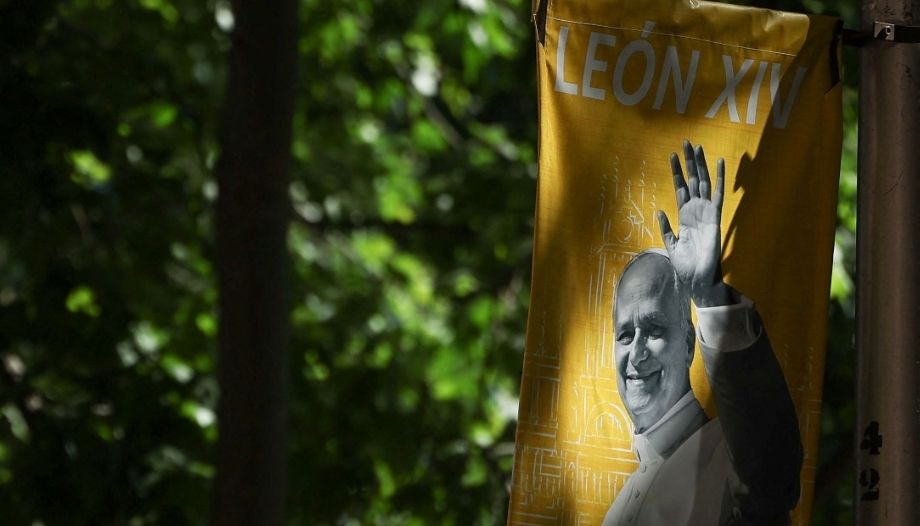
Christ, the heart of the creative impulse 

“The relationship between the Catholic Church and art has not only been fruitful: it has been decisive. We are not afraid of being wrong when we say that the Church has been the greatest producer of art in the history of mankind,” said the actor Antonio Banderas, who continued, “at the heart of this creative impulse is the one who crosses centuries, styles and cultures, and who has certainly been the most represented figure in the history of art: Jesus Christ. A Christ who, as the actor from Malaga wanted to point out, is ”a constant presence. Not as a repeated image, but as an icon of peace, love and sacrifice.

The actor concluded by arguing that “this meeting between the church and civil society is not only opportune: it is necessary. We need to continue to create and share, to continue to ask questions. And he closed his words by paraphrasing St. Augustine: ”You say that times are bad. Be better yourselves and times will be better. You are the time.

For his part, the Rector of the Complutense University, José María Coello de Portugal, focused his words on the need to safeguard an education that respects “diversity but also truth, with full respect for the ethics of research” and advocated for universities that are “academically excellent but socially inclusive, environments in which the culture of effort and competitiveness is developed but presided over by full respect for the dignity of each person”.
Coello de Portugal thanked the Pope for “the recent designation by His Holiness for the first time in history of a university professor as a doctor of the Church, in the person of John Henry Newman”, and presented the Pope with two challenges facing universities today: “how to contribute to building a peaceful society and how to lead through education and research the scientific changes inherent in the technological revolution in which we are immersed”. 

The academic's speech was followed by an exciting and complex performance by the dancer Sara Baras and her team. The Pope, who wanted to greet all the members of the tablao, showed his affection and admiration for the dancers. 

The need for a transformative and profoundly humanistic vision of the company

Antonio Garamendi, president of the Spanish Confederation of Business Organizations (CEOE); Unai Sordo, secretary general of the Comisiones Obreras; Pepe Álvarez, secretary general of the General Union of Workers (UGT); and Ángela de Miguel, president of the Spanish Confederation of Small and Medium Enterprises (CEPYME) shared with the Pope a broad reflection on the world of business, the economy, and the role of AI in the world of work.

In this area, they have defended that “in the social dialogue, Artificial Intelligence ceases to be a tool for labor substitution and becomes a collective project, of shared values, transparency in algorithms and useful to the just transition and respect for the dignity of working people”.

The trade unionists and businessmen have committed themselves to “face what is undoubtedly a real epochal change. Technological transformation, artificial intelligence and global competition are redefining the way we produce, work and relate to each other. And that is why we need to reinforce a transformative and profoundly humanistic vision of the company.

All agreed on the need for a new social pact in today's unstable and fragmented labor environment. 

“Accepting our fragility makes us human.”

Among the most awaited were the testimonies of Carolina Marin and Teresa Perales. Both athletes arrived happy. Both Marín and Perales have often declared their faith, especially in moments of victory but also of injury, or challenges, as in the case of the Paralympian, Teresa Perales, who said that “accepting our fragility and our difficult moments does not make us weak, it makes us human. True victory is not being invincible, but learning to get up with the help of others.

Along the same lines, badminton champion Carolina Marín explained that “the opponent is not an enemy; he is an indispensable traveling companion who, by giving his best, forces us to give the best of ourselves. To compete is to grow with the other, never against the other”.

The Pope went downstairs to greet, with great affection, Teresa Perales and Carolina Marin, who gave him a badminton racket.

“The Church wants to be in dialogue with the world.”

After the speeches of these personalities, the most awaited and central moment of the afternoon arrived: the speech of Leo XIV. 

The Pope, once again, did not hide his appreciation for Spain, emphasizing that in “this beautiful country it is impossible not to admire the trace of creativity that runs through its history”. 

Referring to Spain's rich historical heritage, the Pope asked “what kind of heritage are we leaving to the future and, therefore, what kind of community are we building? And he underlined how ”our society, in fact, possesses an extraordinary capacity to produce, innovate and communicate, yet it seems that we still need to learn to guard the soul of what it generates. Otherwise, we run the risk of being experts in the means and effective in producing, but uncertain about why, for what, with whom and for whom it is produced. In this context, the Church, aware of both her successes and her mistakes throughout history, longs to remain in dialogue with the contemporary world“. 

Christ answers the big questions 

The Church, the Pope recalled, is an expert in humanity in the face of the decisive question of our time: “What does it mean to be truly human? And it is so, the Pope said, because ”Jesus Christ answers the great questions about human life and its fullness“.

To respond to these questions of our time, the Pope advocated “a social dialogue that can be compared to the art of weaving networks, which involves meeting, listening, dialogue and respect”.

Weaving nets: its three meanings 

The image of weaving, the title of the meeting, was a constant theme in the Pope's speech, who wanted to explain that “weaving networks is a dialogue between institutions centered on human dignity that “entails, for example, that the university should not turn its back on the world of work or renounce the truth; that business activity should not see the employee as just another factor in the equation of its interests; that art should not be aimed only at the elite; that sport should not be reduced to a spectacle or turned into a mere business; that technological progress should take into account the elderly, the poor and those who have no voice.

“Our contribution to dialogue, from a Christian vision of life, knows that the Creator has woven human beings with threads of love,” stressed the Pope, who wanted to emphasize how “weaving networks means creating together. And he defended the union that art brings about ”between the material and the spiritual. Finally, the Pope pointed out that “weaving networks means, thirdly, to serve in a disinterested way. And so the Pope recalled the key importance of faith in the shaping of Europe.

As he did at the Vigil with the youth, the Pope recalled his predecessors with that call to audacity: “Do not be afraid, open wide the doors to Christ! Jesus Christ takes nothing from us and gives us everything”, referring to that first and recognizable speech of John Paul II, a memory accompanied by a great applause among the attendees. 

But he went further, asking “Who are being excluded in spite of their virtues and abilities? We cannot ignore that the condition of the poor represents a cry that, in the history of humanity, constantly challenges our lives”.

New threads to weave a new society 

“Christ restores the common good to its rightful place” emphasized the Holy Father, who ended his speech with a special appeal to sport as “a luminous witness of cohesion and peace”.

The Pope concluded with an appeal to those present to be “new threads to weave new networks that harmonize all areas of life, to weave a renewed society where time is imbued with eternity, culture safeguards memory and favors dialogue, education promotes the search for truth with a critical spirit, art awakens wonder and generates noble emotions, business recognizes the dignity of the person and work continues to be the engine of hope”.

Spain

Pope Leo at Corpus Christi in Cibeles: «He is alive and continues to pass in our midst!»

Before a crowd gathered in Cibeles, Pope Leo XIV vindicated the Eucharist as a source of transformation and hope.

Editorial Staff Omnes-June 7, 2026-Reading time: 4 minutes

The Cibeles square became the center of the life of the Church in Spain this Sunday with the celebration of the Holy Mass of the Corpus Christi presided over by Pope Leo XIV, a celebration that, according to the Pontiff, “is not just another feast in the liturgical calendar, but a return to the roots of faith to renew love and fidelity to God”.

Leo XIV traveled through the streets in a popemobile greeting the faithful, who awaited his arrival with enthusiasm and expectation. Once at the Palacio de Cibeles, seat of the Madrid City Hall, the mayor of the city, José Luis Martínez-Almeida, presented him with the Golden Key of Madrid. After signing the Book of Honor of the city, the Pope went to the sacristy to prepare for the liturgical celebration.

The Holy Mass began with the introductory rites and the greeting of the Archbishop of Madrid, Cardinal José Cobo Cano, who welcomed the Holy Father and the thousands of faithful gathered.

Pope invites us to live the Eucharist today

After the liturgy of the Word, Leo XIV focused his homily on the importance of the Eucharist as a transforming element and source of hope, pointing out that “it is not only a matter of taking out the monstrance, but of letting ourselves be taken out of selfishness, indifference, of a comfortable and private faith, to respond to his invitation to conversion, to change our gaze, to welcome his presence that transforms us and makes us builders of a new world”. 

Pope Leo emphasized that “the historical memory of the processions of the Corpus Christi does not allow itself to be imprisoned by a nostalgic memory; it becomes, instead, an invitation for today”. Thus, he commends to Spain “that the religiosity that for centuries has animated this country is not a museum of the past to visit, but a school of faith from which to draw today”.”

The Pope invites us to remember, as the first reading said, who the Lord is, the one who brought you out of Egypt, “so as not to fall into the temptation of trusting in other idols and feeding on bread that does not satisfy”. 

Leo XIV concluded his homily by naming Manuel Gonzalez, whose life reminds us that the Eucharist should not be lived only in great celebrations or occasionally, but also in the silent fidelity of one who accompanies the Lord with a humble and discreet friendship that is nourished day by day.

«Jesus the Eucharist is a fountain that flows and quenches thirst, but without dazzling, without imposing itself with external power, without presenting itself in a spectacular way,» the Pontiff affirmed before the faithful.

He also made a call to drink again from the fountain of the Eucharist “which does not enclose us in a private devotion, but sends us to water our brothers and sisters, families, the poor, those who suffer, those who have lost hope”.

Communion

The celebration was attended by about 500 concelebrating priests and a symphonic choir of about 400 musicians and singers.

One of the main logistical challenges was the distribution of communion. For this, the Archdiocese of Madrid prepared nearly 460,000 consecrated forms, distributed by 1,800 extraordinary ministers of communion, supported by hundreds of volunteers identified to facilitate the organization among the crowd.

In addition, several churches in the center of Madrid remained open throughout the morning to serve the faithful and facilitate the reception of communion, including the parish of San José, the basilica of Jesús de Medinaceli, San Jerónimo el Real, San Manuel and San Benito and Santa Bárbara.

A procession among floral carpets

After the Eucharistic celebration, the Corpus Christi procession began, which went along Alcalá Street to the vicinity of the church of San José and then returned to the Plaza de Cibeles for the solemn blessing with the Blessed Sacrament.

One of the highlights of the tour were the floral carpets made by the Association of Alfombristas do Corpus Christi de Ponteareas. More than 180 people participated in the making of 16 large carpets distributed along more than 500 meters of Alcalá Street.

The compositions, made with more than 30,000 white and yellow carnations, incorporated Eucharistic motifs and symbols linked to the Petrine ministry, including the Sacred Form and the Keys of St. Peter.

Faith takes to the streets

The procession went through one of the main arteries of Madrid amidst songs, moments of prayer and displays of popular devotion. Families, young people, religious, pilgrims and visitors accompanied the passing of the Blessed Sacrament in an atmosphere of recollection and joy.

Before concluding the celebration, Leo XIV said a prayer before the Blessed Sacrament and then imparted the Eucharistic blessing to the entire city and the faithful gathered.

ColumnistsÁlvaro Presno

The truth without effort

"We must recover the fertile Christian intellectual life and the discipline and grace that impel it to truth. Otherwise the great question will no longer be whether machines will one day come to think like men, but whether men will continue to want to think for themselves.".

June 7, 2026-Reading time: 4 minutes

Leonard Peikoff, one of the main continuators of Ayn Rand's objectivism, formulated years ago in one of his lectures an idea that is difficult to dismiss even from philosophical perspectives far removed from his own. Man can voluntarily disengage himself from the study of philosophy, but he cannot live apart from some philosophical conception of the world. He will always live “from” a philosophy. Giving up reflecting on the fundamental questions does not eliminate its influence; it simply leaves the individual exposed to passively incorporating the dominant intellectual categories of his time.

For centuries, this influence came through more or less formal education, the general cultural and domestic environment or the ideological currents of the moment.

– Supernatural artificial intelligence has introduced a substantial change. For the first time we are beginning to coexist with tools capable not only of providing information, but also of structuring, synthesizing, summarizing, ordering, suggesting and filtering. All this immediately and effortlessly. This is not trivial, there has always been a certain inner friction towards serious intellectual exercise: reading, studying, holding a long conversation, going through the difficulty of a dense book or delaying sufficiently before an idea demanded time, attention and previous training.

The main problem with artificial intelligence may not be that machines will come to think like humans, but that humans will end up accepting an increasingly passive relationship with the truth.

AI: optimization, not contemplation

The great Christian intellectual tradition has always held that human understanding is linked to something much deeper: a constitutive openness to Truth itself. Man does not know only in order to orient himself pragmatically in the world, but because he has been created for the Logos. There exists in human intelligence a natural orientation toward the intelligibility of being that refers, in the last analysis, to the rational character of creation and to its creator as the source of all truth.

The intellectual act inwardly engages the whole person because truth possesses a singular capacity to claim the subject. The human understanding not only manipulates information: it seeks to rest in something recognized as true. There is even a specifically intellectual joy in the very act of knowing, because the understanding then experiences a certain connaturality with the contemplated truth. 

St. Thomas precisely described contemplative happiness as one of the highest forms of human perfection: the intelligence rests partially when it participates, even if imperfectly, in that for which it was created.

Nothing similar occurs in artificial intelligence. A generative model can produce a mathematical truth, a rhetorical manipulation or a historical falsehood by means of exactly the same type of statistical operation. There is no love of truth, no desire to understand, no inner orientation towards being. There is optimization, not contemplation.

Has technology transformed the way we think?

Every epoch ends up imagining intelligence from the technologies that best represent its own world-transforming power. When the mechanical clock fascinated early modernity, the universe began to be conceived as an immense clockwork machine governed by precise laws. Later, in the midst of the industrial revolution, man began to describe himself frequently by means of energetic metaphors: impulses, tensions, discharges, inner forces. Freud himself thought of the psyche using a language marked by the thermodynamics of his time. 

Today it is difficult not to imagine the human mind according to the great dominant technology of our time: computation. Understanding appears to be progressively reduced to information processing, efficient data management and machine learning. It is something that has permeated the philosophy of mind and has served as a “metaphor” for intellect and consciousness since the irruption of cybernetics and the computational paradigm in the 20th century.

I myself, professional deformation, can't help but think of Bayesian models, or learning networks adjusting parameters when I watch my son cautiously moving his little fingers to carefully grasp a marker pen. It's natural. But not harmless. It slowly changes the very way humans understand themselves and invites them to blur boundaries.

Romano Guardini has already warned that every great technical transformation also ends up altering the spiritual experience of the world. And Benedict XVI repeatedly insisted that instrumental reason always runs the risk of progressively narrowing the very idea of man. What an incredible pair of ideas, if I may note.

The subject no longer appears as a rational creature called upon to understand the world but as an agent in charge of managing inputs, to produce answers and browse information flows.

Everything must come fast, simplified, summarized and cognitively digested beforehand. Sustained attention begins to be experienced almost as a form of physical discomfort.

The need to combat machine logic

The very logic of AI inevitably favors a passive relationship with knowledge. Intellectual effort begins to seem unnecessary when a machine immediately produces plausible answers to any question.

Important truth rarely appears instantly.

Precisely for this reason, a culture that progressively delegates its relationship with truth runs the risk of losing its inner freedom as well. Because those who stop thinking actively end up living from categories elaborated by others (be that otherness organic or digital). 

The recent encyclical Magnifica Humanitas of Leo XIV seems to point precisely to this anthropological wound when he warns against the temptation to translate human experience completely into categories of performance, calculation and functionality. The text still possesses a density that discourages hasty readings, but it is difficult not to perceive an underlying concern: the risk that modern man will end up understanding even his own interiority under instrumental logics.

It is necessary to recover the fertile Christian intellectual life and the discipline and grace that push it towards truth. Otherwise the great question will no longer be whether machines will one day come to think like men, but whether men will continue to want to think for themselves.

The authorÁlvaro Presno

D. in Engineering and PhD in Mathematics. He is a member of the Artificial Intelligence working group of the Society of Catholic Scientists in Spain.

Spain

Leo XIV, one more young man, who asks young people “Do not be afraid!

They came from Madrid, but also from Cordoba, Algeciras, Valencia and Santiago de Compostela. On the night of June 6, Madrid became the capital of youth with the Vigil presided over by Pope Leo.

Maria José Atienza-June 6, 2026-Reading time: 6 minutes

Madrid, capital of youth. This is how one could sum up the “mood” that was in the air on Saturday afternoon and evening. Hundreds of thousands of people, mostly young people, awaited the arrival of Pope Leo XIV in Madrid. Lima Square with songs, dances, prayers and, above all, a lot of emotion. 

From 5:00 p.m. onwards, there were many people walking the streets around the Bernabeu area, asking about their area. A huge white cross, visible from almost everywhere, presided over the vigil, next to the image of the Virgin of the Almudena.

Enric Chenoll and Estenez (formerly Grilex) were the hosts of the “preview” to the arrival of the Pope. A few moments in which fragments of previous papal visits, testimonial videos and the hymn were played on the screens, placed along the Paseo de Castellana. 

Preliminary music and animations 

The vigil with the young people began at around 6:40 p.m., led by Guillem Climent and Aysha Rua. Young people from all parts of Spain, and also some from nearby countries, filled the area around the Plaza de Lima, in Madrid. 

The music, by artists such as Lola Tuduri, Ignacio Serrano, Inazio, Besmaya + Malmö, Beret or Siloé, enlivened the wait, before the recitation of the Holy Rosary, the Marian prayer par excellence, which contemplated the Luminous Mysteries, included by St. John Paul II. 

The Pope arrived at the Plaza de Lima after 8:45 pm. Leo XIV received the affection of hundreds of thousands of young people as he took the stage set up in the heart of Madrid. Together with him, the Metropolitan Archbishop of Madrid, Cardinal José Cobo Cano, and about thirty young people, who have enjoyed the privilege of accompanying the Pope in these hours. 

Cardinal Cobo: “We want to learn to respond as a Church”.”

The Archbishop of Madrid, Archbishop José Cobo, presented the young people who “arrive with the thirst of those who seek Christ, his Church and the embrace of a fraternity that gives meaning to life”. 

The Cardinal asked the Pope that “from his hand we want to learn to respond as Church, walking together and offering paths of accompaniment and life” and ended by thanking the Pope “for coming to help us raise our gaze. Thank you for confirming us in our faith, encouraging us in our mission and reminding us that the Spirit continues to act and that the Church continues to be sent”. 

The Pope became young with the young people. With great joy he thanked the young people for the fact that they were sharing their faith “with all young people”. 

The Holy Father's dialogue with the young people touched on various topics, such as the missionary past of Pope Prevost, but, with special emphasis, the young people wanted to know from the Pontiff how to listen to the voice of God and the mission of young people in the world. 

A new Don't be afraid! 

The Pope wanted to share with young people the impact on their lives of three saints: St. John Chrysostom, St. Thomas of Villanova and St. Toribio of Mogroviejo. 

Here the Pope reminded himself of St. John Paul II, when he forcefully shared with young people a new “Do not be afraid! Do not be afraid to think about a vocation to the priestly or religious life or to any other service in the Church,” the Pope stressed.

Of the former, the Pope recalled that he was impressed by “his splendid catecheses, which unite love for the truth and righteousness of life, and his courage in speaking before the Emperor, always telling the truth”. 

As for St. Thomas of Villanova, an Augustinian who “undertook an intense work of reform of the Church, especially of the clergy, exhorting his brothers to perseverance in prayer, chastity and obedience”, the Pontiff wanted to highlight the influence of his “ardent charity” that “has encouraged me in times of trial”. 

Finally, Robert Prevost pointed out how the life of prayer, together with the commitment to justice of St. Toribio de Mogroviejo, are for him “a model of dedication to the people”.

His memory of Peru, the Pope wanted to share, is mainly, “the testimony of faith of the people, marked by many difficulties, but full of hope. The encounter “with the wounds and joys of the people made me grow in the way of following Jesus. 

“God knows you and will answer you.”

Then, questioned about how to recognize the voice of God, the Pope stressed the need to seek “silence, which favors attention and recollection. When we seek silence, we decide what not to listen to and what noises not to allow ourselves to be distracted by. 

In addition to the silence, He called for a search for the truth, because “in many things in the networks the truth is not there”. 

“Be certain that God knows your voice well: He hears you and will answer you,” continued the Pope, who encouraged young people to move from interior monologue to prayer: “Our interior speech becomes prayer, praise and supplication when it is entrusted to the only one who can hear it. Prayer is a free voice precisely because it does not speak to give an account, to show that we are ready or to make us feel important. When we ourselves become prayer, the Lord answers us with his Word, who became man for us, affirming that he loves us with his whole being”.

The Eucharist, the “place to free the heart”.”

Thirdly, he encouraged young people to “listen to his living Word” and to cultivate Eucharistic devotion. “Eucharistic adoration, which we share tonight, is precisely the right place to keep silence, free our hearts and “be” ourselves before the Lord, dialoguing with him, so that he becomes eloquent in his love, made food for humanity”. 

In a context that some call a Catholic turn and in which young and not so young people are multiplying and are not afraid to manifest their faith, the Pope invited them to share “your spiritual journey, bearing witness to it with coherence of life: the will to follow Jesus will constantly renew you, especially in the hour of fatigue”. “No one is alone in following Jesus,” the Pope encouraged “Look how many of you are here!”

And he added, “If you pray with love, young people will appreciate the importance of prayer. If you burn with faith, you will transmit its living fire. If you remain faithful to your vocation, you will reflect its attracting grace”.

Royal saints 

The Pope also made a defense of real holiness, with the falls and turns to God of all kinds of people: “The faces of passionate husbands and fathers, of wise priests, of religious men and women dedicated to God to serve their neighbor do not shine in an idea, but in the holiness of a life put to the test”. 

Finally, the young people asked the Pope how to live a committed life and what is the mission that the Pontiff gives to young people. The Pope called them to overcome “fashion”, stressing that Christians “are free from fashion, because we are disciples of the truth; we are open to the future, because we know that death does not await us”.

Our freedom has its source in faith 

The Pope was happy and it showed, especially in his amusing and endearing “exits from the script”, as when he congratulated Fernando, the last young man to ask about his marriage and reminded the young people that “marriage is a great Christian vocation! Do not be afraid of marriage!”

Leo XIV made an impassioned appeal to faith and unity: “To live in this way, it is necessary first of all to interpret present society, living wisely, so that we can then transform it as witnesses to the Gospel. The young Christian, in fact, becomes luminous both in joy and in trial, giving flavor to reality because he inhabits it as a person who enjoys life within himself, without waiting for the taste to be given to him by wealth, pleasure or power. This is our freedom, which has its source in faith”. 

“Be human!” The Pope asked the young people “men and women of flesh and blood. Not appearances, but reliable faces”, looking “to the Apostles, to the first Christians, inhabitants of a pagan world”. This faith is what changes history, concluded the Pope, who was almost “knocked down” by the applause, before the Blessing with the Blessed Sacrament. 

The Holy Father signed the back of the cross of the young people before the moment of adoration of the Blessed Sacrament and the blessing, which were the centerpiece of this meeting of young people.

The Holy Father signed the back of the cross of the young people before the moment of adoration of the Blessed Sacrament and the blessing, which were the centerpiece of this meeting of young people. 

A blessing in which we have been able to see the Pope moved, as well as the hundreds of thousands of people who have made an impressive silence when the priest entered with the Monstrance. 

The reading of the Gospel was followed by a moment of emotional prayer and the singing of the Augustinian song “Tarde te amé”. The prayer continued for several dozens of minutes until the Blessing with the Blessed Sacrament during which the sound of the security helicopters could be heard. A special and emotional night that concluded with the hymn “Alzo la mirada” after a long and heartfelt applause from all those present. 


Spain

Leo XIV: «It is not possible to forget the poor if we do not want to go out of the living current of the Church».»

The Holy Father spent an hour at the Caritas shelter in the Lucero neighborhood, listening to the testimonies of those who have found refuge and a second chance there.

Javier García Herrería-June 6, 2026-Reading time: 5 minutes

It was not a stage with a great protocol. It was a dining room, a courtyard and some rooms where every night dozens of people who have nowhere to go find shelter. And this Monday, between 18:00 and 18:40, the Pope chose that place -the CEDIA 24 Hours Center in the Lucero neighborhood of Madrid- for one of the most intimate meetings of his visit to the capital. A visit that lasted forty minutes and that left a mark difficult to erase in all those who lived it.

CEDIA: open 24 hours a day, 365 days a year

The CEDIA 24 Hour Center is the heart of Cáritas Diocesana de Madrid's emergency care network for the homeless. It never closes: it is available every day of the year, at any time, to offer basic services, social support and reintegration programs to those who find themselves on the streets.

Beyond immediate care, the project includes sheltered housing for people in the process of recovery, vocational training workshops, personalized intervention programs and comprehensive social accompaniment aimed at promoting the autonomy of each person. A model that has shown, year after year, that with the right resources and will, it is possible to help rebuild lives.

Arrival: welcome at the door of the hostel

At 6:00 p.m. sharp, the Pope arrived at the center. At the main entrance he was met by the Cardinal of Madrid, José Cobo, and the director of Madrid Diocesan Caritas, Luis Hernando Vozmediano, who welcomed him.

Once inside, one of the residents explained to the Holy Father how the center works and the type of assistance provided to the homeless. It was a simple and direct presentation, with the authority that only one's own experience can give. The project coordinator and four collaborators then accompanied the Pope to the dining room, where several residents were waiting. Before going out into the courtyard, the Holy Father signed the visitors' book and, finally, went up to the podium and took a seat next to the Cardinal Archbishop.

The courtyard of the Social Pastoral: almost 200 people and four stories of hope

In the courtyard of the Church of Our Lady of the Crucifixion, annexed to the CEDIA complex, Leo XIV held a meeting with representatives of the Social Pastoral of the Church in Madrid. Nearly 200 people were eagerly awaiting the Holy Father under a sun that gave no respite. 

Before the Pope's arrival, attendees were able to write their messages of hope in a space prepared for this purpose, enlivened with musical performances by Migueli and Chito Morales. The event was conducted by journalist Mario Alcudia.

With the Holy Father present, it was Niña Pastori who dedicated one of her songs to him - the artist who had already participated in a meeting with Pope St. John Paul II - in a moment that deeply touched all those present.

Greetings from Cardinal Cobo

During the meeting with the Holy Father, the Cardinal Archbishop of Madrid welcomed the Pontiff, recalling that the identity of the Spanish capital is defined by its capacity to welcome, affirming that «if you are in Madrid, you are from Madrid», and thanking him for also joining in this universal citizenship. 

Cobo stressed that the decision to begin the visitation in a socio-charitable environment is an authentic «confession of faith» based on the certainty that Christ is present in the most disadvantaged. 

Under the slogan «Raise your eyes», the cardinal invited the attendees to raise their eyes towards heaven, but with the unrenounceable condition of keeping «their feet firmly in the mud», that is, glued to the reality of the streets of Madrid where thousands of people continue to suffer from lack of housing, decent employment or simple companionship.

In a second part of his speech, Cobo translated this «far-sightedness» into concrete data to x-ray the immense network of fraternity that sustains the archdiocese in the face of the current challenges.

As proof of the real commitment of the Church in Madrid, he provided figures of great social impact: the balance of Diocesan Caritas, which last year accompanied nearly 90,000 vulnerable people through its parishes and more than 400 projects for families, migrants and homeless people, a work that is strongly supported by another 300 projects led by the consecrated life in the diocese.

Four stories that represent thousands

The Pope then listened to three testimonies to represent a few stories among many. Niurka's story is that of a mother who arrived in Madrid a year ago, alone, pregnant and in fear, was transformed into a testimony of hope thanks to the welcome of the Church at Hogar Santa Barbara. Listening to her story, it became clear how the daily care of nuns and volunteers not only took away her loneliness, but also provided a real family and a community of faith for her twins, Ares and Atenea, who were born and baptized in the warmth of this institution. «Today I look at my children and I know that we can have a future,» Niurka told the Pope.

Next, Khadry, a young Senegalese man who arrived in Spain in 2020 in the context of the pandemic, recounted how he initially felt lost and alone in an unknown country, until he met people who looked at him with respect and made him feel that his life mattered, culminating his intervention with a gesture of profound symbolism: the presentation to the Pope of a replica of his residence card. «It represents a long time of waiting and effort, but also a life that is back on its feet,» he said with gratitude, making his identity card the living reflection of regained dignity and the hope of a new beginning thanks to human solidarity.

Finally, Alicia, from the Hope Project of the Holy Father Adorers, spoke on behalf of the volunteers of the Social Pastoral of the Diocese of Madrid. 

Words of Leo XIV

During his speech at CEDIA, the Pope stressed that the Church's charitable work is not simply a philanthropic endeavor, but an evangelical path that follows in the footsteps of a Jesus who fully identified with human weakness. 

In elaborating on the motto «Lift up your eyes,» the Pontiff recalled that charity does not admit of delay, comparing it to a ripe harvest that is lost if it is not harvested in time. This responsibility, he explained, turns every encounter with the needy into a kairos He warned against the risk of allowing the ecclesial mission to be contaminated by worldly ideologies or economic interests that disregard the exercise of charity as something secondary. 

«It is not possible to forget the poor if we do not want to go out of the living current of the Church,» he said, placing love of neighbor at the incandescent center of faith.

Charity is a good for the one who exercises it.

In a second part of his address, the Pope called for the recovery of the human dimension and the personal encounter in the act of helping, urging those present to look into the eyes and touch the reality of those who suffer. Citing his own reflections on the true nature of almsgiving, he insisted that almsgiving is not mere charity, but an act where the donor receives the greatest grace by allowing himself to be «looked into the eyes of the Lord» through his brother or sister. 

For the Holy Father, to truly love implies going beyond material giving: it requires listening, dialogue and a commitment to the integral promotion of the person. Thus, the gaze he proposes is not distant, but one that seeks to understand the causes of need and to embrace both material and spiritual needs, consolidating aid as an embrace of universal fraternity.

Gift exchange and blessing

Before saying goodbye, an emotional exchange of gifts took place. The Pope presented the CEDIA Center with an icon of the «Face of Christ of Love», a gift full of symbolism for a place where every day they seek precisely that: the face of Christ in the most vulnerable. 

Spain

Leo XIV and Philip VI call for unity from the Royal Palace

During their speeches at the Royal Palace in Madrid, both Pope Leo and King Felipe VI stressed the importance of unity.

Paloma López Campos-June 6, 2026-Reading time: 4 minutes

The King and Queen of Spain, together with their daughters and the Diplomatic Corps, are the first to welcome Pope Leo XIV after landing in Spain.

The welcoming ceremony took place at the Royal Palace in Madrid, where, amid military honors and chants of the gathered faithful, King Felipe VI greeted His Holiness, highlighting “the immense joy” felt by all the Spanish people to receive the Holy Father.

The Church in Spain

In his speech, the king highlighted “the enormous social work of the Catholic Church, fruit of the commitment of religious men and women, priests, deacons, young people who are involved in the life of the parish, volunteers who help in residences, shelters, soup kitchens and shelters”.
Likewise, Felipe VI mentioned “the thousands of missionaries of our country who carry out their social, educational, welfare and pastoral work in so many needy places in the world, often remote or still very disconnected”.

His Majesty also took the opportunity to recall “the cases of abuse, which are not and cannot be representative of the immense ecclesial community”.

A Pope for Today

The King then praised the Pope, “a man of solid scientific formation”. He also highlighted the Pontiff as a man “with a great social conscience and a profound attention to change”.

Felipe VI also made an analysis of current affairs, warning that “we run the risk of forgetting what really matters, of slipping into the mistaken belief that -abolished many of our references by the pulse of current affairs- anything goes, everything is admissible, negotiable and justifiable”.

However, His Majesty affirmed, alluding to the mathematical profile of Pope Leo XIV, “the dignity of the person, human rights, democratic values and international legality must continue to be our prime numbers... Because in them - in their multiple combinations - is the arithmetic of freedom, equality and justice; that which adds and multiplies, not that which subtracts and divides”.

Call for unity

Felipe VI concluded by affirming that “unity as an aspiration arises from the awareness of our fragility as individuals, of our contingency, of our limitations; but also of that inexhaustible capacity for good and beauty that reaches its peak when human beings love their neighbors, when they open up and give themselves to others”.

Spain and Christianity

Pope Leo XIV thanked the King for his words and began by highlighting “the very ancient bond between the Christian faith and this land”, which “although on the one hand does not exhaust the multifaceted identity of your people, on the other hand has deeply shaped its culture and represents a source of hope and guidance among the challenges that today, as a human family, we must face together”.
The Holy Father affirmed that his trip aims to “confirm, encourage and inspire a renewed fidelity of believers to the Gospel, as well as a deeper reconciliation and cooperation among the various forces of this Nation”.

Spiritual Search

For this reason, His Holiness referred to “two figures from this country who, for five centuries, have nourished the life of the Church and the spiritual search of many, even beyond its visible borders”: St. John of the Cross and St. Teresa of Avila.

Following the example of St. John, the Pope said, today “we need, also in public life, men and women who sense, in the darkness, the light; in the end, a possible beginning, almost the bursting forth of a truth as a light that still blinds but that - if we trust and find peace - will lead us gently towards itself”.

Leo XIV insisted that “we need culture, interiority, a free and quality education, we need transcendence”.

In this sense, “the Catholic Church is at the service of this thirst of the human heart”. For this reason, the Pope invited “everyone, for love of the truth, to abandon divisive and polarizing narratives of your social reality and its history, and to move from sterile simplifications to a fruitful appreciation of complexity”.

This, said the Holy Father, is “a specific vocation of Europe, of which Spain is the original and fundamental protagonist”. It is “the gift that the Old Continent can give to the world if it wants to remain young, because young is the one who feels that it has a future and a mission that still challenges”.

Investing in culture and dialogue

For this reason, the Pope affirmed that we must “make a qualitative leap, a change of direction in investments in schools, universities and research, in local communities and in civil society as a seedbed of participation and cultural mediation”.

In addition, the Holy Father alluded to “the presence of Islam in the Iberian Peninsula”, a time when “there was not only confrontation, but also an attempt to create a space for contact, conversation and dialogue on the meaning of truth between Christians, Muslims and Jews”.

Pope Leo concluded his address by encouraging the promotion and cultivation of “dialogue and social friendship, to take into account the perspectives of the poor and the young in imagining the future, to harmonize the demands for autonomy and unity, and to promote the process of European union, not in opposition to other powers, but as a gift for the whole human family.”.

Spain

The Pope is already in Spain

Their Majesties the King and Queen of Spain waited for the Pope at the foot of the stairs of the plane to welcome him to Spanish territory.

Editorial Staff Omnes-June 6, 2026-Reading time: 2 minutes

At 10:12 a.m. on Monday, the ITA Airways plane carrying the Holy Father from Rome touched down at Adolfo Suárez Madrid-Barajas International Airport. With that landing, the fourth International Apostolic Journey of His Holiness Pope Leo XIV, who has arrived in Spain with a message of faith, joy and hope for all, was officially inaugurated.

Reception by the King and Queen and the highest authorities

Their Majesties the King and Queen of Spain waited for the Pope at the foot of the stairs of the plane to welcome him to Spanish territory. Doña Letizia wore white, making use of the privilege enjoyed by Catholic queens to wear that color in the presence of the Pontiff.

Before leaving to receive the Holy Father, the King and Queen greeted the highest representatives of the Church in Spain in the authorities' lounge. The President of the Government, Pedro Sánchez; the President of the Community of Madrid, Isabel Díaz Ayuso; and the Mayor of the city, José Luis Martínez-Almeida, also came to the airport to receive the Pope.

Inside the authorities' pavilion at the airport, the Pope greeted several Spanish families with children with disabilities. He spent some time with each of them, along with the King and Queen of Spain.

Image: EFE:J.J. Guillén

A gesture to the press at 10,000 meters above sea level

During the flight, Pope Leo XIV came to greet the 88 journalists from 55 media outlets from around the world who are accompanying him on this Apostolic Journey. He thanked them personally for their service and for their work, a gesture that did not go unnoticed among the professionals present on board.

The Pope shared with journalists his joy at setting foot on Spanish soil once again, while underlining the character and purpose of this trip:

«I have come many times to Spain, but the first time in this, in this mission. An apostolic visit to come, to meet the faithful, to celebrate the faith, to announce the message of Jesus Christ, but at the same time to greet everyone, all of society, because the Church has a message for everyone, as you will have seen, I think, very clearly in the encyclical letter that was published on May 25.»

The Pontiff also pointed out that this trip will be an opportunity to discover much enthusiasm, especially that of young people; an occasion to live the faith and joyfully proclaim the message of God's love.

Thanks from the organization to the sponsors

This morning, the trip's organizers also released a video thanking the sponsors of the papal visit.

Books

The School of Salamanca and the French Revolution

The influence of the Christian humanism of the School of Salamanca and the ideas of freedom of Francisco de Vitoria served as a theoretical basis for the great liberal revolutions, including the French Revolution.

José Carlos Martín de la Hoz-June 6, 2026-Reading time: 4 minutes

Francisco de Vitoria began his career as a professor in the Faculty of Theology at the University of Salamanca in 1526 and, with this, he initiated what has been called the School of Salamanca. In other words, a new style of approaching humanistic, literary and scientific work; in fact, many international congresses on the subject are being held this year.

In fact, the School of Salamanca has gone down in history as the passage from Renaissance humanism to Christian humanism and, furthermore, thanks to Grotius, a faithful disciple of Vitoria, the human rights that had been emphasized by the School of Salamanca were internationalized.

The Enlightenment was able to spread very quickly because Christian humanism was based on man and, in particular, on everything that concerned the dignity of the human person and the balance between faith and reason.

Roots of liberal revolutions

Let us remember that in the face of extremes, the tendency of the human being always lies in the balance of the middle ground: thus, Lutheranism would be pure fideism and, at the other extreme, Voltaire would show a scientific and profoundly anticlerical Enlightenment, distrustful of God and the Church.

Certainly, the Christian humanism of the School of Salamanca managed to impose its love of freedom and human rights in order to offer theoretical coverage to both the Independence of the United States and the French Revolution and, finally, it would lead to a liberal humanism that crystallized in the Cortes of Cadiz of 1812 and in the Constitutions of other countries in Europe and America.

Precisely, the extensive work of Robert Darnton (New York, 1939), professor at Princeton and Harvard, will help us to discover Vitoria's ideas on freedom in the background and at the time of the French Revolution (1748-1789).

The «revolutionary temperament»

In fact, our author will begin by discussing the “collective conscience” that will be produced in Paris from the beginning of the war of succession in Austria in 1740 and in the successive events that will converge in 1789 with the beginning of the French Revolution. This is what our author will call “the revolutionary temperament” (17). Logically, the revolutionary temperament that will act in 1789 will be nourished by the ideas of freedom that Francisco de Vitoria set in motion in Europe when he confronted Emperor Charles V with his defense of freedom and the dominion of the Indians of America. The support for the independence of America in France was total and complete (245).

The power of public opinion

It is interesting the relation of the means of information used by the thinkers in the salons of Paris to create public opinion and to magnify or silence the news and rumors in operative ideas destined to change the course of events. The origin of the public opinions that had to be held should also be pointed out, for they forced Christian humanism to give accurate conclusions and criteria to the people who were to govern the country or important houses. We cannot fail to emphasize that music and literature were also means of information and formation of public opinion (22).

The exacerbated criticisms of the nobility and the life of the Court that ran through Paris, both from literary works, such as those of Voltaire, as well as those of other playwrights, operas or minor genres that, logically, made the Parisians exaggerate, who distorted the facts that arrived from the Court. Envy immediately appeared, mixed with fierce criticism against the Jesuits, who were the confessors of the kings and their court chaplains, and were accused of allowing such ravings of luxury and bad manners (51, 151). Much of the blame for the hatred of the monarchy comes from literary works and, above all, from Voltaire's theater (137).

Religious tensions and social unrest

We must also add the infighting within the French Church between the Jesuits, who persecuted to the death the “Jansenist saints” to the point of preventing them from being buried in cemeteries and sacred places as heretics, and, on the other hand, the Christian people, who saw the Jansenist “saints” as more consistent with the faith and more faithful to morals than the Jesuits, who were always in favor of probabilism and other moral entanglements (61). The hatred of the Jesuits among the people was in crescendo (124).

Interesting is the description of the seizure of the city of Paris by the people in 1750 in the face of rumors that the police were capturing lonely, abandoned and beggar children of 10 to 12 years of age from the streets of Paris to take them in ships to America (Mississippi) to work in a false silk business, as a way to clean the streets of needy and petty thieves (73). There is talk of masses of 15,000 people (75). It seemed like a rehearsal for the storming of the Bastille (485).

Tax justice and the impact of the Encyclopedia

With respect to fiscal policy, we must remember the wise recommendations of Francisco de Vitoria in his relections on civil power regarding the excessive taxes that the monarchs imposed not only on the nobles of the kingdom but also on the sovereign people. One of the causes for which Vitoria admitted civil revolution was when taxes were excessive and redounded not to the common good, but to the particular good of the kings and the Court: this is precisely the case of France (80, 111).

With respect to the Encyclopédie and the sharing of new scientific and geographical knowledge during those years of the Enlightenment, there was an anticlerical mentality that accused the Church of having kept the people in ignorance with false dogmas and erroneous beliefs. As Blom has shown, the success of the Encyclopedia is not the science it describes, but the mentality it conveys (97).

It is worthwhile to read carefully the final chapters of this documented work, which narrates the beginning of the government of the people manipulated by heartless people who only sought their personal enrichment and to save their lives.

The revolutionary temperament

AuthorRobert Darnton
Editorial: Taurus
Year: 2025
Number of pages: 630

God or nothing

Brother Vincent's story invites us to reflect on the fundamental choice of life: God or nothing. It is a call to rediscover that only in God does the human heart find rest.

June 6, 2026-Reading time: 2 minutes

Vincent died at the age of 37. This monk, whose multiple sclerosis totally prostrated him during his last years and even deprived him of the ability to speak, had a strong impact on Cardinal Sarah, who, after meeting Brother Vincent de la Resurrection, wrote The power of silence

In this book, the purpure wondered: “Who was looking for Brother Vincent? Who came to take him away without a word? God. For Brother Vincent-Marie de la Resurrection the program was simple. It was summed up in three words: God or nothing.”.

God or nothing.

This is the essential dichotomy that marks our life: to choose God or to choose nothingness; eternity or our finitude (more or less long-lived and limited); the path to life or the sorrowful path to death. 

The logic of Christ's Incarnation, that of the God who shares our human condition, is what makes it possible for this choice not to be a chimera: it is inscribed in our nature. 

We have been created out of Love for eternal life and for human life. And one and the other start from the same creative root of God.

God or nothing.

God searches for us every day, as He did for Brother Vincent. “I am my beloved's, and he seeks me with passion.”, we read in the Song of Songs.

God is that creator who asks for us, as St. Josemaría Escrivá recalled in his Way of the Cross. In the hour of life, and in the hour of death, which is another step to life.

Perhaps, too often, we forget that God is greater than the God I imagine, who is everything.

Perhaps that is why we have reduced, not infrequently, the Church to a staff of more or less good (or more or less unbearable) people, and the sacraments to a kind of subway ticket that requires putting on a jacket. 

Perhaps that is why we think that our limited, pocket solutions are better. And we invent liturgies to “reach more people”, and “listeners” to try to heal the wounds of so many who, deep down and in form, are looking for the God of life, the God of the Eucharist, the God who is everything. Because: “You have made us for yourself, Lord, and our heart is restless until it rests in You.” (St. Augustine. Confessions, i, 1, 1).

The Vatican

Spain: a land visited by Popes

Spain has received eight papal visits since the beginning of modern apostolic journeys, with five trips by St. John Paul II and three by Benedict XVI.

Editorial Staff Omnes-June 5, 2026-Reading time: 3 minutes

Spain has been one of the nations that has most frequently welcomed the last pontiffs. Since the beginning of the custom of papal trips, With St. John Paul II, Spain has received John Paul II and Benedict XVI on 8 occasions in total, in different cities and for different reasons, including two World Youth Days. 

John Paul II: 5 visits

The custom of papal trips, it should be remembered, began with St. John Paul II. The Polish Pope visited Spain on 5 occasions: in 1982 with a 10-day trip in which the pontiff visited places such as Alba de Tormes, Salamanca, Zaragoza, Seville, Madrid, Barcelona and Valencia. 

In 1984, the Polish Pope landed in Spain for an almost «express» visit before continuing his apostolic journey to the Dominican Republic and Puerto Rico to inaugurate the novena in preparation for the V Centenary of the evangelization of America. On this occasion, Zaragoza was the Pope's host city and there he prayed before the Virgin of Pilar.

Seven years later, in 1989, St. John Paul II celebrated the IV World Youth Day. It was a trip in which the Pope made the last stage of the Way of St. James on foot, entering the cathedral as a pilgrim of honor and fulfilling the traditional rite of touching the mullion of the Portico de la Gloria. There he presided over the vigil on Monte del Gozo and the central mass of the WYD. In Covadonga, at the feet of the «Santina», one of the most memorable visits of a Pope to Spain would end.

St. John Paul II distributes communion to a young woman during World Youth Day at Monte do Gozo, near Santiago de Compostela, Spain, in August 1989 (Photo OSV News/L'Osservatore Romano, Arturo Mari).

The next visit of John Paul II was in 1993. It was a trip in which the Pope visited southern Spain in a special way to celebrate the V Centenary of the evangelization of America. On this occasion, the pontiff closed the XLV International Eucharistic Congress in Seville, and also visited Huelva and Madrid.

The last trip of Pope Wojtyla to Spain was in 2003 and, during that visit, the Pontiff canonized Pedro Poveda, José María Rubio, Genoveva Torres, Ángela de la Cruz and María Maravillas de Jesús. During those days, the Cuatro Vientos air base was the scene of the last meeting of the Polish pope with young Spaniards. 

Benedict XVI: 3 major events

Benedict XVI was in Spain three times as Supreme Pontiff.

The first time was on the occasion of the closing of the V World Meeting of Families. The Valencian capital welcomed more than one million people who accompanied the Bavarian Pope on that occasion. Benedict XVI He would return to Spain four years later, in 2010, on the occasion of the Compostela Holy Year and the consecration of the Sagrada Familia in Barcelona.

Pope Benedict XVI waves from the popemobile upon his arrival at the Fifth World Meeting of Families in Valencia, Spain, July 8. The pope urged parents to be open to life and to create a home based on love, acceptance and mercy (Photo by CNS/Marcelo del Pozo, Reuters) (July 10, 2006).

In 2011, Madrid hosted the World Youth Day presided over by Joseph Ratzinger. An event that brought together nearly two million young people from all over the world and that left iconic images such as the Pontiff praying with the young people in the midst of a strong summer storm and a gale that hit the venue.

Pope Benedict XVI waves from his popemobile upon his arrival at Cuatro Vientos airfield in Madrid to celebrate the closing mass of World Youth Day August 21, 2011. (Photo by OSV News/Andrea Comas, Reuters)
The World

“If Leo XIII addressed the ‘workers’ question,‘ Leo XIV intends to address the ’technological question”."

Historian Onésimo Díaz studies the evolution of the Church and its concern for the dignity of the person over the last 150 years.

Jose Maria Navalpotro-June 5, 2026-Reading time: 4 minutes

It has been 150 years since the last Pope named Leo, the 13th of those who bore that name. Last year, Cardinal Robert Prevost took that name again, to become Leo XIV. How has the Church changed from the previous one to the current one? What has been the evolution of the Church in this century and a half of changes?

Historian Onésimo Díaz (Madrid, 1966), professor at the University of Navarra and professor of its Master in Christianity and Contemporary Culture, is the author of such books as History, culture and Christianity (1870-2020), Women protagonists of the 20th century., Expansion: The Development of Opus Dei between 1940 and 1945, o  Florentino Pérez Embid: A biography. Now  reviews the evolution of the Church in recent history in a title just published in Sekotia: From Leo XIII to Leo XIV.

Can it be said that in the last 150 years we have gone from a Church somewhat anchored in the past to a more modern one? To whom do we owe the change? 

-Yes, it can be said that the Catholic Church has undergone a profound transformation from the end of the 19th century to the present day. In the pontificate of Leo XIII, an openness to the problems of the contemporary world already began, especially with the encyclical Rerum novarum (1891), which addressed the workers' question and laid the foundations of the Social Doctrine of the Church.

However, the great turning point was the Second Vatican Council, promoted by John XXIII and continued by Paul VI. The Council brought about an updating (“aggiornamento”) of the Church: a new relationship with the modern world, a greater role for the laity, ecumenical openness and a liturgical and pastoral renewal. 

However, change does not depend only on Vatican II. Subsequent pontiffs such as John Paul II, Benedict XVI and Francis have also been influential, each responding to different challenges of his time.

What is there in common between the time of Leo XIII and that of Leo XIV?

-Both are marked by profound technological, social and cultural changes. Leo XIII lived through the impact of the industrial revolution, the rise of modern capitalism and the workers' question. Leo XIV faces the digital revolution, artificial intelligence, globalization and increasing secularization.

In both cases, the Church is faced with the challenge of dialoguing with a world in accelerated transformation without renouncing her identity. It is worth emphasizing precisely this historical continuity: the popes of the contemporary era, especially from Leo XIII to Leo XVI, tried to read “the signs of the times” and to offer moral and spiritual guidance in the midst of great historical changes.

And as for the challenges for the Church, are they the same?

-Some challenges are similar, although they are presented in different ways. The relationship between faith and modernity, the social question, economic inequalities and the loss of religious influence were already present in the time of Leo XIII. Today, however, new problems appear: digital culture, artificial intelligence, anthropological crisis, moral relativism, social loneliness or cultural fragmentation. Moreover, secularization in Europe is much more intense than it was a century ago.

It could be said that the substance of the challenge is the same-how to evangelize in a changing world-but the historical contexts are very different.

In reviewing the contemporary history of the Church, what do you think is its most important contribution to society? 

-The defense of the dignity of the human person is probably one of the greatest contributions of the contemporary Church. Since the Social Doctrine of the Church began with Rerum novarum Until the social encyclicals of the 20th and 21st centuries, the Church has defended workers' rights, social justice, peace, religious freedom and the centrality of the person in the face of totalitarian ideologies or dehumanizing economic models.

The role of the Church in promoting education, health and care, as well as its intellectual and moral contribution to debates on human rights, bioethics and international solidarity, should also be highlighted.

The Church and the war

In these years there have been numerous wars. Has the Church always maintained the same position in the face of wars? Is Leo XIV's position on the U.S. war against Iran consistent with that line?

-The Church's position has evolved historically, although it maintains permanent principles: defense of peace, protection of human life and the search for diplomatic solutions. 

Traditionally there was the theory of the “just war”, developed since St. Thomas Aquinas, but after the world wars of the twentieth century the popes have shown an increasingly critical position towards armed conflicts. In his first encyclical, Magnifica humanitas, The Pope questions the existence of the “just war”, except in case of self-defense and in a few other cases. Popes such as Benedict XV during the First World War, Pius XII during the Second World War, John XXIII with Pacem in terris, Francisco insisted on dialogue and mediation.

In this sense, Leo XIV's prudent and pacifying stance on the conflict between the United States and Iran is consistent with the line followed by contemporary popes: avoiding the escalation of war, defending diplomacy and remembering the human consequences of war.

In recent years, the Church has been losing political weight. Has this meant greater freedom for the Church itself?

-In part, yes. The loss of political and institutional power has also meant greater independence from governments and state interests. The contemporary Church, especially after the Second Vatican Council, has tended to distinguish more clearly between religious mission and political power.

This allows it to act with greater moral freedom and to focus more on its spiritual and social dimension. However, it has also meant less capacity for direct influence on legislation and public life, especially in secularized societies. Ultimately, the Church has learned to function in democratic and pluralistic contexts where it no longer occupies a hegemonic position, but can continue to influence through moral persuasion and witness.

Could Leo XIII be compared with the proclamation of the Social Doctrine of the Church, and Leo XIV with his magisterium on AI and the digital world?

-Yes, it is a plausible comparison. Leo XIII faced the great transformation of the industrial revolution and responded by offering ethical criteria on labor, capital and the social question. His social doctrine sought to give moral direction to a new world.

In a similar way, Leo XIV seems to want to address the challenges of the digital revolution and artificial intelligence. Just as Leo XIII addressed the “workers” question,“ Leo XIV seeks to address the ”technological question": how to preserve human dignity, freedom and moral responsibility in a context dominated by algorithms, automation and technological power. In both cases, the Church seeks to offer ethical principles to guide far-reaching historical changes.

Newsroom

Pope Leo XIV's trip to Spain in 10 figures

A few hours before Pope Leo's landing in Spain, the first major trip of His Holiness to a European Catholic nation, there are many numbers that this event is leaving.

Editorial Staff Omnes-June 5, 2026-Reading time: 3 minutes

Of the half a million people who have signed up for the three languages the Pope will use on the trip. The numbers of Pope Leo XIV's visit to Spain show the magnitude of a historic trip for which there are still hours to go and which has mobilized hundreds of thousands of people throughout Spain. 

600,000 registered participants 

More than half a million people have registered to participate in the different events of Pope Leo XIV's historic visit to Spain through the different websites (one for Madrid and the Canary Islands and another for Barcelona). Even so, the organization expects a larger number of people to attend the main events.

30,000 carnations

More than 30,000 carnations will adorn the route that will make the Pope Leon, carrying the Blessed Sacrament, from the Plaza de Cibeles to the beginning of Gran Via, and back. A space of about 500 meters that will be adorned by 16 large floral carpets made by the Association of Alfombristas do Corpus Christi of Ponteareas. 

30,000 decennaries

Five monasteries of nuns have made tens of thousands of Decenarios (Rosaries of ten beads), one of the most demanded and valued merchandising products of this papal visit. The Augustinian Sisters of the Conversion of Sotillo de la Adrada, the Sisters of the Holy Spirit of Puerto de Santa Maria, the Dominican Sisters of Olmedo, the Cistercians of Casarrubios del Monte and three other convents of Discalced Carmelites from different parts of Spain, have been making these objects of prayer for weeks and spiritually joining the fruits of this visit. 

24,000 volunteers

More than 24,000 volunteers between the three venues, Madrid, the Canary Islands and Barcelona, will assist in the development of the different events in which Lion XIV participates. These volunteers include people of all ages and there will be specific volunteers for people with disabilities or for health issues. 

20,000 security agents

Operation “Grace”. This is the name given to the operation that the security forces have prepared for the visit of Pope Prevost to Spain. 11,000 national police, 2,200 civil guards, 4,000 agents of the municipal police of Madrid; 5,600 mossos; some 500 agents of the Catalan urban guard and another 200 of the Canarian police will participate in an unprecedented security deployment. 

4500 accredited journalists 

The interest of the press in Pope Leo XIV's first trip to Spain has exceeded all the organization's expectations. An estimated 4,500 people have applied for press accreditation to cover the events, especially the masses that the Pontiff will preside in each of the venues of this trip. 

35 people in the papal entourage

Some thirty people make up what is known as the “papal entourage”, which accompanies the Pontiff during the entire trip. Among the members of this entourage from the Vatican are Cardinal Ángel Fernández Artime, S.D.B., proprefect of the Dicastery for Institutes of Consecrated Life, Monsignor Luis Marín de San Martín OSA, prefect of the Dicastery for the Service of Charity, and Monsignor Filippo Iannone, Prefect of the Dicastery for Bishops. The President of the Spanish Episcopal Conference, Bishop Luis Argüello, is also part of this entourage, which also includes members of Vatican security. 

22 speeches by the Pope

During his 5-day trip, the Pope will deliver a total of 22 speeches, including greetings, homilies, speeches and thanksgivings. These speeches will be available on the official website of the Holy See. 

5 vehicles for the Pope 

Leo XIV will use 5 vehicles on this trip. Two “popemobiles”, in which he will travel to the multitudinous events in Madrid, Barcelona, the Canary Islands and Tenerife. Along with the popemobiles, the Pope will also use three electric buggies for smaller events.

3 languages: Spanish, French and Catalan

Most of the Holy Father's speeches will be in Spanish, as confirmed by the Holy See. In addition, it is foreseen that the Holy Father will use French in his greeting to the migrants at the Centro Las Raíces due to the fact that most of those welcomed come from French-speaking areas of Africa. The Pope will also say a few words in Catalan during his stay in Barcelona and Montserrat.  

Father S.O.S

Pilgrims with the Pope

A priest makes his life considerably more complicated if he organizes a trip with his parishioners to see the Pope. However, the efforts will never fall on deaf ears and will bear unpredictable fruits.

Manuel Blanco-June 5, 2026-Reading time: 3 minutes

When the Pope's visit to Spain became official, I remembered Father Manuel Perez Lado (RIP). Priest and host of pilgrims in the Minor Seminary of Santiago, there he lived the last three meetings with the Roman Pontiff. He was excited about them. But he was also fatigued by the administrative burden they entailed. He “emptied himself” to offer a good welcome and to facilitate a profitable stay. He enjoyed it. And he also enjoyed letting off steam: “If I catch the Apostle, he's going to hear me!”.

If our “big ones” have “given their best” and hope to the papal appointments, the “little ones” could not be less. The Youth Pastoral buses are a first choice for catechists: simple, economical and practical infrastructure. For years they have been serving a balanced cocktail between the festive and the spiritual. Pastors, in the absence of substitutes and pastoral replacements, find it more difficult to attend. A trip of this type becomes a pilgrimage and an occasion to speak “deeply”. 

The trip

It is possible to pray. “Frenzy” and organization leave space on buses, trains or flights for Liturgy of the Hours, meditation, reading, rosary, etc. The more extroverted ones enthusiastically take advantage of the songs of praise (a simple Cheerful morning has “woken up” more than one driver). In the “paleolithic” times, video and DVD set the mood or distracted the route (I remember here a legendary carnival fan from Cadiz who tested our “ear” with the language of the chirigotas...). 

If the transport is not crowded, and the “radars” of the surrounding ears are far away, the seats lend themselves to confidences. Those conversations of the “soul” that can mark a turning point in life. You don't need to be an expert; it's enough to share and listen. Ask? You can: If necessary. In your hand luggage, take a “little bottle” of patience, because the group is varied. Mrs. “Cansina” or Mr. “Criticón” also travel. It is time to live together generously and well disposed. There will be a lack of comforts, but no fun. 

The presence of “servants” from Emmaus or the Hospitality of Lourdes (for example), facilitates travel. What a veteran and what a “flavor” of early Christianity! Getting up early: always. “Do they treat you well D. Emilio?”, a parish priest was asked. He answered, knowing himself to be a bit of a “VIP”: “You have never abandoned me under a bridge. God repay you.”. Finishing a stay in Rome, I helped a colleague with his suitcases. The television in his room was broadcasting webcam images of St. Peter's Square. “I was able to pray for the Pope and the Church all the time!”, he commented. 

A meeting of parish collaborators and priests in this type of event is never forgotten. It unites, encourages, amuses and helps. “Do you like this Pope?” “How do you ask that: the Pope is the Pope.”. This is how a priest discussed a possible trip to “murmulandia” in conversation with a colleague of his. With video calls, it is easier to greet parishioners who are unable to travel. The prayer vigil with the Holy Father can be followed live from the parish halls. Two priests say that one day they spent the whole night walking because they were late arriving at their lodgings: “It was like those so-called ‘imaginary’ guards in the military service.”.   

The real fruit

In the parish we work on the slogans and “refrains” of the meeting. Some of them will be printed (in the area there is a tradition of handing out “estampitas” (holy cards). The Pope's words have “juice” and will have to be exploited in meditations, homilies, etc. Many people pray for commitments: first of all, to follow Jesus Christ. If catechists, volunteers for Caritas, married couples, priests or nuns appear, what a blessing! The media are grateful for the availability and simple language to tell about such an experience.

A final “demystification”: “It's okay if things don't work out.”. Sometimes, it is a fact; other times, it is an appearance. When a soccer team works with the youth team, it takes risks: it seems a futile effort, with no immediate victories. But the path matters. Results are not measured on the basis of triumphs. Our psychology can be “broken” by pursuing a chimerical or voluntarist “business performance”. When mocked at a public display of faith with the Pope, let us consider it an honor to associate ourselves with the Crucified One. 

At the last WYD in Lisbon, the singer Carminho wrapped forever in fado “paper” the gift of our faith with the Pope: “Tu és a estrela e eu son o peregrino”.” (You are the star and I am the pilgrim).

The missionary Pope visits us

I am not so foolish as to think that for those of us who are part of the Pontifical Mission Societies the joy of this visit is greater, but I firmly believe that we cannot fail to feel the pride of collaborating with the Pope who is coming in his missionary commitment.

June 5, 2026-Reading time: 2 minutes

The Pontifical Mission Societies is a worldwide network that, in the name of the Pope, supports the mission and the young churches with prayer and charity. This is the definition we usually use when we explain what PMO is.

The four missionary works are the instrument that the Holy Father has to attend to the younger Churches, promoting the vocation to the mission, prayer for those places where the Church has less presence and helping the baptized to feel the responsibility of helping the Pope, as Pastor of all believers, to maintain the ordinary pastoral care in those places, the temples, the social works that he maintains, etc.

Therefore, this month of June will be a special month for the Pontifical Mission Societies of Spain and for all of us who work and collaborate with this missionary work: the Pope is coming to visit us, and with the whole Church in Spain, we will give thanks to God for his magisterium, for his presence among us, for his encouragement in the evangelizing task that is carried out among us and, from here, in so many parts of the world.

Yes, from June 6 to 12, Spanish Christians are going to experience a great feast, which should serve to reaffirm our fidelity to the Pope and to the Church, which should help us to feel the closeness of the sweet Christ on Earth (as St. Catherine of Siena called the Pope), which should motivate us to pray for the Church, for its pastors, for its evangelizing work throughout the world.

It is a precious opportunity to feel and know that we are Church, a family of the baptized, all responsible for carrying forward the immense work that our missionary brothers and sisters are doing throughout the world....

I am not so foolish as to think that for those of us who are part of the PMS the joy of this visit is greater, but yes, I firmly believe that we cannot fail to feel the joy and pride of collaborating with the Holy Father who is coming in his missionary commitment.

The authorJosé María Calderón

Director of the Pontifical Mission Societies in Spain.

Read more

Social doctrine as a theology of communion

Magnifica humanitas offers to the DSI a key that has been maturing for decades and that now receives its proper name: theology of communion.

June 4, 2026-Reading time: 4 minutes

Magnifica humanitas, the first social encyclical of Leo XIV, is much more than a document on artificial intelligence. In it, almost without a sound, a movement of greater significance takes place: the social doctrine of the Church (DSI) is described as «a theology of communion in history» (n. 27). The formula is luminous and, in my opinion, contains the most significant development of the entire text.

From Moral Theology to Theology of Communion

St. John Paul II, in Sollicitudo rei socialis (1987), had placed the SDC «in the sphere of theology, and especially of moral theology» (n. 41). It was a prudent and necessary affirmation: it defended the doctrine against those who reduced it to ideology or a mere political agenda of the Vatican. Over the years, however, this formula has tended to be read in a restrictive way, as if the DSI were nothing more than the part of the manual of moral theology dedicated to the social questions that have arisen from Rerum novarum (1891). In reality, as the Pope explains, its patrimony is much more extensive: it has its roots in Sacred Scripture, the Fathers, medieval and modern theology and law. Think of the School of Salamanca.

Moral theology accompanies the DSI and will continue to do so. But no longer as its exclusive seat. It is not that it loses its place, but rather that its place is integrated into a greater horizon: that of the theology of communion. To the question «what is to be done?», it adds another, more foundational one: «how to keep us united, and what favors or fragments our unity?». One looks at acts; the other, at the bonds that sustain them. Both are needed, but the heart of the DSI beats today in the second.

This shift did not come out of nowhere. In the twentieth century, two major shifts prepared the ground: the relational shift in Trinitarian theology -Rahner, von Balthasar- and that of conciliar ecclesiology toward the communio. The social magisterium itself matured in this direction. The document of Aparecida (2007), written in large part by the then Cardinal Bergoglio, already strongly reflected the language of communion applied to social transformation. Benedict XVI, in Caritas in veritate (2009), placed charity-constitutive relationship-as «the master path of social doctrine» (n. 2). Francis, in Fratelli tutti (2020), elaborated the idea of fraternity as a social principle. Magnifica humanitas clearly names what was already operating in that tradition without a name: the theology of communion.

Dimensions of communion

In the encyclical, «communion» is a precise theological category, articulated on four levels. The first is Trinitarian. The Christian God is a communion of Persons. Leo XIV formulates it in number 48: «the mystery of the living God, revealed in Jesus Christ as a communion of persons; Father, Son and Holy Spirit: love in relationship, which gives itself reciprocally and communicates itself to the world». Communion, before being human, is divine; before being an ethical quality, it is a founding ontological reality.

The second is ecclesiological. The Church, faithful to Vatican II, understands itself to be communio. It is one of the great fruits of the Council, still maturing in the different theological disciplines. In this document, the DSI fully receives the category that is proper to it.

The third is anthropological. Man, made in the image of the triune God, is a being for communion. Gaudium et spes 24 already said: man «cannot find his own fullness except in the sincere gift of self». Leo XIV quotes him expressly.

The fourth is social. The relationships between persons, peoples and institutions are already, or are called to be, the historical manifestation of that ultimate communion. It is here that the object of the SDC is properly situated.

Consequences

Understanding the SDC as a theology of communion crystallizes what was already maturing and brings with it three decisive consequences.

First, a structural multidisciplinarity. Human communion cannot be understood from a single perspective: it requires dialogue with anthropology, law, economics, ecology and other human and experimental sciences. It is not a concession of theology to other disciplines; it is an internal demand of its own object. Its foundation, in my opinion, lies in the unity of reality. This is a profoundly Christian idea and, at the same time, one that can be shared with other spiritual and philosophical traditions: if God, the founding reality, is one and is Love, all of reality must be one and is Love.

Second, a renewed recognition of the autonomy of the temporal. Understood in this way, the SDC offers criteria for discerning links, not technical prescriptions in areas where other knowledge is competent. Here we find a serene response to the ancient secularist objection, a distant echo of the silete theologi by Alberico Gentili. The DSI does not intend to replace the competencies of law, economics or political science.

Third, a communitarian subject. The SDC is not produced only by moral theologians nor read only by the hierarchy. Leo XIV underlines this in Dilexi TeIt would be unimaginable to reread the Christian revelation in modern social, labor, economic and cultural circumstances without Christian laity dealing with the challenges of their time« (n. 82). The insight is not new, but it needed to be remembered. For years, an overly clerical presentation has distanced not a few lay people from exercising their own responsibility in this field.

Practical applications

The change of key is immediately perceived, as soon as the doctrine lands on concrete issues. Take artificial intelligence, the central theme of the encyclical. Along with the usual questions about the rightness of its use - legitimate and undeferrable - the theology of communion introduces another that weighs just as heavily, if not more so: does this technology strengthen human bonds or does it wear them down? The bonds between people, between man and his work, between generations, between peoples and cultures. When the question gains depth, so does the answer.

In the economic field, the relational perspective enriches the discernment of structures: those that allow a human life in which work, the family and care for creation occupy their true place. And, in the debate on migration, the category of communion gives new life to the essential moral judgment, placing it in its authentic horizon: that of the unity of the human family, always fragile and to be rebuilt.

Conclusion

Magnifica humanitas offers to the SDC a key that has been maturing for decades and that now receives its proper name: theology of communion. It is a fundamental step, because it adds to moral theology - without replacing it - a relational gaze capable of embracing human complexity in all its orders. And it is a faithful step: it prolongs the line opened by Benedict XVI and continued by Francis, rooted in Vatican II.

This clarity gives back to the SDC something precious: its own voice in the public debate. Not as a moral code applied from outside, but as wisdom about the bonds that constitute the human. Once again, Leo XIV shows himself to be the pope of unity.

The authorRafael Domingo Oslé

Professor of Law, University of Navarra, Spain

Initiatives

Augustinian spirit in “Cor Unum”, the dessert of Madrid's pastry chefs for the Pope's visit

Lemon and strawberry flavored, the dessert will be sold in bakeries and given away free of charge at the tourist office

Jose Maria Navalpotro-June 4, 2026-Reading time: 3 minutes

A Vatican coat of arms in the middle and the white and yellow colors of the flag of the Holy See predominate in the appearance of the dessert created by the Association of Artisan Entrepreneurs of the Pastry Sector of Madrid (Asociación de Empresarios Artesanos del Sector de Pastelería de Madrid (ASEMPAS), at the request of the Community of Madrid, to commemorate the visit of Leo XIV to the capital.

The dessert has been named “Cor Unum”, a Latin expression that means “one heart”, of long Catholic tradition and refers to the spirit of fraternity and union typical of the Augustinian tradition. The intention is that Leo XIV himself may also taste the sweet at some point during his stay in the capital. In fact, the dessert has already been delivered to the Nuncio, who will be hosting the Pope during these days.

A dessert with traditional roots

Pablo and Jacobo Moreno, creators of the sweet, explained to Omnes that, when considering its elaboration, they thought of a product, first of all, suitable for the dates. That is to say, that it had freshness, and hence the presence of lemon and strawberry in the composition. It was also intended to be a product easy to carry as a souvenir. On the other hand, they explain that, logically, “we wanted there to be a representation of how important it is that the Pope comes”, which refers to the Vatican coat of arms and tones that adorn it. “It is a traditional tea paste, with traditional flavors,” they say.

The Moreno brothers, pastry chefs, are the production managers of the Mallorca chain of pastry shops, which were created by their family more than a century ago, from a lottery jackpot that a predecessor of theirs received and invested in the creation of a store dedicated to the sale of ensaimadas and other products from Mallorca. That initial store has now become an important and prestigious chain of establishments.

The proposal of the Moreno brothers won among others submitted by different bakeries to the call launched by the Community of Madrid and the association of confectioners to create the commemorative dessert for the Pope's visit.

The “Cor Unum” consists of a tea pastry made with two layers of classic butter sablé dough, joined by a soft lemon cream and a core of homemade Aranjuez strawberry jam (an emblematic product of Madrid's orchard). All this is wrapped in a thin white chocolate bath and decorated in yellow tones. On top, a sheet of white chocolate decorated with the Vatican coat of arms.

Among the allergens present in the dessert are gluten, milk, nuts, egg and soy. A gluten-free version suitable for people with celiac disease will also be produced.

A dessert for everyone

The recipe for the sweet has been provided to several bakeries in Madrid so that each one can make its own. Although, given the simplicity of the recipe, Pablo Moreno assures that it could also be made at home, since the components are simple: lemon cream, strawberry jam and cookie. The dessert will be available in different artisan bakeries in the region during the dates of the papal visit.

Also, to publicize this initiative, ASEMPAS, will offer a free dessert tasting on Saturday 6 and Sunday June 7 at the Tourist Office of the Puerta del Sol, in the morning.

The pastry chefs with the Minister of Culture of the Community of Madrid
The Vatican

P. Domingo Amigo, OSA: «Fr. Robert Prevost lived fraternity with his Augustinian brothers in a very normal way».»

The Prior of the Augustinian Province of St. John of Sahagún, emphasizes his gratitude for the visit of the Pope to whom they will convey a message of fraternity, support and attentive listening.

Maria José Atienza-June 4, 2026-Reading time: 4 minutes

The Prior Provincial of the Augustinian Province of St. John of Sahagún He is already counting the hours to receive the man who, for many years, was his immediate superior and with whom he has ties of fraternity and friendship.

This Augustinian Province is made up, in addition to Spain and Portugal, of 7 other vicariates (Argentina, India, Iquitos in Peru, The Antilles, Panama, Tanzania and Venezuela) and two delegations (Central America and Cuba). A reality that strengthens the ties of Pope Leo with his Augustinian friars present in Spain.

Leo XIV, a «son of St. Augustine», as he defined himself on the day of his election, is visiting Spain and, in this context, he will meet with his Augustinian brothers. It is a moment of special joy for the Augustinian family, which is preparing this trip with special enthusiasm: schools, monasteries and the different realities linked to the spirituality of the Augustinian Recollects. St. Augustine, will accompany the Pope on these days.

In the midst of this din, Fr. Domingo shared with Omnes his joy and enthusiasm for a fraternal and festive meeting and the importance of the Pope's visit to Spain.

How is the Augustinian family living these days of preparation for the coming of the Pope, «son of St. Augustine»?

- The Order of Saint Augustine and the entire Augustinian Family in Spain, known as the Spanish Augustinian Family, are living these days of preparation for the visit of the Pope with great joy and, at the same time, making a great effort to prepare for the visit as the Church in Spain is doing, to organize the participation of many young people and families in the events that will take place in Madrid and other cities. Concretely the Spanish Augustinian Family has organized a web page (agustinosconelpapa.es) to motivate and follow the Pope's visit to Spain.

A prayer vigil for the Augustinian Family is scheduled for June 5 at 8:00 p.m. in the Church of the Comendadoras de Santiago in Madrid. Later, on June 6, at 12:30 p.m., there will be a sending Eucharist for the Augustinian Family at Colegio San Agustín, in Madrid. There will be a morning of sharing and celebration of sending forth for the pilgrims of the Augustinian family before participating in the vigil with the Pope.

In addition to all the events mentioned above and other acts of the visit in which we will participate, there are two that have a special resonance for us. They are the meeting that we will have with the Holy Father on June 7 at the Nunciature and the visit of the Pope to the Parish of St. Augustine in Barcelona, which we Augustinians attend. In this parish, on June 10, there will be a meeting of the Holy Father with the diocesan charity and assistance realities.

What will you convey to the Pope during your meeting on Sunday?

- The Augustinians will have a meeting with the Holy Father at the Nunciature on the afternoon of June 7. It is a great joy for us.

Most of us Spanish Augustinians know Pope Leo from his visits of renewal to the communities, from his participation in the provincial chapters and from other presences on the occasion of important events of the Order in Spain. Some of us have had the opportunity to greet the Pope during the General Chapter of the Order, celebrated in Rome in September 2025.

However, most Augustinians have not been able to meet with the Holy Father since he was elected and this fact makes us very grateful to have this meeting.

In this meeting, first of all, we want to listen to the Pope; listen to his words and see what he says to the Augustinians in Spain. We will transmit to him a message of gratitude for his visit; a message of fraternity, of support and of attentive listening to his words and indications.


Leo XIV knows very well the reality of the Spanish Augustinian family. What memories do you have of Robert Prevost's frequent visits to Spain?  

- The Province of San Juan de Sahagún arose in 2020 from the union of the four provinces that the Order had in Spain. In the years that Fr. Robert Prevost, being Prior General of the Order, visited Spain there were more provincial chapters than now. This fact made him come more times for this reason. He was also present in the visits of renewal to the communities and in other important events for the Order in Spain. 

The greatest memory that I can point out is that of meeting a close and cordial person; a well-prepared person as he manifested in the chapters or in other meetings. Fr. Robert Prevost lived the fraternity with the brothers in a very normal way when he visited the communities, participating in the events of the houses and taking care of the tasks and activities of the brothers and the communities.

Among the significant memories we keep are his presence at the Intermediate General Chapter held in San Lorenzo de El Escorial in 2004, his presence at the Provincial Chapter of the Province of Spain in 2010 and the visit to the Monastery of Silos with the capitulars and his presence at the Monastery of El Escorial to receive Pope Benedict XVI, on the occasion of World Youth Day in 2011.

The Pope frequently quotes St. Augustine. Are Catholics rediscovering this Father of the Church and his spirituality?

- I am convinced that these facts will contribute to making St. Augustine much better known.

St. Augustine has been well known in the Church throughout the centuries and, concretely, he has been much quoted in the Second Vatican Council. Pope Benedict XVI, an expert on St. Augustine, has also widely disseminated his thought.

I believe that the fact that Leo XIV is an Augustinian and frequently quotes St. Augustine will increase his knowledge much more and reach many more people, beyond the world of theology. 

Read more
Guest writersFrancisco Cerro Chaves

Corpus Christi: the Eucharist, the heart of Christian life

The Solemnity of Corpus Christi celebrates the Eucharist as the greatest treasure of the Church and the real presence of Christ, who becomes permanent food to satisfy the deepest hungers of human beings.

June 4, 2026-Reading time: 3 minutes

The Solemnity of Corpus Christi in the liturgical experience, it is a feast that makes us reap the sweetness of Easter. It is the celebration of the greatest treasure that Christ left to his Church: his real and permanent presence in the Eucharist. 

I would like to go through some aspects that illuminate and give vigor to the vitalization that the Eucharist brings about in the Church and in Christian life. 

Christ the Eucharist is man's food

We live in an age marked by many hungers. Human beings hunger for happiness, for truth, for meaning, for authentic love, for inner peace, for hope... Deep down, man hungers for God. “Our hungry nature bears the mark of a destitution that is satiated by the grace of the Eucharist.” (Leo XIV, Homily on the Solemnity of the Most Holy Body and Blood. 22-VI-2025)

When Jesus is present, what is necessary is never lacking. “Just as hunger is a sign of our radical vital destitution, so the breaking of bread is a sign of the divine gift of Salvation.” (Leo XIV, Homily on the Solemnity of the Most Holy Body and Blood. 22-VI-2025). 

At Easter the Eucharist is given to us

The Eucharist was born precisely in the context of the Passover (cf. Mk 14:15). When the disciples ask Jesus where they should prepare the Passover meal, the Lord responds with mysterious and symbolic indications. Everything seems already prepared in the heart of Christ. “In this episode, the Gospel reveals to us that love is not the fruit of chance, but of a conscious choice. It is not a simple reaction, but a decision that requires preparation.” (Leo XIV, General Audience, Wednesday, August 6, 2010-2025)

To prepare the Lord's Passover is to prepare the heart for the encounter with the living Christ.

The Eucharist is love to the end

The Eucharist is inseparable from the Glorious Cross. “During the supper, when the devil had already put in the heart of Judas, son of Simon Iscariot, the intention to betray him... Jesus knowing that his hour had come... loved them to the end.” (Jn 13:1-2). 

The Eucharist forms the Christian heart. It teaches us the language of gift, sacrifice and self-giving. “The Lord's example remains for us an urgent criterion for action and service.” (Leo XIV, Homily on the Solemnity of the Most Holy Body and Blood. 22-VI-2025).

The Eucharist generates an encounter of love

New relationships of love take place in the Upper Room. During the Passover meal Jesus reveals that one of the Twelve is about to betray him. “Truly I tell you, one of you will betray me: one who is eating with me.” (Mk 14:18). Jesus reveals these words out of trust and truth. And the question arises in the apostles. “It is perhaps one of the most sincere questions we can ask ourselves. It is not the question of the innocent, but that of the disciple who discovers his fragility. It is not the cry of the guilty, but the whisper of the one who, although wanting to love, knows that he can hurt. It is in this awareness that the path of salvation begins” (Leo XIV, General Audience, Wednesday, August 13, 2025).

From this question we understand the depth of Eucharistic adoration. Remaining in silence before the Blessed Sacrament slowly transforms the heart.

Mary first living tabernacle

In this sense, Mary occupies a special place in the Eucharistic mystery. She was the first tabernacle in history, because she bore the Son of God in her womb. Her whole life was a humble and silent offering. Mary teaches us to adore, to welcome and to give ourselves totally to the will of the Lord.

The Solemnity of Corpus Christi reminds us that the Eucharist is the living heart of the Church and the source of all Christian life. In it, Christ continues to become food to sustain our hope and satisfy the deepest hunger of the human heart. The Eucharist transforms us, unites us and sends us forth to live in love and service to others. We are not alone, because the Lord continues to walk with his people.

Image of the Corpus Christi procession in Toledo.
The authorFrancisco Cerro Chaves

Archbishop of Toledo, Primate of Spain.

Gospel

To be present where Christ is present. Corpus Christi (A)

Vitus Ntube comments on the Corpus Christi (A) readings for June 7, 2026.

Vitus Ntube-June 4, 2026-Reading time: 2 minutes

Today, the Church celebrates the great feast of Corpus Christi, a solemnity deeply linked to Holy Thursday. Once again, the liturgy invites us to return to that sacred night in the Upper Room, when Christ gave us the Most Holy Eucharist. It is as if the Church recognizes that the mystery of that night is so profound, so inexhaustible, that a single celebration is not enough to contain it. 

The readings of this Mass introduce us to the heart of this mystery. They reveal the Eucharist to us as the real presence of Christ, as the source of our unity and as the food that leads us to eternal life. At the heart of today's feast is the truth that Christ is truly present in the Eucharist. This real presence is neither symbolic nor figurative, but real and substantial. 

In various parts of the world, the Church bears public witness to this truth through Eucharistic processions and adoration. The Blessed Sacrament is carried through the streets, proclaiming that Christ walks with his people, that he remains among us. In our time, we often see more protests than processions. Yet Christ has not ceased to be present. His presence remains constant, even if our awareness of it weakens.

George Steiner, in his work Real presence, observed that without a sense of transcendence-without what he calls “real presences”- neither true art nor truth can endure. His intuition leads us to something more profound: not only culture, but humanity itself cannot flourish without a living encounter with that which transcends us. For us Christians, this is fulfilled in the real presence of Christ in the Eucharist.

In today's Gospel, Jesus speaks with striking clarity: “I am the living bread which came down from heaven; whoever eats of this bread will live forever. And the bread that I will give is my flesh for the life of the world.”. These words are not easy. They were difficult for his listeners then, and they remain demanding today. Many questioned him; some even turned away.

The Eucharist is not simply a symbol. It is Christ himself. This celebration not only calls us to believe it but to respond to it. If Christ is truly present, then we too are invited to be present. Be present where Christ is present! 

In the presence of someone important, we are attentive, vigilant and reverent. How much more should this be so in the presence of Christ himself! Before the Blessed Sacrament, we are invited to awaken our hearts: to watch, to listen and to love. Today, as we celebrate Corpus Christi, let us renew our faith in the Real Presence of Christ. And let us also renew our commitment to be truly present before him.

We are called to deepen our Eucharistic devotion: by faithful participation in Mass, by receiving Holy Communion frequently with purity, humility and devotion, by devoting time to adoration before the Blessed Sacrament and by participating in blessings and processions.

Spain

What do the people of Madrid think of the arrival of Pope Leo XIV in Spain?

In the midst of the preparations for the arrival of Pope Leo XIV in Madrid next Saturday, June 6, we heard what the people of Madrid think.

Editorial Staff Omnes-June 3, 2026-Reading time: < 1 minute

Four days before the vigil that will be presided over by the Leo XIV Omnes went to the area to find out what the people of Madrid are expecting from the Holy Father's arrival in Spain. Between billboards, set-ups and preparations for the coming days, the papal visit is already beginning to make itself felt in the city.

Although some recognize the inconveniences that an event of this magnitude can generate, such as the traffic on the Castellana, the voices of hope and illusion predominate. Many consider that the Pope's arrival comes at a particularly opportune moment for Spain and stress the need for messages of peace, unity and confidence in the future.

«He is going to give us a new breath of fresh air,» said one of those interviewed. Spiritual fruits, a renewal of faith or even a greater harmony in public life are some of the expectations of those who are eagerly awaiting Leo XIV's visit and hope that his visit to Madrid will leave a lasting impression...

The Vatican

Leo XIV: prepare for Corpus Christi and “keep alive” the processions

Almost on the eve of his apostolic journey to Spain on Saturday the 6th, Pope Leo XIV mentioned the upcoming Solemnity of Corpus Christi on several occasions, and encouraged to “keep alive” the tradition of processions with the Blessed Sacrament.   

Francisco Otamendi-June 3, 2026-Reading time: 3 minutes

During this Wednesday's general audience, the Holy Father Leo XIV recalled the feast of Corpus Christi, which he also called Corpus Domini, and encouraged “to keep alive the beautiful manifestation of public witness to the faith that are the processions with the Blessed Sacrament”.

The processions with the Blessed Sacrament that take place in the streets of so many countries, he said, “are an expression of popular Eucharistic piety; in this regard, I encourage you to keep alive this beautiful manifestation of public witness to the faith”.

Earlier, addressing the English, Polish and Italian-speaking pilgrims and all the pilgrims and Romans in St. Peter's Square, he referred to the Solemnity of the Most Holy Body and Blood of Christ or, “according to the better known Latin formulation, the Solemnity of Corpus Domini. In the Eucharist we contemplate Jesus, bread broken and given for each one of us,” he stressed.

Corpus Christi and procession, Sunday 7 at Cibeles (Madrid)

Precisely the Pontiff arrives in Spain this Saturday, the 6th, on his apostolic journey, and on Sunday, the 7th, after the Prayer Vigil of the same Saturday in the Plaza de Lima, he will preside the Holy Mass in the Plaza de Cibeles, at 10:00 a.m., and the Corpus Christi Procession through the streets of Madrid. 

It will be the central act of this Eucharistic Sunday, which is expected to be multitudinous, given the hundreds of thousands of registrations that are taking place.

“Special worship of Christ present in the Eucharist.”

In the Audience In the general assembly this morning, with thousands of pilgrims who were certainly noisy, the Successor of Peter said to the English-speaking pilgrims: “As we prepare for the Solemnity of the Most Holy Body and Blood of Christ, let us allow ourselves to be strengthened by this divine gift and become witnesses of his love to all those whom we meet.

In his words to the Poles, the Pope encouraged that “beginning with the Solemnity of Corpus Christi and in the days that follow, you will render special worship to Christ present in the Eucharist. 

May participation in Eucharistic processions - especially by families, children and young people - be a courageous witness of faith and remind everyone that God is present in the midst of his people and accompanies them in their daily lives”. 

Arabs and Italian language: priests and religious of the Middle East. Sacred Heart of Jesus

In his speeches, the Pope addressed at various times “a special word to the priests and religious of the Middle East: I accompany with my prayer and my blessing your ministry and the expectations of your respective countries”.

While he reminded the French-speaking people of “the contemplation of God the Trinity”, in his words to the Portuguese-speaking people he said that in “this month dedicated to the Sacred Heart of Jesus, let us draw near to the source of God's mercy and tenderness, so that the Risen One may transform our hearts, making them more patient, generous and compassionate”.

Three constitutive elements of the Liturgy

Continuing with the catechesis on the Constitution Sacrosanctum Concilium,” the subject of the Pope's catechesis, “today we focus on three constitutive elements of the Sacred Liturgy: the rite, the sign, the symbol,” he told the Spanish-speaking people.

The rite - in which we are called to participate with body, mind and heart - is the ecclesial means which, by giving a definite form to prayer, helps us to attain the divine gifts. 

“It is composed of sensible signs that accomplish the sanctification of man (cf. SC 7), such as water in baptism; and of symbols, which help us to give deeper meaning and values to the reality we perceive.

Taking care of the beauty of our celebrations

Symbols are also simple gestures - such as kneeling, giving the sign of peace - or more complex actions such as the constituent acts of each sacrament, which transform both the material elements and those who come into contact with them, generating a sense of belonging, touching the heart and the mind and giving rise to authentic ecclesial relationships,” the Pope said.

Finally, after mentioning the Apostolic Letter ‘Desiderio desideravi’, by Pope Francis, and Romano Guardini, the Holy Father has said that “we need to allow ourselves to be educated by the rites of the liturgy, taking care with delicacy and without arbitrariness of the beauty of our celebrations and committing ourselves to an authentic mystagogy” (note: pedagogical way of introducing into the mysteries of the faith through the liturgy).

The authorFrancisco Otamendi

Evangelization

241 students from 44 countries are trained at the UNAV thanks to the CARF Foundation.

The rector of the University of Navarra highlights the scope of the formative work of the Ecclesiastical Faculties for the benefit of the universal Church and reminds donors that “helping here is helping the Church in the five continents”.”

Editorial Staff Omnes-June 3, 2026-Reading time: 2 minutes

Some thirty benefactors of the CARF Foundation, from different Spanish provinces, visited on Friday, May 29th
the Pamplona campus of the University of Navarra. Throughout the day, they got to know closely both the Ecclesiastical Faculties and the Bidasoa International Seminary, where seminarians and priests who receive financial support to complete their studies are trained.

During the 2025-2026 academic year, the CARF Foundation has allocated nearly 1.6 million euros to cover tuition fees and accommodation for beneficiary students. Thanks to the support of benefactors, 241 students from 44 countries on five continents have been trained this year.

– Supernatural University of Navarra emphasized during the meeting the international dimension of this formative work. The Rector, Maria Iraburu, recalled that the students who pass through these classrooms will later develop their pastoral activity in countries of the five continents, which makes this collaboration a direct contribution to the service of the universal Church.

Iraburu also highlighted the uniqueness of the Ecclesiastical Faculties within the university project, underlining their integration with other areas of knowledge and the commitment to promote dialogue between faith and the different academic disciplines. In this sense, he mentioned some formative initiatives that reflect this interdisciplinary orientation, such as the Diploma in Theology or the new double degree in Philosophy and Theology.

The event was also attended by Luis Alberto Rosales, general director of the CARF Foundation, and Antonio Robles, director of Student Services of the Ecclesiastical Faculties. In addition, the attendees were able to hear first-hand the testimony of two students who are being educated thanks to these grants: Fernando José Vásquez, Nicaraguan student of the Bachelor of Theology; and Francisco Javier Navarro, Mexican student of the Bachelor of Moral Theology.

The rector also had words of recognition for Emilio Forte, head of the Admissions Service of the Ecclesiastical Faculties, who will soon retire after years of work dedicated to welcoming and accompanying international students.

Spain

Michavila (GAD3) believes that cell phones are being decisive for the Catholic turnaround

A GAD3 survey of 10,000 young people on the occasion of the Pope's trip to Spain reveals, among other things, the enormous influence of cell phones as a new pulpit from which to receive doctrine and information.

Javier García Herrería-June 3, 2026-Reading time: 3 minutes

Generation Z is leading a silent return to values and patterns of behavior that many thought had been overcome. So says Narciso Michavila, president of the consulting firm GAD3, after presenting the results of a survey of 10,000 young people registered in the events organized on the occasion of the Pope's trip to Spain. 

Their conclusions point to a phenomenon broader than religiosity itself: a reencounter with the analogical, the communitarian and the spiritual that crosses cultures and confessions.

«It is not exclusive to Catholicism, it is not exclusive to religion,» Michavila told the media. «Generation Z, those who were born in the first decade of the 21st century, in many behaviors are returning to the values of their grandparents.» To illustrate this, he resorted to an everyday image: «This morning running through the Retiro, before the opening of the Book Fair, I said: 10 years ago we thought that books were going to die, and yet we are reading books on paper as never before in history».

Tolerance

The demographer was careful to qualify what has changed and what hasn't. «The Spanish generation of young people is not that they are more religious,» he said. «The biggest difference with respect to their elders is that they are much more tolerant. Whether they believe or not, they tolerate much more.».

Where Michavila does see a substantial change is in the way young believers relate to the faith. Unlike previous generations, whose religiosity was based on moral compliance, today's young people approach Catholicism from a different position: «For today's young people, all of them, even if they come from Catholic families and have Catholic roots, are approaching Christianity, in the Spanish case, Catholicism, as converts. They are surrounded by young people who are converting, who are discovering the message of Jesus Christ as converts».

The contrast with the religiosity of her grandmothers could not be more marked. «Unlike their grandmothers, who could be above all a scale of values and principles and commandments, and therefore the first thing was moral behavior, and from there everything else followed,» described Michavila, the current generation reverses the order: first the personal encounter with the message, then, if anything, the moral consequences.

Cell phones and the new pulpits

Technology plays a paradoxical role in this rediscovery. «We are in the digital era; they are receiving the messages and spreading them, among other things, thanks to algorithms,» said the president of GAD3, «The new pulpit in the church is the cell phone. However, the same screen that carries the message also generates boredom: »at the same time they are also very tired of the infinite scroll«.

Michavila frames this spiritual search in a broader disenchantment with the promises of modernity. «There are already a number of current conquests that are taken for granted, be it Europe, be it democracy, be it equality, be it the emancipation of women, be it controversy, since in technology we don't even count: they are already taken for granted.» Assumed these conquests, what they miss is something else. «They see that many of these proposals are not bringing them the happiness they are promising them, and many of them are looking for spirituality again, in approaching the church».

A global phenomenon

The phenomenon is not exclusively Catholic. «We are seeing it in the Orthodox Church, we are seeing it in many Protestant moments,» he said. But the Catholic Church, in his opinion, starts from a structural advantage over other confessions: «It is offering something that all these have a much harder time with, especially all the Protestant families: it offers a unique message in the whole planet, a moral message from some holy fathers, which has a moral behavior and also a connection with the tradition that the postmodern world has left behind.»

Michavila said he would publish more data in the coming days. For the moment, his words outline the profile of a generation that, far from the image of religious indifference that preceded it, looks to ancient sources for answers that the present does not provide.

Read more
Spain

When Almeida met the Pope at Cuatro Vientos in the middle of the storm

From sector J4, at the end of the airfield, the current Mayor participated in the vigil of Benedict XVI at World Youth Day.

Jose Maria Navalpotro-June 3, 2026-Reading time: 3 minutes

When the mayor of Madrid receives Pope Leo XIV on June 6, it will not be the first time that José Luis Martínez-Almeida goes to see a Pontiff in the capital: he was present at the last time a Pope, Benedict XVI in this case, set foot in the capital of Spain. It was in 2011, on the occasion of World Youth Day.

Five years ago, the journalist Pedro J. Rodríguez Rabadán published the book Traces of a storm, which included the memories of the current mayor of Madrid at WYD 2011. This text was later published by the magazine Christian World.

Almeida recalls that in August 2011 “Madrid became the capital of Catholicism for a few days”. He mentions how he was present: “I had the good fortune to experience it as just another Madrileño. Three moments had a personal impact on me during those days”.

First of all, “the Retiro Park and the two hundred confessionals in what was called the ‘Feast of Forgiveness’” (on this occasion the experience cannot be repeated, since the organization decided to replace the confessionals with “listening points”). Then, the Way of the Cross on the Paseo de Recoletos with images of the Passion, exponents of the Holy Week celebrated in Spain. 

Finally, he spoke of the highlight: “Personally, I had the gift of being able to attend the prayer vigil with the Pope at the Cuatro Vientos airfield. Some friends invited him, but he hesitated to attend. ”I can't deny that, when I saw on the television news the images of the young people on that huge esplanade waiting for the Pope, I had a lot of doubts. But the insistence of my friends and the conviction that it was going to be a historic day gave me the final push“.

The mayor recounted that, lacking accreditation, he was unable to access the areas of the venue closest to the stage. He recalled: “Maybe it was time to turn around and experience that event from the living room at home. The idea was tempting. 

However, a friend changed their minds. “Paul, tenacious to the point of exhaustion, got the information we needed: the back of the compound could be accessed by going around the entire perimeter. It was a worthwhile option, even though dark clouds were beginning to gather several kilometers away. It was an adventure: ”We then began a hike, the duration of which we did not know. We reached our objective after about an hour. I seem to remember it was sector J4. It was the end. The last possible line. The rear. Behind us, the railroad tracks marked the limit. In front of us, on a blurred horizon, we could sense the stage where the Pope would be. The tide of pilgrims stretching to the podium was overwhelming.

 “We all looked sideways at the storm clouds,” the mayor continues his story. It looked bad. But the arrival of the Pope, with the consequent excitement of those present, provoked an indescribable buzz. We were able to follow the beginning of the prayer vigil thanks to the giant screen. But one eye was always on the storm...which was getting closer and closer".

In the middle of the storm

And then... “What seemed inevitable happened. The storm unloaded on the enclosure as if it were the end of the world. With no possible shelter, and faced with the inevitable soaking, we opted to ‘enjoy’ the rain, not without some fear of the virulence of the thunder and lightning. But the Pope stayed there. Also ‘soaking’. He endured like one more. And, when it seemed that nothing more incredible could happen, an event took place that overwhelmed me. The Blessed Sacrament arrived at the platform exposed in the Custody of Arfe of the Cathedral of Toledo. We could barely make out the details on the giant screen. But we could all experience the silence. Hundreds of thousands of pilgrims prostrated - we prostrated - to adore Jesus Christ in the Eucharist. The thunderous silence that filled the enclosure invited to a trusting prayer. With a society - even then - bathed in incessant noise, it was comforting to allow oneself to be enveloped by that silence and to raise one's petitions to God”.

“I returned home tired but encouraged by that experience,” he added. He concluded: “The next day, I was struck by a photograph of two firemen, hidden from the pilgrims” view, securing the structure of the stage while the Pope was praying on his knees. It was the graphic representation of the quiet and anonymous work that so many professionals had put at the service of others to make WYD Madrid a success.“ ‘And I enjoyed it from ’the J4”," concludes the current mayor of Madrid.

The World

WACOM 6: a congress to rethink Divine Mercy

Gintaras Grušas, Archbishop of Vilnius, hosts the Wacom congress to promote devotion to the Divine Mercy.

Bryan Lawrence Gonsalves-June 3, 2026-Reading time: 4 minutes

As Vilnius prepares to host the Sixth World Apostolic Congress on Mercy (WACOM 6) from June 7 to 12, 2026, Archbishop Gintaras Grušas, President of the Council of European Episcopal Conferences, spoke with Omnes, where he discussed the virtue of mercy, understood as an act that helps societies understand justice and respond to those who suffer.

“A culture of mercy seeks restoration rather than exclusion, reconciliation rather than endless polarization, and solidarity rather than fear,” he explained. 

As archbishop of Vilnius, a city often referred to as the «Rome of the North,» he pastors a place that St. John Paul II commissioned to proclaim the message of Divine Mercy to the world.

The archbishop explained that mercy is “God’s love poured out upon us and within us,” emphasizing that it is not an abstract idea but a lived reality, encountered “in a privileged way through the sacraments, especially the Eucharist and Reconciliation.”

What is WACOM?

WACOM is a global Catholic apostolic conference held every three years in a different country to help people encounter God's mercy and translate it into concrete acts of compassion.

Vilnius holds a special place in the history of Divine Mercy. Saint Faustina lived in the city and recorded her visions of Jesus in her diary, while the first widely recognized image of the Merciful Jesus was painted there under the guidance of her confessor, Blessed Father Michał Sopoćko.

The theme of WACOM 6, Building a City of Mercy, is intended to frame the congress not only as an important gathering, but as a call to conversion and daily witness. In a pastoral letter published in preparation for the congress, Grušas urged Catholics to begin a shared pilgrimage now by building a “city of mercy, not of stone,” but one built on forgiveness, faithfulness, love, and compassion.

Mercy is not theoretical

Grušas said that several images immediately come to mind when he hears the word “mercy”: the image of Divine Mercy itself, the father who runs to embrace the prodigal son, and the Good Samaritan who crosses borders to care for the wounded stranger.

During the conversation, the archbishop frequently emphasized that mercy is not an alternative to justice, but one of its most demanding forms. “A culture of mercy seeks restoration rather than exclusion, reconciliation rather than endless polarization, and solidarity rather than fear,” he explained. The statement reads like a diagnosis of Europe’s current state of mind and, at the same time, an invitation to imagine another.

His understanding of mercy, he added, deepened through personal milestones. He first encountered the Chaplet of Divine Mercy during his preparatory year at the Franciscan University of Steubenville, at a retreat led by Fr. George Kosicki, CSB, who had participated in the translation of St. Faustina’s Diary into English.

Later, in 2000, as a priest in the Archdiocese of Vilnius, he attended the canonization of St. Faustina and participated in previous World Apostolic Congresses on Mercy. Now, as host of WACOM 6, he sees mercy as “a shared mission entrusted to the whole Church.”

Grušas also highlighted pastoral experiences that vividly demonstrated concrete mercy. Witnessing a person being set free during an exorcism, he said, clarified St. John Paul II’s teaching that “mercy is the limit that God places on evil.” It also shed light on what he called the hidden drama of the confessional: “Every confession is a silent liberation, a real victory of grace over darkness.”

Mercy after the Soviet occupation

Lithuania’s recent history, including decades of Soviet occupation, also shapes how the archbishop speaks about mercy. Oppression, he said, wounds “memory and identity,” but the survival of faith under pressure shows that spiritual resilience can outlast political regimes.

As Grušas explained, forgiveness has been a key element since independence in rebuilding the nation; “not as an exercise in forgetting,” but as a firm refusal to allow resentment to define the future. Mercy, he said, allowed the nation to move from mere survival toward renewal and hope.

Differences between the U.S. and Europe

Grušas’s international background, shaped by his childhood in the United States and his subsequent studies in Rome, also informs how he compares mercy across different cultural contexts. “In the U.S.,” he said, “mercy is often expressed through initiative: service, outreach, and concrete action. In Europe, by contrast, mercy is approached with greater caution and depth of reflection, shaped by long and complex histories.” Both instincts, he argued, are necessary: mercy must be “active and courageous,” but also “mature and discerning.”

On a personal level, Grušas explained to Omnes that many Catholics struggle more with accepting mercy than with extending it. People often believe that love must be earned, he noted, and frequent confession helps heal that wound by teaching that grace comes first and conversion follows.

He also cautioned against a common misunderstanding: that mercy excludes repentance. “Mercy invites repentance,” he said, pointing to the prayer “Jesus, I Trust in You” as a concise expression of the relationship between mercy, trust, and conversion.

What WACOM 6 intends to proclaim

According to the conference organizers, the six-day program will include prayer and adoration, talks and testimonies, Mass, reconciliation services, pilgrimages in Vilnius, and charitable works—with 6,000 pilgrims expected to participate. The dates also place the congress between the feasts of Corpus Christi and the Sacred Heart, with organizers linking this time to Pope Francis’s 2024 encyclical on the Heart of Jesus, Dilexit nos.

For Grušas, however, the ultimate measure of success will not be the numbers, but what the participants bring back to their local churches.

“I hope they come as pilgrims and return as witnesses,” he added. If they leave convinced that mercy is not just something received, but something to be lived and proclaimed in their homes, parishes, and communities, he clarified, “then WACOM 6 will have fulfilled its mission.”

The authorBryan Lawrence Gonsalves

Journalist and essayist born in the United Arab Emirates and based in Lithuania. He is a contributor to Omnes, EWTN News and CNA Deutsch.

Evangelization

Ezechiele Pasotti: «Kiko has a capacity for self-giving that has always made me reflect».»

On the 60th anniversary of the Neocatechumenal Way, we interviewed Ezechiele Pasotti, priest attached to the international team, close collaborator of Kiko Argüello and missionary for decades in Europe, Latin America and Africa.

Teresa Aguado Peña-June 3, 2026-Reading time: 5 minutes

Ezechiele Pasotti's relationship with the Neocatechumenal Way began at a decisive moment in his life. He was 26 years old and in his final year of theology at the Society of St. Paul in Rome when a crisis provoked by a conflict with one of his superiors led him to leave the seminary. It was then that a friend invited him to participate in a celebration of the Word of a newly initiated community of the Way in a parish. That experience marked a turning point: “The Word of God illuminated my story in a surprising way. I returned to the seminary and the first thing I did was to go to the superior and ask for forgiveness, with a very strong and sincere gesture. It was the first time I had ever done anything like that in my life,” says Ezechiele Pasotti, who never left the community after that experience.

Shortly afterwards he met Kiko Argüello and Carmen Hernández during an encounter: “I immediately felt a call from the Lord to itinerancy, that is, to leave everything behind - studies, work, religious life - to dedicate myself to proclaiming the Gospel wherever the Lord wanted to send me,” says Pasotti. Since then he has carried out his missionary work in various countries, including Scandinavia, Bolivia and Africa, maintaining close collaboration with the initiators of the Way.

In this interview, Ezechiele Pasotti reflects on the history, challenges and future of the Neocatechumenal Way.

You have been working very closely with Kiko. What is Kiko like on a daily basis, outside of the big meetings and celebrations?

-He is a normal man, capable of getting into the kitchen to prepare a good plate of spaghetti carbonara or a good fish dish. His daily routine is drawing, designing, answering a thousand phone calls, writing poetry, scrutinizing the Word, reading the Holy Fathers... as well as visiting communities, itinerant gatherings, seminaries, catechists, bishops....

His life has been profoundly marked by his encounter with Jesus Christ. He has a special way of dealing with the poor, a freedom, a capacity for self-giving that has always given me, coming from a poor family, serious food for thought. Then, when it comes to working with him, you discover a man with a great intellectual openness, an intuitive capacity, a truly exceptional artistic preparation. A man with an uncommon capacity for work.

Could you tell us about the history of the Camino?

-The Neocatechumenal Way is a mystery of God's love; born from Kiko's encounter with the poor of Palomeras Altas (Madrid's outskirts) and later with the Servant of God, Carmen Hernandez, with all her academic and theological preparation, in contact with the renewal of the Second Vatican Council. The experience that both contribute is crystallized in an itinerary of Christian initiation, according to the model of the ancient catechumenate; based on a tripod:

  • – Supernatural Word that summons the kerygma as a proclamation of salvation, the love of Jesus Christ for you and sets you on a journey with concrete brothers and sisters reached by the same proclamation.
  • The Liturgy who, through forgiveness and the weekly Eucharistic celebration, returns to visit you, to make you a sharer in the grace of the Lord, in his Holy Spirit, and, little by little, with a journey of years, through the different stages of the Neocatechumenate, introduces you to all the fullness and beauty of Easter.
  • The Community, This, together with the gift of the Holy Spirit who gradually builds it up, is the most beautiful gift of the Church, of being Church, an expression of the Father's love, giving to the world - and first of all to her own children and brothers and sisters - the signs of love and unity: the two signs indicated by Christ in the Gospel of John (13:14-15; 17:22-23).

It gradually goes through the different stages of Baptism, bringing back, little by little, all the richness, the depth and the gift of holiness that the wonder of this sacrament brings with it: from a first phase of humility, of pre-catechumenate, leading little by little to an existential listening to the Word of God - a word for me, for my life -, introducing to a truly participatory celebration of the Eucharist and to the gradual formation of a living ecclesial community; towards a fuller catechumenal phase, of simplification (simplicity), made of scrutinies, which help you to know yourself as you are, of initiation to prayer (with the handing over of the Psalter and the Our Father), up to the final stages of the renewal of the baptismal promises, in the presence of the Bishop, in the cathedral, during the Easter Vigil, which introduces to a life of praise to the Lord and of mission.

In the meantime, over the years, various charisms and services emerge and manifest themselves in the community: from the simplest, such as lector, cantor or ostiary, to responsibilities of greater commitment, such as collaboration in various areas of the parish, service as a local catechist, the sending of itinerant catechists called to exercise their mission outside the parish, or the availability of families for the mission. Even the entire community, once the itinerary has been completed, can offer itself to be sent to a particularly needy area of the parish or diocese.

What have been the most decisive moments for the Neocatechumenal Way?

The most delicate and decisive moments have certainly been those in which the initiators found themselves in dialogue with the Vatican Congregations (the Congregation for the Faith, the Congregation for Worship, and in particular, with the Dicastery for the Laity, constituted by Pope St. John Paul II as our point of reference for relations with the Holy See) and the meetings with the Popes (from St. Paul VI, who told Kiko: “...").“Be humble and faithful to the Church and the Church will be faithful to you.”(St. John Paul II, Benedict XVI, Pope Francis and now Leo XIV): all of them had a word of esteem and encouragement for the Way. Another very special moment was the definition of the Statutes of the Way and the approval of the “Catechetical Directory of the Way”.

What would you say are the challenges facing the Neocatechumenal Way?

-The main challenge has been to be recognized by the Holy See not as an association or a movement, but as “one of the diocesan modalities of Christian initiation” (Bylaws, Art. 1,2). In my humble opinion, few - even among Pastors and Bishops - have understood this constitutive element of the Way, which also responds to some difficulties and misunderstandings, including the Sunday liturgy in the Sunday vigil in small community, approved by Benedict XVI in the Bylaws. The Way cannot be an association, because Baptism is a constitutive element of the Church and therefore “...".“Auctor totius Initiationis Christianae Episcopus”(author of all Christian initiation), as stated in the Caeremoniale Episcopororum.

This is the greatest task before us: to help the Church to embrace what the Popes have recognized as “a modality of Christian Initiation”, which through the “tripod” - Word, Liturgy, Community - has a truly precious instrument consolidated by tradition - the Catechumenate - to move from a traditional pastoral ministry of sacramentalization to a pastoral ministry of evangelization, forming adult communities in the faith, capable of giving the world the signs of love and unity.

How do you envision the Camino in 20 years? What role do young people have in its future?

-To see the Church that has once again found in the Catechumenate (through the Way or other realities), authentic ways of evangelization, with the formation of Christian communities that are signs in the world. The catechesis of the Way on the family, open to life, that has earned Kiko a Honorary Doctorate at the Lateran University in Rome, has placed the family at the center of Christian Initiation and, with the family, the children, the young people, to whom so much pastoral attention is dedicated in the Way, with the “Scrutatio”The results of this are seen in the vocational calls where thousands of young men and women offer their willingness to begin a vocational journey to the priestly or religious life.

What would you say to someone who had a bad experience on the Camino?

-I would tell them not to be discouraged: the Church has always been holy and in need of conversion... There are certain dynamics that are consubstantial to life in common, including tensions. There is no need to dwell on this. Every person has to find his place in the Church. A difficult experience can be the basis on which to build one's vocation. Sins also exist after so many years on the Way, but personal sin, which certainly stains and can sometimes destroy the Christian community, does not cancel all the good that grace continues to pour out... Sins also make us more humble, more attentive to others, less full of ourselves.

Vocations

Who is Brendan McGuire, California pastor and AI consultant?

Father Brendan McGuire is a former technology executive in Silicon Valley. Now he hears confessions. Today, this Irish-born pastor of St. Simon's Catholic parish in Los Altos, California, is helping to shape the moral conscience of the artificial intelligence (AI) industry.

OSV / Omnes-June 3, 2026-Reading time: 4 minutes

- Courtney Mares, Vatican City (OSV News)

Earlier this year, Ireland's Brendan McGuire was one of the religious leaders invited by Anthropic, the AI company responsible for the Claude chatbot, to advise on the creation of an ethical framework to regulate how the AI system addresses complex moral issues. 

A bridge between two worlds

Father McGuire, 60, holds an engineering and computer science degree from Trinity College Dublin, and completed the executive business program at Stanford University. He worked for years in Silicon Valley as an executive in the technology sector before leaving it all to be ordained a priest of the Diocese of St. Joseph 26 years ago. 

“I come from that world,” Father McGuire told OSV News. “-My heart has never left it, but it's really with the Lord.” “I've always felt my role was to bring those two worlds together,” he said.

In an interview granted at the Vatican after the promulgation, on May 25, of the encyclical of Pope Leo XIV “Magnifica Humanitas: On the Stewardship of the Human Person in the Age of Artificial Intelligence,» Father McGuire underscored the urgency of the Pope's message.

“What worries me most is that, as humanity, we are not taking this moment seriously,” he said. “If we remain silent and passive, this could have very negative consequences for us.”.

In this photo, taken on January 28, 2025, the Deepseek and Anthropic logos can be seen (Photo by OSV News/Dado Ruvic, Reuters).

Reflection on the dismantling of algorithms

The Silicon Valley priest said he was particularly impressed by Pope Leo's call for a “disarming of algorithms,” a deliberate slowing down of the competitive race to develop ever more powerful AI systems.

“There is an algorithmic race going on,” Father McGuire said. “And to disarm it, we must think carefully about it. It can be dangerous, just like the nuclear arms race. And I thought it was a very shocking idea.”.

In 2019, Father McGuire co-founded the Institute for Technology, Ethics and Culture (ITEC), a formal collaboration between the Markkula Center for Applied Ethics at Santa Clara University and the Vatican's Dicastery for Culture and Education, which brings together business, academic and religious leaders to address the moral challenges posed by artificial intelligence.

“What Pope Leo XIV's encyclical highlights today is a reorientation of artificial intelligence toward human flourishing,” he said.

Participation in AI, everyone's responsibility

Father McGuire stressed that the Pope's challenge is not directed solely at technologists. He argued that governments, regulators, ordinary users and even those who never use a smartphone have an interest in how this technology develops.

He added that we all have a responsibility to participate.

“This is not just about Silicon Valley techies, investors or entrepreneurs making decisions. We all have to play a role and participate at all levels,” he said. “Even non-users need to speak up. Why? Because this will affect them.

Father McGuire is very realistic about the economic forces at play. Trillions of dollars are being invested in AI development, and investors will demand returns. That reality, he said, is precisely why the ethics of AI development cannot be left to the market alone.

“Capitalism needs human guidance. And this is the human guidance that the Pope is asking for,” he told a group of journalists after Chris Olah, co-founder of Anthropic, spoke at the Vatican press conference with Pope Leo XIV to present the encyclical.

Pope Leo XIV shakes hands with Christopher Olah, co-founder of U.S. artificial intelligence company Anthropic, during the presentation of «Magnifica Humanitas» in the Vatican's Synod Hall May 25, 2026 (Photo by OSV News/Yara Nardi, Reuters).

“Transparency builds trust and leads to accountability.”

The priest is also skeptical of industry self-regulation. He argues that transparency is the necessary first step towards accountability. 

“Transparency breeds accountability, and accountability breeds trust. And with trust we will achieve responsible AI. But we can't get to that point without transparency,” he said. “If we don't know how these technologies are developed and what they do, how could we regulate them? It's impossible.”.

Some think that AI will destroy humanity. Others think it will save it.

However, Father McGuire resists both ‘technoutopianism’ and ‘techno-apocalypticism’.

“There are those ... who think it's going to destroy humanity. And then there are those at the other extreme who think it's going to be the great savior of mankind,” he said.

Father McGuire said he falls between those two extremes. 

He acknowledges that many in the AI industry are acting in good faith, although he insists that good intentions are not enough.

“I've seen men and women-and not just at Anthropic, but at other AI companies as well-with genuine good will who are trying to do the right thing,” he said. “If we don't have those good intentions, we're not going to get anywhere, so we need to find the good intention and then engage in a dialogue.”.

The opportunity is now

The opportunity to shape this technology is open now, but, he warned, it may not remain open.

“We're at a time when it's still malleable. It's still in constant change. We can change it. And if we can intervene now to bring about positive change, we will all benefit, to the benefit of all humanity,” he said. “This is the time.”.

————–

- Courtney Mares is Vatican editor for OSV News. Follow her on X @catholicourtney

The authorOSV / Omnes

ColumnistsVictor Torre de Silva

The day I was a Swiss Guard

The Pope's visit to Spain is an opportunity to prepare our hearts and welcome the successor of Peter as a sign of unity for the Church.

June 3, 2026-Reading time: < 1 minute

For a country, it is always an event of great importance to receive a Pope. His presence has an incalculable effect of unity and fruitfulness for the Church of the place that welcomes him. Many of us remember with emotion the last trip of a Roman Pontiff to Spain: World Youth Day of 2011. The prayer vigil in Cuatro Vientos, the imposing Stations of the Cross in the Castellana or the confessionals in the Retiro Park are images that remain vivid when thinking about those days.

I also keep in my memory a very personal moment that I had the good fortune to experience during those days when I participated in the “little Swiss Guard”. This initiative consisted in forming a group of young people to wait for the Holy Father at the airport dressed in the uniform of his personal guard. The mission was to make the Pope feel at home as soon as he landed, seeing the colorful costumes that accompany him on a daily basis.

That moment was prepared for months, during which the costumes were made and the members gathered to form up and pray for the fruits of the trip. Finally, lined up on the runway under the scorching sun of Madrid in August, we saw the plane land and the Pope descend the stairs, waving joyfully. Shortly afterwards we were able to greet him individually in an emotional moment that we will always cherish with special affection.

On the Pope's next visit, only a few will have the privilege of greeting him on the runway. However, we can all be part of that peculiar guard of honor. With our prayer and inner preparation, we can help prepare the ground so that the successor of Peter will feel truly “at home” among us.

The authorVictor Torre de Silva

The Vatican

Pope establishes the «Fratello Sole» foundation for the Vatican's energy self-sufficiency

The “Fratello Sole” Foundation will build and manage an agricultural plant in the offshore area of Santa Maria di Galeria to cover the entire electricity needs of the Vatican City State.

Editorial Staff Omnes-June 2, 2026-Reading time: 2 minutes

By means of a pontifical chirograph dated June 1, 2026, Pope Leo XIV decreed the creation of the «Fratello Sole» Foundation and approved its statutes. This decision is a continuation of the initial commission made by his predecessor, Pope Francis, in his apostolic letter in the form of a Motu Proprio dated June 21, 2024, and follows a bilateral agreement signed with the Italian Republic that came into force on May 27. The central purpose of the institution is to develop a sustainable model that reconciles agriculture and renewable energy generation.

The Foundation's main mission will be the construction, technical and financial management of an agricultural power plant located on the grounds of Santa Maria di Galeria. This facility will not only guarantee the power supply of the radio station in the area, but will also provide the entire electricity supply of the State of the Vatican City, The project will be carried out by the Governatorato, its related institutions and the real estate included in the Treaty of 1929. The land for the project will be provided by the Administration of the Patrimony of the Apostolic See (APSA), while the Governatorato will assume the operational, logistical and maintenance support.

Structure and operation of the entity

The «Fratello Sole» Foundation has been established with Vatican public juridical personality and administrative and accounting autonomy. Its governance will be in the hands of a Board of Directors composed of three members.

During the first three years, the presidency and vice-presidency will be assumed directly by the current presidents of the Governatorato and APSA; these positions will alternate every three years in the future. The third member of the council will be appointed by the Supreme Pontiff. In addition, a Sole Syndic will be appointed to supervise the accounting and oversee the proper administration of the funds.

The statute published today also empowers the foundation to carry out fundraising activities, collaborate with international scientific bodies and, if the needs of the system so require, promote new renewable energy plants at other sites.

In the area of procurement and financial arrangements, the entity will operate under strict criteria of transparency, sustainability and technical reliability, applying the procurement regulations of the Holy See.

Spain

More than half a million registered for Pope Leo XIV's visit to Spain 

The organization has offered today the last of the general press conferences before the arrival of the Pontiff in Spain.

Maria José Atienza-June 2, 2026-Reading time: 3 minutes

In less than a week, Leo XIV will land in Spain in what is his first trip to a large Western nation, with a Catholic majority, and which is marked by the large influx of people who will travel to Madrid, Barcelona, Gran Canaria or Tenerife, to meet the Holy Father.  

Fernando Giménez Barriocanal highlighted the more than 550,000 registrations for all the events, especially those taking place in the Spanish capital. 

More than 25 million euros total budget 

Giménez Barriocanal also wanted to announce the total budget for this trip. 25 million euros is the total budget for this trip. The 85 % has been allocated to the events, while the remaining 15 % has covered the logistics or communication needs. 

As for the origin of this 25 million, 45% has been donated by benefactors, especially companies and foundations, as Barriocanal pointed out. 

These companies include large groups from the financial, insurance, communications, telecommunications, new technologies, transportation, electrical construction, food and catering, hotel and catering and logistics sectors. Companies from the educational world have also played a key role in financing this trip. 

Along with this, Fernando Giménez pointed out that another 30 % of this budget comes from the dioceses' and the EEC's own resources. The public administrators of the Canary Islands and Catalonia have contributed around 20 % of this money while small donors have added 5 % of this total budget. 

Fernando Giménez Barriocanal highlighted the support that the declaration of this visit as an event of public interest by the government has brought. He also pointed out that, as was the case in 2011, the return on this investment always exceeds the amount invested, although, as he emphasized, “the main return is spiritual”. 

Kings and politicians 

For his part, Rafa Rubio, communications coordinator for the visit, shared some details of the Welcome Ceremony at the Royal Palace and the speech at the Spanish Parliament. 

In this regard, the King and Queen will receive the Pope at the airport, although the official welcoming ceremony will take place at the Palace of the Orient. 

As a detail, the Infanta and Queen Sofia will have a personal meeting with the Holy Father before the greetings of the authorities in the Hall of the Kingdom and then, in the Hall of Columns, the King and the Pope will address some speeches to those present. 

As for the Pope's historic visit to the Spanish Cortes, Leo XIV will be received by the presidencies of the Congress and the Senate. It will be in the Sala de los Pasos Perdidos where he will greet all the representatives before delivering his speech from the presidential area of the Congress.

Enrollees value the Pope highly but know little about him 

At this press conference, the first results of a survey conducted by GAD3 among the people registered for the trip were announced. 

Among the results of this survey, it is worth noting the evidently positive opinion of those registered with respect to the figure of the Holy Father, although more than half, 57 %, recognize that they do not know much about the life and teachings of Robert Prevost. 

In terms of motivations, the expression of faith and the experience with family and friends stand out. 

For the registrants, Leo XIV is clear, “pulls” close, is considered more pastoral and is “in the middle”, between traditional and modern. 

Asked about the topics they consider most interesting for the Pope to address, the respondents, some 10,000, pointed to “Youth and the future“ and “Family and life.”.

The Vatican

Montserrat Alvarado, the first laywoman to be Prefect of a Vatican Dicastery

Currently president and chief operating officer of EWTN News, Montserrat Alvarado will succeed Paolo Ruffini in November.

Vatican News / Omnes-June 2, 2026-Reading time: 3 minutes

Pope Leo XIV has appointed Maria Montserrat Alvarado prefect of the Dicastery for Communication, effective November 1, 2026.

Born in Mexico City, Maria Montserrat Alvarado is a graduate of Florida International University and George Washington University. From 2009 to 2023, she held leadership positions in the Becket Fund for Religious Liberty, participating in initiatives dedicated to the defense of religious freedom and the promotion of human dignity.

Since 2023, she has served as President and COO of EWTN News, the publishing division of Eternal Word Television Network, overseeing international media platforms that produce content in seven languages for television, radio, print, digital and social media. In 2024 Alvarado will be awarded the Lumen Gentium Medal from the University of Mary.  

First laywoman to be prefect

With the appointment of Maria Montserrat Alvarado, Pope Leo XIV continues the process of reform and renewal of the Roman Curia initiated by Pope Francis, who has entrusted leadership roles and responsibilities at the service of the universal Church to lay faithful, both men and women. María Montserrat Alvarado is the first non-religious woman to be appointed Prefect of a dicastery of the Holy See.

Created by Pope Francis on June 27, 2015, as part of the reform of the Roman Curia, the Dicastery for Communication oversees the Holy See's communications systems, including Vatican News, Vatican Radio, L'Osservatore Romano, Vatican Media (photo, audio and video services), the Holy See Press Office, the Vatican Publishing House (LEV), the Vatican Press Office and the Vatican Cinematheque.

In addition to its operational and technological functions, the Dicastery also explores and develops the specific theological and pastoral aspects of the Church's activity in the field of communication. Maria Montserrat Alvarado will succeed Paolo Ruffini, appointed in 2018 by Pope Francis as the first lay prefect of a dicastery of the Roman Curia, who will turn 70 this October.

First reactions

In a statement issued after the announcement, Maria Montserrat Alvarado stated, «While this appointment was unexpected, I welcome it with a sincere desire to serve the Holy Father at the beginning of his pontificate. I thank Paolo Ruffini for his commitment over the past few years and look forward to continuing, with friendship and hope, the important work of strengthening the dicastery so that it may continue to serve the Church, in Rome and everywhere, proclaiming Christ to the world.».

Paolo Ruffini addressed a letter to the employees of the Dicastery for Communication, in which he stated: «The Dicastery has ingrained in its DNA the duty to keep constantly abreast of the rapidly evolving world of communication. Since the birth of our institution, our guiding star has been and continues to be this: never to stop, to pass the baton without ceasing to run, to be present here and now, at this precise moment, as the cornerstone of a communication that is an instrument of communion that grows with time. I have entered the final stretch of my career, before the moment - on the long road that is our professional life - when, on reaching 70 years of age, the expected age of retirement, I will pass the baton to María Montserrat Alvarado, the next Prefect. We know each other well. And in the months to come, we will work closely together, in the spirit of communion that unites us in the Church».

«I thank the great family of the dicastery,» adds Paolo Ruffini, «for the journey we have made together during these eight years. Now, in the coming months, we will embark on a process of harmonious transition, so that the dicastery can continue its development in the service of the Holy Father and in its mission to serve in a spirit of unity and openness.».

Michael P. Warsaw, chairman and CEO of EWTN, said Maria Montserrat Alvarado had earned «the trust and respect of all who had the privilege of working alongside her» during her years at the station. He added: «We offer her our prayers, our support and the full backing of the EWTN family as she undertakes this important mission in the service of Pope Leo XIV and his pontificate.».

The authorVatican News / Omnes

Integral ecology

Kristin Collier: “Physician-assisted suicide, an affront to human dignity”.”

After New York State passed a bill that would allow terminally ill patients to end their lives with medical assistance, Kristin Collier, a physician and professor at the University of Michigan, considers physician-assisted suicide “an affront to human dignity and the integrity of the medical profession.”.    

OSV / Omnes-June 2, 2026-Reading time: 5 minutes

- Charlie Camosy, OSV News 

Kristin Collier, a physician and associate professor of Internal Medicine at the University of Michigan at Ann Arbor. is also director of the Health, Spirituality and Religion Program at the University of Michigan Medical School in Ann Arbor. In the interview, she talks with OSV News about the ethical concerns at stake, and how Catholics can respond to arguments in favor of physician-assisted suicide.

Charlie Camosy: I must say that the recent decisions of the American Medical Association (AMA), which not only strongly confirm its rejection of physician-assisted euthanasia, but also reject the use of euphemisms such as «medical aid in dying,» seem momentous to me. What are your thoughts on this?

Kristin Collier: I share your enthusiasm and am encouraged by the recent WADA decisions. These decisions are important for many reasons, but a key one is this. To have a coherent debate on complex issues, we must first be able to talk honestly about what is really going on. 

In this recent decision, the AMA Board of Trustees rightly noted that “terms such as Medical Aid in Dying (MAID), medical assistance in dying, and dignified death could be applied to palliative care and compassionate end-of-life care practices that do not include the intent to bring about the death of patients...This degree of ambiguity is unacceptable for providing ethical guidance.”. 

I would like to remind your readers that we assist and accompany our patients through the dying process at all times. That is the goal of good hospice and palliative care. However, this is categorically different from attempting to end a patient's life (which is the goal of physician-assisted suicide).

Camosy: The state of Michigan has been in the spotlight regarding euthanasia since the controversial debate over Dr. Jack Kevorkian's illegal killing of some patients in the early 1990s. How has the debate evolved since then? What are your colleagues and medical school students' thoughts on the issue?

Collier: I remember a colleague remarking to me a few years ago that he predicted that once the cultural memory of Jack Kevorkian faded in the state of Michigan, efforts would be made to try to get a physician-assisted suicide law passed in the state, and that is exactly what is happening. 

The pro-physician-assisted suicide group, Compassion and Choices, has been very active in the state of Michigan with the goal of generating public support for this practice. They have been active in speaking at events aimed especially at seniors. 

As for my colleagues, of course I haven't done any formal surveys, but in my conversations with them, I would say that most of the people I've talked to on the subject put it this way: that while they may have reservations about physician-assisted suicide and probably wouldn't choose it for themselves, they don't feel strongly enough about it to say that it shouldn't be available to others. 

Distortion: pretending to alleviate suffering by eliminating the patient.

Camosy: What factors or arguments do you insist on the most?

Collier: In our conversations, my colleagues often emphasize medicine's goal of relieving suffering. Then I remind them that intractable physical pain and suffering are not even among the main reasons people request physician-assisted suicide. And that even if they were, purporting to relieve suffering by eliminating the patient is a deeply distorted and impoverished model of medical care. 

I am grateful to groups like the Patients' Rights Action Fund, who are helping to foster conversations about the reality of physician-assisted suicide, and who are building a coalition of their own made up of people from diverse backgrounds with the common goal of resisting the practice of physician-assisted suicide. This practice is an affront to both human dignity and the integrity of the medical profession.

Camosy: It is interesting that there now seems to be a significant push, beyond political differences, to limit PAK. To what do you attribute this?

Collier: I am heartened to see that several states governed by Democrats have recently rejected or stalled physician-assisted suicide legislation. The reasons are likely multifactorial, but it seems that people across the political spectrum are clear about what is at stake. That practices such as physician-assisted suicide put at risk the lives of some of the most vulnerable members of our humanity - those with advanced age, serious illness and disabilities, to name a few - in a society that has decided, under a physician-assisted suicide regime, that their lives are expendable.

If we agree that all members of humanity possess intrinsic worth and inviolable dignity, then it is always wrong to seek their death. Physician-assisted suicide is an affront to human dignity and, therefore, a matter of justice that transcends political affiliations.

The importance of household and family decisions

Camosy: In what ways can the church, both in small groups and in larger institutions, effectively resist PAK?

Collier: I think here of (Stanley) Hauerwas, who said that the church must be the church and that the best way to achieve this is to live in a way that reflects the story of Jesus as a faithful, distinctive and often counter-cultural community. 

In rejecting physician-assisted suicide, we must live in a way that demonstrates what a dignified death means. This begins with the decisions we make in our homes and families about the care of our sick and dying loved ones, while advocating for better systems and policies that enable them to cope with this situation with dignity. This will undoubtedly involve taking on additional responsibilities. 

Camosy: Tell us about that care and carrying burdens.

Collier: Today's dominant cultural narrative proposes to avoid carrying burdens at all costs, conveying a subtle, if not so subtle, message that carrying burdens is ugly, something to be avoided and, frankly, pathetic for both parties. But we, as Christians, must recognize that this is an ugly and harmful lie. Nowhere in Scripture is burden-bearing presented as something to be avoided; on the contrary, I think of Simon, who was asked to carry Jesus' cross, and what a great privilege that was. 

Of course, carrying a burden can be hard or arduous, but it can also be a beautiful privilege to help carry another's cross, and it is a responsibility that no one should have to bear alone. 

This reminds me of an icon that shows Jesus, as the Good Samaritan, literally carrying us on his shoulders. I believe that, as Christians, this work of resistance to physician-assisted suicide reflects the gift of Christian hospitality, where we contribute to forging a culture in which burden-sharing is not avoided at all costs, but is seen as a gift so that we can support one another. 

For further reflections on this important topic, I recommend to readers the book “Living and Dying Well: A Catholic Plan to Resist Euthanasia.”.

————

- Charlie Camosy is a professor of medical humanities at Creighton Medical School in Omaha, Nebraska, and a moral theology fellow at St. Joseph's Seminary in New York.

The authorOSV / Omnes

Pope's teachings

The Church, sign and instrument of unity

In recent weeks, the Pope has taken advantage of general audiences to speak about the mission and identity of the Church based on the apostolic constitution of the Church. Lumen gentium.

Ramiro Pellitero-June 2, 2026-Reading time: 7 minutes

In the catecheses that he is developing in line with the documents of the Second Vatican Council, Leo XIV has concluded the section corresponding to the dogmatic constitution Lumen gentium on the Church. 

We can present it here in three parts: the mystery of the Church and the Church as the People of God throughout history; the hierarchy, the laity and the consecrated life; the eschatological and Marian dimensions of the Church.

The Church, “sacrament of unity” with God and among peoples

The Pope points out that St. Paul explains the origin of the Church by recourse to the Pauline term ‘mystery’. “It is God's plan that has one objective: to unify all creatures thanks to the reconciling action of Jesus Christ, an action that took place in his death on the cross.”(General Audience 18-II-2026). This, adds Leo XIV, is experienced above all in the assembly gathered for the liturgical celebration (especially the Eucharist); for there the diversities are relativized, we find ourselves together and attracted by the Love of Christ, who has broken down the wall of separation between persons and social groups (cf. Eph 2:14). This is the Christian mystery.

Now this convocation," the Pope observes, "is not limited to a group of persons, but is destined to become the experience of all human beings. This is indicated in the Lumen Gentium when he says as soon as he starts: "The Church is in Christ as a sacrament, that is, a sign and instrument of intimate union with God and of the unity of the whole human race." (n. 1). And further on he calls it "universal sacrament of salvation" (n. 48).

Human dimension and divine dimension 

In the second catechesis (cfr. General Audience, 4-III-2026), Leo XIV looks into the expression of Lumen Gentium 8: the Church is a “complex reality”, because it is constituted with its human and divine dimension, without separation and without confusion.

The human dimension, which is also manifested in its institutional organization, is evident, for, as the Pope affirms, “the Church is a community of men and women, with its virtues and its defects.”. But the Church also has a divine dimension which “.“does not consist in an ideal perfection or in a spiritual superiority of its members, but in the fact that the Church is the fruit of God's plan of love for humanity, realized in Christ.".

In order to illustrate this way of being of the Church, Vatican II refers to the life of Christ: “The flesh of Christ -says the Pope., his face, his gestures and his words visibly manifest the invisible God.e”. It is God's method.

Hence, as Benedict XVI pointed out, there is no opposition between the Gospel message and the ecclesial institution or structures. “Does not exist -confirms Leo XIV an ideal and pure Church, separated from the earth, but only the one Church of Christ, incarnated in history.".

The Church, “Messianic People”.”

Already in its second chapter, the Lumen Gentium explains the Church as the People of Godduring history, which was prepared by the covenant with the Chosen People. This is what Leo XIV dealt with in the General Audience of 11-III-2026.

Vatican II calls the Church “messianic people”, The Church has Christ as its head, and its members are grafted as children of God in Christ. Consequently, as Pope Leo XIV points out, “the law that animates relationships in the Church is love, as we received it and experienced it in Jesus; and its goal is the Kingdom of God, towards which it journeys together with all humanity.”. The Church must be open to all. And we believe that all, even those who have not yet received the Gospel, from different nations, languages and cultures, are called and called to be open to all. “oriented” towards God and the Church (Lumen Gentium 13, y 17).

"This -says Leo XIV means that in the Church there is and must be room for everyone, and that every Christian is called to proclaim the Gospel and to bear witness in all the environments in which he or she lives and works. This is how this people shows its catholicity, welcoming the riches and resources of different cultures and, at the same time, offering them the newness of the Gospel to purify and elevate them. (cfr. Lumen Gentium 13).

Priestly, prophetic and royal people (royal)

At the General Audience of 18-III-2026, the Pope emphasized that Baptism anoints the faithful by giving them the condition of the common priesthood to worship God with their whole life, and by Confirmation strengthens their mission to be witnesses to Christ.

As for the prophetic character of the faithful, Leo XIV points out, it manifests itself in the “sense of faith”. This is, according to the doctrinal commission of the Council, “as a faculty of the whole Church, thanks to which in her faith she recognizes the transmitted revelation, distinguishing between the true and the false in matters of faith, and at the same time penetrates more deeply into it and applies it more fully in life.”.

Vatican II teaches that when the faithful universally give their consent in matters of faith and morals, they participate in that infallibility which the Church shares from God under certain conditions (as, moreover, the Pope, when he defines dogmas, or the bishops in communion with the Roman Pontiff, whether in the ordinary universal magisterium or solemnly during an ecumenical council) (cf. Lumen Gentium 27 y 12). All the faithful are called to bear witness to the unity of the faith which the Magisterium protects. To this end they have many gifts and charisms at their disposal, such as, for example, those of the consecrated life or those corresponding to associative forms of the faithful.

The foundation of the Apostles

Leo XIV went on to explain how the Catholic Church finds its foundation in the apostles (cf., 25-III-2026), which Christ willed as living columns of his Mystical Body; and it possesses a hierarchical dimension that works at the service of the unity, mission and sanctification of all its members. Chapter III of Lumen Gentium. The hierarchical structure is not a human construction, but a divine institution whose purpose is to perpetuate until the end of time the mission that Christ gave to the apostles.

The document focuses on the “ministerial or hierarchical priesthood”.”, which differs “essentially and not only in degree” of the common priesthood of the faithful; and reminds that “they are ordained one to the other, for they both share in their own way in the one priesthood of Christ.” (Lumen Gentium 10).

The Second Vatican Council recalls several times and in an effective way the collegial and communion character of this apostolic mission, reaffirming that “the task that the Lord entrusted to the shepherds of his people is a true service, which in Sacred Scripture is properly called diakonia, that is, ministry.” (Lumen Gentium 24).

The laity, “living stones in the Church and witnesses in the world”.” 

And so the Pope arrives at his re-reading of the fourth chapter of Lumen Gentium, which deals with the laity (cf. General Audience, April 1, 1920). The Pope points out how the Council explains in a positive way the mission of the laity, after centuries in which they had been seen simply as those who are not part of the clergy or consecrated. “The dignity of all the members is common, deriving from their regeneration in Christ; common is the grace of filiation; common is the call to perfection: one salvation, one hope and undivided charity.” (Lumen Gentium, 32).

Along with dignity, the Council underlines the mission of the laity in the Church and in the world. “By the name of the laity are designated here all the Christian faithful [...] who, inasmuch as they are incorporated into Christ by baptism, integrated into the People of God and made sharers, in their own way, in the priestly, prophetic and kingly function of Christ, exercise in the Church and in the world the mission of the whole Christian people in the part that pertains to them.” (Lumen Gentium 31).

As John Paul II taught in the Christifideles laici (1988), the broad field of the lay apostolate is not limited to the space of the Church, but extends to the world. The Church, in fact, is present in every place where her children profess and witness to the Gospel. “be imbued with the spirit of Christ and achieve its purpose more effectively in justice, charity and peace.” (Lumen Gentium 36). And Leo XIV exclaims: “And this is possible only with the contribution, service and witness of the laity!”.

Holiness and evangelical counsels in the Church

Lumen Gentium chapter V is devoted to the “universal vocation to holiness”.” that all the faithful have (cf. General Audience, April 8, 2012). This call, the Successor of Peter reminds us, commits us to strive for the perfection of charity, that is, to the fullness of love for God and neighbor, and to bear witness to the faith, if necessary even to the point of martyrdom (cfr. Lumen Gentium 42 y 50). Holiness is a gift of Christ, the Pope observes, “as an interior transformation, whereby the life of every person is configured to Christ by virtue of the Holy Spirit.” (cf. Rom 8:29; Lumen Gentium 40).

Consecrated life is situated in this perspective, to which the consecrated life Lumen Gentium dedicates Chapter VI to it. It is a prophetic sign of the Kingdom of God, already present in the world through the evangelical counsels of poverty, chastity and obedience. These are not obligations which fetter freedom, but “liberating gifts of the Holy Spirit, through which some of the faithful are totally consecrated to God.". “So -states- consecrated persons witness to the universal call to holiness of the whole Church, in the form of a radical discipleship”.”, even to the cross and for love.

The Church on pilgrimage in history towards the heavenly homeland

In Chapter VII of Lumen Gentium the eschatological dimension of the Church is presented (cf. General Audience, "The Eschatological Dimension of the Church")., 6-V-2026). The Church," the Pope points out, "has as her final horizon the Kingdom of God, which includes a communitarian and cosmic dimension of salvation in Christ. The Church knows that she is the place and the means where union with Christ is realized. “more closely” (Lumen Gentium 48), and, at the same time, “recognizes that salvation can be given by God in the Holy Spirit as well.outside its visible limits".

Believers thus live between the “already” and the “not yet,” sustained by hope and called to reject what destroys life and to support those who suffer. As a sign and instrument of the Kingdom, the Church does not proclaim herself, but Christ. And Leo XIV details: “None of the ecclesial institutions can be absolutized; rather, since they live in history and in time, they are called to a constant conversion, to the renewal of forms and the reform of structures, to the continuous regeneration of relationships, so that they can truly respond to their mission.".

Mary, model of the Church

Finally, Lumen Gentium wanted to dedicate the last chapter to the Virgin Mary, who is “both the model, the excellent member and the mother of the whole ecclesial community”. Leo. XIV dedicated to him the General Audience, 13-V-2026.

The Pope says: “One could express all of these characteristics of the Virgin Mary by speaking of her as the woman icon of the Mystery.", "i.e. of the divine design of salvation, at one time hidden and revealed in fullness in Jesus Christ".

In it is also reflected the mystery of the Church, which “.“recognizes in her the very archetype, the ideal figure of what she is called to be.”. His example leads us to ask ourselves (which can serve as a synthesis of these catecheses): “Do I live my membership in the Church with humble and active faith? Do I recognize the covenant community that God has given me to correspond to his infinite love? Do I look to Mary as model, excellent member and mother of the Church, and ask her to help me to be a faithful disciple of her Son?".

Read more

Antonio Gramsci

We will never know with certainty what happened in the intimacy of his spirit. What is clear is that Gramsci was a man who, even in the darkness of cell and illness, kept a window open to the transcendent.

June 2, 2026-Reading time: 3 minutes

The Sardinian Antonio Gramsci (1891-1937) was one of the most influential Marxist thinkers of the 20th century, whose life was marked by political struggle and personal sacrifice. A founding member of the Italian Communist Party, he was imprisoned in 1926 by the fascist regime of Benito Mussolini, despite his parliamentary immunity. During his long and painful captivity, which seriously deteriorated his health to the point of death, he wrote his famous “Prison Notebooks”. This monumental work, written under censorship and in precarious conditions, transformed political theory by moving away from strict economic determinism to focus on the importance of the superstructure and social psychology.

His most famous intellectual contribution is the concept of cultural hegemony, with which he explained that the ruling classes do not only maintain power through force or coercion, but through consensus and the dissemination of their own values and worldview in civil society. Gramsci argued that, to achieve real social change, the working class had to build its own counter-hegemony through education and culture, led by what he called organic intellectuals. His thought revalued the role of institutions - such as the school, the Church and the media - as essential ideological battlegrounds for political emancipation.

The philosopher of praxis and the religious question

Gramsci was not a typical anti-clerical militant. Unlike the aggressive secularism of other co-religionists, his approach to the religious phenomenon was always one of almost reverential intellectual respect. In his famous “Cuadernos de la cárcel” (Prison Notebooks), he analyzed the Church not only in his own way, but also in the way of the Church itself. he analyzed the Church not only as a power structure, but as a force capable of giving moral cohesion and meaning to the popular masses.

For Gramsci, Catholicism was the «spiritual reserve» of Italy. His admiration for figures such as St. Augustine or St. Thomas Aquinas was not merely academic; he recognized in them an anthropological depth that the most crude materialism tended to ignore. This intellectual openness is what makes it possible today to read with different eyes the testimonies that suggest a closeness to the faith in his last days.

The Quisisana clinic controversy

As noted Diego Contreras in Aceprensa, The debate about his presumed conversion was rekindled after the declarations of Monsignor Luigi de Magistris. The archbishop rescued accounts of the Swiss nuns who attended Gramsci in the Roman clinic Quisisana during his agony in 1937. According to these testimonies, the communist leader would have kept a stamp of St. Therese of Lisieux -the «sister of the atheists»- on her bedside table and would have asked to kiss the image of the Christ Child during her last Christmas.

The documentation dusted off by the Jesuit Giuseppe Della Vedova in the 1970s reinforces this atmosphere of research. Sister Angelina Zürcher recalled an exhausted Gramsci who asked for prayers: «Mother, pray for me because I feel that I am at the end».». For his part, the clinic's chaplain, Monsignor Giuseppe Furrer, described his visits as meetings of high theological density where, after discussing the Fathers of the Church, Gramsci respectfully accepted the priestly blessing.

«It's not that I don't want to, it's that I can't.»

Perhaps the most enigmatic phrase collected by Furrer is Gramsci's response to the offer of the last sacraments: «It's not that I don't want to, it's that I can't.». These words reveal the inner drama of a man caught between the honesty of his public political commitment, the possible consequences of a change that could affect his relatives (especially his wife Julia and his two children, in the USSR) and the motions of a conscience that was looming over the abyss of death.

When on April 27, 1937 Gramsci breathed his last, Furrer entered the room to sprinkle the body with holy water, despite the reluctance of his sister-in-law Tatiana. There was no official act of conversion, no public abjuration of his Marxism. But, as with so many great souls, the boundary between doubt and faith turned out to be much more porous than ideologies allow us to admit.

The echo of a search

We will never know with certainty what happened in the intimacy of his spirit. What is clear is that Gramsci was a man who, even in the darkness of cell and illness, kept a window open to the transcendent. His figure reminds us that the dialogue between secular thought and Christianity need not be a battle of annihilation, but a mutual recognition of human complexity.

In a time of superficial radicalisms, the serenity with which Gramsci is said to have gazed at the tabernacle from the door of the chapel of Quisisana is an invitation to reflection. Perhaps, at the end of the road, the great theoretician of history was not looking for a dialectical synthesis, but simply for rest in the arms of that «sister of the atheists» who accompanied him in the silence of his room.